
牛津译林版英语八下U4
初中英语学习材料madeofjingetieji《学英语随堂反馈》提高卷Test for Unit 4 of 8BClass Name一、单项填空(15%)( ) 1. They _______ the train until it disappeared (消失) in the distance (在远处).A. sawB. watchedC. noticedD. realized( ) 2. He will use what he has _______ her a new dress. Her birthday is coming.A. boughtB. to buyC. buyingD. been bought( ) 3. The old lady didn’t know _______ when the house caught fire.A. how to do with itB. how to doC. what to doD. what to do it( ) 4. He _______ until it began to rain.A. didn’t stop workingB. didn’t stop to workC. stopped to workD. stopped working( ) 5. —_______ they _______ the book _______ to the library yet?—Yes, they have.A. Have; returned; /B. Have; returned; backC. Did; return; /D. Did; return; back ( ) 6. Don’t try to do everything at once. Take it a bit _______.A. at timesB. at that timeC. at all timesD. at a time( ) 7. —Be careful! A car may hit you.—Thank you! I _______ I _______ so close to the road.A. didn’t know; am standingB. don’t know; am standingC. didn’t know; was standingD. didn’t know; would stand( ) 8. —You’d better ask Mr Wang for help when _______ problems.—I see, but I’m not sure when _______ time.A. you have; havingB. having; he hasC. to have; he hasD. to have; having( ) 9. —_______ I wash the clothes now?—No, you _______. You _______ clean the room first.A. Must; don’t have to; mayB. Must; needn’t to; mustC. Must; mustn’t; canD. Shall; may; may( ) 10. Mary didn’t know who _______ the problem she met with at that time.A. to talk aboutB. to talk to aboutC. will take to aboutD. will to talk( ) 11. Everyone had an application form in his hand, but no one knew which office room _______.A. to send it toB. to send itC. it to sendD. it send to( ) 12. The _______ woman _______ Shanghai since her husband died in 1990.A. lonely; has gone toB. alone; has leftC. lonely; has been inD. alone; has been to ( ) 13.—Is Mrs Liu a teacher with a lot of teaching _______ ?—Yes, she is. But she had some bad _______ at the beginning.A. experiences; experienceB. experience; experiencesC. experience; experienceD. experiences; experiences( ) 14. Before _______ the medicine (药), _______ should study the instructions or follow the doctor’s _______ .A. you take; you; adviseB. you take; one; adviceC. taking; one; adviceD. taking; you; advise ( ) 15. —Bob called to say welcome back.—Really? _______.A. It’s OKB. You’re welcomeC. Thanks for telling meD. It doesn’t matter二、完形填空(10%)Several years ago, I was waiting at a train station in Amsterdam. I saw a young homeless man 1 people for money so that he could buy breakfast. Most of the 2 simply took no notice of the young man or gave hima dirty look. There was an exception (例外): an older, well-dressed lady. When the young homeless man moved3 this lady, she turned and looked straight into his eyes and4 asked, “How much do you need?” I couldn’t hear what the young man said but watched5 the old lady pulled several dollars from her purse and6 them in the young man’s hands.I don’t know if the young man used this money for breakfast or for some other purpose. What I do know is that I saw two completely different reactions (反应) to the same 7 . I saw people who were either afraid or angry or distrustful (猜疑的). And then I saw this old lady who 8 the homeless man as her brother. I decided then and there that, even though (虽然) we have to be 9 in this world, I would rather (宁愿) be like her.Every day may bring us many chances for 10 . The key is to do it or not.( ) 1. A. asking B. calling C. leaving D. helping( ) 2. A. guests B. friends C. neighbours D. travelers( ) 3. A. from B. after C. before D. over( ) 4. A. softly B. sadly C. loudly D. hopefully( ) 5. A. because B. if C. as D. since( ) 6. A. checked B. put C. covered D. threw( ) 7. A. information B. report C. situation D. programme( ) 8. A. ordered B. treated C. gave D. recommended( ) 9. A. famous B. active C. careful D. useful( ) 10. A. sadness B. happiness C. fitness D. kindness三、阅读理解(20%)(A)Food, Drink & RefreshmentRelax in our new Loch Ness Eatery. Whether (不论) you are looking for asnack or a full meal, we can provide almost anything to suit everyone. We will beready to help you at all times.●Fresh Tea, Coffee, Hot Chocolate, etc●Different kinds of Home Baking and Cakes●Home Made Soup and Sandwiches●Sweets and Soft Drinks●Packed Lunches for Those Who Like a Picnic●Seating for over 150 VisitorsTel: +44(0)456 450321 Web : www.lochness com( ) 1. The above reading is most probably ______.A. an advertisementB. a food reportC. a shopping listD. a menu( ) 2. It’s clear that the Eatery _______.A. can hold 150 people at leastB. only provides Chinese foodC. has a history of less than 30 yearsD. doesn’t offer many kinds of food( ) 3. At the Loch Ness Eatery, visitors can _______.A. book comfortable roomsB. have a picnicC. cook for themselvesD. get a good relaxation( ) 4. The reading also tells us _______.A. the prices of food and drinksB. the address of the EateryC. the name of the managerD. the way of getting in touch with the Eatery( ) 5. The Eatery provides almost everything to _______. .A. treat people for a long timeB. meet (满足) the needs of different visitorsC. let people take awayD. help people learn about Loch Ness(B)Many Chinese people who have been to the United States think that Americans pay a little part of their money for food each day. Yet, in the latest 13 years, food prices have gone up 30% for most American families. Everyone agrees that the cost of feeding a family has risen sharply. But who is really responsible(有责任的)?Many people say the farmers who produce the vegetables, fruit, meat, and eggs are responsible. But farmers say that the rise in food prices is very small compared to (和…相比) the rise in their cost of living. Farmers think middlemen(中间人)have got much more money than they do. Middlemen are those people who stand between the farmers and the people who buy and eat the food. For example, truck drivers, owners of food stores and so on. Are middlemen really responsible for higher food prices?Economists(经济学家)don’t think so. They have found that the money that meat packers(包装商)and food stores get is less than 1% in all. They say that food costs more now because modern housewives have jobs outside the home. They have less time for cooking after a day’s work. They like to buy food which has already been prepared before it reaches the market. They want to buy many kinds of food that can be put on their dining tables easily and quickly. But of course they must be prepared to pay for the services of those who make their work easier.It seems that the answer to the question of rising prices is not an easy one. Quite a number of people share the responsibility for the sharp rise in food costs.( ) 6. Farmers speak for themselves because _____.A. the middlemen have had the biggest share of profit(利润)B. the cost of their products have risen sharply tooC. their cost of living has gone up a lot, tooD. they’ve got very little in the rise of food prices( ) 7. Economists blame (责怪) _____.A. farmersB. middlemenC. housewivesD. storeowners( ) 8. What’s the writer’s opinion (观点)?A. He agrees with the economists.B. He doesn’t think farmers are responsible.C. He thinks the middlemen might get a lot of profit.D. He thinks all those people should be responsible.( ) 9. The underlined sentence means the food prices have gone up _____.A. quickly and carefullyB. suddenly and greatlyC. clearly and naturallyD. angrily and seriously( ) 10. Which of the following is a middleman?A. A farmerB. A shopkeeperC. A housewifeD. An economist四、词形变化(5%)1. Why not learn _______________ (cook) with me at my uncle’s restaurant?2. At the end of the story, the professor came back from some _______________ (hide) hole.3. I am going to stay with a _______________ (France) family during my study in Paris.4. Mo Yan is one of the most famous _______________ (write) in China.5. When he woke up, he found himself tied to a tree, _______________ (able) to move.五、根据句意和汉语注释,写出单词的正确形式(10%)1. We can learn a lot of ________________ (知识) in class if we listen carefully.2. _______________ (管理) a company is much harder than you think.3. What he did really ________________ (感动) us a lot.4. Don’t give up. I’m sure your hard work will lead to _______________ (成功).5. Amy doesn’t like wearing the blue sweater. Annie doesn’t like it, _______________ (也).6. The English book was so popular that 20,000 _______________ (册) were sold out in a week.7. It’s the _______________ (丑陋的) city I have ever seen in this beautiful country.8. The old man put a bag of rice on his right _______________ (肩膀) and left the shop.9. Nobody could understand why he _______________ (拒绝) to accept the invitation (邀请).10. The driver drove _______________ (碰,撞) the wall carelessly and broke his new car.六、动词填空(10%)1. I ______________ (interview) more than ten businessmen so far.2. Many businessmen _______________ (donate) money to help the people in Japan rebuild their homes after the earthquake the year before last.3. What great fun it is _______________ (see) so many beautiful butterflies!4. You _______________ (drive). Don’t talk on the mobile phone.5. Li Ping is asking his uncle, an English teacher, __________ (help) him think of a foreign name.6. —Look! Someone _______________ (clean) the sofa.—Well, it wasn’t me. I didn’t do it.7. Everyone should know how _______________ (save) themselves when a fire breaks out.8. _______________ you _______________ (hear) from your parents recently? I miss them very much as well.9. Please keep warm. The temperature ________________ (drop) a little tomorrow morning.10. The old man had to continue ________________ (work) to support his family after he retired (退休).七、任务型阅读(10%)A long story about people is usually called a novel. It can be about any kind of man, woman, or child. It can be about kings, or Chicago newsboys, or housewives. The French writer, Victor Hugo, wrote his novel Les Miserables about a poor man who stole (偷) a loaf of bread. The American writer, Ernest Hemingway, wrote A Farewell to Arms about a young American with the Italian Army in World War One.A novel can tell the story of any kind of action, over any period of time. The modern Irish writer, James, Joyce, covers less than twenty-four hours in Ulysses. Yet, Joyce takes a thousand pages to tell all that happens fromthe time one man gets up in the morning until he goes to bed early the next morning. A German writer, Herman Hesse, uses only one hundred and fifty pages in his novel Demian to cover a boy’s life from the age of ten until he becomes a young man.A novel does not just tell the things that people do. It also tells why they do them. The Badge of Courage, by the American novelist, Stephen Crane, tells about a young soldier who runs away the first time he is in the war. The book shows why he acted as he did. It describes his mental suffering (精神折磨) until he overcomes his fears.People buy novels because they enjoy reading about other people. The novel meets the human desire (欲望) to know and understand other people.Definition (定义) It is a long story about people.Character (1) of any kind Les Miserables is about a man who stole bread.A Farewell to Arms is about a young Americanwith the Indian Army.(2) Cover any period of time Ulysses covers less than 24 hours.Demian to cover a boy’s life from the age of ten(3) he becomes a young man.Plot (情节) Things and (4) ____for doing them. The Badge of Courage describes a young soldier’s mental suffering.Purpose Meet the human desire to know (5) .八、完成句子(10%)1. 你清楚你的写作该向谁寻求帮助吗?Are you clear ___________________________________________________ your writing?2. 关于如何提高我的英语,你能给我一些意见吗?Can you give me ________________________________________________________?3. 她够聪明,知道该如何处理不同的问题。
牛津译林英语八年级下册Unit 4 Grammar(共23张PPT)
Gulliver wanted to leave Lilliput, but he didn’t know how to talk to the tiny people. verb + question word + to-infinitive Gulliver wanted to get a map, because it could show him where to find his boat. verb + object + question word + to-infinitive
4. We use _d_o_n__o_t _h_a_v_e_t_o_/_d_o_n_’_t _h_a_v_e_t_o_ to say that it is not necessary to do something.
Amy is telling her cousin Shirley some library rules. Complete what she says with must, must not, have to or do not have to. (P56)
2. We use _m_u__st__n_o_t _/ _m_u_s_t_n_’_t to say that something is not allowed.
3. We use _h_a_v_e__to_ when the situation makes something necessary.
run away in the future. However, he couldn't find
his boat, so he had to live in Lilliput. He had to help
(牛津译林版)八年级英语下册课件:Unit4
考点精讲·过中考
过中考
( A )① (2016·南京)It took me almost a whole day to ________ so
many emails.
A. deal with
B. cut in
C. cheer for D. run out
② (2017·黄冈)每个人应该竭尽所能处理这个问题。
帮你归纳
(1) spare作形容词,意为“空闲的,多余的”。如: How do you spend your spare time? 你怎样度过你的空闲时间? (2) spare也可作动词,意为“_留__出__,__匀__出___”。如: Please spare some time for your hobbies. 请为你的爱好留出一些时间。
Everyone is supposed to do what they can __t_o__d_e_a_l__w_i_t_h__ the
problem. (deal)
考点精讲·过中考
核心句型
2. What do you like to read in your spare time? 你在空闲时间喜欢读点什么?
Frenchmen Frenchwomen
Englishmen Englishwomen
Chinese Japanese
(法国人、英国人的复数形式是将a改为e;德国人的复数形式 并不是将a改为e;中国人、日本人单复数形式相同。)
考点精讲·过中考
过中考
① (2017·绥化)The people in __G_e_r_m__a_n__y_(German) speak German. ( A )② (2017·营口)— There ________ many foreign students in her class. — Yes. I know two of them are ________. A. are; Japanese B. is; Australian C. are; Germany D. is; America
牛津译林版英语八下 Unit4 Grammar (共55张PPT)
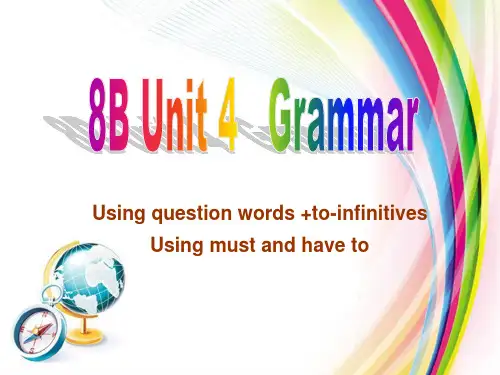
Say sth. about the picture with question words+to-infinitives 马航,你去哪了?
where to find the plane 1. So far we haven’t know________________ (在哪找到这 架飞机). which flight to choose 选哪个航班) 2. They forgot to tell Lily ________________.( how many days to spend 3. We still don’t know _________________ finding the missing plane. (要花多少天) when to find 4. The government is not sure __________ it.(什么时候找到 它).
一线资深高中语文教师语文教研组组长研究并擅长语文阅读和作文教学曾获得本地优秀教师优秀班主任称号
Using question words +to-infinitives
Using must and have to
Translation.
1. 撞到岩石上 crash against the rocks
2. 筋疲力尽 4. 摔倒
be tired out fall over
3. 与…一样大 the same size as 5. 向某人大叫 shout at sb.
6. 继续做某事 continue to do sth. /
continue doing sth.
7. 解开一只手 put one hand free
4. 如何逃跑
讨论:这些短语是由哪两部分构成的? 结论 疑问词+动词不定式
Unit4知识点复习牛津译林版八年级英语下册

U4 A good read【ic strip&wele to the unit】1.Have you decided what to do with these books,Hobo?[decide] vt.决定decide to do sth 决定做某事[decision]n.决定make a decision to do sth.决定做某事[ do with ]处理;处置;对待与what 连用what...do with= deal with 与how连用how....deal with2.I have to use them to reach the box on the fridge.[reach] vt.①能伸到;够得着②到达,抵达reach spl = arrive in/at spl. = get to spl3.I’m reading a book about Germany in World War.[ Germany ] 德国→German n.德国人(复数:German s)不可数名词“德语”adj.“德国的,德国人的”4.They improve my knowledge of the past.[knowledge] 不可数名词“知识,学时;理解,认识”Knowledge is power.知识就是力量。
5.What do you like to read in your spare time.[spare] adj. “空闲的;空余的;多余的”in one's spare/free time在某人空闲时间= when sb be free6.[French] ①adj. “法国,法国人的”法国人:Frenchman(Frenchm e n), Frenchwoman(Frenchwom e n)②不可数名词“法语”→France n.法国7.The story of the ugly man Quasimodo really touched me.[touch] vt.“感动,触动”touching adj.感人的touched adj.受感动的【Reading】1.After our ship crashed against the rocks, I swam as far as I could.●[against] prep. “紧靠,碰,撞,反对”crash against... 撞到...against the war反对战争●as......as one can/could 尽某人所能...... (相当于as ...as possible)2.By the time I finally felt the land under my feet, I was tired out.be tired out 筋疲力尽be tired of sth/doing sth 对某事/做某事感到厌烦,厌倦3.I woke up as the sun was rising.[rise]roserisen 不及物动词“升起,上升”指太阳、月亮、星星等升起,也指水位、价格等上涨●rise by上升了...4.My arms, legs and hair were tied to the ground.[tie] ①vt.“捆、绑、系、打结”tietyingtie...to... 把...栓到...上②n.领带tiesIt moved up over my stomach and neck until it was standing near my face. [until]①连词“直到...为止”●用于肯定句时主句谓语应为延续性动词指主句的动作一直持续到until后的动作发生为止We walked until it got dark.我们一直走到天黑●not ... until... 直到...才...主句动词通常为非延续动词指主句的动作一直到until后的动作发生时才发生The little girl didn’t stop to relax until she finished her work.②prep. “直到...为止”Marry didn’t receive the email until last night.6.He was the same size as my little finger.the same size as.... 和...一样尺寸,与...一样大小= as big asthe same as... 和...一样the same..(lenghth长度、weight重量、width宽度、depth深度)..as.... 和...一样....7.the loud noise made them all fall over.fall over摔倒fall off... 从...上摔下fall down摔倒,落下;倒塌fall behind落后fall asleep睡着fall ill生病8.【continue】v.“继续”+名词、代词、动词不定式、动词ingcontinue one’s education继续求学continue doing sth继续做某事9.I did not know what to say either.[either] adv.也常用于否定句句末,其前可有逗号,也可没有逗号10....finally managed to break the ropes.[manage] vt. ①设法完成manage to do sth.设法完成某事②管理,经营+ 名词/代词→manager n.管理者11.When I lifted my left hand into the air...[lift] ①vt.举起,抬高;提高②可数名词“电梯”12.... a huge army of tiny people.[army ]n. ①大批,大群an army of....一群...②军队(尤指陆军)13.I must run away from them.......how to get away.run away from... 逃离...get away逃跑,跑开14.keep doing sth一直做某事,不断地做某事keep on doing sth.反复/继续做某事keep sb from doing sth阻止某人做某事15.【unable】adj. “不能的,不会的”be unable to do sth = be not able to do sth.不能做某事【Grammar】1.Mr Wu advised us which to choose as afterschool activities. [advise] vt.建议,劝告advise sb (not) to do sth.建议某人(不)做某事advise doing sth建议做某事2.hand in上交,递交代词放中间hand it in反义词:hand out/give out 分发3....what you think of it and so on.and so on等等用在举例的末尾,表示举例未完。
牛津译林版八年级下Unit4 task教学课件

2 When do you usually read books? a Any time I can. b Every night. c At weekends. d During holidays.
3 What is your favourite type of book? a Novel. b Science. c History. d Travel. Other: _________ 4 How do you get most of your books? a Borrow from libraries. b Buy at bookshops. c Borrow from friends. d Receive as gifts.
different types of 意为 “不同种类的”。 e.g. 图书馆里有许多不同种类的书。 There are many different types of books in the library.
2. … it is just opposite my home. …… 它就在我家对面。 opposite prep. 在……对面, 与……相反 e.g.邮局在银行对面。 The post office is opposite the bank.
Unit 4 A good read Task
librarian n. 图书管理员
He has the habit of reading.
n. 习惯
the four great classical Chinese novels
adj. 古典的
1. Do you like reading? 2. How much time do you spend reading each week? 3. What is your favourite type of book? 4. How do you get most of your books?
牛津译林版八年级下Unit4 Grammar 1课件
I don’t know when to begin.
consider、decide、discuss、explain、 forget、know、learn、remember、sho teach、tell、wonder等
Can you tell me how to get to the library?
8B unit4 A good read
Grammar(1)
Revision:
翻译句子。 1.我也不知道说什么。(reading L.15) I did not know what to say either. 2.我不知怎样逃脱。(reading L.20)
I did not know how to get away. 3.米莉已经决定了读什么。 Millie has decided what to read.
明天到什么地方去尚未决定。
Where to go tomorrow has not been decided.
when to begin
我不知道什么时候开始。
I don’t know when to begin.
how to get to the library
你能告诉我怎样到达图书馆吗?
Can you tell me how to get to the library?
where to buy the book
问题是哪里买这本书。
The question is where to buy the book.
Where to go tomorrow has not been decided.
作主语,谓语动词常用单数形式
↓
↓ 作宾语on忘了何时见他的朋友们。
牛津译林版八年级英语下册Unit4 Revision优质课件(共38张PPT)
考点6 until prep.& conj. 直到……为止
[点拨] until用于肯定句时,与延续性 动词连用,意为“直到……为止”;用于 否定句时,与短暂性(瞬间)动词连用,常以 not…until的形式出现,意为“直到…… 才”,可与after, before等引导的时间状 语从句进行转换。
B
not…until…表示“直到…… 才……”。句意:那个小女孩直到 找到她妈妈才停止哭泣。
考点7 hand in 上交,递交
[点拨] hand in为“动词+副词”结构 词组,若接代词it或them作宾语时,代词要 放在hand和in中间,即hand it/them in; 若接名词作宾语时,名词在ha from意为“与……不同”,与 not the same as同义,故选A。
考点4 continue vt.&vi. 继续
[点拨] continue后可接名词、代词、不 定式或动名词形式作宾语。
[搭配] continue to do/doing sth 继续 做某事
to be continued (未完)待续
continued
考点5 either adv. 也
[辨析] either/too/also
either
作副词,表示“也”,通常位于否 定句句末。
too
表示“也”,通常置于肯定句句末。
also
表示“也”,但不能用于否定句, 通常置于实义动词之前或be动词之 后,位于句中。
[拓展] either还可作代词,意为“两者 中的任何一个”。
用作不定代词,指“两者中的任何一个”。 either(+of+复数名词)作主语时,谓语 动词用单数。
[搭配] either…or…或者……或者……
牛津译林版八年级英语下册课件:Unit 4 life on Mars Main task
And people don't need to go to the factory to work, instead of working by computer at home. On the other hand, it is very easy for us to visit the Earth and other stars by riding spaceship. I hope all this can come true. But first, we must treasure and protect Mars and avoid it becoming another polluted earth. If all of us try our best to do it, we will enjoy our life.
D Make a dialogue about advantages and disadvantages of living on Mars with your classmate.
Sample writing: S1: Would you like to live on Mars, Ann? S2: I’m not sure. S1: Why? I think it would be exciting. We could never go outside or do outdoor sports. S2: I know it’s very cold on Mars, but it would be comfortable to stay inside because we would live in very big houses.
Unit 4
Words and Expressions
牛津译林版英语八年级下册Unit4 Revision课件
review
refuse
refuse to do sth
success
confidence
experience
advice
habit
classical
experience的形容词为experienced,意为“有经验的”。
My aunt used to be a tour guide with much ①_________________. She traveled a lot and met many different people, and of course, she ②__________ many things in her work. She likes to tell us her interesting ③____________during her working life. I truly hope I can grow up as a knowledgeable person like her.
[mɪkst]
[ˈlæŋɡwɪdʒ]
[dɪˈskʌs]
1. 杰克是一名八年级学生, 就读于伦敦附近的一所学校。2. 他最喜欢的学科是中文, 他认为学习外语很有趣。3. 学校每学期有一个读书周, 他和他的同学们喜欢这个读书周, 他们可以阅读学校图书馆的许多书和杂志。杰克很喜欢他的学校。
Jack is a Year 8 student at a school near London. His favourite subject is Chinese. He thinks learning foreign languages is fun. His school has a Reading Week every term. Jack and his classmates love it. They can read many books and magazines from the school library. Jack loves his school very much.
牛津译林版英语八下U4 单元复习 (共21张PPT)
16. 拒绝 v. _________ refuse success 17. 成功 n. _______
adj. successful v. succeed
Words
experience 18. 经历,经验 n. ____________ 19. 建议,忠告 n. __________ advice habit 20. 习惯 n. __________ translate 21. 翻译 v. _______________ 22. 胃 n. ____________ stomach shoulder 24. 肩膀 n. ____________ ugly 25. 丑陋的 adj. __________
Unit 4 A good read Revision
Words
Words
I、Words. read 1. 读物 n. __ knowledge
Germany 3. 德国 n. ________ writer 4. 作家 n. _________ 5. 紧靠,碰 6. 空闲的 prep. ___________ against adj. ____________ spare
After a hard day’s work, he_________________. was tired out
7. 你能告诉我如何在线续借书吗? how to renew the books online Could you tell me _____________________________? 8. 到目前为止,这本书已被翻译成20多种语言。 The book ________________________over 20 languages has been translated into so far _____________.