
非谓语动词之动词ing的使用形式练习
非谓语动词之动词ing
1.A new law will go into effect on August 1st.According to this law,people found ______“harmful”advertisements in the streets will be punished strictly.
A.putting up B.to put up C.being putting up D.having put up
2.Time should be made good use of ______ our lessons well.
A.to learn B.learning C.learn D.learnt
3.With trees and grass ______ 39.6%of the urban area,the city of Weifang has taken on a new look.
A.covered B.covering C.to be covered D.being covered
4.______ alone in the large house,the little boy had to learn to survive by himself.
A.To leave B.Leaving C.Left D.Being left
5.The firm was successfully run and ______,he owed his success to the support of his friends.
A.looking back B.looked back C.to look back D.when looked back
6.Taiwan leader Ma Ying-jeou estimated on Friday that more than 500 people had died in floods a nd mudslides ______ by Typhoon Morakot.
A.caus ed B.causing C.being caused D.to be caused
7.The scientist was rewarded by the government for ______ such a great contribution to the country.
A.make B.making C.being made D.having made
8.Nearly half a million people are believed ______ their homes as a result of the disaster.
A.to leave B.to be left C.to be leaving D.to have left
9.—Why are you looking pleased?
—Oh,I’ve just had a job______.
A.to offer B.offering C.offered D.to be offered
10.After the party,most guests left,with only two of them ______ in the host family,______ him cleaning up.
A.remaining;helped B.remaining;helping C.remained;helped D.remained;helpi ng
11.For English teachers ______ a more effective role in teaching,they must make every effort to raise students’ cross-cultural awareness.
A.to play B.playing C.having played D.play
12.Something as simple as _____ vegetables in childhood may help to protect you against serious illness in later life.
A.to eat B.eating C.to be eating D.eaten
13.When I went in,my pet happened ______ on my bed,______TV.
A.to be lying;watching B.to have lain;watch
C.to lie;and watched D.to be laying;watching
14.Friends are like leaves,______ everywhere,but true friends are like diamonds,precious and rare.
A.to find B.finding C.found D.being found
15._____at my classmates’faces,I read the same excitement in their eyes.
A.Looking B.Look C.To look D.Looked
16.The next thing he saw was smoke ______ from behind the house.
A.rose B.rising C.to rise D.risen
17.Look over there—there’s a very long,winding path ______ up to the house.
A.leading B.leads C.led D.to lead
18.Recently a sur vey_____ prices of the same goods in two different supermarkets has caused heated deba te among citizens.
A.compared B.compari ng C.compares D.being compared
19.Bats are surprisingly longlived creatures,some______ a life span of around 20 years.
A.having B.had C.have D.to have
20.Sit down,Emma. You will only make yourself more tired,______ on your feet.
A.to keep B.keeping C.hav ing kept D.to have kept
21.Do you wake up every morning ______ energetic and ready to start a new day?
A.feel B.to feel C.feeling D.felt
22.More highways have been built in China,______ it much easier for people to travel from one place to another.
A.making B.made C.to make D.having made
23.On receiving a phone call from his wife ______ she had a fall,Mr.Gordon immediately rushed home from his office.
A.says B.said C.saying D.to say
24.Sarah pretended to be cheerful,______ nothing about the argument.
A.says B.said C.to say D.saying
25.Lydia doesn’t feel like ______ abroad.Her parents are old.
A.study B.studying C.studied D.to study
26.At one point I made up my mind to talk to Uncle Sam. Then I changed my mind,__ that he could do nothing to help.
A.to realize B.realized C.realizing D.being realized
答案:
1.答案:A 2.答案:A
3.
4.答案:C 5.答案:A 6.答案:A 7.答案:D 8.答案:D 9.答案:C
10.答案:B 11.答案:A
12.句意:童年时像吃蔬菜这样简单的事也许后来会帮助你远离严重的疾病。
答案:B 13.答案:A
14.
15.答案:A 16.答案:B
17.
18.答案:B 19.答案:A
20.解析:句意:埃玛,坐下。
一直站立着,你将只会使你自己更加疲劳。
keeping on your feet=if you keep o n your feet;having kept表示的动作发生在谓语动词表示的动作之前,不符合语境。
答案:B
21.
22.答案:A 23.答案:C 24.答案:D
25.
26.答案:C。
动词-ing形式(专项练习)(解析版)
动词-ing形式精准训练一、单选题1.I still remember to the Famen Temple and what I saw there.A.to takeB.to be takenC.takingD.being taken1. 【解析】 D 记得做过某事要用动词的-ing形式, I与take之间被动的关系, 所以D项正确。
2.There are hundreds of visitors _______ in front of the Art Gallery to have a look at Van Gogh’s paintings.A.waitedB.to waitC.waitingD.wait2.C【解析】本题考查现在分词作后置定语。
“正在等候的参观者”, 所以选C项。
3.Listen! Do you hear someone __________for help?A.callingB.callC.to callD.called3.A 【解析】该空所填内容在句中为非谓语动词作宾语补足语, 根据someone与call的主动关系判断, 排除D项。
hear后接不定式作宾语补足语时应省略to, 由此排除C项。
由listen可判断出此处表示有人正在求救, 可排除B项, 故选A项。
4.He had wonderful childhood, _____with his mother to all corners of the world.A.travelB.to travelC.traveledD.traveling4.D 【解析】主语(he)与动词travel之间存在主动关系, 故用traveling作伴随状语, 故选D。
5. at my classmates' faces, I read the same excitement in their eyes.A.LookingB.LookC.To lookD.Looked5. A 【解析】look与其逻辑主语I之间为主动关系, 因此用looking。
非谓语动词-ing形式
非谓语动词——动词-ing形式动词的-ing形式也是一种非谓语动词。
-ing形式仍保留有动词的特征,可以带有其所需要的宾语或状语而构成-ing短语。
1、-ing的形式:-ing有一般式和完成式。
及物动词的-ing还有主动语态和被动语态,而不及物动词的-ing则没有被动语态。
现在以及物动词make 和不及物动词go为例,将其-ing各种形式列表如下:动词、语态形式及物动词make;不及物动词go主动语态被动语态主动语态一般式making being made going完成式having made h aving been made having gone2、-ing形式的基本用法。
(1)作主语:Seeing is believing.百闻不如一见。
Talking is easier than doing. 说着容易做着难–ing作主语时,可用it作形式主语,而将真正的主语-ing形式或短语后置。
如:It isn’t much good writing to them again.It’s no use waiting here.(2)作表语:Her job is washing and cooking.My hobby is collecting stamps.(3)作宾语:①作及物动词的宾语。
She likes drawing very much.;②作某些短语动词的宾语。
Mary is thinking of going back to New York.;③do+限定词(my, some, any, the等)+ -ing,表示“做…事”之意,如:We often do our cleaning on Saturday afternoon.Will you do any shopping on Saturday this afternoon?④作介词的宾语:Her sister is good at learning physics.;⑤作形容词worth, busy等的宾语:This book is well worth reading.–ing作宾语带有宾语补足语时,要用it作为形式宾语,而将作宾语的-ing后置,如:We found it no good talking like that.Do you think it necessary trying again?(4)作定语:The sleeping child is only five years old.Do you know the man standing at the gate?注:-ing形式作定语用时,如果-ing只是一个单词,就位于其修饰的名词之前,如果是-ing短语,就位于其修饰的名词之后;-ing作定语时,被-ing所修饰的名词就是该-ing的逻辑主语。
非谓语动词之动词ing的用法
非谓语动词ing基本用法一、非谓语动词的概念动词的基本用法是作谓语。
当句中已经有了谓语动词了,要选或要填的动词就只能用非谓语形式了。
非谓语形式有三种:1、动词不定式:to do 2、动词的ing : doing 3、动词的过去分词:done二、三种形式的含义(基本用法)不定式:表示目的和将来;动词的ing:表示主动和进行;过去分词:表示被动和完成。
三、非谓语动词的时态和语态四、非谓语动词的否定形式在非谓语动词前加not, never. 即 not / never to do, not / never doing五、非谓语动词的复合结构不定式的复合结构:for / of sb. to do sth.动词 ing 形式的复合结构:宾格或所有格+doing (-ing 形式作主语时,用的所有格+doing)六、非谓语动词的做题步骤1、判定是否用非谓语形式。
方法:看看句子中是否已有了谓语动词了2、找非谓语动词的逻辑主语。
方法:非谓语动词的逻辑主语一般是句子的主语。
3、判断主被动关系。
方法:非谓语动词与其逻辑主语的主动还是被动关系。
4、判断时间关系。
方法:分析句子,看看非谓语动词所表示的动作发生在谓语动作之前、之后还是同时。
之前常用 done; 之后常用to do; 同时常用doing.学习非谓语形式时,建议把三种形式一起来比较学习,会更加有效一些。
一、非谓语动词作主语和表语的比较1、不定式和动名词作主语和表语a. 不定式表示一次性的、具体的动词。
动词ing 常表示一般的、泛指的或习惯性的动作。
如:________ is a good form of exercise for both young and old.A. The walkB. WalkingC. To walkD. Walk(分析) a good form 暗示泛指一般的行为,用动名词作主语,选 Bb. 不定式作主语时,常用it 作形式主语,即用句型:It is + adj. / n. + (for / of sb. ) to do sth.It’s important for us to learn English well.It’s kind of you to help us.注意:下面几个句型是用动名词:It’s no good / use doing sth.It’s useless doing sth.There is no need to do sth.2、不定式、动名词、分词作表语的比较1、不定式、动名词作表语,.表示主语的内容。
非谓语(-ing形式)
否定形式:not doing/ not having done例如:⑴They couldn’t stand being treated like that.⑵The boy didn’t mind being left at home.⑶I regret not having taken his advice. ⑷I didn’t remember having ever been given such a chance.动名词:一、作主语eg.⑴Seeing is believing. To see is to believe. ⑵Smoking is bad for your health.结构:It’s no use/no good/useless doing sth.It’s a waste of time doing sth.There is no doing sth. (…是不可能的)eg.⑴It’s no use talking too much.⑵There is no getting along with him. (他这个人很难相处)二、动名词作表语eg.⑴My job is teaching English. = Teaching English is my job.⑵His greatest happiness is serving the people.= Serving the people is his greatest happiness.三、动名词作宾语eg.⑴He enjoys playing football. ⑵He left without saying goodbye to us. ⑶She makes a living by selling flowers. 只能接动名词作宾语的动词和词组有:finish, mind, consider, practice, imagine, avoid, miss ,appreciate, escape, risk, admit, feel like, can’t help, give up, end up, can’t stand, be worth等to为动名词的动词短语:习惯于be/get used to 坚持stick to 反对object to 导致lead to 献身于devote to 喜欢prefer to谈到come to 期待look forward to 加上add to开始get down to在介词后面作宾语的词组有:insist on, look forward to, be used to doing, be fond of, get down to(开始做某事), be interested in, spend…(in) doing sth, de vote…to…, object to(反对)等.动名词的复合结构:名词/名词所有格/形物/宾格+doing(动名词)eg.They insisted on Tom/Tom’s /his/ him staying longer.Tom’s / His coming is what we have expected.③既可接动名词又可接动词不定式做宾语的动词有下面几种情况:a)like, love, hate, continue)to do/doingb)start(begin)to do/doing,当主语是物;含有进行体或这两个动词后面有情感动词时只能用to do.因此,首选to do.c)remember(forget, regret)to do/doing, to do表示这个动作还没做;doing表示这个动作已做,已完成。
动词-ing形式(专项练习)(解析版)

动词-ing形式(专项练习)(解析版)精准训练动词-ing形式1.我仍然记得去法门寺和我在那里看到的东西。
答案:D。
记得做过某事要用动词的-ing形式,I与take 之间被动的关系,所以D项正确。
2.有数百名游客在艺术馆前等待观看___的画作。
答案:C。
本题考查现在分词作后置定语。
“正在等候的参观者”,所以选C项。
3.听!你听到有人呼救吗?答案:A。
该空所填内容在句中为非谓语动词作宾语补足语,根据___与call的主动关系判断,排除D项。
hear后接不定式作宾语补足语时应省略to,由此排除C项。
由listen可判断出此处表示有人正在求救,可排除B项,故选A项。
4.他有一个美好的童年,和他的母亲一起去了世界各地。
答案:D。
主语(he)与动词travel之间存在主动关系,故用traveling作伴随状语,故选D。
5.看着我的同学们的脸,我在他们的眼中读到了同样的兴奋。
答案:A。
look与其逻辑主语I之间为主动关系,因此用looking。
选A。
Dina。
who had been struggling for months to find a job as a waitress。
finally landed a n ___.We have ___。
currently being held in Guangzhou。
will be a success.It is difficult to ___.At the beginning of class。
the sound of desks being opened and closed could be heard outside the classroom.10.I deeply regret telling the old man the bad news about his ___.11.___.12.Most citizens do not object to the ban on smoking in public places.13.After being bitten twice。
高中英语语法—非谓语动词 V-ing形式(word版_含答案)
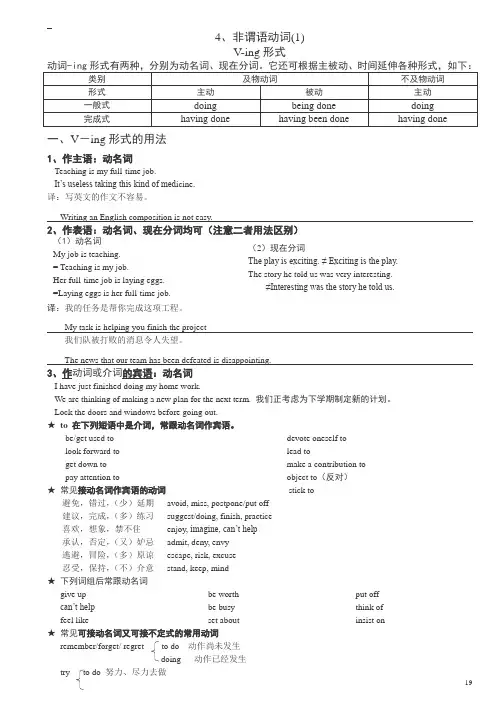
4、非谓语动词(1)V-ing 形式一、V -ing 形式的用法1、作主语:动名词Teaching is my full-time job.It’s useless taking this kind of med icine.译:写英文的作文不容易。
Writing an English composition is not easy.2、作表语:动名词、现在分词均可(注意二者用法区别)译:我的任务是帮你完成这项工程。
My task is helping you finish the project我们队被打败的消息令人失望。
The news that our team has been defeated is disappointing.3、作动词或介词的宾语:动名词I have just finished doing my home work.We are thinking of making a new plan for the next term. 我们正考虑为下学期制定新的计划。
Lock the doors and windows before going out.★ to 在下列短语中是介词,常跟动名词作宾语。
be/get used to look forward to get down to pay attention to devote oneself tolead tomake a contribution toobject to (反对)★ 常见接动名词作宾语的动词 stick to避免,错过,(少)延期 avoid, miss, postpone/put off建议,完成,(多)练习 suggest/doing, finish, practice喜欢,想象,禁不住 enjoy, imagine, can’t help承认,否定,(又)妒忌 admit, deny, envy逃避,冒险,(多)原谅 escape, risk, excuse忍受,保持,(不)介意 stand, keep, mind★ 下列词组后常跟动名词give up can’t help feel like be worth be busy set about put offthink ofinsist on★ 常见可接动名词又可接不定式的常用动词remember/forget/ regret to do 动作尚未发生doing 动作已经发生try to do 努力、尽力去做(1)动名词My job is teaching.= Teaching is my job.Her full-time job is laying eggs.=Laying eggs is her full-time job.(2)现在分词 The play is exciting. ≠ Exciting is the play. The story he told us was very interesting. ≠Interesting was the story he told us.doing 尝试做(看看有何结果)meanto do 打算做(主语常常是人)doing 意味着(主语常常是物)stop/go on to do 停下(继续)去做另一件doing 停下(继续)正在做的事译:露西不介意把她的MP3借给你。
非谓语动词例句解析
非谓语动词例句解析非谓语动词是英语语言中重要的一部分,它们能够表达诸多不同的意思,使句子更加生动、精彩,为英语表达带来更多可能性。
本文将来自现代英语中常见的非谓语动词例句做出解析,以作为学习英语的参考。
首先,非谓语动词可以分为三类:动词不定式(to do)、动名词(doing)、动词过去分词(done)。
动词不定式(to do)一般可以表示动作或行为的目的,使句子更具有目的性和目标性,如:He came here to find a job. 他来这里是找工作的。
I need to finish my homework on time.需要按时完成我的作业。
动名词(doing)表示正在发生的或正在进行的动作,如:He enjoys singing. 他喜欢唱歌。
She hates waiting.讨厌等待。
动词过去分词(done)可以表示一个已经完成的动作或行为,如: She has finished reading the book.已经读完了这本书。
He has done his homework. 他已经做完了作业。
除此之外,非谓语动词还可以用来构成一些特殊句式,如:Some people like going out for a walk. 一些人喜欢出去散步。
They enjoy watching movies. 他们喜欢看电影。
He likes playing chess. 他喜欢下棋。
这些句式表示的意思都是乐于做某件事的意思,可以表达一种积极的心态。
另外,非谓语动词也可以和其他一些短语一起组成一个短语,从而可以表达某种特殊的意思,如:He spent the whole day writing letters. 他花了整天时间写信。
She finished washing the dishes.洗完了碗。
They stopped talking. 他们停止了谈话。
这些短语表达的意思是把动作做完或停止的意思,而不仅仅是表示动作的发生。
非谓语动词 V-ING用法小结附练习
动词的ing形式作表语,定语,宾补和状语一、动词-ing形式作表语1. 表示主语的内容,可以转换到句首作主语Her job is keeping the lecture hall as clean as possible. (= keeping the lecture hall as clean as possible is her job)她的工作是尽量使报告厅保持干净。
2. 表示主语具有的特征、性质和状态(动词ing 相当一个形容词)The problem is quite puzzling.这个问题很令困惑。
3.常用来作表语的现在分词有astonishing, amusing, confusing, disappointing, boring, encouraging, inspiring, moving, tiring, interesting, surprising等。
全析提示:动词-ing形式作表语时,其逻辑主语往往是句子中的主语,但用作表语的-ing形式也可带有自己的逻辑主语。
What worries me most is her staying too late every night. (staying too late every night的逻辑主语是her)二、动词-ing形式作定语1 单个的动词-ing形式可以作前置定语,一般具有两种含义。
①说明被修饰名词的用途和性能。
a reading room = a room which is used for reading 阅览室running shoes =shoes for running 跑鞋a working method =a method for working 工作方法②表示所修饰的人或物的动作或状态,在意思上接近一个定语从句,可以表示正在进行的动作,也可表示经常性动作或当时的状态。
developing countries = countries that are developing发展中国家an ordinary-looking house = a house that looks ordinary看起来很普通的房子a puzzling problem = a problem that puzzles somebody困扰人的问题2 作定语的动词-ing形式如是一个短语,则应放在被修饰词的后面,做后置定语,相当于一个定语从句。
高中英语非谓语动词用法详解及练习(含答案详解)
非谓语动词之五兆芳芳创作非谓语动词(一)——动词不定式动词不定式、分词(现在分词,过来分词)和动名词统称为非谓语动词.现代英语将现在分词和动名词合为一大类叫作v + ing形式.这些动词的形式不克不及在句中单独作谓语用,因而没有语法主语.但可以有逻辑主语.由于没有语法主语,也就不受人称和数的限定,因为不是谓语,也就没有时态和语态,但这些词仍能暗示动作和状态,所以仍有暗示与其他动词相对时间关系的形式.由于与其它词有逻辑上的主谓关系,因此也有暗示主、主动的形式,同时也有自己的宾语和状语,一起组成非谓语动词的短语(动词不定式短语,分词短语,动名词短语).动词不定式、过来分词及v-ing形式在句中均不克不及作谓语用,所以叫做非谓语动词.(一)动词不定式:动词不定式由“to+ 动词原形”组成,如:to study, to play,动词不定式虽然不克不及作谓语动词用,但仍留着动词的特征,它可以带有所需要的宾语或状语而组成动词不定式短语,如:to study hard, to play table tennis.1、动词不定式的形式变更:动词不定式有下列时态和语态的形式变更.2、动词不定式的根本用法:动词不定式能起名词、形容词和副词的作用,可在句中作主语、表语、宾语补足语、定语和状语用,如:(1)作主语:To help each other is good.(动词不定式作主语时,一般可用it作形式主语,而将作主语的动词不定式置于句末,如:It is good to help each other.(2)作表语:My job is to drive them to the power station every day. 动词不定式在系动词be之后作表语,与暗示未来时的be + 动词不定式结构有所区别,如:Our plan is to set up another middle school for the peasants’ children.我们的筹划是给农民子弟再成立一所中学.(句中的谓语动词为is,动词不定式to set up… 为表语,主语为plan,但plan其实不是动词不定式的逻辑主语,即动词不定式to set up所暗示的动作不是主语plan产生的.)We are to set up another middle school for the peasants’ children.我们将为农民的子弟再成立一所中学.(句中的are to set up整个结构为句中谓语,主语为we,同时也是动词不定式to set up所暗示的动作的逻辑主语,即动词不定式to set up所暗示的动作是由we产生的).(3)作宾语:①作及物动词的宾语,如:She wishes to be a musician.;②作某些形容词的宾语:可以有动词不定式为宾语的形容词一般有glad, sorry, afraid, pleased, determined, willing, eager, anxious, ready, sure等,如:I am determined to give up smoking.;③动词不定式一般不作介词的宾语,但动词不定式之前如有疑问词时,就可作介词的宾语,如:Can you give us some advice on what to do next?(4)作宾语补足语,如:Tell the children not to play on the street. 如果句中的谓语动词为see, hear, watch, notice, have, make, let等,作宾语补足语的动词不定式须将to省去,如:I saw a little girl run across the street.(5)动词不定式在句中作宾语,如带有宾语补足语时,须先用it 作形式宾语,而将该动词不定式后置,如:I don’t think i t right to do it that way.(6)作定语:动词不定式作定语时,须位于被其修饰的名词或代词之后,如:Is this the best way to help him? 和定语用的动词不定式如果是不及物动词,不定式前面就要用需要的介词,如:He is the man to depend on. 如果被不定式修饰的名词为place, time, way,不定式前面的介词,习惯上可以省去,如:The old man is looking for a quiet place to live.(7)作状语:动词不定式可以作下列的状语:①目的状语:Every morning he gets up very early to read English. 为了强调不定式暗示目的的作用,可在不定式前加in order to或so as to(以便或为了),但应注意in order to位于句首或句中均可,而so as to不克不及位于句首,如:She reads China Daily every day in order to (so as to) improve her English. 将暗示目的的不定式置于句首,也可强调目的的作用,如:To master a foreign language, one must work hard at it. ②结果状语:They lived to see the liberation of their home town.他们活到亲眼见到了他们故乡的解放.③too + 形容词或副词+ 动词不定式,暗示“足能…”的结果,如:You are old enough to take care of yourself now.3、复合结构不定式:由for + 名词(或代词宾格)+ 动词不定式即组成复合结构的动词不定式.其中for自己无意义.for前面的名词或代词是不定式的逻辑主语,这种不定式在句中可作主语、表语、宾语、定语或状语,如:It is very important for us to get everything ready for the harvest. 当作表语用的形容词暗示不定式的逻辑主语的性质或特征时,就用介词of而不必for引出不定式的逻辑主语,这些形容词一般有good, nice, kind, wise, silly, stupid, foolish, right, wrong, careless, impolite等,如:It is very kind of you to help him every day.4、疑问词+ 动词不定式:疑问代词和疑问副词后可加动词不定式组成不定式短语,在句中可作主语、表语或宾语,如:How to prevent them from swimming in this river is a problem.5、动词不定式的否认式:动词不定式的否认式是由not + 动词不定式组成,如:It’s wrong of you not to attend the meeting.6、动词不定式的时态形式所暗示的时间关系:(1)一般式:动词不定式一般式所暗示的动作是和谓语动词所暗示的动作同时产生,但在多数情况下,是在谓语动词所暗示的动作之后产生,如:We decided to plant more trees this spring.(其后),They often watch us play table tennis.(同时);(2)完成式:动词不定式完成式所暗示的动作产生在谓语动词所暗示的动作之前,如:I am sorry to have kept you waiting.(3)进行式:动词不定式进行式所暗示的动作正在进行中,并且与谓语动词所暗示的动作同时产生,如:She happened to be writing a letter in the room when I came in.7、动词不定式的主动语态用法:如果动词不定式的逻辑主语为这个不定式所暗示的动作的承受者时,不定式一般就用主动语态形式,如:What is to be done next hasn’t been deci ded yet.非谓语动词(二)——动词-ing形式(二)-ing形式:动词的-ing形式也是一种非谓语动词.-ing形式仍保存有动词的特征,可以带有其所需要的宾语或状语而组成-ing短语.1、-ing的形式:-ing有一般式和完成式.及物动词的-ing还有主动语态和主动语态,而不及物动词的-ing则没有主动语态.现在以及物动词make 和不及物动词go为例,将其-ing各类形式列表如下:2、-ing形式的根本用法.(1)作主语:Seeing is believing.百闻不如一见.Talking is easier than doing. –ing作主语时,如果其结构较长,可用it作形式主语,而将作主语的-ing后置.如:It isn’t much good writing to them again. It’s no use waiting here.(2)作表语:Her job is washing and cooking. My hobby is collecting stamps.(3)作宾语:①作及物动词的宾语.She likes drawing very much.;②作某些短语动词的宾语. Mary is thinking of going back to New York.;③do+限定词(my, some, any, the等)+ -ing,暗示“做…事”之意,如:We often do our cleaning on Saturday afternoon. Will you do any shopping on Saturday this afternoon? ④作介词的宾语:Her sister is good at learning physics.;⑤作形容词worth, busy等的宾语:This book is well worth reading. –ing作宾语带有宾语补足语时,要用it作为形式宾语,而将作宾语的-ing后置,如:We found it no good talking like that. Do you think it necessary trying again?(4)作定语:The sleeping child is only five years old. Do you know the man standing at the gate? 注:-ing形式作定语用时,如果-ing只是一个单词,就位于其修饰的名词之前,如果是-ing短语,就位于其修饰的名词之后,-ing作定语时,被-ing所修饰的名词就是该-ing的逻辑主语.另外,-ing作定语用时,其动作和句子谓语动词所暗示的动作是同时进行的,如果不是同时进行的,就不克不及用-ing作定语,要使用定语从句,如:The girl who wrote a letter there yesterday can speak English very well.(5)作宾语补足语:We can see steam rising from the wet clothes. 注:当-ing在复合宾语中作宾语补足语用时,句中宾语就是这个-ing的逻辑主语,可以带有这种复合宾语的动词有see, watch, hear, observe, feel, find, have, keep等.(6)作状语:①时间状语:Seeing Tom, I couldn’t help thinking of his brother. 分词在句中作时间状语时,其前一般可加when或while,如:When crossing street, you must be careful. ②原因状语:Being ill, he didn’t go to school yesterday. ③方法或陪伴状语:Mary stood at the school gate waiting for Betty.3、主动语态-ing完成式的根本用法.主动语态-ing完成式所暗示的动作产生在句中谓语动词所暗示的动作之前,一般在句中作时间或原因状语用.句中的主语是它的逻辑主语,并且是它所暗示的动作的执行者,如:Having answered the letter, she went on to read an English novel.4、主动语态-ing一般式的根本用法.主动语态-ing一般式所暗示的动作是一个正在进行中的主动动作,并且这个主动动作也是和句中谓语所暗示的动作同时产生的.它一般在句中作定语或状语用.如:The truck being repaired there is ours.5、主动语态-ing完成式的根本用法.主动语态-ing完成式所暗示的动作产生在谓语动词所暗示的动作之前,在句中一般作状语用.如:Havingbeen shown the lab, we were taken to see the library.6、-ing形式的复合结构.在-ing前加物主代词或名词所有格即组成-ing的复合结构.其中的物主代词或名词所有格为-ing的逻辑主语.这种结构在句中可作主语、宾语或表语,如:Your smoking and drinking too much will do harm to your health. 但在口语中,这种结构如作宾语用,其中的物主代词经常使用人称代词的宾格,名词的所有格经常使用名词的普通格代替,如:She insisted on Peter’s (or Peter)going there first.7、-ing形式与动词不定式在句中作主语、表语、宾语时的区别.一般说来,暗示一个比较抽象或泛指的动作时多用-ing形式.暗示一个具体某一次的动作时,多用动词不定式,如:Our job is making steel. She likes playing the piano, but she doesn't want to play it today.8、-ing形式与动词不定式在句中作定语的区别.-ing形式作定语用时,其动作一般与句中谓语动词所暗示的动词同时产生,而动词不定式作定语时,其动作一般产生在句中谓语动词所暗示的动作之后.如:The girl writing a letter there can speak English very well./I have three letters to write.9、-ing形式与动词不定式在作宾语补足语时的区别.(1)不定式作宾补时,其动作一般产生在谓语动词所暗示的动作之后,如:I have told them to come again tomorrow.(2)在see, watch, hear, feel等之后,如果用-ing形式作宾补,暗示其动作正在进行中,而用不带to的不定式作宾补时,不定式所暗示的动作是一个动作的进程,如:I hear her singing in the room.我听见她正在屋里唱歌. I hear her sing in the room.我听见她在屋里唱过歌.10、-ing形式与动词不定式在句中作状语的区别.-ing形式在句作状语暗示时间、原因、方法或陪伴情况,而动词不定式一般式在句中作状语时,一般是作目的或结果状语,如:Not receiving his letter, I wrote to him again./ I looked into the window to see what was going on inside.非谓语动词(三)——过来分词( 三)过来分词:1、过来分词的根本用法:过来分词只有一种形式,也没有主动语态,它所暗示的动作是一个主动的或是已完成的动作.过来分词在句中也可用作定语、表语、宾语或状语等成分.过来分词在句中作某种成分时,其逻辑主语一般为该分词所暗示的动作的承受者,如:(1)作定语:过来分词作定语时,如果这个分词是一个单词,就位于其修饰的名词之前,如果是分词短语,就位于其修饰的名词之后.被过来分词所修饰的名词,就是该分词的逻辑主语,如:The stolen car was found by the police last week.(2)作表语:过来分词作表语时,暗示其逻辑主语所处的状态,其逻辑主语就是句中的主语,如:The glass is broken.这个玻璃杯是破的. 注:过来分词作表语时,和动词的主动语态结构相似,但两者表达的意义不合,如:The glass was broken by my little brother.这个玻璃杯是被我小弟弟打破的.作表语用的过来分词在许多词典中已列为形容词,如:crowded, devoted, discouraged, done, dressed, drunk, experienced, frightened, gone, hurt, interested, killed, known, learned, lost, pleased, satisfied, shut, surprised, tired, undressed,worried, astonished, broken, completed, covered 等.(3)作宾语补足语:过来分词作宾语补足语时,句中的宾语就是其逻辑主语,如:When I opened the door, I found the ground covered by fallen leaves. 注:动词have后的复合宾语中,宾语补足语如为过来分词,常暗示该分词所暗示的动作是由他人来执行的而不是句中主语自己来执行的,如:I had my bike repaired yesterday. 昨天我(找他人)把我的自行车给修了.(4)作状语:过来分词作状语时,相当于一个状语从句,该结构的逻辑主语一般都是主句的主语,是过来分词所暗示意义的逻辑宾语.为了使作状语的过来分词意义加倍明确,常在分词前加when, if, while, though, as等连词,如:Seen from the hill/ When seen from the hill, our town looks beautiful.; Given more time/ If given more time, we could have done it better.(we是该结构的逻辑主语,是give的逻辑宾语.)独立主格:上述-ing和过来分词的用法中,-ing和过来分词在句中均有逻辑主语,但有时它们也能有自己的独立的主语,这种独立的主语,一般为名词或代词,位于其前之前,和-ing或过来分词组成独立主格.独立主格在句中一般只作状语用,而-ing和过来分词作用的形式,则要按照它们所暗示的动作和句中谓语动词所暗示的时间关系而定.至于独立主格中是使用-ing或是过来分词,则要按照它们的主语和其所暗示的动作的主动主动关系而定,如:The bell ringing, we all stopped talking. 注:The work having been finished, she sat down to have a rest. ①独立结构中的being或having been常可省去,如:The meeting (being) over, all left the room. ②作陪伴状语的独立结构常可用with短语来代替,如:She read the letter, tears rolling down her cheeks./ She read the letter with tears rollingdown her cheeks.2、-ing形式与过来分词的区别:(1)语态不合:-ing形式暗示主动概念,及物动词的过来分词暗示主动概念.an inspiring speech鼓舞人心的演说;the inspired audience受鼓舞的听众.(2)时间关系不合:现在分词所暗示的动作一般是正在进行中的动作,而过来分词所暗示的动作,往往是已经完成的动作,如:The changing world正在产生的世界;the changed world已经起了变更的世界.易错易混点1.疑问词+动词不定式:疑问代词和疑问副词后可加动词不定式组成不定式短语,在句中可作主语、表语或宾语,如:How to prevent them from swimming in this river is a problem.2.动词不定式的否认式:由not +动词不定式组成.3.v.-ing形式与动词不定式在句中作主语、表语、宾语时的区别.v.-ing形式:暗示抽象或泛指的动作.不定式:暗示具体某一次的动作.She likes playing the piano, but she doesn't want to play it today.4.v.-ing形式与动词不定式在句中作定语的区别.v.-ing形式:动作与谓语动词所暗示的动作同时产生.不定式:动作产生在谓语动词所暗示的动作之后.eg. The girl writing a letter there can speak English very well.I have three letters to write.5.v.-ing形式与动词不定式在作宾语补足语时的区别.(1)不定式作宾补时,其动作一般产生在谓语动词所暗示的动作之后,如:I have told them to come again tomorrow.(2)在see, watch, hear, feel等之后,如果用v.-ing形式作宾补,暗示其动作正在进行中,而用不带to的不定式作宾补时,不定式所暗示的动作是一个动作的进程,如:I hear her singing in the room. 我听见她正在屋里唱歌.I hear her sing in the room. 我听见她在屋里唱过歌.6.v.-ing形式与动词不定式在句中作状语的区别.v.-ing形式:暗示时间、原因、方法或陪伴情况.不定式:作目的或结果状语.7.v.-ing形式与过来分词的区别:(1)语态不合:v.-ing形式暗示主动概念,及物动词的过来分词暗示主动概念.an inspiring speech鼓舞人心的演说; the inspired audience受鼓舞的听众(2)时间关系不合:现在分词所暗示的动作一般是正在进行中的动作,而过来分词所暗示的动作,往往是已经完成的动作,如:the changing world正在变更的世界 the changed world已经变更了的世界8.独立主格结构:有时v.-ing和过来分词在句中也有自己的独立的主语,这种独立的主语一般为名词或代词,和v.-ing还有过来分词组成独立主格结构.该结构在句中一般只作状语. 独立主格中是使用v.-ing仍是过来分词,则要按照它们的主语和其所暗示的动作的主动或被动关系来定,如:The bell ringing, we all stopped talking.注意:①独立结构中的being或having been常可省去,如:The meeting_(being)_over, all left the room.②作陪伴状语的独立结构常可用with短语来代替,如:She read the letter, tears rolling down her cheeks.= She read the letter with tears rolling down her cheeks.非谓语的解题步调或思路(1)先判断空格部分所需的是主句,从句仍是非谓语动词.独立的句子,从句或非谓语独立的句子加句号,分号或破折号的话,后再加一个独立的句子.独立的句子,(逗号)有and,but, so 等词加独立的句子. (2)再按照主句的主语,来判断主动或主动;(3)接下来再判断时态,(4)如果是否认的话,not一定要放在非谓语的前面(5)一定不要忘记主语一致的原则,如果不一致的话,要把非谓语的独立主语加上.非谓语罕有的位置,或在句子中所担当的成分(1)非谓语动词短语, + 主句或是主句,非谓语动词短语这时的非谓语动词短语起到状语的作用例如: influenced by the growing interest in nature, more people enjoy outdaoor activities.在这种情况下,首先,找出主句的主语,然后以主句的主语为出发点,来判断非谓语动词是主动仍是主动,如果已有的非谓语动词的主语和主句主语不一致,还要考虑独立主格结构,也就是把非谓语动词的自己的主语加上去:例如: All flights having been cancelled , they decided to take the train. 其次,把非谓语动词和主句的动词比较,看是否同时产生仍是有明显的先后.(2)跟在介词,动词或某些形容词的前面固定搭配只接动词-ing形式而不接不定式作宾语的动词有:admit 承认 appreciate 感谢 avoid 避免 put off 推迟 keep 保持 consider 考虑 delay/ postpone 耽搁 dislike 嫌恶 resist 抵制 mention 提及 enjoy 喜欢 escape 避免 excuse 原谅 practice 练习 mind介意 fancy想不到 feel like 意欲 finish 完成 risk 冒险 include 包含 forgive 原谅 give up 保持 suggest 建议 miss 逃过 imagine 想象can’t help 情不自禁 involve 需要can’t stand 无法忍受 understand 理解罕有的带介词to的短语:be used to 习惯be related to 与……有关 get down to 着手做 contribute to 奉献put one’s mind to 全神灌输于 give rise to 引起 be equal to 胜任 devote oneself to 献身于lead to 导致 be opposed to 否决 look forward to 盼望 object to 否决stick to 保持 pay attention to 注意(3)介词后一定要加动词的-ing 形式;(4)跟在名词前面做定语时,一般不必having done/ having been done 结构(5)放在句首做主语,一般用动词的ing 和to do …特殊的非谓语短语 Generally speaking 一般来说Considering …. 考虑到,鉴于Time/weather permitting 时间、天气允许的话Taking …into account 考虑到Taking …into consideration 考虑到Provided …假设Providing…假设Suppose…假设Supposing…假设Judging from/ by…按照…判断Given sth 假设,如果;鉴于,考虑到Given that…假设,如果;鉴于,考虑到 including sth (sth included)包含某事非谓语动词根本练习1. He looked around and caught a man ______ his hand into the pocket of apassenger. A. put B. to be putting C. to put D. putting2. When you’re learning to drive, _______ a good teacher makes a big difference.A. haveB. havingC. and haveD. and having3. I felt it a great honor ______ to speak to you.A. to askB. askingC. to be askedD. having asked4. I would love _______ to the party last night but I had to work extra hours to finish a report.A. to goB. to have goneC. goingD. having gone5. Before you decide to leave your job, _______ the effect it will have on your family.A. considerB. consideringC. to considerD. considered6. Robert is said _______ abroad, but I don’t know what country he studie d in.A. to have studiedB. to studyC. to be studyingD. to have been studying7. It is said that in Australia there is more land than the government knows _______.A. it what to do withB. what to do it withC. what to do with itD. to do what with it8. Anyone _______ bags, boxes, or whatever, was stopped by the police.A. seen carryB. seen carryingC. saw to carryD. saw carrying9. Mr Reed made up his mind to devote all he had to _______ some schoolsfor poor children. A. set up B. setting up C. have set up D. having set up10. The discovery of new evidence led to _______.A. the thief having caughtB. catch the thiefC. the thief being caughtD. the thief to be caught11. She looks forward every spring to _______ the flower-lined garden.A. visitB. paying a visitC. walk inD. walking in12. To test eggs, _______ them in a bowl of water: if they float they’re bad, if they sink they’re good.A. putB. puttingC. to putD. to be putting13. “Where is David?”“He is upstairs ______ ready to go out.”A. to getB. gettingC. to be gettingD. having got14. “Mum, why do you always make me eat an egg every day?”“________ enough protein and nutrition as you are growing up.”A. GetB. GettingC. To getD. to be getting15. He was reading his book, completely _______ to the world.A. lostB. losingC. to loseD. to have lost16. We looked everywhere for the keys, but they are nowhere _______.A. to findB. to have foundC. to be foundD. being found17. The boy wanted to ride his bicycle in the street, but his mother told him _______.A. not toB. not to doC. not do itD. do not do18. A cook will be immediately fired if he is found _______ in the kitchen.A. smokeB. smokingC. to smokeD. smoked19. Finding her car stolen, _______.A. a policeman was asked to helpB. the area was searching thoroughlyC. it was looked for everywhereD. she hurried to a policeman for help20. “How do you deal with the disagreement between the company and the cus tomers?”“The key ______ the problem is to meet the demand ______ by the customers.”A. to solving, makingB. to solving, madeC. to solve, makingD. to solve, made21. “What do you think made Mary so upset?”“_______ her new bike.”A. As she lostB. LostC. LosingD. Because of losing22. The research is so designed that once _______ nothing can be done to change it.A. beginsB. having begunC. beginningD. begun23. Though ________ money, his parents managed to send him to university.A. lackedB. lacking ofC. lackingD. lacked in24. Tony was very unhappy for _______ to the party.A. having not been invitedB. not having invitedC. having not invitedD. not having been invited25. Though I have often heard this song _______. I have never heard you _______ it.A. being sung, sangB. sang, singingC. sung, singD. to be sung, to sing非谓语动词提高练习1. The great hall was crowded with many people, __ many children __on their parents’ lapA. including; seatedB. including; seatingC. included; satD. included; sitting2. It’s said that the Olympic Games _____ in Beijing in 2008 will cover more events than any other Olympics did.A. holdingB. to be heldC. heldD. to be holding3. _____ for a long time, most of the crops in this area died from lacking water.A. Being no rainB. There was no rainC. To be no rainD. There being no rain4. Yesterday a street-beggar bought a lottery ticket purposelessly, _____ hima millionaire overnight.A. makingB. makesC. to makeD. made5. In the face of the big fire in October in California, many people in the fire-stricken areas moved out _____.A. to escape burningB. to escape being burnedC. escaping burnedD. escaping from burning6. Taking this medicine, if _____, will of course do good to his health.A. continuedB. to continueC. continuesD. continuing7. The little boy still needs the _____ 20 dollars to do with some things _____.A. remaining; remained to be settledB. remaining; remaining to be settledC. remained; remained to settleD. remained; remaining to settle8. _____ his age, the little boy read quite well.A. ConsideringB. ConsideredC. ConsiderD. Having considered9. _____ from the appearance, it is very peaceful; but in fact, a war will break out soon.A. JudgedB. JudgingC. Having judgedD. To judge10. —Tom enjoys _____ basketball on Sunday afternoons, doesn’t he? —Yes, he does. But what his sister enjoys _____.A. to play; dancingB. playing; to danceC. to play; to danceD. playing; is to dance11. His letter, _____ to the wrong number, reached me late.A. having been addressedB. to have addressedC. to have been addressedD. being addressed12. The Space Shuttle Columbia broke into pieces over Texas as it returned tothe earth on February 1, 2003,_____ all seven astronauts aboard.A. having killedB. killingC. being killedD. killed13. There are lots of places of interest _____ in our city.A. needs repairingB. needing repairedC. needed repairingD. needing to be repaired14. — What caused the party to be put off? — _____ the invitations.A. Tom delayed sendingB. Tom’s delaying sendingC. Tom delaying to sendD. Tom delayed to send15. I was afraid _____ to my customers because I was afraid _____ them.A. of talking back; to loseB. of talking back; of losingC. to talk back; to loseD. to talk back; of losing16. Standing on the top of the hill, I would not do anything but _____ the flowing of the smog around me.A. enjoyB. enjoyingC. enjoyedD. to enjoy17. — Is Tom a good talker? — No, he never speaks to me other than _____ something?A. ask forB. to ask forC. asked forD. asking for18. I can’t get my car _____ on cold mornings, so I have to try _____ the radiator with some hot water.A. run; to fillB. running; fillingC. running; to fillD. ran; filling19. The drunken husband knocked against the table and sent the bowls _____ in all directions before he was sent _____ by his wife.A. flying; to sleepB. flying; sleepingC. to fly; to sleepingD. to fly; to sleep20. When we got back from the cinema, we found the lamp _____ but the door _____.A. being on; shutB. burning; shuttingC. burning; shutD. on; shutting21. We found the students seated at tables and had their eyes _____ on the scene of the launch of Shenzhou V spaceship.A. fixedB. fixC. fixingD. to fix22. A doctor can expect _____ at any hour of the day or night.A. callingB. to callC. being calledD. to be called23. The boy often gives a satisfactory answer to the teacher’s question, _____ just a minute. So he’s usually the teacher’s pet.A. thoughtB. having thoughtC. and to thinkD. thinking24. The policeman came up to the lonely house with the door ____, ____ there for a while and then entered it.A. open; to standB. opening; stoodC. open; stoodD. opened; standing25. _____ along the quiet road at forty miles an hour, and then an old man suddenly started to cross the road in front of me.A. DrivingB. I was drivingC. Having drivenD. When I was driving26. Mr. Smith was much surprised to find the watch he had had _____ was nowhere to be seen.A. repairingB. it repairedC. repairedD. to be repaired27. What did the librarian _____ out of the library?A. permit to takeB. forbid to be takenC. allow to takeD. insist being taken28. — Mum, why do you give me so much popcorn? — _____ the boring time.A. KillB. KillingC. To killD. Having killed29. What Yang Liwei wanted to do when he got out of the spaceship was __ the joy with all the Chinese.A. shareB. sharedC. having sharedD. about to share30. When she was alone at home, Mary needed a friend _____.A. playing withB. having played withC. with whom to play withD. with whom to play31. _____ the big snake, the little girl stood under the tree _____ out of life.A. Seeing; frightenedB. Seeing; frighteningC. Seen; frightenedD. To see; frightening32. The competitor never dreamed of _____ for him to win the first prize in the 100-meter race.A. there was a chanceB. there being a chanceC. it being a chanceD. it was a chance33. _____ everything to go wrong in advance, and you won’t feel quite so bad when it does.A. Having expectedB. ExpectC. To expectD. Expecting34. — You _____ part in the party on time. — Sorry, I was delayed by the accident.A. are to takeB. have supposed to takeC. were to have takenD. supposed to take 35. _____ with the size of the whole earth, the highest mountain doesn’t seem high at all.A. When comparedB. To compareC. While comparingD. It compared36. _____ in her best suit, the girl tried to make herself _____ at the party.A. Dressed; noticedB. Dressing; noticingC. Dressed; noticingD. Dressing; noticed37. The matter _____ your study surely requires _____ carefully.A. relating to; dealing withB. related to; dealt withC. related to; being dealt withD. relating to; having dealt with38. _____ made her parents worried a lot.A. Her not to come backB. Not her to come backC. Her not coming backD. Not her coming back39. Everything _____ into consideration, they believed themselves more and returned to their positions.A. to takeB. takenC. to be takenD. taking40. He moved away from his parents and missed them _____ enjoy the exciting life in New York.A. much so as toB. very much toC. too much toD. enough to41. — What do you think of the plan? —It’s easier said than _____.A. carried outB. carrying outC. carry outD. to carry out42. Many businessmen attended the Boao Forum (博鳌论坛)because they knew what _____ from the forum.A. to getB. to be gotC. gotD. getting43. There was a famous person at the party whom everyone would like _____to themselves. A. to introduce B. to be introduced C. introducingD. being introduced44. — Were you at home last Sunday? — Yeah! I devoted the whole day to _____ the English grammar.A. reviewB. reviewingC. be reviewedD. being reviewed45. Once _____ at the shop, you will be dismissed immediately.A. caught stealingB. caught to stealC. catching stealingD. to catch to steal46. Prices of daily goods _____ through a computer can be lower than store prices.A. are boughtB. boughtC. been boughtD. buying47. _____, John returned to school from his hometown.A. The summer vacation being overB. The summer vacation is overC. Because the summer vacation overD. After the summer vacation being over48. _____ she can’t come, who will do the work?A. SupposedB. SupposingC. Having supposedD. Being supposed。
动词ing练习题
动词ing练习题动词ing练习题动词ing形式是英语中的一种非谓语形式,它可以用作动词、名词、形容词和副词。
掌握动词ing的用法对于提高英语水平非常重要。
下面是一些动词ing练习题,帮助大家更好地理解和运用这一语法结构。
练习一:选择正确的动词ing形式填空。
1. She enjoys (play/playing) the piano in her free time.2. I can't stand (listen/listening) to loud music.3. He admitted (steal/stealing) the money from the cash register.4. They are considering (go/going) on a vacation next month.5. The children were excited about (visit/visiting) the zoo.练习二:根据句意,用动词ing形式填空。
1. The dog wagged its tail, (show/showing) its happiness.2. She is always busy (study/studying) for exams.3. The baby fell asleep, (suck/sucking) on its thumb.4. He hurt his leg while (play/playing) football.5. They spent the whole day (hike/hiking) in the mountains.练习三:改写句子,使用动词ing形式。
1. I watched a movie last night. → (Watch/watching) a movie last night.2. She cooked dinner for her family. → (Cook/cooking) dinner for her family.3. They are studying English at the moment. → They are (study/studying) English at the moment.4. He opened the door and entered the room. → (Open/opening) the door, he entered the room.5. We played soccer in the park yesterday. → (Play/playing) soccer in the park yesterday.练习四:根据提示,写出含有动词ing形式的句子。