
牛津上海版(试用本)二年级上册英语Module 3 Unit 2 In my room课件
Module3Unit1Intheplayground(教案)牛津上海版(试用本)英语二年级上册
M3U1 单元教学目标1. 在语境中学习,理解并运用下列词汇:swing, slide, seesaw, jungle gym2. 在语境中正确理解并能合理运用句型:What can you see? I can see…What colour is it? It’s ….Play/ climb on the …. How fun!3. 通过生动有趣的故事,学会描述自己看到的东西的颜色、大小等特征。
4. 能书写并认读字母Mm, Nn 。
5. 通过课堂语境的创设,使学生沉浸在儿童乐园的愉悦氛围中,感受生活的美好。
教学重点:单词:swing, slide, seesaw, jungle gym句型:What can you see? I can see…What colour is it? It’s ….Let’s play/ climb on the …. It’s fun!教学难点:新授单词的认读。
运用新授单词和句型进行描述和表达。
教学目标(The first period)知识与技能:1、通过语境,初步感知、体验单词slide, seesaw, swing,理解单词的意思。
2、根据语境理解并能运用句型:What can you see? I can see…What colour is it? It’s …. 进行问答。
3、能运用句型:I can see…. It’s …. play on the …. How fun! 对看到的东西进行描述。
过程与方法:Chant;小组合作朗读;分角色朗读和表演;歌曲欣赏情感、态度、价值观目标:通过课堂语境的创设,使学生沉浸在儿童乐园愉悦的氛围中,让学生感受生活的美好。
教学过程:Pre-task:1.Enjoy a songT: What can you do ? P: I can …复习旧知can句型。
2. Watch VCRT: Look! I can see a boy and a girl. What are they doing? Let’s watch.Can Mat play on the slide?Can Maria play on the jungle gym? Can they play on the swing? They are in the children’s garden. 引出课文的主题:children’s garden. While-task:T: It’s a sunny day. Let’s go to the children’s garden!Look! This is the children’s garden. It’s big and nice.①Teach: slideT: Mat, what can you see?Mat: I can see a slide. It’s red.It’s big and tall.Woo… How fun(有趣)!Read: sl_de (ride bicycle white)Chant:Slide, slidePlay on the slide,Play on the slide.Woo…How fun!Practice in pairs:I can see a slide.It’s _____(yellow /blue/ orange/green…).It’s ____(big/ small/ long/short…).How fun!②Teach: swingT: Maria, what can you see?Maria: I can see … Guess(猜)!It’s orange. It’s tall. I can play on it.Low and high, low and high(一低一高).How fun!Read: sw_ _ _ (sing king wing)Chant: Swing, swing,Low and high,Low and high.How fun!③Teach: What can you see? I can see ________.What colour is it? It’s _________.T: Mat and Maria are talking about the things they see. Now I’m Mat. Who will be Maria?Mat: What can you see?Maria: I can see a swingMat: What colour is it?Maria: It’s orange.Role playPair work:A: What can you see?B: _________________.A: What colour is it?B: _________________.④Teach: seesawT: I have a magic for you. Look carefully.Read: seesawT: How is the seesaw? What colour is it?Let’s play:Seesaw, seesaw,Play on the seesaw!Up and down!Up and down!How fun!Fill in the blanks:T:What can Mat see? A slade?What colour is it?Is it long or short?Can you fill in the blanks?I can see a _________.It’’s ______.Play on the _______ .Up and down, up and down.How fun!Post-task:1. Let’s read.2. Look and say:T: Open your books and turn to page 26. Read the words and test.3. Golden eyes.4. Let’s listen.T: We like children’s gardens very much! How about you?(你呢?)It’s a sunny day. Let’s go to the children’s garden.I can see a slide. It’s red. It’s big and tall.Play on the slide. Woo! How fun!I can see a swing. It’s orange. It’s tall.Play on the swing. How fun!I can see a seesaw. It’s yellow. It’s long.Play on the seesaw.Up and down, up and down. How fun!5. Let’s read.6. Try to sayT: Now can you say something about what you see?7. Let’s enjoyT: It’s fun to play in the children’s garden.Do you like to play in the children’s garden?Next time let’s go to the children’s garden together. OK?8. Homework1. Read the new words2. Talk about the things you see in the children’s garden with your friends.。
Module3Unit2Rules(教案)牛津上海版(试用本)英语二年级下册

Teaching Plan for Oxford English (Shanghai Edition)2BM3U2 Rules学情分析:二年级的学生基本形成了较为良好的学习习惯,对于学习充满了热情,大部分学生在课堂上能够积极思考、发言,且声音响亮,也愿意积极主动地参与小组讨论。
他们好奇心强、活泼好动,善于模仿,特别喜欢表演故事中的人物。
通过快两年的英语学习,学生们已经具备了基本的听说、拼写的能力,能进行简短的对话与交流。
在学习本单元内容之前,他们已经了解了不少颜色类词汇;能感受生活中的相关事物,如: giraffe, elephant, zebra, ice cream, hamburger等;也能运用to be, can句型以及I like eating….; I like…..等进行分享与交流。
模块教学任务分析:2BM3的学习主题是Things around us(我身边的事物),分别围绕The four seasons(四季)、Rules(规则)以及My clothes(我的衣服)这三个与孩子生活息息相关的主题而展开。
本模块涉及到的内容都是学生周围发生的事物,都是学生想知道的、想通过学习加以表达与描述的。
其中,涉及了四季名称与气候特点、出行交通安全以及四季常用的服饰等。
期望通过这三个单元的学习,能初步感知、操练与运用常见的身边事物类词汇,能进行简单的喜好分享。
在此过程中,感受不同的事物特点,学会观察,安全出行,积累一定的生活经验。
此外,学习部分辅音字母在单词中的发音。
单元教学任务分析:2BM3U2的单元主题是Rules(规则)。
通过单元学习,能听、说、拼读与运用核心词汇,如:stop、wait、go等;能感知、运用Look at…/ It’s…/ Let’s…等句型来描述交通出行与安全情况;通过基本的交通规则学习,注意安全出行。
此外,学习字母Mm, Nn在单词中的发音。
单元教学设计思考:第一课时,以非洲肯尼亚草原小女孩Lorna(小女孩不懂城市交通规则)来到Safe Town这个城市为背景,感知、学习与运用“The light is red. Red says stop! You can’t go. The light is yellow. Yellow says wait!You can’t go.The light is green. Green says go! You can go.” 等相关内容,最后,Lorna借助学到的规则成为了路跑冠军,由此,让学生初步感受遵守交通规则的重要性。
牛津上海版(试用本)二年级上册英语Module 3 Unit 1 In the children's garden第二课时教案
Unit 1 In the children's garden
第二课时
【教学目标】
1.复习有关颜色的单词,如:red, yellow, blue, brown, pink, purple, orange, grey, white, black等。
2.复习整合三种句型:What can you see? What colour is it? What can you do?
3.拓展句型Let’s …邀请同学一起在儿童乐园玩。
【教学重难点】
重点:掌握三种问答句型。
难点:新旧知识的整合,最后能运用所学句型与同学一起在儿童乐园玩。
【教学手段】
运用多媒体,把信息技术与英语学科教学整合起来,让孩子可以看到许多可爱的图片,听到动听的flash歌曲和儿歌,享受到精彩的Picture story, 在视觉听觉等各方面都得到享受和满足,不仅能提高孩子英语学习的兴趣,又能锻炼孩子听,说,读等各方面的能力。
【教学设计】
通过各种学生比较感兴趣的方式复习有关儿童乐园里的玩具以及颜色的单词,通过拓展句型Let’s …向同学发出邀请,让学生一起做做动作,来更好的掌握运用所学的新知识。
通过听,看一个Picture story,让学生能运用What can you see? I can see…What colour is it? It’s … What can you do? I can …进行
问答练习。
最后让学生邀请自己的好朋友和自己一起玩玩儿童乐园里的玩具,即锻炼了学生的口头表达能力,又增进了孩子间的友谊。
【教学过程】。
牛津上海版(试用本)二年级上册英语Module 3 Unit 3 In the kitchen【共三课时】教学设计
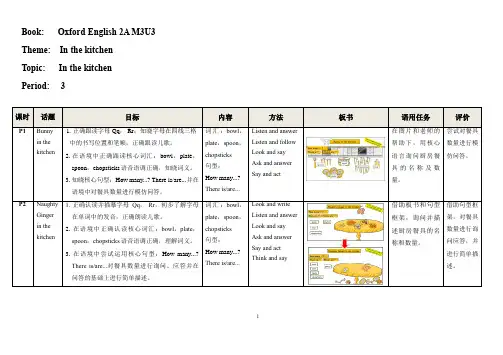
Book: Oxford English 2A M3U3 Theme: In the kitchen Topic: In the kitchen Period: 3课时 话题目标内容方法P1 Bunny 1. 正确跟读字母 Qq, Rr;知晓字母在四线三格 词 汇 :bowl, Listen and answerin the kitchen中的书写位置和笔顺;正确跟读儿歌。
2. 在 语 境 中 正 确 跟 读 核 心 词 汇 : bowl , plate ,spoon,chopsticks 语音语调正确,知晓词义。
3. 知晓核心句型:How many...? There is/are...并在语境中对餐具数量进行模仿问答。
plate,spoon, chopsticks 句型: How many...? There is/are...Listen and follow Look and say Ask and answer Say and actP2 Naughty 1. 正确认读并描摹字母 Qq, Rr,初步了解字母 词 汇 :bowl, Look and writeGinger in the kitchen在单词中的发音,正确朗读儿歌。
2. 在语境中正确认读核心词汇:bowl,plate,spoon,chopsticks 语音语调正确,理解词义。
3. 在语境中尝试运用核心句型:How many...?There is/are...对餐具数量进行询问、应答并在plate,spoon, chopsticks 句型: How many...? There is/are...Listen and answer Look and say Ask and answer Say and act Think and say问答的基础上进行简单描述。
1板书语用任务评价在 图 片 和 老 师 的 尝试对餐具 帮 助 下 , 用 核 心 数量进行模 语 言 询 问 厨 房 餐 仿问答。
上海牛津版(试用本)二年级英语上册unit1、In、the、children's、garden练习题
Module 3 Places and activitiesUnit 1 In the children’s garden (1)Ⅰ. Look and circle(根据所给的单词,把正确的单词部分圈出来):1. slide2. swing3. seesaw4. can5. what6. you7. seeⅡ. Look and number(看图,将单词的编号写在相应的图片下):1. slide2. swing3. seesaw4. swim( ) ( ) ( ) ( ) Ⅲ. Read and match(读句子,将下列句子与相应的图片连线):1. This is a swing. ●●A.s l i b e s l i d es m i n g s w i n gs e e s e e s a w sc u n c a m c c a nw h i r t w h a t sy o r y u o y o u rs e a s e s e s e e2. I can see a seesaw. ●●B.3. Touch the slide. ●●C.4. I can see a kite. ●●D.5. I can see a rope.●●E.Ⅳ. Read and judge(判断下列句子是否符合所给的情景,用☺或☹表示):1.你点着一个秋千,你说:It’s a swing.2.想知道滑滑板的颜色,你问:What colour is the slide?3.告诉朋友,你看见了一个跷跷板,你说:I can see a seesaw.4.想知道朋友有多少个滑滑板,你问:How many swings?5.你的跷跷板是蓝色的,你说:My seesaw is green.Module 3 Places and activitiesUnit 1 In the children’s garden (2)Ⅰ. Read and circle(读一读,圈出在意义上属于不同类的单词):1. 2. 3. 4.A. swimB. swing A. seeB. seesawA. areB. amA. yellowB. colourⅡ. Read and tick(读句子,在相应的图片下打勾):1. I can see a swing.A. ( )B. ( )2. Look, the slide is green.A. ( )B. ( )3. The panda is on the swing.A. ( )B. ( )4. --- How many seesaws?--- Three.A. ( )B. ( )5. --- What can you see?--- I can see a kite.A. ( )B. ( )Ⅲ. Look and circle(看图,圈出正确的单词):1. 2. 3. 4. 5.swing slide green is beeseesaw slides yellow are birdⅣ. Read and judge(判断下列句子是否符合图意,用√或╳表示):1. 2.Look. I can see a cow. ( ) How many slides? Four. ( )3. 4.Look. It’s a mouse. ( ) How many nets? Two nets.5. 6.The cats are on the slide. ( ) The boy can fly the kite. ( )Module 3 Places and activitiesUnit 1 In the children’s garden (3)Ⅰ. Read and circle(读一读,圈出正确的图片):1. 2.swim swingsA. B. A. B.3. 4.kite big mouseA. B. A. B.5. 6.red dress seesawA. B. A. B.Ⅱ. Read and number(读句子,在相应的图片下编号):1. --- What can you see?2. --- What can you see?--- I can see a red swing. --- I can see a yellow slide.3. --- What colour is the swing?4. --- What colour is the slide? --- It’s yellow. --- It’s red.Ⅲ. Choose the best answer(选择最佳答案,将字母代号写在前面的括号内):( ) 1. I ___________ see a slide.A. canB. amC. like( ) 2. --- How many __________? --- Three swings.A. swingB. swingsC. slides( ) 3. The seesaw isn’t __________. It’s red.A. smallB. longC. blue( ) 4. What can __________ see?A. youB. yourC. you’re( ) 5. --- What’s this? --- It’s a __________.A. a netB. netC. nets( ) 6. I can play __________ the children’s garden.A. atB. onC. inⅣ. Read and choose(在括号内写上相应单词的编号):A. greenB. seesawC. seeD. beeE. nets( ) 1. Look, the __________ can fly.( ) 2. --- What colour is it? --- It’s __________.( ) 3. --- Is this a __________? --- Yes, it is.( ) 4. The __________ are blue and yellow.( ) 5. I can __________ the big mouse.Ⅴ. Read and choose(读一读,选择正确的文问句,将字母代号写在前面的括号内):( ) 1. --- ____________ --- The duck is yellow. ( ) 2. --- ____________ --- I can see two ducks.( ) 3. --- ____________ --- The ducks are yellow. ( ) 4. --- ____________ --- It’s a duck.( ) 5. --- ____________ --- I like ducks.Module 3 Places and activitiesUnit 1 In the children’s garden (4)Ⅰ. Look and circle(圈出下列单词中所含的字母Mm和Nn):1. 2. 3.Ⅱ. Look and write(正确抄写下列字母、字母组):M N n m MNn Mnm mNn NmM________________________________________________________________________________________________________________________________________________________________________________________________________________________________________________________Ⅲ. Read and tick(看图,在符合要求的句子前打√):1. 2.( ) A. What can you see? ( ) A. I can see a book.( ) B. What can you hear? ( ) B. I can see two books.3. 4.( ) A. What colour is the kite? Blue. ( ) A. How many slides? Four. ( ) B. What colour is the kite? Red. ( ) B. How many slides? Five.Ⅳ. Look and match(看图,将下列图片与相应的句子连线):1.● ● A. I can see three red pencils.2.● ●B. I can see three green rubbers.3.● ●C. I can see three green pencils.4.● ●D. I can see three red rulers.5.● ●E. I can see three red rubbers. Ⅴ. Read and number(阅读对话,用1→4给下列图片编号):--- What can you see? --- What can you see?--- I can see cola. --- I can see jelly.--- What can you see? --- What can you see?--- I can see milk. --- I can see juice.Module 3 Places and activitiesUnit 1 In the children’s garden (5)Ⅰ. Look and write(正确抄写下列字母组和单词):LMN nml DEFG bcai hen BALL nine HEAD________________________________________________________________________________________________________________________________________________________________________________________________________________________________________________________Ⅱ. Read and number(读一读,将下列图片的编号写在相应的句子前):I can see a green slide. I can see a blue swing.I can see a blue slide. I can see a green swing.Ⅲ. Read and choose(读一读,圈出在意义上不属于同一类的单词,圈在字母代号上):1. A. swing B. seesaw C. see2. A. red B. read C. write3. A. what B. that C. this4. A. is B. are C. can5. A. kites B. ball C. dollsⅣ. Choose the best answer(选择最佳答案,将字母代号写在前面的括号内):( ) 1. What can ___________ see?A. youB. yourC. you’re( ) 2. ___________ is a boy.A. TomB. AliceC. Mary( ) 3. The __________ can fly.A. mouseB. cowC. kite( ) 4. --- How many __________? --- One bee.A. beeB. beesC. a bee( ) 5. --- What colour is it? --- It’s ___________.A. smallB. greenC. fat( ) 6. --- What do you like? --- I like ___________.A. netB. mouseC. miceⅤ. Read and judge(判断下列图片是否符合所给的句子,用√或╳表示):1. 2.Is it a slide? Yes, it is. Look. The seesaw is blue.( ) ( )3. 4.I can see two swings. The mouse is in the net.( ) ( )Ⅵ. Read and judge(阅读短文,判断正误,用T或F表示):Hello, I’m Tom. I’m tall. I’m fat. I can swim in summer and ride a bicycle in spring. Summer is hot and spring is warm. Look, this is a mouse. It’s small. It’s yellow. It can run and swim. But it can not fly.( ) 1. Tom is short.( ) 2. He can swim in spring.( ) 3. Summer is hot.( ) 4. The mouse is not big.( ) 5. The mouse can fly.Module 3 Places and activitiesUnit 1 In the children’s garden (1)Ⅰ. 1. slide 2. swing 3. seesaw 4. can 5. what 6. you 7. see Ⅱ. 2431Ⅲ. 1. D 2. E 3. B 4. C 5. AⅣ. 1. ☺ 2. ☺ 3. ☺ 4. ☹ 5. ☹Module 3 Places and activitiesUnit 1 In the children’s garden (2)Ⅰ. 1. A 2. A 3. C 4. BⅡ. 1. A 2. A 3. B 4. B 5. BⅢ. 1. seesaw 2. slides 3. yellow 4. are 5. beeⅣ. 1.╳ 2. ╳ 3. ╳ 4. √ 5. ╳ 6. √Module 3 Places and activitiesUnit 1 In the children’s garden (3)Ⅰ. 1. A 2. B 3. A 4. B 5. B 6. BⅡ. 2143Ⅲ. 1. A 2. B 3. C 4. A 5. B 6. CⅣ. 1. D 2. A 3. B 4. E 5. CⅤ. 1. C 2. A 3. E 4. D 5. BModule 3 Places and activitiesUnit 1 In the children’s garden (4)Ⅰ. drink small evening NINE SWIM MORNINGⅡ. M N n m MNn Mnm mNn NmMⅢ. 1. A 2. B 3. A 4. AⅣ. 1. D 2. B 3. A 4. E 5. CⅤ. 4123Module 3 Places and activitiesUnit 1 In the children’s garden (5)Ⅰ. LMN nml EDFG bcai hen BALL nine HEADⅡ. 2413Ⅲ. 1. C 2. A 3. A 4. C 5. BⅣ. 1. A 2. A 3.C 4. B 5. B 6. CⅤ. 1. √ 2. ╳ 3. ╳ 4. ╳Ⅵ. 1. F 2. F 3. T 4. T 5. F11。
Module3Unit3Inthekitchen(教案)牛津上海版(试用本)英语二年级上册
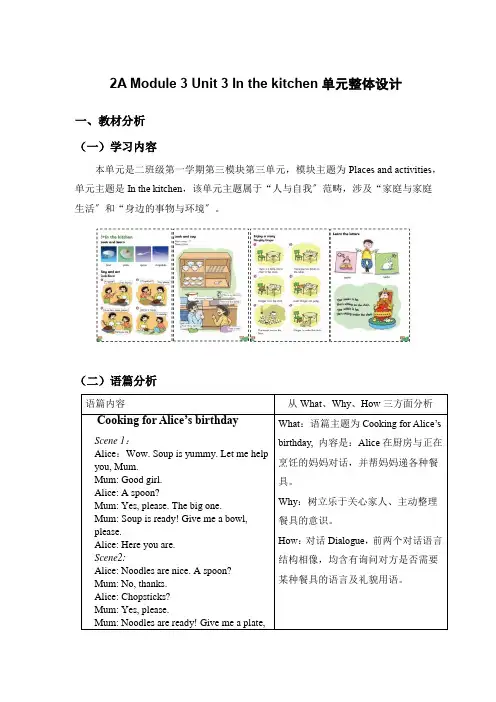
2A Module 3 Unit 3 In the kitchen单元整体设计一、教材分析(一)学习内容本单元是二班级第一学期第三模块第三单元,模块主题为Places and activities,单元主题是In the kitchen,该单元主题属于“人与自我〞范畴,涉及“家庭与家庭生活〞和“身边的事物与环境〞。
(二)语篇分析(三)教学内容分析二、学情分析二班级同学已在此前学习过与食物有关的词汇,会用简洁的形容词描述食物;已学习仿照运用核心句型How many…?询问物品的数量;已学习仿照运用核心句型Give me a…Here you are. Thank you.懂得根本的社交礼仪与日常问答。
以下是学情分析表:三、教学目标 〔一〕单元目标● 学问与技能1. 能知晓、背记字母 Qq, Rr 的音、形及其在单词中的根本读音,并能正确书写;能朗读含有字母 Qq, Rr 的相关单词和儿歌。
能用降调朗读特别疑问句How many…?和陈述句 There is/are...。
2. 能在语境中听、读关于厨房餐具类单词 bowl, plate, spoon, chopsticks ,并能说出这些餐具的名称,知晓他们的复数形式。
3. 能在语境中仿照运用核心句型How many…?询问物品的数量,并做出应答。
能用There is/are...对物品的数量和位置进行描述。
4. 能在语境中听懂、读懂 Look and say, Say and act, Enjoy a story 等教材板块中的对话和故事的意思,猎取相关根本信息,并能尝试进行对话和故事表演。
● 思维与策略在课堂学习和沟通中仔细倾听,乐于仿照,乐观思索,并尝试运用所学语言学问进行表达和沟通。
● 文化与情感树立在家长烹饪时乐于关心、主动整理餐具的意识,同时,初步感受餐具文化,了解根本的餐桌礼仪。
● 单元语用任务在“In the kitchen 〞的相关语境中,能询问及答复所需的餐具、询问及答复餐具的数量,及描述餐具所在的位置。
上海牛津版英语二年级的上册Module3Unit2《Inmyroom》word练习题.doc
Module 3 Places and activitiesUnit 2 In my room (1)Ⅰ. Look and circle1. bag2.box3.desk4.chair5.orange6.pig7.the(根据所给的单词,把正确的单词部分圈出来):b b a p b a g a b gb o z b o s b o x sd e s d e s k e s kc h a r i c h a i rw h i r t w h a t sp i q p i g p a g it h a t h e y t e hⅡ . Look and number(看图,将单词的编号写在相应的图片下):1. desk2. chair3. box4. bag b5E2RGbCAP( )( )( )( )Ⅲ . Read and match (读句子,将下列句子与相应的图片连线):1. I can see a chair.●●A.2.I can see two chairs.3.I can see a desk and a chair.4.I can see two desks.5.I can see a desk. ●●B.●●C.●●D.●●E.Ⅳ. Read and judge (判断下列句子是否符合所给的情景,用或表示):1.你点着身下的椅子,你说:This is a chair.2.想知道书桌的颜色,你问:Where is the desk?3.告诉朋友,你的书包是蓝色的,你说:My bag is not blue.4.想知道朋友有多少只盒子,你问:How many boxes?5.你喜欢大橘子,你说:I like small oranges.Module 3 Places and activitiesUnit 2 In my room (2) X k B 1 . c o mⅠ . Read and circle(读一读,圈出在意义上属于不同类的单词):1. 2. 3. 4.p1EanqFDPwA. box A. in A. appleA. deskB. dog B. six B. it B. peachC. bag C. one C. on C. pearsⅡ . Read and tick(读句子,在相应的图片下打勾):1. I can see a bag.A.( )B.( )2. Look, the box is big.A.( )B.( )3. Is the desk yellow? Yes.A.( )B.( )4.--- How many pigs?---Four.A.( )B.( )5.--- What can you see?---I can see two chairs.A.( )B.( )Ⅲ. Look and circle(看图,圈出正确的单词):1. 2. 3. 4.5. DXDiTa9E3dbag desk box chair orange RTCrpUDGiTpig desks six chairs apple5PCzVD7HxAⅣ . Read and judge(判断下列句子是否符合图意,用√或╳表示):1. 2.Look at the hamburger. ( )How many pears? Five. ( )jLBHrnAILg 3. 4.Look. It’ s a small monkey. ()Put the mouse on the desk. ( )xHAQX74J0X5. 6.Put the dogs on the swing. ( )I can see three chairs. ( )LDAYtRyKfEModule 3 Places and activitiesUnit 2 In my room (3)Ⅰ.Read and circle(读一读,圈出正确的图片):1. 2.bags onA. B. A. B.3. 4.in booksA. B. A. B.5. 6.desk chairA. B. A. B.Ⅱ . Read and number (读句子,在相应的图片下编号):Zzz6ZB2Ltk dvzfvkwMI1rqyn14ZNXI1. --- Put the box on the desk.2. --- Put the bag in the box. EmxvxOtOco--- OK. --- OK.3. --- Put the book in the bag.4. --- Put the box on the chair.SixE2yXPq5---OK.--- OK.Ⅲ . Choose the best answer(选择最佳答案,将字母代号写在前面的括号内):( ) 1. _______ is a girl.A. KittyB. EddieC. Peter() 2. Put the book __________ the chair.A. inB. onC. no( ) 3. This is my ___________. He’ s tall.A. mumB. dadC. sister( ) 4. How many ___________?A. deskB. desksC. chair( ) 5. Look ___________ your chair, please.A. itB. catC. at( ) 6. Look, the ___________ is big. The ears are big, too. 6ewMyirQFLA. duckB. monkeyC. pigⅣ . Read and choose (在括号内写上相应单词的编号):A. pleaseB. pencil caseC. pencilsD. yourE.kavU42VRUsroom( ) 1. My __________ are yellow and red.( ) 2. Put the rubber in the __________.( ) 3. Touch your face, __________.( ) 4. I can see a desk and a chair in my __________. y6v3ALoS89 ( ) 5. Do you like __________ books ?Ⅴ . Read and draw (读一读,画出相应的图片):1. Put the ruler on the chair.2.Put the bag on the desk. M2ub6vSTnP3. Put the ball on the book.4. Put the pencil case in the box.0YujCfmUCwModule 3 Places and activitiesUnit 2 In my room (4)Ⅰ.Look and circle (圈出下列单词中所含的字母Oo和 Pp):1. 2. 3. eUts8ZQVRdorange peach oink sQsAEJkW5T4. 5. 6.APPLE PEAR NOODLESⅡ. Look and write(正确抄写下列字母、字母组):O P p o OPp PoO oPp OpP GMsIasNXkA ______________________________________________________________TIrRGchYz g______________________________________________________________7EqZcWLZ NX______________________________________________________________lzq7IGf02E ______________________________________________________________zvpgeqJ1hkⅢ . Read and tick(看图,在符合要求的句子前打√):1. 2.( ) A. Put the book on the desk.() A. Look, the desk is yellow. NrpoJac3v1( ) B. Put the book in the bag.() B. Look, the desksare yellow.1nowfTG4KI3. 4.( ) A. I can see the dogs on the slide.() A. Put the bag inthe box.fjnFLDa5Zo( ) B. The dogs are on the seesaw.() B. Put the box in thebag. tfnNhnE6e5Ⅳ. Look and match (看图,将下列图片与相应的句子连线):1.●● A. Put the pencils in the pencil case.HbmVN777sL2.。
Module3Unit1Intheplayground(教案)牛津上海版(试用本)英语二年级上册
-测试:教师可以通过设计一些小测试来评估学生对操场活动相关知识的掌握情况。例如,教师可以设计一些填空题或选择题,让学生完成,检查他们对操场活动相关词汇和句型的理解和运用能力。
-设计实践活动或实验,让学生在实践中体验知识的应用,提高实践能力。
-在新课呈现结束后,对操场活动的知识点进行梳理和总结。
-强调重点和难点,帮助学生形成完整的知识体系。
(四)巩固练习(预计用时:5分钟)
随堂练习:
-随堂练习题,让学生在课堂上完成,检查学生对知识的掌握情况。
-鼓励学生相互讨论、互相帮助,共同解决问题。
-句型结构:主语+ be动词(am/is/are) +动词-ing形式+其他。
5.课堂活动
-角色扮演:学生分组扮演不同的操场活动,使用所学词汇和句型进行交流。
-小组讨论:围绕操场活动的话题展开讨论,分享自己的经验和看法。
6.写作练习
-描述操场活动:学生用所学的词汇和句型描述操场上的活动,如玩滑梯、玩秋千等。
答案:playing
解析:根据图片,男孩正在滑梯上玩,使用动词playing。
(2) In the playground, the children are _______ around.
答案:running
解析:根据情景描述,孩子们正在操场上跑来跑去,使用动词running。
4.仿写句子题
(1) The girl is playing on the swing.
知识点梳理
牛津上海版二年级上册-M3U2
- Put the ____ on the desk, please. - OK. / All right.
... ...
Make a cake
Put the _____ on the cake. Put the _____ on the cake. Put the _____ on the cake. Look, this is my cake. Yummy, yummy!
... ...
Role play
Miss Fang:Good morning, Kitty. Kitty:Good morning, Miss Fang.
Miss Fang:Put the pencil case on the desk, please. Kitty:Yes, Miss Fang.
Module 3
Places and activities
Unit 2 In my room
Look and learn
bag
bБайду номын сангаасx
desk
chair
Put the pencil icnasteheinptehnecibl acga,sep,leKaistety. . OAKll,rMiguhmt!.
case
Put … in …
Mum:Put the pencil in the pencil case, Kitty.
Put the ____ in the pencil case.
... ...
Mum:Put the pencilsinintthheeppeennccililccaassee. .
Put the ____ in the pencil case. ... ...
牛津上海版小学英语二年级上册全册教案
牛津上海版小学英语二年级上册全册教案目录Module1 Getting to know you《Unit1 Hello》 (2)Module1 Getting to know you《Unit2 I’m Danny》 (11)Module1 Getting to know you《Unit3 A new classmate》 (16)Module2 Me, my family and friends《Unit1 I can swim》 (19)Module2 Me, my family and friends《Unit2 That’s my family》 (23)Module2 Me, my family and friends《Unit3 My hair is short》 (27)Module3 Places and activities《Unit1 In the children’s garden》 (33)Module3 Places and activities《Unit2 In my room》 (37)Module3 Places and activities《Unit3 In the kitchen》 (42)Module4 The natural world《Unit1 In the sky》 (46)Module4 The natural world《Unit2 In the forest》 (51)Module4 The natural world《Unit3 In the street》 (56)Module1 Getting to know you《Unit1 Hello》1教学目标1、知识目标(1)能够听、说、认读单词:bowl、plate、fork、knife、spoon,并能理解这些餐具的含义。
2、能力目标(1)能通过一系列任务活动培养学生主动思考、自己探究、交流合作的学习能力。