
人教新目标英语八年级下册教案--Unit 1
初中英语学科“问题导学、互动探究”教案Unit 1What’s the matter?The First PeriodSection A (1a-2d)I.Teaching aims1.Key words:matter,stomachache,foot,neck,stomach,throat,fever,lie,rest,cough,X-ray, toothache, headache,break,hurt2.Key phrases: have a sore throat, have a stomachache, have a cold, lie down, take one’s temperature, have a fever, go to a doctor3.Important sentences:①—What’s the matter?—She talked too much yesterday and didn’t drink enough water. She has a very sore throat now.②You should drink some hot tea with honey.③It doesn’t sound like you have a fever.④You need to take breaks away from the computer.⑤I think I sat in the same way for too long without moving.⑥If your head and neck still hurt tomorrow, then go to a doctor.II.Important points:1.重点短语和句型2.询问对方身体状况的句型及答语III.Difficult points:询问对方身体状况的句型及答语IV.Teaching processStep 1 Lead in(Show some pictures about people’s illness to the students) Teacher: What’s the matter with them?Then help the students answer the question in English.Step 2 Work on 1a-1c1.学生朗读1a中的单词,教师纠正错误读音,然后学生识记单词并将单词和身体部位匹配。
2.让学生仔细观察1a图片中的人物,然后认真听录音,按听到的顺序为1b中的人物标号,完成课本上1b的听力任务。
3.再听一遍录音,并跟读对话。
4.结对练习1c中的对话,并请一些学生展示他们的对话。
5.让学生模仿1c中的对话,结合1b的答案材料与同伴编练新对话,并邀请几组学生表演对话。
A:What’s the matter?B:She talked too much yesterday and didn’t drink enough water. She has a very sore throat now.Step 3 Work on 2a-2c1.认真观察2a图片,按听到的对话顺序给图片标号,集体核对答案。
2.认真阅读2b中的单词和短语,再听一遍录音,将问题和建议匹配,完成后集体核对答案。
3.听第三遍录音,让学生跟读。
4.让学生利用2a,2b中的信息仿照2c 的形式练习对话,并要求几组同学表演对话。
A:What’s the matter?B:My head feels very hot.A:Maybe you have a fever ...B: ...Step 4 Work on 2d1.学生自读对话,回答下面的问题。
①What’s the matter with Lisa?②Why does Lisa’s head and neck hurt?③What should we do if we play computer games for a long time?2.大声朗读2d中的对话,读熟后与同伴结对练习,分角色表演对话。
3.邀请三组来表演对话。
Language points1.What’s the matter?你怎么了?(教材第1页)这句话通常用于询问别人身体有什么不舒服,或有何麻烦,后跟with构成:What’s the matter with ...?类似的句子还有:What’s wrong with ...? 和What happened to ...?他们的答语往往是表示得了什么病,或什么地方不舒服,常用句型“I have a ...”。
如:have a headache,have a toothache(牙疼),have a sore throat,have a cold,have a sore back(背疼), have a fever(发烧)等。
2.should的运用should是情态动词,表示“应该;应当”,后加动词原形,可用于各种人称。
它比must 的语气要委婉,用来表示向对方提出建议或忠告,或者表示某种义务或责任。
其否定形式为shouldn’t,意思是“不应该;不应当”。
Exercise一、单项选择。
1.—What’s ________?—I have a sore back.A.matterB.the matterC.the questionD.the wrong2.Watching TV ________ is bad for your eyes.A.too manyB.too muchC.much tooD.very much3.The girl is ________ a ticket.A.enough tall buyingB.tall enough to buyC.tall enough buyingD.enough tall to buy4.I don’t like coffee. I like milk ________ sugar.A.forB.inC.withD.at二、根据汉语提示完成句子。
1.听起来你不像是发烧了。
It doesn’t you .2.你需要远离电脑休息。
You should the computer.3.我想我以同样的方式坐得太久没有动了。
I think I sat for too long .HomeworkUse the sentence “What’s the matter ...?” to make a dialogue.板书设计Unit 1What’s the matter?The First PeriodSection A (1a-2d)What’s the matter?My head feels very hot.Maybe you have a fever ...intoIVthe illness.What should you do? Will you leave or send the person to the hospital? The bus driver Wang Ping and the passengers on his bus give us an good example. Let’s read the story together to find the answers.Step 2 Work on 3a-3b1.阅读3a短文,根据短文内容回答问题“Do you think it comes from a newspaper or a book? How do you know?”2.认真阅读短文,标注出故事中所发生的事情,完成后让学生展示自己的答案,教师点拨。
3.再次细心阅读短文,理解每一句话的意思,小组合作解决遇到的疑难问题。
4.教师点拨短文中出现的重点和难点。
5.熟读短文,识记背诵知识要点。
Step 3 Work on 3c1.认真阅读3a短文,思考3c提出的问题。
2.小组讨论发表自己对三个问题的观点。
3.在班级内分小组发表对三个问题的观点,由教师引导点拨。
Language points1.He got off and asked the woman what happened. 他下了车,问那个妇女发生了什么事。
(教材第3页)(1)get off为“动词+副词”结构的短语,人称代词作宾语时,应放在动词与副词之间,此处意为“下车”。
(2)happen为不及物动词,意为“发生”。
2.But to his surprise, they all agreed to go with him.但出乎他的意料,他们都同意和他一起去。
(教材第3页)(1)to one’s surprise为固定结构,意为“使某人惊讶的是;出乎某人意料”。
(2)此处surprise为不可数名词,意为“惊奇;惊讶”;作可数名词时,意为“令人吃惊的事物”。
(3)此处agree为及物动词,意为“同意”,后面可跟名词、代词、动词不定式或宾语从句。
【拓展】agree常作不及物动词,意为“同意”,后面常跟to,with,on等。
Exercise单项选择。
1.Walk ________ the street, you can see a bank on the right.A.alongB.longC.onD.at2.The students ________ when the teacher came in.A.readB.readsC.are readingD.were reading3.When I looked out of the window, I saw a girl ________ in the park.A.danceB.dancedC.dancingD.dances4.To ________ surprise, ________ parents bought a new computer for ________A.her;her;herB.her;her;hersC.she;hers;herD.hers;her;her5.They have talked about the plan for two hours,at last they all agreed ________ what Jim's said.A.toB.onC.withD.for6.________ the kind man, the girl was saved.A.Thank forB.Thanks toC.BecauseD.Thanks a lotHomeworkRead the passage in 3c and remember important words and phrases.板书设计Unit 1What’s the matter?The Second PeriodSection A (3a-3c)get off下车have to不得不thanks to由于;多亏;因为in time及时get to到达教学反思:The Third PeriodSection A (Grammar Focus-4c)I.Teaching aims1.Key words:herself2.Key phrases:fall down3.Important sentences:①Do you have a fever?②You shouldn’t eat so much next time.③He should lie down and rest.④He should see a dentist and get an X-ray.⑤—Should I put some medicine on it?—Yes, you should./No, you shouldn’t.⑥She should take her temperature.⑦Did you hurt yourself playing soccer?II.Important points:1.询问他人身体状况的句型及答语2.情态动词should的用法III.Difficult points:1.询问他人身体状况的句型及答语2.情态动词should的用法IV.Teaching processStep 1 Lead inTeacher:Hello, everyone.We are all here today except Jim. Do you know what’s the matter with him?Student 1:I think he has a cold.Student 2:I think he has a fever....Step 2 Work on Grammar Focus学生大声朗读Grammar Focus的句子。
人教版英语八年级下册 教案Unit 1(3)
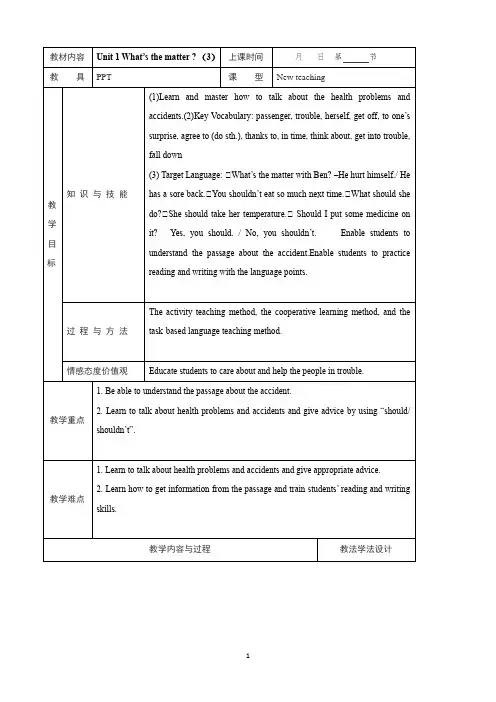
Unit 1 What’s the matter ?(3)
上课时间
月日第节
教具
PPT
课型
New teaching
教
学
目
标
知识与技能
(1)Learn and master how to talk about the health problems and accidents.(2)Key Vocabulary: passenger, trouble, herself, get off, to one’s surprise, agree to (do sth.), thanks to, in time, think about, get into trouble, fall down
过程与方法
The activity teaching method, the cooperative learning method, and the task-based language teaching method.
情感态度价值观
Educate students to care about and help the people in trouble about health problems and accidents and give appropriate advice.
2. Learn how to get information from the passage and train students’ reading and writing skills.
教学重点
1. Be able to understand the passage about the accident.
2. Learn to talk about health problems and accidents and give advice by using “should/ shouldn’t”.
人教版新目标八年级英语下册全册电子版教案
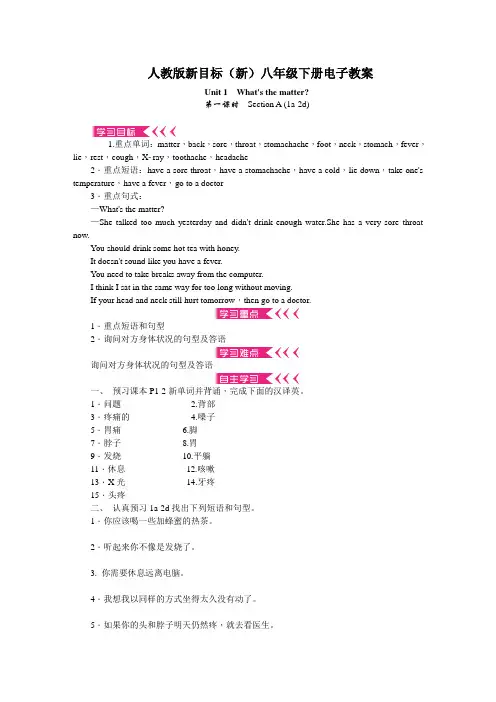
人教版新目标(新)八年级下册电子教案Unit 1What's the matter?第一课时Section A (1a-2d)1.重点单词:matter,back,sore,throat,stomachache,foot,neck,stomach,fever,lie,rest,cough,Xray,toothache,headache2.重点短语:have a sore throat,have a stomachache,have a cold,lie down,take one's temperature,have a fever,go to a doctor3.重点句式:—What's the matter?—She talked too much yesterday and didn't drink enough water.She has a very sore throat now.You should drink some hot tea with honey.It doesn't sound like you have a fever.You need to take breaks away from the computer.I think I sat in the same way for too long without moving.If your head and neck still hurt tomorrow,then go to a doctor.1.重点短语和句型2.询问对方身体状况的句型及答语询问对方身体状况的句型及答语一、预习课本P1-2新单词并背诵,完成下面的汉译英。
1.问题____________ 2.背部____________3.疼痛的____________ 4.嗓子____________5.胃痛____________ 6.脚____________7.脖子____________ 8.胃____________9.发烧____________ 10.平躺____________11.休息____________ 12.咳嗽____________13.X光____________ 14.牙疼____________15.头疼____________二、认真预习1a-2d找出下列短语和句型。
(人教版新目标)初中八年级英语下册Unit1 Section B1听说课讲解教学课件

expressions.
(人教版新目标)初中八年级英语下册Unit1 Section B1听说课讲解教学课件
Thanks
思维品质:To learn different treatments when accidents happen and give advice.
学习能力:To develop listening and speaking skills.
(人教版新目标)初中八年级英语下册Unit1 Section B1听说课讲解教学课件
He cut his knee.
What should he do?
He should put a bandage on it.
['bæ ndɪdʒ] 绷带(n.) 用绷带包扎(v.)
(人教版新目标)初中八年级英语下册Unit1 Section B1听说课讲解教学课件
What’s the matter?
He got hit on his head by a football.
What should the boy do?
He should go to the hospital and get an X-ray.
Lead-in What is happening in each picture?
The person cut his finger with a knife.
treatment next to the problems you checked in the chart above.
a. put a bandage on it b. took his temperature c. told him to rest d. put some medicine on it e. took him to the hospital to get an X-ray f. told her to put her head back.
2020-2021学年人教版英语八年级下册Unit1SectionA(1a-2c)教案
-难点举例:疑问句结构的变化,如“Did you go to the movies last night?”;否定句的形成,如“I didn't play soccer.”
(3)在实际语境中灵活运用一般过去时态描述过去事件。
-难点举例:学生在口语表达时,可能难以将学到的时态和句型自然地结合,流畅地叙述过去的事情。
五、教学反思
在完成Unit 1 Section A (1a-2c)的教学后,我对整个教学过程进行了深入的思考。首先,我注意到在导入新课阶段,通过提问同学们的周末活动,成功引起了他们对一般过去时的兴趣。这种方法让学生能够迅速将新知识与自己的生活实际联系起来,提高了他们的学习积极性。
在新课讲授环节,我采用了理论介绍、案例分析和重点难点解析相结合的方式。我发现学生们对一般过去时的基本概念掌握得比较好,但在不规则动词的过去式变化上还存在一些困难。这说明在今后的教学中,我需要更加重视这部分内容的讲解和复习。
1.对不规则动词过去式的讲解需要更加细致,可通过编故事、歌曲等方式帮助学生记忆。
2.增加口语练习,提高学生在实际情景中运用一般过去时的能力。
3.关注每个学生的参与情况,提高小组讨论的互动性和效果。
在今后的教学中,我将不断调整和完善教学方法,以期提高学生们对英语学科的兴趣和核心素养。同时,我也会更加关注学生的学习反馈,及时调整教学策略,确保每个学生都能在课堂上获得更好的学习体验。
2020-2021学年人教版英语八年级下册Unit 1 SectionA (1a-2c)教案
一、教学内容
2020-2021学年人教版英语八年级下册Unit 1 Section A (1a-2c)主要包括以下内容:1a部分,通过图片和关键词引入本单元主题——谈论过去的经历;1b部分,学习如何用一般过去时描述过去的事件,通过听力练习,训练学生捕捉关键信息的能力;1c部分,进行口语练习,学生两人一组讨论他们的过去经历;2a-2c部分,进一步深入学习一般过去时,通过听力练习和口语交流,让学生在实际语境中运用目标语言,了解和分享彼此的过去活动。教学内容与教材紧密相关,确保学生能够扎实掌握本节课的重点知识。
人教版(新目标)初中英语八年级下册Unit 1
人教版(新目标)初中英语八年级下册Unit1Unit1 Whats the matter?Unit1 知识梳理【重点单词】matter [?m?t?] v. 重要,要紧,有关系Whats the matter? 怎么了?出什么事了?sore [s?:(r)] adj. 疼痛的,酸痛的have a cold 感冒stomach [st?m?k] n. 胃,腹部stomachache [st?m?ke?k] n. 胃痛,腹痛have a stomachache 胃痛foot(复数feet) [fu:t] n. 脚neck [nek] n. 颈,脖子throat [rt] n. 喉咙fever [fi:v?] n. 发烧,发热lie [la?] v. 躺,平躺lie down 躺下rest [rest] n. 剩余部分,其余;放松,休息cough [k?f] n. v. 咳嗽X-ray [eksre?] n. X光,X射线toothache [?tu:e?k] n. 牙痛take ones temperature 量体温headache [?hede?k] n. 头痛have a fever 发烧break [bre?k] n. v. 休息,暂停;打破take breaks (take a break)休息hurt [h?:t] v. 伤害,损害,使受伤passenger [p?s?nd] n. 乘客,旅客off [?f] adv. prep. 离开(某处);从去掉get off 下车to ones surprise 使惊讶,出乎意料onto [nt?] prep. 向,朝trouble [?tr?bl] n. 麻烦,烦扰,问题hit [hit] n. v. 碰撞,打,打击right away 立即,马上get into 陷入,参与herself [h?:?self] pron. 她自己,她本身(she的反身代词)bandage [b?nd?d?] n. v. 绷带;用绷带包扎sick [s?k] adj. 患病的,不适的knee [ni:] n. 膝盖nosebleed [?nzbli:d] n. 鼻出血breathe [bri:e] v. 呼吸sunburned [?s?nb?:nd] adj. 晒伤的ourselves [ɑ:?selvz] pron. 我们自己(we的反身代词)climber [?kla?m?(r)] n. 登山者be used to 习惯于适应于risk [r?sk] n. v. 风险,危险;冒险take risks (take a risk) 冒险accident [ksid?nt] n. 意外事件;事故situation [?sitju?ein] n. 状况,形式,情况kg=kilogram [?k?l?gr?m] n. 公斤,千克rock [r?k] n. 岩石run out (of) 用尽,耗尽knife [naif] n. 刀,餐刀cut off 切除blood [bl?d] n. 血mean [mi:n] v. 意味着,意思是,意欲get out of 离开,从出来importance [?m?p?:tns] n. 重要性decision [d?sn] n. 决心,决定,抉择control [k?ntrl] v. 控制,支配,操纵be in control of 掌管,管理spirit [sp?r?t] n. 勇气,意志death [de] n. 死亡give up 放弃nurse [n?:s] n. 护士【重点短语】1.have a fever 发烧2.have a cough 咳嗽3.have a toothache 牙疼4.talk too much 说得太多5.drink enough water 喝足够的水6.have a cold 受凉;感冒7.have a stomachache 胃疼8.have a sore back 背疼9.have a sore throat 喉咙痛10. take risks 冒险11.hot tea with honey 加蜂蜜的热茶12.see a dentist 看牙医13.get an X-ray 拍X 光片14.take one s temperature 量体温15.put some medicine on sth. 在上面敷药16. give up 放弃17. sound like 听起来像18. all weekend 整个周末19. in the same way 以同样的方式20. go to a doctor 看医生21. go along 沿着走22. on the side of the road 在马路边23. shout for help 大声呼救24. without thinking twice 没有多想25. get off 下车26. have a heart problem 有心脏病27. to one s surprise 另某人惊讶的是28. thanks to 多亏了;由于29. in time 及时30. make a decision 做出决定31. get into trouble 造成麻烦32. right away 立刻;马上33. because of 由于34. get out of 离开;从出来35. keep on doing sth. 继续或坚持做某事36. put a bandage on sth. 用绷带包扎37. fall down 摔倒38. feel sick 感到恶心39. have a nosebleed 流鼻血40. cut his knee 割伤他的膝盖41. put her head back 把她的头向后仰42. have problems breathing 呼吸困难43. mountain climbing 登山运动44. be used to doing sth. 习惯做某事45. run out (of) 用完;用尽46. so that 以便47. so...that... 如此以至于...48. be in control of 掌管;管理49. in a difficult situation 在闲境中【重点句型】1. Whats the matter with you?= Whatthe trouble with you?= Whats wrong with you? 你怎么了?2. What should she do? 她该怎么办呢?3.Should I take my temperature? 我应该量一下体温吗?4.You should lie down and rest. 你应该躺下休息一会儿。
最新初中英语人教版八年级下Unit 1 Section B 1a~1d教案
Unit 1 What’s the matter?Section B (1a~1d)教学目标【知识与技能】1. 掌握重点词汇fall down、get some rest、cut one’s knee、hurt one’s back、feel sick…2. 能掌握含有should的用法。
【过程与方法】1. 运用图片、情景等手段激发学生的学习兴趣,学会对遇到的问题及事故提出合理化建议,发散思维。
2. 小组合作完成细节任务,互帮互助,学生重难点词汇,并小组汇报分享学习成果。
【情感、态度与价值观】引导学生正确面对生活中遇到的困难,爱惜身体,坚持锻炼。
教学重难点【教学重点】情态动词should的用法。
【教学难点】教材中出现的词组的掌握以及对听力材料的理解。
教学准备图片、多媒体等教学过程Step 1 Warm up1. Revise: Ask several pairs of students to the front of the classroom to act out the dialogue:—What’s the matter with you? —I have a sore throat.Then ask others: What’s the matter with him/her ?Help Ss answer: He has a sore throat. He should drink lots of water.2. Look at pictures and practice the dialogue.Step 2 Lead in1. Learn some new words and phrases on page 4.2. Finish the task of Section B 1a. Read these phrases.Step 3 ListeningT: Now, boys and girls, you have learned something about how to deal with accidents. Now let’s listen to a conversation. Try catch what happened and what the treatments are.Step 4 Practice and role play the conversationT: Now, class, for pair work, I would like one student to be the nurse and the other the patient. Use the information in the textbook to role-play a conversation.T: Good. Let’s look at an example, and then I would like you to act out your own dialogue.课堂作业1. Preview the new words in Section B.2. Preview the passage of part 2b教学反思要加强对提建议句型的使用。
新目标英语八年级下册Unit 1-10全套教案
新目标英语八年级下册Unit 1-10全套教案Unit 1 What’s the matter? (1)Unit 2 I’ll help to clean up the city park. (25)Unit 3 Could you please clean your room? (50)Unit 4 Why don’t you talk to your parents? (69)Unit 5 What were you doing when the rainstorm came? (91)Unit 6 An old man tried to moved the mountains. (111)Unit 7 What’s the highest mo untain in the world? (134)Unit 8 Have you read Treasure Island yet? (156)Unit 9 Have you ever been to a museum? (176)Unit 10 I’ve had this bike for three years (199)Unit 1 What’s the matter?教学目标:1语言目标:描述健康问题的词汇,及如何根据别人的健康问题提建议。
2 技能目标:能听懂谈论健康问题的对话材料;能根据别人的健康问题提建议;能写出重点单词和重点句型,并能描述怎样对待健康问题。
3 情感目标:通过开展扮演病人等活动,培养学生关心他人身体健康的品质。
通过本课的阅读,培养学生处理紧急事件的基本能力,树立紧急事件时互相帮助的精神。
教学重点:短语: have a stomachache, have a cold, lie down, take one’s temperature, go to a doctor, get off, to one’s surprise, agree to do sth., get into trouble,fall down, be used to, run out (of), cut off , get out of, be in control of ,keep on (doing sth.), give up句子:1 What’s the matter? I have a stomach ache. You shouldn’t eat so much next time.2 What’s the matter with Ben?He hurt himself. He has a sore back.He should lie down and rest.3 Do you have a fever? Yes, I do. No, I don’t.I don’t know.4 Does he have a toothache? Yes, he does.He should see a dentist and get an X-ray.5 What should she do? She should take her temperature.6 Should I put some medicine on it? Yes, you should No, you shouldn’t.教学难点:掌握情态动词should \shouldn’t. 的用法学习have的用法课时划分:Section A1 1a – 2dSection A2 3a-3cSection A3 Grammar Focus-4cSection B1 1a-2eSection B2 3a-Self checkSection A 1 (1a – 2d)Step 1 Warming up and new words1.Look at a picture and learn the parts of the body.2.New words and phrases.Step 2 Presentation1a Look at the picture. Write the correct letter [a-m] for each part of the body.___arm ___ back ___ ear ___ eye ___ foot___hand ___ head ___ leg ___ mouth___ neck ___nose ___ stomach ___ toothStep 3 Listening1b Listen and look at the picture. Then number the names 1-5Listen to the conversations again and fill in the blanks.Conversation 1Nurse: What’s the matter, Sarah?Girl: I ___________.Conversation 2Nurse: What’s the matter, David?Boy: I _________________.Conversation 3Nurse: What’s the matter, Ben?Boy: I _________________.Conversation 4Nurse: What’s th e matter, Nancy?Girl: I _________________.Conversation 5Betty: What’s the matter, Judy?Ann: She __________________.Step 4 Speaking1c Look at the pictures. What are the students’ problems? Make conversations.ExamplesA: What’s the m atter with Judy?B: She talked too much yesterday and didn’t drink enough water.She has a very sore throat now.A: What’s the matter with Sarah?B: She didn’t take care of herself on the weekend. She was playing withher friends at the park ye sterday. Then it got windy, but she didn’t puton her jacket. Now she has a cold.Step 5 Guessing gamesGuess what has happened to the students by using the important sentences. Step 6 Listening2a Listen and number the pictures [1-5] in the order you hear them.2b Listen again. Match the problems with the advice.Step 7 Speaking2c Make conversations using the information in 2a and 2bA: What’s the matter?B: My head feels very hot.A: Maybe you have a fever.B: What should I do?A: You should take your temperature.Step 8 Role–playImagine you are the school doctor. A few students have health problems.Role-play a conversation between the doctor and the students.2d Role –play the conversationStep 9 Language points and summary1. What’s the matter?这是人们特别是医生和护士询问病人病情时最常用的问句, 意思是―怎么了?‖其后通常与介词with连用。
人教版新目标八年级英语下册第一单元课件PPT
1- d 2- a 3- b 4- c 5- e
Look at the pictures. What are the students’ problems? Make conversations.
What’s the matter? I have a cold.
I have a fever.
What’s the matter? I have a toothache.
2. The old man had a heart problem. (T )
3. Some passengers didn’t help Mr. Wang to move the man on the bus. ( F )
4. At last, the doctors saved the man in time. ( T )
What’s the matter?
I have a _s_o_r_e_t_h_r_o_a_t___. You should d_r_in__k_s_o_m__e_h_o_t_t_e_a_w__it_h__h_o_n_e_y, or_g_o__to__s_e_e_t_h_e_d_o_c_t_o_r_. You shouldn't _e_a_t_d_r_y_f_o_o_d__su__ch__a_s_c_o_o_k_i_e_s___ or _s_p_e_a_k_t_o_o_l_o_u_d_l_y_.
Unit 1
Section A Period 1 (1a —2d)
the names of the body
a mouth
a nose
twano eyes
twano ears
a tooth two teeth
a neck
人教版新目标八年级英语下册-全册电子版--教案
人教版新目标(新)八年级下册电子教案Unit 1What's the matter?第一课时Section A (1a-2d)1.重点单词:matter,back,sore,throat,stomachache,foot,neck,stomach,fever,lie,rest,cough,Xray,toothache,headache2.重点短语:have a sore throat,have a stomachache,have a cold,lie down,take one's temperature,have a fever,go to a doctor3.重点句式:—What's the matter?—She talked too much yesterday and didn't drink enough water.She has a very sore throat now.You should drink some hot tea with honey.It doesn't sound like you have a fever.You need to take breaks away from the computer.I think I sat in the same way for too long without moving.If your head and neck still hurt tomorrow,then go to a doctor.1.重点短语和句型2.询问对方身体状况的句型及答语询问对方身体状况的句型及答语一、预习课本P1-2新单词并背诵,完成下面的汉译英。
1.问题____________ 2.背部____________3.疼痛的____________ 4.嗓子____________5.胃痛____________ 6.脚____________7.脖子____________ 8.胃____________9.发烧____________ 10.平躺____________11.休息____________ 12.咳嗽____________13.X光____________ 14.牙疼____________15.头疼____________二、认真预习1a-2d找出下列短语和句型。
人教版新目标(go for it)英语八年级下册英语全册教案
人教版新目标八年级下册英语教学计划Co ntents(教案目录)Unit 1 What's the matter?......................................................1(6课时)Unit 2 I'll help to clean up the city park...............................25(6课时)Unit 3 Could you please clean your room?.........................48(6课时)Unit 4 Why don't you talk to your parents? ........................70(6课时)Unit 5 What were you doing when the rainstorm came? ...94(6课时)Unit 6 An old man tried to move the mountains. ...............117(6课时)Unit 7 What's the highest mountain in the world? ...........139(6课时)Unit 8 Have you read Treasure Island yet? .......................156(6课时)Unit 9 Have you ever been to a museum? ..........................173(6课时)Unit 10 I've had this bike for three years. ..........................187(6课时)周星期2015年_月__日第周星期总第__课时2015年__月__日第周星期总第__课时2015年_月__日第周星期总第__课时2015年_月__日第周星期总第__课时2015年_月__日第周星期总第__课时2015年_月__日第周星期总第__课时2015年_月__日第周星期总第__课时2015年_月__日第周星期总第__课时2015年_月__日第周星期总第__课时2015年_月__日第周星期总第__课时2015年_月__日第周星期总第__课时2015年_月__日第周星期总第__课时。