
七年级英语下册Unit 5 Topic1复习课课件 最新仁爱版
合集下载
最新仁爱版七年级英语下册Unit5Topic1SectionA精品课件

1. Review the means of transportation. 2. Read the sounds and words in 3a. 3. Memorize the new words.
Thank you
(3)How does Jane always come to school? Jane always comes to school by bus.
1a Look, listen and say.
1.—Happy New Year! —The same to you.
2.—Do you often come to school by bike? —Yes, I do.
Exaபைடு நூலகம்ple:
A: How do you usually come to school? B: I usually come to school by bike. C: I usually come to school on foot.
…
You may report like this: In our group, three of us come to
1b Read the sentences and choose the correct one for each picture.
C
D
A
B
A. He comes to school on foot. B. She goes to school by bus. C. He comes to school by bike. D. She goes to school by subway.
YeNHsi,acIpedpotyo. HNsoewewdyYooeyuao,rut!ouosu! ally
最新仁爱版七年级英语下册Unit5Topic1SectionC精品课件
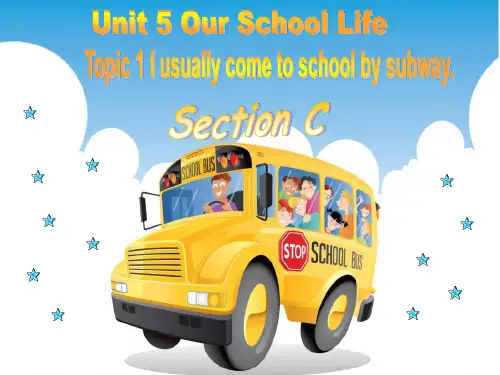
3. Work in pairs. Make up new conversations with the words and phrases in the box.
Activity: meet friends watch TV listen to music read books cook go to the zoo play soccer
Tell the time
8:00 9:05 10:15 11:30 12:45 17:50
• eight o’clock • nine o five • ten fifteen / a quarter past ten • eleven thirty / half past eleven • twelve forty-five / a quarter to one • seventeen fifty / ten to eighteen
Survey your classmates about how often they do the following things and fill in the table. Then report it to the class.
Activity name Wang Li
watch TV in the
Ellen listen to music watch TV
A:_W__h_a_t _d_o_e_s_E_l_le_n_u_s_u_a_l_ly__d_o_a_f_te_r_s_c_h_o_o_l?__________ B:_S_h_e__u_s_u_a_lly__li_s_te_n__s_t_o_m__u_s_ic_,_b_u_t_s_h_e__d_o_e_s_n_’t_w_a_t_c_h__T_V_.
仁爱版七年级下册英语课件:Unit5 Topic1 Section D(共33张PPT)
Aims and demands
1.Learn the vowels: / /, / / 2.Learn some new words and phrases:
New words
3.Sum up the useful expressions in this topic. (1)Happy New year! The same to you! (2)The early bird catches the worm. (3)Nice talking to you.
⑤They always take a bus to the zoo. ⑥How does Maria go home? She
sometimes takes the subway home. ⑦How often do they have ball games?
Four times a year. ⑧He usually plays soccer, but he doesn’t
1. How do American students usually go to school? They usually take a yellow school bus or walk to school.
2. Where do the students usually have their lunch? They usually have lunch at school.
We usually go to the They always go to
park on foot.
the zoo by bus.
Functions
Happy New Year! Happy New Year! /The same to you. The early bird catches the worm. She goes to bed at about a quarter to ten. How often do you come to the library? Three times a week. / Very often. / Every day.
1.Learn the vowels: / /, / / 2.Learn some new words and phrases:
New words
3.Sum up the useful expressions in this topic. (1)Happy New year! The same to you! (2)The early bird catches the worm. (3)Nice talking to you.
⑤They always take a bus to the zoo. ⑥How does Maria go home? She
sometimes takes the subway home. ⑦How often do they have ball games?
Four times a year. ⑧He usually plays soccer, but he doesn’t
1. How do American students usually go to school? They usually take a yellow school bus or walk to school.
2. Where do the students usually have their lunch? They usually have lunch at school.
We usually go to the They always go to
park on foot.
the zoo by bus.
Functions
Happy New Year! Happy New Year! /The same to you. The early bird catches the worm. She goes to bed at about a quarter to ten. How often do you come to the library? Three times a week. / Very often. / Every day.
仁爱英语7年级下 Unit 5 Topic 1 Section B(PPT)5-3

Unit 5 Topic 1 Section B
Revision 1 How do you usually come to school ? 2 What time do you get u时进行:齐头~。 【并举】动不分先后,同时举办:工农业~。 【并力】〈书〉动一起出力:~坚守。 【并立】动同时 存在:群雄~。 【并联】动①并排地相连接。②把几个电器或元器件,一个个并排地连接,形成几个平行的分支电路,这种连接方法叫并联。 【并列】动并 排平列,不分主次:这是~的两个分句|比赛;邹城家和开锁 / 邹城家和开锁 ;结果两人~第三名。 【并拢】动合拢:两 脚~|~翅膀。 【并茂】形比喻密切相关的两种事物都很优美:图文~|声情~。 【并排】动不分前后地排列在一条线上:三个人~地走过来|这条马路可 以~行驶四辆大卡车。 【并且】连①用于连接并列的动词或形容词等,表示几个动作同时进行或几种性质同时存在:聪明、机智~勇敢|会上热烈讨论~一 致通过了这个生产计划。②用在复句后一个分句里,表示更进一层的意思:她被评为先进生产者,~出席了先进生产者经验交流会。 【并吞】动把别国的领 土或别人的产业强行并入自己的范围内。 【并网】动把单独的输电、通信等线路接入总的系统,形成网络;把若干个输电、通信等网络合并,形成新的网 络:~发电|~运行。 【并线】动车辆在行驶过程中从所行驶的车道驶向并行的邻接车道:~行驶。 【并行】动①并排行走:携手~。②同时实行:~不 悖|治这种病要打针和吃~。 【并行不悖】同时实行,互不冲突。 【并用】动同时使用:手脚~|多种手段~。 【并重】动同等重视:预防和治疗~。 【病】①名生理上或心理上发生的不正常的状态:疾~|心脏~|他的~已经好了。②动生理上或心理上发生不正常状态:他着了凉,~了三天。③害处; 私弊:弊~。④缺点;错误:语~|通~。⑤〈书〉祸害;损害:祸国~民。⑥〈书〉责备;不满:诟~|为世所~。 【病案】’名把病历资料加工整理所 形成的档案。 【病包儿】〈口〉名多病的人(含诙谐意)。 【病变】动由致病因素引起的细胞、组织或器官的变化,是病理变化的简称。 【病病歪歪】? (~的)形状态词。形容病体衰弱无力的样子。 【病残】名疾病和残疾:~儿童|战胜~,做生活的强者。 【病程】名指患某种病的整个过程。 【病虫害】 名病害和虫害的合称。 【病床】名病人的床铺,特指医院、疗养院里供住院病人用的床。 【病度】名①比病菌更小的病原体,多用电子显微镜才能看见。没 有细胞结构,但有遗传、变异等生命特征,一般能通过能阻挡细菌的过滤器,所以也叫滤过性病度。天花、麻疹、牛瘟等就是由不同的病度引起的。②指计 算机病度。 【病笃】〈书〉
Revision 1 How do you usually come to school ? 2 What time do you get u时进行:齐头~。 【并举】动不分先后,同时举办:工农业~。 【并力】〈书〉动一起出力:~坚守。 【并立】动同时 存在:群雄~。 【并联】动①并排地相连接。②把几个电器或元器件,一个个并排地连接,形成几个平行的分支电路,这种连接方法叫并联。 【并列】动并 排平列,不分主次:这是~的两个分句|比赛;邹城家和开锁 / 邹城家和开锁 ;结果两人~第三名。 【并拢】动合拢:两 脚~|~翅膀。 【并茂】形比喻密切相关的两种事物都很优美:图文~|声情~。 【并排】动不分前后地排列在一条线上:三个人~地走过来|这条马路可 以~行驶四辆大卡车。 【并且】连①用于连接并列的动词或形容词等,表示几个动作同时进行或几种性质同时存在:聪明、机智~勇敢|会上热烈讨论~一 致通过了这个生产计划。②用在复句后一个分句里,表示更进一层的意思:她被评为先进生产者,~出席了先进生产者经验交流会。 【并吞】动把别国的领 土或别人的产业强行并入自己的范围内。 【并网】动把单独的输电、通信等线路接入总的系统,形成网络;把若干个输电、通信等网络合并,形成新的网 络:~发电|~运行。 【并线】动车辆在行驶过程中从所行驶的车道驶向并行的邻接车道:~行驶。 【并行】动①并排行走:携手~。②同时实行:~不 悖|治这种病要打针和吃~。 【并行不悖】同时实行,互不冲突。 【并用】动同时使用:手脚~|多种手段~。 【并重】动同等重视:预防和治疗~。 【病】①名生理上或心理上发生的不正常的状态:疾~|心脏~|他的~已经好了。②动生理上或心理上发生不正常状态:他着了凉,~了三天。③害处; 私弊:弊~。④缺点;错误:语~|通~。⑤〈书〉祸害;损害:祸国~民。⑥〈书〉责备;不满:诟~|为世所~。 【病案】’名把病历资料加工整理所 形成的档案。 【病包儿】〈口〉名多病的人(含诙谐意)。 【病变】动由致病因素引起的细胞、组织或器官的变化,是病理变化的简称。 【病病歪歪】? (~的)形状态词。形容病体衰弱无力的样子。 【病残】名疾病和残疾:~儿童|战胜~,做生活的强者。 【病程】名指患某种病的整个过程。 【病虫害】 名病害和虫害的合称。 【病床】名病人的床铺,特指医院、疗养院里供住院病人用的床。 【病度】名①比病菌更小的病原体,多用电子显微镜才能看见。没 有细胞结构,但有遗传、变异等生命特征,一般能通过能阻挡细菌的过滤器,所以也叫滤过性病度。天花、麻疹、牛瘟等就是由不同的病度引起的。②指计 算机病度。 【病笃】〈书〉