
仁爱版英语七年级上册Unit 1 Topic 1《Welcome to China》(SectionA)教案
Unit1 Topic1 Section A参考教案Section AThe main activities are 1a, 2a and 3a. 本课重点活动是1a, 2a和3a。
Ⅰ.Teaching aims and demands 教学目标1.(1)Learn the letters Aa-Gg.(2)Learn some new words:good, morning, welcome, to, China, thank, you, hello, I, am, are, yes, no, not, nice, meet, too2. Learn about greetings and introductions:(1)—Good morning.—Good morning.(2)—Welcome to China!—Thank you./Thanks.(3)—Hello/Hi!—Hello/Hi!(4)—I’m … Are you …?—Yes, I am./No, I’m not. I’m …(5)—Nice to meet you.—Nice to meet you, too.Ⅱ. Teaching aids 教具投影仪/教学挂图/音频设备/字母卡片/小黑板Ⅲ. Five-finger Teaching Plan 五指教学方案Step 1 Introduction 第一步介绍(时间:6分钟)本节课是开篇,教师应向全体学生说明以下两点:1.学习英语的重要性。
2.学习英语的正确方法。
目的:激发学生学习英语的兴趣,使学生树立自信心,养成良好的学习习惯和形成有效的学习策略。
Step 2 Presentation 第二步呈现(时间:9分钟)呈现简单的打招呼用语,并进行听说练习,学以致用。
1. (运用真实情境,让学生学会如何与他人简单地打招呼。
)(1)(教师向一名学生做手势以示打招呼。
)T: Hello!S1: Hello!(启发学生回答。
)(板书Hello!让学生猜测其意思并掌握。
)hello(师生互动操练Hello!)T: Hello!Ss: Hello!(2)(用同样的方式教学Hi!板书并要求学生理解。
)(同时教师可以请一位学生帮忙,示范熟人之间应怎样打招呼,并让学生之间用真实姓名依次操练。
)T: Please look at us and see how we are greeting. Then you can use your names to greet each other.(教师给以适当的汉语提示。
)T: Hi, Li Lei!S2: Hi, Mr./Miss××.S3:Hi, Zhang Hua!S4:Hi, Chen Jun!S5:Hello, Zhou Jie!S6:Hello, Zheng Hua!(3)(教师亲切地用手势跟同学们打招呼。
)T: Good morning!(重复几遍后,启发学生回答。
)Ss: Good morning!(板书并要求学生掌握。
)(让学生猜测Good morning!的意思,教师给予提示:早上见面问好可用Good morning!代替Hello!师生互动操练Good morning!)(教师让学生用自己的真实姓名互动操练Hi!/Hello!/Good morning!)S7:Hi! S8.S8:Hi! S7.S9:Hello! S10.S10:Hello! S9.S11:Good morning! S12.S12:Good morning! S11.…(对学生的表演给予掌声鼓励。
)2. (用投影仪或教学挂图出示1a,图中康康在接机大厅接人,三个外国学生刚下飞机。
问学生:他们之间应该怎样打招呼呢?)Ss: Hi!/Hello!/Good morning!(利用上面图片教学China,板书并要求学生掌握。
)T: Good morning! Welcome to China!Ss: Good morning! Thank you./Thanks.(帮助学生回答。
)(板书并教学,要求学生掌握。
)(师生互动操练以上对话。
)3. (播放1a录音, 让学生跟读, 注意模仿语音语调。
)T: Listen to the tape and follow. Pay attention to the pronunciation and intonation.4. (出示四个小主人公的人物图,让学生认识他们,并教学生读Kangkang, Michael, Jane,Maria四个名字,教师播放1b录音,完成1b。
核对答案并打分。
)Step 3 Consolidation第三步巩固(时间:12分钟)通过师生对话,教学自我介绍的功能用语,并进行练习和表演,让学生运用所学英语进行简单交际。
1. (1)(教学I’m … Are you …? Yes, I am./No, I’m not.)(教师找两名男生和两名女生分别扮演Kangkang, Michael, Jane, Maria。
分别教他们说I’m Kangkang. I’m Michael. I’m Jane. I’m Maria. 引出I’m=I am. 再问Are you …? Yes, I am./ No, I am not.)(板书并要求学生掌握。
)(教师向全班同学介绍自己,然后请几个学生向全班同学打招呼,并做自我介绍。
)T: Hi!/Hello! I’m … (教师手指着自己,并引导学生做自我介绍。
)S1: Hi!/Hello! I’m Wu San. (S1站起来。
)S2: Hi!/Hello! I’m Wang Xiang. (S2站起来。
)S3: Hi!/Hello! I’m Wei Hua. (S3站起来。
)(教师接着对刚刚做过自我介绍的学生进行提问,练习上面板书的另两个句式。
) T: I’m … Are you Wei Hua?S3: Yes, I am. (学生点头,这时教师引导学生作答。
)T: I’m … Are you Li Feng?S2: No, I’m not. I’m Wa ng Xiang.(让学生两人一组进行类似操练。
)(2)(再找来一名学生S4,教学Nice to meet you. Nice to meet you, too.的情景用法。
板书重点句子。
)(教师示范表演。
)T: Hello! I’m … Are you Liu Siyang?S4: N o, I’m not. I’m Wendy.T: Oh, nice to meet you, Wendy.S4: N ice to meet you, too. (教师引导学生作答。
)(让学生互相问答,借此机会运用类似的对话认识同学。
)2. (播放3a录音,让学生跟读,注意模仿语音语调并进行人机对话。
完成3a。
) T: Listen to the tape and repeat. Pay attention to the pronunciation and intonation, please. Then practice the dialog with the tape. (教师给以适当汉语提示。
)3. (让学生自由组合操练1a和3a,然后两人一组上讲台表演。
进行小组竞赛,巩固1a和3a所学内容。
完成3b。
)T: Practice a dialog according to 1a and 3a in pairs, then act it out. (教师给以适当汉语提示。
)S1: Good morning!S2: Good morning!S1: I’m … Are you …?S2: Yes, I am.S1: Nice to meet you.S2: Nice to meet you, too.S1: Welcome to China!S2: Thanks./Thank you.4. (再让学生四人一组上台表演打招呼和做自我介绍。
)T: Act out the dialog with your own names.S3: Hi!S4: Hi!S3: I’m … Are you …?S4: Yes, I am.S3: Hello! Are you …?S5: No, I’m not. I’m …S3: Nice to meet you.S5: Nice to meet you, too.S3: Hi! Are you …?S6: Yes, I am.S3: Welcome to China!S6: Thanks./Thank you.Step 4 Practice 第四步练习(时间:10分钟)通过教学读写字母Aa-Gg并做字母接力游戏,培养学生的合作精神,激发学生的学习兴趣。
1. (学习字母Aa-Gg。
)(1)(教师逐个出示字母卡片,先示范字母的读音,要求学生仔细听,认真观察教师的口型,再进行模仿。
每个字母都要用升降调来读。
)T: Listen to me and read the letters after me. Learn Aa-Gg by heart.(教师先教学字母Aa-Gg,然后全体学生跟读Aa,Bb, Cc, Dd, Ee, Ff, Gg。
)T: Aa Bb Cc Dd Ee Ff GgSs: Aa Bb Cc Dd Ee Ff Gg(2)(告诉学生,每个英文字母都有印刷体和书写体、大写和小写之分。
关于字母的书写,要严格要求学生用四线格的练习本,按笔顺和格式书写。
逐个板书英文字母。
书写每个字母时,教师要做好示范,从起笔到收笔,用几笔写成的都要示范清楚。
带着学生用右食指在空中模仿,然后让学生在四线格上临摹。
完成2a。
)T: Now let’s learn how to write the letters.2. (1)(英语字母接力游戏。
)T: Now let’s play a game.(由第一排第一个同学快速说出“A”,第二个同学快速接上“B”。
依次C,D,E,F,G,A,B……)T: The first stud ent in the first row says “A” quickly, and the second student says “B” and then other students say C, D, E, F, G, A, B … one by one. (教师给以汉语提示。
)(待上个游戏完成后,再要求第一个同学报出“AB”,第二个同学快速接上“BC”,第三个同学快速接上“CD”……以此类推,直到全班同学都参与进去。
仁爱版英语七年级上册课文及翻译图文稿

仁爱版英语七年级上册课文及翻译集团文件发布号:(9816-UATWW-MWUB-WUNN-INNUL-DQQTY-仁爱版七年级上册Unit 1 Making New Friends交新朋友Topic 1 Welcome to China!欢迎来到中国!Section A1aGood morning!I’m Kangkang.早上好,我是康康!Good morning!早上好!Welcome to China!欢迎来到中国!Thank you.谢谢!2a1.Hello!你好!Hello!你好!I’m Kangkang.Are you Michael我是康康。
你是迈克吗Yes,I am.是的,我是。
2.Hello!Are you Maria你好!你是玛丽娜吗No,I’m not. I’m Jane.不,我不是。
我是简。
Oh, nice to meet you, Jane. 哦。
很高兴见到你,简。
Nice to meet you, too.我也很高兴见到你。
3.Hi,Maria!你好,玛丽娜!Hi,Kangkang.你好,康康!Welcome to China!欢迎来到中国!Thanks.谢谢!Section B1aGood morning, Mr. Brown! Nice to see you.早上好,布朗先生!很高兴见到你。
Good morning, Maria! Nice to see you, too.早上好,玛丽娜!我也很高兴见到你。
n,.this is my mom.妈妈,这是我的老师,布朗先生。
布朗先生,这是我的妈妈。
How do you do你好!How do you do你好!Topic 2 Where are you from?你来自哪里Section A1aExcuse me, are you Jane打扰一下,你是简吗Yes, I am.What’s your name,please是的,我是。
湘教版(仁爱版)七年级英语上册unit 1 Topic 1 welcome to China 练习
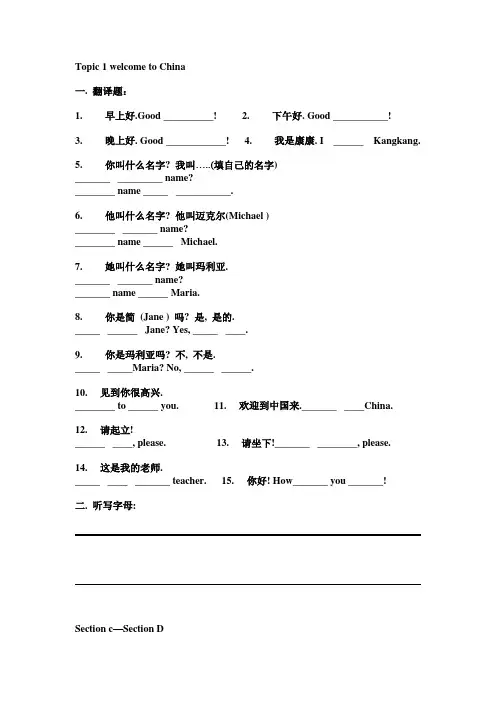
Topic 1 welcome to China一.翻译题:1. 早上好.Good __________!2. 下午好. Good ___________!3. 晚上好. Good ____________!4. 我是康康. I ______ Kangkang.5. 你叫什么名字?我叫…..(填自己的名字)_______ _________ name?________ name _____ ___________.6. 他叫什么名字?他叫迈克尔(Michael )________ _______ name?________ name ______ Michael.7. 她叫什么名字?她叫玛利亚._______ _______ name?_______ name ______ Maria.8. 你是简(Jane )吗?是,是的._____ ______ Jane? Yes, _____ ____.9. 你是玛利亚吗?不,不是._____ _____Maria? No, ______ ______.10. 见到你很高兴.________ to ______ you.11. 欢迎到中国来._______ ____China.12. 请起立!______ ____, please.13. 请坐下!_______ ________, please.14. 这是我的老师._____ ____ _______ teacher. 15. 你好! How_______ you _______!二.听写字母:__________________________________________________________________Section c—Section D一.翻译题:1. A:你好吗?B:不错,谢谢.你好吗?A:我也很好.How ______ you?B: Not ______, ________. How _____ you?A: _____ fine , _____.2. 明天见._____ _____ tomorrow.3. 再见._______.4. 王先生______ Wang5.李小姐________ Lee6. Ms Wu ____________7. 他是李明吗?不,他不是。
仁爱版七年级上册Unit 1 Topic 1 Welcome to China!Section
e.g. —Are they your rulers? —No, they aren’t. I am not Jenny. They are not / aren’t my friends. Her name (名字) is not / isn’t Linda.
用no或not完成下列句子或对话。 1) I am _n_o_t_ fine. 2) This is _n_o_t_ my dictionary. 3) There is _n_o__ ruler in my backpack. 4) —Is that your bike?
H_e_l_lo_/_H__i,
students!
_H__el_l_o__,
Miss Wang!
中国人与外国人打招呼的差异
“吃了吗”“去哪儿”是中国人习惯的 打招呼方式,而西方人就简单问声好,
一个“Hello”就好!
5. be动词am、is和are,它们都表示 “是”的意思,但三者之间也有区别。 e.g. I am Li Hui. 我是李辉。
Nice to meet you. =It’s nice to meet you. 回答: Nice to meet you, too. too, “也”, 只能用在肯定句中, 一般放在句尾, 并用 逗号隔开。
e.g. He is a boy, too.
学英语,讲礼貌,招呼用语来报到。 早上见面问声好,Good morning!不可少; 如果下午见了面,Good afternoon!最常见; 晚上礼节也必要,Good evening!晚上好。
1. Please imagine and list some objects which have the same shape with the English letters.
仁爱版英语七年级上册Unit1Topic1《WelcometoChina》(SectionA)说课稿

仁爱版英语七年级上册Unit 1 Topic 1《Welcome to China》(SectionA)说课稿一. 教材分析《仁爱版英语七年级上册Unit 1 Topic 1》的主要内容是《Welcome to China》。
这一部分主要介绍了中国的地理、历史、文化等方面的知识。
通过学习,学生可以了解中国的基本情况,提高对祖国的认同感。
教材通过丰富的图片、生动的语言和有趣的活动,使学生在轻松愉快的学习过程中掌握知识。
二. 学情分析面对七年级的学生,他们已经具备了一定的英语基础,但对于祖国的认识可能还不够全面。
因此,在教学过程中,需要关注学生的认知水平,引导学生从英语的角度去了解和认识中国。
同时,学生可能对英语学习存在一定的恐惧心理,因此在教学过程中,需要注重激发学生的学习兴趣,让他们在轻松愉快的氛围中学习。
三. 说教学目标1.知识目标:学生能够掌握中国在地理、历史、文化等方面的基本知识。
2.能力目标:学生能够用英语进行简单的交流,提高英语口语表达能力。
3.情感目标:学生能够增强对祖国的认同感,培养爱国情怀。
四. 说教学重难点1.重点:学生能够掌握中国在地理、历史、文化等方面的基本知识。
2.难点:学生能够用英语进行相关的交流和表达。
五. 说教学方法与手段1.教学方法:采用任务型教学法,让学生在完成任务的过程中学习知识,提高能力。
2.教学手段:利用多媒体课件、图片等辅助教学,激发学生的学习兴趣。
六. 说教学过程1.导入:通过展示中国的地图、图片等,引导学生关注中国的地理特点,激发学生的学习兴趣。
2.新课呈现:介绍中国的历史、文化等方面的知识,让学生在听、说、读、写的活动中掌握知识。
3.课堂活动:学生进行小组讨论,让学生用英语介绍中国的某个地方或文化,提高学生的口语表达能力。
4.巩固练习:通过完成相关任务,让学生运用所学知识进行实际操作,巩固所学内容。
5.课堂小结:对本节课的内容进行总结,强调重点知识。
仁爱版七年级上册Unit1Making new friends Topic1Welcome to
1.第一轮:A先-B后;第二轮: B先-A后;两轮为
一个回合。
2.肯定回答和否定回答各操练一个回合。
e.g.(例1):
e.g.(例2):
A: Are you…? A: Are you…?
B: Yes,I am.
B: No,I’m not. I’m…
=I am
While--listening
Look, listen and understand.
3. a_g_e / eɪ dʒ / 4. ba_k_e /beɪ k/ 5. _s_ay /seɪ /
6. _d_ay /deɪ / 7.___b_ee /bi: / 8.__f _ee /fi: /
Jane:_____D__________.
A.Hi B.Thanks C.No,I’m not D. Nice to meet you,too
Kangkang: Hi, Maria! Maria:____A_______,Kangkang! Kangkang:Welcome to China! Maria:_____B______-.
• 2.是的,我是.__Y_e__s_, _I_a__m__. _____
注意:am 在句末不能与主语I缩写。
• 3.不, 我不是._N__o_,_I_’_m___n_o_t_._____
• 4.很高兴见到你(初次见面)
_N__i_c_e__t_o_m___e_e_t_y_o__u.
• 5我也很高兴见到你。
T: Good morning .I am Miss. Yang. S: Good morning. I’m…. T: Welcome to … S: Thanks. S:
Tsak 2复习字母 Play a game!比一比,看谁快
仁爱版英语七年级上册Unit1Topic1《WelcometoChina》(SectionD)说课稿
仁爱版英语七年级上册Unit 1 Topic 1《Welcome to China》(SectionD)说课稿一. 教材分析《仁爱版英语七年级上册Unit 1 Topic 1》的主要内容是《Welcome to China》。
本节课的主要内容是介绍中国的地理、人口、历史和文化等基本情况。
通过本节课的学习,学生可以了解中国的基本情况,提高他们的英语听说读写能力,同时增强他们的爱国情感。
二. 学情分析七年级的学生已经掌握了一定的英语基础知识,但他们的英语听说读写能力还有一定的差距。
因此,在教学过程中,我们需要注重激发学生的学习兴趣,提高他们的英语听说读写能力,同时培养他们的合作意识和创新精神。
三. 说教学目标1.知识目标:学生能够掌握中国的基本情况,如地理、人口、历史和文化等。
2.能力目标:学生能够用英语介绍中国的基本情况,提高他们的英语听说读写能力。
3.情感目标:学生能够增强爱国情感,提高他们对祖国的认同感。
四. 说教学重难点1.重点:学生能够掌握中国的基本情况,如地理、人口、历史和文化等。
2.难点:学生能够用英语流利地介绍中国的基本情况,提高他们的英语听说读写能力。
五. 说教学方法与手段本节课采用任务型教学法,通过小组合作、讨论和展示等形式,激发学生的学习兴趣,提高他们的英语听说读写能力。
同时,利用多媒体教学手段,如图片、视频等,帮助学生更好地理解中国的基本情况。
六. 说教学过程1.导入:通过展示中国的美景、美食等图片,激发学生的学习兴趣,引出本节课的主题。
2.呈现:教师用英语介绍中国的基本情况,如地理、人口、历史和文化等,同时引导学生用英语进行表达。
3.操练:学生分组进行讨论,用英语介绍中国的基本情况,教师进行指导和纠正。
4.展示:各小组进行展示,其他学生进行评价和补充。
5.总结:教师对本节课的内容进行总结,强调重点和难点。
6.作业:学生回家后,用英语写一篇介绍中国的短文。
七. 说板书设计板书设计主要包括本节课的主题和中国基本情况的主要内容,如地理、人口、历史和文化等。
湘教版仁爱版初中英语七年级上册Unit 1Topic 1 Welcome to China!word教案
Topic 1 Welcome to China!Section ATeaching times : 2The main activities are 1a, 2a and 3a.Ⅰ.Teaching aims and demands1.(1)Learn the letters Aa-Gg.(2)Learn some useful words and expressions:good, morning, welcome, to, China, thank, you, hello, I, am, I’m, are, yes, no, not, nice, meet, too2. Talk about greetings and introductions:(1)—Good morning.—Good morning.(2)—Hi/Hello!—Hi/Hello!(3)—I’m … Are you …?—Yes, I am./No, I’m not. I’m …(4)—Nice to meet you.—Nice to meet you, too.(5)—Welcome to China!—Thanks./Thank you.Ⅱ. Teaching aids录音机/字母卡片/小黑板Ⅲ. Teaching PlanStep 1 IntroductionThis lesson is the very beginning, teachers, all students should note the following two points: 1. The importance of learning English. 2. The right way to learn English. Objective: To stimulate students interest in learning English to improve learning efficiency.Step 2 Presentation1—Hello! —Hi!(非正式)—Hello! —Hi!T: Please look at the picture and see how they are greeting. Then you can use your name to greet each other.S3: Hi, Zhang H ua!S4: H i, Chen Jun!S3: H ello, Zhou Jie!S5: H ello, Zhang Hua!(3) T: Good morning! Ss: Good morning!S5: Hi! S6. S6:Hi! S5. S7:Hello! S8. S8: Hello! S7. S9: Good morning!S10.2. T: Listen to the tape and follow. Pay attention to the pronunciation and intonation.Step 3 Consolidation1. T: Listen to the tape and repeat, pay attention to the pronunciation a nd intonation, please.Then practice the dialog with the tape.2. T: Practice a dialog according to 1a and 3a in pairs, then act it out.S1: G ood morning!S2: G ood morning!S1: I’m … Are you …?S2: Y es, I am.S1: N ice to meet you.S2: N ice to meet you, too.S1: W elcome to China!S2: T hanks./Thank you.Step 4 Practice1.T: Listen to me and read the letters after me. Learn Aa-Gg by heart.T: Now let’s learn how to write the letters.Aa Bb Cc Dd Ee Ff GgAa Bb Cc Dd Ee Ff GgStep 5 Project1. T: Can you imagine and list some objects which have the same shapes with English letters? For example:The legs of bench are like “A”, ears are like “B”, the moon is like “C” or “D”, etc.T: Group work. A group of seven students act as Aa-Gg, greeting each other.Example:S A: Hello! S B: Hello! S A: Are you Cc? S B: No, I’m not. I’m Bb. S A: Nice to meet you.S B: Nice to meet you, too.Welcome to China! Section A1.— Hi! 5.— Are you Maria?— Hi! — No, I’m not. I’m Jane.2.— Hello! 6.— Nice to meet you.— Hello! — Nice to meet you, too.3.— Good morning! 7.— Welcome to China.— Good morning! — Thanks./Thank you.4.— I’m Kangkang. Are you Michael?— Yes, I am.课后反思Section BTeaching times: 1The main activities are 1a, 2a and 3a.Ⅰ. Teaching aims and demands1. (1) Learn the letters Hh-Nn.(2) Learn some useful words and expressions:this, is, Mr.=mister, see, my, mom, teacher, how, do2. Talk about greetings and introductions:①Miss Wang, this is Michael. Micheal, this is Miss Wang.②—Nice to see you.—Nice to see you, too.③—How do you do?—How do you do?Ⅱ. Teaching aids字母卡片/录音机/多媒体课件/照片Ⅲ. Teaching PlanStep 1 Review1. T: Hi/Hello/Good mor ning!Ss: Hi/Hello/Good morning!2. T: Good morning, S1.S1: G ood morning.T: I’m Miss Wang. You can call me Miss Wang./This is Miss …(让学生三人一组做类似的操练。
仁爱版英语七年级上册Unit1Topic1《WelcometoChina》(SectionB)说课稿
仁爱版英语七年级上册Unit 1 Topic 1《Welcome to China》(SectionB)说课稿一. 教材分析《仁爱版英语七年级上册Unit 1 Topic 1》这一节课的主要内容是《Welcome to China》。
通过本节课的学习,学生将学习如何用英语介绍自己和询问他人的国籍、名字等基本信息。
教材通过丰富的图片和情境,引导学生进行实际的语言运用,培养他们的英语交际能力。
二. 学情分析面对七年级的学生,他们已经初步掌握了英语的一些基本语法和词汇,但对于如何运用英语进行实际交流还有一定的困难。
因此,在教学过程中,我需要关注每一个学生的学习情况,引导他们通过实践掌握英语交流的技巧。
三. 说教学目标本节课的教学目标是让学生能够用英语进行自我介绍,并询问他人的基本信息,如国籍、名字等。
同时,通过学习,使学生能够熟练运用本节课所学的词汇和句型,提高他们的英语交际能力。
四. 说教学重难点本节课的重难点是让学生能够正确地使用所学的词汇和句型进行实际的英语交流。
对于一些特殊疑问词如“Where are you from?”的运用,以及如何正确地回答这些问题,都需要学生在实践中去体会和掌握。
五. 说教学方法与手段在教学过程中,我将采用情境教学法,通过设定各种真实的场景,让学生在实际的语言环境中学习和使用英语。
同时,我还会运用任务型教学法,让学生在完成各种实际任务的过程中,提高他们的英语交际能力。
六. 说教学过程1.导入:通过展示一些中国的旅游景点和美食,引起学生的兴趣,然后用简单的英语进行自我介绍,引导学生进入学习状态。
2.新课呈现:通过展示教材中的图片,引导学生学习新词汇和句型,并用英语进行介绍。
3.实践环节:设定一个情境,让学生分组进行角色扮演,运用所学的词汇和句型进行实际的英语交流。
4.总结环节:让学生用自己的话总结本节课所学的知识和技能,检查他们的学习效果。
七. 说板书设计板书设计将包括本节课的课题《Welcome to China》,以及所学的关键词汇和句型,如“Hello, my name is…”,“Where are you from?”等,以便学生能够清晰地看到和记住本节课的重要内容。
仁爱版七年级英语上册Unit1Topic1WelcometoChina!C优质教案(1)
Topic1WelcometoChinaSectionCⅠ.Materialanalysis本节课通过四组图画和对话呈现教学,主要活动是1a和2a。
学生将在本课中进一步学习表示问候、道别、感谢的表达方式“Goodafternoon.”,“Howareyou?”及其答语“Fine,thanks.I’mOK.”此外,还将完成26个英文字母的学习。
本节课是一节读写课,教师在教学过程中,应该把重心放在对学生读写能力的培养上,加强学生语言运用能力的培养。
Ⅱ.Teachingaims1.Knowledgeaims能够正确朗读并运用下列词汇:afternoon,goodbye,fine,and,here能熟练读写字母Oo~Zz并认识到字母有印刷体和书写体,大写和小写之分;能用英语表达有关问候和告别:Howareyou?Fine,thanks.Andyou?I’mOK.Goodbye.Hereyouare.Thankyou.⒉Skillaims能听懂有关问候、道别、感谢等的表达方式;能运用表示问候、道别、感谢等的表达方式进行简单的交流;能在教师的指导下进行简单的角色表演;能正确地朗读对话,并能注意语音语调;能大声、准确地演唱英文字母歌;能正确书写和使用大小写字母。
⒊Emotionalaims能够与同学积极合作,参与课堂活动,大胆实践;能够认真、规范书写字母和单词;能体会到学习英语的兴趣,培养学生良好的学习习惯。
Ⅲ.Thekeypointsanddifficultpoints1.Keypoints正确使用表示问候、道别、感谢等的表达方式;正确书写字母Oo~Zz和辨音。
2.DifficultpointsBe动词am,is,are的应用;大小写字母的转化;含有相同音节的字母归类。
Ⅳ.Learningstrategies唱英语歌曲是学习英语的一种好方法。
Ⅴ.Teachingaids录音机、多媒体、黑板和闪卡。
Ⅵ.TeachingproceduresSte p InteractionpatternsStudentactivityTeacheractivityIntrodu ction (8minutes) 1.Thewholeclasswork.2.Thewholeclasswork.3.Individualwork.4.Thewholeclasswork.1.Studentsreplytotheteacher“Hi!Goodmorning!”2.Responsetheteacher’squestionsonebyone.T:Howdoyoudo?S:Howdoyoudo!T:Welcometo…!S:Thanks.T:Nicetomeetyou.S:Nicetomeetyou,too.3.Readthelett1.GreetswithstudentsusingtheExpressions“Hello!Goodmorning!”2.PointoutsomeflashcardsusingthekeysentencesinSectionsA&Bandmakeconversationswithstudents.3.Playagame.Theteachershowsalworkandp airwork. tfollowsthete acherandaskstheteacher“Ho wareyou?”;Th estudentanswers:“I’mOK.”2.Do1a.Studentsfirstlookatthepicturesan dguesswhatthepicturesareabout,andthendi scussthemeaningsofthepicturesinpairs;Fourpairssharetheirideasaboutthepictureanswercorrectlythecardandsay:“Hereyouare.”Walktoonestudentandsay:“Hello!Howareyou?”Helpthestudentresponse,“Fine,thanks.Andyou?”andcontinuetosay“I’mOK.”Showtheflashcardwith“Howareyou?”onitandletstudentsfollowittwice;Walktoonestudentandlethim/hertoaskthePractice (10minu tes) 1.Thewholeclasswork.2.Individualwork.3.Individualwork.4.Thewholeclasswork.1.Do2a.Listentotheteachercarefully,observetheteacher’smouthandimitatethepronunciation;Trytowritedowntheletterswithcorrectstrokeorderwithbookclosed;Thenopenthebooksandself-checktheirownspellings.Followtheteachertotracethelettersintheairwiththeirhandsandread.2.Do2b.Readth1.ShowthelettercardsfromOotoZzonebyoneandreadthemwithrisingandfallingtones;Askstudentstowritethemdownwithcorrectstrokeorder;Walkaroundtheclassroomandcheck;Thenwritedownthelettersonebyonewithcorrectstrokeorderwhilereadingthemaloud.2.LetstudentⅦ.Blackboarddesign。
仁爱版七年级英语上册:Unit 1 Topic 1. Welcome to China! 课件(共33张PPT)
go to the big letter. If you see the small er, but
yours is the big, please go to the small letter, and say:
We are “ b, B”.
We arwe “b, B”.
For example:
This is my dad.
Mr. +姓
Miss +姓
Mrs.+姓 Ms. +姓
英语国家常把男士称Mr., 女士称为 Miss(未婚)或Mrs.(已婚)。如果在不明女 士是否已婚的情况下, 可用Ms.(这是英国 女权运动的产物)。
需要注意的是: Mr.或Ms.通常与姓名或 姓连用, 而不能单独与名连用; Miss可单独 用来称呼女性;Mrs.只能与夫姓或自己的姓 加夫姓连用。
Miss Wang. B: __N_i_c_e_t_o_m__e_e_t_y_o_u_,
Miss Wang. A: Nice to meet you, too.
Listen again and fill in the blanks.
A: Jane, this is my dad. Dad, __th__is_i_s__Jane.
Complete the conversation and then practice with your partner.
•Mr. Brown: Hi , Miss Wang! _N_i_c_e_to__se_e__yo_u_._ •Miss Wang: ___H_i _ , Mr. Brown! Nice to see
Thanks.
Practice. Hello!