
仁爱版英语八年级下册Unit6__Topic2__SectionA__教案
仁爱版英语8年级下册
Unit6 Topic2 SectionA 参考教案
Ⅰ. Material analysis
本节课为该话题的第一节课,建议用1-2课时上完。
主要活动为Section A 的1a 和3。
本话题以游览天安门广场为话题展开故事情节,先是邀请,接着是游览,从而对天安门广场进行描述,并引出方向及方位词。
通过谈论天安门各个建筑物的位置关系来练习方向和方位介词。
本话题还以日记形式叙述了旅行的感受,培养学生热爱旅游、积极探索、热爱祖国的态度。
while, when, before, after, as, until 和as soon as引导的时间状语从句是本话题的语法重点。
在Section A 的1a,Michael 邀请Darren来北京度假,并请求Kangkang帮助制定北京的游览计划,谈论考查,学习时间状语从句,并在3中设置了造句练习来巩固时间状语从句的用法。
Ⅱ. Teaching aims
Knowledge aims:
1. 学生能正确拼读并运用黑体单词。
2. 学生能自如地运用以下句式进行交流:
I’d like to speak to Michael.
Glad to receive your postcard.
Would you like to come to China for your vacation?
I’m looking forward to meeting him.
That would be very interesting.
3. 学生能简单地掌握时间状语从句的用法。
Skill aims:
1. 能听懂有关度假和旅游的短文或对话,并从中获取信息。
2. 能使用英语与他人谈论关于旅游的话题。
3. 能理解有关旅游等方面的叙述,并从中获取需要的信息。
4. 能用英语制订旅游计划。
Emotional aims:
1. 具有积极参与课堂上各种英语实践活动的兴趣。
2. 培养学生热爱旅游、积极探索、热爱祖国的态度。
Ⅲ. The key points and difficult points
Key points:
1. 谈论度假和旅游的话题。
2. 初步掌握时间状语从句的用法。
Difficult points:
掌握when 和while 引导的时间状语从句的用法。
Ⅳ. Learning strategies
善于创设情景,在情景中提高语言交际能力,突显语言交际功能。
Ⅴ. Teaching aids
Computer multimedia projector, the flash of the song, I love Tian’anmen Square of Beijing, a postcard.
Ⅵ. Teaching procedures
Ⅶ. Blackboard design。
仁爱版八年级英语下册课件 Unit 6 Topic 2 Section A

Have a match
1.Would you help me make a plan to explore Beijing before he comes?
2. Would you like to come to China for your vacation?
3. How about exploring Tian’anmen Square?
Tonight I am busy with the homework. prapare sth. for sb. 为某人准备某物 prapare for sth.=get ready for sth.为某事做准备 prepare to do sth.=get ready to do sth.准备做某事
Lead in
What are they doing? They are talking on the phone. What are they talking about?
Learning 1a Listen, look and say.
Darren: Hello! This is Darren. I'd like to speak to Michael.
4√
5√
visit the Great Wall
meet their friend
v. to get or accept sth. from sb. 收到
receive a postcard
Learning
1c
Read 1a and number the following sentences. Then try to retell it.
Language points
5. Would you help me make a plan to explore Beijing before he comes? 在他来之前,你能帮我制定一个考察北京的计划吗? 这是一个由连词before引导的时间状语从句。 before“在……之前”,根据具体语境还可意为 “还没来得及/ 还没有……就……;……才……”等。 after“在……之后”表示主句动作发生在从句动作之后。 e.g.昨天我们离开学校的时候,我们打扫了教室。
仁爱版八年级英语下册全册教案
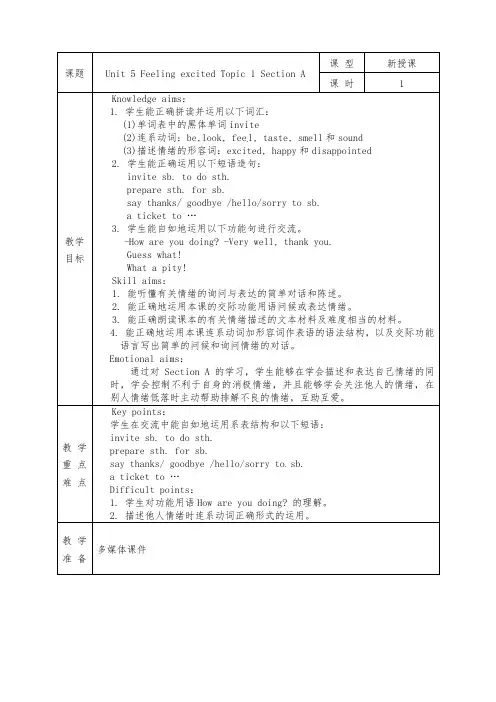
课题Unit 5 Feeling excited Topic 1 Section A 课型新授课课时 1教学目标Knowledge aims:1. 学生能正确拼读并运用以下词汇:(1)单词表中的黑体单词invite(2)连系动词:be,look, fee l, taste, smell和sound(3)描述情绪的形容词:excited, happy和disappointed2. 学生能正确运用以下短语造句:invite sb. to do sth.prepare sth. for sb.say thanks/ goodbye /hello/sorry to sb.a ticket to …3. 学生能自如地运用以下功能句进行交流。
-How are you doing? -Very well, thank you.Guess what!What a pity!Skill aims:1. 能听懂有关情绪的询问与表达的简单对话和陈述。
2. 能正确地运用本课的交际功能用语问候或表达情绪。
3. 能正确朗读课本的有关情绪描述的文本材料及难度相当的材料。
4. 能正确地运用本课连系动词加形容词作表语的语法结构,以及交际功能语言写出简单的问候和询问情绪的对话。
Emotional aims:通过对Section A的学习,学生能够在学会描述和表达自己情绪的同时,学会控制不利于自身的消极情绪,并且能够学会关注他人的情绪,在别人情绪低落时主动帮助排解不良的情绪,互助互爱。
教学重点难点Key points:学生在交流中能自如地运用系表结构和以下短语:invite sb. to do sth.prepare sth. for sb.say thanks/ goodbye /hello/sorry to sb.a ticket to …Difficult points:1. 学生对功能用语How are you doing? 的理解。
初中仁爱英语优秀教学设计5篇
初中仁爱英语优秀教学设计5篇《仁爱版英语》是由北京市仁爱教育研究所于2002年3月依据《英语课程标准》在教育部成功立项、依据《英语课程标准》编写、于2003年9月第一次送教育部审查就获得通过的英语教材。
下面是小编为大家整理的初中仁爱英语优秀教学设计5篇,希望大家能有所收获!初中仁爱英语优秀教学设计1教材分析1.本节内容就是为了进一步巩固主句为一般过去时的宾语从句,是对上一节课的巩固,并为以后的学习做了铺垫。
这节课学的知识是本册书的重点之一。
学情分析1,通过练习发现学生宾语从句并不是很懂,做起题来很蹩脚。
2,由于宾语从句是新学的语法项目,学生在日常学习中也接触,但由于在语文中并不涉及,这为英语中宾语从句的学习设置了障碍。
所以学生学起来有一定的难度。
教学目标知识与能力目标:1,学习新单词和主句为一般过去时的宾语从句;2,继续谈论时装表演,了解各民族服装;3,通过本课学习,使学生对中国服装文化能有更深刻的了解。
过程与方法:让学生在反复练习的基础上,能够很自然的掌握宾语从句。
情感态度和价值观:通过対本课的学习,让学生了解民族服装文化,加强对民族服装文化的了解,增进民族感情。
教学重点和难点主句为一般过去时的宾语从句教学过程(本文来自优秀教育资源网斐.斐.课.件.园)Step 1. Review the object clauses of which the main clauses are in the pastsimple tense..Step 2. Lead in the new lesson and learn new words.Step 3.Presention:1.Listen to the tape and pay attention to the pronunciation. Read 1a indifferent ways to learn it2. Let the students answer some questi___. And then fill in blanksaccording to 1a.Step 4. PracticeLead into Part 2and practice the object clauses of which the main clausesare in the past simple tense.Step 5.C___olidation :Step 6.Homework:教学环节一,复习二,导入三,呈现四,练习五,巩固六,作业复习宾语从句,然后利用宾语从句引入新课,并展示图片,学习生词,进而学习少数民族服装,处理第三部分。
仁爱英语八下教案

仁爱英语八下教案【篇一:仁爱英语八下unit7教案】topic 2section asection a 需用1课时。
重点活动是1a 和2。
教学目标:1. 知道几种中餐的做法。
2. 学习表示顺序的副词。
3. 学习表示行为的副词。
教学过程:第一步:复习1.头脑风暴:让学生说出表示中餐的单词并让他们记在笔记本上。
2.以小组为单位谈论:do you like cooking? why? what do you like to cook?例如:a: do you like cooking?b: yes, i do.a: why do you like it?b: because cooking is fun.a: what do you like to cook?b: i like to cook noodles.第二步:呈现1.阅读1a。
找出新单词,猜它们的意思并回答问题:what’s kangkang doing?然后老师给出新单词的意思和问题的答案。
注意表示行为举止的副词的构成。
notes: careful+ly→carefullylight+ly→lightlyfine+ly→finelyslow+ly→slowly2. 让学生跟读录音带,并划出表示顺序的副词。
3. 老师把表示顺序的副词写在黑板上,要求学生用这些关键单词练对话。
first...next...then...after that...第三步:巩固1. 学生独立完成1b。
按照1a对话的顺序将图片排序。
2. 学生做1c之后,老师让学生总结表示顺序的副词和表示行为的副词的用法。
3. 老师表演,让学生运用副词来描述。
例如:the teacher moves the desk lightly.然后,要求学生两人一组照样子做。
第四步:练习1.完成2:用所给词的正确形式完成说明,然后排列图的顺序。
2.老师让一位学生起立,走到黑板前面,然后再回到座位上。
仁爱版英语八年级下册_Unit_6_Topic_2_Section_C__阅读
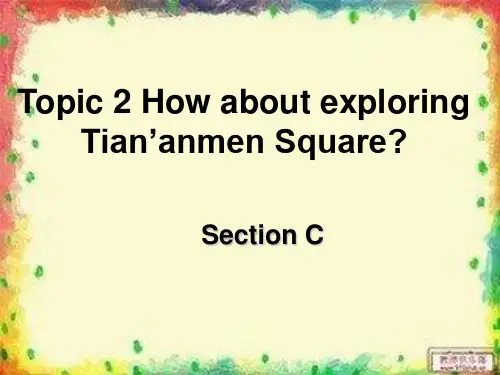
Henan is in the center ____ of China.
Anhui is in the ______of China. east on It’s _____the _________of southeast Henan. northwest on Henan is _____the _________of Anhui.
(3) until 和not … until…的用法比较: not … before… I won’t leave here after until the rain stopped. I will stay here until the rain stopped. not…..until:“直到….才…..” (否定句,主句的谓语动词常用终结性动词。) until/till:“直到….为止” (肯定句,主句的谓语动词常用延续性动词。) 我会等到雨停了才离开这里。
从句动词
when while 延续性动词或短暂性 动词 延续性动词 延续性动词
意义
主从句动作同时发生,或从 句动作发生在主句动作前后 同时发生,强调对比 同时发生,强调伴随状态, “一边…一边…”“随着…”
as
主从句动作同时发生,且从句动作为延续性动词时,when, while,as 可以互换使用。
1. The children got to Tian’anmen Square after an hour’s ride. =one hour by bike (F) 2. The parking lot was too crowded to park their bikes. (F ) park v.停放 3. Someone stepped on Michael’s feet. (F) 4. Darren was lost but, at last, Kangkang and Michael found him. (T )
仁爱版英语八年级下册 Unit 6 Topic 2 Section A 单词 词组 句子 基础检测(英汉互译)
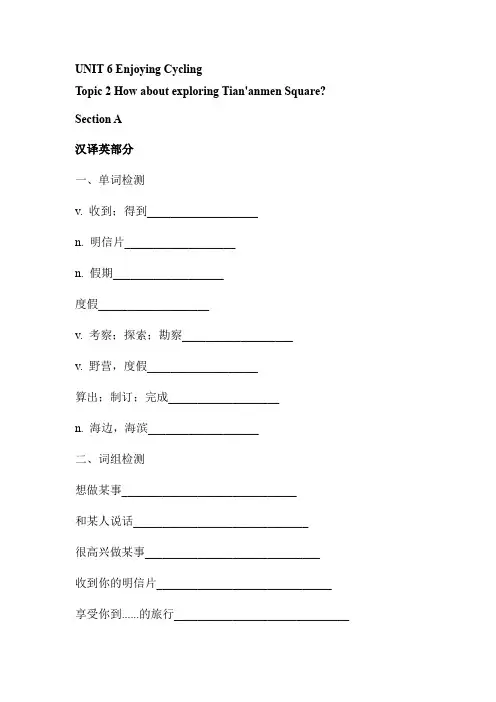
UNIT 6 Enjoying CyclingTopic 2 How about exploring Tian'anmen Square? Section A汉译英部分一、单词检测v. 收到;得到___________________n. 明信片___________________n. 假期___________________度假___________________v. 考察;探索;勘察___________________v. 野营,度假___________________算出;制订;完成___________________n. 海边,海滨___________________二、词组检测想做某事______________________________和某人说话______________________________很高兴做某事______________________________收到你的明信片______________________________享受你到......的旅行______________________________忙着做某事______________________________为某事做准备______________________________在度假______________________________来中国______________________________四分钟后______________________________在康康那里______________________________来拜访某人______________________________拜访某人______________________________和我一起见他______________________________期待做某事______________________________帮助某人做某事______________________________制定一个计划______________________________探索北京______________________________当然______________________________ ......怎么样______________________________很有趣______________________________制定一个探索计划______________________________享受他的旅行______________________________参观长城______________________________见见他们的朋友______________________________收到一张明信片______________________________邀请某人做某事______________________________访问中国______________________________为了某人的拜访______________________________来自某人______________________________见某人______________________________计划一次旅行______________________________跟某人一起来______________________________把某人带到那里______________________________好吧______________________________害怕......______________________________没有时间______________________________很想......______________________________对......感到抱歉______________________________上课______________________________爬一座山______________________________进来______________________________敲______________________________完美的假期活动______________________________计算出______________________________学会做某事______________________________在海里游泳______________________________更多地了解某事______________________________去海边______________________________决定做某事______________________________在森林里露营______________________________三、句子检测1. 你好!我是达伦。
高效课堂策略初中英语预习性作业设计
校园英语 /高效课堂策略初中英语预习性作业设计福建省泉州三中/庄毓娥一、引言有效教学是教师利用教学过程的规律,成功引起、维持和促进学生的学习兴趣,相对有效地达到了预期教学效果的教学。
它既是有效果的(学生的学习有了进步和发展),又是有效益的(实现了预期目标),更是有效率的(在规定的时间内达到尽可能多的教学产出)。
实施教育改革新政策以来,英语课容量很大,教师必须在有限的学时内达到教育教学目标。
为了使教学更有针对性,减少学生在学新课时因某些方面知识的欠缺所造成的障碍,要求学生先于英语教学进行合理的预习。
学生通过自学可以掌握的知识,可以解决的问题全部放给学生,教师加以精心的组织指导,充分体现学生是学习主体的原则。
有效预习对学好英语、培养学生自主学习能力尤为重要。
为此,教师的责任就是将最好的、最有效果的学习方法传授给学生,使学生在预习的习惯中,逐渐形成一种自学能力,高效完成教学任务。
二、教学现状在日常教学过程中,经常会看到学生作业记录本或者黑板布置作业的角落上某个学科的预习作业就只写着:预习第几页或者预习某一课。
教师布置预习作业表达随意、笼统,初中阶段的学生得不到明确、具体的预习要求,也就对预习抱以应付的态度,有的干脆不预习。
众所周知,预习是学习过程的一个重要环节,是学生对课堂学习的准备,有效预习则是高效课堂的基础和必然要求。
要达到英语新课程改革教学要求,教师必须不遗余力地探索有效教学的方法,制定高效课堂策略。
基于前述状况,为提高课堂教学效率,引导学生主动学习,我将教材中的单词、课文与操练任务以及配套练习等环节安排为新课之前的预习作业,并给予明确的目标任务。
三、预习要求和作业设计词汇预习。
我采用“集中识词”,分为四个步骤:1.学期结束时,将新学期所要学习的全部单词作为假期作业布置下去,开学时,大部分学生因为已经按照要求模仿录音而基本会拼读本册所有词汇;2.学每一单元之前,学生再预习一遍词汇,做到读音准确,词义明确,对四会词还要求拼写正确;3.教师在完成每节课预定教学任务之后的最后几分钟,引导学生再次预习下一课的单词,以加深和巩固记忆。
仁爱版英语八下Unit6__Topic2__SectionA__参考教案
Unit6 Topic2 SectionA 参考教案Ⅰ. Material analysis本节课为该话题的第一节课,建议用1-2课时上完。
主要活动为Section A 的1a 和3。
本话题以游览天安门广场为话题展开故事情节,先是邀请,接着是游览,从而对天安门广场进行描述,并引出方向及方位词。
通过谈论天安门各个建筑物的位置关系来练习方向和方位介词。
本话题还以日记形式叙述了旅行的感受,培养学生热爱旅游、积极探索、热爱祖国的态度。
while, when, before, after, as, until 和as soon as引导的时间状语从句是本话题的语法重点。
在Section A 的1a,Michael 邀请Darren来北京度假,并请求Kangkang帮助制定北京的游览计划,谈论考查,学习时间状语从句,并在3中设置了造句练习来巩固时间状语从句的用法。
Ⅱ. Teaching aimsKnowledge aims:1. 学生能正确拼读并运用黑体单词。
2. 学生能自如地运用以下句式进行交流:I’d like to speak to Michael.Glad to receive your postcard.Would you like to come to China for your vacation?I’m looking forward to meeting him.That would be very interesting.3. 学生能简单地掌握时间状语从句的用法。
Skill aims:1. 能听懂有关度假和旅游的短文或对话,并从中获取信息。
2. 能使用英语与他人谈论关于旅游的话题。
3. 能理解有关旅游等方面的叙述,并从中获取需要的信息。
4. 能用英语制订旅游计划。
Emotional aims:1. 具有积极参与课堂上各种英语实践活动的兴趣。
2. 培养学生热爱旅游、积极探索、热爱祖国的态度。
北京仁爱版初中英语八年级下册 Unit6 Topic2 课文填词(含课文原文)
仁爱英语八年级下册课文填词Unit6 Topic2 How about exploring Tian’anmen Square?SectionA-1aDarren:Hello! This is Darren. I'd like to to Michael.Michael:This is Michael (speak). Oh, Darren! How are you?Darren:Fine. Glad to receive your [ˈpəʊstkɑːd] . While you were (enjoy) your trip to Mount Tai, I was busy (prepare) for my (exam). But now I'm vacation.Michael:Would you like to come to China for your[veɪˈkeɪʃn]?Darren:Great idea! See you.(Forty minutes (late), at( Kangkang))Michael:Hey, Kangkang. Darren, my friend San Francisco, is (come) to visit me. I'd like you to meet him me when he (arrive).Kangkang:Great! I'm (look) [ˈfɔːwəd] to (meet) him.Michael:Would you help me make a plan to explore Beijing he comes? Kangkang:Yes, of course. How exploring Tian'anmen Square?Michael:That would be very [ˈɪntrəstɪŋ] .SectionB-1aDarren:Hello, Kangkang. Could you tell me (thing) about Tian'anmen Square? Kangkang:Sure. It is in the center Beijing City. It's largest city square in the world. It (cover)440 000 square meters. It's 880(meter) long from northto and 500 meters w from[iːst] to west. It can hold one [ˈmɪljən] people.Darren:That's (amaze)! Are there any great (building)?Kangkang:(c ertain). We can see the Mounment to the People's (h ero) in the center of the square. In the[nɔːθ] of the[skweə(r)] , we can see Tian'anmen Rostrum. There Chairman Mao Zedong(announce) the(found) of the People's Republic of China1949.Darren:The square must (be) quite (meaning) to all (China) people.Kangkang:Yes, there are many(story) about it. And we can see some[ˈʌðə(r)] great buildings there.Darren:Wow, I (can) wait see it. By the way, how far is it here to Tian'anmen Square?Kangkang:It's about one and a half (hour) by bike.SectionC-1aAfter they(ride) their bicycles for one and a half hours, Kangkang, Michael and(fill)(they) bicycles.After(park) their bicycles, they walked to Tian'anmen Square.Darren and Michael were(surprise) at Tian'anmen Square.They took out a camera and(take ) many(picture).As they were(explore) happily, more more peoplecame to square.W the crowd was pushing Darren in all (direction), someone stepped on his (foot)."Ouch! Don't[pʊʃ] !" he shouted.When Darren(final) pushed his way, he(could) find his friends.He was too(worry) to think what to do.His heart was (beat)fast.Slowly he walked to the near side the square and (sit) on a step beside a tree(sad).He raise his head until someone (call) him.It was Kangkang."Oh, Darren! There you are! It's great to find you!"As soon the three boys saw each other, they all jumped around (happy).Unit6 Topic2 How about exploring Tian’anmen Square?(课文原文)SectionA-1aDarren:Hello! This is Darren. I'd like to speak to Michael.Michael:This is Michael speaking. Oh, Darren! How are you?Darren:Fine. Glad to receive your postcard. While you were enjoying your trip to Mount Tai, I was busy preparing for my exams. But now I'm on vacation.Michael:Would you like to come to China for your vacation?Darren:Great idea! See you.(Forty minutes later, at Kangkang's)Michael:Hey, Kangkang. Darren, my friend from San Francisco, is coming to visit me. I'd like you to meet him with me when he arrives.Kangkang:Great! I'm looking forward to meeting him.Michael:Would you help me make a plan to explore Beijing before he comes? Kangkang:Yes, of course. How aout exploring Tian'anmen Square?Michael:That would be very interesting.SectionB-1aDarren:Hello, Kangkang. Could you tell me something about Tian'anmen Square? Kangkang:Sure. It is in the center of Beijing City. It's the largest city square in the world. It covers 440 000 square meters. It's 880 meters long from north to south and 500 meters wide from east to west. It can hold one million people.Darren:That's amazing! Are there any great buildings?Kangkang:Certainly. We can see the Mounment to the People's Heroes in the center of the square. In the north of the square, we can see Tian'anmen Rostrum. There Chairman Mao Zedong announced the founding of the People's Republic of China in 1949.Darren:The square must be quite meaningful to all Chinese people.Kangkang:Yes, there are many stories about it. And we can see some other great buildings there.Darren:Wow, I can't wait to see it. By the way, how far is it from here to Tian'anmen Square?Kangkang:It's about one and a half hours by bike.SectionC-1aAfter they rode their bicycles for one and a half hours, Kangkang, Michael and Darren arrived at a parking lot near Tian'anmen Square.The parking lot was full of tour buses, cars and bicycles, so they had to look for space to park their bicycles.After parking their bicycles, they walked to Tian'anmen Square.Darren and Michael were surprised at Tian'anmen Square.They took out a camera and took many pictures.As they were exploring happily, more and more people came to the square.While the crowd was pushing Darren in all directions, someone stepped on his feet."Ouch! Don't push!" he shouted.When Darren finally pushed his way out, he couldn't find his friends.He was too worried to think about what to do.His heart was beating fast.Slowly he walked to the near side of the square and sat on a step beside a tree sadly.He didn't raise his head until someone called him.It was Kangkang."Oh, Darren! There you are! It's great to findyou!"As soon as the three boys saw each other, they all jumped around happily.。
仁爱版八年级英语下册Unit7Topic2SectionA教学设计
3.树立正确的人生观和价值观,明白付出与回报的关系,懂得珍惜和感恩;
4.增强环保意识,关注社会问题,积极参与社会公益活动;
5.提高自信心和自尊心,勇于表达自己的观点和看法,尊重他人的不同意见。
一个全面的志愿者活动介绍。”
2.引导学生关注社会问题,培养他们的同理心和关爱他人的意识;
3.鼓励学生积极参与志愿者活动,将所学知识运用到实际生活中,体验助人为乐的喜悦;
4.培养学生的团队合作精神,让他们在志愿者活动中学会相互尊重、相互帮助;
5.培养学生热爱英语,树立终身学习的观念,为他们的未来发展奠定基础。
三、教学重难点和教学设想
(一)教学重难点
1.新词汇和短语的掌握:本节课涉及多个新词汇和短语,学生需要在实际语境中运用,以达到熟练掌握的程度。
Example:
I志愿者at the local hospital every Saturday. I help the nurses give medicine to the patients and talk to them to make them feel better. I want to be a volunteer because I want to help others and learn more about medical knowledge.
2.学生分享自己在本节课的收获,包括新词汇、句型、语法等方面。
3.教师强调参与志愿者活动的重要性,鼓励学生在日常生活中积极投身于志愿者事业,为社会贡献力量。
4.布置课后作业,要求学生运用所学知识,描述自己参加过的或想参加的志愿者活动,巩固课堂所学。
五、作业布置
1.请学生运用本节课所学的词汇和句型,写一篇关于自己理想中的志愿者活动的短文,不少于80词。要求描述清楚活动的性质、目的以及自己为何想参与其中,以此来巩固学生对一般现在时态的掌握,并激发他们参与社会实践的热情。