
Module9 Unit2 Did you have a nice holiday课件完美版
Homework
• 1. Read the text .
风,没有衣裳;时间,没有居所;它们是拥有全世界的两个穷人生活不只眼前的苟且,还有诗和远方的田野。你赤手空拳来到人世间,为了心中的那片海不顾一切。 运动太多和太少,同样的损伤体力;饮食过多与过少,同样的损伤健康;唯有适度可以产生、增进、保持体力和健康。 秋水无痕聆听落叶的情愫红尘往事呢喃起涟
Look at these photos.
Did you go to Hong Kong last year?
Yes , I did.
No , I didn’t.I went to…
Did you visit the Great Wall last year?
No, I did’nt. I went to Hangzhou.
以。既然已成既然,何必再说何必。想念是人最无奈的时候唯一能做的事情。你受的苦,会照亮你the famous West Lake ?
Yes , I did.
Did you see your friend Lili in Hangzhou?
• No, she was on holiday in Shanghai.
Did you travel by train?
Module 9
Unit2 Did you have a nice
holiday?
Did you have a nice holiday?
Yes, we did. We went to the earth.
Did you like the people? Yes, I did. They were very nice. But they weren’t very beautiful!
漪无数心口无语奢望灿烂的孤独明月黄昏遍遍不再少年路岁月极美,在于它必然的流逝。
春花、秋月、夏日、冬雪。 你必汗流满面才得糊口,直到你归了土;因为你是从土而出的。你本是尘土,仍要归于尘土。 我始终相信,开始在内心生活得更严肃 的人,也会在外表上开始生活得更朴素。在一个奢华浪费的年代,我希望能向世界表明,人类真正需要的的东西是非常之微少的。世界上的事情,最忌讳的就是个 十全十美,你看那天上的月亮,一旦圆满了,马上就要亏厌;树上的果子,一旦熟透了,马上就要坠落。凡事总要稍留欠缺,才能持恒。 只有经历过地狱般的磨砺, 才能练就创造天堂的力量;只有流过血的手指,才能弹出世间的绝响。时光只顾催人老,不解多情,长恨离亭,滴泪春衫酒易醒。梧桐昨夜西风急,淡月朦胧,好 梦频惊,何处高楼雁一声? 如果你长时间盯着深渊,深渊也会盯着你。 所有的结局都已写好 所有的泪水也都已启程 却忽然忘了是怎么样的一个开始 在那个古老 的不再回来的夏日 无论我如何地去追索 年轻的你只如云影掠过 而你微笑的面容极浅极淡 逐渐隐没在日落后的群岚 遂翻开那发黄的扉页 命运将它装订得极为拙劣 含着泪 我一读再读 却不得不承认青春是一本太仓促的书 记忆是无花的蔷薇,永远不会败落。 我也要求你读书用功,不是因为我要你跟别人比成就,而是因为,我
希望你将来会拥有选择的权利,选择有意义,有时间的工作,而不是被迫谋生。 尽管心很累 很疲倦 我却没有理由后退 或滞留在过去与未来之间
三千年读史,不外功名利禄;九万里悟道,终归诗酒田园。 这是一个最好的时代,这是一个最坏的时代这是一个智慧的年代,这是一个愚蠢的年代;这是一个光明 的季节,这是一个黑暗的季节;这是希望之春,这是失望之冬;人们面前应有尽有,人们面前一无所有;人们正踏上天堂之路,人们正走向地狱之门。 我有所感事, 结在深深肠。 你一定要“离开”才能开展你自己。所谓父母,就是那不断对着背影既欣喜又悲伤,想追回拥抱又不敢声张的人。 心之所向 素履以往 生如逆旅 一 个人的行走范围,就是他的世界。因为爱过,所以慈悲;因为懂得,所以宽容。 刻意去找的东西,往往是找不到的。天下万物的来和去,都有他的时间。 与善人 居,如入芝兰之室,久而自芳也;与恶人居,如入鲍鱼之肆,久而自臭也。 曾经沧海难为水,除却巫山不是云。 回首向来萧瑟处,归去,也无风雨也无晴。 半生 闯荡,带来家业丰厚,儿孙满堂,行走一生的脚步,起点,终点,归根到底,都是家所在的地方,这是中国人秉持千年的信仰,朴素,但有力量。风吹不倒有根的 树我能承受多少磨难,就可以问老天要多少人生。心,若没有栖息的地方,到哪里都是流浪...如果有来生,要做一只鸟,飞越永恒,没有迷途的苦恼。东方有火红 的希望,南方有温暖的巢床,向西逐退残阳,向北唤醒芬芳。如果有来生,希望每次相遇,都能化为永恒。不乱于心,不困于情。不畏将来,不念过往。如此,安 好。 笑,全世界便与你同声笑,哭,你便独自哭。 一辈子,不说后悔,不诉离伤。上帝作证,我是真的想忘记,但上帝也知道,我是真的忘不了 如果其中一半是 百分百的话那就不是选择了而是正确答案了,一半一半,选哪一半都很困难,所以这才是选择。跟着你,在哪里,做什么,都好。眠。我倾尽一生,囚你无期。择 一人深爱,等一人终老。痴一人情深,留一世繁华。断一根琴弦,歌一曲离别。我背弃一切,共度朝夕。 人总是在接近幸福时倍感幸福,在幸福进行时却患得患失。 路过的已经路过,留下的且当珍惜 我相信,真正在乎我的人是不会被别人抢走的,无论是友情,还是爱情。我还是相信,星星会说话,石头会开花,穿过夏天的木 栅栏和冬天的风雪之后,你终会抵达! 每一个不曾起舞的日子,都是对生命的辜负。 每个清晨都像一记响亮的耳光,提醒我,若不学会遗忘,就背负绝望。 那一 年夏天的雨,像天上的星星一样多,给我美丽的晴空,我们都有小小的伤口,把年轻的爱缝缝又补补,我会一直站在你左右,陪你到最后的最后。 如果一开始就知道是这样 的结局,我不知道自己是不是会那样的奋不顾身。 黄昏是一天最美丽的时刻,愿每一颗流浪的心,在一盏灯光下,得到永远的归宿。 因为有了因为,所以有了所
Module-9-Unit-2--Did-you-have-a-nice-holiday学案

Module 9 Unit 2 Did you have a nice holiday?学案班级姓名小组等级一、自主学习1.自学指导:1.听单词录音,跟读单词。
第一次跟读一遍,第二次跟读三遍。
2.小组内自学单词。
可以小组长领读,实行兵教兵,不会读的单词划出来,重点突破。
3.各组提交不会读的单词,先找学生回答,学生不会的老师帮助。
2.自学检测:利用单词卡片,小组内单个成员起来念单词;学生根据PPT的图片,口头说出本节课学习的新单词。
3.自学指导:1.教师给学生播放课文录音,整体感知课文。
学生勾画出不理解的单词和句子。
再听课文,学生跟读课文。
小组内谈论并判断正(T)误(F):1.We went to the earth. ( )2.Xiaoyong went to Shanghai. ( )3.He visited the famous West Lake. ( )4.Xiaoyong saw his friend Lili ( )5.Lili was on holiday in Shanghai. ( )4.自学检测: 学生讨论后回答以上问题。
二、合作探究:1.小组内自学课文,解决不理解的单词和句子,弄清课文汉语意思。
2.小组内合作,根据下列例子,讨论出怎样用英语来表示使用什么交通方式。
Did you travel by train? ? I come here by plane?我发现:我猜想:乘小汽车乘公交车乘自行车乘船乘出租车 taxi 乘地铁步行四.自我反思:一节课的学习,你收获了什么?请你总结在下面。
Module9 Unit 2 Did you have a nice holiday?(教学设计)外

Module 9 Unit 2 Did you have a nice holiday?(教学设计)教学目标1.学生能够口头表达过去的假期活动2.学生能够听懂关于别人假期的问题并做出适当的回答3.学生能够初步理解过去时态的用法和结构4.学生能够将所学内容运用到日常生活当中教学重点1.过去式动词的基本形式和构造方法2.过去的假期活动的友好话题讨论教学准备1.PPT2.班级卡片3.相关图书教学步骤1. Warming-up•让学生根据卡片上给出的提示,说出自己的假期活动。
•利用PPT和图书,展示不同地方的假期活动和名胜古迹。
2. Presentation•利用PPT展示过去时态的用法和结构。
•引导学生观察不同动词的过去式形式,并进行义项理解。
•将过去式动词的构造方法引导到规则动词,不规则动词,以及变化规律。
3. Practice•运用小组间互动角色扮演,练习过去假期的口语表达。
•安排学生两个一组,交换最近的假期经历并总结口头表达出来。
•老师进行组间点评和口头表扬。
4. Production•进行小组间的对话,让学生互相问答过去假期的活动。
•老师提供过去式的词汇和表达,引导学生按规则动词和不规则动词进行回答。
5. Homework•让学生用今天学到的过去式结构和用法,写一篇小故事,记录一个玩耍的假期经历。
教学反思利用学习小组的交流角色,能够使学生平等的参与和分享,达到目标的基本要求。
强化学生的口语表达能力,培养出更多的好习惯,让学生在不知不觉中感受英语的乐趣。
引导学生通过口头表达进一步理解过去时态,加深难点,使之更加深入人心。
这样的教学设计充分考虑了学生的语言和教育思维能力,有效的调动了学生的积极性和主动性,极大地提高了课堂效率,为学生的后续学习打下了坚实的基础。
Module9Unit2Didyouhaveaniceholiday?(教案)-英语四年级下册

外研版四年级下册英语Module 9《Unit 2 Did you have a nice holiday?》教案一、教材分析:本课是外研版四年级下册Module 9《Unit 2 Did you have a nice holiday?》,主要围绕假期的话题展开。
通过本课的学习,学生将学习新词earth,掌握句型Did you...?,并能够阅读和理解课文大意。
二、教学目标:语言知识目标:1. 全体学生能够在所给的语境中理解本课的新词earth的含义。
2. 全体学生能理解并运用Did you...?这一句型。
3. 能够阅读和理解课文大意。
语言技能目标:1. 全体学生能认读earth生词。
2. 全体学生听懂并进行Did you...?的问答。
3. 大部分学生能通过阅读技巧,抓关键信息,读懂文本。
学习策略目标:1. 主动学习,初步感知和运用阅读方法。
2. 积极思考,并与他人交流合作,共同完成学习任务。
三、教学重难点教学重点:1. 学生掌握阅读方法,理解课文大意。
2. 在活动中渗透阅读技巧,提取Who,where,what,How,Why的关键信息。
教学难点:1. 掌握阅读技巧。
2. 培养学生的质疑能力,提升学生的思维品质。
四、学情分析:学生是四年级的学生,已经掌握了一定的英语基础知识,具备一定的听说读写能力。
他们对于新词和句型的学习具有一定的接受能力,但在阅读理解方面可能存在一定的困难。
因此,在教学过程中需要设计多样化的活动,引导学生主动思考和合作交流。
五、教学过程:Step 1: Warmup1. Greet the students and ask them about their recent holidays. For example, "Good morning, class! How are you today?I hope you all had a great holiday. Now, can you raise your hand and share one fun thing you did during your holiday?"2. Show pictures of different holiday activities, such as swimming, hiking, or visiting a museum. Ask the students to discuss in pairs or small groups what they did during their holidays. Encourage them to use plete sentences to describe their activities.3. Have a class discussion and elicit responses from the students. Ask followup questions to encourage more detailedanswers, such as "Did anyone go swimming? Where did you go swimming? How was it?"Step 2: Presentation1. Introduce the new word "earth" by showing a picture or using real objects related to the earth, such as a globe or a map. Hold up the object and say, "This is the earth. Can you repeat after me? Earth."2. Elicit the meaning of "earth" from the students by asking questions like, "What do we call the planet we live on?" or "What is the name of our home planet?" Listen to their answers and provide a simple definition if needed, such as "The earth is the planet we live on."3. To practice the pronunciation of "earth" together as a class, lead a repetition exercise. Say the word clearly and have the students repeat it several times, emphasizing the correct pronunciation and intonation. Encourage them to pay attention to the vowel sound in the word.Teacher: "Now let's practice saying the word 'earth' together. Repeat after me: 'earth'."Students: "Earth."Step 3: Language Practice1. Introduce the sentence pattern "Did you...?" by askingthe students questions about their holidays using this structure. For example, "Did you go swimming? Did you visit any interesting places?" Model the correct responses and encourage the students to answer using the same sentence pattern.Teacher: "Now, let's talk about your holidays using the sentence pattern 'Did you...?' For example, I can ask, 'Did you go swimming?' and you can answer, 'Yes, I did. I went swimming at the beach.' Let's try it together."Student 1: "Did you go swimming?"Student 2: "Yes, I did. I went swimming at the pool."Teacher: "Great job! Now, let's continue with more questions and answers."2. Organize a pair or group activity where students take turns asking and answering questions about their holidays using "Did you...?" For example, one student can ask, "Did you go hiking?" and the other student can respond, "Yes, I did. I went hiking in the mountains."Teacher: "Now, I want you to work in pairs or small groups. Take turns asking and answering questions about your holidays using the sentence pattern 'Did you...?' Remember to use plete sentences. You can start with questions like 'Did you visit any interesting places?' or 'Did you try any new activities?'"Students work in pairs or groups, asking and answering questions about their holidays using the sentence pattern "Did you...?" The teacher moves around the classroom, monitoring the students' conversations and providing assistance when needed.Teacher (providing guidance): "That's great! Now, try asking followup questions to get more information. For example, if your partner says they went hiking, you can ask 'Where did you go hiking?' or 'How was the hiking trail?'"Step 4: Reading prehension1. Divide the class into small groups and distribute copies of the reading passage to each group. The passage should be related to holidays or vacation experiences.2. Explain the purpose of the reading task and introduce the key questions: Who, where, what, how, why. Write these questions on the board.3. Instruct the students to read the passage silently and underline or circle the answers to the key questions. Encourage them to read carefully and pay attention to the details.4. After reading, encourage the students to discuss their answers within their groups and justify their choices. They can take turns sharing their answers and discussing any differences or similarities.5. Conduct a class discussion to check the students' understanding and elicit their answers to the key questions. Ask different groups to share their answers and provide feedback on their prehension.Step 5: Consolidation and Application1. Ask the students to work individually and write a short paragraph about their own holidays using the sentence pattern "Did you...?" For example, "Write a paragraph about your holiday activities. Start each sentence with 'Did you...?' and describe what you did during your holiday."2. Provide a writing template or guide to support the students in organizing their ideas. Include sentence starters like "Did you go to any interesting places? Did you try any new activities? Did you meet any new friends?"3. Encourage the students to share their paragraphs witha partner and give feedback on each other's writing. They can discuss what they liked about their partner's paragraph and offer suggestions for improvement.六、板书设计:Unit 2 Did you have a nice holiday?Did you...?Who? Where? What? How? Why?七、教学反思:本节课通过引导学生讨论假期活动、介绍新词并练习句型,以及进行阅读理解活动和写作练习,全面培养学生的听说读写能力。
外研版(三起)-英语-四年级下册-Module 9 Unit 2 Did you have a nice holiday.教案
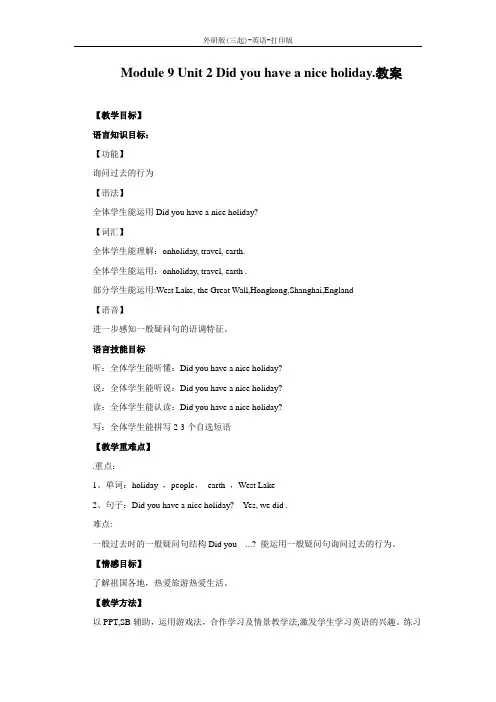
Module 9 Unit 2 Did you have a nice holiday.教案【教学目标】语言知识目标:【功能】询问过去的行为【语法】全体学生能运用Did you have a nice holiday?【词汇】全体学生能理解:onholiday, travel, earth.全体学生能运用:onholiday, travel, earth .部分学生能运用:West Lake, the Great Wall,Hongkong,Shanghai,England【语音】进一步感知一般疑问句的语调特征。
语言技能目标听:全体学生能听懂:Did you have a nice holiday?说:全体学生能听说:Did you have a nice holiday?读:全体学生能认读:Did you have a nice holiday?写:全体学生能拼写2-3个自选短语【教学重难点】.重点:1、单词:holiday ,people,earth ,West Lake2、句子:Did you have a nice holiday? Yes, we did .难点:一般过去时的一般疑问句结构Did you ...? 能运用一般疑问句询问过去的行为。
【情感目标】了解祖国各地,热爱旅游热爱生活。
【教学方法】以PPT,SB辅助,运用游戏法,合作学习及情景教学法,激发学生学习英语的兴趣。
练习学生的听说读的能力。
【教具准备】PPT,SB【课时安排】1课时Teaching procedure一、Warming up1、Greeting2、Review M9-U1二、Leading in有两个外星人到地球来度假了。
Did they have a nice holiday? Let’s have a look! 进而导入SB Unit 2活动1三、Presentation1、T:Xiaoyong had a nice holiday. Let’s have a look,OK?导入活动2的学习。
四年级下册英语Module9-Unit 2 Did you have a nice holiday?

Homewor kቤተ መጻሕፍቲ ባይዱ
Talk about “What did you do last holiday?” with your partner.
Module9
Unit 2 Did you have a nice holiday?
单词:earth 句子: Did you have a nice holiday? Yes,we did. We went to the earth. We went there by train. Did you visit the famous West Lake? Did you see your friend Lili in Hangzhou?
Guess and say.
教师准备表示地点的单词卡片。 学生两人一组,一名学生抽卡 片,另一名学生猜地点。 句型:Did you go st year? Yes, I did./No,I didn't. I went to....
Ask and answer.Then write.
Birdhouse
New
Language
Did
you
travel
by…plane
?
Yes, I did.
No, I didn't. I went there by…
plane bike
train ship
car bus
Questions
听录音,回答问题。
1.Did Xiaoyong have a nice holiday?
Did he…?
Yes, he did.
看图,说句子。
No, he didn’t.
New words earth 地球
四年级下册英语教案 Module 9 Unit 2 Did you have a nice holiday 外研社(三起)

2. Great! Now let’s look at Picture 2. Can you guess where it is?
太棒了!现在请看第2幅图,你能猜猜这是哪里呢?
Look at Picture 3. Where is it?
Module 9 Unit 2 Did you have a nice holiday?教学设计
科目版本
小学英语(三年级起点)外研版四年级下册
章节
Module 9
课名
Module 9, Unit 2 Did you have a nice holiday?
学习目标
1.能听懂、会说on holiday, travel, earth,Did you travel by ....? Yes, I did. No, I didn’t. I went there by ...
同学们,今天我们一直在谈论假期。你们喜欢假期吗?下面就让我们听一首关于假期的歌曲吧。
5. Do you love this song? Now let’s learn this song. Please read after me.
你们喜欢这首歌吗?下面让我们一起学习一下。请跟着我读。
6. Now let’s try to sing with the video.
今天我们学习了如何谈论过去,用怎样的方式去旅游。请你采访两位同学,问问他们的假期都去了什么地方,又是怎么去的。
进一步加强学生对重点句型的运用。
作业布置
今天我们学习了如何讲述自己假期的旅行,大家都学会了吗?课后请你向自己的同学讲一讲,刚刚过去的假期,你去了什么地方,是怎么去的。
四年级下册Module_9__Unit_2Did_you_have_a_nice_holiday
Module 9 Unit 2Did you have a nice holiday ?教学目标:1.知识目标:掌握本单元的新单词earth,复习上一单元的单词。
巩固本模块的重点句型:Did...?及相对应的回答。
2.水平目标:能使用本模块的知识对过去的动作提问,并能回答别人的提问。
3.情感目标:激发学生学习英语的兴趣,使学生敢于、乐于说英语。
教学重点:1.掌握本单元的新词earth ,复习上一单元的单词。
2.巩固Did…?句型及相对应的回答。
教学难点:使用本模块的知识对过去的动作提问,并能回答别人的提问。
教学用具:课件,卡片,地球仪。
教学设计:;Step1 :Warming-up1.Greeting2.Say the chant.Welcome to China!Welcome to Beijing!Did you cme by train?Did you cme by plane?Step2 :Prersentation活动一:外星人对话:1.教师展示地球仪,引导学生说出地球,然后教师将单词earth板书到黑板上,实行教读。
2.播放Listen point and say 局部的录音,学生跟读,教师对学生的发音实行规范。
(强调people theseweren’t的发音)3.将学生分两组,分角色朗读对话。
4.让学生扮演课本中的外星人,在课文内容的基础上,实行自由编对话并在班上展示。
设计理念与意图:用实物实行教学,加深学生对于单词的记忆,并丰富学生的语言知识。
活动二:听说练习1.教师播放第二局部的录音,学生实行跟读,模仿录音的发音和语气,教师对学生的发音实行规范。
即时对学生表现好的一面实行表扬。
2.将学生分成三组,分角色朗读活动二局部的课文,比比哪组读得好。
3.教师抽取局部学生实行对话练习。
4.将学生分成四人一组的小组,分小组讨论上一次假期的生活,说说自己都去了哪些地方,做了什么事情。
设计理念与意图:即时对学生实行鼓励,争强学生的自信心,从而提升课堂效率。
四年级下册英语教案 Module 9 Unit 2 Did you have a nice holi
四年级下册英语教案 Module 9 Unit 2Did you have a nice holiday外研社(三起)本文为外研社(三起)四年级下册英语教案中的第九模块第二单元的教案。
本教案寓教于乐,旨在引导学生在课堂上进行英语学习,并在合适的时间和场合运用所学知识,提高学生听、说、读、写等英语语言技能。
教学目标知识目标1.学习并掌握新单词和词组:nice, holiday, weekend, often。
2.掌握句型:“Did you have a nice holiday/weekend?”“Yes, I did. / No, I didn’t.”“Do you often…?”“Yes, I do. / No, I don’t。
”技能目标1.能听懂、会说、会读、会写所学新单词和句型。
2.能在日常生活中运用所学知识交际。
情感目标1.培养学生积极向上的情感态度,激发学生学习英语的兴趣和动力。
2.培养学生勇于表达自己的意见和感受的能力,增强学生的自信心和自尊心。
教学内容New words and expressions1.nice2.holiday3.weekend4.oftenSentence patterns1.Did you have a nice holiday/weekend?2.Yes, I did. / No, I didn’t.3.Do you often…?4.Yes, I do. / No, I don’t.DialogueA: Did you have a nice holiday? B: Yes, I did. I went to the beach with my family. A: That sounds great. Did you swim in the sea? B: Yes, we did. We had a lot of fun. A: Do you often go to the beach? B: Yes, I do. My family loves the beach.教学过程Step 1: Warm-up (10 minutes)1.Greet the students.2.Ask the students about their holidays or weekends and encourage them to share their experiences with the class.3.Write down any new words or expressions that the students use on the board.Step 2: Presentation (15 minutes)1.Introduce the new words and expressions to the students using flashcards or other visual aids.2.Drill the new words and expressions with the class.3.Model the sentence patterns for the students and have them repeat after you.Step 3: Practice (25 minutes)1.Divide the students into pairs.2.Have the pairs practice the dialogue from the text.3.Walk around the classroom and listen to the students practicing.Step 4: Extension (10 minutes)1.Ask the students to come up with their own sentences using the new words and expressions.2.Have the students share their own sentences with the class.Step 5: Summary and homework (5 minutes)1.Review the new words and expressions with the class.2.Assign homework to the students.教学反思本节课教学内容紧凑、简单明了,便于学生们理解和掌握。
M9Unit2Did_you_have_a_nice_holiday[1]
1.Did they have a nice holiday? Yes, they did.
2.Where did they go?
They went to the earth.
3. Did they like the people?
Yes, they did.
Fill in the blanks.
No, I did’nt. I went to … .
Hyde Park the Great Wall Buckingham Palace Sanya
Birdhouse
Did you travel …
Yes, I did.
by plane
?
No, I did’nt. I went there by…
---Yes,主语+ did.
---No, 主语+ didn’t.
--- Did you have a nice holiday?
---Yes , I did. ---Did you see your friend Lili in Hangzhou ? ---No, she was on holiday in Shanghai.
earth地球
Did you like Beijing? Yes, it was very beautiful. But there were a lot of people. Look at these photos.
Did you go to Hangzhou?
Yes, I did. No, I didn’t.
Summary
1.New word earth 2. 句型 Did you have a nice holiday? Yes, I did./ No, I didn’t.
四年级下册英语教案Module9Unit2Didyouhaveaniceholiday外研社(三起)
四年级下册英语教案Module 9 Unit 2 Did you have a nice holiday 外研社(三起)教学内容本课选自外研社《新标准英语》四年级下册,第九模块第二单元。
教学内容主要围绕询问和描述假期活动的交际用语,包括讨论假期的活动、地点以及感受。
通过本课的学习,学生能够运用一般过去时来询问和描述过去的假期经历。
教学目标1. 知识与技能:学生能够听懂、会说、会读本课的关键单词和句子,如 "holiday", "go to", "have a good time" 等。
2. 过程与方法:通过情景模拟、小组合作等教学方法,提高学生的英语听说能力和交际能力。
3. 情感态度价值观:培养学生对英语学习的兴趣,增强学生合作学习的意识,激发学生对假期的美好向往。
教学难点1. 正确运用一般过去时描述过去的假期活动。
2. 词汇的记忆与运用,特别是新学的单词和短语。
3. 交际用语的正确使用和口语表达的自然流畅。
教具学具准备1. 多媒体教学设备,用于播放课件和视频。
2. 教学卡片,包括单词卡片和句子卡片。
3. 学生活动手册和学习材料。
教学过程1. 导入:通过展示一些假期的图片,引导学生谈论自己的假期经历,激发学生的学习兴趣。
2. 新授:利用多媒体课件展示本课的关键单词和句子,讲解语法点和交际用语。
3. 练习:通过听录音、模仿跟读、角色扮演等活动,让学生练习本课的重点内容。
4. 巩固:进行小组活动,让学生在模拟的情景中运用所学知识进行交流。
板书设计1. 关键单词和短语。
2. 重点句子和交际用语。
3. 语法点的简单说明。
作业设计1. 书面作业:完成学生活动手册的相关练习。
2. 口头作业:回家后与家长用英语交流自己的假期经历。
3. 扩展作业:查找一些关于假期的英语资料,如旅游广告、假期故事等,下节课分享。
课后反思1. 教学方法是否有效,学生是否积极参与。