
人教版七年级上册英语Unit5 Do you have a soccer ball
Unit5 Do you have a soccer ball一、单项选择(共15小题;共15分)1. --- Who a dog in my class?--- Many students .A. have; hasB. has; hasC. has; haveD. have; have2. I five books and my brother two books.A. have; haveB. has; hasC. have; hasD. has; have3. My cousin a white bag.A. doesn't hasB. don't haveC. don't hasD. doesn't have4. your father a new computer?A. Is; haveB. Do; haveC. Does; haveD. Does; has5. he a ping-pong ball bat?A. Does; hasB. Do; haveC. Does; haveD. Do; has6. We have studied English for only one year, we can perform English short plays already.A. yetB. forC. andD. or7. Bob is young, he knows a lot.A. becauseB. soC. butD. unless8. --- I don't have white shoes for tomorrow's speech contest.--- My brother has pair. Would you like to try on?A. a; itB. one; itC. one; themD. two; them9. I will do my homework at home instead of basketball.A. playB. playedC. playingD. to play10. To save class time, our teacher has students do half of the exercise in class and complete theother half for our homework.A. ourB. weC. usD. ours11. --- What does your sister ?--- She a basketball.A. have; hasB. has; hasC. have; haveD. has; have12. --- Does she any pencils?--- Yes, she three pencils.A. have; hasB. have; haveC. has; haveD. has; has13. The boy arms, but he can write with feet.A. hasB. haveC. doesn't hasD. doesn't have14. --- Daniel glasses?--- Yes, he .A. Do; put on; isB. Does; wear; wearsC. Does; wear; doesD. Does; have; do15. --- your mother a computer?--- Yes, she does .A. Does; hasB. Do; haveC. Does; haveD. Is; have二、单词拼写(单句首字母填空)(共15小题;共15分)16. She goes to school l (not early).17. There's nothing interesting in today's newspaper. It's too b .18. Do pandas o live in China?19. The s meeting is from Thursday till Saturday.20. My parents usually w TV in the evening.21. Chinese people are very good at table t , and it's our favorite sport.22. --- Do you have a v ?--- No, I don't. I have a basketball.23. Mr. Zhang is a good teacher. He always makes his classes i .24. It's very d to pick up apples in water with teeth.25. I like my job, because it's r .26. We should arrive at school on time. Don't be l for school.27. I don't like the soap opera (肥皂剧). It's very b .28. You have ten yuan, but I have o one yuan.29. I wore my s shoes for the gym class yesterday.30. He usually stays at home and w TV at home.三、单词拼写(根据中文提示拼写单词)(共15小题;共15分)31. The book should be returned no (迟) than next Friday.32. The music (听起来) like birds singing.33. Lucy and Lily are in the (同样的) school, but they are in different classes.34. Please look after your (同学) clothes. They are doing sports activities.35. Do you like playing (排球)?36. --- Let's play music.--- That sounds (轻松).37. I think this book is very easy and that book is very (困难的).38. This book is very (有趣的). I like it very much.39. --- Does he have a bat?--- Yes, he (仅仅) has one.40. Do you have a (网球)?41. Mrs. Gao always comes home (迟) than her husband.42. The music (听起来) so wonderful.43. Cindy has the (相同) handbag as I do.44. Sun Li is in Class Two. I'm in Class Two, too. We are (同班同学).45. Tom likes playing (排球) very much.四、完形填空(共10小题;共15分)My name is Bill. I 46 two sisters. They 47 Emma and Sally. We have 48 at home.49 breakfast, we all drink milk. Emma and Sally 50 eggs, but I 51 . I like bread for breakfast. We have lunch at school. I like hamburgers with 52 , but they don't. They like hamburgers with 53 . We all have dinner at home. Emma and I eat 54 salad, but Sally 55 . She likes carrots. We often eat fruit after dinner.46. A. have B. has C. like D. likes47. A. be B. am C. is D. are48. A. breakfast B. lunch C. dinner D. dessert49. A. At B. With C. Of D. For50. A. likes B. like C. isn't like D. doesn't like51. A. is B. am C. don't D. am not52. A. chickens B. a chicken C. the chicken D. chicken53. A. a vegetable B. vegetables C. meats D. meates54. A. lots of B. a lots of C. a lot D. many55. A. don't B. doesn't C. isn't D. aren't五、阅读理解(共20小题;共40分)AThe Browns are from America. Now they live in Hangzhou, China. Mr. Brown is a famous professor in Zhejiang University. He is humorous and his lesson is interesting. Mrs. Brown is a housewife. She has to look after her family. They have two children. The brother Peter is ten years old. The sister Judy is four years old. Peter can play the piano well. He wants to become a musician. Judy can sing a lot of songs. She can dance well. Everyone in the family loves her.56. Which country do the Browns live in now?A. In the UK.B. In the US.C. In China.D. In Australia.57. The underlined word "humorous" means " " in Chinese.A. 善良的B. 活跃的C. 幽默的D. 严肃的58. What does Mrs. Brown do?A. She is a teacher.B. She is a professor.C. She is a housewife.D. She is a musician.59. What is Judy good at?A. Dancing and writing.B. Music and dancing.C. Music and writing.D. Teaching.60. Which of the following is NOT true?A. There are four people in Brown's family.B. Both of the two children love music.C. Peter likes to dance.D. Judy is Peter's younger sister.BJack is a thirteen-year-old boy. He lives in California, US. Jack likes to read a newspaper in the evening. And his favorite cartoon is Garfield(《加菲猫》).Now let's go to have a look at his house. He lives in a two-floor single family house(独栋小楼). It is not far from his school. Jack's father has a car, but Jack walks to school. Jack's house has a garden. It's not big, but Jack's parents grow oranges, lemons, sunflowers, peas(豌豆) and many other veggies and flowers. They can cook some of them for dinner.After supper, Jack's parents often watch TV in the living room. But Jack's favorite place is his bedroom. He likes jumping on the bed.61. Where does Jack come from?A. China.B. France.C. The US.D. Japan.62. How does Jack go to school?A. By bus.B. On foot.C. By taxi.D. In his father's car.63. The underlined word "veggies" means in Chinese.A. 玩具B. 蔬菜C. 宠物D. 衣服64. What do Jack's parents often do after supper?A. Read a newspaper.B. Go out for a walk.C. Grow oranges and lemons.D. Watch TV in the living room.65. From the passage, we can learn .A. there is a garden in Jack's houseB. Jack doesn't like his living roomC. there aren't sunflowers in Jack's gardenD. Jack likes watching Garfield in the eveningCJenny gets up early in the morning. She has her breakfast and goes to school. She walks to the bus stop and takes a bus. She gets to school at about half past seven.Jenny is never late for school. She likes school and works hard. Classes begin at 8:00. She has six classes every day. Jenny is good at all her lessons, and she likes English best.Usually Jenny has lunch at school. She goes home at five in the afternoon. Sometimes, she helps her friends with their lessons. After supper she usually watches TV news.Then she does her homework. She goes to bed at about 9:30. Jenny is a good girl.66. Where does Jenny have her breakfast?A. She has her breakfast at homeB. She has her breakfast at schoolC. She has her breakfast on her way to schoolD. She has her breakfast on the bus67. How does Jenny do at her lessons?A. She doesn't like going to schoolB. She can't do her lessonsC. She does very well in her lessonsD. She doesn't know her lessons at all68. How many hours is Jenny at school?A. She is at school for seven hoursB. She is at school for seven and a half hoursC. She is at school for eight hoursD. She is at school for nine and a half hours69. What does Jenny sometimes do after school?A. She has supper with her classmates at schoolB. She helps her friends with their lessonsC. She does some shopping for her motherD. She goes home with her friends70. What does Jenny do after supper?A. She watches TV and then goes to bedB. She watches TV and does some houseworkC. She watches TV and does her homeworkD. She reads her English and does some sportsDTickets for the NBA basketball game are going on sale. Lots of people like to go to watch basketball. Most of them are going to cheer(欢呼) for their teams. However(然而), there are never enough tickets for everyone. So some people come the day before and sleep in front of the ticket office. At night, when they are waiting, some people play music, others dance and sing, and still others talk about their favorite players. Sometimes they argue(争论) because they like different teams. After waiting all night to buy tickets, they will be too tired to enjoy the game.71. Why do many people like to go to basketball games?--- .A. It's easy to buy ticketsB. They like to see their favorite teams playC. They have free ticketsD. They live near the basketball court72. Why is it hard to buy tickets?--- .A. The ticket office is far awayB. The tickets are very expensiveC. There aren't enough tickets for everyoneD. There are too many tickets73. What do some people do when they buy tickets?--- .A. Go to the ticket office right before the gameB. Ask a basketball player for helpC. Pay by credit cardD. Wait in front of the ticket office74. What do they do when they are waiting for the ticket office to open?--- .A. Sing, dance, and talkB. Play basketballC. Cheer for their teamsD. Go on sale75. Which is the best title?--- .A. Waiting to Buy TicketsB. NBA BasketballC. Tickets OfficeD. Tickets on Sale六、阅读与表达(判断式)(共5小题;共10分)Come and look at the picture. It is a picture of an American family. The man in the hat(戴着帽子) is Mr. John White. He is a teacher. He teaches(教) English in a middle school in China. You can see Mrs. White, too. She is Dora White. She's from Canada(加拿大). She's a doctor. Mr. and Mrs. White have two children, Tom and Mary. Tom is ten and Mary is six. They love them very much.根据短文内容,判断正误,正确的为T,错误的为F。
人教版英语七上 U5 Do you have a soccer ball 讲义
Unit5 Do you have a soccer ball?一、重点词汇及拓展1. have v.(1) 有e.g. I have a pen. 我有一只钢笔。
(2) 吃;喝e.g. I have breakfast every day. 我每天吃早饭。
(3) 经历e.g. have a good time 玩得开心;过得愉快(4) 上课e.g. We have English lessons every day. 我们每天上英语课。
(5) 举办e.g. Mark has a party. 马克举办了一个派对。
(6) 得…病e.g. He has a cold and a headache. 他感冒和头疼。
2. let v.允许;让let’s = let us 让我们let sb. do sth. 让某人做某事let sb. not do sth. 让某人不要做某事e.g. Let’s have a party tonight! 让我们今晚举办一个派对吧!make sb. do sth. 使某人做某事e.g. The movie makes me miss my mother. 这部电影使我怀念我的妈妈。
3. go v.去;走go to +地点去某地go to school 去学校go here/there/home 去这儿/去那/回家go shopping 去购物go swimming 去游泳go hiking 去远足go skating 去轮滑go boating 去划船4. lateadj. 迟的;晚的be late for school 上学迟到be late for class 上课迟到1be late for work 上班迟到adv. 迟地;晚地later adv. 后来;以后e.g. Three days later, he found his father. (句中有段时间+later,句子用一般过去时)三天后,他找到了他的爸爸。
七年级英语上册 Unit 5 Do you have a soccer ball(单词+重点句型)语法解析

——————————新学期新成绩新目标新方向——————————unit 5does 用于构成否定句和疑问句;做;干have 有tennis 网球ball 球pingpong 乒乓球 table tennis 乒乓球bat 球棒;球拍soccer (英式)足球soccer ball (英式)足球volleyball 排球basketball 篮球 basketball team 篮球队;basketball match 篮球比赛 basketball player 篮球运动员hey 嘿;喂let 允许;让us (we的宾格)我们let's 让我们(一起)let's us 让我们(一起)go 去;走we 我们late 迟到has (have的第三人称单数形式)有get 去取(或带来);得到great 美妙的;伟大的play 参加(比赛或运动);玩耍sound 听起来好像interesting 有趣的boring 没趣的;令人厌倦的fun 有趣的;使人快乐的n.乐趣;快乐difficult 困难的relaxing 轻松的;令人放松的watch 注视;观看TV 电视;电视机 many TVs 很多电视机watch TV 看电视same 相同的love 爱;喜爱with 和......在一起;带有;使用sport 体育运动 play/do/have sports 做运动 sports shoes 运动鞋a sports shoes 体育运动鞋them (they的宾格)他(她、它)们only 只;仅like 喜欢;喜爱easy 容易的;不费力的after 在......以后class 班级;课(近义词:lessen);等级;类别;阶段classmate 同班同学 roommate 室友 workmate 同事 deskmate 同桌schoolmate 校友Bill 比尔(男名)on的用法,详见unit4【解析】on可以表示“通过;使用……方式”,后面通常接表示通信工具的名词。
Unit 5 Do you have a soccer ball 知识点归纳-七年级上册英语
人教版新目标七上英语单元知识点归纳Unit 5 Do you have a soccer ball?重点词汇tennis/'tenis/ n. 网球bat /bæt/ n. 球棒;球拍soccer ball (英式)足球volleyball/'vɔlibɔ:l/ n. 排球basketball/'ba:skitbɔ:l/ n. 篮球late/leit/ adj. 迟到great/greit/ adj. 美妙的;伟大的play/plei/ v. 参加(比赛或运动);玩耍sound/saund/ v. 听起来好像interesting/'intrəstiŋ/ adj. 有趣的boring/'bɔ:riŋ/ adj. 没趣的;令人厌倦的fun/fʌn/ adj. 有趣的;使人快乐的n.乐趣;快乐difficult/'difikəlt/ adj. 困难的relaxing/ri'læksiŋ/ adj. 轻松的;令人放松的watch/wɔtʃ/ v. 注视;观看same/seim/ adj. 相同的easy/'i:zi/ adj. 容易的;不费力的class/kla:s/ n. 班级;课classmate/'kla:smeit/ n. 同班同学重点短语:a tennis bat 一个网球拍play basketball 打篮球baseball bat 棒球棒have a soccer ball 有一个足球play soccer 踢足球with our friends 和我们的朋友一起have a ping-pong ball 有一个乒乓球play ping-pong 打乒乓球have a volleyball 有一个排球play volleyball 打排球at school 在校,上学play sports 做运动watch TV 看电视in my bag 在我的包里be late 迟到on TV 电视上必背典句:1. Do you have a soccer ball? 你有一个足球吗?2. Does he/she have a ping-pong ball?他/她有一个乒乓球吗?3. Do you play sports with your classmates? 你和你的同学一起做运动吗?4. Let’s play soccer together! 我们一起踢足球吧!5. How many sports do you like?你喜欢多少种运动?6. I like playing soccer and basketball. 我喜欢踢足球和打篮球。
人教版新课标英语七年级上册《Unit 5 Do you have a soccer ball Sec

人教版新课标英语七年级上册《Unit 5 Do you have a soccer ball Section A 》教学设计2一. 教材分析人教版新课标英语七年级上册《Unit 5 Do you have a soccer ball Section A》主要讲述了日常生活中常见的体育运动用品以及询问某人是否拥有某物的交际场景。
本节课的主要语言点是球类名词、动词短语“have”以及一般疑问句“Do you have…”的运用。
本节课内容贴近学生生活,有利于激发学生的学习兴趣,培养他们用英语进行日常交流的能力。
二. 学情分析七年级的学生已经掌握了基本的英语语法和一些日常词汇,具备了一定的听说读写能力。
但是,学生在英语口语表达方面仍有待提高,特别是在运用英语进行日常交流方面。
因此,在教学过程中,教师需要注重培养学生的口语表达能力,让他们在真实情境中运用所学知识。
三. 教学目标1.知识目标:学生能够掌握球类名词、动词短语“have”以及一般疑问句“Do you have…”的运用。
2.能力目标:学生能够在日常生活中用英语询问和描述他人是否拥有某物,并能够用英语进行简单的交流。
3.情感目标:通过本节课的学习,学生能够提高学习英语的兴趣,增强自信心,培养团队协作精神。
四. 教学重难点1.重点:球类名词、动词短语“have”以及一般疑问句“Do you have…”的运用。
2.难点:一般疑问句“Do you have…”的构成和用法。
五. 教学方法1.情境教学法:通过设定生活情境,让学生在实际语境中学习并运用所学知识。
2.任务型教学法:通过完成小组任务,培养学生的团队合作精神和口语表达能力。
3.游戏教学法:通过设计趣味游戏,激发学生的学习兴趣,提高他们的口语表达能力。
六. 教学准备1.教师准备:提前准备好教学课件、球类图片、实物球类等教学资源。
2.学生准备:预习本节课内容,了解球类名词和动词短语“have”的用法。
人教版七上英语Unit 5 Do you have a soccer ball 第四课时

2b Read the survey results in a school magazine and answer the question: Who has a soccer ball?
Do You Have a Soccer Ball? Frank Brown: I don’t have a soccer ball, but my brother Alan does. We go to the same school and we love soccer. We play it at school with our friends. It’s relaxing.
Do you have a soccer ball? Do Frank Brown, Gina Smith and Wang Wei have a soccer ball? What sports things do they have?
Frank Brown Gina Smith
Wang Wei
孩子的爱是很伟大的。 【语境串记】My parents give me much love and I love them. 我的父母给了我很多爱,我爱他们。
4. We play it at school with our friends. 我们和朋友们一 起在学校踢足球。(教材P29 2b) with prep. 和……在一起;带有; 使用
2c Who do you think says these sentences? Check (√) F for Frank, G for Gina or W for Wang Wei.
1. I play ping-pong with my classmates after class.
人教版英语七年级上册Unit5Doyouhaveasoccerball?同步听力训练
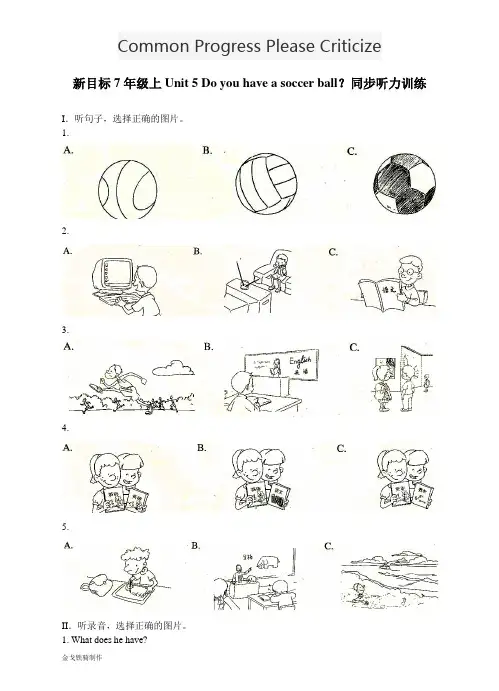
新目标7年级上Unit 5 Do you have a soccer ball?同步听力训练I.听句子,选择正确的图片。
1.2.3.4.5.II.听录音,选择正确的图片。
1. What does he have?2. What do they have?3. Where is the baseball?4. Who has the baseball bat?5. Where’s Tony’s baseball?III.听对话,选择正确的答案。
1. What does Bill have?A. A ping-pong ball.B. A ping-pong bat.C. A tennis bat.2. Where’s the jacket?A. On Jim’s chair.B. On Jim’s bed.C. On Jim’s desk.3. What’s this?A. A picture of a school.B. A picture of a classroom.C. A picture of the teachers.4. How many(多少) basketballs does Bob’s father have?A. Three.B. Four.C. Seven.5. Who has a tennis bat?A. Gina.B. Mike.C. Mike’s father.IV.听长对话,选择正确的答案。
Dialogue A1. What does Paul have?A. A volleyball.B. A baseball.C. A basketball.2. Where is the volleyball?A. In the bag.B. On the chair.C. On the teacher’s desk.Dialogue B3. What is difficult for Jack?A. Soccer.B. Basketball.C. Tennis.4. Who has basketballs?A. Jack.B. Jack’s sister.C. Peter.5. What will (将要) they play?A. Baseball.B. V olleyball.C. Soccer.V.听Mike的独白,回答下列问题。
七年级英语上册Unit5-Do-you-have-a-soccer-ball优秀教案
Unit 5 Do you have a soccer ball? Learning objectives (教学目标)Analyze and rearrange teaching materials (教材分析和重组)1. 教材分析本单元以“Do you have a soccer ball?”为话题, 共设计了三个部分的内容。
Section A该部分有4个模块:第一模块围绕“Do you have a soccer ball?”这一话题展开词汇学(1a)、听力(1b)、口语(1c)训练;第二模块继续围绕“Do /Does… have a…?”进行听力(2a-2b)、口语训练(2c);第三模块围绕“Make suggestions.”这一话题展开训练,训练形式为单词填空(3a)和角色表演谈论图画为训练形式(3b);第四模块就“Complete the forms according to the sports club you like.”以结对活动形式进行介绍。
Section B该部分有4个模块:第一模块是词汇的学习(1a)与运用(1b);第二模块仍然围绕(1a-1b) 的词汇进行听力训练(2a-2b)、围绕提建议进行口语训练(2c);第三模块继续围绕“Ownership”这一话题展开有关收藏品阅读(3a), 写作训练(3b-3c);第四模块仍就“Ownership”这一话题以口语训练形式展开全班活动。
Self Check该部分有3个模块:第一模块以填空形式对所学词汇进行训练;第二模块以默写已学过的五个单词的形式对所学的词汇继续巩固复习; 第三模块围绕有关ownership和suggestions对话开展口语训练和写作训练。
教材重组和课时分配Period 1 (Section A: 1a, 1b, 1c) New function presenting Period 2 (Section A: 2a, 2b, 2c, 3a, 3b, 4) PracticePeriod 3 (Section B: 1a, 1b, 2a, 2b, 2c) V ocabulary building Period 4 (Section B: 3a, 3b, 4) Integrating skillsPeriod 5 (Self Check: 1, 2, 3 & Workbook) Self CheckPeriod 6 WritingTeaching procedures and ways (教学过程与方式)Period One New function presentingLanguage goals (语言目标)1. Words & expressions: have, soccer ball, tennis, racket, tennis racket,ping–pong, volleyball, basketball, bat (P25)2.Key sentences: Do you have a ping–pong ball?Yes, I do. No, I don’t. (P25)Ability goals (能力目标)Enable the students to understand and talk about ownership and make suggestions.Emotion & attitude goals (情感和态度目标)Enable the students to form positive attitude toward sports collection and love sports, keep healthy and learn to make suggestions politely. Strategy goals (策略目标)To understand the target language by reading pictures, drawing pictures, countingnumbers, drawing a chart.Culture awareness goals (文化意识目标)People’s attitude toward sports collections is different in English speaking countries.Teaching important points (教学重点)Talk about ownership and make suggestions.Teaching procedures & ways (教学过程和方式)Step 1. Revision and Lead-inAsk one or more students to show their homework.T: In the last unit, I ask you to do a project about filling in the chart because we want to have a ball game. But we don’t know what kind of balls you have. Please ask your classmates in the group what balls he /she has. Then write down the information in the chart. Now who wants to display your project on the blackboard?T: Do you have tennis? S: Yes, I do.Second point to the others in the classroom.T: Does Wang Wei have tennis? S: Yes, he does.Third point to Li Hong in the classroom who has ping–pong ball, but no tennis.T: Do you have tennis?S: No, I don’t.T: Do you have a ping–pong ball?S: Yes, I do.T: Does Li Hong have tennis?Ss: No, she doesn’t.T: Does Li Hong have a ping–pong ball?Ss: Yes, she does.T: Today we are going to learn how to talk about ownership and make suggestions.Step 2. Listing and SpeakingAsk the students to read the picture on Page 25.T: What can you see in the picture?Ss: We can see a ping–pong ball, a ping–pong bat, a tennis racket, a soccer ball, volleyball, a basketball, a TV, a computer game.T: Ask the students to match the words with the things in the picture.Ss: Say, Number 1 is (C), tennis racket. Number 2 is (a), ping–pong ball…After checking the answers in 1a, ask the students to read aloud the new words again and again, ask and answer about them in pairs. And then play the recording again. This time students listen to conversation and circle the words they hear. And then check the answers. Students circle ping–pong bat and computer game.Step 3. Pair workAsk the students to read the example conversation. Have students repeat. And then point to the television in the illustration and substitute that word in the conversation. Have students repeat again. And then ask students to practice the conversation in pairs and remind them to use various objects from the illustration. As students practice, move around the classroom to check progress and help with pronunciation.Ask for more ideas from the students and write their ideas on the blackboard.p hone, cars, pencil case, eraser, pen, book, dictionary, watch, key, notebook, ring, sister , brother, chair, bookcase, CD, video tape, hat, desk, dresser…Show the following to the students and then ask them to practice in pairs.—Do you have a phone?—Yes, I do.—Do you have a CD?—No, I don’t.T: Now work in pairs, make conversations with the newwords in 1a and act it out around the students.Sample conversations:1. S1: Do you have a ping–pong bat?S2: Yes, I do.S1: Do you have a ping–pong bat?S2: No, I don’t.2. S3: Do you have volleyball?S4: Yes, I do.S3: Do you have a basketball?S4: No, I don’t.3. S5: Do you have a tennis racket?S6: Yes, I do.S5: Do you have a TV?S6: No, I don’t.Step 4. Homework1. Ask the students to do more practice as required in 1 c on Page 25.2. Ask the students to prepare the next period. Think about the usage of “Does she /he have…?”Period Two PracticeLanguage goals (语言目标)1. Words & expressions: does, doesn’t, let, us, let’s, play, well, sound,good, sport, we, many, club, more, class (P26)2. Key sentences:—Let’s play volleyball.—That sounds good. (P26)Ability goals (能力目标)Enable the students to make suggestions politely.Emotion & attitude goals (情感和态度目标)Train the Ss to make suggestions politely and take activity part in school sports club and keep healthy.Strategy goals (策略目标)Enable the students to match the problems and worries.Culture awareness goals (文化意识目标)Learn to how to make suggestions politely.Teaching important points (教学重点)Talk about making suggestions.Teaching procedures & ways (教学过程和方式)Step 1. RevisionBefore class, let’s have a revision. First make up a conversation with “Do you have…?”about ownership, and then in threes make up a conversation with “Do you have…? Does she /he have…?”Sample dialogues:1. S1: Do you have a soccer ball? S2: Yes, I do.S1: Do you have a basketball? S2: No, I don’t.2. S1: Do you have a computer game? S2: No, I don’t.S1: Do you have a ping–pong bat? S2: Yes, I do.S3: Does he have a computer game? S1: No, he doesn’t.S3: Does he have a ping–pong bat? S1: Yes, he does.Step 2. Listening PracticePlay the recording for the first time.T: Listen to the tape. You only listen.Play the recording for the second time. Then check the answers.T: You’ll hear the same conversation again in the picture. This time please listen for the names in the pictures, and then number the pictures (1-4).After that ask a few students to say out their answers in 2a.S1: The answers are 3, 1, 4, 2.S2: Number the pictures: 3, 1, 4, 2.Play the recording for the third time.T: You will hear the conversations for the third time. You are to match the people from activity 2a to the balls in the recording for the fourth time and then correct the answers.T: You listen to the tape and write the numbers from the pictures in 2b next to the correct balls.After doing listening, talk about the dialogue about 2b, and then ask some students to say out their answers in 2b.S3: The answers are 3, 2, 1, 4.S4: They are 3, 2, 1, 4.Step 3. Pair workLook at the things in the picture. Ask your partner if he /she has the things in 2c.Ask the students to act out the conversation in pairs.Sample conversations:1. S1: Do you have a dictionary? S2: Yes, I do.S1: Do you have an eraser? S2: No, I don’t.2. S3: Do you have a baseball? S4: No, I don’t.S3: Do you have a football? S4: Yes, I do.3. S5: Does Tom have volleyball? S6: Yes, he does.S6: Does Mike have a pen? S5: No, he doesn’t.Step 4. PracticeLook at 3a, point out the words in the box and then ask a student to read aloud the four words to the class.T: Fill in the blanks with the words from the box alone. I’m sure you’ll fill in the correct answers. And now who’ll tell me the answers? Please hand up if you know the answers. Oh, thank you, --------!S1: The answers are: 1. don’t,2. Let’s,3; have,4. soccer.T: You are right. Thank you. Now let’s practise reading aloud the conversations in pairs and act them out. And then tell the students how to make suggestions politely using “Let’s…!”For example:T: Let’s play ping–pong ball./ Let’s play tennis./ Let’s play volleyball…S: That sounds good.After finishing practising the conversations in 3a, ask the students to make conversations with their partners according to the pictures below in 3b. Ask the students to point to each one and describe each object. Show the students how to use the pairs of pictures as substitutes in the conversation.For example:T: Let’s play basketball.S: I don’t have a basketball.T: Well, let’s play football.S: That sounds good.Ask pairs of students to perform the conversation for the class and tell them how to make suggestions politely in 3b.Step 5. Writing and practiceThis activity gives students a chance to role play a conversation about sports. Students review the language of introductions, and then complete the form, introduce themselves to the coach.T: What sports do you like to play? Who are your favorite sportsmen and sports women? What sports are available at school?S1: I like to play football. My favorite sports man is Liu Xiang. Basketball and volleyball are available at our school.T: Our school has a sports Club with all the sport that you would like to play. If you would like to join the school sports club, please fill in the form with your personal information. When students have completed filling in the form, divide them into pairs.T: Wha t’s your first name? What’s your last name? What sports do you like? Do you like…? What class are you in?S: My first name is Li. My last name is . I like ping–pong ball. I’m in Class 4, Grade 7.Have students role play the conversation between a student and coach. Walk around the class and offer help where necessary.Step 6. SummaryAsk some students to sum up what we have learned key vocabulary and the target languages.Step 7. Today’s homeworkT: First make up dialogues with “ownership and make suggestions” in pairs /in groups. Next class I’ll ask you to act them out. Second, prepare for the next class P 28 (1a, 1b, 2a, 2b, 2c).Period Three New vocabularyLanguage goals (语言目标)1.Words & expressions:interesting, boring, fun, difficult,relaxing, watch, watch TV (P28)2. Key sentences: (1) Let’s play computer games.(2) That sounds interesting. (P28)Ability goals (能力目标)Enable the students to learn to make suggestions politely and responses.Emotion & attitude goals (情感和态度目标)Enable the students to learn to express their feelings about different suggestions.Strategy goals (策略目标)Enable the students to know how to express their feelings aboutdifferent suggestions.Culture awareness goals (文化意识目标)Different countries, different suggestions.Teaching important points (教学重点)Learn to how to express different suggestions and responses. Teaching procedures & ways (教学过程和方式)Step 1. Revision and word studyCheck the homework:T: Last class we asked the students to make up conversationswith “ownership and make suggestions”in pairs /ingroups. Now we’ll ask you to act them out.Point to the five words and ask the students to repeat each one,and then point to the five pictures and ask the students tomatch each picture with one of the words in section B (1a).Ask the students to write the letter of the picture on the linenext to each word.Ask the students to say out the answers. Go around the room,asking students to point to a picture and say the word that goeswith that picture. The answers are: 1. c; 2. d; 3. e; 4. b; 5. a.Step 2. Guessing the wordsThis activity makes students practise using the vocabularywords from this unit. Point to the picture in 1a and reviewthe words.T: Now please draw pictures that show somethinginteresting, boring, fun, difficult or relaxing. Please showyour pictures to some of your classmates. Everyone triesto guess the meaning.Step 3. Listening and word studyBefore playing the recording for the first time, point out thefive words in 1a above and ask a student to read them aloudto the class.Play the recording for the first time in 2a.T: Listen to the tape carefully and remember the fouradjective words you hear.Play the recording for the second time.T: Listen to the conversation and put a checkmark to the leftof each word in 1a that you hear.Ask the two students to say out their answers.Ss: The answers are: a. interesting; b. boring; c. fun;d. difficult;e. relaxing.Step 4. Listening and writingT: I’ll ask a student to read the name of each activity to theclass. And then I’ll play the tape. Listen to the tapecarefully for the first time and remember what Tony saysabout these activities. I’ll play the recording again. Thistime listen to the conversation and write the word in theblank.After listening to the tape for the second time, ask somestudents to read the same example to the class.Ss: The answers are: 1. interesting; 2. difficult; 3. boring; 4. fun.Step 5. Practice and actingBefore asking the two students to read the dialogues, listthese activities on the blackboard: play computer games,play volleyball, watch TV, play basketball.T: I’ll ask the two students to act out the dialogues, talkingabout the activities in 2b.One acts as Jenny, the other acts as Tony, move around theclassroom offering languages support and checkingprogress when the students talk about the activities. Ask afew pairs of students to perform their conversations for theclass.Sample dialogues:1. S1: Let’s play volleyball.S2: That sounds fun.2. S3: Let’s watch TV.S4: That sounds boring.Step 6. Summary1. This class we have learned how to make suggestions andresponses politely. We also have learned how to use somedescription adjectives.2. Prepare for the next class.Step 7. Today’s homework1. Make up dialogues about “Make suggestions and responses”.2. Prepare for the next lesson.Period Four Integrating skillsLanguage goals (语言目标)1. Words & expressions:has, great, collection, but, play sports,only,them, a great sports collection, tennis racket, soccer ball, onTV, everyday (P29)2.Key sentences: (1) Ed Smith has a great collection.(2) But he doesn’t play sports—he only watches them on TV.Ability goals (能力目标)Train the ability of the students about reading and writing.Emotion & attitude goals (情感和态度目标)Enable students to form wide interests and hobbies.Strategy goals (策略目标)Enable students to collect what they like.Culture awareness goals (文化意识目标)Enable students to understand different people have different interests and hobbies.Teaching important & difficult points (教学重点和教学难点)1. The plural form of noun.2. The Present Simple TenseTeaching procedures & ways (教学过程与方式)Step 1. RevisionFirst check the homework, and then ask a few pairs to act out the conversation about: Making suggestions and responses.T: Who can make up a dialogue about making suggestions and responses in pairs?S1: Let’s play football.S2: That sounds fun, but I don’t have a football.S1: Well, do you have a basketball?S2: Yes, I do.S1: Then let’s play basketball.S2: Oh, basketball is so different.S1: OK. Let’s play ping–pong ball.S2: That sounds boring. Let’s play computer game! Do you havea computer?S1: Yes, I do.S2: That sounds interesting.Step 2. ReadingBefore reading this magazine article, ask students to name everything they see in the picture (3a).T: Read the article by yourself, and then circle the vocabulary words that are about sports activities.Give examples such as a stamps collection or a coin collection.T: Please close your books, look at the overhead projector, listen to me carefully, and then fill in the blanks with the sports things in 3a. Please tell the students the answers.S1: 1. tennis racket; 2. basketball; 3. baseball; 4. soccer ball; 5. volleyballT: Y ou’re right. OK. Thank you! Pay attention to the usage of thePresent Simple Tense and the plural form of noun.Explain the usage of the grammar and some key sentences, ask the students to retell the text next class.Step 3. Reading and writingBefore reading this article, ask students to name everything they see in the picture (3b). And then read the article to the class. Ask students to look at the picture and fill in the blanks by themselves. After that, let the students correct the answers in pairs. Ask three students to write their answers on the blackboard. (The answers are: 1. baseball; 2. basketball; 3. tennis rackets; 4. volleyball.)After finishing filling in the blanks, explain the usage of the Present Simple Tense, the plural form of noun and some key words, key sentences. Ask students to recite the text (3b).Step 4. Writing and SpeakingT: After finishing learning the articles about 3a and 3b, now you write about yourself. Talk about your hobbies and interests such as:What sports do you play?What sports things do you have?What other things do you do? And so on.After a while I’ll ask some students to read their stories to the class.S1: I collect coins. I have ten American coins, five Russian coins.S2: I have a great toy cars collection. I have two Chinese toy cars, threeJapanese toy cars, four British toy cars. I play them every day.Step 5. Spoken English and writingNow look at 4 Survey, write “have,you, an alarm clock, do”on the blackboard.T: Please say the words in the correct order to make a question. Come tothe blackboard, Wang Fei.S1: Do you have an alarm clock?T: OK, you’re right. Thank you. Please write a student’s name under thequestion on the blackboard. Who can do it? OK, Yang Fan, please.S2: Li Gang.T: OK, Li Gang, please come to the blackboard. Do you have an alarm clock?Guide him to answer “Yes, I do. /No, I don’t.”S3: Yes, I do.T: Now, please write four questions like this. After that ask students to say other things they might ask. As the students complete the questions, move around the classroom checking progress and offering suggestions as needed, at the same time ask students to move around the room, asking their questions and writing in names. In this way the students learn the target language easily. Step 6. Today’s homework1. Write a story about your /his /her collection.2. Make up dialogue with “Do you have…?”3. Finish off all the exercises on the small blackboard.Period FiveLanguage goals (语言目标)1. Words & expressions: basketball, tennis racket, baseball bat, ping–pong ball,soccer ball, volleyball, interesting, boring, run, difficult, relaxing, TV2. Key sentences: (1) Do you have a ball? Yes, I do.(2) —Let’s play soccer.—That sounds good./It’s boring.Ability goals (能力目标)Train students’ writing abilities.Emotion & attitude goals (情感和态度目标)Learn to talk about ownership and make suggestions.Strategy goals (策略目标)Enable students to form wide interests and hobbies.Culture awareness goals (文化意识目标)Enable students to understand the different countries have different suggestions and hobbies.Teaching important & difficult points (教学重点和教学难点)Learn to how to talk about ownership and make suggestions. Teaching procedures & ways (教学过程与方式)Step 1. RevisionBefore class ask a few students to read aloud the stories about themselves, and then have some pairs act out dialogues about ownership. Also give students three minutes to have a free talk.Step 2. Words checkingThis activity provides a comprehensive review of key vocabulary presented in this unit.T: Now let’s go over key vocabulary in this unit. I speak Chinese, you speak English. First answer my questions one by one, and then answer my questions together. OK let’s begin.有趣的,无聊的,休闲的……篮球,网球球拍……Ss: Interesting , boring, relaxing…T: OK, so much for this. Now take out your English exercises books, write five new words in it, and then share your lists with your groups.Step 3. Reading and writingThis activity focuses on students understanding of the target language in the unit.T: Please read aloud the following sentences in 3a, and then number the sentences to make a conversation that follows the situations in the pictures by yourself.After a while, check the students’ answers. The answers are: 5, 1, 4, 2, 3, 6, 7.After checking the answers, ask the students to act out the dialogue and recite it.T: Now look at the chart on the blackboard with the names of five activities and five words at the top: interesting, boring, fun, difficult, relaxing. And then make up a dialogue talking about ownership and makingAsk two students to act out the dialogue.S1: Let’s play baseball!S2: That sounds interesting, but I don’t have a baseball.S1: …S2: …Step 4. Group workT: The class ball games will be held soon. The students in the class are training recently. Please give suggestions to your group and ask them to train after class.As you make up conversations, please use the drills “Do you have a…? /Yes, I do. /No, I don’t / Let’s… /No, it’s boring.”Step 5. Homework1. Finish off all he exercises in the workbook.2. Talk about your friends’hobbies. (play basketball /soccer ball /ping–pong ball /watch TV /play computer games /play sports every day)Period Six Writing(ppt展示)Teaching Resources (教学资源库)1.语法:(1) 名词复数的构成及读音规律:特别提醒:名词复数的不规则变化是:①只变元音字母,如:man—men, woman —women, foot—feet, policeman—policemen ②单复数形式一样,如:a fish—some fish, a Japanese —some Japanese ③其它变化,如:child—children等。
人教版新教材七年级英语上unit5_do_you_have_a_soccer_ball_SectionB
Haha! It’s difficult.
boring 无聊的,令人生厌的
Hmm. It’s boring.
1. interesting 有趣的, 令人感兴趣的
2. fun
有趣的, 令人愉快的
3. relaxing
4. difficult
5. boring
轻松的
困难的
无聊的, 令人生厌的
What do the pictures mean?
Let play baseball.
A: Let’s play basketball. B: I
don’have t a basketball.
A: Well, let’s play ping-pong.
B: That play volleyball.
B: I don’t have a volleyball.
A: Well, let’s play soccer. B: That sounds good/interesting/fun…
A: Let’s … B: That sounds good/interesting/difficult/
boring/fun/relaxing/....
computer
___you _____ Do have a computer? Yes, I_______. do I ______ have a computer
√
___ he have _____ Does a ruler? No, he doesn ______. ’t ’t have a Hedoesn __________ ruler.
有趣的
2a Find the sports words in the unit. Write them in the correct column.
英语人教版七年级(上)Unit5 Do you haveasoccerball基础练习含答案
英语人教版七年级(上)Unit5 Do you have a soccer ball?基础练习�含答案学校:___________姓名:___________班级:___________考号:___________一、单项选择1.—Is this a photo of your school library? It looks very nice!—Yes, it is. And in the library ________ lots of interesting books.A.is B.are C.has D.have2.–Why were you late for school this morning?–I got up very early this morning, ________ I didn’t catch the first bus.A.and B.but C.or D.so3.There is no bus. He has to _______ there ________ his bicycle.A.go to; on B.go to; by C.go; on D.go; by 4.—Does Potter like playing computer games?—No, he __________. He only likes reading books.A.isn’t B.don’tC.doesn’t D.didn’t5.It’s a bit dark. Please turn on the _________. I want to read a book.A.TV B.computer C.light6.your sister have many skirts ?A.Are B.Is C.Do D.Does 7.—What do you think of Peter?—Well, ________ his father, Peter ________ helping people in need.A.likes, like B.like; likes C.likes; likes D.like; like 8.He _______ a brother and a sister.A.doesn’t have B.doesn’t has C.don’t has D.don’t have 9.Li lei has to practice ________ the guitar before he can ________ TV.A.playing, see B.plays, read C.playing, watch 10.She’s talking ________ the phone ________ her mother.A.on, to B.on, at C.in, to D.in, with 11.—Lovely twins! Do they share Barbie Dolls with each other?—Yes. Look! These are ________.A.them B.their C.theirs D.they 12.—How fun the cartoon Tom and Jerry is!—Yeah! I like the cartoon, too. It’s so ________.A.boring B.scaryC.interesting D.sad13.—Ed, do you like The Readers hosted by Dong Qing?—Yes. I watch ________ every week.A.one B.it C.them 14.Most girls like singing, but I’m different from _______. I like playing basketball. A.they B.her C.their D.them 15.Miss. White is English teacher. She teaches(教) English.A.our, us B.our, ourC.we, us D.we, our16.Mr Hu will teach ________ English next year.A.we B.our C.ours D.us 17.Let Cindy ________ with you, OK?A.go B.goes C.going D.to go 18.I think soccer is easy (容易的). Let’s __________ it.A.play B.get C.help D.spell 19.—My parents are strict ________ me in my study.—Because they wish you to get ________ marks(分数) .A.on, full B.with, filled C.with, full 20.There is a new TV ________ the wall.A.on B.in C.after 21.Don't worry. There ______ enough water, vegetables and fruits in the fridge. A.have B.are C.is D.has 22.I don’t like the game. It is so ________.A.boring B.smart C.strong23.I like music very much and next year I am going to .A.play sports B.make the soccer teamC.play an instrument D.study math hard24.— you have a brother?—Yes. His name is Peter.A.Do B.Are C.Does 25.Sally ________ Kate are in the classroom, ________ Alan isn’t.A.and; or B.but; but C.and; but 26.—What would you like, Kate?—I’d like some fish ________ rice.A.has B.for C.in D.with 27.Mrs. Brown often plays sports ________ the weekend.A.for B.on C.in D.with 28.Don’t throw the paper away. There is _______ in it.A.interesting something B.interesting nothing C.something interesting D.nothing interesting29.He ________ cook food for dinner.A.have to B.has to C.has D.have 30.—I don’t know the meaning of this word.—You can look it ________ in the dictionary.A.at B.for C.after D.up 31.I live ________ Shanghai ________ my grandparents.A.in; with B.in; and C.with; in D.in; in 32.一Do you have a red pencil?一No, I don’t. I have a green ________.A.one B.it C.ones D.them 33.—The little mouse in a red hat is really ________. Who painted it?—Tom did. He is good at painting.A.lovely B.easy C.cheap D.ugly 34.—Look! Kangkang, that old man is crossing the crosswalk.—Jane, let’s________ him.A.helps B.to help C.helping D.help 35.—Do you like bread?—Yes, I really like ________.A.it B.them C.one 36.She is always ________ help me ________ my English.A.ready to; at B.ready to; with C.ready for; with D.ready to; for 37.All of the club members are either ________ costurne, funny hats ________ making crazy faces.A.with ... and B.of ... and C.in ... nor D.in ... or 38.—Who is the girl in red under the tree?—She is my Mary.We’re in the same class.A.teacher B.son C.mother D.classmate 39.Can he ________ it ________ English?A.speak; in B.say; in C.talk; with D.tell; with 40.A professor from _______university said that he would think out _______unusual way to face the serious problem .A.a ; the B.an ;a C.a ; an D.an ;the 41.—Mom, ________ I watch TV this evening?—No, you can’t. You must do your homework.A.do B.am C.can D.must 42.The woman over there is ________ teacher. She teaches ________ geography. A.our; us B.our; our C.ours; our43.Italy is famous ________ a city ________ many beautiful places.A.for; has B.for, with C.as; has D.as; with 44.—How many girls are there in your class?—__________ 25.A.Before B.Over C.After45.I have ______ basketball. Let’s play ______ basketball.A.the;the B.an;/C./;the D.a;/ 46.Mrs. Green looks so nice, but she is strict ________ us ________ our study.A.to; with B.with; in C.about; in D.of; with 47.These oranges look nice, but ________ very sour(酸的).A.feel B.taste C.sound48.Usually my brother ________ his classroom after school. But now he ________ soccer. A.cleans; is playing B.is cleaning; is playing C.cleans; plays 49.—Last weekend, the Wu family were not happy ________ their room. Do you know why?—They didn’t sleep all night because of the noise in Room 301.A.to B.about C.with50.—________ are you, Miss Brown?—If you really want to know, I am older than you.A.How many B.How long C.How much D.How old二、用所给单词的正确形式填空51.I got home very late, so my mother got very ________ with me. (anger)52.How about ________ (go) fishing with me this afternoon?用括号内所给单词的适当形式填空53.John, let ________(we)play soccer after school.54.My brother ________(play)computer games every day.55.My sister ________(watch)TV every evening.56.Jack has a dog. Its name ________(sound)good.57.Lucy ________(have)an English— Chinese dictionary.58.—Were you quite busy?—Yes. I had a lot of things ____.(do)59.Thanks again for ________ (watch), and I look forward to ________ (bring) you more great interviews.60.Swimming in summer is a(n) ________ (relax) sport.61.—Does Jane _________ a car? (have)—Yes, she does.62.Would you like ________ (go) to the zoo with me?63.Look! ______ (we) classroom is much cleaner than ______ (they)64.The pants look nice. I want ________ (try) ________ (they) on.三、根据汉语提示填空65.Tom is playing table tennis ________(和……一起)Linda.66.He often runs, plays tennis and ________(去)swimming.67.My brother ________ (看电视) every day.68.We have a good time ________ (踢,玩耍) basketball.69.Some red ________(球)are under the table.70.I ________ (仅仅) have a brother. He is Ben.71.Our first flag ________ ________ ________ ________(有一头白象)on it. 72.We don’t want to see the ________(可怕)thing of beating women will happen(发生)in a restaurant in Tangshan again.73.John’s father thinks watching TV is very ________(放松的).74.I have ________ (仅仅) one friend in his class.75.He likes ________ football matches. (看)76.Thank ___________(你)for telling__________(我们)the time.77.My brother has a basketball and three __________(排球).78.Jane doesn’t like watching TV. She thinks it is ________ (无聊的).79.Your idea _______ (听起来) good.80.Aunt Sarah is _________ (看) TV.81.We play soccer at school with our friends, it’s ________.(轻松的)82.There is ________ (仅) one ball in the basket, let’s go to the playground and look for some.83.My brothers have three ________(排球)at school.84.This is an ________ (有趣的) game.四、划线部分提问85.Ann has a nice tennis racket. (对画线部分提问)_____ _____ Ann _____?86.He can play soccer. (对划线部分提问)What ________ ________ he play?87.Jim’s aunt is a woman driver. (对画线部分提问)________ ________ Jim’s aunt ________?88.Jill goes to the chess club every Saturday. (对画线部分提问)________________ ________________ Jill ________________ to the chess club?89.1 am going to have some bread and lemonade for breakfast this morning. (对划线部分提问)_________ are you going to _________ for breakfast this morning?五、同义句转化90.How will travelling in Shanghai be in 10 years? (改为同义句)_________ will travelling in Shanghai be _________ in 10 years?91.He didn’t go to see a film. He stayed at home.(保持句意不变)He stayed at home ___________ _________ __________ to see a film. 92.Mrs. Green is our Chinese teacher. (写出同义句)Mrs. Green ________ ________ Chinese.93.Spell “orange”, please.(改成同义句)________ ________ you ________ “orange”?94.Can I help you? (同义句转换)________ can I ________ ________ ________?六、改写句子95.I did my homework after having dinner last night.(改为否定句)I _________________________ my homework after having dinner last night. 96.She has some pen pals in Japan.(改为一般疑问句)______ she ______ pen pals in Japan?97.Jane does her homework every evening. (改为否定句)Jane ________ ________ her homework every evening.98.Mary does the dishes after dinner. (改为否定句)Mary ________ the dishes after dinner.99.He did his homework at home last weekend.(改为否定句)He ________________ his homework at home last weekend.100.The book is very interesting. (感叹句)________ ________ the book is!101.The girl went into the room alone.(改为一般疑问句,并作否定回答)—________ the girl ________ into the room alone?—No, ________.102.Kitty read storybooks at home yesterday. (改为否定句)Kitty _________ _________ storybooks at home yesterday.103.I have a big nose. (改为否定句)_________ _________ _________ a big nose.104.Do you have tennis rackets?(将主语改为he)_____________________________________________参考答案:1.B【详解】句意:——这是你们学校图书馆的照片吗?它看起来很漂亮!——是的,它是。
人教版英语七年级上册Unit 5 Do you have a soccer ball教学设计
人教版英语七年级上册Unit 5 Do you have a soccer ball教学设计一. 教材分析人教版英语七年级上册Unit 5主要围绕着球类运动展开,本节课将学习到关于足球的词汇和句型。
教材通过介绍不同球类运动,引导学生运用英语进行交流,提高他们的语言运用能力。
本节课的主要内容包括词汇:soccer ball, basketball, volleyball, table tennis等,以及句型:Do you have a …? Yes, I do. No, I don’t. How many … do you have?二. 学情分析七年级的学生已经掌握了基本的英语语法和词汇,具备一定的听说读写能力。
他们在日常生活中对球类运动有浓厚的兴趣,因此本节课的主题能够激发他们的学习兴趣。
然而,部分学生可能在英语表达上还存在一定的困难,需要教师在课堂上给予更多的关注和引导。
三. 教学目标1.知识目标:学生能够掌握关于球类运动的词汇和句型,正确运用Doyou have a …? 和How many … do you have? 进行交流。
2.能力目标:学生能够在小组活动中用英语介绍自己的球类运动用品,提高他们的语言运用能力。
3.情感目标:培养学生对球类运动的热爱,增强他们的团队协作精神。
四. 教学重难点1.重点:学生能够掌握关于球类运动的词汇和句型。
2.难点:学生能够正确运用Do you have a …? 和How many … do youhave? 进行交流。
五. 教学方法1.任务型教学法:通过设置不同的任务,让学生在实践中运用英语,提高他们的语言能力。
2.合作学习法:通过小组活动,培养学生的团队协作精神,激发他们的学习兴趣。
3.游戏教学法:通过球类游戏,让学生在轻松愉快的氛围中学习英语。
六. 教学准备1.教师准备:提前准备球类运动的图片、词汇卡片、录音机等教学用具。
2.学生准备:带上课本、笔记本,提前预习本节课的内容。