
2020春沪教牛津五年级英语下册教学资料- Module 2 知识清单
Module Work and play
一、核心词汇
1. 名词
storybook 故事书story 故事dictionary 字典;词典magazine 杂志newspaper 报纸week 周;星期student 学生weekend 周末film 电影boat 小船;舟
holiday 假日;假期seafood 海鲜hotel 旅馆island 岛plan 安排;计划
2. 动词
buy 买stay 待;暂住;逗留build 建筑;建造cry 哭;喊叫
3. 形容词
clear 清澈的
4. 副词
tomorrow 明天until 直到
5.兼类词(双重词性)
next 紧接着;随后;紧接着的
二、拓展词汇
1.名词
poster 海报writer 作家swing 秋千butterfly 蝴蝶
2.形容词
best 最好的
3.短语
over there 在那边do a survey 做调查act …out 表演see a film 看电影row a boat 划船how long 多久go swimming 去游泳in the south of 在……的南部
all year round 一年到头
三、核心句型
1.I’m going to read a story every day. 我打算每天阅读一个故事。
解读: 此句是一个肯定句,用来表示心中打算及准备要做某事。
这里的be going
to 相当于will,后面跟动词原形,be 动词的形式随人称和数的变化而变化。
举一反三: I’m going to draw a picture of a rabbit. 我打算画一幅兔子的画。
We are going to take a photo together. 我们打算一起拍一张照片。
2.What are you going to do this weekend?这个周末你们打算做什么?
解读: 这是一个由what 引导的特殊疑问句。
举一反三: What is Jack going to do tomorrow?明天杰克打算做什么?
What are they going to do next week?下个星期他们打算做什么?
3.Where will we stay?我们将住在哪里?
解读: 这是一个由where 引导的特殊疑问句。
举一反三: Where will you stay?你将住在哪里?
Where will they stay?他们将住在哪里?
4.How long will we stay in Sanya?我们将在三亚待多久?
解读: 这是一个由how long 引导的特殊疑问句,how long 意思是“多久”。
一
般疑问句把will 放在主语we 的前面。
Sanya 面积比较大,所以其前面用介词in。
举一反三: How long will they stay in Beijing?他们将在北京待多久?
How long will Lucy stay in the operating room?露西将在手术室里待多久?
四、拓展句型
1.What are the pictures about?这些图片是关于什么的?
解读: 这是一个由what 引导的特殊疑问句。
what 意思是“什么”,about 意思
是“有关;关于”。
由于pictures 是复数,所以be 动词用are。
2.The students in Class 5A are going to make posters about the best stories for children. 5A 班的学生们准备制作有关孩子们最喜欢的故事的海报。
解读: 这是一个陈述句。
In Class 5A 是介词短语,作the students 的定语;about the best stories for children 也是介词短语,修饰名词posters 作定语,放在被修饰名词posters 的后面。
3.They are going to take some photos of the books too. 他们还准备拍这些书的照片。
解读: 这是一个含有be going to 结构的句型,因为主语they 是复数,所以be 动词用are。
take some photos 意思是“拍一些照片”,介词of 表示“……的”,它跟
后面的词构成介词短语作定语修饰前面的名词。
4.I don’t have any plans for the weekend. 这个周末我没有任何计划。
解读: 这是一个否定句,have 是实义动词,其否定形式必须借助于don’t,any
意思是“一些;任何”,用于否定句或疑问句中。
介词for 意思是“为了”,表示目
的性。
5.Do you want to come with me,Alice?你想要跟我一起来吗,艾丽斯?
解读: 这是一个以助动词do 开头的一般疑问句,to come 是动词不定式,动词
不定式的结构是“to + 动词原形”,在句子中,除了不能作谓语,其他什么成分都
可以做。
介词with 意思是“和……一起”,后面跟人称代词宾格。
6.I need a house. 我需要一个房子。
解读: need 在此处是及物动词,后面直接跟名词作宾语。
7.Don’t wait until tomorrow. 不要等到明天。
解读: 这是一个否定祈使句。
其结构就是以don’t开头,后面跟动词原形,until
意思是“直到”,后面跟时间短语。
沪教牛津版五年级下册单元知识点一览表
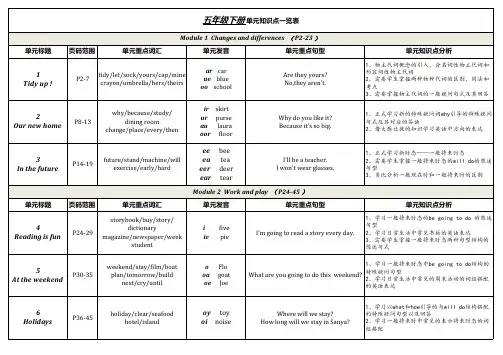
1、学习以what和how引导的与will do结构搭配 的特殊疑问句型以及回答 2、学习一般将来时中常见的表示将来时态的词 组搭配
单元标题
7 Open day
页码范围
单元重点词汇
P46-51
meet/school gate/art room hall/finally/meeting room
show
五年级下册 单元知识点一览表
单元标题
1 Tidy up !
页码范围
单元重点词汇
Module 1 Changes and differences ( P2-23 )
单元发音
单元重点句型
P2-7
tidy/let/sock/yours/cap/mine crayon/umbrella/hers/theirs
1、正式学习新时态——一般将来时态 2、需要学生掌握一般将来时态的will do的陈述 句型 3、类比分析一般现在时和一般将来时的区别
单元知识点分析
1、学习一般将来时态的be going to do 的陈述 句型 2、学习日常生活中常见书籍的英语表达 3、需要学生掌握一般将来时态两种句型结构的 陈述句式
You should take some medicine. You shouldn't go to bed late.
1、学习日常生活中常见的不适症状以及需要注 意事项的英语表达 2、进一步学习以情态动词should引导的表示建 议的祈使句型
Module 4 Things we enjoy ( P68-87 )
1、学习日常生活中常见的节假日的英文表达
11 Chinese fesivals
P74-79
festival/important/call end/village/last
上海牛津版五年级下册M2U2讲义-情态动词shall用法加阅读练习

M2U2重点词汇&情态动词Shall & 阅读理解重点词汇&一般过去时特殊疑问句【知识梳理1】重点词汇Words (词汇)entrance入口处exit出口film电影see a film看电影seat座位funny有趣的princess公主ticket票ticket office售票处【例题精讲1】例.根据以下图片说出对应单词Keys:entrance, princess, seat, film, ticket office, exit【巩固练习1】1.翻译句子请找个座位坐下.2.Let’s go (see) a film.3.The (prince) was born and she was so beautiful.4.When I finished watching the film, I couldn’t find the e . Keys:1.Please take a seat.2. to see3.princess4.exit【知识梳理2】重点语法1. a lot of = lots of, 意为“许多,大量的”,修饰可数或不可数名词,通常用于肯定句中。
如:A lot of money, a lot of people, a lot of potatoes a lot of beefThere are a lot of mushrooms in his plate.He eats a lot of food.2. some表示“一些”,修饰可数或不可数名词,用于肯定句或委婉的请求。
否定句和一般疑问句用any。
I have some book. Would you like some tea?I don’t have any book. Is there any coffee in your cup?There is some bread in the basket.Is there any water in the bottle?3. shall 是情态动词,过去式should。
五年级英语下册MODULE2unit1教案沪教牛津版
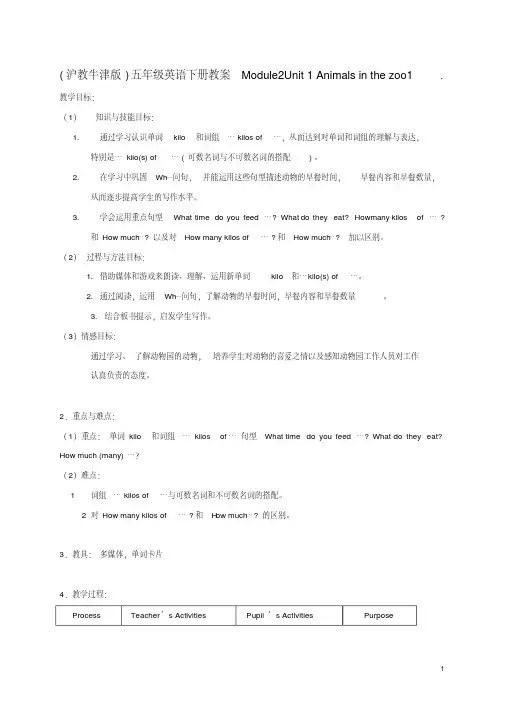
(沪教牛津版)五年级英语下册教案Module2Unit 1 Animals in the zoo1.教学目标:(1)知识与技能目标:1. 通过学习认识单词 kilo和词组… kilos of…,从而达到对单词和词组的理解与表达,特别是… kilo(s) of… (可数名词与不可数名词的搭配)。
2. 在学习中巩固Wh—问句,并能运用这些句型描述动物的早餐时间,早餐内容和早餐数量,从而逐步提高学生的写作水平。
3. 学会运用重点句型What time do you feed …? What do they eat? How m any kilos of … ?和How much…? 以及对How many kilos of … ?和How much…? 加以区别。
(2)过程与方法目标:1. 借助媒体和游戏来朗读、理解、运用新单词kilo和…kilo(s) of…。
2. 通过阅读,运用Wh—问句,了解动物的早餐时间,早餐内容和早餐数量。
3. 结合板书提示,启发学生写作。
(3)情感目标:通过学习、了解动物园的动物,培养学生对动物的喜爱之情以及感知动物园工作人员对工作认真负责的态度。
2.重点与难点:(1)重点:单词 kilo和词组… kilos of…句型What time do you feed …? What do they eat? How much (many) …?(2)难点:1 词组… kilos of…与可数名词和不可数名词的搭配。
2 对How many kilos of … ?和H ow much…? 的区别。
3.教具:多媒体,单词卡片4.教学过程:Process Teacher’s Activities Pupil’s Activities PurposePre-task preparationWhile –task procedure 1. Song(Questions:)(1) How many animals doyou hear in the song?(2) What are they?2. Ask and answer:(1) What’s Mr Tang?(2) What does Mr Tang doevery day?1. Listen and answer:Questions:(1) What time does Mr Tangfeed the elephants?(2) When does Mr Tangclean their cage?(3) What do the elephantseat?(4) How much hay do theyeat?2. Teach “kilo”“…. kilo (s) of..”(1) “kilo”(2) “…kilo (s) of …”(3) “The … eat…kilo(s) of ….”1. Ps sing the song. <Inthe zoo>(Ps answer thequestions.)(Ps answer)(Ps listen and answer)2. Ps learn the newwords:“kilo/ ..kilo(s)of…”(1) Ps read(2) Have a match(3) Pair wok让学生带着问题进行活动,由歌曲引入animals这个主题。
沪教牛津版(深圳用)五年级英语下册Module2Unit4Readingisfun阅读很有趣知识梳理
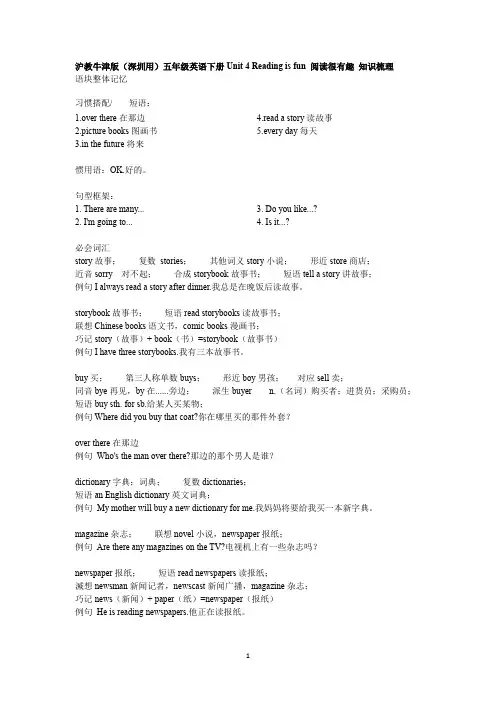
沪教牛津版(深圳用)五年级英语下册Unit 4 Reading is fun 阅读很有趣知识梳理语块整体记忆习惯搭配/短语:1.over there在那边2.picture books图画书3.in the future将来4.read a story读故事5.every day每天惯用语:OK.好的。
句型框架:1. There are many...2. I'm going to...3. Do you like...?4. Is it...?必会词汇story故事;复数stories;其他词义story小说;形近store商店;近音sorry 对不起;合成storybook故事书;短语tell a story讲故事;例句I always read a story after dinner.我总是在晚饭后读故事。
storybook故事书;短语read storybooks读故事书;联想Chinese books语文书,comic books漫画书;巧记story(故事)+ book(书)=storybook(故事书)例句I have three storybooks.我有三本故事书。
buy买;第三人称单数buys;形近boy男孩;对应sell卖;同音bye再见,by在......旁边;派生buyer n.(名词)购买者;进货员;采购员;短语buy sth. for sb.给某人买某物;例句Where did you buy that coat?你在哪里买的那件外套?over there在那边例句Who's the man over there?那边的那个男人是谁?dictionary字典;词典;复数dictionaries;短语an English dictionary英文词典;例句My mother will buy a new dictionary for me.我妈妈将要给我买一本新字典。
英语五年级(下)上海牛津版(M2+Unit1基础知识梳理)教师版
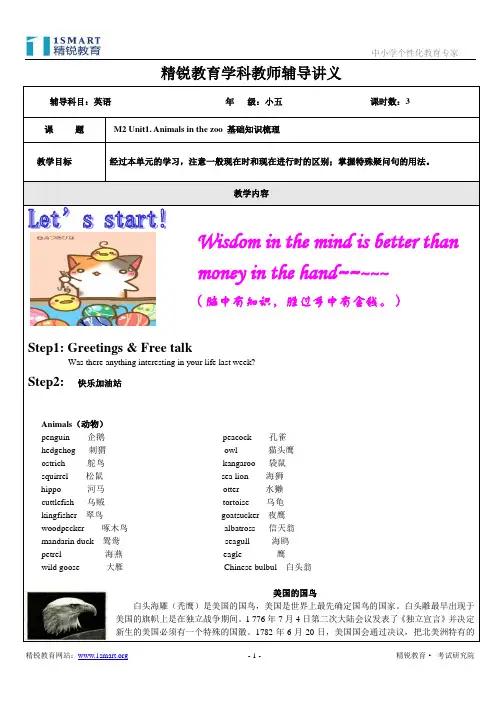
精锐教育学科教师辅导讲义辅导科目:英语年级:小五课时数:3课题M2 Unit1. Animals in the zoo 基础知识梳理教学目标经过本单元的学习,注意一般现在时和现在进行时的区别;掌握特殊疑问句的用法。
教学内容Wisdom in the mind is better thanmoney in the hand~~~~~(脑中有知识,胜过手中有金钱。
)Step1: Greetings & Free talkWas there anything interesting in your life last week?Step2: 快乐加油站Animals(动物)penguin 企鹅peacock 孔雀hedgehog 刺猬owl 猫头鹰ostrich 鸵鸟kangaroo 袋鼠squirrel 松鼠sea lion 海狮hippo 河马otter 水獭cuttlefish 乌贼tortoise 乌龟kingfisher 翠鸟goatsucker 夜鹰woodpecker 啄木鸟albatross 信天翁mandarin duck 鸳鸯seagull 海鸥petrel 海燕eagle 鹰wild goose 大雁Chinese bulbul 白头翁美国的国鸟白头海雕(秃鹰)是美国的国鸟,美国是世界上最先确定国鸟的国家。
白头雕最早出现于美国的旗帜上是在独立战争期间。
1 776年7月4日第二次大陆会议发表了《独立宣言》并决定新生的美国必须有一个特殊的国徽。
1782年6月20日,美国国会通过决议,把北美洲特有的白头海雕作为美国的国鸟,并把这种鸟作为国徽图案的主体。
白头雕外观美丽、性情凶猛,头上有丰满的羽毛,它的最大特点是两头白,即白头白尾。
它代表着勇猛、力量和胜利。
Step3: 错题回顾(请老师添加学生以往错题)Step4: Key points in this unitSection A: Key words一、重点词汇1. branch n.树枝【例句】The cat is on the branch.猫在树枝上。
五年级下册牛津英语M2知识点

Module2知识点汇总Vocabulary词汇一类词汇(要求:会读、知晓词意、会造句表达、会听写)meat pork beef chicken fish vegetable(s)tomato(es) potato(es)carrot(s)cabbage(s)bean(s)fruit rice noodles bread drinks milk juice water tea ticket entrance exit seat shall Chinese English Maths Art Music IT PE subject break timetable二类词汇(要求:会读、知晓词意、会造句表达)breakfast lunch dinner hamburger cola healthy unhealthy either sound a lot of too much chocolate ice cream fridge do exercise hole happen keep...away favourite ham film on上映be quick adult dwarf hunter princess look like fall asleep stay with wake up the fairest Here we are!buy mirror leave add nothing carefully count line dot cinema yesterday run away minute from...to find out safe today have great fun pretty tonight queen一、重点句子(要求:会读、知晓句意、会替换造句、尝试背诵)1.What did you have for breakfast,Danny?I had a hamburger and a cola.2.That doesn’t sound healthy.That’s not healthy either.3.An apple a day keeps the doctor away.语音词汇(要求:会拼读、知晓词意、认读音标)音标组合例词/əƱ/o no ago photo go o_ethose home close hole ow show bowl growcrowblowoa coat boat /a Ʊ/ouout south loud cloud ow how now bow cow /m/m milk mouse room cream film mice moon /n/n night find win incrayonfinerain/ŋ/ng sing ring wingn(k)bankthankn(g)hungry English /j/y yes you yellow year yet /h/h he hat hearhashellohatewh who whose /w/w we wind wait withwhwhenwhatwhere4.Healthy children like running,jumping and playing.They eat a lot of fruit and vegetables.5.Unhealthy children do not play sport very often.They watch too much TV and eat too much sweet food.6.They drink a lot of soft drinks.They do not like rice,fruit or vegetables.7.Jim does some exercise every day.Matt never does any exercise.8.-Shall we go to see a film this afternoon?-Great!/Good idea!/Sorry!9.There are three films on at City Cinema.Which one do you want to see?10.Shall we see Little Tadpoles next time?11.It’s on at two o’clock.Let’s leave home at one thirty.12.Here we are!Let’s buy the tickets first.13.Can I have three tickets for Snow White,please?Two children and one adult.14.Shall we get some drinks?15.Be quick!The film starts in five minutes.16.-What film is on?-Rabbit Run.17.She looks like an old woman.18.What classes do we have today?We have Chinese,Maths,English and IT.19.IT and PE are my favourite subjects.What about you?20.It’s time for Chinese class./It’s time to have Chinese class.21.This is my timetable for today.22.There is a short break after each class.23.From11.30to13.00,I have a lunch break.24.Art is my favourite subject,because I like painting.二、语法知识点(要求:理解并运用)1.too much,too many和a lot of(lots of)它们都是“许多”的意思,但是用法不一样。
沪教牛津版五年级英语(下)Module 2模块知识梳理卷
沪教牛津版五年级英语(下)Module 2模块知识梳理卷时间:30分钟满分:100分一、重点单词。
(英汉互译)(27分)1. 故事书__________________2. 买______________________3. 故事____________________4. 字典;词典______________5. 杂志____________________6. 报纸____________________7. 周;星期________________ 8. 学生____________________9. 周末____________________ 10. 待;暂住_______________11. 电影___________________ 12. 小船____________________13. 安排;计划_____________ 14. 明天___________________15. 建造;建筑_____________ 16. 紧接着_________________17. 哭;喊叫_______________ 18. 直到___________________19. 假日;假期_____________ 20. 清澈的_________________21. 海鲜___________________ 22. 旅馆___________________23. 岛_____________________ 24. poster __________________25. best ____________________ 26. writer __________________27. swing___________________二、按要求写单词。
(24分)1. storybook(复数) ____________________2. picture(复数) _______________________3. story(复数) ________________________4. place(复数)_________________________5. photo(复数)________________________6. read(现在分词)_____________________7. children(所有格)____________________8. cry(第三人称单数)__________________9. butterfly(复数)______________________10. taste(第三人称单数)________________11. beach(复数) _______________________12. plan(复数) ________________________三、重点短语。
上海沪教牛津版英语五年级下册Module 2 重点归纳
—How long will you stay in Sanya? 你将在三亚待多久? —I'll stay there for five days. 我将在那里待五天。 —How long will you stay in the hotel? 你们将在旅馆待多久? —We'll stay there for three days. 我们将在那里待三天。
……………………………………………………………………………………………………………………………………………………………………
推理法是在理解原文表面信息的基础上,作出一定的判断和推理,从而得到文章隐含意 义的阅读方法。
阅读短文,判断正(T)误(F)。 Dear Amy,
I'm happy to write to you. I'll tell you about my summer holiday plan. First, I will join a football club because I like playing football. Second I will visit my grandparents. I miss them very much. I will stay with them for five days. Third, I will learn to cock. My mother is very tired after work. I will cook for her. What about your summer holiday plan, Amy? Please write to me soon.
2020春沪教牛津五年级英语下册教学资料- Module 2 知识清单
Module Work and play一、核心词汇1. 名词storybook故事书story故事dictionary字典;词典magazine杂志newspaper报纸week周;星期student学生weekend周末film电影boat小船;舟holiday假日;假期seafood海鲜hotel旅馆island岛plan安排;计划2. 动词buy买stay待;暂住;逗留build建筑;建造cry哭;喊叫3. 形容词clear清澈的4. 副词tomorrow明天until直到5.兼类词(双重词性)next紧接着;随后;紧接着的二、拓展词汇1.名词poster海报writer作家swing秋千butterfly蝴蝶2.形容词best最好的3.短语over there在那边do a survey做调查act … out表演see a film看电影row a boat划船how long多久go swimming去游泳in the south of在……的南部all year round一年到头三、核心句型1.I’m going to read a story every day. 我打算每天阅读一个故事。
解读: 此句是一个肯定句,用来表示心中打算及准备要做某事。
这里的be going to相当于will,后面跟动词原形, be动词的形式随人称和数的变化而变化。
举一反三: I’m going to draw a picture of a rabbit. 我打算画一幅兔子的画。
We are going to take a photo together. 我们打算一起拍一张照片。
2.What are you going to do this weekend?这个周末你们打算做什么?解读: 这是一个由what引导的特殊疑问句。
举一反三: What is Jack going to do tomorrow?明天杰克打算做什么?What are they going to do next week?下个星期他们打算做什么?3.Where will we stay?我们将住在哪里?解读: 这是一个由where引导的特殊疑问句。
2020春沪教牛津五年级英语下册全册知识清单
2020春沪教牛津五年级英语下册全册知识清单In fifth grade English。
we learn about core vocabulary。
which includes noun possessive pronouns like yours。
mine。
hers。
and theirs。
We also learn about nouns like socks。
caps。
crayons。
machines。
and exercises。
Verbs like let。
stand。
and will arealso included。
as well as adverbs like why。
then。
early。
and hard。
There are also dual-purpose words like tidy。
change。
and study。
Other words like because。
every。
and dining room are also important to know.XXX。
we learn about nouns like nails。
seconds。
and messes。
verbs like drop and stick。
adjectives like enough and more。
and adverbs like twice and easily。
We also learn aboutdual-purpose words like north。
south。
umbrella。
and place。
as well as phrases like tidy up。
full of。
a few。
wild goose。
in the future。
in front of。
take a photo。
wear glasses。
weak in。
not anymore。
all day。
and do exercise.XXX。