
高中英语人教版必修4Unit4BodylanguagePeriod2Languagepoints教案(系列五)
Unit 4 Body languageLanguage points教案Teaching goals教学目标Help the students recognize the useful words and expressions learnt in Reading: be likely to, at ease.Master the usage of the v.-ing form as the adverbial and the attribute2. Ability goals 能力目标Get the students to apply the v.-ing form properly3. Learning ability goals学能目标Lead the students to summarize the grammatical rules themselves.Systematic explanation to help the students apply the v.-ing form correctly.Teaching important points教学重点Get the students to use the v.-ing form as the adverbial and the attribute.Get the students to master the useful words and expressions learnt in ReadingTeaching difficult points 教学难点How to help the students to use the v.-ing form as the adverbial and the attribute.Teaching methods教学方法Question-and-answer activity to help the students to go through the words of this unit.Pair work or group work to make every student work in class.Practicing independently and explainingTeaching aids 教具准备A multi-media computerTeaching procedures and ways教学过程与方式Teaching steps:Step 1 RevisionT: Good morning, boys and girls! Last class I assigned you to collect some information about body language in different cultures. Who would like to have a try?S: Different cultures often have different forms of behavior by sending the same body signals. Nodding one’s head is generally meant to show agreement “yes”, but to Nepalese, Sri Lankans, some Indians and some Eskimos, it means not “yes”,but “no”. When an American rubs his nose, it may mean his disagreeing with someone or rejecting something....T: Good job! Everyone has done a very good job!Step 2 Useful words and expressionsT: You are expected to complete the exercises in Learning about language independently. Now le t’s check the answers.(Ask some students to the blackboard to write down their answers, then ask the other students to correct them.)Suggested answers:Ex.1 on Page 271.local (are)2.represent3.approach4.major5.express6.curious7.general8.likely to (do something)9.avoidEx.2 on Page 281.major2.introduce3.body language4.general5.represent6.actions7.spoken8.likely to; express9.approach10.curious;avoids11.general;localEx.3 on Page 281.nod2.hug3.kiss4.shake5.smile6.clap7.slap8. shakeEx.2 on Page 64Pic 1: starePic 2: frownPic 3: winkPic 4: poutPic 5: raise one’s eyebrowPic 6: shrug one’s shoulders and make a facePic 7: nodPic 8: shake one’s headPic 9: blow a kissPic 10: yawnPic 11: scratch one’s headPic 12: waveStep 3 Find sentencesT: OK, so much for the homework. Today, we are going to learn the v.-ing form used as adverbial and attribute. First, I will give you 4 minutes to read the text again on Page 25 and find out all thesentences with the v.-ing from.After 4 minutes, ask some students to read out the sentences they’ve found.T: OK, time’s up. Who have found out the sentences?S: They are visitors coming from several countries, who are interested in the development of business in China.S: Four people enter looking around in a curious way.S: This is an exciting experience for you, so you stand watching and listening.S: You see her step back appearing surprised, and take a few steps away from Mr Garcia.S: The visitor from Japan comes in smiling at the same time as George Cook from Canada.S: His nose touches Mr Cook’s moving hand, and they both apologize.S: Not all cultures greet each other the same way, nor are they comfortable touching strangers or being too close or too far away.S: In the same way that people communicate with spoken language, they also express their feelings using unspoken “language” through keeping physical distance, actions or posture.S: Most people around the world now greet each other by shaking hands, but some cultures use other greetings as well.S: She arrives hurrying, recognizes Mr Garcia’s smiling face, and then they shake hands and kiss each other twice on each cheek.S: It is an interesting study and can help you avoid difficulty in communication.Step 4 Structure studyT: Today, we are going to learn the v.-ing as the attribute. It means that the v.-ing form is used as the adjective to modify a noun. In the above sentences, which sentences have the v.-ing as the attribute?S: They are visitors coming from several countries, who are interested in the development of business in China.S: This is an exciting experience for you, so you stand watching and listening.S: His nose touches Mr Cook’s moving hand, and they both apologize.S: She arrives hurrying, recognizes Mr Garcia’s smiling face, and then they shake hands and kiss each other twice on each cheek.S: It is an interesting study and can help you avoid difficulty in communication.T: Very good. You have totally understood the usage of v.-ing as attribute. Now, let’s learn more. Take the second sentence for example. Four people enter looking around in a curious way. In this sentence, the v.-ing describes the movement “enter”.So it’s used as an adverbial.In the above sentences, which belongs to this usage?S: Four people enter looking around in a curious way.S: This is an exciting experience for you, so you stand watching and listening.S: You see her step back appearing surprised, and take a few steps away from Mr Garcia.S: The visitor from Japan comes in smiling at the same time as George Cook from Canada.S: Not all cultures greet each other the same way, nor are they comfortable touching strangers or being too close or too far away.S: In the same way that people communicate with spoken language, they also express their feelings using unspoken “language” through keeping physical distance, actions or posture.S: She arrives hurrying, recognizes Mr Garcia’s smiling face, and then they shake hands and kiss each other twice on each cheek.Step 5 Exercises for consolidationT:So far you have got a clear idea about the v.-ing as the attribute and adverbial. Now let’s do some exercises to consolidate your understanding. Have a look at Ex.2 on Page 29.There are some verbs in the box. You have to use their proper forms to finish the sentences.Suggested answers:A1. We were all nervous about the approaching examinations.2. Business leaders look very serious. They do not often have smiling faces.3. The shaking buildings showed us that an earthquake was coming.4 .It is exciting to watch competing athletes reach the other end of the swimming pool.B1. My mother is a happy woman. She always gets up smiling.2. After the dog fell in the lake, it climbed out shaking itself.3. After we saw the comedy show, we left the theatre laughing.4. The blind man walked touching the walls of the buildings.T: OK. So much for the textbook. Now have a look at the following sentences. There are some mistakes in the following sentences. You are required to find out the mistakes and correct them. I will give you 5 minutes to finish this task. You can discuss with your partners.The sentences with some mistakes:1. Having not seen the film, I can’t tell you what I think of it.2. The men worked for extra hours got an extra pay.3. Seen from the top of the hill, we find the city more beautiful.4. Generally speak, facial expressions are helpful communications too.5. “Can’t you read?” the man said, angrily pointed to the notice on the wall.6. Knocking at the door before entering, please.7. European football is played in 80 countries, made it the most popular sport in the world.After 5 minutes, ask some students to give their answers.T: Who has found out all the mistakes and can correct them?S: 1.Not having seen the film, I can’t tell you what I think of it.S: 2.The men working for extra hours got an extra pay.S: 3.Seeing from the top of the hill, we find the city more beautiful.S: 4.Generally speaking, facial expressions are helpful communications too.S: 5.“Can’t you read?” the man said, angrily pointing to the notice on the wall.S: 6.Knock at the door before entering, please.S: 7.European football is played in 80 countries, making it the most popular sport in the world. Step 7 Summary and HomeworkT: Today we have gone over the important words and expressions in this unit. We’ve learnt the v.-ing form as the attribute and as the adverbial. I hope you’ll review what you have learnt after class. T: Homework for today is to finish the exercises of Using structures on Page 64.The Design of the Writing on the BlackboardUnit 4Body languagePeriod 2Learning about language1.Revisioneful words and expressions3.Find sentences4.Structure study (v.-ing as the attribute)5.Exercises for consolidationRecord after TeachingActivities and ResearchThe teacher may first prepare some cards on which some words are written describing body movements. And then two students are needed to act-and-guess, that is, one is to act the body movements and the other may just speak out the words. It is a good chance for the students to consolidate the words they learnt.Reference for teachingGrammar动词-ing形式作定语和状语作定语1.动词-ing形式作定语,单个分词作定语时,放在所修饰的名词之前,说明其修饰名词的性质或特征,表示“供作……之用”和“……的”。
人教版高中英语必修四_Unit4_Body_Language-ReadingII课件(人教新课标)

madeofcanruohanxing
Unit 4 Body Language
Warming up ( 10 m )
Usually what gestures we will do ?
I am tired.
I am full.
I am hungry.
press palms/rest your head on it/ eyes closed
smile
A smile can hide other feelings, such as anger, fear or worry.
A smile does not always mean that one is happy.
Discussion ( 5m )
Post –reading Disctory!
quiet
stop
Discussion :
1.What is the function of body language? 2. What do think the role of body language in our daily life? 3. Are all the body language the same in the world? What do you know about them?
to show no interest to the person
6. standing, holding your arms across your chest
to protect yourself from an unwanted conversation
similar body language
similar body language
英语必修4Unit4BodyLanguage全单元新人教版
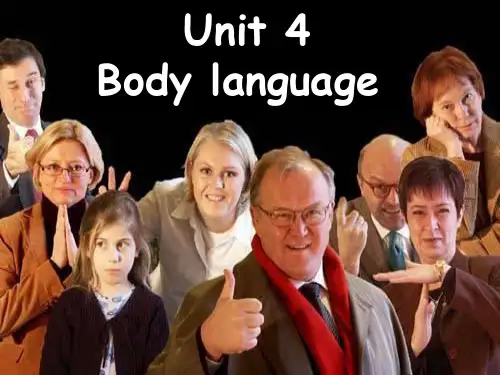
What are they trying to tell us? How are they expressing themselves?
Come and join us!
You’re great! I’m listening carefully!
I’m sorry! Nice to meet you!
hide your feeling
smile
Agreement or refusal
Nod the head up and down or shake the head
Be not interested Look away from a person or yawn
interested Do not believe
• It includes body movements, facial expressions, gestures, posture , speaking distance and other non-verbal signals.
Game: Choose a student to the front of the blackboard and bring out the meaning of some words by some postures.
Unit 4 Body language
Teaching plan
Period 1&2: Warming up & Reading
Period 3: Language & Structure
Period 4: Using Language
Period 5: Period 6:
Listening & Speaking & Writing Workbook reading and practice
高中英语新人教版必修4 Unit4 Body language

Unit 4 Body languageTeaching aims:1.TopicBody language; cultural differences and intercultural communicationeful words and expressions:Nouns: check, stranger, action, comedy, expression, agreement, chest, gesture, adultVerbs: approach, represent, introduce, touch, express, nod, avoid, misunderstanding, yawn, punish Adjectives: major, local, curious, spoken, general, similar, facialExpressions: be likely to, at ease3.Functional items:1. Prohibition and warningsDo not smoke here.Watch out! A car is coming!You may not….Don’t slip.Always stay….Be careful when…Don’t enter here.Don’t sit here.Stop!Be quiet.2. ObligationYou /He must…You should never…4.Grammar1). The –ing form as the attribute.They are visitors coming from several countries.… and this is an exciting experience for you…His nose touches Mr. Cook’s moving hand….2). The –ing form as the attributeFour people enter looking around in a curious way.She arrives hurrying, recognizes Mr. Garcia’s smiling face…Teaching proceduresPeriod 1 SpeakingStep 1. Warming-upT shows some pictures on screen. These pictures are from the Evening Party Celebrating the coming Lunar New Year ofthe Rooster of 2005.Step 2. SpeakingTask 1.Ss look at the screen and try to explain the meaning of the pictures.Suggested answers:Task 2. Ss finish warming up on page 25.Suggested answers:Time forfunTask 3.Ss ingroups offour. Onethinks ofasituation and asks the others to show some actions using bodylanguage. When the one chooses the action that is most likely,it is his or her turn to think of some other situation forthe others to show the actions so that the game may go on fora few rounds.Step 4. TalkingTask 4. Get the Ss to work in pairs. The situation is thatyou are worried about Lin Pei, who is not friendly any more,and does not want to talk to you or her other friends. Sheseems to be sad. She stays alone. She is not doing her homeworkand the teacher is not pleased with her. She doesn’t seemto care about how she looks and behaves.Step 5. Role playTask 5. Ss finish the speaking task on page 67.Period 2. ReadingStep 1. Warming upTask 1. Ss try to answer the following questions:1.What is the purpose of language?2.Do people send each other messages only by words? Whatother ways can be used?3.How can you tell if someone is sad even if they do notspeak?4.Give an example of how you can communicate a feeling tosomeone who does not speak your language.Step 2. ReadingTask 2: Ss read and answer the following questions:1.What’s the main idea of the passage?2.How many parts can the passage be divided into?3.What’s the main idea of each part?4.What can we learn from the passage?A.Never too old to learn.B.Do as the Romans do.C.Four eyes see more than two.D.Every country has its own customs.5.“Mr Garcia approaches Ms Smith,…” the underlined wordhas the same meaning as __________.A.all the approaches to the palace were guarded bytroops(军队).B.The club has made an approach to a local business firmfor sponsorship(资助).C.The time is approaching when we must think about buyinga new house.D.I find him difficult to approach.Task 3: Ss read and fill the following chart:Step 4. After- readingTask 4: Ss in groups and discuss:Suppose your friend is to attend an English corner. Many students coming from different countries will be present as well. She is excited but nervous because she doesn’t know how to make others accept her. What should she do then? Period nguage learningStep 1. RevisionSs retell the text with their own words.Text retelling:My boss has sent me to Pudong Airport to meet some business people from many parts of the world, who are interested in the development of the economy in China.The first one to arrive is Mr. Garcia from Columbia with Julia Smith, a British lady, following behind closely. I introduce them to each other and I’m surprised to see Mr. Garcia come up to Ms. Smith, touch her shoulder and kiss her on the cheek while Ms. Smith steps back appearing surprised. Just then, in comes a visitor from Japan, smiling at the time when the Canadian, George Cook reaches out his hand to him. It happens that Mr. Cook’s hand touches the Japanese’s nose as he bows and they both apologize.So you see, people from different cultures may not greet others in the same way. English people usually do not stand very close to others or touch strangers as people from Spain, Italy and South American countries do. Most people around the world shake hands when they meet while Japanese people will bow. People from Jordan stand quite close to other men and shake hands, but they simply nod to women. And French people shake hands and kiss others on the cheeks.In a word, body language varies in different cultures and is widely used in communication.Step 2. The –ing form as the Attribute and AdverbialAsk Ss to pick out the sentences with v-ing in them and underline them:1.They are visitors coming from several other countries…2.Four people enter looking around in a curious way.3.This is an exciting experience for you, so you standwatching and listening.4.You see her step back appearing surprised, and take a fewsteps away from Mr. Garcia.5.The visitor from Japan comes in smiling at the same timeas George Cook from Canada.6.His nose touches Mr. Cook’s moving hand, and they bothapologize.7.…, nor are they comfortable touching strangers or beingtoo close or too far away.8.…, they also express their feelings using unspokenlanguage through keeping physical distance, actions or posture.9.Most people around the world now greeting each other byshaking hands…10.She arrives hurrying, recognizes Mr. Garcia’s smilingface, and then they shake hands…11.It is an interesting study and can help you avoiddifficulty in communication.12.In most countries, nodding the head up and down showsagreement, while shaking the head means that you do not agree…13.If you stand holding your arms across your chest, you maybe protecting yourself…14.If you sit looking at and turn toward the person you aretalking to…15.We show respect for people by using different gestures.16.Children are taught that looking directly at an adult isnot good behavior.17.…so it is an amazing thing that we understand each otheras well as we do.18.Showing our hands means that we are not armed.19...the Western custom of shaking hands is used,20.Japanese people might cover one hand with the other and,depending on whom they are greeting, how slightly or quite low.Step 3. Language points1. make: make sb do sth.Make oneself doneMake sth to doHis father’s death made him leave school.He was made to leave school by his father’s death.I had to speak loud to make myself heard.They had to make a fire to warm themselves.2. prepare: v. preparation: n.prepare for:be prepared to do3. disappoint: v. disappointment: n.disappointed / disappointing: adj.4. closely /closeShe sat close against the wall.Please listen closely.Come close to doing sth.= almost doing sth.5. Not all cultures greet each other the same way, nor are they ….表否定的not放在句首,该句用倒装语序。
人教版高中英语必修四Unit Four Body language.docx
高中英语学习材料***鼎尚图文理制作***Unit Four Body language课程标准中的内容标准:本单元的的中心话题是“身势语”。
了解身势语的不同文化涵义并正确地加以运用,会在交际场合中起到意想不到的好效果。
单元各项活动的设计都围绕着这个主题进行。
教学细目:1、(情感目标)通过对各种身势语的学习,正确地理解和运用身势语,以达到良好的交际效果。
2、(交际)学习掌握常用的表示“禁止”、“警告”、“义务”的用语。
3、(词汇)通过阅读、师生互动掌握本单元的教学目的和要求中的词汇。
4、(写作)通过口语交流和书面训练,学习并掌握写封短信,询问朋友发生了什么以及是否需要帮助。
5、(语法)通过阅读理解和书面训练,学习掌握动词的-ing形式作定语、状语的用法,并对该项语法内容做一小结。
学习领域与主题内容及要求目标层次人教版必修四UnitFourBodylanguage理解掌握运用1.1.1. 话题:Cultural differences andintercultural communication√1.1.2功能(通过听和说,能在生活中运用下列英语进行交际):1. Prohibition and warning(禁止和警告)Always stay … Do not …Stop! Keep away from …Go away. Don’t enter here.Watch out! Look out!Be careful when … Be quiet.√Come here. You may not …You’ll be fined (200) yuan.Don’t smoke here.Be careful! Don’t slip.2. Obligation(义务和责任)You must … You should never …You’ll be … You’ll have to …You will need to …√1.1.3 Understanding vocabulary(理解词汇)(通过听、看、阅读,能理解下列词汇含义。
人教版高中英语必修四Unit 4《Body language》ppt课件2
成分隔开。
1.做时间状语
①动词-ing表示的动作一发生,谓语表示的动作立即发生(动词-
ing短语多置于句首),如:
Hearing the news,they all jumped with joy.
听到这个消息,他们都高兴地跳了起来。
Seeing the old picture,I couldn’t help thinking of my happy
语法指南
2.做条件状语(一般放在句首) Working hard,you’ll surely succeed. 如果你努力工作,你就会成功。 Knowing anything about it,I will let you know. 如果知道有关此事的任何情况,我会告诉你的。 3.做原因状语(多放在句首) Being excited,she couldn’t say a word. 由于激动,她一句话也说不出来。 Not knowing the language and having no friends in the country,he found it impossible to get a job. 不懂这个国家的语言,在这又没有多少朋友,他觉得不可能找到 工作。
2019/7/31
最新中小学教学课件
10
thank
you!
Байду номын сангаас
2019/7/31
最新中小学教学课件
11
Generally speaking,girls care more for clothes than boys. 一般说来,女孩比男孩更注重着装。
语法指南
(4)当分词已转化成介词或连词,此时也无须考虑与主句主语的关 系。
人教版高中英语必修四:unit4bodylanguage(period2)
Period 2(Reading)预习案一、重点单词1.______________ n.陈述;说明state v t.陈述2.______________ n.飞行;航班fly v i.飞;放飞3._______________ n.社团;联系associate v t.联系4._______________ n.功能;作用5.______________ n.怒火angry adj.气愤的angrily ad v.愤怒地6._____________ v t.代表representative n.代表(人)7.________________ v t. & v i.靠近;接近n.方法;途径8.__________________ v i.误解misunderstanding n.误解understand v t.理解9.__________________ v t.保卫;保护defence n.防御10._________________ v i.减轻11._________________adj.好奇的curiously ad v.好奇地curiosity n.好奇12.___________________ adj.主要的majority n.多数13.___________________ adj.主观的subject n.主语14._________________ adj.面部的face n.面部;脸face v t.面对15.____________ ad v.真实地true adj.真的truth n.真理9._____________________出现,向前10_____________________ 在远处,在远方11._________________________ 好像12._______________________ 准备做某事13.___________________________ 舒适地14.____________________ 丢脸15._____________________背对,背弃二、必备短语1.be curious about2.defend against3.apologize to sb.for sth.4.put up5.on the contrary6.be likely to do sth.7.in general8.shake hands with sb.重点短语再现1. 保卫……以免受 ________________________________2. 很可能;有希望…… ________________________________3. 总的来说;通常 ________________________________4. 仿佛;好像 ________________________________5. 防卫;防护 ________________________________6. 站得离……近 ________________________________7. 与……握手 ________________________________8. 向……伸出手 ________________________________9. 也;还 ________________________________10. 相反 ________________________________I.重点短语1. defend against2. be likely to3. in general4. as if5. in defence6. stand close to7. shake sb's hand/shake hands with sb.8. reach one’s hand out9. as well 10. on the contrary探究案I.重点句型1. Yesterday, another student and I, , went to the Capital International Airport to meet this year's international students.昨天,我和另一名同学代表我们大学的学生会去首都国际机场迎接今年的国际学生。
人教版高中英语必修4《Unit 4 Body language》教案2篇
人教版高中英语必修4《Unit 4 Body language》教案2篇Teaching plan of unit 4 body language编订:JinTai College人教版高中英语必修4《Unit 4 Body language》教案2篇前言:英语作为在许多国际组织或者会议上都是必需语言,几乎所有学校选择英语作为其主要或唯一的外语必修课。
英语教学涉及多种专业理论知识,包括语言学、第二语言习得、词汇学、句法学、文体学、语料库理论、认知心理学等内容。
本教案根据英语课程标准的要求和教学对象的特点,将教学诸要素有序安排,确定合适的教学方案的设想和计划、并以启迪发展学生智力为根本目的。
便于学习和使用,本文档下载后内容可按需编辑修改及打印。
本文简要目录如下:【下载该文档后使用Word打开,按住键盘Ctrl键且鼠标单击目录内容即可跳转到对应篇章】1、篇章1:人教版高中英语必修4《Unit 4 Body language》教案2、篇章2:人教版高中英语必修4《Unit 4 Body language》教案篇章1:人教版高中英语必修4《Unit 4 Body language》教案教学准备教学目标1.教学目标(1)知识目标:学生能掌握下列重点单词和短语的意义和用法:greet, represent, approach, expression, defend, misunderstand, adult, cheek, major, likely, in general。
能够表达一些Body language.(2)能力目标:学生能掌握基本的阅读理解方法:速读,寻读,归纳中心和查找细节。
(3)情感目标:学生了解不同国家和文化的身势语,激发学生学习这种语言的兴趣。
教学重难点教学重点和难点(1)培养学生的阅读策略和技巧,让学生了解文章的细节知识和文章结构。
(2)让学生合适地使用不同的身势语。
(3)课文中现在分词作定语和状语的长难句。
人教版高中英语必修四:unit4bodylanguage(period2).docx
高中英语学习材料***鼎尚图文理制作***Period 2(Reading)预习案一、重点单词1.______________ n.陈述;说明state v t.陈述2.______________ n.飞行;航班fly v i.飞;放飞3._______________ n.社团;联系associate v t.联系4._______________ n.功能;作用5.______________ n.怒火angry adj.气愤的angrily ad v.愤怒地6._____________ v t.代表representative n.代表(人)7.________________ v t. & v i.靠近;接近n.方法;途径8.__________________ v i.误解misunderstanding n.误解understand v t.理解9.__________________ v t.保卫;保护defence n.防御10._________________ v i.减轻11._________________adj.好奇的curiously ad v.好奇地curiosity n.好奇12.___________________ adj.主要的majority n.多数13.___________________ adj.主观的subject n.主语14._________________ adj.面部的face n.面部;脸face v t.面对15.____________ ad v.真实地true adj.真的truth n.真理9._____________________出现,向前10_____________________ 在远处,在远方11._________________________ 好像12._______________________ 准备做某事13.___________________________ 舒适地14.____________________ 丢脸15._____________________背对,背弃二、必备短语1.be curious about2.defend against3.apologize to sb.for sth.4.put up5.on the contrary6.be likely to do sth.7.in general8.shake hands with sb.重点短语再现1. 保卫……以免受 ________________________________2. 很可能;有希望…… ________________________________3. 总的来说;通常 ________________________________4. 仿佛;好像 ________________________________5. 防卫;防护 ________________________________6. 站得离……近 ________________________________7. 与……握手 ________________________________8. 向……伸出手 ________________________________9. 也;还 ________________________________10. 相反 ________________________________I.重点短语1. defend against2. be likely to3. in general4. as if5. in defence6. stand close to7. shake sb's hand/shake hands with sb.8. reach one’s hand out9. as well 10. on the contrary探究案I.重点句型1. Yesterday, another student and I, , went to the Capital International Airport to meet this year's international students.昨天,我和另一名同学代表我们大学的学生会去首都国际机场迎接今年的国际学生。
人教英语必修四Unit4Bodylanguage教案2
Unit 4 Body languangePeriod 2 Learning about Language优秀教案The General Idea of This PeriodThis period will consolidate the words and expressions the students learnt in the reading part and deal with the grammar part:-ing form as the adverbial and the attribute.You will have systematic explanations of it and assign some exercises for the students to consolidate what they learn.Get the students to use the -Get the students to masterHow to help the students to use the -Question-and-answer activity to help the students to go through the words oA multi-media computerThree Dimensional Teaching AimsHelp the students recognize the useful words and expressions learnt in Reading:be likely to,at Master the usage of the -Systematic explanation to help the students apply the -Get the students to apply the -Step 1 RevisionT:Good morning,boys and girls!Last class I assigned you to collect some information about bodyS:Different cultures often have different forms of behavior by sending the same body signals.Nodding one’s head is generally meant to show agreement “yes”,but to Nepalese,S ri Lankans,some Indians and some Eskimos,it means not “yes”,but “no”.When an American rubs his.....T:Step 2 Useful words and expressionsT:You are expected to complete the exercises in Learning about language independently.Now let’s(Ask some students to the blackboard to write down their answers,then ask the other students toSuggested answers:Ex.1 on P1.local (are)2.represent3.approach4.major5.express6.curious7.general8.likely to (do something)1.major2.introduce3.body language4.general5.represent6.actions7.spoken8.likely to;express9.approach10.curious;avoids1.nod2.hug3.kiss4.shake5.smile6.clap7.slapEx.2 on Page 64Pic 1:starePic 6:shrug one’s shoStep 3 Find sentencesT:OK,so much for the homework.Today,we are going to learn the v.-ing form used as adverbial and attribute.First,I will give you 4 minutes to read the text again on Page 25 and find out all the sentences with the v.-T:S:They are visitors coming from several countries,who are interested in the development ofS:Four people enter looking around in a curious wayS:This is an exciting experience for you,so you stand watching and listeningS:You see her step back appearing surprisedS:The visitor from Japan comes in smiling at the same timeS:His nose touches Mr Cook’s moving handS:Not all cultures greet each other the same way,nor are they comfortable touching strangers orbeing too close or too far away.S:In the same way that people communicate with spoken language,they also express their feelings using unspoken “language” through keeping physical distance,act ions or postureS:Most people around the world now greet each other by shaking hands,but some cultures useS:She arrives hurrying,recognizes Mr Garcia’s smiling face,and then they shake hands and kiss each other twice on each chS:It is an interesting study and can help you avoid difficulty in communication.Step 4 Structure studyT:Today,we are going to learn the v.-ing as the attribute.It means that the v.-ing form is used as the adjective to modify a noun.In the above sentences,which sentences have the v.-ing as theS:They are visitors coming from several countries,who are interested in the development ofS:This is an excitingS:His no se touches Mr Cook’s moving handS:She arrives hurrying,recognizes Mr Garcia’s smiling face,and then they shake hands and kissS:It is an interesting study and can help you avoid difficulty in commT:Very good.You have totally understood the usage of v.-ing as attribute.Now,let’s learn more.Take the second sentence for example.Four people enter looking around in a curious way.In this sentence,the v.-ing describes the movement “enter”.So it’s used as an adverbial.In the aboveS:Four people enter looking around in a curious wayS:This is an exciting experience for you,so you stand watching and listeningS:You see her step back appearing surprised,aS:The visitor from Japan comes in smiling at the same timeS:Not all cultures greet each other the same way,nor are they comfortable touching strangers or being too close or too far awayS:In the same way that people communicate with spoken language,they also express their feelings using unspoken “language” through keeping physical distance,actions or postureS:She arrives hurrying,recognizes Mr Garcia’s smiling face,and then they sh ake hands and kisseach other twice on each cheek.Step 5 Exercises for consolidationT:So far you have got a clear idea about the v.-ing as the attribute and adverbial.Now let’s do some exercises to consolidate your understanding.Have a look at Ex.2 on Page 29.There are some verbs1.We were all nervous about the approaching2.Business leaders look very serious.They do not often have smiling3.The shaking4.It is exciting to watch competing1.My mother is a happy woman.She always gets up smiling2.After the dog fell in the lake,it climbed out shaking3.After we saw the comedy show,we left the theatre laughing4.The blind man walked touchingT:OK.So much for the textbook.Now have a look at the following sentences.There are some mistakes in the following sentences.You are required to find out the mistakes and correct them.IThe sentences with some mistakes:5.“Can’t you read?” the man said,angrily pointed to the notice on t7.European football is played in 80 countries,made it the most popular sport in theT:Who has found out all the mistakes and can coS:S:S:S:4.Generally speaking,facial expressions are helpfS:S:S:7.European football is played in 80 countries,making it the most popular sport in the world. Step 7 Summary and HomeworkT:Today we have gone over the important words and expressions in this unit.We’ve learnt the v.-ing form as the attribute and as the adverbial.I hope you’ll review what you have learnt afterT:Homework for today is to finish the exThe Design of the Writing on the BlackboardUnit 4Body languagePeriod 2Learning about language4.Structure study (v.-5.ExercisActivities and ResearchThe teacher may first prepare some cards on which some words are written describing body movements.And then two students are needed to act-and-guess,that is,one is to act the body movements and the other may just speak out the words.It is a good chance for the students toReference for teaching动词-ing形式作定语和状语作定语1.动词-ing形式作定语,单个分词作定语时,放在所修饰的名词之前,说明其修饰名词的性质或特征,表示“供作……之用”和“……的”。
高中英语(人教版必修四)配套课件:Unit 4 Body language Period Two Word版含解析
[归纳拓展] ease n.安逸;舒适;vt.减轻(痛苦、忧虑) at ease舒适;快乐;自由自在 with ease 轻易地;毫不费力地 take one’s ease使某人放松一下 ease sb.of sth.减轻某人的(痛苦、负担等) [易混辨析] at ease/with ease (1)at ease悠闲,安适,舒适,相当于comfortably。 (2)with ease容易地,相当于easily。
1
2
3
4
5
3.If you are not interested in others’ talking,you may A .
A.look away from him or yawn
B.turn toward and look at something
C.fix your attention on the speaker
Part 3(Para.7)( B )
C.Body language is sometimes more important
than spoken language.
答案
.课文阅读理解
1.Which of the following about body language is TRUE?
答案
1
2
3
4
5
5.From the passage we can conclude that A . A.we can understand each other though there are some differences in body language B.it is impossible to understand others from different cultures C.people can communicate freely with each other by smiling,frowning or nodding D.body language is more important than spoken language