
外研版七年级英语下Module11 Body language复习学案
Module11 Body language
【学习目标】
1、掌握下列单词:
bow, kiss, shake, smile, British, German, Japanese, Russian, visitor, Russia, what, nod,head, together, touch…
2、理解并运用下列短语:
shake hands, each other, three times, arm in arm…
3、掌握重点句子:
It is + adj + to do sth.
4、了解各国见面礼仪。
【学以致用】
一、根据首字母和句意完成单词。
1) In Japan people usually b_______ when they meet each other.
2) In Russia people k______ three times.
3) S_______ is also a kind of language.
4) Every year there are lots of v_______ in Dalian.
5) If you agree, please _____ your head. 6) Don't t______ the knife, it's dangerous.
7) Bi Fujian's eyes are small and his n_____ is big.
二、完成下面短语
1)握手_______________ 2)彼此__________________
3)在不同的国家______________ 4)触摸鼻子_______________
5)私人空间____________ 6)nod our heads _____
7)hug each other______________ 8)close to … _______________
9)三次__________________ 10)wave to say Goodbye __________ 11)臂挽臂地 __________________ 12) 事实上 ______________
13) 一点也不 ______________
三、按照句子意思,填入恰当的词。
1. How many f________ languages can you speak?
2. Give more______(person) space when talking to North Americans.
3. I cannot find my glasses. I must put it _________ (某个地方).
4. We Chinese like to ______ (wave) to say goodbye.
5. It is_____ (有礼貌的) to look at people when talking to Chinese.
6. (事实上),wave goodbye is (粗鲁的)in Greece.
7. — Do you like the Japanese food?
— _______________. (一点也不)
8. They are very good friends. They always walk ________(臂挽臂地) when they are together.
四、根据各国见面礼仪完成下列句子。
1.People do _____ things in _____ counties when they meet ______.
2. In Russia People usually _____ ______ times.
3. In China People _____ _____ and _____.Sometimes we ____ our ______.
4. In the US People______ ______, ______ or _____ each other.
5. In India People _____ their ____ together and ____ their_____.
6. In New Zealand Maori people ________ ________.
【祈使句】
1.定义:用于表达命令、请求、劝告、警告、禁止等的句子叫做祈使句。
2.特点:
(1)祈使句没有主语,也可看做省略的主语you。
(2)祈使句以动词原形开头。
Open the door.
(3)祈使句的否定句是在句首加Don’t.如:Don’t smoke in the museum.
(4)Please可以加在祈使句的句首,也可以加在句尾
Please open the door. = Open the door,please.
五、把下列句子变为祈使句。
It’s important to be polite to your parents. ——————————————————————
It’s important to make your room clean. ————————————————————
You cannot touch anything if the teacher doesn’t ask you to. ——————————————————————————
You cannot shout in class. ——————————————————
You cannot enter the lab alone.
【homework】
Write five sentences,for example:
--What do you do when you meet an Indian?
---I put my hands together and nod my heads.
You can use: an American, your best friend, people in the Middle East…。
外研版七年级下册英语Module11Bodylanguage全模块同步学案(含答案)
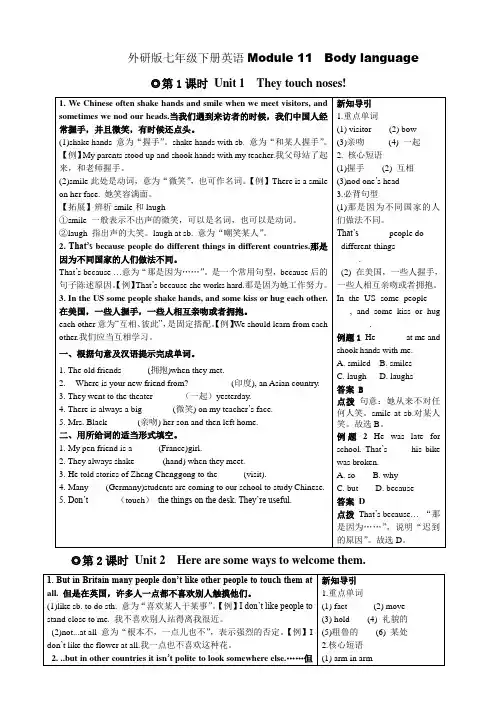
外研版七年级下册英语Module 11 Body language ◎第1课时Unit 1 They touch noses!1. We Chinese often shake hands and smile when we meet visitors, and sometimes we nod our heads.当我们遇到来访者的时候,我们中国人经常握手,并且微笑,有时候还点头。
(1)shake hands 意为“握手”。
shake hands with sb. 意为“和某人握手”。
【例】My parents stood up and shook hands with my teacher.我父母站了起来,和老师握手。
(2)smile此处是动词,意为“微笑”,也可作名词。
【例】There is a smile on her face. 她笑容满面。
【拓展】辨析smile和laugh①smile 一般表示不出声的微笑,可以是名词,也可以是动词。
②laugh 指出声的大笑。
laugh at sb. 意为“嘲笑某人”。
2. That’s because people do different things in different countries.那是因为不同国家的人们做法不同。
That’s because …意为“那是因为……”。
是一个常用句型,because后的句子陈述原因。
【例】That’s because she works hard.那是因为她工作努力。
3. In the US some people shake hands, and some kiss or hug each other. 在美国,一些人握手,一些人相互亲吻或者拥抱。
each other意为“互相、彼此”,是固定搭配。
【例】We should learn from each other.我们应当互相学习。
一、根据句意及汉语提示完成单词。
Module11大单元教学设计英语七年级下册

外研版七年级下册Module 11 Body language单元教学设计
第二单元主要讲述了身体语言在不同情境下的运用。
本单元通过介绍一些基本的身体语言,如微笑、点头、摇头、拥抱等,让学生学会用英语描述这些动作,并了解在不同文化背景下,身体语言的含义可能会有所不同。
本节课的主要内容包括一个关于身体语言的对话和一个相关的故事。
通过学习本节课,学生将能够掌握相关词汇和表达方式,提高他们的听说能力和跨文化交际意识。
第三单元课型是复习课。
主要内容为Language in use。
本单元的主题是身体语言,通过学习不同的肢体动作和表情,让学生掌握一些身体语言的表达方式,并学会用英语进行交流。
本节课时的重点是学习和掌握身体语言中的一些表情和动作,和他人交流时的一些常用表达方式。
通过学习这些内容,能够让学生在日常生活中更好地理解他人的身体语言,并能够自信地用英语表达自己的意思。
核心语言知识分析:这一单元的学习重难点是训练学生对祈使句的理解和使用,并使学生掌握如何正确使用祈使句提出要求和建议,让学生能够熟练的使用英语阅读的方法,如skimming和scanning.
本单元主要采用情景中学习、问题中思考、听读中输入、说写中输出、自主学习与小组合作学习相结合的学习方式。
外研社初中英语七年级下册Module 11 body language Unit 1 教案2

外研社初中英语重点知识精选掌握知识点,多做练习题,基础知识很重要!外研社版初中英语和你一起共同进步学业有成!TB:小初高题库Module 11 body language Unit 1 They touch noses教学目标1. To understand what is talked about in ht conversations2. To briefly talk about the body languages people use when they meet in some countries.教学重点Key words: shake, shake hands, smile, what, head, each other, touch, nose Key structures: How do I do that? No, I didn’t know that.TB:小初高题库教学难点Some students can not understand the conversation and they have difficulty in talking about the body language in English.学情分析This unit is about body language, and different customs in different countries , so students may be very interested in it.学法指导Interactive approach , groupwork教学过程教学内容教师活动学生活动效果预测(可能出现的问题)补救措施修改意见一、lead-in二、show more pictures about body languages三、listen to the 1、Ask students to dothe exercise inactivity 1.1、 show pictures1、go through the1、students do the exercisein activity 1.1、say the words in eachpicture and repeat theaction1、go through the1、some studentscan’t understandthe meaning and theymay have difficultyin doing theexercise.1、some studentscan’t read thewords andexpressions aboutbody language.1、some studentsmay not know thewhere are the people1、 to explainthe order moreclearly.1、 to explain thewords and askstudents to readafter the teacher.1、ask otherstudents to answerTB:小初高题库tape and match the pictures with the nationality in activity 2.四、Act and guess nationalities in thebox with the class.Ask where they arefrom.2、Ask students todescribe the picturesin pairs with theirown words and guesstheir nationalities.3、Play therecording and tellstudents to decidewhich picture isdescribed.4、check theanswers.1. ask one students tocome to the front andact out the words onnationalities in the boxand answer the teacher’squestions.2、describe the pictures inpairs with their own wordsand guess theirnationalities.3、listen to the tape anddecide which picture isdescribed in the tape.4、elicit answers from theclass and ask students tosay why.1. one students to come tothe front and act out thein the picture from.2. students can’tdescribe thepictures with theirown words.3、students areunable tounderstand theconversation in thetape.4. some students maygive the wronganswers.1. some students maynot understandtheir classmates.the question untilsomebody give thecorrect answers.2、the teacher givethem an example.3、play the tapeagain.4. ask otherstudents to answerthe question and theteacher can give theanswers too.1. ask theirclassmates for theanswers.TB:小初高题库五、Introduce more about the body language in different countries六、Homework the PPT, then theother students guess.Show students PPTwords on the PPT, then theother students guess板书设计Module 11 Body languageUnit 1 They touch noses Bow : 3 Homework: Kiss: 1Shake hands: 2Smile: 1 2 3参考书目及推荐资料七年级下英语教材教学反思TB:小初高题库TB:小初高题库相信自己,就能走向成功的第一步教师不光要传授知识,还要告诉学生学会生活。
初一七年级英语下册外研版Module 11 Body language 教案
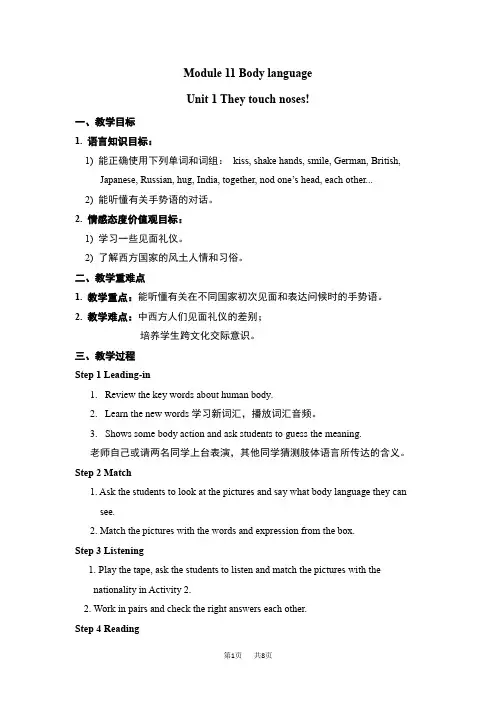
Module 11 Body languageUnit 1 They touch noses!一、教学目标1. 语言知识目标:1) 能正确使用下列单词和词组:kiss, shake hands, smile, German, British,Japanese, Russian, hug, India, together, nod one’s head, each other...2) 能听懂有关手势语的对话。
2. 情感态度价值观目标:1) 学习一些见面礼仪。
2) 了解西方国家的风土人情和习俗。
二、教学重难点1. 教学重点:能听懂有关在不同国家初次见面和表达问候时的手势语。
2. 教学难点:中西方人们见面礼仪的差别;培养学生跨文化交际意识。
三、教学过程Step 1 Leading-in1.Review the key words about human body.2.Learn the new words学习新词汇,播放词汇音频。
3.Shows some body action and ask students to guess the meaning.老师自己或请两名同学上台表演,其他同学猜测肢体语言所传达的含义。
Step 2 Match1. Ask the students to look at the pictures and say what body language they cansee.2. Match the pictures with the words and expression from the box.Step 3 Listening1. Play the tape, ask the students to listen and match the pictures with thenationality in Activity 2.2. Work in pairs and check the right answers each other.Step 4 Reading1.Guide the students to listen to the conversation in Activity 3 and answer thequestion:What so the people in China/US/India/New Zealand do when they meet?1)In China a. shake hands, kiss or hug each other2)In the US b. shake hands, smile or nod heads3)In India c. touch nose4)In New Zealand d. put their hands together and nod theirheads2. ScanningScan the language and answer the questions:1)Who will come to Linging’s school?2)What will Maori people do when they meet?3. Careful readingAsk the students to read the dialogue carefully and complete the table with the correct form of the words from the box.Step 5 Post-reading1. Let the students act out the dialogue.2. Show some pictures and things to organize the students to talk about them.3. Have the students act out their new dialogues.Step 6 listen and repeatListen to the recording and pay attention to the pronunciation.Step 7 Group workMake a conversation to talk about what you do and say when you meet.--- What do you do and say when you meet your teacher in the morning?--- I smile and say good morning.Step 8 Language points1. … in Russia, people usually kiss three times, left, right, left.kiss v.吻,亲吻eg. The mother kissed the sleeping baby on his head.妈妈亲了一下这个睡着的婴儿的额头。
外研版七年级英语下册Module11Bodylanguage复习教案
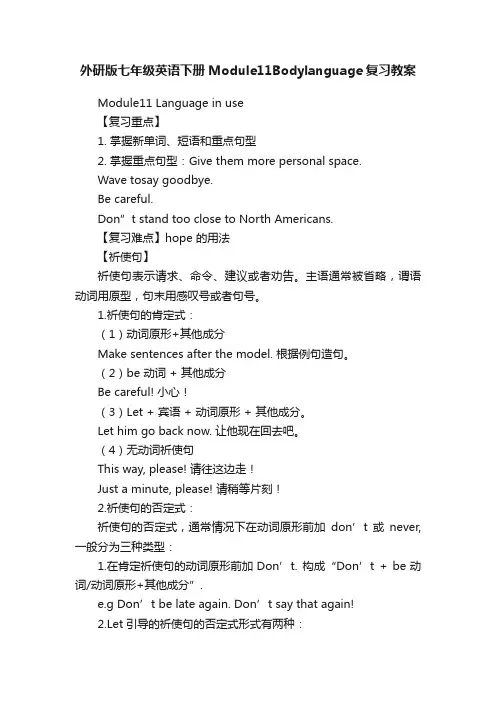
外研版七年级英语下册Module11Bodylanguage复习教案Module11 Language in use【复习重点】1. 掌握新单词、短语和重点句型2. 掌握重点句型:Give them more personal space.Wave tosay goodbye.Be careful.Don”t stand too close to North Americans.【复习难点】hope 的用法【祈使句】祈使句表示请求、命令、建议或者劝告。
主语通常被省略,谓语动词用原型,句末用感叹号或者句号。
1.祈使句的肯定式:(1)动词原形+其他成分Make sentences after the model. 根据例句造句。
(2)be 动词 + 其他成分Be careful! 小心!(3)Let + 宾语 + 动词原形 + 其他成分。
Let him go back now. 让他现在回去吧。
(4)无动词祈使句This way, please! 请往这边走!Just a minute, please! 请稍等片刻!2.祈使句的否定式:祈使句的否定式,通常情况下在动词原形前加don’t 或never, 一般分为三种类型:1.在肯定祈使句的动词原形前加Don’t. 构成“Don’t + be动词/动词原形+其他成分”.e.g Don’t be late again. Don’t say that again!2.Let引导的祈使句的否定式形式有两种:以let 开头的祈使句,如果后面跟第一、第三人称名词或代词①以let’s 开头的祈使句,必须在let’s 后加not.Let’s not eat and drink in the classroom.②Let sb do sth.,可在句首加Don’t, 也可在let 后加not.Eg.Don’t let him cry here.=Let him not cry here.(3) 在公共场所的提示语中,否定祈使句常用“No+ 名词\动词ing形式”表示禁止做某事.eg.No smoking.禁止吸烟!No photos!禁止拍照!Ⅰ. 用所给词的适当形式填空1. Here________(be)some ways to welcome foreign actors.2. ________(not walk)in the forest. It’s d angerous.3. ________(Russia)kiss each other when they meet.4. They shake their heads________(say)no.5. Many________(visit)come to the Great Wall every day.Ⅱ. 单项选择1. ______when you cross the road.A. To careB. Be carefulC. To be carefulD. Be care2. ______sleep too late. It’s bad for your health.A. Can’tB. Not toC. Don’tD. Doesn’t3. We can’t say______.A. somet hing personalB. personal somethingC. anything personalD. personal anything4. —Shall we meet at 9: 00 tomorrow morning? —______.A. All rightB. That’s all rightC. RightD. That’s right5. They waved _______ goodbye to us.A. sayB. to sayC. sayingD. Said。
外研版英语七年级下册《Module11BodylanguageUnit2》说课稿
外研版英语七年级下册《Module11 Body language Unit 2 》说课稿一. 教材分析外研版英语七年级下册《Module11 Body language Unit 2》是一篇关于身体语言的阅读文章。
本节课的主要内容是通过一个故事情节,让学生掌握与身体语言相关的词汇和表达方式,并能够运用这些词汇和表达方式进行口语交流。
文章内容丰富,贴近学生的生活,有利于激发学生的学习兴趣。
二. 学情分析根据我对所教班级的了解,学生们对英语学习充满热情,具备一定的英语基础。
他们善于观察生活中的细节,能够发现并模仿身体语言。
然而,部分学生对英语口语表达仍存在一定的恐惧心理,需要在课堂上给予更多的鼓励和指导。
三. 说教学目标1.知识目标:让学生掌握与身体语言相关的词汇和表达方式,如smile,nod, shake hands等。
2.能力目标:培养学生运用所学生态进行口语交流的能力,能够用英语描述和解释身体语言。
3.情感目标:培养学生对英语学习的兴趣,增强自信心,提高团队合作意识。
四. 说教学重难点1.重点:让学生掌握与身体语言相关的词汇和表达方式。
2.难点:运用所学生态进行口语交流,用英语描述和解释身体语言。
五. 说教学方法与手段1.情境教学法:通过设置真实的生活情境,让学生在实际语境中学习和运用英语。
2.任务型教学法:通过小组合作完成任务,激发学生的学习兴趣,提高团队合作意识。
3.直观教学法:运用图片、视频等直观教具,帮助学生更好地理解和记忆单词和表达方式。
4.互动式教学法:鼓励学生积极参与课堂活动,提高英语口语表达能力。
六. 说教学过程1.导入:通过展示一组图片,引导学生观察并描述图片中的身体语言,激发学生对课程的兴趣。
2.呈现:教师通过讲解和示范,让学生学习和掌握与身体语言相关的词汇和表达方式。
3.实践:学生分组进行角色扮演,运用所学生态进行口语交流,教师给予指导和反馈。
4.巩固:学生进行小组讨论,用英语描述和解释生活中的身体语言现象。
外研版英语七年级下册《Module11 Body language Unit 2 》教学设计
外研版英语七年级下册《Module11 Body language Unit 2 》教学设计一. 教材分析外研版英语七年级下册《Module11 Body language Unit 2》主要讲述了身体语言在不同情境下的运用。
本单元通过介绍一些基本的身体语言,如微笑、点头、摇头、拥抱等,让学生学会用英语描述这些动作,并了解在不同文化背景下,身体语言的含义可能会有所不同。
本节课的主要内容包括一个关于身体语言的对话和一个相关的故事。
通过学习本节课,学生将能够掌握相关词汇和表达方式,提高他们的听说能力和跨文化交际意识。
二. 学情分析七年级的学生已经具备了一定的英语基础,能运用简单的英语进行日常交流。
但是,对于身体语言的理解和运用还有待提高。
此外,学生可能对不同文化背景下的身体语言差异了解不多,因此需要在教学中加以引导和拓展。
三. 教学目标1.知识目标:学生能掌握与身体语言相关的词汇和表达方式,如smile,nod, shake one’s head, give a hug等。
2.能力目标:学生能在日常生活中运用所学知识进行简单的交流,提高他们的听说能力。
3.情感目标:学生能意识到不同文化背景下身体语言的差异,培养他们的跨文化交际意识。
四. 教学重难点1.重点:学生能掌握与身体语言相关的词汇和表达方式。
2.难点:学生能正确运用所学知识进行实际交流,并了解不同文化背景下身体语言的差异。
五. 教学方法1.任务型教学法:通过设置各种真实的任务,让学生在实践中学习和运用语言。
2.情境教学法:创设各种情境,让学生在具体的语境中学习和发展语言。
3.交际教学法:鼓励学生积极参与课堂交流,提高他们的听说能力。
六. 教学准备1.教师准备:提前准备好与身体语言相关的图片、视频等教学资源。
2.学生准备:学生预习相关词汇和表达方式,了解身体语言的基本概念。
七. 教学过程1.导入(5分钟)教师通过展示一些身体语言的图片,如微笑、点头、摇头等,引导学生谈论身体语言的使用和意义。
外研版七年级下册(新)英语教案:Module 11 Body language 教案
Module 11 Body language【教学内容分析】本模块以肢体语言为话题。
比较详细的介绍了各国的肢体语言,利用对话等相关内容展示了各国应该遵守的肢体语言规则。
内容充实,且功能性强,学生在语言学习和语言训练的同时可以了解更多的外国文化。
本模块的语法内容是祈使句。
掌握祈使句的定义及特点。
会运用祈使句表达自己的情感、命令和要求。
教师在教学的过程中要运用归纳法来帮助学生形成一个整体的概念。
【学情分析】学生对本模块的中心话题会很感兴趣,握手等身体语言为学生所熟悉,所以便于开展听、说、读、写活动,激发学生的学习热情,积极参加小组活动。
Unit 1 They touch noses!【教学目标】Knowledge objectiveTo master some words and expressions: bow, kiss, shake hands, smile, British, German, Japanese, Russian, visitor, Russia, what, nod, head, hug, each, each other, India, together, Maori, touch, noseAbility objective1. To understand a conversation about body language.2. To make a new dialogue about body language.Moral objectiveTo be glad to know about other kinds of culture, and respect the foreign culture.【教学重点】To learn about the different body languages in different countries.【教学难点】To make a new dialogue in pairs.【教学方法】PWP method, task-based method and interactive approach【教学手段】A tape recorder, multimedia and some pictures【教学过程】Teaching Procedures:Step 1 Warming upSs look the pictures and say what body language they can see.Step 2 Consolidate new wordsLook and say. The teachers shows the pictures of new words and let the students to say as quickly as possible.Step 3 Listen and match the pictures with the nationality1. Look at the pictures and choose the right pictures.2. Work in pairs and check the right answers each other.Step 4 Listen and answerListen and answer the question.1. Who will come to Linging’s school?2. What will Maori people do when they meet?Step 5 Listen and read1. Complete the table with the correct form of the words from the box.2. Point out the everyday English.Step 6 Learning to learnLet Ss know to understand and respect the body language in other countries.Step 7 Pronunciation1. Listen and repeatPractise pronunciation2. Group workMake a conversation to talk about what you do and say when you meet.- What do you do and say when you meet your teacher in the morning?- I smile and say good morning.Step 8 Language points1. We Chinese often shake hands and smile.shake hands 表示“握手”。
七下外研社英语M11Body language学案
1、会读并应用本课的新词汇和短语。
2、能听懂并流利阅读本课的对话。
3、会谈论身势语,掌握祈使句的用法.二.学习重点、难点1、新词汇P109 :bow, kiss, shake, shake hands, smile, British, German,Japanese ,visitor ,Russia ,what ,nod ,head ,hug ,each ,each otherIndia ,together ,Maori ,touch ,nose2、重点句型:1)In Rssia,people usually kissthree times,left,right,left.2)They touch noses.3) How do I do that?4)That’s because …5)I didn’t know that.一、检测联系阶段选词填空:People do ________ things in ________ counties when they meet ________ _______.阅读课本第66页Activity 3中的对话,并试着将下列短语英汉互译。
1)握手_______________ 2)彼此__________________3)在不同的国家______________ 4)触摸鼻子_______________5)I didn't know that._____________ 6)nod our heads_________________7)hug each other_______________ 8) in Russia ___________________9)三次____________________ 10)do different things__________10)body language ______________11)最好的朋友 ____________________ 12)电影明星__________________二、启动导入阶段认真预习书本P101-102页Module 11语法,了解祈使句的用法。
2023年外研版七年级英语下册module 11 Unit1 学案
Module 11 Body Language学案Unit 1 They touch noses!(Period 1)[学习目标]1.能听懂对不同国家身体语言的描述。
2.能运用本课语言谈论不同国家的身体语言。
3.了解不同国家的身体语言及文化,从中体会学习英语的乐趣。
[学习重难点]1.要求掌握的词汇:bow, kiss, shake, smile, British, German, Japanese, Russian,visitor, Russia, what, nod heads, hug, each, India, together, Maori, touch noses.2.重点句型:①Lingling, you know, in Russia, people usually kiss three times, left, right, left.②That’s because people do different things in differen t countries.③They touch noses![自主先学]1.思考:We can express ourselves not only through language but also body language such as different postures and facial expressions. 除了语言之外,身体语言也可以达到交流表达的目的,比如不同的姿势和表情。
那么,聪明的你在生活中都注意到哪些身体语言了呢?______________________________________________________________ .[合作探究]1.Listen for the key words(关键词)-greeting and nationalities while listening.They are _______________. They are ____________. They are ______________. They are ______________ They are ___________. They are ____________.2. Choose the countries mentioned(提及).Russia ( ) China( ) French ( ) US( ) British ( ) New Zealand( ) German( ) India ( )3. Listen and answer1): Who will Linging meet tomorrow?________________2): What will she do to welcome the visitors?In _________, people usually ______________________ when they meet visitors 3): What do people do in the US when they meet?In the US, some people __________, and_______or________each other.4): Maori people in New Zealand ___ when they meet.A. shake handsB. touch nosesC. hug each other教师的职务是‘千教万教,教人求真’;学生的职务是‘千学万学,学做真人’。