
2018年6月英语六级详细参考答案(全三套)
2018年6月英语六级详细参考答案(全三套)2018年6月丨六级听力1听力第一套Section AConversation OneM: What's all that? Are you going to make a salad?W: No I'm going to make a gazpacho.M: What's that?W: Gazpacho is a cold soup from Spain. It’s mostly vegetables. I guess you could call it a liquid salad. M: Cold soup? Sounds weird.W: It's delicious. Trust me. I tried it for the first time during my summer vacation in Spain. You see, in the south of Spain, it gets very hot in the summer, up to 40°C.So acold gazpacho is very refreshing. The main ingredients are tomato, cucumber, bell peppers, olive oil and stale bread.M: Stale bread? Surely you mean bread for dipping into the soup?W: No. Bread is crushed and blended in like everything else. It adds texture and thickness to the soup. M: Mm. And is it healthy?W: Sure. As I said earlier it's mostly vegetables. You can also add different things if you like, such as hard-boiledegg or cured ham.M: Cured ham? What’s that?W: That's another Spanish delicacy. Have you never heard of it? It is quite famous.M: no, is it good too?W: Oh, yeah, definitely. It’s amazing. It’s a little dry and salty, and it's very expensive because it comes from a special type ofpigthat only eats a special type of food. The harm is covered in salt to dry and preserve it. And left to hang for up to 2 years, it has a very distinct flavor.M: Mm. Sounds interesting. Where can I find some?W: Itusedto be difficult to get Spanish produce here. But it's now a lot more common. Most large supermarket chains have cured ham in little packets but in Spain you combine a whole leg.M: A whole peg leg? Why would anybody want so much ham?W: In Spain, many people buy a whole leg for special group events, such as Christmas. They cut it themselves into very thin slices with a long flat knife.Questions 1 to 4 are based on the conversation you have just heard.1. What do we learn about gazpacho?2. For what purpose is stale bread mixed into gazpacho?3. Why does the woman think gazpacho is healthy?4. What does the woman say about cured ham?Conversation TwoM: Hello, I wish to buy a bottle of wine.W: Hi, yes. What kind of wine would you like?M: I don't know, sorry. I don't know much about wine.W: That’s no problem at all. What’s the occasion and how much would you like to spend?M: It's for my boss. It’s his birthday. I know he likes wine, but I don't know what type. I also do not want anything too expensive, maybe mid-range. How much would you say is a mid-range bottle of wine approximately?W: Well, it varies greatly. Our lowest prices are around $6 a bottle, but those are table wines. They are not very special. And I would not suggest them as a gift. On the other end, our most expensive bottles are over $150. If you are looking for something priced in the middle, I would say anything between $30 and $60 would make a decent gift. How does that sound?M: Mm, yeah. I guess something in the vicinity of 30 or 40 would be good. Which type would you recommend?W: I would say the safest option is always a red wine. They are generally more popular than whites, and can usually be paired with food more easily. Our specialty here are Italian wines, and these tend to be fruity with medium acidity. This one here is a Chianti, which is perhaps Italy's most famous type of red wine. Alternatively, you may wish to try and surprise your boss with something less common, such as the Infantile. The grapes are originally native to Croatia but this winery is in east in Italy and it has a more spicy and peppery flavor. So to summarize, the Chianti is more classical and the Infantile more exciting. Both are similarly priced at just under $40.M: I will go with Chianti then. Thanks.Questions 5 to 8 are based on the conversation you have just heard.5. What does the woman think of table wines?6. What is the price range of wine the man will consider?7. Why does the woman recommend red wines?8. What do we learn about the wine the man finally bought?Section BPassage OneMany people enjoysecretcodes, the harder the code the more some people would try to figure it out. In war time, codes are especially important, they help army sendnews about battles and signs of enemy forces. Neither side wants its code broken by the other. One very important code was never broken, it was used during world war two by the Americans. It was spoken code, never written down and it was developed and used by NH Indians. They were called the NH code talkers. The NH created the codes in their own language. NH was hard to learn and only a few people know it. So it was pretty certain that the enemy would not be able to understand the code talkers. In addition, the talkers used code words. They called a submarine and an iron fish and a small bomb thrown by hand, a potato. If they wanted to spell something, they used code words for letters of the Alphabet. For instance, the letter A was ant orappleor ax, the code talkers worked mostly in the islands in the Pacific. One or two would be assigned a group of soldiers. They would send messages by field telephone to the code talker in the next group. And he would relay the information to his commander. The code talkers played an important part in several battles. They helped the troops coordinate their movements and attacks. After the war, the US governments honored them for what they had accomplished. Theirs was the most successful wartime code ever used.Questions 9 to 11 are based on the passage you have just heard.9 . What does the speaker say many people enjoy doing?10.What do we learn about the NH talkers?11.What is the speaker mainly talking about?Passage TwoIf you are young and thinking about your career, you want to know where you can make a living, well, this going to be a technological replacement of a lot of knowledge intensive jobs in the next twenty years. Particularly in the two largest sectors of the labor force with professional skills. One is teaching, and the other, health care. You have so many applications and software and platforms, but going to come in and provide information and service in these two fields, which means a lot of health care and education sectors, would be radically changed, and lots of jobs will be lost. Now, where will the new jobs be found, well the one sector of the economy that can't be easily duplicated by even small technologies is the caring sector, the personal care sector, that is, you can't really get a robot to do agreat massage or physical therapy. Or, you can't get the kind of personal attention you need with regard to therapy or any other personal service. There could be very high and personal services, therapist do charge a lot of money, I think there's no limit to the amount of personal attention and personal care, people would like if they could afford it. But, the real question in the future is, how come people afford these things if they don't have money, because they can't get a job that pays enough, that's why I wrote this book, which is about how to reorganize the economy for the future when technology brings about destructive changes, to what we used to consider high income work.Questions 12 to 15 are based on the passage you have just heard.12. What does the speaker say will happen in the next twenty years?13. Where will young people have more chances to find jobs?14. What does the speaker say about therapist?15. What is the speaker’s book about?Section CRecording OneAmerican researchers have discovered the world's oldest paved road, a 4,600-year-old highway. It linked a stone pit in the Egyptian desert to waterways that carried blocks to monument sites along the Nile. The eight-mile road is at least 500 years older than any previously discovered road. It is the only paved road discovered in ancient Egypt, said geologist Thomas Bown of the United States Geological Survey. He reported the discovery on Friday. "The road probably doesn't rank with the pyramids as a construction feat, but it is a major engineering achievement," said his colleague, geologist James Harrell of the University of Toledo. "Not only is the road earlier than we thought possible, we didn't even think theybuiltroads." The researchers also made a discovery in the stone pit at the northern end of the road: the first evidence that the Egyptians used rock saws. "This is the oldest example of saws being used for cutting stone," said Bown’s colleague James Hoffmeier of Wheaton College in Illinois."That's two technologies we didn't know they had," Harrell said "And we don't know why they were both abandoned." The road was discovered in the Faiyum Depression, about 45 miles southwest of Cairo. Short segments of the road had been observed by earlier explorers, Bown said, but they failed to realize its significance or follow up on their observations. Bown and his colleagues stumbled across it while they were doing geological mapping in the region. The road was clearly built to provide services for the newly discovered stone pit. Bown and Harrell have found the camp that housed workers at the stone pit. The road appears today to go nowhere, ending in the middle of the desert. When it was built, itsterminal was a dock on the shore of Lake Moeris, which had an elevation of about 66 feet above sea level, the same as the dock. Lake Moeris received its water from the annual floods of the Nile. At the time of the floods, the river and lake were at the same level and connected through a gap in the hills near the modern villages of el-Lahun and Hawara. Harrell and Bown believe that blocks were loaded onto barges during the dry season, then floated over to the Nile during the floods to be shipped off to the monument sites at Giza and Saqqara.Questions 16 to 18 are based on the recording you have just heard.16. What do we learn from the lecture about the world’s oldest paved road in Egypt?17. What did the researchers discover in the stone pit?18. For what purpose was the paved road built?Recording TwoThe thin, extremely sharp needles didn’t hurt at all going in. Dr. Gong pierced them into my left arm, around the elbow that had been bothering me. Other needles were slipped into my left wrist and, strangely, into my right arm, and then into both my closed eyelids.There wasn’t any discomfort, just a mild warming sensation. However, I did begin to wonder what had driven me here, to the office of Dr. James Gong, in New York’s Chinatown.Then I remembered--the torturing pain in that left elbow. Several trips to a hospital and two expensive, uncomfortable medical tests had failed to produce even a diagnosis.“Maybe you lean on your left arm too much,”the doctor concluded, suggesting I see a bone doctor.During the hours spent waiting in vain to see a bone doctor, I decided to take another track and tryacupuncture. A Chinese-American friend recommended Dr. Gong. I took the subway to Gong’s second-floor office, marked with a hand-painted sign.Dr. Gong speaks English, but not often. Most of my questions to him were greeted with a friendly laugh, but I managed to let him know where my arm hurt. He asked me to go into a room, had me lie down on a bed, and went to work. In the next room, I learned, a woman dancer was also getting a treatment. As I lay there a while, I drifted into a dream-like state and fantasized about what she looked like. Acupuncturists today are as likely to be found on Park Avenue as on Mott Street. In all there are an estimated 10,000 acupuncturists in the country. Nowadays, a lot of M.D.s have learned acupuncture techniques; so have a number of dentists. Reason? Patient demand. Few, though, can adequately explain how acupuncture works.Acupuncturists may say that the body has more than 800 acupuncture points. A life force called qicirculates through the body. Points on the skin are energetically connected to specific organs, body structures and systems. Acupuncture points are stimulated to balance the circulation of qi.The truth is, though acupuncture is at least 2,200 years old,“nobody really knows what’s happening,”says Paul Zmiewski, a Ph.D. in Chinese studies who practices acupuncture in Philadelphia.After five treatments, there has been dramatic improvement in my arm, and the pain is a fraction of what it was. The mainly silent Dr. Gong finally even offered a diagnosis for what troubled me.“Pinched nerve,”he said.Questions 19 to 21 are based on the recording you have just heard.19. What does the speaker find especially strange?20. Why did the speaker go see Dr. Gong?21. What account for the growing popularity ofacupuncturein the United States, according to the speaker?Recording ThreeRonald and Lois married for two decades considered themselves a happy couple. But in the early years of their marriage both were distilled by persistent arguments that seem to fade away without ever being truly resolved. They uncovered clues to what was going wrong by researching a fascinating subject. How birth order affects not only your personality but also how compatible you are with your mate. Ronald and Lois are only children and onlies grow up accustomed to being the apple of parents’ eyes. Match two onlies and you have partners to sub consciously expect each other to continue fulfilling this expectation while neither has much experience in the giving and here's a list of common birth order characteristics and some thoughts on the best and worst Marischal matches for each. The oldest tends to be self-assured, responsible, a high achiever and relatively seriously reserved. He may be slow to make friends. Perhaps content with only one companion. The best matches are with a youngest and only or a mate raised in a large family. The worst match is with another oldest since the two will be too sovereign to share a household comfortably. The youngest child of the family thrives on the tension and tends to be outgoing, adventurous, optimistic, creative and less ambitious than others in the family. He may lack self-discipline and have difficulty making decisions on his own. A youngest brother of brothers often unpredictable and romantic will match best with an oldest sister of brothers. The youngest sister of brothers is best matched with the oldest brother of sisters who will happily indulge these traits. The middle child is influenced by many variables however middles are less likely to take initiative and more anxious and self-critical than others. Middles often successfully marry other middles. Since both arestrong on tact not so strong on the aggressiveness and tend to crave affection. The only child is often most comfortable when alone. But since an only tends to be a well-adjusted individual she'll eventually learn to relate to any chosen spouse. The male only child expects his wife to make life easier without getting much in return. He is sometimes best matched with the younger sister of brothers. The female only child who tends to be slightly more flexible is well matched with an older man who will indulge her tendency to test his love—her worst much. Another only of course.Questions 22 to 25 are based on the recording you have just heard.22. What does the speaker say about Ronald and Lois's early years of married life?23. What do we learn about Ronald and Lois?24. What does the speaker say about the oldest child in the family?25. What does the speaker say about the only children?参考答案:BADCB ADDCA CBCAB DABDC .ACADB2听力第二套Section AConversation One1. D) She is the owner of a special cafe.2. A) They bear a lot of similarities.3. A) By giving them regular cleaning and injections.4. C) They love the animal in her cafe.Conversation Two5. D) It is mostly garbage.6. B) TV commercials.7. C) Trying to trick children into buying their products.8. C) They seldom had junk foodSection BPassage One9. C)Tombs of ancient rulers.10. B) It’s hardly associated with great civilizations.11. A ) It carries about one fifth of the world’s fresh water.Passage Two12.B) We are always in a rush to do various things.13. C) She was accustomed to tight schedules.14. D) Reading a book about slowing down.15. B) She came to enjoy everyday tasks.Section CRecording One16. C) They pose a threat to the local ecosystem.17. D) Their distinctions are artificial.18. A) Only a few of them cause problems to native species. Recording Two19. A)Respect their traditional culture.20. C) Drinking alcohol on certain days of a month.21.D) They have a break from 2:00 to 5:30.Recording Three22. D) He had the company’s bedroom extensively renovated.23. B) Its articles should be short and inspiring.24 D) He treated the employees like members of his family.25 C) Several hundred of its employees got fired.2018年6月丨六级阅读1阅读第一套Section A开头:Scientists26. K) puzzled27. M) removed28. A) chronicles29. L) remnants30. F) maximum31. D) fascinates32. I) perfect33. J) precision34. E) hypothesis35. O) slightlySection B标题:Peer presure36-40 HCLJG 41-45 AIFKDSection CPassage One开头:The Ebno Dleta46.C) Rice farmers in the Ebro Delta are waging a battle of similar importance.答案出处:…during the Spanish Civil War, is now the setting for a different contest, one that is pitting rice farmers against two enemies…47. D) Using one evil to combat the other.答案出处:The most promising stragy has become to harness one foe against the other.48. C) Its immediate priority is to bring the pest under control.答案出处:…the short-term fight against the snail, and a mid- to long-term fight against climate change, But the sanil has given the project greater urgency.49.B) It will invade other rice-growing regions of Europe.答案出处:For now, the giantapplesnial's presence in Europe is limited to the Ebro Delta. But the snail continues its march to new territory, says Serrat. "The question is not whether it will reach other rice-growing areas of Europe, but when."50. A) Cultivating ideal salt-resistant rice varieties.答案出处:Asan EU-funded effort, the search for salt-tolerant varieties of rice is taking place in all three countires. Each team is crossbredding a local European short-grain rice with a long-term Asian varity that carrises the salt-resistant gene. The scientists are breeding successivee generations to arrive at varieties that incorporate salt tolerance but retain about 97 percent of the European rice genome (基因组)。
2018年6月大学英语六级考试真题及参考答案
Part I Writing (30 minutes)Directions:For this part,you are allowed 30 minutes to write a short essay on the importance of building trust between teachers and students. You should write at least 120 words but no more than180 words.【参考范文】It is universally acknowledged that trust is one of the most valuable assets for interpersonal communication. However, it is not uncommon to have misunderstanding and generation gap between teachers and students. with the current trend of communication becoming necessary and indispensable in this ever-changing modern society, building trust is of great significance.In order to set up the credibility between teachers and students, on the one hand, as teachers, weshould sincerely deal with the students’ problems and difficulties, comprehending their necessities.On the other hand, as students, it is necessary that more understanding and respect should begiven. Becoming good friends to have the trans-positional consideration each other canbuilda harmonious atmosphere.Only in this way, would the relationship of trust between teachers and students be established effectively. When students encounter the difficulties and problems, they would be willing to turn to their respected teachers, whereby the education development in our country could have a further step.PartⅡ Listening Comprehension ( 25 minutes)暂缺选项PartⅢReading Comprehension ( 40 minutes)Section ADirections:In this section,there is a passage with ten blanks. You are required to select one word for each blank from a list of choices given in a word bank following the passage.Read the passage through carefully before making your choices. Each choice in the bank is identified by a letter. Please mark the corresponding letter for each item on Answer Sheet 2 with a single line through the centre. You may not use any of the words in the bank more than once.Questions 26 to 35 are based on the following passage.When Elon Musk says that his new priority is using artificial intelligence to build domestic robots, we should look forward to the day in admiration.Mr. Musk is a guy who gets things done. The founder of two tech companies, Tesla Motors and SpaceX, is bringing electric vehicles to mass market and 26 humans to live on other planets. This sounds like so much hot air, but the near $13 billion fortune this entrepreneur has 27 comes from practical achievements rather than hypothetical ones.A lot of clever people are 28 about artificial intelligence, fearing that robots will one day become so 29 that they’ll murder all of us. These fears are mostly 30 : as with hysteria about genetic modification, we humans are generally wise enough to manage these problems with speed and care.And just think of how wonderful it would be if you had a live-in robot. It could, 31 , be like having a babysitter and a nurse rolled intoone--or, if that required 32 intelligence beyond the power of Mr. Musk’s imagined machine, at least someone to chop the carrots, wash the car and mow the lawn. Once purchased and trained, thiswould allow the 33 user to save money and time, freeing up 34 space in our busy lives to read a good book.That is why we welcome Mr. Musk’s latest 35 , and wish him well. As long as robots add to the sum of human happiness, reduce suffering, and create time to read world-class journalism, we should be their fans. Especially since journalism is one job robots will never do.A)amassedB)casualC)emotionalD)enablingE)eventuallyF)exaggeratedG)extravagantH)generouslyI)misleadingJ)preciousK)rewardL)smartM)sphereN)terrifiedO)venture【参考答案】26. D. enabling27. A. amassed28. N.terrified29. L. smart30. F. exaggerated31. E. eventually32. C. emotional33. B. casual34. J. precious35. O. ventureSection BDirections:In this section, you are going to read a passage with ten statements attached to eachstatement contains information given in one of the paragraphs. Identify the paragraph from which the information is derived. You may choose a paragraph more than once. Each paragraph is marked with a letter. Answer the questions by marking the corresponding letter on Answer Sheet 2.In the real world, nobody cares that you went to an Ivy League schoolA) As a high school junior, everything in my life revolved around getting into the right college. I diligently attended my SAT, ACT, and Advanced Placement test preparation courses. I juggled (尽力应付)cross-country and track schedules, newspaper staff, and my church’s youth group and drama team. I didn’t drink, party, or even do much dating. The right college, I thought, was one with prestige,one with a name. It didn’t have to be the Ivy League, but it needed to be “top school.”B) Looking back now, nine year s later, I can’t remember exactly what it was about these universities that made them seem so much better. Was it a curriculum that appeared more rigorous, perhaps? Or an alumni network that I hoped would open doors down the line? Maybe. “I do think there are advantages to schools with more recognition,” notes Marybeth Gasman, a professor of higher education at the University of Pennsylvania. “I don’t necessarily think that’s a reason to go to one.”C) In reflection, my firm belief in the power of the brand was naive, not to mention a bit snobby. I quickly passed over state schools and southern schools, believing their curriculums to be automatically inferior to northeastern or western counterparts. Instead, I dreamed of living in New York City and my parents obliged me with a visit to New York University’s (NYU) campus. During the tour, tuition fees were discussed. (NYU is consistently ranked one of the country’s most expensive schools, with room and board costs totaling upwards of $64,000 a year.) Up until then, I hadn’t truly realized just how expensive an education can be. Over the next few months, I realized not only could I not afford my dream school, I couldn’t evenafford the ones where I’d been accepted. City University of New York (CUNY), Rutgers University, and Indiana University were out of reach as were Mississippi State and the University of Alabama, where I would have to pay out-of-state fees. Further complicating my college search was a flourishing stack career—I wanted to keep running but my ti mes weren’t quite fast enough to secure a scholarship.D) And so, at 11pm on the night of Georgia State University’s (GSU) midnight deadline, I applied online. Rated No.466 overall on Forbes’ Lists Top Colleges, No. 183 in Research Universities, and No. 108 in the South, I can’t say it was my top choice. Still, the track coach had offered me a walk-on spot, and I actually found the urban Atlanta campus a decent consolation prize after New York City.E) While it may have been practical, it wasn’t prestigious, But here’s the thing: I loved my “lower-tier” (低层次的) university. (I use the term “low-tier” cautiously, because GSU is a well-regarded research institution that attracts high quality professors and faculty from all over the country.) We are taught to believe that only by going to the best schools and getting the best grades can we escape the rat race and build a better future. But what if lower-tier colleges and universities were the ticket to escaping the rat race? After all, whereelse can you leave school with a decent degree—but without a lifetime of debt?F) My school didn’t come pre-packaged like the more popular options, so we were left to take care of ourselves, figuring out city life and trying to complete degree programs that no one was championi ng for us to succeed in. What I’m saying is, I loved my university because it taught us all to be resourceful and we could make what we wanted out of it.G) I was lucky enough to have my tuition covered by alottery-funded scholarship called HOPE (Helping Outstanding Pupils Educationally). When I started college, the HOPE scholarship was funded by the state of Georgia and offered to graduating high school seniors with a GPA of 3.0 or higher. Living costs and books I paid for with money earned during high school, supplemented by a small college fund my deceased grandfather left for me and a modest savings account my parents created when I was born.H) So what about all that name recognition? Sure, many of my colleagues and competitors have more glamorous alma maters(母校)than I do. As a journalist, I have competed against NYU,Columbia, and Northeastern graduates for jobs. And yet, not a single interviewer has ever asked me about my educational background. In fact, almost every interview I’ve ever had was due to a connection—one that I’ve gained through pure determination, not a school brand.I) According to The Boston Globe, students who earned their bachelor’s in 2012 have an average monthly loan payment of $312, which is one-third more than those who graduated in 2004. Ultimately, that’s the thing universities don’t want to admit. Private universities are money-making institutions. If you can afford to buy prestige, that’s your choice. For the rest of us, however, our hearty lower-tiered universities are just fine, thank you.J) Wealthy universities talk up the benefits their name will give graduates; namely, strong alumni networks, star faculty, and arésumé boost. But you needn’t attend an Ivy League school to reap those rewards. Ludacris and the former CEO of Bank of America Ken Lewis are alumni of my college, as well as VICE’s first female editor-in-chief, Ellis Jones. Successful people tend to be successful no matter where they go to school. And lower-tier schools can have alumni networks just as strong as their big name counterparts. In fact, lower-tier school alumni networks are arguably stronger,because fellow alumni recognize that you didn’t necessarily have an easy path to follow. They might be more willing to offer career help, because your less famous school denotes that, like them., you are also full of energy and perseverance.K) The Washington Post reported on a recent study by Princeton economists, in which college graduates, who applied to the most selective schools in the 12th grade were compared to those who applied to slightly less selective schools. They found that students with more potential earned more as adults, and the reverse held true as well, no matter where they went to school.L) Likewise, star faculty is not always found where you’d expect. Big name schools are not necessarily the best places for professors; plus, many professors split teaching time between multiple colleges and/or universities. This means, for instance, a CUNY student could reasonably expect to receive the same quality of instruction from a prestigious professor as they would if they were enrolled in the same class at NYU.M) It’s possible that some hiring managers may be drawn to candidates with a particular educational résumé, but it’s no guarantee. According to a 2012 survey described in The Atlantic,college reputation ranked lowest in relative importance of attributes in evaluating graduates for hire, beaten out by top factors like internships, employment during college, college major, volunteer experience, and extracurriculars.N) Maybe students who choose less prestigious universities are bound to succeed because they are determined to. I tend to think so. In any case, if I could do it again, I’d still make the same choice. Today I’m debt-free, resourceful—and I understand that even the shiniest packaging can’t predict what you’ll find on the inside.36. Modest institutions can also have successful graduates and strong alumni networks.37. The money the author made in high school helped pay for her living expenses and books at college.38. The author came to see how costly college education could be when she was trying to choose a university to attend.39. A recent study found that a graduate’s salary is determined by their potential, not the university they attended.40. The author cannot recall for sure what made certain top universities appear a lot better.41. None of the author’s job interviewers cared which college she went to.42. The author thinks she did the right thing in choosing a less prestigious university.43. In order to be admitted to a prestigious university, the author took part in various extracurricular activities and attended test preparation courses.44. The author liked her university which was not prestigious but less expensive.45. Colleges are reluctant to admit that graduates today are in heavier debt.【参考答案】46. [J] 题干:Modest institutions can also have successful graduates and strong alumni networks.47. [G] 题干:The money the author made in high school helped pay for her living expenses and books at college.48. [C] 题干:The author came to see how costly college education could be when she was trying to choose a university to attend.49. [K] 题干:A recent study found that a graduate’s salary is determined by their potential, not the university they attended.50. [B] 题干:The author cannot recall for sure what made certain top universities appear a lot better.51. [H] 题干:None of the author’s job interviewers cared which college she went to.52. [N] 题干:The author thinks she did the right thing in choosing a less prestigious university.53. [A] 题干:In order to be admitted to a prestigious university, the author took part in various extracurricular activities and attended test preparation courses.54. [E] 题干:The author liked her university which was not prestigious but less expensive.55. [I] 题干:Colleges are reluctant to admit that graduates today are in heavier debt.Section CDirections:There are 2 passages in this section. Each passage is followed by some questions or unfinished statements. For each of them there are four choices marked A), B) , C) and D). You should decide on the best choice and mark the corresponding letter on Answer Sheet 2 with a single line through the centre.Passage OneQuestions 46 to 50 are based on the following passage.Economically speaking, are we better off than we were ten years ago? Twenty years ago?In their thirst for evidence on this issue, commentators seized on the recent report by the Census Bureau, which found that average household income rose by 5.2% in 2015. Unfortunately, that conclusion puts too much weight on a useful, but flawed and incomplete, statistic. Among the more significant problems with the Census’s measure are that: 1) it excludes taxes, transfers, andcompensation like employer-provided health insurance; and 2) it is based on surveys rather than data. Even if precisely measured, income data exclude important determinants of economicwell-being, such as the hours of work needed to earn that income.While thinking about the question, we came across a recently published article by Charles Jones and Peter Klenow, which proposes an interesting new measure of economic welfare. While by no means perfect, it is considerably more comprehensive than average income, taking into account not only growth in consumption per person but also changes in working time, life expectancy, and inequality. Moreover, it can be used to assess economic performance both across countries and over time.The Jones-Klenow method can be illustrated by a cross-country example. Suppose we want to compare the economic welfare of citizens of the U.S. and France in 2005.In 2005, as the authors observe, real consumption per person in France was only 60% as high as the U.S., making it appear that Americans were economically much better off than the French on average. However, that comparison omits other relevant factors: leisure time, life expectancy, and economic inequality. The Frenchtake longer vacations and retire earlier, so typically work fewer hours; they enjoy a higher life expectancy, presumably reflecting advantages with respect to health care, diet, lifestyle, and the like; and income and consumption are somewhat more equally distributed there than in the U.S. Because of these differences, comparing France’s consumption with the U.S.’s overstates the gap in economic welfare.Similar calculations can be used to compare the U.S. and other countries. For example, this calculation puts economic welfare in the United Kingdom at 97% of U.S. levels, but estimates Mexican well-being at 22%.The Jones-Klenow measure can also assess an economy’s performance over time. According to this measure, as of theearly-to-mid-2000s, the U.S. had the highest economic welfare of any large country. Since 2007, economic welfare in the U.S. has continued to improve. However, the pace of improvement has slowed markedly.Methodologically, the lesson from the Jones-Klenow research is that economic welfare is multi-dimensional. Their approach is flexible enough that in principle other important quality-of-lifechanges could be incorporated—for example, decreases in total emissions of pollutants and declines in crime rates.46. What does the author think of the 2015 report by the Census Bureau?A) It is based on questionable statistics.B) It reflects the economic changes.C) It evidences the improved welfare.D) It provides much food for thought.47. What does the author say about the Jones-Klenow method?A) It is widely used to compare the economic growth across countries.B) It revolutionizes the way of measuring ordinary people’s livelihood.C) It focuses on people’s consumption rather that their average income.D) It is a more comprehensive measure of people’s economicwell-being.48. What do Jones and Klenow think of the comparison between France and the U.S. in terms of real consumption per person?A) It reflected the existing big gap between the two economies.B) It neglected many important indicators of people’s welfare.C) It covered up the differences between individual citizens.D) It failed to count in their difference in natural resources.49. What is an advantage of the Jones-Klenow method?A)It can accurately pinpoint a country’s current economic problems.B) It can help to raise people’s awareness of their economicwell-being.C) It can diagno se the causes of a country’s slowing pace of economic improvement.D) It can compare a country’s economic conditions between different periods of time.50. What can we infer from the passage about American people’s economic well-being?A) It is much better than that of their European counterparts.B) It has been on the decline ever since the turn of the century.C) It has not improved as much as reported by the Census Bureau.D) It has not been accurately assessed and reported sincemid-2000s.Passage TwoQuestions 51 to 55 are based on the following passage.暂缺。
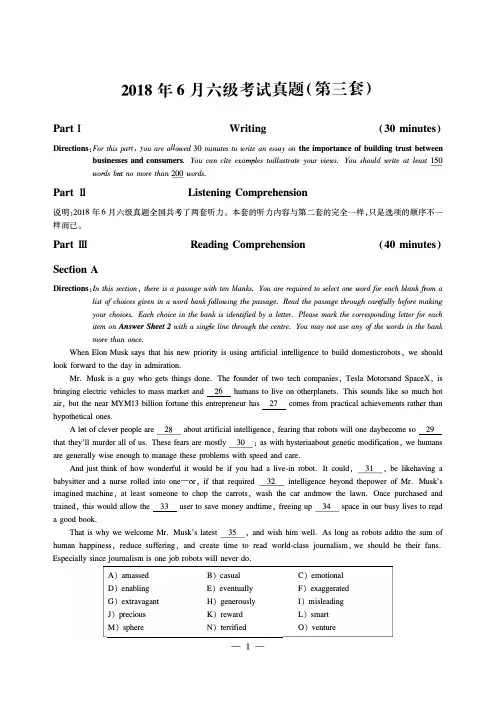
六级英语真题2018年6月(第三套)试卷及答案详解
—1—
Section B
Directions: In this section, you are going to read a passage with ten statements attached to it. Each statement contains 叫ormation given in one of the paragraphs. Identify the paragraph from咖ch the information is derived. You may choose a paragraph more than once. Each paragraph is marked with a letter. Answer the questions by marking the corresponding letter on Answer Sheet 2. In the real world, nobody cares that you went to an Ivy League school
And just think of how wonderful it would be if you had a live-in robot. It could, 31 , be likehaving a babysitter and a nurse rolled into one—or, if that required 32 intelligence beyond thepower of Mr. Musk's imagined machine, at least someone to chop the carrots, wash the car andmow the lawn. Once purchased and trained, this would allow the 33 user to save money andtime, freeing up 34 space in our busy lives to read a good book.
2018 年 6 月英语六级考试真题(第三套)(含答案)(Word精校版)
2018 年6 月英语六级考试真题试卷附答案(完整版第3 套)Part I Writing (30 minutes)Directions: For this part, you are allowed 30minutes to write an essay on theimportance ofbuilding trust between businesses and consumers. You can citeexamples to illustrate yourviews. You should write at least 150 words but no more than 200 words.________________________________________________________________________________________________________________________________________________________________________________________________________________________Part II Listening Comprehension (30 minutes)说明:由于2018 年6 月六级考试全国共考了两套听力,本套真题听力与前2 套内容相同,只是选项顺序不同,因此在本套真题中不再重复出现。
Part III Reading Comprehension (40 minutes)Section ADirections: In this section, there is a passage withten blanks. You are required to select one word foreach blank from a list of choices given in a word bankfollowing the passage. Read thepassage through carefully before making yourchoices. Each choice in the bank is identifiedby a letter. Please mark the corresponding letter for each item on Answer Sheet 2 with asingle line through the centre. You may not use any of the words in the bank more than once.When Elon Musk says that his new priority is using artificial intelligence tobuild domesticrobots, we should look forward to the day in admiration.Mr. Musk is a guy who gets things done. The founder of two tech companies,Tesla Motors andSpaceX, is bringing electric vehicles to mass market and ___26___ humans to live on otherplanets. This sounds like so much hot air, butthe near $13 billion fortune this entrepreneurhas ___27___ comes from practical achievements rather than hypothetical ones.A lot of clever people are ___28___ about artificial intelligence, fearing that robots will oneday become so ___29___ that they'll murder all of us. Thesefears are mostly ___30___: aswith hysteria about genetic modification, we humans are generally wise enough tomanage these problems with speed and care.And just think of how wonderful it would be if you had a live-in robot. It could,___31___, belike having a babysitter and a nurse rolled into one—or, if that required ___32___intelligence beyond the power of Mr. Musk's imagined machine, at least someone to chopthe carrots, wash the car and mow the lawn.Once purchased and trained, this would allowthe ___33___ user to save money and time, freeing up ___34___ space in our busy lives toread a good book.That is why we welcome Mr. Musk's latest ___35___, and wish him well. As long as robotsadd to the sum of human happiness, reduce suffering, and createtime to read world-classjournalism, we should be their fans. Especially since journalism is one job robots will neverdo.A) amassed B) casual C) emotional D enabling E) eventually F) exaggerated G)extravagant H) generously I) misleading J) precious K) reward L) smart M) sphere N)terrified O) ventureSection BDirections: In this section, you are going to read a passage with ten statements attached toit. Each statement contains information given in one of the paragraphs. Identify theparagraph from which the information is derived. You may choose a paragraph more thanonce. Each paragraph is marked with a letter.Answer the questions by marking thecorresponding letter on Answer Sheet 2.In the real world, nobody cares that you went to an Ivy League schoolA) As a high school junior, everything in my life revolved around getting into the right college.I diligently attended my SAT, ACT, and Advanced Placementtest preparation courses. Ijuggled (尽力应付) cross-country and track schedules, newspaper staff, and my church's youthgroup and drama team. I didn't drink, party, or even do much dating. The right college, Ithought, was one with prestige, one with a name. It didn't haveto be the Ivy League, but itneeded to be a "top school."B) Looking back now, nine years later, I can't remember exactly what it was about theseuniversities that made them seem so much better. Was it a curriculum that appeared morerigorous, perhaps? Or an alumni network that I hoped would open doors down the line?Maybe."I do think there are advantages to schools with more recognition," notes M arybethGasman, a professor of higher education at the University of Pennsylvania. "I don'tnecessarily think that's a reason to go to one."C) In reflection, my firm belief in the power of the brand was naive, not tomention a bitsnobby. I quickly passed over state schools and southern schools, believing their curriculumsto be automatically inferior to northeastern orwestern counterparts. Instead, I dreamed ofliving in New York City and my parents obliged me with a visit to New York University's (NYU)campus. Duringthe tour, tuition fees were discussed.(NYU is consistently ranked one of thecountry's most expensive schools, with room and board costs totaling upwards of $ 64,000 ayear.) Up until then, Ihadn't truly realized just how expensive an education can be. Over thenext few months, I realized not only could I not afford my dream school, I couldn't evenafford the ones where I'd been accepted. City University of New York (CUNY), RutgersUniversity, and Indiana University were out of reach as were Mississippi State and theUniversity of Alabama, where I would have to pay out-ofstate fees. Further complicating mycollege search was a flourishing track career—I wanted to keep running but my timesweren't quite fast enough to secure a scholarship.D) And so, at 11 pm on the night of Georgia State University's (GSU) midnight deadline, Iapplied online. Rated No.466 overall on Forbes' Lists Top Colleges, No.183 in ResearchUniversities, and No.108 in the South, I can't say it was my top choice. Still, the trackcoach had offered me a walk-on spot, and I actually found the urban Atlanta campus ad ecent consolation prize after New York City.E) While it may have been practical, it wasn't prestigious. But here's the thi ng: I loved my"lower-tier" (低层次的) university.(I use the term "low-tier" cautiously, because GSU is a well-regarded researc h institution that attracts high quality professors and faculty from all overth e country.) We are taught to believe that only by going to the best schools an d getting thebest grades can we escape the rat race and build a better future . But what if lower-tiercolleges and universities were the ticket to escaping th e rat race? After all, where else canyou leave school with a decent degree—b ut without a lifetime of debt?F) My school didn't come prepackaged like the more popular options, so we were left to takecare of ourselves, figuring out city life and trying to complete degree programs that no onewas championing for us to succeed in. What I'm saying is, I loved my university because ittaught us all to be resourceful and we could make what we wanted out of it.G) I was lucky enough to have my tuition covered by a lottery-funded schola rship calledHOPE (Helping Outstanding Pupils Educationally). When I started c ollege, the HOPEscholarship was funded by the state of Georgia and offered t o graduating high school seniorswith a GPA of 3.0 or higher. Living costs and books I paid for with money earned during highschool, supplemented by a sm all college fund my deceased grandfather left for me and amodest savings ac count my parents created when I was born.H) So what about all that name recognition? Sure, many of my colleagues a nd competitorshave more glamorous alma maters (母校) than I do. As a journalist, I have competed againstNYU, Columbia, and No rtheastern graduates for jobs. And yet, not a single interviewer hasever asked me about my educational background. In fact, almost every interview I've e verhad was due to a connection—one that I've gained through pure determi nation, not a schoolbrand.I) According to The Boston Globe, students who earned their bachelor's in 2012 have anaverage monthly loan payment of $312, which is one-third more than those who graduatedin 2004. Ultimately, that's the thing universities do n't want to admit. Private universities aremoney-making institutions. If you ca n afford to buy prestige, that's your choice. For the restof us, however, our h earty lower-tiered universities are just fine, thank you.J) Wealthy universities talk up the benefits their name will give graduates: na mely, strongalumni networks, star faculty, and a résuméboost. But you nee dn't attend an Ivy Leagueschool to reap those rewards. Ludacris and the for mer CEO of Bank of America Ken Lewis arealumni of my college, as well as VI CE's first female editor-in-chief, Ellis Jones. Successfulpeople tend to be successful no matter where they go to school, and lower-tier schools canhave alu mni networks just as strong as their big name counterparts. In fact, lower-tie r schoolalumni networks are arguably stronger, because fellow alumni recog nize that you didn'tnecessarily have an easy path to follow. They might be m ore willing to offer career help,because your less famous school denotes that , like them, you are also full of energy andperseverance.K) The Washington Post reported on a recent study by Princeton economists, i n which collegegraduates who applied to the most selective schools in the 12 th grade were compared tothose who applied to slightly less selective schoo ls. They found that students with morepotential earned more as adults, and the reverse held true as well, no matter where theywent to school.L) Likewise, star faculty are not always found where you'd expect. Big name s chools are notnecessarily the best places for professors; plus, many professor s split teaching time betweenmultiple colleges and/or universities. This mea ns, for instance, a CUNY student couldreasonably expect to receive the same quality of instruction from a prestigious professoras they would if they were enrolled in the same class at NYU.M) It's possible that some hiring managers may be drawn to candidates with a particulareducational résumé, but it's no guarantee. According to a 2012 survey described in TheAtlantic, college reputation ranked lowest in relative importance of attributes in evaluatinggraduates for hire, beaten out by top fa ctors like internships, employment during college,college major, volunteer ex perience, and extracurriculars.N) Maybe students who choose less prestigious universities are bound to suc ceed becausethey are determined to. I tend to think so. In any case, if I co uld do it again, I'd still makethe same choice. Today I'm debt-free, resourcef ul—and I understand that even theshiniest packaging can't predict what you'll find on the inside.36. Modest institutions can also have successful graduates and strong alumni networks.37. The money the author made in high school helped pay for her living expe nses and booksat college.38. The author came to see how costly college education could be when she was trying tochoose a university to attend.39. A recent study found that a graduate's salary is determined by their pot ential, not theuniversity they attended.40. The author cannot recall for sure what made certain top universities app ear a lot better.41. None of the author's job interviewers cared which college she went to.42. The author thinks she did the right thing in choosing a less prestigious u niversity.43. In order to be admitted to a prestigious university, the author took partin variousextracurricular activities and attended test preparation courses. 44. The author liked her university which was not prestigious but less expensive.45. Colleges are reluctant to admit that graduates today are in heavier debt.Section CDirections: There are 2 passages in this section. Each passage is followed by some questionsor unfinished statements. For each of them there are four choices marked A), B), C) andD). You should decide on the best choice and markthe corresponding letter on Answer Sheet2 with a single line through the centre.Passage OneQuestions 46 to 50 are based on the following passage.Economically speaking, are we better off than we were ten years ago? Twentyyears ago?In their thirst for evidence on this issue, commentators seized on the recentreport by theCensus Bureau, which found that average household income rose by 5.2% in 2015.Unfortunately, that conclusion puts too much weight on auseful, but flawed andincomplete, statistic. Among the more significant problems with the Census's measure arethat:1) it excludes taxes, transfers, and compensation like employer-provided healthinsurance; and 2) it is based on surveys rather than data. Even if precisely measured,income data exclude important determinants of economic wellbeing, such as the hours ofwork needed to earn that income.While thinking about the question, we came across a recently published article by CharlesJones and Peter Klenow, which proposes an interesting new measure of economic welfare.While by no means perfect, it is considerably morecomprehensive than average income,taking into account not only growth inconsumption per person but also changes in workingtime, life expectancy, and inequality. Moreover, it can be used to assess economicperformance both across countries and over time.The Jones-Klenow method can be illustrated by a cross-country example. Suppose we wantto compare the economic welfare of citizens of the U.S. and France in 2005.In 2005, as the authors observe: real consumption per person in France wasonly 60% ashigh as the U.S., making it appear that Americans were economically much better off thanthe French on average. However, that comparisonomits other relevant factors: leisuretime, life expectancy, and economic inequality. The French take longer vacations and retireearlier, so typically workfewer hours; they enjoy a higher life expectancy, presumablyreflecting advantages with respect to health care, diet, lifestyle, and the like; and income andconsumption are somewhat more equally distributed there than in the U.S. Because of thesedifferences, comparing France's consumption with the U.S.'s overstates the gap in economicwelfare.Similar calculations can be used to compare the U.S. and other countries. Forexample, thiscalculation puts economic welfare in the United Kingdom at 97% of U.S. levels, butestimates Mexican well-being at 22%.The Jones-Klenow measure can also assess an economy's performance over time.According to this measure, as of the early-to-mid-2000s, the U.S. had the highest economicwelfare of any large country. Since 2007, economic we lfare in the U.S. has continued toimprove. However, the pace of improvement has slowed markedly.Methodologically, the lesson from the Jones-Klenow research is that economic welfare ismulti-dimensional. Their approach is flexible enough that in pri nciple other importantquality-of-life changes could be incorporated-for exa mple, decreases in total emissions ofpollutants and declines in crime rates.46. What does the author think of the 2015 report by the Census Bureau?A) It is based on questionable statistics.B) It reflects the economic changes.C) It evidences the improved-welfare.D) It provides much food for thought.47. What does the author say about the Jones-Klenow method?A) It is widely used to compare the economic growth across countries.B) It revolutionizes the way of measuring ordinary people's livelihood.C) It focuses on people's consumption rather than their average income.D) It is a more comprehensive measure of people's economic well-being.48. What do Jones and Klenow think of the comparison between France and the U. S. interms of real consumption per person?A) It reflected the existing big gap between the two economies.B) It neglected many important indicators of people's welfare.C) It covered up the differences between individual citizens.D) It failed to count in their difference in natural resources.49. What is an advantage of the Jones-Klenow method?A) It can accurately pinpoint a country's current economic problems.B) It can help to raise people's awareness of their economic well-being.C) It can diagnose the causes of a country's slowing pace of economic impr ovement.D) It can compare a country's economic conditions between different periods of time.50) What can we infer from the passage about American people's economic well-being?A) It is much better than that of their European counterparts.B) It has been on the decline ever since the turn of the century.C) It has not improved as much as reported by the Census Bureau.D) It has not been accurately assessed and reported since mid-2000s. Passage TwoQuestions 51 to 55 are based on the following passage.If you've ever started a sentence with,"If I were you..." or found yourself scratching yourhead at a colleague's agon y over a decision when the answer is crystal-clear, there's ascientific reason behind it. Our own decision-making abilities can become depleted over thecourse of the day causing indecision or poor choices, but choosing on behalf of someone elseis an enjoyable task that doesn't suffer the same pitfalls. The problem is "decision fatigue," a psychological phenomenon that takes a toll on thequality of your choices after a long day of decision making, sa ys Evan Polman, a leadingpsychologist.Physicians who have been on the job for several hours, for example, are more likely toprescribe antibiotics to patients when it's unwise to do so. "Presumably it's because it'ssimple and easy to write a prescription and con sider a patient case closed rather thaninvestigate further," Polman says.But decision fatigue goes away when you are making the decision for som eone else.When people imagine themselves as advisers and imagine their ow n choices as belonging tosomeone else, they feel less tired and rely less on d ecision shortcuts to make those choices."By taking upon the role of adviser rather than decision maker, one does not suffer theconsequences of decision fatigue," he says."It's as if there's something fun and liberatingabout making someone else's c hoice."Getting input from others not only offers a fresh perspective and thought pr ocess; it oftenalso includes riskier choices. While this sounds undesirable, it c an be quite good, says Polman."When people experience decision fatigue-when they are tired of making ch oices—theyhave a tendency to choose to go with the status quo (现状)," he says."But the status quocan be problematic, since a change in the course of acti on can sometimes be important andlead to a positive outcome."In order to achieve a successful outcome or reward, some level of risk is al most alwaysessential."People who are susceptible to decision fatigue will likely choose to do not hingover something," he says,"That's not to say that risk is always good, but it is related totaking action9w hereas decision fatigue assuredly leads to inaction and the possible chagrin(懊恼) of a decision maker who might otherwise prefer a new course but is unfo rtunatelyhindered."Just because you can make good choices for others doesn't mean you'll do th e same foryourself, Polman cautions."Research has found that women negotiate higher salaries forothers than the y do for themselves," he says, adding that people slip in and out of decision roles.51. What does the author say about people making decisions?A) They may become exhausted by making too many decisions for themselve s.B) They are more cautious in making decisions for others than for themselve s.C) They tend to make decisions the way they think advantageous to them.D) They show considerable differences in their decision-making abilities.52. What does the example about the physicians illustrate?A) Patients seldom receive due care towards the end of the day.B) Prescription of antibiotics can be harmful to patients' health.C) Decision fatigue may prevent people making wise decisions.D) Medical doctors are especially susceptible to decision fatigue.53. When do people feel less decision fatigue?A) When they take decision shortcuts.B) When they help others to make decisions.C) When they have major decisions to make.D) When they have advisers to turn to.54. What are people likely to do when decision fatigue sets in?A) They turn to physicians for advice.B) They tend to make risky decisions.C) They adopt a totally new perspective.D) They refrain from trying anything new.55. What does the passage say about taking some risk in decision making?A) It is vital for one to reach the goal desired.B) It is likely to entail serious consequences.C) It will enable people to be more creative.D) It will more often than not end in regret.Part IV Translation (30 minutes)Directions: For this part, you are allowed 30minutes to translate a passage from Chinese intoEnglish. You should write your answer on AnswerSheet 2.自行车曾经是中国城乡最主要的交通工具,中国一度被称为“自行车王国”。
2018年6月大学英语六级真题与参考答案系列全3套
2018年6月大学英语六级真题与参考答案全3套目录2018年6月大学英语六级真题与参考答案-1...... 1-18页2018年6月大学英语六级真题与参考答案-2......19-36页2018年6月大学英语六级真题与参考答案-3......37-55页2018年6月大学英语六级真题与参考答案-1Part 1 writing (30 minutes)Directions: For this part, you are allowed 30 minutes to write an essay on the importance of building trust between employers and employees. You can cite examples to illustrate your views. You should write at least 150 words but no more than 200 words.范文示例:The relationship between employers and employees is based on the labor contract that they have signed together. However, if this relationship is to develop well and the two sides intend to achieve success through cooperation, trust has to be built between employers and employees.On the one hand, employers should communicate their vision, mission and code of ethics to their employees in order to inspire employees´trust in the company: On the other hand, employees should strictly comply with company or industry rules and regulations. Otherwise, any irregular or deceitful practice will easily destroy the trust between employers and employees. In fact, trust is the foundation on which companies are built. Without trust, no company will be able to survive, and no individual can fully explore his or her potential.Both employers and employees should bear in mind that trust is not built overnight. It requires months, even years of hard work, and yet it may be still very fragile. The trust between employers and employees needs to be nurtured and protected by both sides carefully.Part ⅡSection A Directions:In this section,you will hear 8 short conversations and 2 long conversations.At the end of each conversation,one or more questions will be asked about what was said.Both the conversation and the questions will be spoken only once.After each question there will be a pause.During the pause,you must read the four choices marked A) ,B) ,C) and D) ,and decide which is the best answer.Then mark the corresponding letter on Answer Sheet 1 with a single line through the centre.。
18年6月英语六级考试真题答案
18年6月英语六级考试真题答案全文共3篇示例,供读者参考篇1Title: Answers to the June 2018 English CET-6 ExamIntroduction:The June 2018 English CET-6 exam has drawn attention from English learners and educators alike. With its challenging questions and diverse topics, candidates have eagerly awaited the release of the official answers in order to gauge their performance. In this document, we provide the answers to the June 2018 English CET-6 exam, helping candidates assess their strengths and weaknesses.Listening Section:1. A) Forecasts of consumer spending.2. C) They may not have enough information about products.3. D) She is impressed by its features and price.4. B) It greatly influences buying decisions.5. A) Researchers have developed a way to convert CO2 into fuel.6. B) It is abundant and easily accessible.7. C) They are working to make the process cost-effective.8. D) There is a lack of financial incentives.Reading Section:Passage One:9. C) To meet the desire for something extra that does not require effort.10. A) A failed government policy results in poaching.11. D) Raising and releasing predator birds.12. B) It restores the balance of nature.13. C) Appetite for throwaway culture.Passage Two:14. C) It has the potential to revolutionize healthcare.15. D) Fossil fuels will soon be replaced by algae as a source of energy.16. A) They engulf carbon dioxide and produce oxygen.17. B) The substance they make can be used in various consumer products.18. C) Carbon emissions are significantly reduced.Passage Three:19. C) People should not expect others to adhere strictly to rules.20. D) The author's admiration for Chinese fans' creativity.21. A) The domestic demand for SUVs in China.22. B) Lack of parking space is a headache in Chinese cities.23. C) It is hard to keep the city free of illegal parking.Writing Section:Essay 1:In recent years, social media has become a prominent tool for communication and networking. However, some argue that it has negative impacts on individuals' mental health. In my opinion, while social media has its drawbacks, it also offers numerous benefits. First of all, social media provides a platform for individuals to connect with friends and family, regardless of geographical boundaries. Additionally, it serves as a source ofentertainment and a platform for creative expression. Moreover, social media can be utilized for educational and professional purposes, facilitating learning and networking. Therefore, I believe that the benefits of social media outweigh its negative impacts.Essay 2:The issue of climate change has become a pressing concern in today's world. While some argue that human activities are the primary cause of climate change, others believe that it is a natural occurrence. In my opinion, the evidence overwhelmingly supports the fact that human activities, such as burning fossil fuels and deforestation, contribute significantly to climate change. The rise in global temperatures, melting ice caps, and extreme weather events are all consequences of human-induced climate change. Therefore, it is crucial for individuals, governments, and businesses to take immediate actions to mitigate the impact of climate change and transition towards sustainable practices.Conclusion:In conclusion, the answers provided in this document offer insight into the June 2018 English CET-6 exam. By reviewing the answers, candidates can evaluate their performance and identifyareas for improvement. With dedication and practice, candidates can enhance their English proficiency and achieve success in future examinations.篇2The 2018 June English CET-6 Exam was a challenging test with a variety of question types and topics. Below, we have provided the answers to the multiple-choice questions from the reading comprehension section of the exam:Passage One:1. B) They have difficulty maintaining concentration.2. C) Inattentive viewers have slower brainwaves.3. A) They show diminished self-control.4. D) They process information differently.5. B) They have decreased gray matter in the brain.Passage Two:6. D) Acts of kindness can have a positive impact on our health.7. C) It found that people who performed acts of kindness experienced greater well-being.8. A) It boosts levels of dopamine and oxytocin.9. B) Integrate acts of kindness into your daily routine.10. D) It suggests that acts of kindness can improve overall health.Passage Three:11. C) Unstable and prone to frequent changes.12. D) Intimates making an engaging and interesting subject.13. A) Mental health issues can affect relationships.14. B) Victims of online abuse need support and understanding.15. A) They offer a platform where people can share their feelings and experiences.Overall, the 2018 June English CET-6 Exam was challenging but manageable for many test-takers. It is essential to prepare thoroughly to achieve success on this exam. Good luck to all future test-takers!篇32018年6月英语六级考试真题答案Part I Writing (30 minutes)Directions: For this part, you are allowed 30 minutes to write a short essay on the title Thinking Before Acting. You should write at least 150 words following the outline given below in Chinese:1. 想清楚再行动是个人应该具备的品质之一。
2018年6月英语六级考试真题试卷(完整版-第3套)
Part I Writing (30 minutes)Directions: For this part, you are allowed 30 minutes to write an essay on the importance of building trust between businesses and consumers. You can cite examples to illustrate your views. You should write at least 150 words but no more than 200 words.Part III Reading Comprehension (40 minutes)Section ADirections: In this section, there is a passage with ten blanks. You are required to select one word for each blank from a list of choices given in a word bank following the passage. Read the passage through carefully before making your choices. Each choice in the bank is identified by a letter. Please mark the corresponding letter for each item on Answer Sheet 2 with a single line through the centre. You may not use any of the words in the bank more than once.When Elon Musk says that his new priority is using artificial intelligence to build domestic robots, we should look forward to the day in admiration.Mr. Musk is a guy who gets things done. The founder of two tech companies, Tesla Motors and SpaceX, is bringing electric vehicles to mass market and ___26___ humans to live on other planets. This sounds like so much hot air, but the near $13 billion fortune this entrepreneur has ___27___ comes from practical achievements rather than hypothetical ones.A lot of clever people are ___28___ about artificial intelligence, fearing that robots will one day become so ___29___ that they'll murder all of us. These fears are mostly ___30___: as with hysteria about genetic modification, we humans are generally wise enough to manage these problems with speed and care.And just think of how wonderful it would be if you had a live-in robot. It could, ___31___, be like having a babysitter and a nurse rolled into one—or, if that required ___32___ intelligence beyond the power of Mr. Musk's imagined machine, at least someone to chop the carrots, wash the car and mow the lawn. Once purchased and trained, this would allow the ___33___ user to save money and time, freeing up ___34___ space in our busy lives to read a good book.That is why we welcome Mr. Musk's latest ___35___, and wish him well. As long as robots add to the sum of human happiness, reduce suffering, and create time to read world-class journalism, we should be their fans. Especially since journalism is one job robots will never do.A) amassed B) casual C) emotional D enabling E) eventually F) exaggerated G) extravagant H) generously I) misleading J) precious K) reward L) smart M) sphere N) terrified O) ventureSection BDirections: In this section, you are going to read a passage with ten statements attached to it. Each statement contains information given in one of the paragraphs. Identify the paragraph from which the information is derived. You may choose a paragraph more than once. Each paragraph is marked with a letter. Answer the questions by marking the corresponding letter on Answer Sheet 2.In the real world, nobody cares that you went to an Ivy League schoolA) As a high school junior, everything in my life revolved around getting into the right college. I diligently attended my SAT, ACT, and Advanced Placement test preparation courses. I juggled (尽力应付) cross-country and track schedules, newspaper staff, and my church's youth group anddrama team. I didn't drink, party, or even do much dating. The right college, I thought, was one with prestige, one with a name. It didn't have to be the Ivy League, but it needed to be a "top school."B) Looking back now, nine years later, I can't remember exactly what it was about these universities that made them seem so much better. Was it a curriculum that appeared more rigorous, perhaps? Or an alumni network that I hoped would open doors down the line? Maybe. "I do think there are advantages to schools with more recognition," notes Marybeth Gasman, a professor of higher education at the University of Pennsylvania. "I don't necessarily think that's a reason to go to one."C) In reflection, my firm belief in the power of the brand was naive, not to mention a bit snobby. I quickly passed over state schools and southern schools, believing their curriculums to be automatically inferior to northeastern or western counterparts. Instead, I dreamed of living in New York City and my parents obliged me with a visit to New York University's (NYU) campus. During the tour, tuition fees were discussed. (NYU is consistently ranked one of the country's most expensive schools, with room and board costs totaling upwards of $ 64,000 a year.) Up until then, I hadn't truly realized just how expensive an education can be. Over the next few months, I realized not only could I not afford my dream school, I couldn't even afford the ones where I'd been accepted. City University of New York (CUNY), Rutgers University, and Indiana University were out of reach as were Mississippi State and the University of Alabama, where I would have to pay out-of-state fees. Further complicating my college search was a flourishing track career—I wanted to keep running but my times weren't quite fast enough to secure a scholarship.D) And so, at 11 pm on the night of Georgia State University's (GSU) midnight deadline, I applied online. Rated No. 466 overall on Forbes' Lists Top Colleges, No. 183 in Research Universities, and No. 108 in the South, I can't say it was my top choice. Still, the track coach had offered me a walk-on spot, and I actually found the urban Atlanta campus a decent consolation prize after New York City.E) While it may have been practical, it wasn't prestigious. But here's the thing: I loved my "lower-tier" (低层次的) university. (I use the term "low-tier" cautiously, because GSU is a well-regarded research institution that attracts high quality professors and faculty from all over the country.) We are taught to believe that only by going to the best schools and getting the best grades can we escape the rat race and build a better future. But what if lower-tier colleges and universities were the ticket to escaping the rat race? After all, where else can you leave school with a decent degree—but without a lifetime of debt?F) My school didn't come prepackaged like the more popular options, so we were left to take care of ourselves, figuring out city life and trying to complete degree programs that no one was championing for us to succeed in. What I'm saying is, I loved my university because it taught us all to be resourceful and we could make what we wanted out of it.G) I was lucky enough to have my tuition covered by a lottery-funded scholarship called HOPE (Helping Outstanding Pupils Educationally). When I started college, the HOPE scholarship was funded by the state of Georgia and offered to graduating high school seniors with a GPA of 3.0 or higher. Living costs and books I paid for with money earned during high school, supplemented by a small college fund my deceased grandfather left for me and a modest savings account my parents created when I was born.H) So what about all that name recognition? Sure, many of my colleagues and competitors havemore glamorous alma maters (母校) than I do. As a journalist, I have competed against NYU, Columbia, and Northeastern graduates for jobs. And yet, not a single interviewer has ever asked me about my educational background. In fact, almost every interview I've ever had was due to a connection—one that I've gained through pure determination, not a school brand.I) According to The Boston Globe, students who earned their bachelor's in 2012 have an average monthly loan payment of $312, which is one-third more than those who graduated in 2004. Ultimately, that's the thing universities don't want to admit. Private universities are money-making institutions. If you can afford to buy prestige, that's your choice. For the rest of us, however, our hearty lower-tiered universities are just fine, thank you.J) Wealthy universities talk up the benefits their name will give graduates: namely, strong alumni networks, star faculty, and a résumé boost. But you needn't attend an Ivy League school to reap those rewards. Ludacris and the former CEO of Bank of America Ken Lewis are alumni of my college, as well as VICE's first female editor-in-chief, Ellis Jones. Successful people tend to be successful no matter where they go to school, and lower-tier schools can have alumni networks just as strong as their big name counterparts. In fact, lower-tier school alumni networks are arguably stronger, because fellow alumni recognize that you didn't necessarily have an easy path to follow. They might be more willing to offer career help, because your less famous school denotes that, like them, you are also full of energy and perseverance.K) The Washington Post reported on a recent study by Princeton economists, in which college graduates who applied to the most selective schools in the 12th grade were compared to those who applied to slightly less selective schools. They found that students with more potential earned more as adults, and the reverse held true as well, no matter where they went to school. L) Likewise, star faculty are not always found where you'd expect. Big name schools are not necessarily the best places for professors; plus, many professors split teaching time between multiple colleges and/or universities. This means, for instance, a CUNY student could reasonably expect to receive the same quality of instruction from a prestigious professor as they would if they were enrolled in the same class at NYU.M) It's possible that some hiring managers may be drawn to candidates with a particular educational résumé, but it's no guarantee. According to a 2012 survey described in The Atlantic, college reputation ranked lowest in relative importance of attributes in evaluating graduates for hire, beaten out by top factors like internships, employment during college, college major, volunteer experience, and extracurriculars.N) Maybe students who choose less prestigious universities are bound to succeed because they are determined to. I tend to think so. In any case, if I could do it again, I'd still make the same choice. Today I'm debt-free, resourceful—and I understand that even the shiniest packaging can't predict what you'll find on the inside.36. Modest institutions can also have successful graduates and strong alumni networks.37. The money the author made in high school helped pay for her living expenses and books at college.38. The author came to see how costly college education could be when she was trying to choosea university to attend.39. A recent study found that a graduate's salary is determined by their potential, not the university they attended.40. The author cannot recall for sure what made certain top universities appear a lot better.41. None of the author's job interviewers cared which college she went to.42. The author thinks she did the right thing in choosing a less prestigious university.43. In order to be admitted to a prestigious university, the author took part in various extracurricular activities and attended test preparation courses.44. The author liked her university which was not prestigious but less expensive.45. Colleges are reluctant to admit that graduates today are in heavier debt.Section CDirections: There are 2 passages in this section. Each passage is followed by some questions or unfinished statements. For each of them there are four choices marked A), B), C) and D). You should decide on the best choice and mark the corresponding letter on Answer Sheet 2 with a single line through the centre.Passage OneQuestions 46 to 50 are based on the following passage.Economically speaking, are we better off than we were ten years ago? Twenty years ago?In their thirst for evidence on this issue, commentators seized on the recent report by the Census Bureau, which found that average household income rose by 5.2% in 2015. Unfortunately, that conclusion puts too much weight on a useful, but flawed and incomplete, statistic. Among the more significant problems with the Census's measure are that: 1) it excludes taxes, transfers, and compensation like employer-provided health insurance; and 2) it is based on surveys rather than data. Even if precisely measured, income data exclude important determinants of economic well-being, such as the hours of work needed to earn that income.While thinking about the question, we came across a recently published article by Charles Jones and Peter Klenow, which proposes an interesting new measure of economic welfare. While by no means perfect, it is considerably more comprehensive than average income, taking into account not only growth in consumption per person but also changes in working time, life expectancy, and inequality. Moreover, it can be used to assess economic performance both across countries and over time.The Jones-Klenow method can be illustrated by a cross-country example. Suppose we want to compare the economic welfare of citizens of the U.S. and France in 2005.In 2005, as the authors observe: real consumption per person in France was only 60% as high as the U.S., making it appear that Americans were economically much better off than the French on average. However, that comparison omits other relevant factors: leisure time, life expectancy, and economic inequality. The French take longer vacations and retire earlier, so typically work fewer hours; they enjoy a higher life expectancy, presumably reflecting advantages with respect to health care, diet, lifestyle, and the like; and income and consumption are somewhat more equally distributed there than in the U.S. Because of these differences, comparing France's consumption with the U.S.'s overstates the gap in economic welfare.Similar calculations can be used to compare the U.S. and other countries. For example, this calculation puts economic welfare in the United Kingdom at 97% of U.S. levels, but estimates Mexican well-being at 22%.The Jones-Klenow measure can also assess an economy's performance over time. According to this measure, as of the early-to-mid-2000s, the U.S. had the highest economic welfare of anylarge country. Since 2007, economic welfare in the U.S. has continued to improve. However, the pace of improvement has slowed markedly.Methodologically, the lesson from the Jones-Klenow research is that economic welfare is multi-dimensional. Their approach is flexible enough that in principle other important quality-of-life changes could be incorporated-for example, decreases in total emissions of pollutants and declines in crime rates.46. What does the author think of the 2015 report by the Census Bureau?A) It is based on questionable statistics.B) It reflects the economic changes.C) It evidences the improved-welfare.D) It provides much food for thought.47. What does the author say about the Jones-Klenow method?A) It is widely used to compare the economic growth across countries.B) It revolutionizes the way of measuring ordinary people's livelihood.C) It focuses on people's consumption rather than their average income.D) It is a more comprehensive measure of people's economic well-being.48. What do Jones and Klenow think of the comparison between France and the U. S. in terms of real consumption per person?A) It reflected the existing big gap between the two economies.B) It neglected many important indicators of people's welfare.C) It covered up the differences between individual citizens.D) It failed to count in their difference in natural resources.49. What is an advantage of the Jones-Klenow method?A) It can accurately pinpoint a country's current economic problems.B) It can help to raise people's awareness of their economic well-being.C) It can diagnose the causes of a country's slowing pace of economic improvement.D) It can compare a country's economic conditions between different periods of time.50) What can we infer from the passage about American people's economic well-being?A) It is much better than that of their European counterparts.B) It has been on the decline ever since the turn of the century.C) It has not improved as much as reported by the Census Bureau.D) It has not been accurately assessed and reported since mid-2000s.Passage TwoQuestions 51 to 55 are based on the following passage.If you've ever started a sentence with, "If I were you..." or found yourself scratching your head at a colleague's agony over a decision when the answer is crystal-clear, there's a scientific reason behind it. Our own decision-making abilities can become depleted over the course of the day causing indecision or poor choices, but choosing on behalf of someone else is an enjoyable task that doesn't suffer the same pitfalls.The problem is "decision fatigue," a psychological phenomenon that takes a toll on the quality of your choices after a long day of decision making, says Evan Polman, a leading psychologist. Physicians who have been on the job for several hours, for example, are more likely to prescribeantibiotics to patients when it's unwise to do so. "Presumably it's because it's simple and easy to write a prescription and consider a patient case closed rather than investigate further," Polman says.But decision fatigue goes away when you are making the decision for someone else. When people imagine themselves as advisers and imagine their own choices as belonging to someone else, they feel less tired and rely less on decision shortcuts to make those choices. "By taking upon the role of adviser rather than decision maker, one does not suffer the consequences of decision fatigue," he says. "It's as if there's something fun and liberating about making someone else's choice."Getting input from others not only offers a fresh perspective and thought process; it often also includes riskier choices. While this sounds undesirable, it can be quite good, says Polman. "When people experience decision fatigue-when they are tired of making choices—they have a tendency to choose to go with the status quo (现状)," he says. "But the status quo can be problematic, since a change in the course of action can sometimes be important and lead to a positive outcome."In order to achieve a successful outcome or reward, some level of risk is almost always essential. "People who are susceptible to decision fatigue will likely choose to do nothing over something," he says, "That's not to say that risk is always good, but it is related to taking action9whereas decision fatigue assuredly leads to inaction and the possible chagrin (懊恼) of a decision maker who might otherwise prefer a new course but is unfortunately hindered."Just because you can make good choices for others doesn't mean you'll do the same for yourself, Polman cautions. "Research has found that women negotiate higher salaries for others than they do for themselves," he says, adding that people slip in and out of decision roles.51. What does the author say about people making decisions?A) They may become exhausted by making too many decisions for themselves.B) They are more cautious in making decisions for others than for themselves.C) They tend to make decisions the way they think advantageous to them.D) They show considerable differences in their decision-making abilities.52. What does the example about the physicians illustrate?A) Patients seldom receive due care towards the end of the day.B) Prescription of antibiotics can be harmful to patients' health.C) Decision fatigue may prevent people making wise decisions.D) Medical doctors are especially susceptible to decision fatigue.53. When do people feel less decision fatigue?A) When they take decision shortcuts.B) When they help others to make decisions.C) When they have major decisions to make.D) When they have advisers to turn to.54. What are people likely to do when decision fatigue sets in?A) They turn to physicians for advice.B) They tend to make risky decisions.C) They adopt a totally new perspective.D) They refrain from trying anything new.55. What does the passage say about taking some risk in decision making?A) It is vital for one to reach the goal desired.B) It is likely to entail serious consequences.C) It will enable people to be more creative.D) It will more often than not end in regret.自行车曾经是中国城乡最主要的交通工具,中国一度被称为“自行车王国”。
2018年度6月英语六级真命题及答案解析(第三套)
2018年6月英语六级真题及答案(第三套)Part I Writing (30 minutes)Directions: For this part, you are allowed 30minutes to write an essay on the importance of building trust between businesses and consumers. You can cite examples to illustrate your views. You should write at least 150 words but no more than 200 words.The Importance of Building Trust Between Businesses and Consumers Today, in the context of this era featured by increasing commercialization an d digitalization, mutually-trusted relations between businesses and consumers appear to be particularly important.As for me businesses should take a leading role in establishing the trust relationship: to be honest with their consumers. Firstly, if a business has a dishonest attitude toward its customers, the customers will lack purchasing confidence in its goods or services, which will bring huge economic loss to the business. What's worse, the adverse side effect of such dishonesty can endanger the business and it is impossible to recover. The collapse of Sanlu Milk Powder Company is a testament to this. Moreover, the incident of poisonous milk has exerted devastating consequences on the whole milk powder market. Be sides, because of the proliferation of counterfeit goods, more consumers lose confidence in domestic products, and then they have no alternative but to resort to foreign brands, which is one reason why cross-border online shopping is gaining more and more popularity in China.Therefore, it is high time for us to strengthen the importance of maintaining trust between businesses and consumers to promote the healthy development t of the whole social economy.Part II Listening Comprehension (30 minutes)说明:由于2018 年6 月六级考试全国共考了两套听力,本套真题听力与前2 套内容相同,只是选项顺序不同,因此在本套真题中不再重复出现。
2018年6月大学英语六级CET6真题试卷及详细答案精品版(三套全)
2018年6月大学英语六级CET6真题试卷及详细答案精品版(三套全)目录2018年6月大学英语六级真题试卷一详细答案 (1)2018年6月大学英语六级真题试卷(一) (49)快速对答案 (64)2018年6月大学英语六级真题试卷(二) (64)快速对答案 (79)2018年6月大学英语六级真题试卷二详细答案 (80)2018年6月大学英语六级真题试卷(三) (131)快速对答案 (141)2018年6月大学英语六级真题试卷三详细答案 (141)2018年6月大学英语六级真题试卷一详细答案Part I Writing (30 minutes) (请于正式开考后半小时内完成该部分,之后将进行听力考试)Directions: For this part,you are allowed30minutes to write an essay on the importance of building trust between employers and employees.You can cite examples to illustrate your views.you should write at least150words but no more than200words.【解析】写作题考察了同学们的写作能力,要求在30分钟内完成,时间有限,因此在备战英语四级的时候,平时应积累一些模版,多背一些精彩的句子,在平时的练习中,应该在20分钟内完成一篇不少于150词的作文,下面给出以下几点建议:一,写作中,字体要工整,改卷老师在批改四级作文的时候,由于任务量大,再加上批改时视觉疲劳,不可能对每一篇作文都看得那么仔细,有时候就凭卷面的第一印象打分,因此字体美观大方能提高作文的分数;二,注意段落结构,写作时,应带有题目,一般分三段进行,第一段总体概述,引出正文,第二段详细阐述文档内容,要分条理进行,比如,firstly,secondly,等,正文一般4-6句话阐述完毕,第三段总结正文部分,回归主题。
2018年6月大学英语六级真题及答案
2018年6月大学英语六级真题试卷及答案Part I Writing (30 minutes)(请于正式开考后半小时内完成该部分,之后将进行听力考试)卷一:Directions: For this part, you are allowed 30 minutes to write an essay on the importance of building trust between employers and employees. You can cite examples to illustrate your views. you should write at least 150 words but no more than 200 words.卷二:Directions: For this part, you are allowed 30 minutes to write an essay on the importance of building trust between teachers and students. You can cite examples to illustrate your views. you should write at least 150 words but no more than 200 words.卷三:Directions: For this part, you are allowed 30 minutes to write an essay on the importance of building trust between businesses and consumers. You can cite examples to illustrate your views. you should write at least 150 words but no more than 200 words.Part II Listening Comprehension (30 minutes) (卷三)Section ADirections:In this section, you will hear two long conversations. At the end of each conversation, you will hear four questions. Both the conversation and the questions will be spoken only once. After you hear a question, you must choose the best answer from the four choices marked A), B), C) and D). Then mark the corresponding letter on Answer Sheet 1 with a single line through the centre.注意:此部分试题请在答题卡1上作答。
2018年6月大学英语六级真题试卷及答案(三套全)
2018年6月大学英语六级真题试卷及答案(三套全)目录2018年6月大学英语六级真题试卷及答案(一) (1)快速对答案 (16)2018年6月大学英语六级真题试卷及答案(二) (16)快速对答案 (31)2018年6月大学英语六级真题试卷及答案(三) (32)快速对答案 (42)2018年6月大学英语六级真题试卷及答案(一)Part I Writing(30minutes) (请于正式开考后半小时内完成该部分,之后将进行听力考试)Directions:For this part,you are allowed30minutes to write an essay on the importance of building trust between businesses and consumers.You can cite examples to illustrate your views.you should write at least150words but no more than200words.Part II Listening Comprehension(30minutes) Section ADirections:In this section,you will hear two long conversations.At the end of each conversation,you will hear four questions.Both the conversation and the questions will be spoken only once.After you hear a question,you must choose the best answer from the four choices marked A),B),C)and D).Then mark the corresponding letter on Answer Sheet1with a single line through the centre.注意:此部分试题请在答题卡1上作答。