
四年级英语上册 Module7 unit1教案 外研版
1
Module 7 Travel
Unit 1 We're going to go to Hainan.
I. Get four large pieces of paper and write the following words on them.
Chinese
English
Japanese
American
1.Place the words on the walls around the class.
2.Tell the ss that you are going to call out the names of the countries and they have
to point and say the adjectives.
Examples
T:England.
Ss:English.
T:China.
Ss:Chinese.
3.This will help the ss with the listening passage in the next section.
II. Listen and point.
1.Tell the ss to close their books.
2.Now tell them that you are going to play the tape and they have to listen and write
down the names of the countries they hear.
Teaching tip
Always try to find a simple activity to introduce the listening to the ss . We call these
"gist activities".They get the ss to focus on the listening but not to listening the ss
have to listen for the names of countries.
3.Now get the ss to open their books and to follow the story.
4.Tell the ss to look at the story carefully. On the board write the following things.
Hainan 5 o'clock
by plane Grandpa
5.Tell the ss to say sentences from the dialogue using these key words.
2
Examples
T:Hainan.
Ss:We're going to Hainan tomorrow.
T:Grandpa.
Ss:I'm going to visit my grandpa.
6.Continue like this.It will get the ss to focus on the key language.
III. Point and say.
1.You may want to extend this activity.Tell the ss to think of one thing they are going
to do tomorrow and to draw a simple picture of it.
2.Now call out the names of the ss and get them to stand up and say what they are going
to do tomorrow.
3.They should hold up their pictures .If anyone else has drawn the same thing ,they should
stand up and say the same sentence, but add the word "too".
Examples
T:Maria.
Maria:I'm going to play tennis.
Ss(with the same picture):I'm going to play tennis,too.
T:Paul.
Paul:I'm going to ride my bike.
Ss(with the same picture):I'm going to ride my bike ,too.
4.This is a good activity for helping the ss to understand the word "too" and for practising
the future with "be going to".
Module 7 Unit 1 I helped Mum (教案) 英语四年级下册
Module 7 Unit 1 I helped Mum.教学设计一、教学目标1、学生能在图片、单词卡片、自然拼读法的帮助下听说认读单词cook,wash, computer以及play, help等词的过去式。
2、学生能用所学句型描述过去发生的事情,借助思维导图朗读课文,复述课文基本内容。
3、通过学习,学会运用所学句型与人交流做过的事情。
二、教学重难点学生利用动词过去式表达过去时间所做的事情。
三、教学过程Step 1. Warming up and lead in1. Look and sayLook at the pictures and guess What did Yuyu do?(Yuyu帮妈妈做了什么?)2.Let’s chant. Let students clap hands and chant.(设计意图:学生利用chant复习学过的短语并利用游戏导入本课的学习,能激发学生学习英语的兴趣,让学生迅速进入学习英语的氛围。
)Step2. Presentation PPT呈现图片1T: Do you remember these people?S: Yes, they are Amy, Sam, Grandma and Tom.(在黑板上贴上Amy 和Grandma.PPT呈现图片2On Monday, Amy phoned Grandma.(板书phoned并利用单词卡片教学phoned)What did Amy do yesterday?Students guess and say. She cooked noodles yesterday. She help ed Mum and she wash ed clothes. So she is a good girl.(板书cook ed noodles,help ed Mum, wash ed clothes,同时贴上相应活动图片,并利用自然拼读法和单词卡片教学cooked,helped, washed)PPT呈现图片3What about Sam?Students guess and say. He didn’t help Mum. He play ed on the computer and he watch ed TV.(板书played on the computer, watch ed TV,贴上相应活动图片,利用自然拼读法教学computer并利用单词卡片教学played 和watched)PPT呈现图片4What about Tom?He helped Mum too. So he is a good boy and his Grandma loves him.(板书help ed Mum,贴上相应活动图片并在Sam头像旁边贴上一个大拇指贴画)(设计意图:读图猜测,让学生看图猜,能更好的调动学生学习的积极性;以自然拼读的方法进行教学,能锻炼学生自己拼读单词的能力,同时运用单词卡片教学动词的过去式,突破了教学目标一。
四年级英语下册module7unit1what'sthetime教案4外研版一起

Module 7 Unit 1 What's the time?教案1教学目标一、知识与技能目标:1.通过读图提问、听音解疑、阅读标划等形式,引导学生了解课文大意。
2.通过分解发音、看图片练习的方式,引导学生理解并正确朗读新单词cartoon, much3.能够用What’s the time? It’s …和Is it … now? Yes, it is. / No, it isn’t.句型来询问和说明时间。
4.通过板书的鱼骨图,帮助学生讨论他人时间表是否合理,并能够使用一般现在时态并为他人修改时间表。
二、学习策略目标:1. 能够在学习中利用看图片等非文字信息帮助理解文本内容。
2. 通过小组活动,培养学生的合作意识。
3. 通过参与游戏,制定时间表等形式,提高运用英语交流的能力。
三、情感态度与文化意识目标:通过讨论、调整、为他人或自己组制定新的时间表的活动,使学生具有合理安排时间,珍惜时间的观念,在此过程中培养学生用英语思维和做事情的能力。
2学情分析本节课的授课对象是四年级3班的学生。
该班学生从一年级起开始使用此教材,具备了一定的听、说、读、写的能力,对英语学习有较高的兴趣。
学生能够听懂老师的课堂指令,并用简单的语句表达自己的想法。
课堂上,学生能够积极思考,对于自己熟悉的话题有强烈表达的欲望,并乐于参加小组活动。
3重点难点教学重点:用英语讨论他人的时间表是否合理,能够为他人的时间表提出更合理的建议,同时能为他人或者自己组制定科学,完善的时间表。
教学难点:单词cartoon发音Is it … now? 一般疑问句声调表达4教学过程活动1【导入】Warm-up1. Greet the Ss2. T: Today we’ll learn M7U1.Let’s sing a song. ”What’s the song about?”S: Sing a song together; It means…3. T: What does “time” mean to you?S: It means活动意图:通过歌曲活跃课堂气氛,激发学生学习兴趣,调动学生积极性,迅速带领学生进入到本课的话题中。
外研版(一起)英语四年级上册全册课件
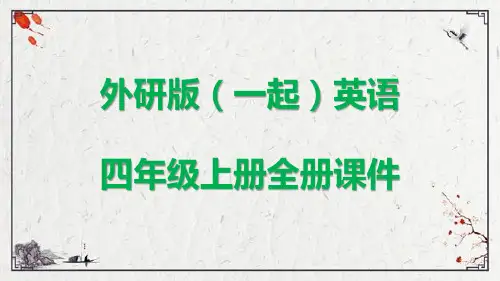
4 Listen and say. Then sing.
CHILDREN FROM CHINA ARE CHINESE Children from China are Chinese. Children from
England are English. Chinese, English, we all love fun. Children of the world, we are all one. Children from America are American. Children from Russia are Russian. American, Russian, we all love fun. Children of the world, we are all
知识讲解
Yesterday, I cleaned my room. 昨天,我打扫了我的房间。
句型“主语+动词过去式(+其他).”用于描述某人过去的行为。时态 为一般过去时,句中的动词要用过去式。
I played football yesterday afternoon. 我昨天下午踢足球了。
单元新词
love
爱你的
love(动词)爱,热爱 lovely(形容词)可爱的
1 Listen, point and say.
Where is my desk? It was here!
1 Listen, point and say.
It's there.
Oh, it's there now!
2 Listen, point and find “was, were”.
2 Listen, point and find “was, were”.
外研版英语(三起点)四年级下册Module7 unit1教学设计
Module 7Unit1 I helped Mum.教学目标:知识目标1.掌握词汇:phone,cook,wash, computer, really, what about? did,didn’t, love, him。
2.掌握I helped Mum and I washed clothes./ I cooked noodles yesterday.等句型,并能用I ...yesterday 等句型描述自己昨天做了什么事情。
3.掌握动词过去式的标志后缀-ed。
能力目标1.能够实践练习中熟练运用本节课的新单词和句型。
2.能够正确运用动词过去式来进行描述。
情感目标1.激发学生学习英语的兴趣。
2.让学生学会关心和体恤他人,培养学生的劳动意识,在家里帮助父母分担家务。
教学重难点1.教学重点:掌握词汇phone,cook,wash, computer,really, what about? did, didn’t, love, him;掌握I helped Mum and I washed clothes./ I cooked noodles yesterday.等句型,并能用I ...yesterday 等句型描述自己昨天做了什么事情;掌握动词过去式的标志后缀-ed。
2.教学难点:能够实践练习中熟练运用本节课的新单词和句型。
教学准备:PPT、单词卡片、点读笔、教学光盘教学过程:Step 1 Warming up1. Greeting.2.今天我们将玩闯关游戏(共五关)。
Step 2 Presentation1.The First Round:说出is, am, are的过去式。
2.The Second Round:读一些学过的动词词组(play basketball,play football,play table tennis,row a boat,watch TV,help Mum)3.The Third Round:(1)学习新单词(cook,wash,computer,phone)和新词组(cook noodles,wash clothes,play on the computer,phone my friend)(2)教师用课件展示自己昨天做的事情,让学生从句子中归类总结出动词过去式的变化方法。
(外研版 三起)四年级英语下册Module 7《Countries》Unit 1 教案

第1页/共2页 Module 7 Countries Unit 1 New York is in the east. 一、教学目标 1.熟练运用句子:Washington D.C is the capital of the USA. San Francisco is in the west. It’s in the east.
2.谈论国家、首都、城市及地理方位等
3.画一张自己所在学校、社区或超市的方位图,向同学进行描述。 二、教学程序 (一)、热身 1. Sing the song together.”I am the music man.”(construct funny atmosphere) 2. Show some pictures or maps about London. 3. Free talk ( Have students describe the picture)(review and present the new lesson)
(二)、介绍 1.Teacher’s Q: Which countries speak English/ S: England, American… Q: What do you know about America? S: In Chinese they may say something about it. OK, today let’s do it in English.
(三)、课文教学 a.Show a map of America.(Teacher draw it before the class) And introduce “This is my project .It about America” (show “project…) read it and understand it. b. Use questions to show new words Q: what language do the people speak in America? S: people speak English in America. Q: what’s the capital of America? S: Washington D.C is the capital of the USA. Q: where is it? S: It’s in the east. New words :speak , east c. Use the map to show the position of New York and San Francisco. And present the text contest on the blackboard. (teach new words “ city , west , cousin ) d. Make sure that all the contest on the blackboard and use a color chalk underline the 第2页/共2页
四年级英语下册 Module 7 Unit 1(1)说课稿 外研版
(外研版)四年级英语下册说课稿Module7 CountriesUnit 1 New York isin the east.尊敬的各位领导,老师:大家好,今天我说课的内容是新标准英语第八册M7 U1 New York is in the east.其主要内容是描述事物在某一范围内的具体位置。
本课的知识与以往所学相联不大,而且句子比较复杂,内容也比较单调,我采用了小组竞赛的机制,调动了他们的积极性。
在教材处理上,为了保持方位的整体性,我把U2的north, south拿到本课中,让学生全面感知方位,进行了弱化处理,通过第二课之后,再要求学生达到准确熟练掌握。
一、针对以上对教材内容的分析,这节课的教学目标为:1. 知识目标:a. 学习方位词 east/ westb. 掌握功能句“….is in the east/west of …”2. 能力目标:使学生能表达事物的具体位置。
3. 情感目标:激发学生的积极情感,培养学生交流与合作的能力。
二、结合教学目标的要求,我把本课的重难点设置为:教学重点:单词:east, west重点掌握:north, south, country, America, cousin次重点掌握功能句:He lives in the east of America. Los Angeles is in the west of America. 教学难点:能够比较灵活表达事物的具体位置。
三、为了实现本课的教学目标,我设计了争当最优秀的导游团的这一任务.围绕这一任务,设计了如下环节:第一环节:复习启动,激活思维为激活了学生原有的知识储备,为学习新知识埋伏笔,上课一开始,通过Twinkle twinkle little star表演唱,自然引出宇宙、星星、地球的话题;接着通过描述世界上的国家,渗透了单词country, America以及句型He lives in…,为后面的学习做好准备,同时也降低了新授部分的难度。
小学英语外研版一年级起点四年级上册全套教案
Module1 UNIT1 Lucy lives in London.课时目标:1)复习一般过去式和一般现在式第三人称单数的动词变化2)掌握英文书信的一般格式3)能够运用Where does she live? She lives in …… .It was my birthday on Saturday.We were at Buckingham Palace.课时重、难点简析:1) 一般现在式第三人称单数的动词变化+s/esWhere does she live? She lives in …… .学生对此语法项掌握的不扎实,虽然2-3年级都有学习和复习,但是在实际运用中会忘掉动词的相应变化。
2)What does she/he live?特殊疑问句和第三人称单数的动词变化放在一起出现,对应学生来说要通过多练习才能掌握。
学生认知分析:1)学生对英文书信的格式有了解2)对于一般过去式和一般现在式的第三人称单数的动词变化有了解。
3)对于大地点(城市、国家)前用in,在小地点(home/park…)前用at,都学过、练习过。
教学过程Warm-upGood morning, boys and girls.How are you?Did you have a good summer holiday?What did you do in summer holiday?I read some books, watched the film and did many other things.What about you?You did so many things in s ummer holiday. The summer holiday passed. Now we’re having class. We’re having an English class.Who can ask me?PPC(What are you/is he/is she doing?I’m/She’s/He’s __ing …… .Reminding: )S: What are you doing?T: I’m eating noodles.Who can come here and do the action?Who can ask?Presentation:1.What is Amy doing? Let’s watch to the videoWhat is Amy doing? If you are Amy.S: I’m reading a letter.Great! What does the letter say?2.Let’s watch the video again and answer the qu estions. 1) Where does she live?She lives in London.2) What day was Zara’s birthday?It was my birthday on Saturday.3) Where were they?We were at Buckingham Palace.3. Listen and repeat the text.4. read in group5. ShowPractise:6.AB E11)read and do2)check the answer7. Talk about your birthday.It was my birthday on Monday. We were at Guanxiangshan Park.Who can talk about yours?8.Book Practise31)give an example2)do in pairs3)show9.AB E3&E41)ask and anwer2)show4)write down板书:Module 1Unit 1 Lucy lives in LondonWhat is she doing? She’s reading a letter.What does she live ? She lives in London.作业:1)listen and repeat the text 5 times2)retell the words.Module1 UNIT2 I've got a new friend. 教学目标:5. 阅读和学写英文信及回信6. 复习现在时态和过去时态教学重难点及突破措施:5. 英文信格式6. 含有be动词的过去时态句型.措施:5. 强调英文信称呼,正文,结束语,写信人都顶格写6. 含有be动词的句子变过去时: am /is变为was ; are变为were .1.text:.Listen and repeat.● Have the students draw a picture of s omething they own. They must take turns to guess the other student’s picture.ExamplesA: I’ve got a picture of something.B: Is it a pet?A: No, it isn’t.B: Is it a toy?A: Yes.B: Is it a toy train?A: No.B: Is it a toy car?A: Yes, it is.2.Listening:T2 close the book and listen ,then repeat.3.Sing :T3 listen and say .Then sing.4. Game: guess.● Write these mixed up words on the board.gknuimnenzhuohzgigunlihawanu● Tell the students that these are the n ames of some Chinese cities.● Now have the students word in pairs. They have to put the letters in the correct order to make the words.AnswersKun MingZheng ZhouGui LinWu HanHomework:Listen to the tape 30 min a day.Read Module 1Unit2 at home.Try to write a letter to Lucy.Module2 UNIT1 I helped my mum.教学目标:1)学生能四会单词:wash, help, finish, clean,以及知道他们的过去式;2)学生能正确认读功能句a. I cleaned my room .b. I washed my trousers.c. I helped my mum .3)学生能在“昨天”这个时间范围内正确理解并初步使用过去式;教学重点:1. 初步感知过去式的正确用法;2. 学习生词wash, help, finish, clean,知道并会用他们的过去式;教学难点:使学生理解过去式的正确使用范围,学生能有意识的正确使用过去式。
四年级下册英语教案-Module7Unit1IhelpedMum∣外研版(三起)
四年级下册英语教案 Module7 Unit1 I helped Mum | 外研版(三起)教学内容本单元主要围绕“家庭生活中的帮助行为”展开,通过描述孩子们在家庭中帮助父母做家务的情景,教授学生如何用英语表达帮助行为。
教学内容包括核心词汇如“cleaned, washed, helped”等,以及主要句型“I helped ”的使用。
还包括相关的阅读材料和听力练习,旨在提高学生的综合语言运用能力。
教学目标1. 知识目标:学生能够掌握并运用核心词汇和句型,描述自己在家庭中的帮助行为。
2. 能力目标:培养学生运用英语进行日常交流的能力,提高听、说、读、写的综合运用水平。
3. 情感目标:通过教学内容,培养学生乐于助人的良好品质,增强家庭责任感。
教学难点1. 词汇记忆:本单元涉及多个家务相关的动词,学生需要准确记忆并运用。
2. 句型构造:正确构造“I helped ”句型,并能根据实际情况灵活运用。
3. 听力理解:听力材料中包含多种不同的家务场景,学生需要提高对细节的捕捉和理解能力。
教具学具准备1. 多媒体设备:用于播放教学视频和音频材料。
2. 图片卡片:展示各种家务活动的图片,辅助词汇教学。
3. 角色扮演道具:模拟家庭场景,进行角色扮演练习。
教学过程1. 课堂导入:通过播放相关视频或图片,引起学生对家庭帮助行为的兴趣。
2. 词汇教学:利用图片卡片,教授新词汇,并进行朗读和拼写练习。
3. 句型练习:通过师生互动、小组合作等形式,练习构造和使用“I helped ”句型。
4. 听力训练:播放听力材料,让学生听并回答相关问题,提高听力理解能力。
5. 角色扮演:学生分组进行角色扮演,模拟家庭中的帮助场景,运用所学语言进行交流。
板书设计1. 核心词汇:列出本单元的重点词汇,并附上中文翻译。
2. 句型结构:“I helped ”句型的基本构造。
3. 听力材料摘要:简要记录听力材料的主要内容,便于学生回顾。
4. 课堂活动安排:列出本节课的主要活动流程,帮助学生跟上教学进度。
2018-2019年英语外研版小学四年级下册Module7 Unit1 I helped Mum优质课教案
Module7 Unit1 I helped Mum教学设计一、教学内容:二、本单元内容选自新标准英语教材四年级下册M odule 7 的Unit1 I helped Mum.本单元主要学习用一般过去时态描述过去发生的事情。
本单元所要掌握的句型是:I helped Mum./ Did you cook meat yesterday? Yes,I did./ No, I didn’t. 所要掌握的单词是:phone, day, yesterday.二、教学目标:1、语言知识:会说phone, day, yesterday这些新单词,学习I helped Mum./ Did you cook meat yesterday? Yes, I did./ No,I didn’t.…这个句型,并学习打电话时的一些问候语。
2、语言技能:(1)能在图片和动作的提示下听懂简单的小故事并做出反应。
(2)能够根据表演猜测意思、说词语。
(3)能根据图、文说出单词或短句。
(4)能用英语做游戏并在游戏中用英语进行简单的交际; 能做简单的角色表演;3、学习策略:引导和启发学生在各种情境当中感受语言的交际功能,并让他们通过多种游戏和活动,逐步熟练运用所学到的语言,培养和引导学生与同伴互助合作,共同探究学习道路上的困惑,分享成功的喜悦。
以上内容转自小精灵网()4、情感态度:(1)帮助学生树立学习英语的自信心,培养他们在日常生活中敢说、乐说英的积极性;(2)培养学生学习英语的兴趣以及在实际情景中运用知识的能力,提高他们的交际能力。
5、文化意识:介绍并让学生简单地了解中西方国家人与人之间问候的不同方及文明礼仪。
三、学情分析:四年级学生对英语学习有了一定的基础,对于英语课堂中的每个细节都充满了强烈的好奇心,巧妙挖掘身边资源并合理运用课件为孩子们营造语言交流的场景,营造真实的情景让孩子们应用所学到的语言与同伴交流和玩耍,让他们在玩中感受成功的喜悦和学习英语的乐趣。
Module7Unit1IhelpedMum(教学设计)外研版(三起)英语四年级下册
教学设计:外研版(三起)英语四年级下册Module 7 Unit 1 Ihelped Mum一、教学目标1. 知识目标:(1)能够听懂、会说、会读本课核心词汇:window, door, floor, room, kitchen, garden, helped, washed, cleaned, swept, raked。
(2)能够理解并运用句型 "I helped Mum / Dad " 表达自己帮助家人做家务的经历。
2. 能力目标:(1)能够运用所学词汇和句型描述自己帮助家人做家务的经历。
(2)能够听懂并参与角色扮演,与他人交流家务劳动的经历。
3. 情感目标:培养学生的家庭责任感和劳动意识,让他们认识到帮助家人做家务的重要性。
二、教学内容本课主要讲述学生帮助家人做家务的经历。
通过学习,学生能够掌握相关词汇和句型,并用英语描述自己帮助家人做家务的经历。
三、教学重点与难点1. 重点:(1)掌握本课核心词汇。
(2)能够运用句型 "I helped Mum / Dad " 描述自己帮助家人做家务的经历。
2. 难点:(1)正确运用动词过去式。
(2)在实际情景中灵活运用所学词汇和句型。
四、教具与学具准备1. 教具:PPT、黑板、粉笔。
2. 学具:课本、练习册、文具。
五、教学过程1. 导入:通过歌曲 "I'm a little teapot" 引导学生进入课堂,激发学生学习兴趣。
2. 新课呈现:(1)通过图片和实物展示,引导学生学习本课核心词汇。
(2)教师示范句型 "I helped Mum / Dad ",并引导学生模仿。
3. 课堂练习:(1)小组活动:学生分组,用所学词汇和句型描述家人做家务的经历。
(2)个人任务:学生抽取任务卡,用英语描述自己帮助家人做家务的经历。
4. 巩固练习:通过游戏、角色扮演等活动,巩固所学词汇和句型。