
人教版七年级下册英语《Unit2Whattimedoyougotoschool》词句精讲精练
Unit 2 What time do you go to school?撰稿:王红艳审稿:白雪雁词汇精讲1. do one’s homeworkdo one’s homework的意思是“做某人的家庭作业”。
短语中的one’s可以用名词所有格或者形容词性物主代词。
例如:What time do you often do your homework?你经常在什么时候做你的家庭作业?2. get dresseddressed在本单元是形容词,意为“打扮好的,穿着衣服的”;get在此是连系动词,后接形容词dressed 构成系表结构。
词组get dressed意为“穿上衣服”。
例如:Mary, can you help your baby sister get dressed?玛莉, 你可不可以帮你年幼的妹妹穿衣服?After I get dressed, I have breakfast.我穿好衣服以后吃早饭。
拓展:dressed 的其他常见用法1)dress up, 意为“装扮,乔装打扮”或者“穿上盛装,打扮”。
例如:You needn’t dress up for the party.你不必为这个聚会精心打扮。
2)dress up as,意为“装扮成……,打扮成……”。
例如:The boy often dresses up as a monkey.那个男孩常装扮成一只猴子。
3)well-dressed,意为“穿着考究的;穿着入时的;着装得体的;衣着讲究的”。
例如:a well-dressed lady 一位穿着体面的女士3. take a shower1)shower 名词,意为“阵雨,淋浴”;take a shower 意为“洗澡,洗淋浴”,等于have a shower。
shower前面可以加形容词来修饰。
例如:I often take a shower in the evening. 我经常在晚上洗澡。
I take a cold shower when I feel tired. 我感到累时就洗个冷水澡。
2)类似于“take a shower=have a shower”这样的用法还有:take a look= have a look 看一看take a seat = have a seat 坐下,入座take a rest = have a rest 休息一下4. work1)work不及物动词,意为“工作,劳动”,第三人称单数是works;worker是名词,意为“工人”,复数是workers。
例如:He works very hard. 他工作很努力。
There are 30 workers in the factory. 工厂里有30个工人。
2)work 名词,意为“工作”,是不可数名词,但表示一份工作可以用“a piece of work”。
常用于以下词组:out of work 失业/下岗at work 在上班after work 下班后go to work 去上班in work 就业3)work 名词,意为“著作,作品”,是可数名词,复数为works。
She is reading a new work on history.她正在看一本关于历史的新书。
Shakespeare’s works are very famous. 莎士比亚的作品很著名。
5. funny1)funny 形容词,意为“有趣的,可笑的,滑稽的,奇怪的”;意为“有趣”时,相当于“interesting”。
例如:What a funny (an interesting) story! 多么有趣的故事啊!Sometimes he is funny; sometimes he seems like a poet. 有时他很滑稽, 有时他又像个诗人。
The machine is making a very funny noise. 这部机器发出一种很怪的声音。
2)fun 是funny的名词形式,意为“乐趣,娱乐,嬉戏,有趣的事”。
常用于词组“have a fun (玩得开心)”。
例如:Life isn’t all fun; it has its bad moments.人生不仅有乐趣, 也有令人不快的时刻。
Picnics are fun. 野餐是件有趣的事。
We have a lot of fun in the park on weekends. 每周末我们都在公园里玩得很快活。
Everybody had a fun last night. 昨天晚上每个人都玩得很开心。
6. exercise1)exercise 作动词,意为“运动,锻炼”等时,既可以作及物动词也可以作不及物动词。
例如:Every day I exercise before I go to sleep. (不及物动词)我每天睡觉前锻炼。
We should constantly exercise our muscles. (及物动词)我们应当经常锻炼肌肉。
2)exercise 作名词,意为“练习,操”等时,是可数名词。
意为“锻炼”时,是不可数名词。
例如:We should do eye exercises. 我们应该做眼保健操。
Let's take exercise together. 让我们一起锻炼吧。
7. quarter1)quarter 作名词时,可以译为“四分之一”或者“一刻钟”。
例如:A quarter of the apples are green. 有四分之一的苹果是青的。
It’s a quarter past seven. 七点一刻了。
2)quarter作动词时,可以译为“把…四等分”。
例如:We should quarter the pineapple.我们应该把这个菠萝分成四等份。
8. taste1)taste做行为动词时,既可以是及物动词也可以是不及物动词,意为“吃,品尝,喝,”等。
例如:I can taste something sour. 我尝到了酸味。
(及物动词)Sometimes when you are ill, you can't taste properly. (不及物动词)有时生病时吃什么都没有滋味。
2)taste做连系动词时,后面跟名词或者形容词作表语,构成主系表结构;意为“吃起来,尝起来”。
例如:The soup tastes good. 这汤的味道不错。
The pizza tastes delicious. 比萨饼很好吃。
3)taste 还可以作名词,意为“味道,味觉,品味”等。
例如:I like the taste of wine. 我喜欢葡萄酒的味道。
She has excellent taste in dress. 她在服装方面有极高的品味。
9. lifelife 名词,既可以是可数名词也可以是不可数名词。
作“生活”讲时,是不可数名词;作“生命”讲时是可数名词,其复数是“lives”。
例如:Life is like a journey. 生活像一次旅行。
(不可数)Three people lost their lives in the accident. 事故中三人丧生。
(可数)拓展:常见的使用life的词组有live a …life 过……的日子lose one's life 丧生save one’s life 救……的命give one’s life 献身come (back) to life 复活10. usually1)usually是频度副词,意为“通常”,常位于系动词、助动词或情态动词之后,实义动词之前,在句子中作状语; 但有时也可以放在句首修饰整个句子。
例如:I usually go to school at seven o’clock. 我通常七点去上学。
It is usually in the morning that she sees her patients. 她通常在上午看望病人。
Usually, I get up early. 通常, 我起得很早。
2)usually的形容词是usual,意为“通常的,平常的”。
常用于词组as usual,意为“像平常一样”。
它的反义词是unusual,意为“罕有的,不同寻常的”。
例如:She goes to work as usual. 她像平常一样去上班了。
It was an unusual day for summer. 这是夏季少有的一天。
11. brush1)brush 作动词,意为“刷,擦”,三单形式是brushes。
常用于以下短语中:brush one’s teeth / shoes / hair 刷牙/擦鞋/ 梳头。
例如;Please brush your shoes. 请把你的鞋擦一下。
I brush my teeth every day. 我每天都刷牙。
2)brush 作名词,意为“刷子,画笔,毛笔”,是可数名词,其复数是brushes。
例如:I can paint a picture with a brush. 我可以用刷子画画。
We gave him paint and brushes. 我们给了他油漆和几把刷子。
12. toothtooth 名词,意为“牙齿”,可数名词。
其复数形式是特殊变化teeth。
例如:The dentist took out two of my teeth. 牙医拔掉了我两颗牙。
拓展:1)一些名词的复数是不规则变化的。
例如:foot →feet(脚)child →children(孩子)man→men (男人)woman→women(女人)mouse →mice(老鼠)2)还有一些名词的单复数是一样的。
例如:sheep→sheep(绵羊)deer→deer(鹿)Chinese→Chinese(中国人)Japanese→Japanese(日本人)3)还有些名词是集合名词,本身就是复数的概念,不需要再变复数。
例如:cattle 牛people 人,人们police 警察词汇精炼Ⅰ. 用适当的词填空,补全下面的短文。
I usually 1 (起床)at six o’clock. I have milk and bread for breakfast. After breakfast, I 2(洗澡)and then I 3 (上学)by bus. I get to school at a quarter to eight. I have five classes in the morning. And then I have lunch at twelve o’clock. In the afternoon I have two classes. I 4 (回家)at half past four. I get home at 5:00. I 5 (吃晚饭)at about 6:00. After dinner, I 6 (做作业).I 7 (睡觉)at 8:00. My life is busy but not exciting.Ⅱ. 根据句意、首字母或汉语提示,写出正确的单词。
人教七年级英语下册Unit2 What time do you go to school语法
(2)当询问某年某月某日的上午、下午、晚上等某个具体时刻钟点时,用what time。 当泛指“做某事的时间”时,when和what time一般可互换。
The student often plays basketball at school.这名学生经常在学校打篮球。 My friends always help me with my English.我的朋友们总是在英语上帮助我。 Sometimes Jim plays the piano after lunch.吉姆有时在午饭后弹钢琴。
A.in
Br.Wang ___D_____ gets up early.So he is ________ late for work.
A.always;always
B.never;never
C.always;often
D.always;never
9. —___B_____ do you usually help your mom with housework (家务)?
二、单项选择
6. —___B_____ —It's ten o'clock. A.Where is it? B.What's the time in Beijing? C.What’s it in Beijing?
7. —David,when do you get up every day?
—I usually get up __B______ half past six. I'm never late for school.
Unit2Whattimedoyougotoschool单元知识点人教版七年级英语下册
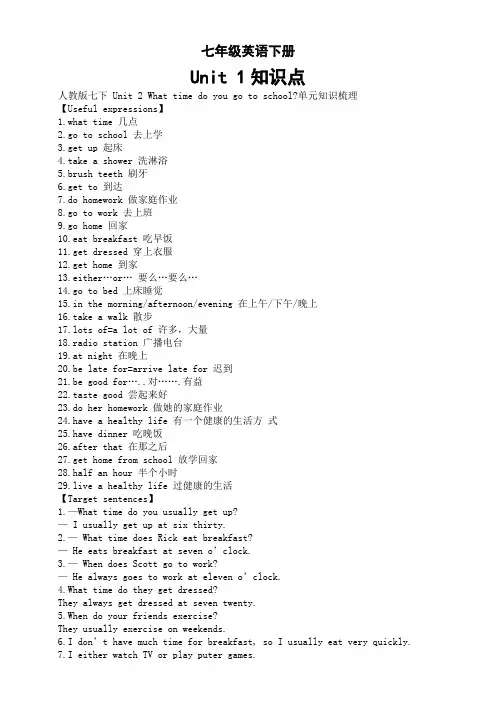
七年级英语下册Unit 1知识点人教版七下 Unit 2 What time do you go to school?单元知识梳理【Useful expressions】1.what time 几点2.go to school 去上学3.get up 起床4.take a shower 洗淋浴5.brush teeth 刷牙6.get to 到达7.do homework 做家庭作业8.go to work 去上班9.go home 回家10.eat breakfast 吃早饭11.get dressed 穿上衣服12.get home 到家13.either…or…要么…要么…14.go to bed 上床睡觉15.in the morning/afternoon/evening 在上午/下午/晚上16.take a walk 散步17.lots of=a lot of 许多,大量18.radio station 广播电台19.at night 在晚上20.be late for=arrive late for 迟到21.be good for…..对…….有益22.taste good 尝起来好23.do her homework 做她的家庭作业24.have a healthy life 有一个健康的生活方式25.have dinner 吃晚饭26.after that 在那之后27.get home from school 放学回家28.half an hour 半个小时29.live a healthy life 过健康的生活【Target sentences】1.—What time do you usually get up?— I usually get up at six thirty.2.— What time does Rick eat breakfast?—He eats breakfast at seven o’clock.3.— When does Scott go to work?—He always goes to work at eleven o’clock.4.What time do they get dressed?They always get dressed at seven twenty.5.When do your friends exercise?They usually exercise on weekends.6.I don’t have much time for breakfast, so I usually eat very quickly.7.I either watch TV or play puter games.8.At twelve, she eats lots of fruit and vegetables for lunch.9.She knows it’s not good for her, but it tastes good!10.After school, I sometimes play basketball for half an hour.【Language points】1.get dressedget dressed 穿上衣服【用法详解】get dressed为固定短语,表示穿的动作。
人教版七下 Unit 2 What time do you go to school?知识点总结
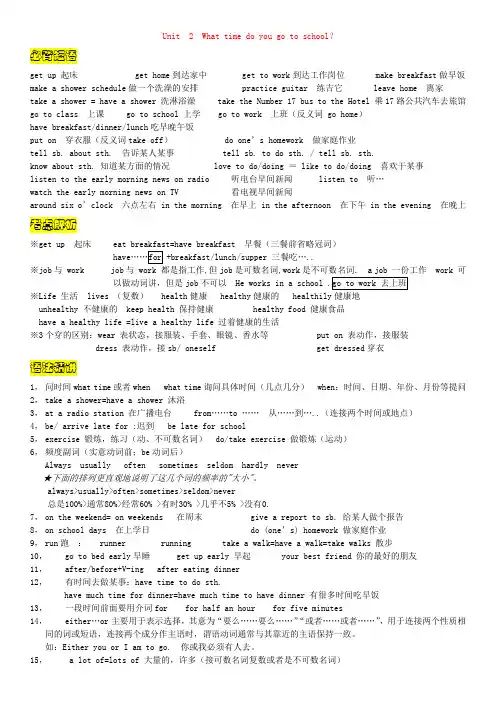
Unit 2 What time do you go to school?必背短语get up 起床 get home到达家中 get to work到达工作岗位 make breakfast做早饭make a shower schedule做一个洗澡的安排 practice guitar 练吉它 leave home 离家take a shower = have a shower 洗淋浴澡 take the Number 17 bus to the Hotel 乘17路公共汽车去旅馆go to class 上课 go to school 上学 go to work 上班(反义词 go home)have breakfast/dinner/lunch吃早晚午饭put on 穿衣服(反义词take off) do one’s homework 做家庭作业tell sb. about sth. 告诉某人某事 tell sb. to do sth. / tell sb. sth.know about sth. 知道某方面的情况 love to do/doing = like to do/doing 喜欢干某事listen to the early morning news on radio 听电台早间新闻 listen to 听…watch the early morning news on TV 看电视早间新闻around six o’clock 六点左右 in the morning 在早上 in the afternoon 在下午 in the evening 在晚上考点解析※get up 起床 eat breakfast=have breakfast 早餐(三餐前省略冠词)have三餐吃…..※job与 work job与 work 都是指工作,但job是可数名词,work是不可数名词. a job 一份工作 work 可以做动词讲,但是job不可以※Life 生活 lives (复数) health健康 healthy健康的 healthily健康地unhealthy 不健康的 keep health 保持健康 healthy food 健康食品have a healthy life =live a healthy life 过着健康的生活※3个穿的区别:wear 表状态,接服装、手套、眼镜、香水等 put on 表动作,接服装dress 表动作,接sb/ oneself get dressed穿衣语法精讲1,问时间what time或者when what time询问具体时间(几点几分) when:时间、日期、年份、月份等提问2,take a shower=have a shower 沐浴3,at a radio station 在广播电台 from……to ……从……到…..(连接两个时间或地点)4,be/ arrive late for :迟到 be late for school5,exercise 锻炼,练习(动、不可数名词) do/take exercise 做锻炼(运动)6,频度副词(实意动词前;be动词后)Always usually often sometimes seldom hardly never★下面的排列更直观地说明了这几个词的频率的"大小"。
人教版七年级下册英语《Unit2Whattimedoyougotoschool》词句精讲精练
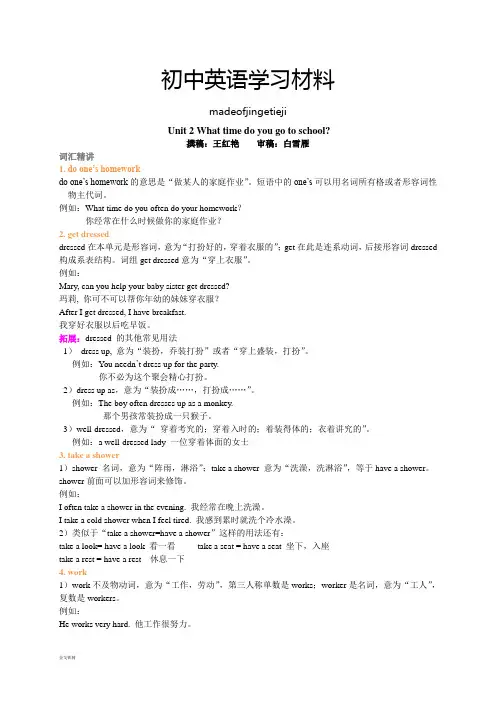
初中英语学习材料madeofjingetiejiUnit 2 What time do you go to school?撰稿:王红艳审稿:白雪雁词汇精讲1. do one’s homeworkdo one’s homework的意思是“做某人的家庭作业”。
短语中的one’s可以用名词所有格或者形容词性物主代词。
例如:What time do you often do your homework?你经常在什么时候做你的家庭作业?2. get dresseddressed在本单元是形容词,意为“打扮好的,穿着衣服的”;get在此是连系动词,后接形容词dressed 构成系表结构。
词组get dressed意为“穿上衣服”。
例如:Mary, can you help your baby sister get dressed?玛莉, 你可不可以帮你年幼的妹妹穿衣服?After I get dressed, I have breakfast.我穿好衣服以后吃早饭。
拓展:dressed 的其他常见用法1)dress up, 意为“装扮,乔装打扮”或者“穿上盛装,打扮”。
例如:You needn’t dress up for the party.你不必为这个聚会精心打扮。
2)dress up as,意为“装扮成……,打扮成……”。
例如:The boy often dresses up as a monkey.那个男孩常装扮成一只猴子。
3)well-dressed,意为“穿着考究的;穿着入时的;着装得体的;衣着讲究的”。
例如:a well-dressed lady 一位穿着体面的女士3. take a shower1)shower 名词,意为“阵雨,淋浴”;take a shower 意为“洗澡,洗淋浴”,等于have a shower。
shower前面可以加形容词来修饰。
例如:I often take a shower in the evening. 我经常在晚上洗澡。
初中英语人教版七年级下Unit 2 What time do you go to school知识点

七年级英语下册Unit2知识点Section A1.Get up 起床2.Go to school 去上学3.Get dressed 穿衣服Dress (名词) 连衣裙 (动词) 穿衣服Put on, wear, dress区别:Put on强调穿衣服的动作Eg: It’s cold outside, please put on your sweater.“外面天气冷,请穿上你的毛衣。
”wear强调穿衣服的状态Eg: The girl wears a sweater today.“这个女孩今天穿了一件毛衣。
”Dress 后面接人,表示给某人穿衣服Eg: The boy is too young to dress himself.“这个小那还太小了不能自己穿衣服。
”4.Brush teeth 刷牙(1)Brush (名词) 刷子Eg: Please pass the brush to me.“请把刷子递给我。
”Brush(动词) 刷Eg: The floor is easy to brush clean.“这个地板很容易刷干净。
”(2)Teeth 是tooth(牙齿)的复数形式5.Eat breakfast/lunch/dinner “吃早/午/晚饭”= have breakfast/lunch/dinner注意:在表示吃早午晚饭时不可加冠词,但当有形容词修饰早午晚饭时可加冠词Have a good breakfast“吃一顿好的早饭”句型:have ... for breakfast/lunch/dinner“早/午/晚饭吃...”Eg: We have bread and milk for breakfast.“我们早饭吃面包和牛奶。
”6.Take a shower= have a shower 洗淋浴7.At six thirty 在六点半在具体某一时刻前通常用介词 at时间表达法:1)采用数词表达时间Eg: six thirty 六点半;eight fifteen 八点十五分2)采用介词past,to表达时间一般说来半个小时以内,常常用介词past,表示“几点过几分”Eg: a quarter past three 三点一刻;half past eight 六点半;ten past two 两点十分半小时过后多用介词to,表示“差几分到几点”Eg: a quarter to three 两点四十五;twenty to four 三点四十3)a. m. 和p. m.A.m. 表示“午前;上午”(午夜12:00后至中午12:00前);p.m. 表示“午后;下午”(中午12:00后至午夜12:00前)。
人教版七年级下册英语:Unit 2 What time do you go to school知识点讲解及练习题目及答案

Unit 2 What time do you go to school?单元复习题重点知识点讲解1. what time与whenwhat time翻译为“几点”问的是具体的时间,一般回答要具体到小时。
What time do you go to school?I go to school at half past seven o’clock.回答具体到点钟,且注意在几点前边的介词用at。
when也是对时间的提问,但与what time的区别是:用when提问,回答既可以是具体的时间,也可以是不具体的时间,如:in the morning,last year,in 1998等范围大的时间。
向对方询问具体时间时,即几点几分,只能用what time,不能用when。
询问年份、月份、日期时,只能用when,不能用what time。
2. 英语时间的表达(1)整点时间可表示为“钟点数+o’clock”或直接读钟点数,省去o’clock。
如:It’s ten o’clock a. m.现在是上午十点整。
(2)非整点时间可直接采取读数法。
如:It’s eight-thirty. 是八点三十分。
注意时间的表达方式:用数词。
点与分钟之间用连字如:注:英语时刻的表达法:顺读法和逆读法。
顺读法:钟点数+分钟数。
4:25→four twenty-five,6:58→six fifty-eight,7:00→seven o’clock 说明:这种表达不论分钟数是多少,均可使用。
逆读法:分钟为+介词to/past+钟点数,可分两种情况:1)分钟为不超过半小时,用分钟数+past (/pa:st/过+钟点数。
4:23→t wenty-three past four,5:19→nineteen past five.2)分钟数超过了半小时,用(所差的)分钟的+to+(下一个)钟点为。
10:58→two to eleven 7:31→twenty-nine to eight在逆读法中分钟数逢“五”逢“十”可省略minute(s)。
人教版七年级英语下册《Unit 2 What time do you go to school》(含
《Unit 2 What time do you go to school》(含5课时)导学案【学习目标】1. 正确听、说、读、写section A 单词。
2. 运用“what time”和“where”引导的特殊疑问句询问并回答日常活动的时间。
【学习重点】熟练运用“what time”和“where”引导的特殊疑问句。
【学习难点】准确使用“what time”和“where”引导的特殊疑问句询问并回答。
【学习流程】一、自主学习(教师寄语:Knowledge is power.知识就是力量.)学习任务一:会读写、本课4个单词及7个短语.1、个人自读、记忆本课单词.2、小组互相检查单词读的情况.3、小组内竞赛,看谁记得快、准,并展示(默写)单词: 锻炼;练习___________ 淋浴,淋浴器___________通常___________ 刷;刷净___________短语:几点,什么时候_________________ 穿上衣服_________________ 洗淋浴_________________ 吃早饭_________________广播电台_________________ 刷牙_________________4、认真观察1a的图画,将词语与图片搭配,并核对答案。
二、交流展示学习任务二:运用句型What time ...?谈论Rick的日常生活.1、熟读1a中的对话,理解并复述.2、小组为单位,两人合作,谈论Rick的日常生活(分别扮演Rick和采访者).3、熟读2d中的对话,理解并复述.4、小组为单位,两人合作,角色扮演Scott和采访者.【合作共建】小组讨论该如何表达时间?写出下列时间.9:00 ________________ 11:00 ____________10:30 _______________ 12:50 ____________三、知识反馈(一)根据汉语完成句子1. 我早上六点起床.I ______ ______ _______ six in the morning.2.他的爸爸晚上九点洗澡.His father ______ ______ _______ ____ nine in the evening.3.你每天早上七点跑步吗?_____ you _______ ______ seven every morning?4.你姐姐几点吃晚饭?______ ______ _____ your sister eat _______?5.我上班从不迟到.I’m_______ _____ ______ work.6.他十二点吃午饭.He ______ _____ at twelve.(二)句型转换,按要求改写句子.1.Alice takes a shower at 9:00.(提问划线部分)__________________________________________?2.I have some tea in my cup.(改为否定句)__________________________________________.3.The old man is seventy.( 提问划线部分)__________________________________________.四、学后反思____________________________________________专注:心无旁骛,万事可破Unit 2 What time do you go to school?第2课时【学习目标】1.熟练掌握本课的单词和部分短语.2.熟练运用句型询问时间,以及在某个时间干什么事What's the time? It's…What time do you usually…? I usually…at…3.能根据要求写出简单的句子表述自己和他人的日常活动.【学习重点】能根据要求写出简单的句子表述自己和他人的日常活动.【学习难点】一般现在时中不同人称对应的动词的变化形式.【学习流程】一、自主学习(教师寄语:Knowledge is power.知识就是力量.)学习任务一: 读写、记忆本课单词和短语.1.个人自读,记忆.2.小组互相检查读、写情况.3.根据汉语写出下列英语单词和短语并展示.单词:最好的_________ 小时_________ 组;群________ 牙齿__________ 短语:在周末_______________ 去上班_______________二、交流展示学习任务二: 通过练习描述一天的时间1. Grammar Focus2. Writing(3a,3b)3. Survey (3c)学习任务三:试着模仿说出自己的一天的活动三、知识反馈专注:心无旁骛,万事可破(一)单项选择1. The bus usually ________ him to work.A. takeB. takesC. /D. bring2. I usually go to school _________ seven o'clock..A. atB. inC. onD. for3. — What's the time? —__________ nine-fifteen.A. The time isB. It'sC. AtD. This is4.We go to ________at six thirty in the morningA. the schoolB. a schoolC. schoolD. schools(二)用括号内所给词的适当形式填空1.Alice brushes her __________(tooth) every morning.2.I t’s __________(fun) to play volleyball on the beach(沙滩).3.I usually get __________ (dress) at six in the morning.4.Tom is my __________ (good) friend in my class.5.My father __________ (work) in a school.四、学后反思____________________________________________专注:心无旁骛,万事可破Unit 2 What time do you go to school?第3课时【学习目标】1.正确听、说、读、写section B单词.2.能够利用所学句型询问及表述时间.3. 学会谈论自己或别人的日常生活,询问及表述时间.【学习重点】学会谈论自己或别人的日常生活,询问及表述时间。
人教版七年级英语下册《Unit 2 What time do you go to school》教案
《Unit 2 What time do you go to school》教案Teaching objectives knowledgeThetarget1. Learn and master the following words:up get up dress g et dressed brush toothshower take a shower usually forty wownever early fifty job work station radiostation o’clock night funny exercise2. To learn to ask and talk about the spokenlanguage of the time, make the schedule:-What time do you usually take a shower?-I usually take a shower at six forty.-What time do you usually get up?-I usually get up at eight thirty at night.AbilitytoThetarget1) learning with credit to special questions abouttime and time.2) with the knowledge of the target language t o lifeand learning activities to make plans, to reasonablyarrange work and rest time.emotionalTheSection A, talk about the topic is "routine" time,the learning content close to student's life, becausethe students' work and rest time arrangement is verytarget regular. By asking each other or talk about yourself or a loved one's work and rest time arrangementand activity plan, and punctuality can cultivatestudents' good habit, the habit.Teaching important points Learn to ask and talk about time and make the schedule.Teaching difficultpoints Credit to guide the expression of special questionsand time.The teachingmethodTask-based teaching method and teaching.。
人教版七年级下英语Unit2Whattimedoyougotoschool
人教版七年级下英语Unit2WhattimedoyougotoschoolUnit 2What time do you go to school?.一.A s k i n g w a y s:(问路)1.W h e r e i s(t h e n e a r e s t)……?(最近的)……在哪里?2.C a n y o u t e l l m e t h e w a y t o……?你能告诉我去……的路吗?3.H o w c a n I g e t t o……?我怎样到达……呢?4.I s t h e r e……n e a r h e r e/i n t h en e i g h b o r h o o d?附近有……吗?5.W h i c h i s t h e w a y t o……?哪条是去……的路?二.S h o w i n g t h e w a y s:(指路)1.G o s t r a i g h t d o w n/a l o n g t h i s s t r e e t.沿着这条街一直走。
2.T u r n l e f t a t t h e s e c o n d t u r n i n g.在第二个路口向左转。
3.Y o u w i l l f i n d i t o n y o u r r i g h t.你会在你右手边发现它。
4.I t i s a b o u t o n e h u n d r e d m e t e r s f r o mh e r e.离这里大约一百米远。
5.Y o u’d b e t t e r t a k e a b u s.你最好坐公交车去。
(Y o u’d be t t e r+动词原形)三.词组1.a c r o s s f r o m……在……的对面 a c r o s s f r o m t h eb a n k在银行的对面2. n e x t t o……紧靠…… n e x t t o t h e s u p e r m a r k e t 紧靠超市3.b e t w e e n……a n d……在……和……之间b e t w e e n t h e p a r k a n d t h e z o o在公园和动物园之间a m o n g表示位于三者或三者以上之间4.i n f r o n t o f……在……前面 T h e r e i s a t r e e i nf r o n t o f t h e c l a s s r o o m.课室前面有棵树。
七年级英语下册Unit2Whattimedoyougotoschool短语语法知识点汇总人教版
Unit 2 What time do you go to school 一、基础归纳【教材内容解析】Section A1.get dressed (P. 7)get dressed意为“穿上衣服”,dress用作动词,表示“给(某人)穿衣服”,接宾语时,只能接表示人的名词或者代词。
He can’t dress himself.I usually dress my daughter before I go to work.【拓展】辨析wear, put on和dress2.take a shower (P. 7)take a shower意为“洗淋浴”,相当于have a shower,shower用作名词,表示“淋浴”。
I often take a shower in the evening.I take a cold shower when I feel tired.3.What time do you usually get up, Rick? (P. 7)(1)what time用来询问具体的时间点,表示“什么时候”。
What time do you go to school?(2)usually是频度副词,意为“通常、一般”,在句中作状语,一般位于实义动词之前,连系动词be、助动词或者情态动词之后。
I usually have lunch at school.He usually goes to school by bike.4.I never get up so early. (P. 8)early此处用作副词,表示“很早地”,反义词为late,意为“晚地”。
Please come to school early tomorrow.【拓展】early还可以用作形容词,表示“早的、提前的”,反义词是late,意为“晚的”。
He gets up early to catch the early bus.5.Scott has an interesting job. (P. 8)job用作可数名词,表示“工作”,强调具体的职业或者工作,work表示“工作”时,用作不可数名词,指人们日常生活和工作中从事的体力或者脑力劳动,及各类工作。