
Unit8 第3课时 (Grammar Focus-3c)(含答案)
第3课时(Grammar Focus-3c)
there be句型
◆定义:there be句型也称为“存在句”,表示“某地有某物”。
◆用法及构成
①there be句型结构为:There be+名词(主语)+地点副词/介词短语(表示地点)。
there be句型属于倒装句,主语通常放在谓语后面,动词be为谓语。
Be动词应根据主语的单复数而变化,若主语是可数名词单数,用there is;是复数则用there are,若主语是不可数名词,则用there is。
eg:There are 50 students in our class.我们班有50个学生。
②there be句型中的谓语应和后面的主语保持一致。
若有两个或两个以上的主语,动词be的形式应与离be最近的那个主语保持一致:即遵循“就近原则”。
eg:There is a pen and two books on the desk.
There are two books and a pen on the desk.
③there be句型的否定句,直接在be动词后加not;其一般疑问句,要将be动词放在句首。
肯定回答为Yes,there is/are;否定回答为No,there isn’t/aren’t。
[注意]there be句型的否定句和一般疑问句若中有some,则应将some改为any。
④There be句型一般现在时的特殊疑问句由“特殊疑问词+is/are +there+地点状语”构成,有时地点状语可省略。
答语不能用Yes或No,需根据情况直接回答。
eg:--How many apples are there in the bag? 包里有多少苹果?
--Five.五个
◆there be与have/has的区别
there be结构表示客观存在,意为“某地有某物(人)”;have/has表示所属关系,意为“某人拥有某物”。
eg:There is a TV in our classroom.在我们的教室里有一台电视机。
We have a TV in our classroom.我们有一台电视机在教室里。
方位介词(词组)
◆next to 紧挨着,与……相邻
◆near 在……附近
◆behind 在……后面
◆across from 在……对面
◆in front of 在……的前面(范围之外)
[拓展] in the front of在……的前面(范围之内)
一、根据句意。
选用is或are完成下列句子。
1.There a pool in the park.
2.There lots of students in the dining hall.
3.There some books on the desk.
4.There no juice in the yellow cup.
5.There a clock and some pictures on the wall.
二、按要求完成下列句子。
6.There is a park on Center Street.(改为一般疑问句)
a park on Center Street?
7.There are some boats on the river.(改为否定句)
There boats on the river.
8.Is there a park near here?(作否定回答)
,
9.There are two supermarkets and a park in our town.(改为同义句)
a park and two supermarkets in our town.10.Many people are in the sports hall.(改为同义句)
many people in the sports hall.
三、根据汉语意思完成下列句子翻译。
11.服装店在动物园后面。
The clothes store the zoo.
12.格林俱乐部在我家对面。
Green club is my home.
13.这家超市紧挨着一个食品店。
This supermarket is the food store.14.图书馆前有公共汽车站吗?
Is there a bus stop the library? 15.我们学校在银行和公园之间。
Our school is the park.
参考答案
一、l.is 2.are 3.are 4.is 5.is
二、6.Is there 7.aren’t any8.NO;there isn’t9.There is
10.There are
三、11.is behind 12.across from 13.next to 14.in front of
15.between the bank and。
八年级英语上册Unit8第3课时(GrammarFocus_3c)同步语法精讲精练人教新目标版
二、语法填空。
Yesterday,I visited a friend of 6. _______ (I).At his home,he showed mine to_make carefully me how 7._________ (make) banana milk shakes.I 8.__________ (careful) watched the process (步骤). up .And then he put First,he peeled the bananas and cut them 9. _____ them in the blender. 10. _________ Second (two),he poured a cup of milk and two 11.__________ spoons (spoon) of honey into the blender,added some sugar
2.—______________ How_many cups of yogurt would you like?
—Only one.
How_much are the tomatoes,please? 3.—_____________ —Five dollars. How_many sheep are there on the hill? 4.—_____________ —There are many sheep. How_much salt do we need? 5.—______________ —One spoon.
eg:—How much are they?它们多少钱? —Fifty dollars.50美元。
描述动作或事物发生的先后顺序:
►first作副词, 意为“首先”,可位于句首,也可位于句末。
Unit8 第3课时 Section A(Grammar Focus-3c)七年级英语上册(人教版)
形容词性物主代词或名词所有格
_M__y_/H__is_/H__e_r/_A_l_ic_e_’s_或__I_t___ is on/in…
询问及回答生日 用句型 When is/are sb.’s birthday(s)? 来询问他人的生日。 回答时用sb.’s birthday(s) is/are (on/in) …或用句型:It’s (on/in) … 例如: — When is your birthday? 你的生日在什么时候?
1. 你的生日是什么时候?
__W__h_e_n___isyour birthday? 2. 我的生日是5月2日。
My birthday is __o_n __M__ay__2_n_d.
3. 他的生日是什么时候?
W__h_e_n_ _i_s__ his _b_i_r_t_h_d_a_y?
4. 他的生日是在1月17日。
Ask and answer. How old are you, Mary?
When is your birthday?
I’m twelve.
It’s on March 6th.
When is his/ her His/Her ____’s birthday? birthday is on ...
A: When is her birthday?
B: Her birthday is June 3rd. = It’s June 3rd.
A: How old is she? B: She is nine years old.
= She is nine.
NAME: John Miller DATE OF BIRTH: March 21st AGE: 15
单数名词
第三课时 Section A (Grammar Focus3c)
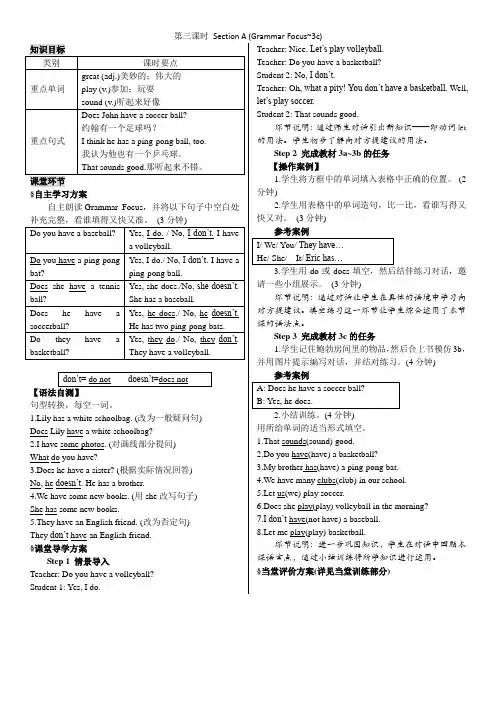
第三课时 Section A (Grammar Focus~3c)§自主学习方案自主朗读Grammar Focus ,并将以下句子中空白处【语法自测】句型转换,每空一词。
1.Lily has a white schoolbag. (改为一般疑问句) Does Lily have a white schoolbag?2.I have some photos. (对画线部分提问) What do you have?3.Does he have a sister? (根据实际情况回答) No, he doesn’t . He has a brother.4.We have some new books. (用she 改写句子) She has some new books.5.They have an English friend. (改为否定句) They don’t have an English friend. §课堂导学方案Step 1 情景导入Teacher: Do you have a volleyball? Student 1: Yes, I do. Teacher: Nice. Let’s play volleyball. Teacher: Do you have a basketball? Student 2: No, I don’t. Teacher: Oh, what a pity! You don’t have a basketball. Well, let’s play soccer. Student 2: That sounds good. 环节说明:通过师生对话引出新知识——即动词let 的用法。
学生初步了解向对方提建议的用法。
Step 2 完成教材3a~3b 的任务 【操作案例】1.学生将方框中的单词填入表格中正确的位置。
(2 分钟)2.学生用表格中的单词造句,比一比,看谁写得又快又对。
Unit8SectionA(GrammarFocus-3c)课件人教版八年级英语上册
Next, put the tree in the hole. Then, put the soil back into the hole. Finally, water the tree.
Sample 2 How to make beef noodles?
A: Do you know how to make noodles We __n_e_ed__ three __b_a_n_a_n_a_s_.
8. 我们需要多少酸奶? _H_o_w__ m__u_c_h_ yogurt do we need?
9. 我们需要一杯茶。 We need _o_n_e__c_u_p__o_f_ tea.
3a
Circle the correct word in each question.
Practice 根据课本内容,完成下列句子。
1. 你怎样做香蕉奶昔? _H__o_w_ do you m__a_k_e_ a banana milk shake?
2. 首先,将香蕉剥皮。 _F_i_r_s_t _, __p_e_e_l the bananas.
3. 接下来,将香蕉放入果汁机中。 _N_e_x_t, __p_u_t_ the bananas in the blender.
问句为一般疑问句,故应用yes或no 来回答。
a. Half a cup.
b. _F_i_rs_t__ , put the corn into the popcorn machine.
第3课时 Section A (Grammar Focus-3c)
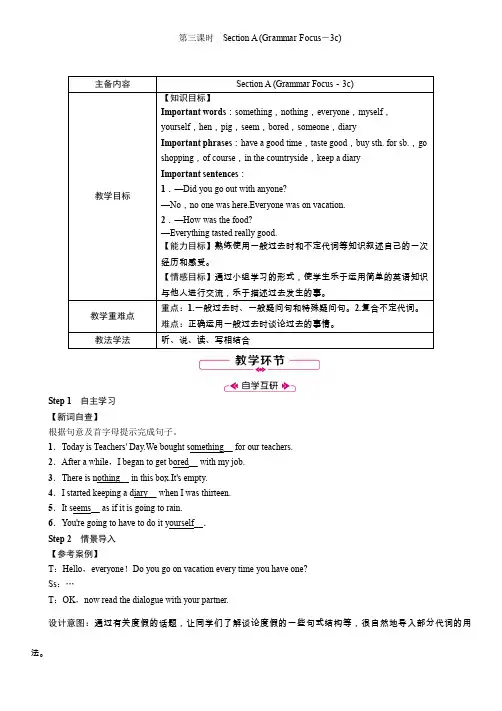
第三课时Section A (Grammar Focus-3c)Step 1自主学习【新词自查】根据句意及首字母提示完成句子。
1.Today is Teachers' Day.We bought something__ for our teachers.2.After a while,I began to get bored__ with my job.3.There is nothing__ in this box.It's empty.4.I started keeping a diary__ when I was thirteen.5.It seems__ as if it is going to rain.6.You're going to have to do it yourself__.Step 2情景导入【参考案例】T:Hello,everyone!Do you go on vacation every time you have one?Ss:…T:OK,now read the dialogue with your partner.设计意图:通过有关度假的话题,让同学们了解谈论度假的一些句式结构等,很自然地导入部分代词的用法。
Step 3畅通Grammar Focus回顾语法重点【操作案例】1.学生阅读Grammar Focus中的句子,标出句子中的复合不定代词。
2.思考探究:如何正确使用复合不定代词。
设计意图:巩固对复合不定代词的学习,同时为完成3a的任务扫清障碍。
Step 4完成教材3a-3c的任务【操作案例】1.要求学生熟读3a中的句子,理解句子的含义,并且根据自己的理解用所给单词的适当形式填空。
然后邀请几位同学给出自己的答案,全班一起检查讨论。
T:There is a conversation between Linda and Alice in 3a.Let's read and fill in the blanks with the correct words.2.让两位同学带上单词读对话,讲解对话,然后订正答案。
Unit8_SectionA(Grammar_Focus-3c)精品教案
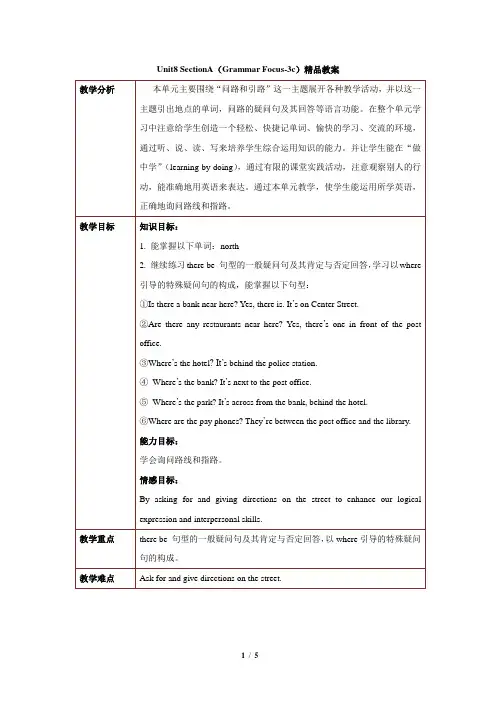
Unit8 SectionA(Grammar Focus-3c)精品教案教学分析本单元主要围绕“问路和引路”这一主题展开各种教学活动,并以这一主题引出地点的单词,问路的疑问句及其回答等语言功能。
在整个单元学习中注意给学生创造一个轻松、快捷记单词、愉快的学习、交流的环境,通过听、说、读、写来培养学生综合运用知识的能力。
并让学生能在“做中学”(learning by doing),通过有限的课堂实践活动,注意观察别人的行动,能准确地用英语来表达。
通过本单元教学,使学生能运用所学英语,正确地询问路线和指路。
教学目标知识目标:1. 能掌握以下单词:north2. 继续练习there be 句型的一般疑问句及其肯定与否定回答,学习以where引导的特殊疑问句的构成,能掌握以下句型:①Is there a bank near here? Yes, there is. It’s on Center Street.②Are there any restaurants near here? Yes, there’s one in front of the postoffice.③Where’s the hotel? It’s behind the police station.④Where’s the bank? It’s next to the post office.⑤Where’s the park? It’s across from the bank, behind the hotel.⑥Where are the pay phones? They’re between the post office and the library.能力目标:学会询问路线和指路。
情感目标:By asking for and giving directions on the street to enhance our logicalexpression and interpersonal skills.教学重点there be 句型的一般疑问句及其肯定与否定回答,以where引导的特殊疑问句的构成。
Unit8 SectionA(Grammar Focus-3c)名师教案
S2:Doeshehaveavolleyball
S1:Yes,hedoes…
通过游戏来继续运用所学句型解决问题
学生能够正确提出问题和回答问题
Ste
我们English物品,写出五个一般疑问句的问答句。
巩固所学句型
学生能够运用所学知识进行造句
【教材内容坼分分析】本单元SectionA学习运动项目,学生们从中挑选出各自喜欢的体育项目,并说明原因,目的是巩固并新学一些体育项目的名词;学生互相询问所爱好的运动,并根据情况发出邀请,学会用have对物品的所属进行提问与回答,掌握用do和does引导的一般疑问句的构成及使用,了解用Let’s提建议的句型;,SectionB进一步拓展了此话题,按照“听力输入--阅读训练--由读促写”的过程逐层递进,写成日记,进一步复习、巩固所学的语言目标。
2继续学会do和does引导的一般疑问句,理解并掌握英语句子中的人称和数,掌握并熟练运用下列句型。
①—Doyouhaveabaseball
—Yes,Ido/No,Idon't
②—Doesshe/hehaveatennisball
—Yes,she/hedoes/No,she/hedoesn't
③—Dotheyhaveasoccerball
—Yes,theydo/No,theydon't
3能用Let’s…句型来提建议。
2情感态度价值观目标:
利用学生喜爱运动的心理,激发学生学习英语的欲望和兴趣,使他们乐于参与各种英语实践活动。在小组活动中,培养学生团结协作精神。
教学重难点
1教学重点:
1总结do和does引导的一般疑问句及其回答语。
2在实际生活情景中能正确运用所学的句型谈论自己或他人所拥有的东西。
人教版英语八年级上册Unit8SectionA(GrammarFocus~3c)教学设计
1.语法讲解:教师通过PPT展示一般将来时的结构,解释will+动词原形和be going to的用法,并举例说明。
2.情境创设:教师创设情境,如:“I will go to the movies with my friends tomorrow.”,让学生模仿并运用一般将来时描述自己的未来计划。
b.对于基础较好的学生,引导他们运用一般将来时进行更复杂的句子构建和对话交流。
3.互动交流:组织小组讨论、角色扮演等活动,让学生在互动中运用所学知识,提高口语表达能力。
4.写作练习:布置与一般将来时相关的写作任务,如编写一段关于未来计划的对话或短文,巩固所学知识,提高写作能力。
5.课后拓展:鼓励学生课后关注英语学习资源,如英语电影、歌曲等,拓展学生的国际视野,增强跨文化交际能力。
在教学过程中,关注以下策略:
1.注重启发式教学:引导学生主动发现问题、解决问题,培养他们的思维能力和创新意识。
2.适时反馈与鼓励:关注学生的学习过程,及时给予反馈和鼓励,增强学生的自信心,激发学习动力。
3.个性化辅导:针对学生的个体差异,给予个性化的辅导和指导,帮助学生克服学习难点。
4.家校合作:加强与家长的沟通,共同关注学生的学习状况,形成家校共育的良好氛围。
2.词汇和短语:本节课涉及的一些核心词汇和短语,如plan to do sth., be going to do sth., tomorrow, next week等,学生需要熟练掌握并在实际语境中运用。
3.阅读理解:提高学生对3c部分对话的理解能力,能够准确提取关键信息,理解并运用一般将来时进行交流。
3.能够通过阅读和理解3c部分的对话,提取关键信息,提高阅读理解能力。
4.能够在真实语境中运用所学语法和词汇进行交流,提高口语表达能力。
第三课时 Grammar Focus-3c)
11.His friend wants to find a job (工作) in Beijing. 12.Let's work in group (小组).
五、单项选择。(5×6分=30分) 13. B your father watching TV in the evening? A.Does, likes B.Does, like C.Is, likes A.don't B.don't do D.Do, likes C.doesn't D.doesn't do 14.Susan D her homework at school every weekend. 15.Zhang Lili is a very good teacher and her students like her. A A.always B.usually C.never D.sometimes
always goes to work at eleven o'clock.
— He's never late.
四、根据句意及提示写单词。(5×6分=30分) 8.My grandfather usually exercises (锻炼) after dinner. 9.Do you like to get up 10.That's really a sports. early (早)? best (最好的) time to play
eat/have_dinner
三、核心句型。(2×10分=20分) 6.—你通常什么时候起床? —我通常在6点半起床。
—What time do you usually get up?
—I usually get up at six thirty.
高二英语人教版选修8unit3Section ⅢGrammar精讲精练(含答案)
Section ⅢGrammar——过去分词作定语、表语和宾语补足语考点一过去分词作定语1.过去分词作定语时,相当于形容词,其逻辑主语就是它所修饰的名词。
分词所表示的动作与其所修饰的名词构成动宾关系。
The concert given by their friends was a success.他们朋友举办的音乐会很成功。
2.单个的过去分词作定语时,常常置于其所修饰的名词前;而过去分词短语作定语时,常常置于其所修饰的名词后。
They are cleaning the fallen leaves in the yard.他们正在打扫院子里的落叶。
The meeting,attended by over five thousand people,welcomed the great hero.(他们举行了)欢迎英雄的大会,到会的有五千多人。
3.过去分词及过去分词短语作定语一般可转换为一个定语从句。
We must adapt our regulations to the changed conditions.=We must adapt our regulations to the conditions that have been changed.我们必须调整规章制度来适应变化了的情况。
4.有些过去分词作前置定语与后置定语时意义不同。
in the given time在既定的时间内with the words given用所给的单词a concerned look一个关切的神情the people concerned有关人士[名师点津]及物动词的过去分词除表示“完成”的动作之外,还表示“被动”的意义。
如:spoken English(英语口语);iced beer(冰冻啤酒);cooked food(熟食);fried chips(炸土豆条)。
不及物动词的过去分词常表示“完成”的动作,而不表示“被动”意义。