
人教版八年级英语下册Unit6 An old man tried to move the mountains单元测试卷
Unit 6 An old man tried to move the mountains.单元综合试卷Class: ________ Name: ________I 单项选择。
(每题2分,共40分)( )1. Once upon a time, there was _________emperor in _________Europe.A. a, aB. an, anC. a, /D. an, /( )2. They tried _________the mountain away in their life.A. to finish movingB. to finish takingC. finishing to moveD. finishing to take( )3. I’ll phone you as soon as I ______.A get to homeB got to homeC get homeD got home( )4. It used to take a long time for them to get to _________side of the mountain.A. anotherB. an otherC. otherD. the other( )5. There are some ________ways to solve the problem.A. another C. an other C. other D. the other( )6. Listen! Can you hear a man’s ________?A. voiceB. noiseC. soundD. noises( )7. His words reminded us ________the experience in the mountain last year.A. at C. with C. to D. of( )8. We are trying to ________our country ________a more beautiful country.A. compare, withB. compare, toC. turn, intoD. look, after ( )9. We were so ________by the girl’s story that we kept ________.A. move, to cryB. move, cryingC. moved, to cryD. moved, crying ( )10. ________the TV program came out, children all over the country became interested in it at once.A. As soon asB. UnlessC. IfD. Until( )11. For us, hard work leads ________good grades.A. toB. withC. atD. in( )12. The Monkey King keeps fighting to help _________weak.A. aB. anC. theD./( )13. They went to Shanghai ________the first time ________October, 2002.A. at, inB. at, onC. for, inD. for, on( )14. The story is ________interesting ________we all like it very much.A. such, thatB. too, toC. enough, toD. so, that( )15. He didn’t go to bed ______ eleven o’clock last night.A. afterB. inC. sinceD. until( )16. Zhang Lan is ill. Let me go to the meeting instead ________.A of sheB of herC off sheD off her( )17. We couldn’t help _____ when we heard the funny story.A laughB laughingC laughsD to laugh( )18. If you are busy, you may come another day .A. instead ofB. insteadC. in order toD. either( )19. you study harder, you will not pass the history exam.A. IfB. UnlessC. BecauseD. Until( )20. The little girl couldn’t stop when she saw the snake.A. to cryB. cryingC. criedD. criingII.词型填空。
(每题2分,共30分)1. He tried ______ (climb) the mountain, but he failed.2. Yu Gong kept ______ (try) and didn’t _____ (give) up.3. But what could Yu Gong do instead of ______ (move) the mountains.4. Do you find a good way _______ (solve) the problem?5. My mother always tells me not to give up ______ (work) hard.6. If you keep on______(practice) like that, you will win the race.7. The new couple were so happy that they couldn’t stop _____ (smile) .8. Once upon a time, Hou Yi _____ (shoot) down nine suns.9. Mary is a shy girl. She always ______ (hide) herself from others in her room.10.Yu Gong’s family could continue______ (move) the mountains after he died.11. Our parents always remind us_________ (study) hard every day.12. As soon as he saw me, he stopped (talk)to me.13. _______ (make) more money, the two brothers came to the city.14. When the teacher came in, the students stopped (talk).15. When he ______ (wake) up, his favorite TV show was on.III. 完形填空。
(每题1分,共10分)An interesting thing happened to me last Sunday. The weather was so fine that I decided to 1 in the country. On my way home, my car stopped. It ran out of gasoline(汽油). I decided to walk along the road until I found someone who could sell me some gasoline. I had walked a long way before I found a big 2 near the road. I was _3 to see it because it was getting dark. I knocked at the door and an old lady came out. She said, “I’ve been waiting for you for a long time. Come in, please. I got 4 ready for you.” I was very surprised.“Oh, Tony! You used to love tea.”I told her my car ran out of gasoline, 5 she didn’t seem to hear me. She was talking so strangely that I wanted to 6 . As soon as she went to get the tea, Iwent out of the house as quickly as possible.I was so happy when I saw 7 house by the road. When I told the man about the old lady, he said, “Oh, that’s Helen. She lives by 8 in that big house. She’s strange, but she wouldn’t hurt anyone. She is still 9 for the man whom she was going to marry 25 years ago. The man was named Tony. The day before they got married, he went away and __10 came back.”( )1.A.walk B. drive C. run D. ride ( )2.A.house B. tree C. hospital D. car ( )3.A.sad B. angry C. happy D. surprised ( )4.A.coffee B. milk C. water D. tea ( )5.A.and B. or C. but D. so ( )6.A.stay B. leave C. sit down D. have a rest ( )7.A.others B. the other C. other D. another ( )8.A.themselves B. myself C. herself D. himself ( )9.A.keeping B. talking C. working D. waiting ( )10.A.never B. usually C. often D. sometimesIII. 阅读理解。
英语人教版八年级下册Unit6 An old man tried to move

An old man tried to move
Unit 6
the mountains.
R 八年级下册
Section A 2a-2d
教学目标
2c
2c
His family would live and grow, but the mountains could not get bigger. So Yu Gong and his family kept on digging day after day and year after year.
possible if you work hard. _______________________________________ 6. 我认为我们应该努力找到其他的解决问题的方 法。 _______________________________________ I think we should try to find other ways to
Magic Brush Ma Liang
Do you know other traditional Chinese stories?
Chang’e Flies to the Moon
2a. Listen and number the pictures [1-4]
in order to tell the story.
2c. Look at the pictures in 2a and tell
the story in your own words.
Yu Gong and his family began to move some of the earth and stone to the sea. One day, a man saw Yu Gong and his children when they were working on moving the mountains.
人教版八年级英语下册 Unit 6 An old man tried to move the mou

Unit 6 An old man tried to move the mountains 短语归纳1.work on doing sth 致力于做某事2.As soon as 一。
就。
3.Once upon a time 从前4.Continue to do sth 继续做某事5.Make sth happen 使某事发生6.Try to do sth 努力做某事7.The journey to sp 。
之旅8.Tell a story 讲故事9.Put on 穿上10.A little bit 有点11.Keep doing sth 坚持做某事12.Give up 放弃13. instead of 代替;反而14. turn .. . into 变成15. get married 结婚16. the main character 主要人物;主人公17. at other times 在另外一些时候18. be able to 能;会19. come out (书、电影等)出版20. become interested in... 对……感兴趣21. walk to the other side 走到另一边去22. a fa iry tale 一个神话故事23. the rest of the story 故事的其余部分24. leave sb. to do sth. 让某人做某事25. make a plan to do sth. 筹划/计划做某事26. go to sleep 去睡觉27. lead sb. to sp. 把某人领到某地28. get lost 迷路29. change one’s plan 改变计划30. tell sb. to do sth. 叫某人做某事31. in the moonlight 在月光下32. find one’ s way home 找到某人回家的路33. the next day 第二天34. send sb. to sp. 派某人去某地用法1. try是动词,意为“试图,设法”如:我正设法算出这道数学题。
人教版八年级英语下册Unit 6 An old man tried to move the moun
Unit 6 An old man tried to move the mount导学案导学目标1、通过听力了解愚公移山的故事内容,鼓励学生对这一故事各抒己见。
2、掌握although,s o…that,unless的应用。
3、通过听力训练,学习使用一般过去时态讲诉故事。
教学重点在具体语境中感悟、理解和学习过去时的用法。
教学难点掌握although,s o…that,unless的应用。
教学过程环节教学内容教学任务教师活动学生活动预见性问题及对策备习归纳一般过去时结构、用法。
复习听写Unit 6的单词。
找基础较差的学生到白板前进行单词听写,巡视指导,抽查对子之间的互批情况。
听写单词,对子之间进行互批,进行报告。
检查备习。
创设情景导入新课。
由教师提问:What fairy tales doyou know ?导入本课。
认真倾听,积极参与大家熟知故事的讲诉。
研习1、P411a—1c 。
理解1a和1c中的短语和句型。
学习如何用一般过去时讲故事。
二、2a-2c通过听力内容进一步了解愚公移山故事情节。
一、通过听力内容的逐步展开,让学生体会如何用英语讲故事。
二、主要训练学生通过听和说感悟一般过去时态的使用。
训练学生通过听力来获取细节的技巧,然后让学生根据图片及听力内容练习讲诉愚公移山的故事。
一、谈论图片中的神话故事,并把1a图片与神话故事相匹配。
二、让学生看清1b—2b的任务要求,完成听力训练。
三、让学生根据听力内容讲诉愚公移山的故事。
一、谈论图片中的神话故事,并把1a图片与神话故事相匹配。
二、看清1b—2b的任务要求,完成听力训练。
三、根据听力内容讲诉愚公移山的故事。
在运用一般过去时讲诉故事时,学生会忽视动词过去式的变换,教师要及时给予更正。
精习本单元语法一般过去时态、重点句型和巩固练习。
梳理总结一般过去时态的用法、构成。
梳理一般过去时态用法、完成学案中的反馈练习,查漏补缺。
教师及时补充梳理有遗漏的地方,时习1、同步轻松练习Unit6 Section A 情景对话题。
人教版英语八年级下册 Unit 6 An old man tried to move the mou
Unit 6 An old man tried to move the mountains.Part I 基础知识入门测Key words:1.________adj.虚弱的,无力的→ _________ adv. 虚弱地→ ___________n. 弱点,软弱2.________adj. 能,有能力的→__________n. 能力, 能耐3._______v. 隐藏→___________adj. 隐藏的4.________ v.使激动,使兴奋→__________ n. 兴奋,刺激→ ________ adj. 令人兴奋的→ ________adj.感到兴奋的5.__________ n. 西方→__________ adj. 西方的6.__________ n. 南方→__________ adj. 南方的7.__________ n. 东方→__________ adj. 东方的8.__________ n. 北方→__________ adj. 北方的9.__________ n. 王子→__________ n. 公主10.__________ n. 男服务员→__________ n. 女服务员11.__________ n. 男演员→__________ n. 女演员12.__________ adj. 明亮的,鲜明的→__________adv. 明亮地,鲜明地→__________ n. 亮度13.__________ v. 带路, 引领→__________ n. 领导14.__________ adj. 勇敢的→__________adv. 勇敢地Key phrases:__________________ 从事___________________ 一......就......____________ 拿走,带走__________________ 穿上a little bit ________ seem very possible ___________different opinions ____________ _____________________ 主人公___________________ 从前___________________ 做出72种变化turn ... into ... ________ hide his tail ___________________________ 出版,出现the weak _______________________________ 做一条连衣裙__________________ 爱上,喜欢上______________ 结婚think of ways __________________________________ 全世界sound stupid __________________in the forest _________________ __________________ 全家________________ 制定计划be quiet ___________________________________ 去睡觉________________ 起床along the way __________________ _______________ 迷路_________________ 醒来go out _________________pieces of bread __________ _______________ 不要紧find one’s way out ____________ ___________________ 在房子里面________________ 了解_________________________ 解决他的问题的好办法__________________ 设法做某事___________________ 完成做某事___________________ 继续做某事____________________ 让某人做某事_________________一直做某事____________________ 代替做某事___________________ 能够做某事___________________ 喜欢做某事___________________ 没有时间做某事___________________ 忍不住做某事___________________ 听见某人正在做某事___________________ 带领某人去某地leave sth. at/in someplace ________________ become interested in doing sth. ___________________________________ 向某人展示某物It takes some time to do sth. _________________Key sentences:1.As soon as the man finished talking, Yu GONG said that his family could continue to move themountains after he died.______________________________________________________________2.因为他们如此大, 以至于走到另一边要花很长时间.______________________________________________________________3.He cannot turn himself into a man unless he can hide his tail.______________________________________________________________4.他是<<西游记>>里的主人公.______________________________________________________________5.Once upon a time, there was a very old man..._______________________________________________________________Part II 知识点详解1. I like these photos and they can ____ me _____ the life living in the countryside.2. ---Is the wine made _____ grapes?---Yes, it’s made ____ France.A. of; inB. from; inC. from; by3. They found a wonderful house _____ wood.4._________ ________ hanging out with friends, I prefer to watch TV at home. 我更愿意待在家里看电视, 而不是更朋友在外闲逛.5.用seem的适当形式填空She seems honest. --- She seems ______ ______ honest.It seems that she doesn’t like the coat. --- She _______ ______ ______ ______ the coat.It ______ ______ a good idea. 那似乎是一个好主意.6.I heard Tom _________ when I walked past his room yesterday.A.singB. to singC. singing7.用along, across, through填空The Black family are walking ________ the square.There is a chart(图表) showing how water flows _________ the pipes.Go _______ the street and turn left at the first turning.8.用sound, voice, noise填空Don’t make any _________ , kids._________ travels slower than light.The little girl has a very beautiful sweet _________.I can hear the ________ of the bells outside.9.China’s Got Talent is ________interesting _______ many people like watching it.A.Too; toB. so; thatC. such; that10.Lin Shuhao is _______ famous ________ all the basketball fans in China know him.A.Too; toB. so; thatC. such; thatGrammar:unless, as soon as引导的条件状语从句unless: “除非,如果不”, 引导条件状语从句,若主句为一般将来时, 祈使句或谓语中含情态动词时, 从句常用______________表将来. unless可与if...not结构互换.as soon as: “一......就......”, 引导条件状语从句,若主句为一般将来时, 祈使句或谓语中含情态动词时, 从句常用______________表将来.●举一反三1.The nurse won’t leave her patients ________ she’s sure they are all taken good care of.A. becauseB. unlessC. since2.I’ll go to visit my aunt in England _________ the summer holiday starts.A. whileB. untilC. as soon as3.--When will your aunt leave for Shanghai? --I don’t know, but I’ll call you as soon as she ________.A.leavesB. will leaveC. to leave4.--Could you tell me when ______ tomorrow? --I will call you as soon as he _________?A.will he come; arrivesB.he will come; arrivesC.he will come; will arrivePart III 课堂知识小测一.单项选择1. Not only the young but also the old are getting interested in Wechat _______ letters, because in thisway they can communicate more freely.A. because of B begin with C. instead of2. The moment she arrived in Hong Kong, she ________ it.A. fell downB. fell behindC. fell in love with3. He watched TV ______ day because of the heavy rain.A. WholeB. the wholeC. the all4. Cao Wenxuan’s new book has _________. Let s go and buy one.A. come overB. come downC. come out5. --Did Liu Ying and Liu Li come to your birthday party, Tina?--I had invited them, but_________ of themshowed up.A. bothB. allC. neither6. --Do you like our music teacher? --Yes, I do. She has a beautiful________.A. soundB. noiseC. voice7. --That's a new T-shirt _________ cotton. It feels soft and comfortable.--Great! Id like to try it on.A. is made ofB. made ofC. is made from8. --Listen, the music__________sweet. --It's Yesterday Once More, my favorite.A. soundsB. smellsC. feels9. --________ fine day! Shall we go for a walk? --That sounds great!A .What B. How C. What a10. It was such a funny show that people couldn’t _______stop _______ again and again.A. laughB. to laughC. laughing二.完形填空.Once upon a time, the youngest daughter of Emperor Yan went boating on the East China Sea. While she was ___1____ herself, a strong wind rose on the sea and her boat was broken. Just before she was buried by the waves, her spirit turned into a beautiful ____2____. As it flew over the sea, it cried sadly in the sound “Jingwei. Jingwei.” That was ____3____ people called it “Jingwei”.The bird lived on a mountain near the sea. It hated the sea so much that it decided to ____4____ it up. Every day, it flew between the mountain and the sea, carrying some stones or branches(树枝)from the mountain and ____5____ them into the sea.One day, the sea said to Jingwei, “Poor little bird, stop doing that ___6____ thing! You’ll never fill me up.”Jingwei replied, “I’ll fill you up! I will make it, ___7_____ if it’ll take me thousands of years! I’ll fight on until the ___8_____ of the world!”The brave little bird ___9____ carrying stones and branches from the mountain to the East China Sea without taking a rest.From this story comes the idiom(成语) “The bird Jingwei ____10____ to fill the sea.” We use it to describe people who are firm and will not stop until they achieve their goals.( )1. A looking B. enjoying C. singing( )2. A bird B. fish C. shark( )3.A. so B. because C. why( )4. A. full B. fill C. cover( )5. A dropping B. giving C. hiding( )6. A boring B. difficult C. meaningless( )7.A. as B. although C. even( )8.A end B. last C. rest( )9. A. forgot B. kept C. remembered( )10. A tries B. gets C. knowsB卷能力提升一.首字母填空I. In some w_________ countries like ltaly and Britain, people drive on the left.2 You are really b______ enough to accept the challenge. Many people don’t dare to have a try.3 Tom is a s_________ businessman. His family are all proud of his achievement.4. It is really a long j_________, because we have traveled around eight countries.S. In fact, she has been m_________ for a few years. She has a clever daughter.二.完成对话。
初中英语人教版八年级下册Unit 6 An old man tried to mo
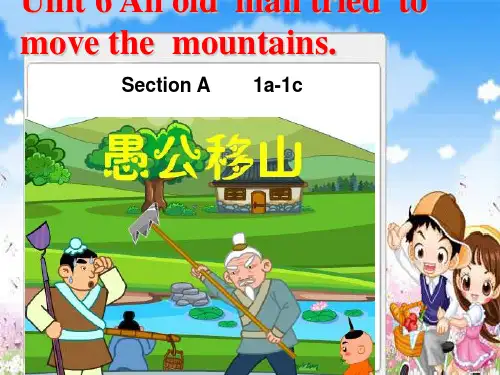
Tell the story Yu Gong Moves a Mountain in English to your parents. Once upon a time, there was a very old man …
Show Time: Who are the best actors?
Yu Gong Moves a mountain.
Yu Gong . . . 3 minutes
Role-play the story (Groupwork)
Monologue(独白): Once upon a time, there was a very old man. There were two mountains near his house…
Unit 6 An old man tried to move the mountains.
Section A 1a-1c
Do you like listening to or telling stories?
Do you know this story?
Let’s tell a story : Yu Gong Moves a Mountain
How does the story begin?
Well, the old man told his _______ that they should all help family to move ____ _____ the mountains.
What happened next?
Yu Gong said they could put into the ____ sea . Because it’s it ____ ____ to hold everything. big _____ enough So they all starteddigging _______ the next day. .
初中英语人教版八年级下册Unit6 an old man tried to move

Unit 6 An old man tried to move the mountains.Section A 3a邹夏夏太和北城中学一、Teaching objectives:1.The first objective is on language:Most of the students can understand the main idea of the text—The Monkey King is a symbol of Chinese culture and why people like it;Half of the students can use the 5 words: who, which, when, what, why to find some specific information and tell stories;Some top students can use the reading strategy to make good preparation for their writing.2. Objectives about culture:By knowing some basic information of The Monkey king, a majority of the students will be able to learn the spirits of him;One third will know more about the background of The Monkey King and the reason why people like him;Ss are encouraged to think deeply about the culture of these 2 countries.3. Learning abilities:Most of the students will learn to use the new reading strategy;Half of them can master this strategy correctly and skillfully.二.Key points and difficulties1.Key points: how to develop Ss’ read ing skills, which is to get some specific information by using 5Ws, and guide the Ss to express their feelings about the book characters.2.Difficult points: how to lead the Ss to use this reading strategy correctly, and even in some other passages, and how to guide students to realize the true spirit of The Monkey king and some other “typical characters”.三.Teaching methods:Task-based language teaching methods四.T eaching Procedures:Step 1. Leading in1.Free talk : What’s your favorite Chinese traditional story? (Purpose: To review what we’ve learnt in Section A).2.Show a video about Journey to the W est.(Purpose: Arouse Ss’ interests ).Step 2 Pre-readingThere are many typical characters in Journey to the West. The Ss are encouraged to guess Which Character is talked in our passage. Most of them can make a prediction of the passage depending on the picture. Step 3 While-reading1. Fast readingFor the first reading, they could skim the passage quickly and check their predictions. And then, Ss are led to skim the text again and match the main idea of each paragraph. What’s more, they are asked to underline the key sentences while reading.Purpose(The main idea usually lies at the beginning or the end.)2. Careful readingTo get more details, this time they will read the passage carefully and answer some questions by reading each paragraph.Q1, When and how did pupils in England know The Monkey king for the first time?Q2 ,What can The Monkey King do or not and fill in the blanks.Q3,Why do children like this monkey so much? It is a little difficult for them. I will encourage them not only to find the answers in the passage, but also think about the background of Journey to the West . There were 81 difficulties in this long and rough journey, The monkey always tries his best to protect his partners by using his wisdom and courage. He keeps fighting to help the weak and never give up. So all this spirit make him be loved by children all around the world.After they finish reading, they will observe the 5 questions again. Some top students can point out the important factors of an article——main character, which book is he from, time, ability and reason. We can turn them into 5Ws—— who, which, when, what and why, which makes them easy to remember.3. RetellingAfter reading, a mind map is used to help students retell the passage. Step4.Post readingAfter learning the Monkey King, I’ll let Ss think about some typical characters in Western countries like Helen Keller in Three Days to See,or Robinson Crusoe. Students are familiar with these characters or stories. They will work in groups. I’ll also provide a sample of Robinson Crusoe. They can choose any characters they know . After 5 minutes’ discussion, each group chooses a student as the reporter. He or she can show their opinions according to 5Ws .Step 5 Summary and homework1. SummaryWe’ll review some ideas about the Monkey King and reading strategies like: skimming,scanning,and how to tell stories with 5Ws.2. HomeworkThere are 2 levels homework. Level A is for all Students, they can search the information about their favorite cartoon characters on Internet, and talk about it from 5 aspects in brief in next class. Some top Students can choose Level B. Write an introduction according to 5Ws. In this way, Ss in different levels can both review and practice. Some top Ss can turn early output of speaking into writing form.Step6 Blackboard designThe last part, blackboard design. I’ll write the key words and phrases on the left for the Ss to remember. On the right is the main structure of the passage. So they will have a general impression of The Monkey King and also remember the 5Ws better with the shape of a magic stick.。
英语人教版八年级下册Unit 6 An old man tried to
Which story are Anna and Wang Ming talking about?
They are talking about “Yu Gong Moves a Mountain”.
__ The two mountains were very high and big. __ A very old man tried to move the mountains. __ A man told Yu Gong that he could never do it.
2a Listen and number the pictures [1-4] in order to tell the story.
P 42
3
2
1
4
2b Listen again and circle the words you hear.
1. A man saw Yu Gong and his (children / family) when they were working on moving the mountains. 2. He told Yu Gong he could never do it because he was old and (poor / weak). 3. As soon as the man finished (talking / speaking), Yu Gong said that his family could continue to move the mountains after he died.
2d
1. Read the dialogue aloud for a We ’ll see which group few minutes by yourself; 2. Role play in groups; does the best. 3. Role play in front of the class.
英语人教版八年级下册Unit6 An old man tried to move
Unit6 An old man tried to move the mountains.Period 3(Section B 1a-1d)I、Teaching Aims:1. Knowledge aims:1) Help the Ss to master the new words below:gold, emperor, underwear, silk,stupid, cheat,2) Help the Ss to master the key phrases below:as soon as2. Emotion Aims:Arouse the Ss to learn more about Chinese traditional stories and fair tails from Europe. Enlarge the Ss’ knowledge about culture.II、Teaching Important points and Difficult points1. Teaching Important points:1) Master the key words and learn to use them correctly.2) Train their listening abilities about how to capture the useful information.2. Teaching Difficult points:1). Train the Ss’ listening skills by deal with the listening tasks.2). Guide the Ss to retell the story according to use the key phrases and tell what t hey think about the characters and the story.III、Teaching Procedures:Step 1 Review the key points in Section ALet some Ss talk something about the Monkey King.Step 2 Warm up1. T: Show one picture of the story The Emperor’s New Clothes.2. Ask some questions about it.1). Look at the picture. Do you know this story?What’s the name of this story?S1: The Emperor’s New Clothes.2). Can you tell the story briefly?The Ss are all familiar with this story but it’s difficult for most of my Ss to tell it in English. First let them try to tell the story and find out their difficulties.Step 3 Presentation1.Show the flashcards on PPT to help the Ss learn to read the new words:gold, emperor, underwear, silk, stupid, cheat.2.Present the key phrases and words, and guide the Ss to use them to tell some key sentences in the story.Step 4 MatchingWork on 1a1. Ask one student read words in 1a. Tell Ss to match the words with the letters i n the pictures in 1b.2. Let some Ss tell their answers. Then check together.3. Guide the to say the sentences below:1). The emperor wares an underwear.2). The emperor gave so many gold to the cheats.3). The cheats want to keep everything for themselves.4). The cheats came to visit the emperor.Step 5 ListeningWork on 1b:1. Look through each picture and the sentences next to them.2. Listen to the tapes and number the pictures.3. Play the recording again and check their answers.Ask the Ss to say the reasons or what they heard.Work on 1c:1. Let Ss read the sentences in 1c according to the numbers they marked.2. Then let the Ss listen again and fill in the blanks with the right words.3. Ask the volunteers to share their answers.4. Check the answers with the whole class.Keys: clothes, brothers, give, kept, looked, saw, shouted, wearingStep 6 Post-listeningListen and try to answer the questions?1. What’s the name of the story?2. Is it a traditional Chinese story?3. What’s the emperor’s hobby?4. Why were the new clothes special?5. How do we know that the two brothers were really trying to cheat the emperor?6. Why didn’t everyone say that the new clothes were really nice?7. Who told the truth? What do you think of the boy?Keys: 1. It’s The Emperor’s New Clothes.2. No, it isn’t. It’s from Europe.3. He liked new clothes. He loved buying and looking at his new clothes.4. Because people couldn’t see the new clothes unless they were clever.5. Because they kept all the gold and silk for themselves.6. Because they didn’t want other people to know that they were stupid.7. A young boy. He is brave and honest.(描写人物品质的词:greedy, dishonest,vainglorious)贪婪的不诚实爱慕虚荣的Step 6 Telling the story1. Work in groups. Tell the story of The Emperor’s New Clothes. Use the key p hrases below the pictures on PPT.2. Let some groups tell the story to the class.3. Let some volunteers to tell what they think of the story and the emperor, the cheats, the young boy.Step 7 Summary and homework1. Read or act the story after school.2. Make the outline of your favorite story and try to tell it to your friends or fami ly.3. Finish the marked exercises on <5.3>.。
初中英语人教版八年级下册Unit 6 An old man tried to ...
Unit 6 An old man tried to moved the mountains.Period 1 Section A 1 (1a-2c)一、教学目标:1.知识目标(1)To understand the vocabulary in the lesson.(2)Listening practice(3)To learn the Past Tense.2.能力目标(1)To train students’listening and speaking skill(2)能够用Once upon a time,there was an old man…叙述故事3.情感目标:通过学习故事中的人物特点,培养学生坚忍不拔的品格和契而不舍的精神。
二、教学重难点通过图片和相关词汇谈论中国古代的故事。
三、教学过程Step1.Warning upBy asking :Do you like reading books ?what kind of books do you like ?How many fairy tales do you know ? 导入本单元主题。
Step2.Introuce the teaching aimsStep3.1a.Match the story with the pictures [a-d]. Look at the pictures in 1a, then read the names of the story in the box.2. Ss discuss with their partners and match the names of the stories with the pictures.1)Teaching new words:shoot stone God2)Teaching how to write the name of book in EnglishStep4.Listening1. T: Tell Ss they will hear a great Chinese traditional story. Listen and see who know the name of the story.2. Play the recording for the Ss to listen.3. Ss who know the name of the story may hand up.4. Play the recording again. Let Ss check the facts they hear.5. Check the answers.Step 5 Pair work1. Read the questions in the box in 1c.2. Ss discuss the questions with their partners.3. Let some pairs ask and answer the questions.Step 6 ListeningWork on 2a:T: Let’s continue to listen to the story.1. Look at the pictures in 2a. Discuss the things they are going to do. When you listen to the story, please number the pictures.2. Play the recording for the Ss to listen and number the pictures.3. Play the recording again to check the answers.Work on 2b:1. Let Ss read the sentences below. Explain some main sentences for the Ss. Make sure they know what to do.2. Play the recording for the Ss to circle the correct words in the brackets.3. Play the recording again to check the answers.Answers: 1. children 2. weak 3. talking 4. two 5. know Step 7 2c1. Tell Ss to make a story chain. Ss tell the story one by one with the pictures on the big screen.2. Let some Ss tell the story to the class.3. See which student’s story is better.Step8.Sum-upStep9.Homework:1. Recite the conversation in 2d after school.2. Tell the story Yu Gong Moves a Mountain in English to your parents. Once upon a time, there was a very old man…教后反思:。
初中英语人教版八年级下册Unit 6 An old man tried to mo
Unit 6 An old man tried to move mountainsSection A 1a-2c教学设计西安市第七十中学童斌【教材依据】本教学设计依据的教材为人民教育出版社出版的教育部审定2013义务教教育教科书Go for it八年级下册。
单元题目为:Unit 6 An old man tried to move mountains Section A 1a-2c一、设计思路(一).指导思想。
义务教育阶段的英语课程的总目标是:通过英语学习使学生形成初步的综合语言运用能力,促进心智发展,提高综合人文素养。
Unit6 Section A涉及对故事,神话传说的了解,引出愚公移山听力训练,旨在培养学生了解故事发生。
2b 活动让学生进行故事排序,意在培养学生快速阅读并归纳语篇中心的能力;(二)学情分析与教学目标:能够用英语询问故事的开始、发展及后续等。
能够对故事中的人物或情节发表一些简单的看法或观点学生在Unit4和5已经学过了用一般过去时讲述故事。
在本节课上通过课堂互相讨论,可以拓展思路,加深认识。
本课时的教学目标如下:1.语言知识目标:1) 能掌握以下单词:remind, bit, silly, instead of能掌握以下句型:① How does the story begin?② What happened next?③ What do you think of the story of Yu Gong?④ What could Yu Gong do instead of moving the mountains?2) 能够用英语询问故事的开始、发展及后续等。
能够对故事中的人物或情节发表一些简单的看法或观点。
2. 语言能力目标:。
3. 情感态度目标:学习愚公,要学习他“主动挖山”的精神。
在我们生活工作中存在着很多的“山”。
在这些山的面前我们应该采取怎样的态度对待它?是通过“搬家”来避开它或找领导请求帮助;还是像愚公一样明知困难却迎难而上,凭借自己的力量勇敢的克服困难。