
八年级上册英语沪教牛津Module1Unit3trouble!(thefunny_6
Homework
1.Each student finish a form of six essential elements and write a story based on it.
2.(Optional) Search the Internet to find more exciting stories of an ordinary career and tell stories in class.
Who
A _______
How
Beginning: The man was _______ _______ _______ ________ inside his coat
Climax: I thought he _____ ______ it, so I ______ him.
Ending: We soon _______ him. Because he just wanted to ______ it to the shop ___ ___ _____, but he ____ _____ his wife to see him.
The teller ___ him money and the man ____ ____.
She ____ a phone call to the police and ____ them to go to the man's flat and ____ him.
The police ____ him as soon as he ___ ___ ___the lift.
story c When Where Who How
Once
As he was going through _______
A _______
Beginning: He was trying to _______ some _______ ________ from ______ into _______ Climax: The birds _______ _____ ________ Ending: He was _______.
3. How did he rob?
6.Why did the police find him so quickly?
5. How did she help the police?
4. Who
helped the
police?
15%
Story B
The robber ___ on the back of an envelop, and ___ it to the teller.
What did he want to smuggle?
Which country did he come from and want to go?
Where did he hide the birds?
Did he pass the customs? Why not?
What do you think of the sumggler?
WELCOME
POLICE WORK
Brainstorm What do policemen do in their work? What do you think of police work?
THE FUNNY SIDE OF POLICE WORK
Quickly switch slides—in or out of sequence—from a visual grid viewable at a glance.
release
arrest steal
return hate
arrest return
steal hide
hate
release
when where who
ː how
beginning climax ending
story A 复述故事
When
Once
Where
In a _______ _______
Please match the situations with stories.
a bird helped the policemen a robber gave the teller his address the police arrested a man by mistake
Please match the situations with stories.
Answer the questions
How did the teller feel when she gave money to the robber?
How do you think of the teller?
What do you think of the robber?
Story C
smuggling case robbery theft
thief [θiːf] n. pl. thieves
theft [θeft] n.
Where can we see a theft?
rob [rɒb] v. robber ['rɒbə] n. robbery ['rɒb(ə)rɪ] n. Where can we see a robbery?
S2 What happened at the end?
The policeman soon _____ me.
S1
S2 What a day!
What do you want to know from story B
1. Did the police man catch him?
2. What did he do?
He ____ that he had robbed the bank, but he ____ _____ that we _____ him so quickly.
story B When Where Who How
______ _______, when I _______ _______ _________ _______ _______ On the _______ _______
Proverb
Tʌg(ə)l] v. smuggler ['smʌg(ə)lə(r)] n.
smuggling [ˈsmʌglɪŋ] n. Where can we see a smuggling case?
句子
Find out important verbs in story A
hide
In ________________. S1
I was _______________. S1
My wife___________, S1 but I _____________. I just wanted to _______, but I did't want _______.
S2 Why?! Where did it happen? S2 What was you doing? S2 Why did you hide the sweater?
Answer the questions
Why didn't the man want his wife to see him?
What do you think of the policeman?
The man told his friend this unusual experient
I was arrested yesterday. S1
A _______
Beginning: The man _______ the bank.
Climax: We _______ a _______ ______ from the ________. We _______ him as soon as he _______ _________ ______ the lift. Because the front of the envelope he used in the ______ had ___ ______ and _______ on it! Ending: He ________ that he had _______ the bank.
six essential factors how
tell stories
When where who beginning climax ending
Topic of your funny story:_______________
When
Where
Who
How
Beginning
Climax
Ending
牛津上海英语八年级上册 Module 1 Unit 3 Trouble ! (共12张PPT)

at home and watch some TV?
How did you spend your
What TV programmes were on?
evening?
3 At noon
Did you do some school
Where did you have lunch?
work?
How was the food?
their diaries? 3 What tense do people usually
use when writing a diary?
C Before we write our own diaries, we are going to complete an entry from Judy’s diary. Look at the picture on the right and answer the two questions below. 1 Who came in the morning?
1 What was the date last Sunday? 4 In the afternoon
2 In the morning
What did you do?
When did you get up?
Did anything exciting
What did you do?
happen?
Did you go somewhere or did you stay 5 In the evening
Verbs climb take run
come be
start fall
Other words helicopter money surprised into
牛津上海版八年级上册 Unit 3 Trouble 说课稿

牛津上海版八年级上册 Unit 3 Trouble 说课稿一. 教材分析教材是牛津上海版八年级上册的Unit 3 Trouble,本节课的主题是关于麻烦和问题的解决。
通过本节课的学习,学生能够掌握与麻烦相关的基本词汇和表达方式,并能够运用所学知识描述和解决生活中的问题。
教材内容丰富,包括听力、口语、阅读和写作等多个方面,有助于培养学生的综合语言运用能力。
二. 学情分析八年级的学生已经具备了一定的英语基础,对于生活中的一些常见问题能够用英语进行简单的描述。
但他们在口语表达和听力理解方面还存在一定的困难,需要通过大量的练习来提高。
此外,学生在本节课学习中可能会遇到一些新的词汇和表达方式,需要教师进行讲解和引导。
三. 说教学目标1.知识目标:学生能够掌握与麻烦相关的词汇和表达方式,如“havetrouble with”,“problem”,“solution”等;2.能力目标:学生能够运用所学知识进行简单的口语交流,描述和解决生活中的问题;3.情感目标:通过本节课的学习,学生能够培养乐观积极的心态,面对生活中的困难和问题能够寻求帮助和解决方案。
四. 说教学重难点1.重点:学生能够掌握与麻烦相关的词汇和表达方式;2.难点:学生能够运用所学知识进行口语交流,描述和解决生活中的问题。
五. 说教学方法与手段1.教学方法:采用任务型教学法,通过设定各种情境,让学生在实践中学习和运用英语;2.教学手段:利用多媒体课件、图片、卡片等辅助教学,提高学生的学习兴趣和参与度。
六. 说教学过程1.导入:通过展示一些生活中的常见问题,如“丢失钥匙”、“迷路”等,引导学生思考如何用英语描述和解决这些问题;2.新课呈现:讲解与麻烦相关的词汇和表达方式,如“have troublewith”,“problem”,“solution”等,并通过例句和情景进行巩固;3.口语练习:通过角色扮演、小组讨论等形式,让学生练习运用所学知识进行口语交流,描述和解决生活中的问题;4.阅读理解:阅读一篇关于解决问题的短文,学生能够理解文章内容,并回答相关问题;5.写作练习:让学生写一篇关于解决生活中问题的短文,培养学生运用所学知识进行写作的能力;6.总结:对本节课所学内容进行总结,强调重点词汇和表达方式;7.作业布置:让学生课后用英语描述和解决一个生活中的问题,提高学生的实际运用能力。
八年级英语上册 Module 1 My life Unit 3 Trouble wor
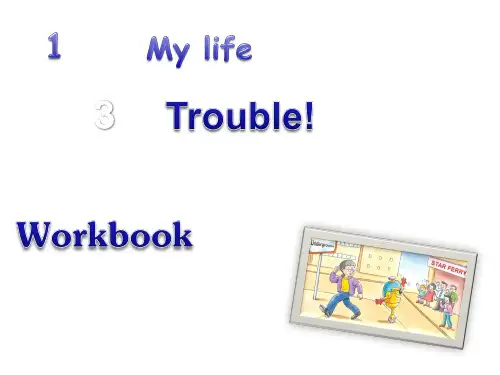
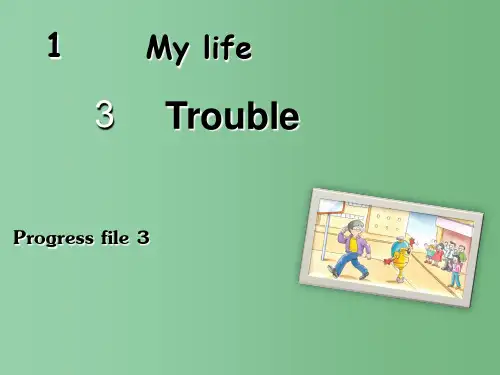
I went to Sunshine Shopping Centre last Saturday. Suddenly I saw something on the floor. It was a (1)____________. A man picked it up. I (2)____________ at him for a few seconds and (3)____________ that he put the purse into his pocket. Then he (4)____________ towards the underground station. ‘That’s (5)____________,’ I thought. ‘It was a woman’s purse. That man took it. He is not an honest person!’
I saw a policeman and I (6)____________ it to him. I also gave him some details about the man. He said, ‘Thank you very much. I’ll (7)____________ with it.’ Soon another policeman came. Then I followed them into the underground station.
Write the correct past tense form of these verbs.
shout __________
八年级英语上册 Module 1 My life Unit 3 Trouble Progress file课件 (新版)牛津上海版
123
3-3
Put the following in the right order to make correct sentences. 13 helped/ago/hour/Helen’s/an/husband/half/He/.
1
My life
3 Trouble
Progress file 3
Vocabulary Grammar
Vocabulary
Use the words or phrases in the box to plete the following sentences.
1 Someone ___s_to_l_e__ my bag while I was away. happened to
He helped Helen’s husband half an hour ago. 14 flat/Linda’s/Larry/February/buy/Did/last/?
Did Larry buy Linda’s flat last February? 15 he/left/didn’t/He/the/window/close/when/.
I hurried to work. 8 you show your ticket?
Did you show your ticket? 9 Mark buys and sells old cars.
Mark bought and sold old cars.
123
3-2
Circle the correct answer for each sentence. 10 The boy was born at/in 1982. 11 An accident happened near that restaurant last Monday/
牛津上海版英语八年级上册《Unit 3 Trouble!》教学设计4
牛津上海版英语八年级上册《Unit 3 Trouble!》教学设计4一. 教材分析《Unit 3 Trouble!》是牛津上海版英语八年级上册的一单元,本单元主要围绕“麻烦”这个主题展开,通过学习本单元,学生能够掌握一些与麻烦相关的词汇和表达方式,并能运用所学知识进行简单的交流和表达。
教材中包含了一个故事、几个对话和一些练习,内容丰富且贴近学生的生活。
二. 学情分析八年级的学生已经具备了一定的英语基础,能够听、说、读、写一些简单的英语句子。
但部分学生对英语学习的兴趣不高,学习积极性有待提高。
此外,学生的英语水平参差不齐,因此在教学过程中需要因材施教,尽量让每个学生都能参与到课堂活动中来。
三. 教学目标1.知识目标:学生能够掌握与麻烦相关的词汇和表达方式,如“havetrouble with”、“in trouble”等;2.能力目标:学生能够听懂、会说、会读、会写与麻烦相关的话题,具备简单的交流和表达能力;3.情感目标:学生能够学会在面对麻烦时保持积极乐观的态度,学会寻求帮助和解决问题。
四. 教学重难点1.重点:学生能够掌握与麻烦相关的词汇和表达方式;2.难点:学生能够运用所学知识进行简单的交流和表达,特别是在实际生活中的应用。
五. 教学方法1.任务型教学法:通过设置各种任务,让学生在完成任务的过程中学习和运用英语;2.情境教学法:创设真实的语境,让学生在特定的情境中学习和运用英语;3.交际法:鼓励学生进行互动交流,提高他们的口语表达能力。
六. 教学准备1.准备相关课件和教学素材;2.准备一些与麻烦相关的问题和情境;3.准备录音机、磁带或其他音频播放设备。
七. 教学过程1.导入(5分钟)利用音频播放一段与麻烦相关的情景,引导学生关注本节课的主题。
2.呈现(10分钟)展示本节课的主要词汇和表达方式,如“have trouble with”、“in trouble”等,并通过例句让学生理解其含义。
3.操练(10分钟)设计一些练习,让学生分组进行角色扮演,运用所学知识进行交流。
八年级英语上册 Module 1 My life Unit 3 Trouble Grammar 2课件 (新版)牛津上海版
6-1
Using ago
The word ago refers to a period of time before now. It always es after the time word(s).
I passed my driving test six months ago. Vicky wrote to the pany weeks ago. David first met Melanie a long time ago. —Have you see Emma? —Yes, just a few minutes ago.
123456
6-5
Here are some examples with ‘night’.
I woke up in the night. (= at midnight) It happened on Monday night. I couldn’t sleep at night.
123456
6-6
in + part of a day in the morning in the evening
123456
in + a week or longer times
in the Christmas holiday in the spring term
6-3
Using on with time
on + a day in a week/date
We do not use in, on or at before these words:
every last next this tomorrow yesterday We go to Hong Kong every summer. My brother came home last Christmas. I’ll see you next Friday. I leave school this year. The party is tomorrow evening. The group set off yesterday morning.
牛津上海版英语八年级上册教案:Unit 3 Trouble Reading
Module 3 TroubleReading一、章节分析(Reading section )(一)综述(二)本单元的阅读部分是以日记的形式讲述了一起抢劫案。
作者和他的父亲在了解案情的情况下,报警抓罪犯的过程,可以让学生得到两个启示:一、我们要在别人危难之际,勇于帮助他人。
二、危及时刻,可以尽快通知有关部门,我们无须把自己陷入困境中。
本篇阅读中还出现了一些核心词汇如: argue, deal with, dial, robbery,steal, trouble ,等也是教师教学的重点。
(二)阅读目标1知识目标学习课文中重点词、词组、句型和语法。
能力目标掌握英语日记格式和地址写法。
2情感目标教育学生遇到突发事件,要沉着冷静,有勇有谋。
(三)教学方法采用任务型教学法组织教学,通过听说,讨论等具体活动,达到教学效果。
(四)重点和难点1词汇学习1)核心词汇argue (v )争吵,争论 empty (a.) 空的crowd (n) 人群 stare (n)&(v) 瞪视,盯着看notice (v) 注意到 follow (v) 跟从,跟随action (n) 行为,举动 report (v)&(n) 报道,报告dial (v) 拨号 rob (v) 抢劫detail (n) 细节 steal (v) 偷 (steal---stole—stolen) 拓展词汇argument (n)争吵 purse (n) (女用)钱包robbery (n.) 抢劫案 handcuffs (n) 手铐noisily (ad)吵闹地 railing (n) 栏杆permission (n)许可 aboard (adv) 在船上,到船上(火车上,飞机上等) definitely (ad)明确地2)词组:shout at 对…大喊deal with 处理、应付hold out 端出、伸出发行wait for 等候、等待stare at 瞪着…看 women tourists 女游客(复数)go on 发生 at first 起先hurry aboard 匆忙上船run away 逃跑go down onto the ferry 走下到渡船上be afraid of 害怕get off 下(船)车well done 干得好 shop assistant 营业员教学设计(Teaching Designs)[链接1][链接3]1. Where did the robbery happen?2 .How did Paul report the robbery?3 . Paul and his father didn’t get on the man’s ferry, did they?4 .What number did his father dial?5 .What do you think of Pau l’s father?[链接4] 英文信格式注:1. 英文日记时间时间写在全文第一行的确右侧。
八年级上册英语沪教牛津Module1Unit3Trouble!Dealingwi_1
Don’t care so much about anything but life. 不要太在意除生命之外的任何东西。
Dear×××,
Beginning
Writing
Why didn’t he catch the man directly(直接地)?
What did Paul think of his dad at first? And what about at last?
What do you think of Paul’s father?
He is a _cl_e_v_er_/_s_m_a_r_t man.
4. How about the other two men? They ran away.
Guessing
What’s the meaning of crowd?
a group of people
Finding clues(线索)
Why did the crowd just stare at them but didn’t say anything?
Who two women tourists, a young man, crowd
What shout at…, hold out…, empty…,stare at…
How is it going with you? I write to share a story with you and tell you how to deal with trouble.
Retell the story (The story is about…
八年级英语上册 Module 1 My life Unit 3 Trouble Grammar 1课件 (新版)牛津上海版
Ling: (a)__________ the weather bad? (be) Leo: Yes. A strong wind (b)__________. (come) Ling: (c)__________ it __________ down your tents? (blow) Leo: Yes, it (d)__________ down all our tents. (blow)
Paul: ______, we _________ on it with him.
5 Julia: ______ you _________ what your dad was going to do? (know)
Paul: ______, I _____________ what he was going to do.
6 Julia: ______ the police _________ the ferry in time? (meet)
Paul: ______, they _________ it in time.
A2 Julia is asking some more questions. Complete the questions and answers with information from the diary. Use the verbs in brackets and yes or no. Use one or more words as required.
Ling: What happened? Leo: I (a)__________ my sunglasses.
(drop) Ling: (b)__________ they __________?
Unit+3+listening+and课+2023-2024学年牛津上海版(试用本)八年级英语上册
Build thin
(11)_t_h_i_n_
Hair
black and (2)_b_r_o_w_n__ in colour, (12)_s_h_o_r_t_ hair;
quite (3)_lo_n_g__ hair, over
black baseball (13)__c_a_p___
his (4)__ea_r_s___
3
While-listening
Listen to the dialogue and complete the table.
Age
about 25
about (9)_2_0__
Height quite (1)__ta_l_l___
rather (10)_sh__o_rt_ /ˈrɑːðə(r)/
old, (16)_w__h_it_e__ sports shoes
4
Post-listening Look and find thPe orteh-err etwaodtihniegves.
5
Speaking
Describe the twoPtrheie-vrees.ading
He was about 25 years old. He was quite tall and very thin. His hair is black and brown in colour. It was quite long and over his ears. He was wearing a white T-shirt. It had some writing on it and he was wearing a pair of old blue jeans. He had black shoes.