
外研版七年级上册英语Module 9 知识点精讲(含答案)
外研版七年级上册英语Module 9 People and places Unit1 We’re enjoying the school trip a lot.
1.call
(1)call 意为“( .... )打电话", 后面可以直接跟打电话的对象,即call sb.
(2)call 意为“称呼;把.......叫作"的意思。
(3)called 意为“被叫作...”
【例题解析】
用所给词的适当形式填空
(1)Please (call) me this afternoon.
(2)They (call) the panda Lingling.
(3)I know a girl (call) lingling.
答案:call call called
2.lie in the sun 躺在太阳底下
lie 躺现在分词形式是: lying
【例题解析】
用所给词的适当形式填空
My cat likes (lie) in the sun.
答案:lying
3.stand in line 站成一排
【例题解析】
用所给词的适当形式填空
They are (stand) in line.
答案:standing
4.take photos 照相
【例题解析】
用所给词的适当形式填空
They are (take) (photo) of the beautiful flowers. 答案:taking photos。
外研版七年级上册Module9 知识点+习题(含答案)

第9讲People and places学习目标一、熟练掌握重点单词、词组的用法;二、熟练掌握现在进行时的基本用法;三、熟练掌握现在分词的变化规则;四、熟练掌握现在进行时的句型变。
知识串烧单词1、postcard ['pəʊstkɑːd] 明信片2、call [kɔːl] (给……)打电话3、lie [laɪ] 躺;平躺4、sun [sʌn] 太阳5、line [laɪn] 行、排、列6、take [teɪk] 拿、,取;花费(时间)7、take photos 拍照8、wait [weɪt] 等待,等候9、wait for 等待,等候10、walk [wɔːk] 行走,不行11、trip [trɪp]旅行12、few [fjuː] 一些、几个、很少(的)13、a few 一些、几个14、sale [seɪl] 卖、出卖15、on sale 正在出售16、enjoy [ɪn'dʒɔɪ] 享受…的乐趣喜爱17、anyway ['enɪweɪ] 尽管如此;无论如何18、back [bæk] 向后;回到;返回19、go back 回去20、drive [draɪv] 驾驶;驾车21、off [ɒf] prep.下(飞机、火车、公共汽车等)22、get off 下(飞机、火车、公共汽车等)23、hot dog 热狗(一种中间夹香肠的三明治)24、leave [liːv] 离开25、restaurant ['resətrɒnt] 饭店;餐馆26、moment ['məʊmənt] (某事发生的)的时刻,时候27、place [pleɪs] 地点28、thing [θɪŋ] 事情、东西29、most [məʊst] 大部分(的);大多数(的)30、still [stɪl] 仍然;依旧31、star [stɑː] 明星;星;星状物32、run [rʌn] 跑,奔跑33、study ['stʌdɪ] 学习;研究课文U1 We're enjoying the school trip a lot.Betty: Hi, Mum!Mum:Hello, Betty! Where are you now?Betty: I'm standing on the Great Wall of China and talking to you.Really? That's great.Betty: We're on a school trip.What about the others? Are they with you?Betty: Well, right now Tony is eating a delicious ice cream. Wang Hui is taking lots of photos. Lingling is buying a few presents and postcards. They're on sale at the shop. Daming is having lunch and lying in the sun.I'd like a postcard too, but please take some photos of the Great Wall and send them to me by email. Betty: OK. We're enjoying the school trip a lot. Anyway, it's time to go back to school now. Bye,Mum!Bye, Betty!U2 They're waiting for buses or trains.At this moment, in different places of the world, people are doing different things.A In London, it's five o'clock in the afternoon and people are leaving work and are going home.They're waiting for buses or trains. Some people are driving home. Some are getting off buses or trains. Some are having afternoon tea at home or having a drink.B In Moscow, it's eight o'clock in the evening, so people aren't having afternoon tea. They arehaving dinner at home or in restaurants. Some are going to the theatre or watching a film. Some are watching television or playing games at home.C In Beijing, it's one o'clock at night, so people aren't having dinner. Most people are sleeping.Some people are still working and some are going home from work.D In Los Angeles, it's nine o'clock in the morning. People aren't sleeping. They're working.Children are starting their lessons.E In New York, it's twelve o'clock. People aren't working. They're having lunch. They are eatinghamburgers or hot dogs and drinking coffee or cola. Some people are seeing friends, calling home or shopping.语法一、现在进行时(I)1. 现在进行时态主要用于表示现在正在进行的动作,有时也可表示现阶段正在进行的动作。
外研版七年级上册Module9People and places单元知识梳理(含答案)
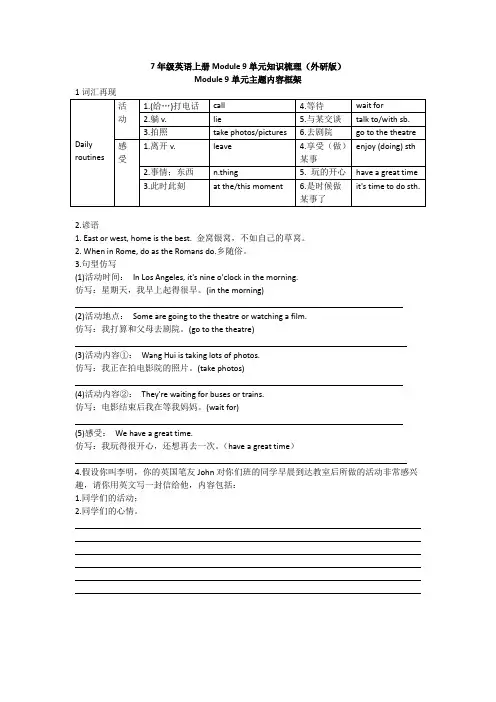
7年级英语上册Module 9单元知识梳理(外研版)Module 9单元主题内容框架2.谚语1. East or west, home is the best. 金窝银窝,不如自己的草窝。
2. When in Rome, do as the Romans do.乡随俗。
3.句型仿写(1)活动时间:In Los Angeles, it's nine o'clock in the morning.仿写:星期天,我早上起得很早。
(in the morning)(2)活动地点:Some are going to the theatre or watching a film.仿写:我打算和父母去剧院。
(go to the theatre)(3)活动内容①:Wang Hui is taking lots of photos.仿写:我正在拍电影院的照片。
(take photos)(4)活动内容②:They're waiting for buses or trains.仿写:电影结束后我在等我妈妈。
(wait for)(5)感受:We have a great time.仿写:我玩得很开心,还想再去一次。
(have a great time)4.假设你叫李明,你的英国笔友John对你们班的同学早晨到达教室后所做的活动非常感兴趣,请你用英文写一封信给他,内容包括:1.同学们的活动;2.同学们的心情。
答案:1.On Sunday, I get up early in the morning.2.I'm going to go to the theatre with my parents.3.I'm taking photos of the cinema.4.I wait for my mother after the movie ends.5.I have a great/good time and want to go there again.作文:Dear John,My classmates are all in the classroomº. We are very busy. [Lingling is cleaning theblackboard. Lucy is talking to Anna. They look happy. Some students are sweeping the floor.The floor becomes clean because of them. Some are doing their homework. What about me?I'm writing this letter to you!We have lots of8 things to do but we are happy.Yours,Li Ming。
(新版)外研版七年级英语上册《Module 9 Unit 2 They’re waiting for
(新版)外研版七年级英语上册《Module 9 Unit 2 They’re wting for buses or trns》说课稿一. 教材分析《Module 9 Unit 2 They’re wting for buses or trns》是人教版初中英语七年级上册的一篇课文。
本节课的主要内容是让学生掌握现在进行时态的用法,以及如何用现在进行时态描述正在进行的动作。
通过本节课的学习,学生能够理解课文内容,掌握相关的词汇和短语,并能运用现在进行时态进行日常交流。
二. 学情分析七年级的学生已经掌握了基本的英语语法知识,对日常英语交流有一定的了解。
但部分学生可能对现在进行时态的用法还不够熟悉,因此需要在教学中加以引导和巩固。
此外,学生们的学习兴趣和积极性较高,课堂参与度较好,有利于开展本节课的教学活动。
三. 说教学目标1.知识目标:学生能够理解并掌握现在进行时态的用法,能够用现在进行时态描述正在进行的动作。
2.能力目标:学生能够熟练运用现在进行时态进行日常交流,提高英语表达能力。
3.情感目标:通过本节课的学习,学生能够培养对英语学习的兴趣,增强自信心。
四. 说教学重难点1.重点:学生能够掌握现在进行时态的用法,能够用现在进行时态描述正在进行的动作。
2.难点:学生能够灵活运用现在进行时态进行日常交流,并在实际情境中正确运用。
五. 说教学方法与手段本节课采用任务型教学法,通过设定各种真实的任务情境,引导学生运用现在进行时态进行交流。
同时,利用多媒体教学手段,如图片、视频等,激发学生的学习兴趣,提高课堂趣味性。
六. 说教学过程1.导入:通过展示一张交通拥堵的图片,引导学生思考交通状况,为新课的学习营造一个真实的情境。
2.呈现:教师通过展示课文图片,引导学生观察并回答问题,引导学生关注现在进行时态的关键词。
3.操练:学生分组进行角色扮演,运用现在进行时态描述正在进行的动作,教师给予评价和指导。
4.扩展:学生分组讨论,用现在进行时态描述日常生活中正在进行的动作,分享给全班同学。
外研版初一上册英语Module9练习试题及答案(2)

外研版初一上册英语Module9练习试题及答案(2)Ⅳ. 任务型阅读It is a fine Saturday morning. Bob and his family get up later than usual, because he doesn’t go to school and his father and mother don’t go to work. They are all staying at home. But they are not free. Each of them is doing a different thing.Bob’s father is in the garage (车库). He is washing his car. His mother is in the kitchen. She is busy preparing a good meal for the family. Bob is helping his mum with the washing, and sometimes he goes to the garage and watches his father wash his car. His elder brother, Jack, are staying in his study till lunch. His two sisters are listening to some beautiful music while they’re cleaning the house. And his y ounger brother, Tim, is training his puppy. He gets a lot of fun. At about 12: 30, the whole family are sitting around the table, and they are enjoying a wonderful meal.根据短文内容,回答问题。
外研版英语七年级上册Module9 U2解析
Choose the best answer. 1. In London, it’s five o’clock and
people are _____. A. leaving home B. having lunch C. going home 2. It’s eight o’clock, people are washing
Read and fil
What are they doing?
London
five o’clock going home
Moscow
eight o’clock having dinner
Beijing
one o’clock sleeping
Los Angeles nine o’clock working
4. People are ____ in Beijing when people are having lunch in New York.
A. having dinner B. sleeping C. watching television
Complete the passage with the correct form of the words from the box.
New words and expressions
drive v. 驾驶;驾车 get off 下(飞机、火车、公共汽车等) hot dog 热狗(一种三明治)
leave v. 离开 restaurant n. 饭店;餐馆
moment n. (某事发生的) 时刻, 时候 place n. 地点 thing n. 事情; 东西 most adj. 大部分(的); 大多数 (的) still adv. 仍然, 依旧 star n. 明星;星;星状物
外研版英语七年级上册Module 9知识点归纳
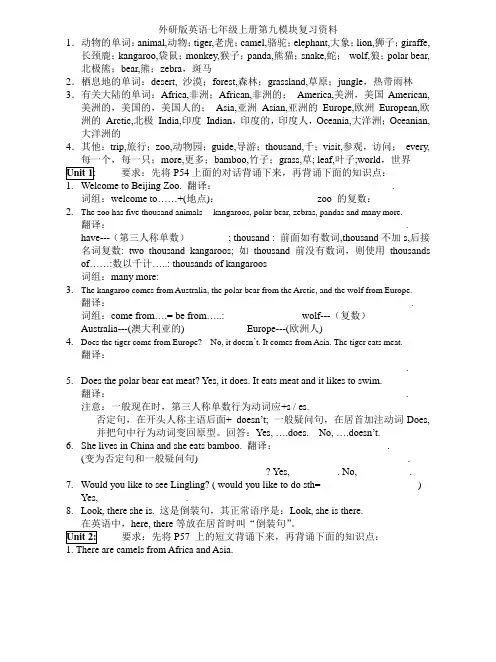
外研版英语七年级上册第九模块复习资料1.动物的单词:animal,动物;tiger,老虎;camel,骆驼;elephant,大象;lion,狮子;giraffe,长颈鹿;kangaroo,袋鼠;monkey,猴子;panda,熊猫;snake,蛇;wolf,狼;polar bear,北极熊;bear,熊;zebra,斑马2.栖息地的单词:desert, 沙漠;forest,森林;grassland,草原;jungle,热带雨林3.有关大陆的单词:Africa,非洲;African,非洲的;America,美洲,美国American,美洲的,美国的,美国人的;Asia,亚洲Asian,亚洲的Europe,欧洲European,欧洲的Arctic,北极India,印度Indian,印度的,印度人,Oceania,大洋洲;Oceanian,大洋洲的4.其他:trip,旅行;zoo,动物园;guide,导游;thousand,千;visit,参观,访问;every,more,更多;bamboo,竹子;grass,草; leaf,叶子;world,世界要求:先将P54上面的对话背诵下来,再背诵下面的知识点:翻译:___________________________________.词组:welcome to……+(地点):___________________ zoo 的复数:_______ 2.The zoo has five thousand animals--- kangaroos, polar bear, zebras, pandas and many more.翻译:___________________________________________________________.have---(第三人称单数)________; thousand : 前面如有数词,thousand不加s,后接名词复数: two thousand kangaroos; 如thousand前没有数词,则使用thousands of……:数以千计…..: thousands of kangaroos词组:many more: _________3.The kangaroo comes from Australia, the polar bear from the Arctic, and the wolf from Europe.翻译:____________________________________________________________.词组:come from….= be from…..:_______________ wolf---(复数)_________ Australia---(澳大利亚的)____________ Europe---(欧洲人)_____________4.Does the tiger come from Europe? No, it doesn’t. It comes from Asia. The tiger eats meat.翻译:___________________________________________________________________________________________________________________________.5.Does the polar bear eat meat? Yes, it does. It eats meat and it likes to swim.翻译:___________________________________________________________.注意:一般现在时,第三人称单数行为动词应+s / es.否定句,在开头人称主语后面+ doesn’t; 一般疑问句,在居首加注动词Does, 并把句中行为动词变回原型。
外研版英语七年级上册Module9 单元必考知识点
Module9 单元必考知识点1. 【课本原句】We’re enjoying the school trip a lot.【解析】(1) enjoy作动词,其后接名词(词组),表示“享受……的快乐”。
Enjoy 之后也可以接反身代词,与have a good time / have fun同义,表示“玩得开心;过得愉快”。
如:We often enjoy ourselves on Sunday. = We often have a good / nice / great / wonderful time on Sundays. 周日我们经常过得很愉快。
(2) a lot用来修饰动词,表示“很;非常”。
如:Thanks a lot. 非常感谢!2. 【课本原句】Wang Hui is taking lots of photos.【解析】(1)take photos与take pictures同义,都表示“照相”,该短语后接of 短语时,表示给某人照相。
如:Let me take photos / pictures of you. 我来给你照几张照片吧。
(2)lots of用来修饰可数名词复数或不可数名词,表示“许多,大量”,与a lot of 有相同用法。
They have lots of books to read. 他们有很多书要读。
3.【课本原句】They’re waiting for buses and funning for trains.【解析】wait是不及物动词,不能直接跟宾语,接宾语时,后面需用for引出。
for后接表示人或车辆等名词。
如:Someone is waiting for you outside the school gate. 学校门口有人在等你。
4.【课本原句】They’re on sale at the shop.【解析】sale作名词,意为“卖;出售”,on sale表示“出售;上市;打折销售”,for sale表示“供出售,待售”。
+Module+9+单元知识点总结 外研版七年级英语上册
Module9 People and places一.重点短语1. have a good/great time玩得开心2. go to sleep 去睡觉3. call a friend 给朋友打电话4. drive a car 开车5. run for a bus 赶公共汽车6. study history 学习历史7. send ...to... 寄……给…… In8. start school开始上学9. wait for 等待,等候10. a few 一些;几个11. take some photos of拍一些……的照片12. by email通过电子邮件13. go back 回去14. stand in line站成一排15. take photos 拍照16.at this moment 在此时17. get off下(飞机、火车、公共汽车等)18.make notes做笔记19. have afternoon tea喝下午茶20. in the evening在晚上21. watch a film 看电影22. play games 玩游戏23. hot dog热狗(一种中间夹香肠的三明治)24. see friends看望朋友25. movie star 电影明星二.重点句式1. I'm standing on the Great Wall of China and talking to you.我正站在中国的长城上和你交谈。
2. They're on sale at the shop.商店里正在打折。
3. Daming is having lunch and lying in the sun.大明正躺在阳光下,吃着午饭。
4. We're enjoying the school trip a lot.我们这次学校旅游玩得非常开心。
5. Anyway, it's time to go back to school now.尽管如此,现在到回学校的时间了。
Module 9 重要知识点讲解2021-2022学年外研版七年级英语上册
Module 9 People and places重要知识点讲解Unit 1一、重点短语表达the Great Wall 长城talk to friends 与朋友们交谈take photos 拍照a lot of / lots of 许多, 大量lying in the sun 躺在阳光下send me postcards给我发送贺卡wait for the bus 等公共汽车on sale 正在出售go back to school 回到学校postcards on sale 正在出售的贺卡on a school trip 在郊游by email 通过电子邮件二、现在进行时(1)[点拨]1.现在进行时:表示现在、说话瞬间正在进行或发生的动作;常与表示现在进行状态的时间状语连用:如:look,listen,now,at the moment, at this moment。
2.现在进行时的构成:肯定句:主语+am/is/are+现在分词...They are waiting for buses.他们正在等公交车。
否定句:主语+am/is/are+not+现在分词...They aren't waiting for buses.他们不是在等公交车。
疑问句:Am/Is/Are+主语+现在分词...?(一般疑问句)回答:Yes,主语+am/is/are. No,主语+am not/isn't/aren't.-Are we waiting for buses?我们是在等公交车吗?-Yes,we are.是的。
疑问代词/疑问副词+am/is/are+主语+现在分词...?(特殊疑问句)What are they waiting for?他们在等什么?三、现在分词的构成[点拨]常见的现在分词的构成方式如下:1.动词+ingbuy-buying stand-standing talk-talking2.以不发音的e结尾,去e再加ingwrite-writing lie-lying dance-dancing3.以重读闭音节结尾,呈现"辅音+元音+辅音"的结构,双写最后字母再加ing shop-shopping run-running swim-swimming四、enjoy一词[点拨]enjoy一词用两个常用的搭配用法:1)enjoy doing sth.喜欢做某事She enjoys playing tennis.她喜欢打网球。
外研版七年级英语上册(课件):Module 9
2. 贝蒂正在给她妈妈打电话。她想和妈妈说话。 calling her mother. She wants is Betty ________ ________ to _______ ________ talk to/with her. 3. 你能送给我一张你的照片作为礼物吗? Could you ________ a photo of you ________ me give to ________ a present? as 4. ——你现在在做什么? ——我正在等我的朋友们。 —What ________ you ________ now? are doing —I'm ________ ________ my friends. waiting for 5. 商店中有许多衣服在廉价销售。 There are ________ ________ clothes ________ of on lots ________ at the shop. sale
【2】wait的用法 【教材例句】wait for the bus 等公交车(教材第54页) 【要点思维导图】
【举例】Hurry up! Everyone is waiting. 快点!大家 都在等着。 Lucy is waiting for her mother to bring her some photos. 露西正等着她妈妈给她带些照片来。
【2】a lot与a lot of的区别 【教材例句】We're enjoying the school trip a lot. 我们很喜欢学校的这次郊游活动。(教材第54页) 【要点思维导图】
【举例】He likes playing football a lot. 他非常喜 欢踢足球。 My brother is feeling a lot better today. 今天 我弟弟感觉好多了。 I have a lot of things to do. 我们有许多事情要