
2020七年级英语上册《Module 4》知识点及练习(无答案) 外研版
七年级上册module4M4:食物_______饮料;喝_________糖果__________水果__________肉________蔬菜___________牛肉_________胡萝卜_________鸡肉___________巧克力___________咖啡_________果汁________马铃薯,土豆__________香蕉_________西红柿__________健康的__________不健康的____________健康________美味的____________面包_________汉堡包_____________面条_________米,米饭____________糖__________小孩,儿童___________(pl. children)甜的________奶酪_________牙齿_________(pl. teeth)劳累的_________保持,停留__________ 肥胖的______早饭___________午饭__________晚饭,正餐__________短语:go shopping去购物 have got拥有 be good for对…有益 be bad for 对…有害 too much 太多(加不可数名词)chicken soup鸡汤 stay/keep/be healthy保持健康 ice cream冰激凌 a bit 稍微,有点 healthy food健康的食品 fruit juice果汁 all right好吧 eat well吃好 every morning每天早上 be in good health身体很好 be in poor health身体不好主要句型1.We haven’t got any meat .我们没有肉了。
2.—Have we got any chocolate? —Yes ,we have /No ,we haven’t.我们有巧克力吗?3.How about some orange juice?一些橘汁怎么样?what about =how about4.Is your food and drink healthy ?你的饮食健康吗?5.What’s your favourite food and drink? 你最喜欢的食物和饮料是什么?6.Meat and fish are healthy food .肉和鱼是健康食品!7.Let’s go shopping for food and drink.我们去购物买些食物和饮料吧!8.Too much chocolate isn’t good for you .吃太多巧克力对你的身体不好。
/Cola is bad for you .可乐对你不好!9.What kind of fruit ?什么种类的水果10. Eat the right food and be healthy.吃合适的食物并保持健康。
11.A bit tired?=Are you a bit tired? 有点劳累吗?12. A Western breakfast.一份西式早餐13.It’s important to remember :eat well ,stay healthy, and don’t get fat !记住这些是很重要的:吃好,保持健康,不要变胖It’s important to do sth 做。
是重要的Remember to buy some fruit.记得买些水果。
①remember to do sth 记得去做某事②remember doing sth 记得做过某事,表示这件事已经做过主要语法Module 4 —have got 的用法表示某人有某物。
(与时态无关)当第三人称单数做主语时,其形式变为has gotWe have got many books。
She has got a computer.Some,any 的用法—Some用于肯定句,any用于否定句和疑问句。
但是在一些表示询问,希望得到肯定回复的问句中也可以用some,Would you like some coffee?Have的用法:Have的意思为“有”,其单数三人称形式为has.句型转换has:肯定句:He has a big dog.否定句:He hasn't(has not) a big dog.一般疑问句:Does he have a big dog?(前面用了does后面就用have的原形)Yes,he does./No,he doesn't.2、have:肯定句:They have a big dog.(have用于除第三人称单数之外的其他情况)否定句:They haven't(have not) a big dog.一般疑问句:Do they have a big dog? Yes,they do./No,they don't.总结:在只含有have的句子中,变否定句在have前加don’t,其余不变。
变疑问句在句首加Do,其余不变。
C、在只含有has的句子中,变否定句在has前加doesn’t,has变成have。
变疑问句在句首加Does, has变成have。
have作为实义动词的时候,有这些意思:有,拥有 This coat has no pockets.这件衣服没有口袋。
吃;喝;吸(烟) They had their lunch in a cafeteria.他们在一家自助餐厅吃了午饭。
Have a cup of coffee, please.请喝杯咖啡。
必须,不得不[+to-v] I have to go right now.我马上得走。
上课 We have art and history today. 我们今天上艺术课和历史课。
Have/has got的用法:定义Have/Has got句型:它表示某物归某人所有,是一种所属关系,主语为人,只有“拥有”的意思。
转换:have got=have has got=has二、Have/Has got句型的转换否定句:在Have或Has后加not, 缩写为Haven’t或Hasn’t.如:I have got three sisters. → I haven't got three sisters.He has got a bike. → He hasn't got a bike.B、一般疑问句:把Have或Has提前到句首I have got three sisters. → Have you got three sisters? Yes,I have./No,I haven't.He has got a bike. → Has he got a bike? Yes, he has./No, he hasn't.There be 句型一、定义There be句型是一常见的表示“存在”的句型。
该结构表示某地某处客观存在某物,是一种倒装语序,其真正的主语在there be 之后。
二、结构There be + sth + 地点状语There is a flower in the bottle. 瓶里有一朵花。
There is some money in the purse. 钱包里有些钱。
三、There be 句型中be动词的确定there be 结构中的谓语动词be在人称和数上应与其后的主语保持一致。
主语是不可数名词或单数可数名词时用is,是复数时用are。
如:There is a flower in the bottle. 瓶里有一朵花。
There is some money in the purse. 钱包里有些钱。
There are four apples on the desk.桌子上有四个苹果。
若句子中有几个并列的主语时,be的形式要与离其最近的一个主语在人称和数上保持一致。
(就近原则)如: There is a boy, a girl and two women in the house. 房子里有一个男孩,一个女孩和两个妇女。
There are ten students and a teacher in the office. 办公室里有十个学生和一个教师。
另外,在陈述句中为了强调地点,也可将介词短语提置句首。
如:In the tree there are five birds. 树上有五只鸟。
There be 结构的句型转换1、否定句there be的否定式通常在be后加not构成(在口语中be时常与not缩写在一起)。
如果句中有some,一般要变成any。
如:There are some children in the picture. →There aren't any children in the picture.2、一般疑问句及其答语把be提到there前,首字母大写,句末用问号即可。
其肯定答语是Yes, there is / are;否定答语为No, there isn't / aren't。
如:—Are there two cats in the tree?—Yes, there are. (No, there aren't.)单项选择(10分)1. I usually(通常) have eggs and milk __________ breakfast.A. forB. atC. inD. with2. We haven’t got __________ carrots. We need to buy__________.A. any; anyB. some; someC. any; someD. some; any3. (2020·福州中考)—I am thirsty. May I have something to drink?—OK. Here’s some__________.A. riceB. breadC. water4. Please get a red apple __________ me.A. forB. withC. toD. from5. The chicken and beef__________ very nice.A. areB. isC. doD. does6. —Have you got any sugar?—__________.A. Yes, we have anyB. No, we haven’t got anyC. No, thanks.D. Yes, please.7. There are__________ eggs in the fridge.A. lots ofB. a lotC. lot ofD. a lots8. —How about a cup of tea?—__________.A. GoodB. Not badC. Good ideaD. I want to drink9. Milk is a healthy drink __________ cola is my favourite drink.A. butB. andC. orD. /10. __________ the west, they have too much sweet food.A. ForB. OfC. InD. At(Ⅰ) 根据句意及首字母提示完成单词(5分)1. My favourite drink is orange j__________ .2. Fruit and v__________ are good for our health.3. He is thirsty (口渴的). He drinks lots of w__________.4. What k__________ of fruit have you got?5. I like eating fish. It’s very d__________.(Ⅱ)用所给词的适当形式填空(5分)6. He goes __________ (shop) with his mother on Sunday.7. How many __________ (potato) are there in the basket?8. __________ (child) like ea ting chocolate but it’s unhealthy.9. There __________ (be not) any money in his pocket.10. Let’s__________ (give) them some milk.Ⅵ. 完成句子(10分)1. 多吃蔬菜少吃肉对健康有好处。
七上英语书外研版第四单元知识点
七上英语书外研版第四单元知识点第四单元《Our Nature》是七年级上册英语教材《英语(周颖等)(外研版)》的其中一个单元,主要围绕自然界的各种事物展开学习。
以下是第四单元的知识点总结和参考内容。
一、词汇1. 名词:自然界的各种事物的名称,例如:flower(花)、river(河流)、mountain(山)、tree(树)等等。
2. 形容词:用来形容自然界的各种事物的特征,例如:beautiful(美丽的)、wild(野生的)、tall(高的)等等。
3. 动词:描述自然界的活动或人与自然的互动,例如:bloom (开花)、flow(流动)、protect(保护)等等。
二、句型1. What can you see?这是一个常见的提问句型,询问某人能看到什么事物或景象。
回答可以使用"I can see..."或者" I see..."。
2. What is it like?这是询问事物的特征和状态的句型,可以回答事物的形状、颜色、大小等。
3. Do you like...?这是询问某人对某事物的喜好或态度的句型,回答可以使用"Yes, I do."表示喜欢,或者"No, I don't."表示不喜欢。
4. What's your favorite...?这是询问某人最喜欢的事物的句型,可以回答某个特定事物或特定类别的事物。
三、语法1. 一般现在时一般现在时表示经常发生的动作、事实、习惯、存在的状态等。
句子的基本结构是主语 + 动词原形 + 其他成分。
例如:I like flowers.(我喜欢花。
)2. 物主代词(形容词性物主代词和名词性物主代词)形容词性物主代词在句子中作定语,修饰名词,表明所属关系。
名词性物主代词在句子中作主语或宾语,替代名词。
例如:This is my book.(这是我的书。
)The book is mine.(这本书是我的。
七年级上册外研版module 4的知识点
七年级上册外研版module 4的知识点七年级上册外研版英语的第四个模块主要包括了四个单元,分别是“Do you know London?”, “Where were you born?”, “What do you usually do on weekends?”和“How do you get to school?”1. “Do you know London?”这个单元主要介绍了伦敦的一些地标建筑和文化。
重点知识点有:Big Ben, Buckingham Palace, St Paul’s Cathedral, Thames River 等地标建筑的英文名称和位置描述;Tea Time是英国人的文化习惯;Can you…? 和Yes, I can./ No, I can’t. 的问答句型。
2. “Where were you born?”这个单元主要介绍了动词be的过去式和一些人的出生地和国籍。
重点知识点有:be动词的过去式was /were 的用法;where引导的问句和回答;介绍自己和他人国籍和出生地的常用句型如:I was born in China. I am Chinese.3. “What do you usually do on weekends?”这个单元主要介绍了表示频率的副词和一些周末的活动。
重点知识点有:频率副词的用法如:always, usually, often, sometimes,hardly ever, never;常用的周末活动的表达,如playing basketball, watching TV, visiting grandparents等。
4. “How do you get to school?”这个单元主要介绍了交通工具、方位介词和问路的表达。
重点知识点有:交通工具的名称及其用法,如bus, subway, bike等;方位介词的用法如:in, on, under, next to等;问路时用到的句型如Excuse me, Where is…? How can I get to…? 等。
外研版英语七年级上册Module4单元必考知识点

外研版英语七年级上册Module4单元必考知识点Module4 单元必考知识点1.【课本原句】Tony, let’s go shopping for food and drink. (P21, activity5)托尼,咱们去买些食物和饮料吧。
【解析】1)“go + 动词-ing”表示“去从事某种活动”。
如:go swimming / skating / boating去游泳/滑冰/ 划船。
2) 介词for在此表示“目的”,意为“为了,为”。
2. 【课本原句】Too much chocolate isn’t good for you.吃太多巧克力对你没有好处。
(P21, activity5)【解析】1) too much意为“太多”,常用作形容词修饰不可数名词,也可作副词或代词。
如:Is watching TV too much good or bad for your health?电视看得太多对你的健康有益还是有害?2) be good for意为“对……有好(益)处”,其反义词组是be bad for(对……有害处),其中for的意思是“对于,就……而论”。
如:Eating an apple a day is good for you. (=It’s good for you to eat an apple a day.)每天吃一个苹果对你有好处。
3. 【课本原句】It’s important to remember: eat well, stay healthy, and don’t get fat!记住吃好和保持身体健康并且不要长胖是很重要的。
(P22, activity3)【解析】本句是“It’s + 形容词+ to do sth”结构,此结构意为“做某事是……”,it是形式主语,真正的主语是后面的动词不定式短语to do sth,形容词important 作表语。
如:It’s nice of you to help me with my English. 你能帮助我学英语,真是太好了。
七年级英语上册 Module 4 Unit 1 How many people are there in your family学案(无答案)外研版

七年级外研版英语模块42011.10Ⅰ.根据括号内所给汉语写出单词的正确形式(10分)1.Lucy!This is my (爷爷).2.I've got two (电子邮件)from my pen friend.3.We (做)dumplings every week.4.Are they your (祖父母)?5.There are many (人)in the park.6.There (有)a map of China on the wall.7.Our class comes a new boy,but I don't know (他)now.8.I (做)my homework at 8 o'clock in the evening.9.My (家)has eight people.It's big.10.Sara hasn't got any uncles (和)aunts.2. Listen to the dialogue and complete the dialogue.D: Have you got a big ______. Tony?T: Yes, I ____. Look! This is a photo of my family. These are my grandparents at the back. I’ve ____ two grandfathers and two ______________. I’ve got two uncles and one aunt. D: _______you ___any brothers or sisters?T: Yes, this is my sister at the front. Her name’s Linda.3. Read the dialogue in pairs and answer the following questions1) Has Tony got a sister?2) Has Tony got two uncles and two aunts?3) Have Tony’s parents got a s ister?4) Has Tony got a small family or a big family?4. Read the following sentences and fill in the blanks.1) I have got two grandfathers and two grandmothers.2) I’ve got two uncles and I’ve got one aunt.3) Tony has got a sister.4) Tony hasn’t got a small family.5) Tony’s parents have got a sister.have/has got 表示:_____________相当于:_______肯定句:sb + ________________________________否定句:sb + ________________________________. Read the questions of Ex.2, 陈述句变疑问句需将__________提到主语之前。
外研版英语七年级上册Module 4知识点归纳
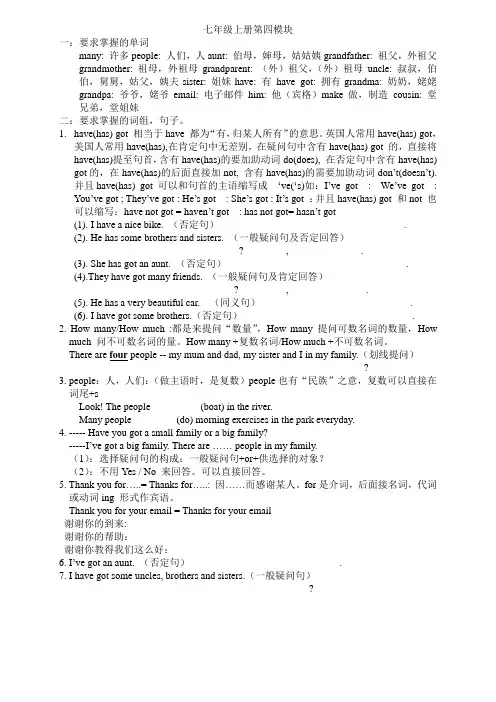
七年级上册第四模块一:要求掌握的单词many: 许多people: 人们,人aunt: 伯母,婶母,姑姑姨grandfather: 祖父,外祖父grandmother: 祖母,外祖母grandparent: (外)祖父,(外)祖母uncle: 叔叔,伯伯,舅舅,姑父,姨夫sister: 姐妹have: 有have got: 拥有grandma: 奶奶,姥姥grandpa: 爷爷,姥爷email: 电子邮件him: 他(宾格)make 做,制造cousin: 堂兄弟,堂姐妹二:要求掌握的词组,句子。
1.have(has) got 相当于have 都为“有,归某人所有”的意思。
英国人常用have(has) got,美国人常用have(has),在肯定句中无差别,在疑问句中含有have(has) got 的,直接将have(has)提至句首,含有have(has)的要加助动词do(does), 在否定句中含有have(has) got的,在have(has)的后面直接加not, 含有have(has)的需要加助动词don’t(doesn’t).并且have(has) got 可以和句首的主语缩写成‘ve(‘s)如:I’ve got : We’ve got : You’ve got ; They’ve got : He’s got : She’s got : It’s got :并且have(has) got 和not 也可以缩写:have not got = haven’t got : has not got= hasn’t got(1). I have a nice bike. (否定句)_____________________________________.(2). He has some brothers and sisters. (一般疑问句及否定回答)______________________________? ________, ______________.(3). She has got an aunt. (否定句)____________________________________.(4).They have got many friends. (一般疑问句及肯定回答)_____________________________? _________, _______________.(5). He has a very beautiful car. (同义句)______________________________.(6). I have got some brothers.(否定句)__________________________________.2. How many/How much :都是来提问“数量”,How many 提问可数名词的数量,How much 问不可数名词的量。
外研版七上英语M4知识点讲解及习题
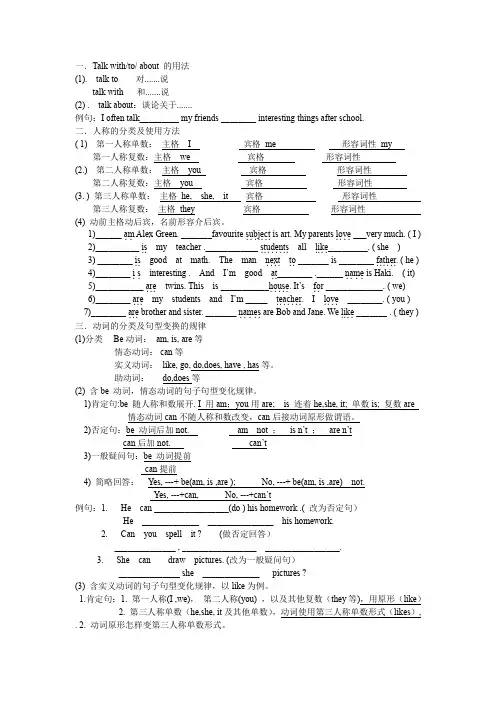
一.Talk with/to/ about 的用法(1). talk to 对.......说talk with 和.......说(2) . talk about:谈论关于.......例句:I often talk_________ my friends ________ interesting things after school.二.人称的分类及使用方法( 1) 第一人称单数:主格I 宾格me 形容词性my 第一人称复数:主格we 宾格形容词性(2.) 第二人称单数:主格you 宾格形容词性第二人称复数:主格you 宾格形容词性(3. ) 第三人称单数:主格he, she, it 宾格形容词性第三人称复数:主格they 宾格形容词性(4) 动前主格动后宾,名前形容介后宾。
1)______ am....___very much. ( I ) ..Alex Green. _______favourite subject.......is art. My parents love2)__________ is ..my teacher .____________ st..udents...._________. ( she )......all like3) ________ is ..good at math. The man next to....... ( he )......_______ is ________ father4)________ i s..interesting . And I’m good at..________ .______ name.... is Haki. ( it)5)___________ are...twins. This is ___________house...... It’s fo..r _____________. ( we)6)________ are....________. ( you ) ...my students and I’m _____ teacher........ I love7)________ are.... _______ . ( they ) ...brother and sister. _______ names.....are Bob and Jane. We like三.动词的分类及句型变换的规律(1)分类Be 动词: am, is, are等情态动词: can等实义动词: like, go, do,does, have , has 等。
外研版英语七年级上册 Module 4 重点难点易错点梳理
A.cook B.table C.food D.tool
解析:句意是“这家饭店里的食物尝起来很美味”。Food与句意相符。答案:C
2.名词的数
I’m so hungry.Please give me ______ to eat.
4.还有一些不规则变化
变内部原因字母:man→men男人woman→women女人foot→feet脚tooth→teeth牙齿
单复数同形:sheep绵羊deer鹿Chinese中国人Japanese日本人
完全不规则:child→children孩子mouse→mice老鼠
常考点&
例题分析
1.名词辨析
难点
一、have/has got的用法
1. have got意为“有;拥有”,如果想表达某人拥有某物,可用句型“主语+have/has got+其他”,其中have有人称和数的变化,当句子主语为第三人称单数或单数名词时,用has got。当句子主语是其他人称时,用have got。
2. have got的否定形式为:haven’t got或hasn't got。
解析:water是不可数名词,且该句是否定句。答案:C
5.连词辨析
Have you got any hamburgers ______ candy?
A.but B.or C.and D.so
解析:句意是“你有汉堡或者糖果吗?”or意为“或者”,表示选择。答案:B
6.Remember的用法
Remember ________ healthy food,please.
外研版七年级上册Module4测试(无听力 包含答案)
七年级上册module4测试一、听力。
(略)二、单项选择。
( )1. Would you like bread?A.anyB.someC.aD.one( )2.There isn’t money in the purse.A.someB.anyC.aD.ten ( )3. Don't drink wine.It's your health.A.much too;bad atB.too much;badforC.too much;bad atD.much too;badfor( )4. --Could you give me money?--Sorry.I don't have with me.A.some;anyB.little;someC.any;someD.little;any ( )5. Reading more is good your writing.A.atB.forC.withD.to( )6. --Let's buy some in the shop.--That sounds good.A.tomatosB.breadsksD.eggs ( )7. Please get a red apple me.A.forB.withC.toD.from( )8. The chicken and beef very nice.A.areB.isC.doD.does( )9. There are eggs in the fridge.A.lots ofB.a lotC.lot ofD.a lots( )10. --How about a cup of tea?-- .A.GoodB.Not badC.Good ideaD.I want to drink三、完形填空。
Hello,my name is Lisa.I am1English girl.I'm in China2my parents now.I3Chinese food.I eat eggs and bread4breakfast.I have5at school.The lunch is really6.I can have different(不同的)7.Sometimes(有时)I eat rice and chicken. Sometimes I8noodles(面条)and vegetables.I have dinner at home.I often have some milk and fruit.9are my favorite fruit.I have10eating habits,right?What about you?( )1. A.a B.an C.the D./( )2. A.with B.to C.after D.at( )3. A.know B.thank C.lose D.like( )4. A.on B.in C.for D.of( )5. A.lunch B.fruits C.vegetables D.dinner( )6. A.right B.fat C.boring D.good( )7. A.bread B.apples C.hamburgers D.food( )8. A.sell B.have C.see D.do( )9. A.Eggs B.Carrots C.Strawberries D.Salads( )10. A.relaxing B.easy C.healthy D.long四、阅读理解。
外研社七年级英语上册module4知识点总结
外研社七年级英语上册 module 4 知识点总结Module 41、in the future 在将来 Do you want to go to America in the future?in future 从今以后,今后 I hope you will be careful in future. 2、chalk、paper是物质名词,为不可数名词,但表示种类时,也可有复数形式。
a piece of chalk 一支粉笔 a piece of paper 一张纸 some coloredchalks 一些彩色粉笔3、in +一段时间,句子用将来时--How soon will you come back? 对in+一段时间提问,用 How soon-- In two weeks.4、maybe 可能,也许(副词) ,一般位于句首。
Maybe Tom is at home. may be 也许是,may是情态动词,位于句中。
Tom may be at home.5、use sth. to do sth. 用某物做某事 We can use knives to cut things.6、on the Internet 在网上 You can listen to music on the Internet.by Internet 通过网络 They can ask their teachers questions by Internet.by +交通工具 by bus I go to school by bus every day.7、be able to = can 后接动词原形 I am able to swim. = I can swim. 注意:can只有could和原形两种形式be able to 可以有各种时态 am /is/are/was / were / will / have been/ has been 8、not ...any more=no...more 不再...He isn’t a child any more. Don’t do that any more.9、answer one’s question 回答某人的问题Please answer my question now.10、need to do sth. 需要做某事,need是实义动词 You need to lookafter yourself well.need do sth. need做情态动词用时,后接动词原形I needn’t go toschool today. 11、job 指具体的工作,为可数名词work 工作,为不可数名词12、come true 实现常与dream、idea连用 Your dream will come trueone day. 13、mean sth 意味着 Health means everything. 健康就是一切。
外研版英语七上Module 4重要单词语法点总结
七上Module 4 Healthy food1.food n.1.“食物,食品”,表示泛指的食物或食物总体时是不可数名词(在大多数情况下用)What's your favorite food? 你最喜欢的食物是什么?Let’s buy some . 我们去买些食物吧。
2.当表示特定的食品或某种类的食物时,为可数名词。
sea foods baby foods 婴儿食品frozen foods 冷冻食品 a favourite food最喜欢的食物There are all kinds of on the table. 桌子上有各种各样的食物。
2.drink n.1.意为“饮料”时,一般为名词。
Have you got any drink? 你有饮料吗?2.指不同种类的饮料时,为名词。
There are all kinds of drinks in the shop.Cola isn’t a healthy drink. 可乐不是一种健康的饮料。
3.还可指“一杯(饮料)”或“一份(饮料)”。
Let’s have a drink.Please give me a cold drink.【拓展】drink作动词,“”。
I don’t drink tea.You should drink more hot water.Would you like to drink some juice?1.I am thirsty, I need some .(drink)2.Mary often (drink) some milk for breakfast.3.candy n 糖果4.fruit n.1.“水果”,指水果总称时,为名词。
Do you like fruit? ( 泛指水果) 你喜欢水果吗?2.指水果的种类或个别水果时,是名词。
I like to eat apples, bananas and other fruits. ( 强调种类用fruits ) 我喜欢吃苹果、香蕉及其他水果。