
六年级下册英语:Module 1 Unit 2《Changes in our lives》
Correct
1.In the past, sheuseds a pen and paper to write her books.
2.In the past, she goets her crops in by hand.
3. Now he usesd a digital camera. In the past
4.Now he swept the streets with a broom.
Practice
a writer
a pen and paper a computer
Presentation
photographer
Mr Zhang is a photographer.
Presentation
street cleaner
.
3.Miss Brown is a _w__ri_te_r_
.
Homework
d T h e E n来自her book. Now she uses _a__c_o_m_p_u_t_er_.
Listen and write
Mrs Hong is a farmer. In the past, she got her crops in _b_y_h__a_n_d_. Now she uses _a_m__a_c_h_i_n_e_.
Mr Yang is a street cleaner.
Presentation
writer
Ms Wen is a writer.
Guo Jingmin is a writer, too.
Read and write
1.Ms Wang is a _c_l_e_a_n_e_r
.
2.Mr Liu is a _p_h_o_to_g_r_a_p_h_e_r_
沪教版小学英语(三起)六年级
下册 Module1 Unit 2
Lesson 1
Warm up
In the past
Now
Warm upIn the past
Warm up Now
Listen and write
Ms Wen is a writer. In the past, she used _a__p_e_n__ and _p_a_p_e_r__ to write
Read and write
Mr Yang is a street cleaner. In the past, he swept the streets with _a__b_ro__o_m___ . Now he drives _a__s_tr_e_e_t_s_w__e_e_p_e_r__. It can clean the streets in a short time.
Read and write
Mr Zhang is a photographer. In the past, he used __fi_lm__ to take photos. Now he uses _a__d_ig_i_ta_l_c_a_m__e_r_a__. He can see his photos right away.
牛津上海版(三起)英语六年级下册Module 1 Unit 2 单元测试卷 (含答案)
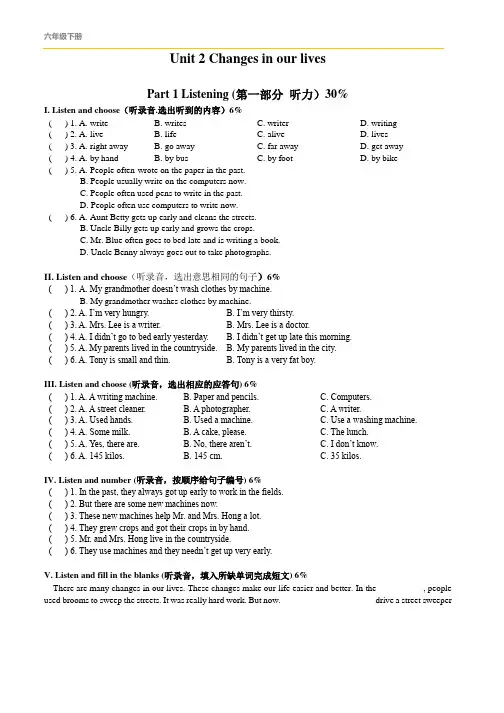
Unit 2 Changes in our livesPart 1 Listening (第一部分听力)30%I. Listen and choose(听录音.选出听到的内容)6%( ) 1. A. write B. writes C. writer D. writing( ) 2. A. live B. life C. alive D. lives( ) 3. A. right away B. go away C. far away D. get away( ) 4. A. by hand B. by bus C. by foot D. by bike( ) 5. A. People often wrote on the paper in the past.B. People usually write on the computers now.C. People often used pens to write in the past.D. People often use computers to write now.( ) 6. A. Aunt Betty gets up early and cleans the streets.B. Uncle Billy gets up early and grows the crops.C. Mr. Blue often goes to bed late and is writing a book.D. Uncle Benny always goes out to take photographs.II. Listen and choose(听录音,选出意思相同的句子)6%( ) 1. A. My grandmother doesn’t wash clothes by machine.B. My grandmother washes clothes by machine.( ) 2. A. I’m very hungry. B. I’m very thirsty.( ) 3. A. Mrs. Lee is a writer. B. Mrs. Lee is a doctor.( ) 4. A. I didn’t go to bed early yesterday. B. I didn’t get up late this morning.( ) 5. A. My parents lived in the countryside. B. My parents lived in the city.( ) 6. A. Tony is small and thin. B. Tony is a very fat boy.III. Listen and choose (听录音,选出相应的应答句) 6%( ) 1. A. A writing machine. B. Paper and pencils. C. Computers.( ) 2. A. A street cleaner. B. A photographer. C. A writer.( ) 3. A. Used hands. B. Used a machine. C. Use a washing machine.( ) 4. A. Some milk. B. A cake, please. C. The lunch.( ) 5. A. Yes, there are. B. No, there aren’t. C. I don’t know.( ) 6. A. 145 kilos. B. 145 cm. C. 35 kilos.IV. Listen and number (听录音,按顺序给句子编号) 6%( ) 1. In the past, they always got up early to work in the fields.( ) 2. But there are some new machines now.( ) 3. These new machines help Mr. and Mrs. Hong a lot.( ) 4. They grew crops and got their crops in by hand.( ) 5. Mr. and Mrs. Hong live in the countryside.( ) 6. They use machines and they needn’t get up very early.V. Listen and fill in the blanks (听录音,填入所缺单词完成短文) 6%There are many changes in our lives. These changes make our life easier and better. In the __________, people used brooms to sweep the streets. It was really hard work. But now. __________ __________ drive a street sweeperto clean the streets. I usually watched programs on TV, but now I never watch them on TV, because I can __________different programs on my __________. I’m a writer. I also write my books on it. Computers make my life fantastic. I __________in the future there will be more new things and t hey’ll help people a lot.Part 2 Reading and Writing (第二部分读写)60%I. Read and judge (判断下列各组单词划线部分的发音是否相同,相同的打“√”,不同的打“×”) 6%1. blow coat ( )2. house flower ( )3. hole crop ( )4. new grow ( )5. digital green ( )6. machine chair ( )II. Look and write (根据图意,填上适当的单词完成句子) 61. Little Match Girl is a p_____ girl. She has nothing to eat.2. The s_____ are very quiet in the early morning.3. Snow White and the seven dwarfs (矮人) had a happy 1_____4. I really like tennis. I am a tennis f_____.5. Do you want to go to the t_____ w ith me?6. My uncle d_____ a bus every day.III. Read and write (用所给单词的适当形式填空) 8%1. In the past, there __________ (be) a river near my home. Now there __________ (be) some tall buildings.2. __________ you __________ (sweep) the floor yesterday?3. __________ (farm) Wang grows vegetables.4. I’m tired. I would like to __________ (take) a rest.5. Don’t use that cup. It’s __________ (my).6. Sam usually __________ (go) to bed early, but yesterday he__________ (go) to sleep late.IV. Read and choose (选择填空) 10%( ) 1. The machine is helpful. It can clean the floor______.A. in the pastB. in a short timeC. in a long time( ) 2. I don’t like machines. I always do the washing ______.A. every dayB. by handC. by machine( ) 3. Long long ago, there ______ a lot of wild birds here.A. areB. wereC. is( ) 4. — How much do you weigh? —______A. 5 kilos.B. 500 kilos.C. 50 kilos.( ) 5. In the story, a fairy is ______.A. a beautiful ladyB. an ugly womanC. a handsome man( ) 6. — Helen, this new computer is for you. — ______A. How fun!B. How fantastic!C. How exciting( ) 7. I can’t find my broom, but it ______ here.A. wereB. wasC. is( ) 8. —How do you go to work every day? —______A. Take a bus.B. In the morning.C. On a bus.( ) 9. What do you usually do ______?A. nowB. after workC. yesterday( ) 10. I like using the digital camera, because______.A. it can take photosB. I can see the photos right awayC. it’s a good oneⅤ. Read and write(用适当的介词填空)6%1. Please take the photos ______ your new camera.2. My parents smiled ______ each other.3. I like washing my clothes ______ hand.4. We always enjoy ourselves ______ the weekend.5. My friend Peter has a house ______ a swimming pool.6. Would you like to go there ______ foot?Ⅵ. Rewrite the sentences (按要求改写下列句子) 7%1.People wrote letters on paper in the past. (改成一般疑问句)___________________________________________________________________________________________________ 2. Mr. White is a photographer. (对划线部分提问)___________________________________________________________________________________________________ 3. I was 100 days old in this photo. (对划线部分提问)___________________________________________________________________________________________________ 4. There was a lake in the village before. (对划线部分提问)___________________________________________________________________________________________________ 5. A street sweeper can clean the streets quickly. (对划线部分提问)___________________________________________________________________________________________________ 6. I would like to see a film. (另写一句,但意思不变)___________________________________________________________________________________________________ 7. Mr, apples, Lee, a, to, knife, cut, use, the (连词成句)___________________________________________________________________________________________________ VII. Read and match (读一读,把问答句配对) 6%( ) 1. Does your mother wash clothes by hand? A. I don’t know. But maybe they use a machine.( ) 2. You can make a wish on your birthday day. B. Yes. And I also take photos with my mobile (手机). ( ) 3. How does a farmer plant and get in crops? C. No. But there was a nice river outside the city.( ) 4. Was there a beautiful lake in the city? D. I don’t need any wishes, but thank you anyway.( ) 5. Do you take photographs with a camera? E. Usually. I rarely use pens and paper now.( ) 6. So you write on your computer? F. Oh, no. She used hands to wash clothes in the past. VIII. Read and choose (读一读,选择适当的句子完成对话) 5%Sam: Hi, Peter. ___1___Peter: Yes, it was a wonderful film.Sam: Really? What is the film about?Peter: ___2___Sam: Sounds interesting! So what changes did the film tell?Peter: A lot. For example, people rode horses or walked to a far place.Sam: ___3___Peter: Yes. There weren’t any mobile phones before.Sam: But now we can talk, read and watch TV on a mobile phone.Peter: ___4___ Inventions change our life.Sam: And make our life better! I want to see the film too!Peter: ___5___Sam: I think so.IX. Writing (请你写一写生活中,过去和现在有什么不一样,不少写六句) 6%In the past, people watched black and white TV. Now people watch color TV._______________________________ ___________________________________________________________________________________________________ ___________________________________________________________________________________________________ ___________________________________________________________________________________________________ ___________________________________________________________________________________________________ ___________________________________________________________________________________________________Part 3 Speaking (第三部分口语)10%I. Read aloud (朗读下列句子) 5%1. A photographer takes photos with digital cameras now.2. Fred and Doris smiled at each other and went away.3. I wish you a happy Spring Festival.4. There’s a poor farmer called Henry.5. Mrs. Hong got her crops in by hand in the past.II. Answer the question (回答问题) 5%1. Were you thin in the past?2. Do you live in the city or in the countryside?3. How does your mother wash dishes?4. What does a photographer do?5. What did people use to write in the past?Unit2 Changes in our livesPart 1 Listening (第一部分听力)I. Listen and choose (听录音, 选出听到的内容)1. In the future, I want to be a write. (C)2. There are a lot of changes and the life is better. (B)3. I will give you the book right away. (A)4. In the past, people usually went to work by bike. (D)5. People often use computers to write now. (D)6. Mr Blue often goes to bed late and is writing a book. (C)II. Listen and choose (听音,选出意思相同的句子)1. My grandmother likes washing clothes by hand. (A)2. I would like a glass of water. (B)3. Mrs Lee writes stories for children. (A)4. I went to bed very late last night. (A)5. My parents liked their old home. There were rivers and hills nearby. (A)6. Tony is 145 cm tall and weighs 60 kg. (B)III. Listen and choose (听录音,选出相应的应答)1. What did people use to write in the past? (B)2. Mr Wang drives a street sweeper. What’s his job? (A)3. How does your mother wash clothes? (C)4. What would you like to eat? (B)5. Are there many changes in our lives? (A)6. Alice is 10 years old. How much does Alice weigh? (C)IV. Listen and number (听录音,按顺序给句子编号)Mr and Mrs Hong live in the countryside. In the past, they always got up early to work in the fields. They grew crops and got their crops in by hand. But there are some new machines now. These new machines help Mr and Mrs Hong a lot. They use machines and they needn’t get up very early.(2,4,5,3,1,6)V. Listen and fill in the blanks (听录音,填入所缺单词完成短文)There are many changes in our lives. These changes make our life easier and better. In the past, people used brooms to sweep the streets. It was really hard work. But now, street cleaners drive a street sweeper to clean the streets. I usually watched programs on TV, but now I never watch them on TV, because I can watch different programs on my computer. I’m a writer.I also write my books on it. Computers make my life fantastic. I wish in the future there will be more new things and they’ll help people a lot.Part 2 Reading and writing (第二部分读写)I. 1. ✓ 2. ✓ 3. ✕ 4.✕ 5.✕ 6.✕II. 1. poor 2. streets 3. life 4. fan 5. theatre 6. drives III. 1. was, are 2. Did, sweep 3. Famer 4. take 5. mine 6. goes, went IV. 1. B 2. B 3. B 4. C 5. A 6. B7. B 8. A 9. B 10. BV. 1. with 2. at 3. by 4. at 5. with 6. onVI. 1.Did people write letters on paper in the past?2. What is Mr White?/What does Mr White do?/What is Mr White’s job?3. How old were you in this photo?4. How many lakes were there in the village before?5. What can a street sweeper do?6. I want to see a film.7. Mr Lee uses a knife to cut the apples.VII. 1. F 2. D 3. A 4. C 5. B 6. EVIII 1. E 2. A 3. D 4. B 5. C六年级下册。
六年级下册英语短语句型

Module 1 ChangesUnit 1 Xiao ling’s New ApartmentPart 1 短语1. Welcome to…欢迎来到……2. Let me + 动词原形让我……Let us (Let’s)+ 动词原形让我们……3. between A and B 在A和B之间4.连词and 1. 表示“并列”关系;2. 意为“和;以及”3. 模式:A and B A和Bbut 1.表示“转折”;2.意为“但是;可是;然而……”4. 判断依据:两个句子中出现相对的意思5. 模式:句子1,but 句子2so 1.表示结果;2.意为“所以;因此;于是……”3.判断依据:存在原因和结果的关系4.模式:(原因)句子,so (结果)句子5.A +be动词(is/are)+ far away from B A 距离B很远6. A + be动词+ near to B A在B 附近7. A + be动词+close to B A 接近B8.不定代词单数= 1 (is) this 这个 that 那个复数≥2 (are) these 这些 those 那些Part 2 形容词比较级A.本单元的形容词原形比较级原形比较级small bigbright darklarge nearclose prettycomfortableB.形容词的比较级和最高级比较级最高级以单音节词及ly/er/ow结尾的形容词 + er + est单音节词以e结尾的形容词 + r + st重读闭音节要双写末尾字母 + er + est多音节形容词要在前面 + more +most由分词演变的形容词要在前面 + more +most以辅音字母+ y 结尾的形容词 y – ier y –iestB.不规则形容词原级比较级最高级good/well(好的) better bestbad(坏的) worse worstlittle(少的) less leastmuch/many(多的) more mostfar(远的) further furthestold(老的) older/elder oldest/eldestC.比较级语法公式1.两种物品的比较(2种)或同种事物的前后比较“A”+be动词+形容词比较级(-er/more 形容词)+than “B”注意:much放在比较级前可加强“程度”2.三种以上的物品的比较“A“+ be 动词+the+最高级(形容词est/most 形容词)…注意:“序数词” 一般放在the 和最高级之间如:the first biggest3.the+比较级…,the+比较级=== 越……越……4.比较级and 比较级===越来越……如:more and more…越来越多……Part 3 句型1.反意疑问句:(1)陈述部分肯定式+疑问部分否定式They work hard, don’t they?他们努力工作,不是吗?Yes, they do.对,他们工作努力。
六年级下册英语Module 1 Unit 2《Change in our lives》
Look and say
Mrs Hong is a _f_a_rm__er___. In the past, she got her crops in by _h_a_n_d_. Now she uses a ___m_a_c_h_in_e__.
Look and say
Which way is faster to get the crops in?
Think and say
Think and say
What does a fireman/… do? A fireman/… puts out fires/…
4 4
11
22
33
Read aloud
Ms Wen is a writer. In the past, she used a pen and paper to write her books. Now she uses a computer.
can see photos right away
film
digital camera
Read aloud
Mr Zhang is a photographer. In the past, he used film to take photos. Now he uses a digital camera. He can see his photos right away.
Think and match
in the past now
drive a street sweeper
cleaned the streets with a broom
swept the streets slowly
clean the streets in a short time
Unit2_Changes_in_our_lives_教学内容与目标
Unit2 Changes in our lives 教学内容与目标【内容来源】上海教育出版社(2015年版)六年级下册Module1 Unit2【教学内容】一、功能差别比较、描述:比较过去和现在的生活方式变化并进行描述。
二、语言知识1. 句型复习和用语:(1) In the past, she used a pen and paper to write her books.Now she uses a computer.(2) I’d like to give you three wishes.(3) I wish you a happy life.2. 词汇:life, writer, street cleaner, drive, poor, wish, by hand, right away, in a shorttime3. 语音:o, o-e, ow, ou三、语言技能1. 听:听懂谈论现在和过去工作方式变化的短文。
2. 说:用一般现在时和一般过去时说说现在和过去的生活变化。
3. 读:(1) 读懂有关四个人物的工作方式变化的短文,了解时代变迁。
(2) 读懂故事《快乐的农夫夫妇》,理解故事中蕴含的道理。
4. 写:能结合语境用正确的句子描写生活变化。
【教学目标】1. 能在语境中正确运用本单元的核心词汇,复习已学相关核心词汇。
2. 能用一般现在时和一般过去时表达现在和过去生活方式上的变化。
3. 能根据o, o-e, ow和ou的发音规律,正确拼读简单的单词。
4. 能正确看待生活中的各种变化,乐于接受新事物。
教学重点:1. 词汇学习:life, writer, street cleaner, drive, poor, wish, by hand, right away, in ashort time2. 句型复习:In the past, she used a pen and paper to write her books. Now she uses acomputer.I’d like to give you three wishes.3. 语音复习:复习字母o和字母组合o-e,ow和ou在单词中的发音。
小学六年级英语下册教学要点
小学六年级英语下册教学要点内容:本册一共有五个模块和一个复习模块,分别是:Module 1 changes (第一模块) , Module 2 Diaries (第二模块) ,Module 3 Famous Peoples (第三模块) ,Moudle 4 Stories and Fables (第四模块) ,Module 5 Hopes and Fantasies (第五模块) ,Module 6 Revision (复习) 。
第一部分:全册教学目标、重难点教学目标、重难点1、能听懂本册书话题的语段和简短的故事;能就所学的话题(如变化与对比、日记、名人、故事寓言、希望与幻想等)与教师或同学交换简单的信息;能读懂与本册书知识水平相当的小故事及其他文体的阅读材料;能按话题或看图写出意思连贯、语法结构比较准确的5个以上的句子;能进行简单的交际性活动,形成有效的学习方法,克服学习中遇到的困难。
2、能熟练识记与运用各单元的四会单词、短语、习惯用语和固定搭配;能运用所学词汇描述事物、行为和特征;能熟练理解各话题的对话与课文的内容;3、熟练掌握名词的单复数形式;正确使用主要人称代词;正确使用所学的各种时态;掌握常用的时间、地点和位置的介词;掌握英语简单句的基本形式和表意功能;基本理解和掌握比较人、物体及事物的表达形式;4、能读懂简单的对话、故事和短文并理解大意,能较准确地按要求做任务;5、能掌握规范的句子书写;能模仿范例写出或回复简单的问候卡和邀请卡等文体;6、能根据提示词和所给图片编写简单的对话或小短文,语法结构比较准确的5个以上的句子并且句式有所变化;7、能按日记的基本格式写简单的日记。
第二部分:模块教学目标、重难点第一模块:本模块主要要求学生能谈论关于变化,尤其是家庭及家庭成员的变化话题。
语言的知识和技能与上两个学期所学习的重点语法知识:形容词、副词的比较级和一般过去时有所联系和发展。
1.词汇:pillow / comfortable/ kung fu/ show / change/ dark / far away from/ album/ naughty/ gosh/ diet/ go on a diet/ show/ dark/ close to/ grammar/ try/ just/ healthy/ trouble/ in trouble/ footballer/ fit/ become/ player/ good-looking/ student/ ago2、句型:要求理解下面的句型:(1)The animal is ugly to look at.(2)The picture is beautiful , isn’t?These bedrooms are more beautiful than yours, aren’t they?进一步掌握有关形容词、副词比较级和一般过去时的有关句型第二模块:本模块的话题是日记,对于六年级的学生来说,他们已经在语文课中学习过如何用中文来写日记,对日记的格式和写作方法比较熟悉。
外研版(三起)-英语-六年级下册--外研版三起Module 1 Unit 2教材同步讲解
Unit 2:What do you want to eat?(第二单元:你想吃什么?)(教材5~7页)1.Listen and chant.听一听并跟着唱。
(教材第5页)课文英汉互译What do you want to eat?你想吃点什么?I want to eat some meat.我想要吃些肉。
And I want a hot dog,please,请给我一个热狗,with lots and lots of cheese.和很多很多奶酪。
重难点精析一、What do you want to do sth?的用法1.What do you want to eat?你想吃点什么?【点拨】“What do you want...?”用来询问对方想要什么东西,除此以外,还可以加动词不定式来表示相应的动作。
句中的to eat就是动词不定式。
例如:What do you want to drink?你想喝什么?What do you want to play?你想玩什么?【生活实例】小红到洋洋家做客,到了午饭时间,洋洋妈妈关心地问小红:What do you want to eat?你想吃点什么?小红说:1 want to eat some fish.我想吃些鱼。
【即学即用】-What do you do?-I want to play football.A. wantB.want toC.wants to二、some和any的用法2.1 want to eat some meat.我想吃些肉。
【点拨】some与any都表示“一些”,但两者用法不一样。
some用于肯定句中,any 用在疑问句和否定句中。
例如:I have some story books.我有一些故事书。
(肯定句)Do you have any story books?你有一些故事书吗?(疑问句)I haven't any story books.我没有一些故事书。
牛津小学英语六年级下册(三年级起点)各单元课文翻译
六年级英语下册(三年级起点)各单元课文翻译本套教材以“话题—结构—功能一任务”为主线,设计和安排大量形式多样、语境真实、趣味性强的语言实践活动,让学生综合运用所学的英语语言知识和语言技能来体验、实践、参与、探究和合作。
一、教材目录Module 1 Changes and differencesUnit 1 You and meUnit 2 Changes in our livesUnit 3 Our school in the futureModule 2 Work and playUnit 4 ArtUnit 5 CraftsUnit 6 PE lessonsModule 3 Things we doUnit 7 Helping othersUnit 8 Reading signsUnit 9 Reusing thingsModule 4 Things we enjoyUnit 10 Great storybooksUnit 11 Western fesivals二、课文翻译Module 1 Changes and differencesUnit 1 You and meUnit 1 Listen and say英语课文翻译Joe is visiting his cousin George in the countryside.Joe: I weigh 47 kilograms. How much do you weigh, George? George: I weigh 40 kilograms.Joe: I' m 150 centimeters tall. How tall are you?George: I' m 152 centimeters tall.Joe: You're taller. Do you do a lot of exercise?George: Yes. I usually play basketball andtable tennis after school.Joe: I usually play football after school. I' m a football fan. George:Sometimes I go fishing with my grandpa.Joe: How exciting! I don't go fishing often. There's no river near my home.George: But you can go to museums.乔正在拜访他在乡村的表弟乔治。
(外研版 三起)六年级英语下册Module 1 Unit 2教案
(外研版三起)六年级英语下册 Module 1 Unit 2 教案一、教学目标1.学习掌握以下单词:cabbage, carrot, potato, tomato。
2.学会运用“What`s in/on the …?”来询问水果和蔬菜。
3.听、说、读、写短语:have some, have a lot of, not at all。
4.能够正确地组织句子,运用所学句型进行日常对话。
5.能够通过进行角色扮演,模拟真实生活情景进行日常英语对话。
二、教学重点1.运用“What`s in/on the …?”来询问水果和蔬菜。
2.能够正确地组织句子,运用所学句型进行日常对话。
三、教学难点1.听、说、读、写短语:have some, have a lot of, not at all。
2.能够通过进行角色扮演,模拟真实生活情景进行日常英语对话。
四、教学过程1. 教师引入1.老师说:“Hello, boys and girls. Today, we are going to learnabout fruits and vegetables.”2.老师出示图片,说:“What fruit is this?”并引导学生说出答案,如此循环。
2. 自主学习1.老师让学生自己阅读课本,学习词汇:cabbage, carrot, potato, tomato。
2.老师让学生观看视频,学习What`s in/on the …?句型。
3. 回答问题1.老师提问“What`s in/on the …?”,并且要求学生回答。
2.学生回答后,老师再进行适当的纠正和指点。
4. 英语口语练习1.老师安排小组活动,让学生进行角色扮演,模拟真实生活情景进行日常英语对话。
2.分别让不同的学生来做不同的角色,让每个学生都有机会参与,以达到练习英语口语的目的。
5. 课堂作业1.老师让学生利用课本和所学句型,写一段文章介绍自己喜欢的水果和蔬菜,并且需要用到What`s in/on the …?句型以及所学短语:have some, have a lot of, not at all。
沪教版六年级英语下册(上海牛津6B)知识点总结
lazy
懒惰的
take off
脱掉
roof
屋顶
yard
院子
hit
碰撞
see the world
见世面
one by one
一个接一个地
look out of
往外看
even
甚至
themselves
他们自己
sweep
扫地
space
太空
theatre
剧院
broom
扫帚
dinosaur
恐龙
go fishing
去钓鱼
drive
驾驶
a piece of
一张
enjoy oneself
玩得愉快
street sweeper
环卫工人
have a picnic
去野餐
get…in
收割
油
craft
手艺,工艺
long race
长跑
oil painting
油画
crown
王冠
short race
短跑
powerful
强有力的
scissors
剪刀
win
获胜
ink
墨水
tape
胶带
long jump
跳远
brush
画笔,刷子
glue
胶水
high jump
跳高
paints
绘画颜料
saw
锯
swimsuit
kilogram
千克,公斤
writer
作家
online
在线的
centimeter
厘米
photographer
牛津英语上海版六年级下册知识点整理
牛津英语上海版六年级下册知识点整理Module1 City lifeUnit1 Great cities in Asian词组:the capital of... ...的首都 north-east东北 from...to...从...到...in the past在过去 the Great Wall长城 more than=over超过eat dumpling吃饺子 tall buildings高楼大厦huge department stores大型的百货商店 a lot of许多语法点:1.Beijing is north of Shanghai.北京在上海的北部。
(1)两地不相邻:A is north of B.(2)所属关系:A is in the north of B.(3)两地接壤:A is on the north of B.2.How far is it from Shanghai to Beijing?从北京到上海有多远?How far... 多远。
询问距离的远近,路程的长远。
3.How long does it take to travel from Shanghai to Beijing by train?坐火车从上海到北京要多久?(1)How long...多久。
询问时间长短。
How long…多长。
用于询物的问长度。
(2)by+交通工具,表示“乘...交通工具”,用How提问。
4.It takes about ten hours.大约需要十小时It takes (sb.) st. to do sth. 做某事需要花费多长时间。
5.They enjoy eating dumplings.他们喜欢吃饺子enjoy/like/love doing sth. 喜欢做某事6.Two and a half days=Two days and a half两天半Half an hour=one and a half hours=one/an hour and a half一个半小时Unit2 At the airport词组:plane ticket机票 silk scarf丝巾 a lot of/plenty of大量的,许多departure time出发时间 leave for出发去某地 have to不得不be going to将要 arrive at到达boarding card登机牌 name tap姓名语法点:1.Aunt Judy and Uncle Mike have lived in Los Angeles for six years.朱迪婶婶和迈克叔叔在洛杉矶已住了六年。