
PEP六年级上册英语第2单元知识点
Unit2: Ways to go to school
一、重点单词和短语
1. 四会词汇:
on foot步行=walk by bus =take a/the bus 乘公交车 by plane,乘飞机by taxi 乘出租车
by ship乘船 by subway 乘地铁 by train乘火车 by bike骑自行车
slow down 慢下来 stop 停止 wait等 go 走
了解:by…= take a / the …例如:by bus = take a / the bus
2. 频率副词:(次数从多到少)
always总是 > usually通常 > often 经常 > sometimes有时 > never从不3. 其他:
pay attention to注意 by ferry乘轮渡 by sled滑雪橇
cross the road横穿马路 traffic light(s) 通信号灯 at
home在家
missed(miss的过去式)想念 different不同的 same 相同的
cross穿过look right向右看chopsticks筷子(复数)
door门 look at朝……看 play with和……一起玩
二、按要求写单词:
go (反义词)come foot(复数)feet child(复数)children
good(反义词)bad坏的 take带走(反义词)bring拿来 slow慢的(反义词)quick/fast
go(过去式)went do(过去式) did do(第三人称单数)does
go(第三人称单数)goes same 相同的(反义词)different不同的 miss (过去式) missed
wrong 错误(反义词)right正确 can(否定形式)can’t early早的(反
义词)late晚的
三、重点句子
(一)四会句子
1. --- How do you come to school 你(们)怎么来学校的
--- Usually, I come on foot. = Usually, I walk. 通常情况下,我步行来。
2. In the USA people on bikes must wear one. 在美国骑自行车的人必须带头盔。
3. Don’t go at the red light! 别闯红灯!
4. I must pay attention to the traffic lights. 我必须注意交通信号灯。
四、重点语法
1. How do you come to school 你(们)怎么来学校的
此问句是由特殊疑问词how引导的特殊疑问句,用于询问对方的出行方式。
回答时要根据具体情况作答。
表示地点的词:
Germany德国 Munich慕尼黑 England英国 Australia澳
大利亚
school学校 the park 公园 the cinema电影院 the hospital医院
the post office邮局 the bus stop公共汽车站 home家
2. Usually, I come on foot. = Usually, I walk. 通常情况下,我步行来。
此句是对出行方式的回答句。
其中usually意为“通常”,表示频率很大, on foot意为“步行”。
一般用by表示出行方式。
by后面一定要直接加交通工具的单数形式,只有“小脚丫”foot与on 搭配,“步行”用on foot表示。
练习:I usually come to school on foot.(对划线部分提问)
________________________________________________
3. I must pay attention to the traffic lights. 我必须注意交通信号灯。
must是情态动词,意为“必须”后面跟动词原形。
动作词组:
wear a helmet戴头盔 pay attention to the traffic lights注意交通信号灯
look right向右看 wear a life jacket 穿救生衣
4. Don’t go at the red light! 别闯红灯!
此句是Don’t开头的祈使句的否定句, don’t后面跟动词原形。
意为“不要做某事”。
动作词组:run跑 go at the red light闯红灯 touch the door触摸门
Eg. Don’t smoke.不要吸烟。
/ 禁止吸烟。
Don’t take photos.禁止拍照。
注意:祈使句的否定句变为肯定句就是把Don’t去掉,句首字母改为大写。
5. We must look right before crossing the road.我们在横穿马路前必须看看右边。
此句中must是情态动词,意为“必须”后面跟动词原形,在此句中before是一个介词,而介词后面跟动词-ing形式。
6. There is no door on the bus.公共汽车上没有门。
此句是there be句型的单数句, be动词要根据后面名词的单复数形式来决定,名词为单数或不可数名词就用there is, 名词为复数就用there are. 此句中no door意为“没有门”,表示单数含义,因此要用there is开头。
注意:there be句型的否定句和一般疑问句的变换方法以及回答。
原句:肯定句:There are some books on the desk.
否定句:There are not / aren’t _______ books on the desk.
一般疑问句:Are there any books on the desk
Yes, ___________.
No, ____________.
五、句型变换:
1. You must stop at the red light. (改为祈使句)
____________________________________
2. Go at the red light. (改为否定句)
_______ go at the red light.
3. Don’t stop at the red light. (改为肯定句)
____________________________________
4. I come to school by bus. (对划线部分提问)
________ do _______ come to school
5. I come to school on foot. (写出同义句)
I ________ to school.
六、完成下列对话.
A: _______ ______ . _______ _____a post office near here B: Yes, ________ ________. It’s ________ to the bank.
A: _____ ________ ________
B: No, it’s near here.
A: _____ ______ ________ __________ _________
B: You can go by the No. 12 bus. _______ ________ the bus at the park. Then get off at the zoo. Walk ____________ for two minutes. It’s _____ the left.
A: _____________ .
B: You’re welcome.
七、根据对话中上下文意思,在空格中填上合适的词使句子完整。
1 _ can I go to the zoo You can go the bus.
2. _ is the science museum It’s ______the bank.
3. I want to buy a book, I’m going to the . I want to
send a letter. I’m going to the .
4. If you hurt your leg. You can go to the to see
a .
5. A is a place where you can get or save money.。
新人教版(PEP)小学英语六年级上册各单元知
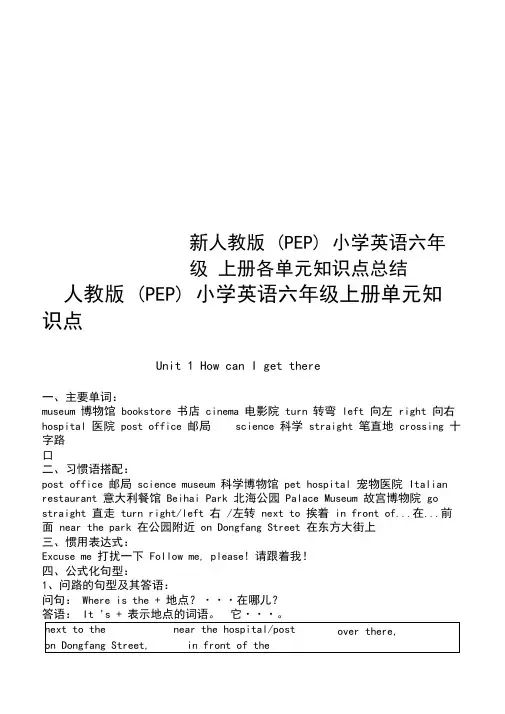
新人教版 (PEP) 小学英语六年级上册各单元知识点总结人教版(PEP) 小学英语六年级上册单元知识点Unit 1 How can I get there一、主要单词:museum 博物馆bookstore 书店cinema 电影院turn 转弯left 向左right 向右hospital 医院post office 邮局science 科学straight 笔直地crossing 十字路口二、习惯语搭配:post office 邮局science museum 科学博物馆pet hospital 宠物医院Italian restaurant 意大利餐馆Beihai Park 北海公园Palace Museum 故宫博物院go straight 直走turn right/left 右/左转next to 挨着in front of...在...前面near the park 在公园附近on Dongfang Street 在东方大街上三、惯用表达式:Excuse me 打扰一下Follow me, please! 请跟着我!四、公式化句型:1、问路的句型及其答语:问句:Where is the + 地点?···在哪儿?答语:It 's + 表示地点的词语。
它···。
2、询问怎么到某地的句型及其答语:问句:How can +主语+ get (to)+地点?···怎么到···?同义句型:Can you tell me the way to + 地点?Where is + 地点?Which is the way to + 地点?答语:Turn +方向+表示地点的介词短语。
···转。
at the cinema at the corner near the post office...五、例句:Where is the cinema, please? 请问电影院在哪里?It ' s next to the hospital. 它与医院相邻。
六年级英语上册(PEP版)Unit 2必备知识点
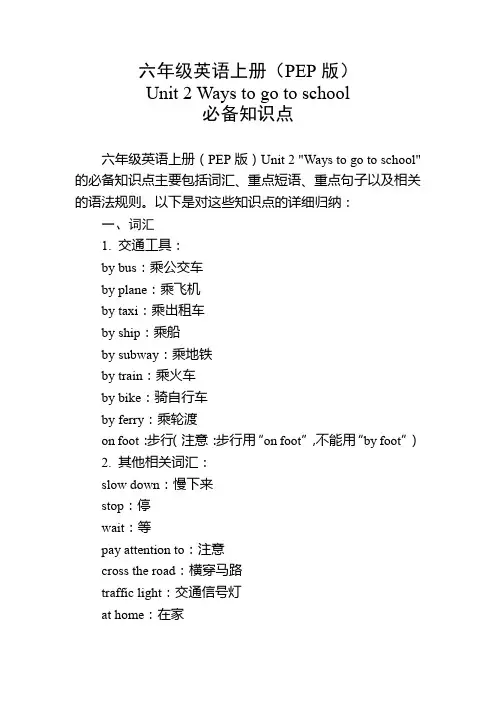
六年级英语上册(PEP版)Unit 2 Ways to go to school必备知识点六年级英语上册(PEP版)Unit 2 "Ways to go to school" 的必备知识点主要包括词汇、重点短语、重点句子以及相关的语法规则。
以下是对这些知识点的详细归纳:一、词汇1. 交通工具:by bus:乘公交车by plane:乘飞机by taxi:乘出租车by ship:乘船by subway:乘地铁by train:乘火车by bike:骑自行车by ferry:乘轮渡on foot:步行(注意:步行用“on foot”,不能用“by foot”)2. 其他相关词汇:slow down:慢下来stop:停wait:等pay attention to:注意cross the road:横穿马路traffic light:交通信号灯at home:在家missed(miss的过去式):想念different:不同的chopsticks(筷子,复数形式)cross:穿过look right:向右看same:相同的door:门look at:朝……看play with:和……一起玩buy:买want to:想要a pair of:一双/一对get on:上车get off:下车turn left:左转turn right:右转driver:司机must:必须二、重点短语1. traffic rules:交通规则2. be far from…:表示离某地远3. get to:到达4. on the right/left side of the road:在路的右边/左边5. pay attention to the traffic lights:注意交通信号灯6. cross the road safely:安全地过马路三、重点句子1. 询问出行方式:How do you go to school? 你怎么去上学?Usually I go to school on foot. Sometimes I go by bus. 通常我步行去上学,有时候乘公交车。
Pep人教六年级英语上册Unit 2知识点思维导图
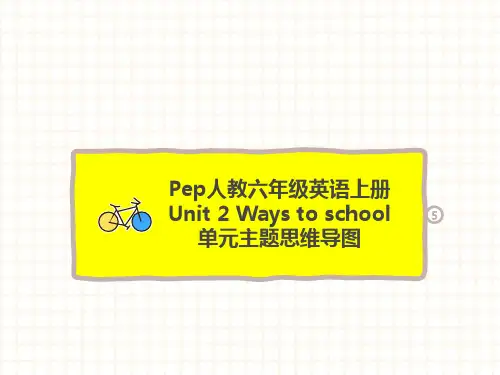
语法知识点
by的用法 must的用法
“by+交通工具”表示搭乘某种交 通工具,交通工具前不加冠词。 I go to school by bike. 我骑自行车去上学。
must是情态动词,其后接动词原形。 You must stop at a red light. 红灯时你必 公共汽车 plane:飞机 taxi:出租汽车 ship: (大)船 subway:地铁 train:火车 slow:慢的 down:坚守
slow down:慢下来 stop :停下
on foot:步行 by bus =take a bus 乘公交车
by plane乘飞机 by taxi 乘出租车
by ship乘船 by subway 乘地铁
by train乘火车
单词 短语
主题 词汇
Pep人教六年级英语上册 Unit 2 Ways to school
单元主题思维导图
询问及回答去 某地的交通方式
句型结构:How do you come/go(to) +地点?
- How do you come to school? - I usually come by bus.
表达命令 或劝告
句型结构:某人+must+动词原形+其它。
- You must look right before you cross the road.
Don't +动词原形+......告诫某人不要做某事
- Don't touch the door.
常见的频 率副词
always > usually > often > sometimes > never 总是 >通常 >经常>有时 >从不
六年级的英语上册版第二单元复习新PEP人教版完美版ppt课件
A. to C. a
B. / D. at
11. We go to Beijing ______ train.
A. in
B. at
C. by
12. How do you get to the USA ____China?
A. for
B. to
C. from
13. In the USA, people on bikes must ____ a helmet.
(.) _T_h_e_y_a_r_e__fr_o_m__m__y_c_o_u_s_i_n_i_n_t_h_e__U_S_A_._ 8. get, the, can, I, to, hospital, how
_H_o__w_c_a_n__I_g_e_t_t_o_t_h_e_h_o__s_p_it_a_l?_______
2. That’s good_________ A. exercise. B.a exercise C.the exercise D.excercises
3. What’s this? ________a helmet.
A. This is B. That is C. It’s D Its 4. The bus is__________.
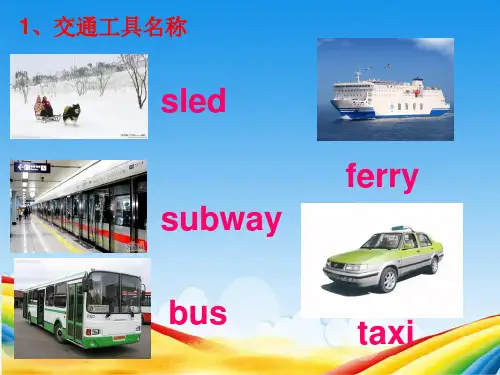
1、交通工具名称
sled
subway
ferry
bus
taxi
2、频率副词
always > usually > often > sometimes > never
3、短语
慢下来:
slow down
注意:
pay attention to
交通信号灯:
traffic lights
Stop and wait at a red light .
(完整版)PEP六年级上册英语第2单元知识点

Unit2: Ways to go to school一、重点单词和短语1. 四会词汇:on foot步行=walk by bus =take a/the bus 乘公交车by plane,乘飞机by taxi 乘出租车by ship乘船by subway 乘地铁by train乘火车by bike骑自行车slow down 慢下来stop 停止wait等go走了解:by…= take a / the …例如:by bus = take a / the bus2. 频率副词:(次数从多到少)always总是> usually通常> often 经常> sometimes有时> never从不3. 其他:pay attention to注意by ferry乘轮渡by sled滑雪橇cross the road横穿马路traffic light(s) 通信号灯at home在家missed(miss的过去式)想念different不同的same 相同的cross穿过look right向右看chopsticks筷子(复数)door门look at朝……看play with和……一起玩二、按要求写单词:go (反义词)come foot(复数)feet child(复数)childrengood(反义词)bad坏的take带走(反义词)bring拿来slow慢的(反义词)quick/fast go(过去式)went do(过去式)did do(第三人称单数)doesgo(第三人称单数)goes same 相同的(反义词)different不同的miss(过去式)missed wrong 错误(反义词)right正确can(否定形式)can’t early早的(反义词)late晚的三、重点句子(一)四会句子1. --- How do you come to school? 你(们)怎么来学校的?--- Usually, I come on foot. = Usually, I walk. 通常情况下,我步行来。
PEP六年级上册英语第2单元知识点
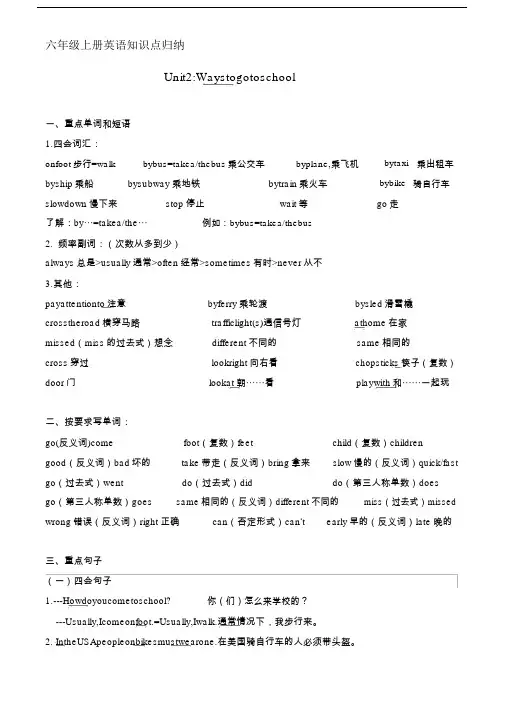
Unit2:Waystogotoschool一、重点单词和短语1.四会词汇:onfoot步行=walk bybus=takea/thebus乘公交车byplane,乘飞机bytaxi乘出租车byship乘船bysubway乘地铁bytrain乘火车slowdown慢下来stop停止wait等了解:by⋯=takea/the⋯例如:bybus=takea/thebusbybikego走骑自行车2.频率副词:(次数从多到少)always总是>usually通常>often经常>sometimes有时>never从不3.其他:payattentionto注意byferry乘轮渡bysled滑雪橇crosstheroad横穿马路trafficlight(s)通信号灯athome在家missed(miss的过去式)想念different不同的same相同的cross穿过lookright向右看chopsticks筷子(复数)door门lookat朝⋯⋯看playwith和⋯⋯一起玩二、按要求写单词:go(反义词)come foot(复数)feet child(复数)childrengood(反义词)bad坏的take带走(反义词)bring拿来slow慢的(反义词)quick/fast go(过去式)went do(过去式)did do(第三人称单数)doesgo(第三人称单数)goes same相同的(反义词)different不同的miss(过去式)missed wrong错误(反义词)right正确can(否定形式)can’t early早的(反义词)late晚的三、重点句子(一)四会句子1.---Howdoyoucometoschool?你(们)怎么来学校的?---Usually,Icomeonfoot.=Usually,Iwalk.通常情况下,我步行来。
2.IntheUSApeopleonbikesmustwearone.在美国骑自行车的人必须带头盔。
PEP六年级上册英语第2单元知识点
Unit2: Ways to go to school一、重点单词和短语1. 四会词汇:on foot步行=walk by bus =take a/the bus 乘公交车by plane,乘飞机by taxi 乘出租车by ship乘船by subway 乘地铁by train乘火车by bike骑自行车slow down 慢下来stop 停止wait等go走了解:by…= take a / the …例如:by bus = take a / the bus\2. 频率副词:(次数从多到少)always总是> usually通常> often 经常> sometimes有时> never从不3. 其他:pay attention to注意by ferry乘轮渡by sled滑雪橇cross the road横穿马路traffic light(s) 通信号灯at home在家missed(miss的过去式)想念different不同的same 相同的cross穿过look right向右看chopsticks筷子(复数)door门look at朝……看play with和……一起玩】二、按要求写单词:go (反义词)come foot(复数)feet child(复数)children good(反义词)bad坏的take带走(反义词)bring拿来slow慢的(反义词)quick/fast go(过去式)went do(过去式)did do(第三人称单数)does go(第三人称单数)goes same 相同的(反义词)different不同的miss(过去式)missedwrong 错误(反义词)right正确can(否定形式)can’t early早的(反义词)late晚的—三、重点句子(一)四会句子1. --- How do you come to school 你(们)怎么来学校的--- Usually, I come on foot. = Usually, I walk. 通常情况下,我步行来。
六年级上册英语素材知识点归纳Unit2_人教PEP
Unit 2 Ways to go to school 一.知识点归纳(一)、词汇四会自行车)by ( 乘坐)慢下来bus (公共汽车) go to school (上学)plane ( 飞机) on foottrain (火车) how (怎样)ship (轮船) stop 停下来taxi 出租车ferry 轮渡sled 雪橇subway ( 地铁)(交通工具前加by , 表示乘坐但步行要用on foot )(二)、重点句型①询问交通方式用疑问代词how1. How do you go/come to school ? 你怎样去/来上学?Usually I go/come to school on foot . 通常我走路去/来上学。
2.How does he/she/ Peter go /come to school? 他/她/皮特怎样去/来上学?He/ She usually goes/comes to school by bike. 他/她通常骑自行车去/来上学。
3. How does your father go to work ? 你父亲怎样去上班?He goes to work by subway . 他坐地铁去上班。
②询问地点,用疑问代词whereWhere is your home ? 你家在哪里?It’s near the post office . 在邮局旁边。
Where are the teachers ? 老师们在哪儿They are in the teacher’s office .在老师的办公室。
③问路How can/ do I get to the Fuxing Hospital?我怎么到福星医院?You can take the No .1 bus .④交通规则(traffic rules )Slow down and stop at a yellow light 黄灯面前要减速并停下来Stop and wait at a red light. 红灯面前停下来并等待Go at a green light. 绿灯行.课本第16面的一些交通规则In China and the USA drivers drive on the right side of the road .在中国和美国,司机靠右行驶。
人教PEP版六年级英语上册Unit 2 知识点清单
Unit Ways to go to school一、核心词汇1. 交通工具: bus 公共汽车plane 飞机taxi 出租车ship (大)船subway 地铁train 火车2. 其他: by(表示方式)乘slow(使)放慢速度;慢的down 减少;降低stop 停下3. 短语: on foot 步行slow down 减速二、了解词汇1. 名词: Mrs 夫人helmet 头盔attention 注意traffic 交通Munich 慕尼黑(德国城市) Germany 德国Alaska 阿拉斯加州(美国州名) sled 雪橇ferry 轮渡Papa Westray 帕帕韦斯特雷岛Scotland 苏格兰2. 形容词: early 早到的fast 快的3. 动词: must 必须wear 戴4. 短语: pay attention 注意traffic lights 交通信号灯三、核心句型1. — How do you come to school? 你们怎么来学校的?— Usually, I come on foot. Sometimes I come by bus. 通常我走路来。
有时候我乘公共汽车来。
句型结构: — How do/does+主语+go/come (to) …?……怎么去/来……?—主语+go/goes/come/comes ………去/来……(1)助动词do和does要根据主语而进行变化。
当主语是第三人称单数形式的时候要用does,其他则用do。
举一反三: — How do you go to work? 你怎么去上班?— I go to work on foot.我走路去上班。
(2)go home/go there等词组中没有to,因为home/there在这里是副词。
举一反三: — How do you go home?你怎么回家?— How does he go there?他怎么来这里?2. — Mr Jones, how can I get to the Fuxing Hospital? 琼斯先生,我怎么到复兴医院?— Take the No.57 bus over there. 乘那边的57路公共汽车。
人教PEP版英语六年级上册2单元知识点
PEP 六年级上册单元重点知识集锦Unit 2一.单词(教材111页Unit 1,共计25个)二.短语1.pay attention to 注意2.the traffic lights交通灯3.go by subway 坐地铁去e on foot走着来5.cross the road过马路6.slow down减速7.different ways to go to school不同的到校方式8.snow a lot 经常下雪9.stop at a red light 红灯停10.drive slowly慢开车11.wear a life jacket 穿着救生衣12.go to work 去工作13.play with us和我们玩儿14.on the left side 在左边15.be different from 和......不同16.be the same as和.....相同三.知识点1.pay attention to doing/n 注意做某事2.wait for 等候can’t wait to do迫不及待的做某事3.must 表示主观,必须have to 表示客观,不得不4.by +交通工具5.sometimes=at times 有时some times 几次sometime 某时some time 一段时间6.exercise不可数名词锻炼take exerciseexercises可数名词操或练习题do morning/eye exercisesexercise动词锻炼exercise your body7.wear 穿着,表示穿的状态,put on 穿上,表示穿的动作和过程8.learn to do sth 学习做某事learn from sb 向某人学习learn by oneself 自学9. over= more than 超过10.cross the road 过马路,cross 动词go/walk across the road 过马路across 介词11.tell sb (not) to do sth 告诉某人做某事tell sb sth = tell sth to sb 告诉某人某事tell sb about sth 告诉某人关于某事12.stop to do sth 停止去做stop doing 停止做stop sb from doing sth 阻止某人做某事13.have fun in doing sth = have fun with sth 做某事很有意思14.sb is interested in sth =sth is interesting to sb 某人对某事感兴趣interest n show/have interest in sth 对某事感兴趣interest v sth interest sb 某事使某人感兴趣四.句子1.How do you come to school?你怎么上学?2.You must pay attention to the traffic lights. 你必须注意交通灯。