
(外研版)六年级英语下册课件_Module_8_Unit_2
Copyright 2004-2009 版权所有 盗版必究
He was dead. He made the first letters in Braille.
Copyright 2004-2009 版权所有 盗版必究
布莱叶点字法 18世纪30年代,在法国巴黎一所盲人学校里,有位教师叫布莱叶。 布莱叶小时候因意外事故双目失明。后来,他进入盲人学校读书,毕业 后留校当了教师。 那时,在盲人学校里,老师把一个个用又大又厚的纸片剪成的字母, 粘在像缝纫机一样的台板上,孩子们读书时,用手指一个一个摸过去, 要摸好久才能读懂一句话。 为此,布莱叶很想创造出一种专供盲人摸读和书写的文字。一次,他 偶然听说一位法国军官发明了一种“夜码”,能在夜间准确传送情报。 布莱叶立即跑去请教。原来,在战场上,为了防止暴露目标,夜间不能 随便点灯。这位军官想出了个办法,用钻子在厚纸上打出小洞,使纸的 背面微微凸出。再用手摸纸背,就可分辨出“小洞”表示的暗语来。他 们就用这些打过洞的厚纸相互传送情报。 布莱叶对这种靠手摸的“夜码”非常感兴趣。经过五年时间的反复研 究,布莱叶终于创造出了一种简单、实用的“点字盲文”。1837年,布 莱叶的不朽巨著《点字盲文》面世,这种“点字盲文”是由6个凸点组成, 通过它们不同位置的排列,可以表示出全部26个拉丁字母。这是世界上 第一本布莱叶盲文读物。布莱尔盲文由63个编码字符组成,每一个字符 由1~6个突起的点安排在一个有6个点位的长方形里 。为了确认63个不 同的点式或盲文字符,数点位时是左起自上而下1,2,3,然后右起自上 而下4,5,6。便于盲人摸读。这种文字由打在厚纸上的6个点组成,通 过几组点的不同排列,可以表示出所有26个拉丁字母。 1887年,“点字盲文”获得国际公认,布莱叶给无数盲人带来了光明。
•
Paragraph 2
She is very beautiful,but she can’t see and she can’t speak. As a small child,she became deaf.She likes dancing very much.When she was 15 years old,she learned to dance.In 2005,she danced in Spring Festival Evening.Now she is a very famous dancer. Who is she?____________________.
1. My name is Tom. What 2. I am 13 years old. How old When 3.I usually get up at 6:00. What time 4.My grandparents live in Shanghai.
Where
5.There are three pencils in my bag.
Copyright 2004-2009 版权所有 盗版必究
Paragraph 1
He was born in Shanghai in 1980.He is 226cm tall.He is a China’s favourite basketball star.And he is also a well-know basketball player in the NBA.He is a model for all the basketball players and for you and me. Who is he?_________________.
1) Where was Louis Braille born? 2) When was he born? 3) What happened to him? 4) When did it happen? He became blind. Blind children. To read. In France. In 1809. He helped blind people to read. The first Braille letters. In 1812.
Copyright 2004-2009 版权所有 盗版必究
man picture Look at the ______ in the _______. His name born _____was Louis Braille. He was_____in born 1809. He was _________ in France. He blind became _______ in 1812.He learned to read blind _____ at a school for _____ children. He letters made the first _______ in Braille in 1824.
Where was she born? What happened to her? What did she learn to do? Why is she famous? How long did she live? Who taught her to read? What kind of book did she write? When did she become blind and deaf?
Copyright 2004-2009 版权所有 盗版必究
In this photo, I was five years. I could read. I couldn’t speak English.
Copyright 2004-2009 版权所有 盗版必究
Copyright 2004-2009 版权所有 盗版必究
•
Paragraph 3
He was China’s first man in space. He is from Liaoning.He was born in 1965.First he became a polit,then he became a taikonaut.In 2003,Shenzhou V flew into space with him.All Chinese people are proud of him. What is his name?______________________.
Copyright 2004-2009 版权所有 盗版必究
Talking time:
围绕以下4个话题分组进行谈论。
1、My Father Or Mother 2、My Idol(偶像)
3、My Favourite Teacher
4、My Best Friend
You Can Talk About Them like this:
Copyright 2004-2009 版权所有 盗版必究
They are singers. They are 3 lovely girls. They can sing well.
Copyright 2004-2009 版权所有 盗版必究
外研版六年级英语下册
Module 8 Unit 2
His name was Louis Braille.
He’s from Liaoning. He spent about twenty-one hours in space. He travelled into space.
Copyright 2004-2009 版权所有 盗版必究
When did he fly into space? Where is he from? How many hours did he spend in space? Why is he famous?
How many
Copyright 2004-2009 版权所有 盗版必究
尝试练习二:用所给的疑问词填空。
who, what, how much, where, how many 1.--How much did you spend?---Sorry,I
couldn't remember it. Maybe it was 200 yuan.
Copyright 2004-2009 版权所有 盗版必究
Copyright 2004-2009 版权所有 盗版必究
Copyright 2004-2009 版权所有 盗版必究
Copyright 2004-2009 版权所有 盗版必究
Copyright 2004-2009 版权所有 盗版必究
Ask and answer .(每组将拿到一个问题和另一个问题的答案, 看哪组能最快的回答问题。)
•
Paragraph 4
He was born in a poor family in the year 551 B.C.(公元前) and he was born in the state of Lu(鲁国).When he was 3 years old,his father died(死). He learned by himself.At last he became a great educator(教育家). He lived to be 73. What was his name?______________________.
Why is he famous?
Copyright 2004-2009 版权所有 盗版必究
He’s a sportsman. He can run very fast. He’ s also tall.
Copyright 2004-2009 版权所有 盗版必究
When was he born? Where was he born? Why is he famous?
Copyright 2004-2009 版. He's so tall. He plays basketball very well.
外研版六年级英语Module 8 Unit 2
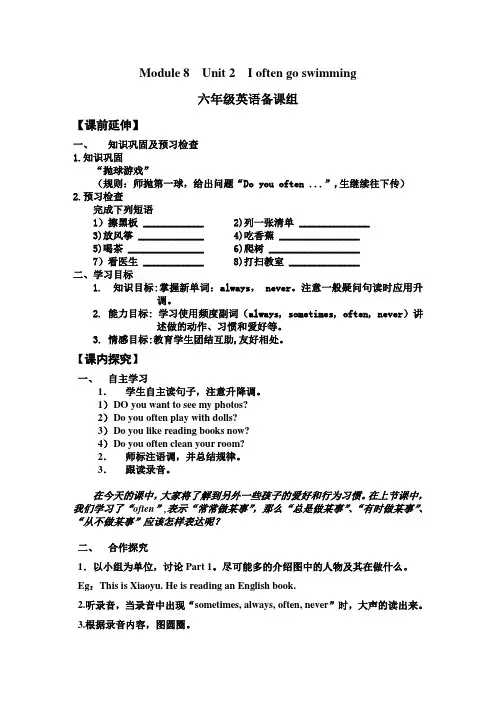
Module 8 Unit 2 I often go swimming六年级英语备课组【课前延伸】一、知识巩固及预习检查1.知识巩固“抛球游戏”(规则:师抛第一球,给出问题“Do you often ...”,生继续往下传)2.预习检查完成下列短语1)擦黑板 ____________ 2)列一张清单 ______________3)放风筝 _____________ 4)吃香蕉 ________________5)喝茶 _______________ 6)爬树 __________________7)看医生 ____________ 8)打扫教室 ______________二、学习目标1. 知识目标:掌握新单词:always, never。
注意一般疑问句读时应用升调。
2. 能力目标: 学习使用频度副词(always, sometimes, often, never)讲述做的动作、习惯和爱好等。
3. 情感目标:教育学生团结互助,友好相处。
【课内探究】一、自主学习1.学生自主读句子,注意升降调。
1)D O you want to see my photos?2)D o you often play with dolls?3)D o you like reading books now?4)D o you often clean your room?2.师标注语调,并总结规律。
3.跟读录音。
在今天的课中,大家将了解到另外一些孩子的爱好和行为习惯。
在上节课中,我们学习了“often”,表示“常常做某事”,那么“总是做某事”、“有时做某事”、“从不做某事”应该怎样表达呢?二、合作探究1.以小组为单位,讨论Part 1。
尽可能多的介绍图中的人物及其在做什么。
Eg:This is Xiaoyu. He is reading an English book.2.听录音,当录音中出现“sometimes, always, often, never”时,大声的读出来。
外研版小学英语六年级下册课文翻译

part1
你在做什么,西蒙?
我正在打扫我的房间。
噢,你的猫正在帮助你!
part2
在这张照片了,我们在山里。阳光明媚,微风习习。奶牛在喝水。小鸟在唱歌。鸭
子在游泳。兔子正在跳。我和西蒙正在玩捉迷藏。
我们正度过一段美好的时光!
爱你的
大明
Module4 unit1
part1
我喜欢你。
你喜欢我。
我们喜欢苹果。
你想喝什么?
牛奶。
那么我们要一个汉堡包、面条、牛奶和一杯可乐。
好的。
Module2 unit1
part1
我要起床吃早餐。get up起床have breakfast吃早餐
早餐?11点半了。你要吃午餐了!
part2
我们今天在公园里野餐吧!
好哇!
···后来···
我很饿。我们什么时候吃饭,妈妈?When既可以对事情发生的具体时间提问,也可对大体时间提问。
好主意。你正在信里些什么?
嗯,首选我写一个朋友的名字。看!这一封是埃米的。
然后我在每封信里写了“祝你每天开心”。
哇!这里大约有四十封信。好多美好的祝愿啊!
Module10 unit1
part1
我将要去湖泊中学。
我将去公园中学。
你将去狗狗中学吗?哈哈···
part2
玲玲的告别演讲。
亲爱的同学们,我们很快就要离开我们的小学,今年九月份就要开始上中学了。我很兴奋,也很伤心。primary school小学
我来拿它们吧。
当心!
噢不!对不起!
噢不!我的新短裤和新鞋!
unit2
part1
你想要吃什么?
我想吃些肉。some意为“一些”,用来表示不确切的数量,既可以修饰可数名词复数,也可以修饰不可数名词。
Module8 Unit 2一般现在时课件2022-2023学年外研版一起六年级上册
5. should, every, your, day, tidy, you, room, (.)
You should tidy your room every day.
6. you, often, do, library, to, go, the, (?)
Do you often go to the library?
I often go.
Do you often play with your dog?
Yes,I often play with my dog .
Do you like playing football?
No,I never play football.
What do you do after school?
Talk about yourself.
I always/usually/often/sometimes/never …on Sundays.
do housework clean the room do some washing
Talk about your friend.
He/She always/usually/often/sometimes/never …on Sundays.
A 4.I will tidy your desk.
D. Yes,every day.
C 5. Do you eat bananas?
E. Let's read.
Amy: What are you doing, Lingling? Lingling: I'm tidying my room. Amy: Let me help you. Do you often tidy your room? Lingling: Yes. I tidy my room every day.
外研版六年级英语下册Unit 2 It will snow in Harbin

It will be sunny after the rain. 阳光总在风雨后。
Exercise
一、rain C. sunny D. snow E. warm F. windy G. hot
That’s right. You’re in ________.
Listen and say. Then chant.
What are you going to do today? I’m going to the park to play.
And what are you going to do after dinner? I’m going to play chess and I’ll be the winner!
1. B
2. D
3. F
4. A
A. cold B. rain C. sunny D. snow E. warm F. windy G. hot
5. C
6. G
7. E
二、选择题。
1. It will ______ tomorrow.
A. rain
B. rains
C. rainy
2. It will ______ cold in Harbin.
►为你理想的人,否则,爱的只是你在他身上找到的你的影子。 ►有时候,我们愿意原谅一个人,并不是我们真的愿意原谅他,而是我们 不愿意失去他。不想失去他,惟有假装原谅他。不管你爱过多少人,不管 你爱得多么痛苦或快乐。最后,你不是学会了怎样恋爱,而是学会了,怎 样去爱自己。
A. do
B. be
C. is
3. We ______ watch TV ______ home.
六年级下册英语课件M5U2 _外研版(三起) (共24张PPT)
3.吃晚饭 ____e_a_t_d_i_n_ner
12.门铃__d_o_o_r_b_e_ll
4.开始下雨___s_t_a_r_t _to__r_a_in
5.在空中_____in__th__e_sky
13.loudly(形容词)_lo_u_d__
ห้องสมุดไป่ตู้
6.做操______d_o__e_x_e_rcises
7.放风筝____f_ly__a_k_ite
eg: I have a book and you have a book, too.
Test She is flying s kite but Daming is riding a bike. 一、判断下列句子是(Y)否(N)并列句,并说明原因。
I’m reading a book. N In this photo,the sun is shining. N The birds are singing and the ducks are eating. Y He’s riding his bike, but it’s starting to rain. Y
3.You are___w_a_v_i_ng(wave)to say
goodbye.
4.It’s_s_t_a_rt_in_g_ (start) to rain.
5.I _a_m__g__o_in_g__to__g_o (go) to the park
tomorrow.
(will go)
看图完成句子:
_a_n__d_w__e_a_r_e_f_ly_i_n_g_k_i_t_e_s_, _to_o_.____
• She is writing her homework ,but the phone is ringing .
外研版六年级英语下册课件Module 8
三、选词填空。
习题源于《典中点》
1. —Where’s my book?
—I put it ________(at/on) the chair. on into 2. The teacher came ________(into/inside) the classroom and saw some pupils there. on 3. Put ________(in/on) the cap. It’s very hot.
讲解来自《点拨》
知识点 1 Why do you have cups on your heads? 你们为什么把杯子戴在头上? 用法:这是用于询问对方做某事的原因的句型。句中的 Why是特殊疑问词,意为“为什么”,用来询问原 因、理由。Have...on 意为“戴着……”。
句型结构:Why do/does + 主语+ 动词原形+ 其他?
本节课我们学习了以下知识,请同学们一定加 强巩固,以便能和同学们进行灵活交流哦! 重点词汇:cup, planned, more, baseball, smile
重点短语:make mistakes, plan to do sth.
重点句式:Why do you have cups on your heads? They planned to play a baseball game. It’s easy to make mistakes with English words...
例句:Why does he sing this song?他为什么唱这首歌 ?
外研版英语六年级下册第八册全册教案
Step 4 Practice课件呈现Listen and say部分的对话,
学生看图跟读。小组内练习,分组表演。A: Wha dog,please. A: How much is it? B: It’s thirteen dollars and twenty-five cents. Step Ⅳ Development Make a fast food restaurant把讲台布置成快餐店的柜台,并请程度较好的学生来扮演顾客,教师扮演服务员,进行一个简单的表演。最后鼓励学生进行以小组为单位的情景短剧的表演。(设计意图:通过Make a fast food restaurant情景练习活动促使学生在实践中运用所学英语,增强对所学英语的体验,培养学生的合作精神。)
Step 2: Leading in
T: Now I feel hungry and thirsty. I want something to eat and drink. Can you give me some suggestions? (出示许多事物的图片,让学生说出他们知道的食物和饮料,并板书在黑板上)
How much is it?
It’s thirteen dollars and twenty –five cents。
教学准备:CO-ROM,点读笔,图片
课时安排:2课时
教学过程设计
二次备课或
即时反馈
Step1.Warming up
(1)课前播放学生以前学过的英文儿歌渲染课堂学习的活跃气氛。
(2)Say “Hello” to the children and talk about some interesting experience during the winter vacation.
外研版小学英语六年级下册M8U1课件
Love the world, Love our life
Complete the sentence.
eat a hamburger listen to music read a book
speak English write letters watch TV
play the trumpet clean the classroom
She was ______ born in Hubei in 1976.As a small child, she ___________ became deaf. She _________ hear or talk. When She was couldn’t 5 years old, she ________ learned to dance. She likes dancing very much. In 2005, she danced Qian Shou Guan Yin. model for us. She is a _________
lived to be 87
Let’s check!
Helen Keller was born in
.As asmall child,
she became
.She couldn’t see and she
.The teacher
couldn’t ter, Helen had a drew letters in Helen’s and .She could also
. Helen learned to . She wrote a .She lived to
book about herself. She went be 87.Helen Keller is a for us.
外研版小学英语六年级下册教学设计Module 8(教案)
外研版小学英语教学设计Module 8Unit 1 Helen Kellerlearning aims:1、能听懂、会说、会认、会读:born ,child , as, later ,drew, letter, herself ,all over , world , model. 等单词。
2、能听懂并熟练运用Could 和Could’t谈论过去的能力。
.3、能口头运用What was his name ?When was he born? Where was he born?等问句。
4.能根据所给的资料来描述人及其过去所发生的事情。
教学步骤:Step 1:Warm-up and show the learning aims1、Introduce Helen Keller:T: My kids, We can see, we can hear and write now .we could see, we could hear, we could speak when we were a small child, but there is a girl, as a small child, she became blind and deaf, she couldn’t see and she couldn’t hear, when she grown up, she learned to speak、read、and write , she wrote a book, and went all over the world, do you know who she is?S: She is …Now let’s learn Module 8 Unit 1 Helen Keller,OK?(板书课题并齐读) First ,please look at our learning aims.(出示本课学习目标,教师慢慢读,学生仔细看、认真听。
外研版(三起)-英语-六年级下册--外研版三起Module 8 Unit 1教材同步讲解
例句:I like to play baseball.我喜欢玩棒球。
④smile/smal/v.(动词)微笑;挖.(名词)微笑
短语:wear a smile面带笑容big smile热情的微笑
例句:They all smiled at the good news.听到这个好消息,他们都喜笑颜开。
是连词,作“因为”讲,其后要接一个句子来陈述原因、理由。例如:
-Why do they want to go to China?他们为什么想去中国?
-Because they want to learn Chinese.因为他们想学习汉语。
【即学即用】
do you like eating fish? -Because it's delicious.
He smiled at her.他对她微笑。
⑤mistakes /mɪ'stek/n.(名词)错误
同义词:error错误,过失
短语:bad mistake严重的错误(过失)sad mistake惨痛的错误(过失)
例句:We all make mistakes,我们都会犯错误。
I made a mistake about the time.我把时间搞错了。
they put the cups on their heads and laughed more.
大明告诉了他这个故事。他们打算玩一个棒球游戏。埃米让玲玲为这个游戏拿来一些帽
子。但是玲玲拿来了一些杯子。他们都笑了。然后他们把这些杯子放在他们的头上并
大笑。
Sam smiled.④ "It's easy to make mistakes⑤with⑥ English words," he said. "I make lots of mistakes with Chinese words too. Now look what's in my bag! "Sam opened his bag.There were baseball caps " Hooray!"everyone shouted. They put the caps on Then they went to the playground and played baseball together.