
【人教版】七年级英语上册正式篇:Unit5Doyouhaveasoccerball教案
Unit 5 Do you have a soccer ball?一、单元教材分析本单元主要学习动词have的一般现在时的用法;使用do和does引导的一般疑问句的构成以及简单回答。
本单元围绕“和朋友一起欢度时光”这一话题安排了三个任务:一是列举所学的运动项目,从中挑选出各自喜欢的体育项目,并说明原因,目的是巩固并新学一些体育项目的名词;二是让学生互相询问所爱好的运动,并根据情况发出邀请,学会用have对物品的所属进行提问与回答,掌握用do和does引导的一般疑问句的构成及使用,了解用Let’s提建议的句型;三是写作,把任务一、二的完成情况写成日记,进一步复习、巩固所学的语言目标。
通过本单元的学习,学会用have对物品的所属进行提问与回答;学会用let’s…句型提建议;能够谈论自己喜欢哪些球类运动,不喜欢哪些球类运动及原因;能够谈论怎样和自己的朋友度过一段愉快的时光。
二、单元学情分析本单元的主题是使用have对物品的所属进行提问及回答,以掌握行为动词在一般现在时中的构成和使用;同时引导学生使用所学的句型谈论自己在球类运动中的喜好。
行为动词在一般现在时的肯定句、否定句和一般疑问句中的构成和使用是初中英语教学中非常重要的内容,本单元知识的掌握程度将直接影响今后的英语学习。
学生在以前的学习中已经掌握了be动词在一般现在时中的构成和使用,在学生的头脑中也已经形成了一个模式,这种模式将直接影响学生对本单元知识内容的接受,所以教师在教学中一定要善于引导,以免学生养成不良习惯。
该部分学习内容贴近学生的生活,谈论的主题是符合学生喜爱运动的心理,极易于激发学生学习英语的欲望和兴趣,使他们乐于参与各种英语实践活动。
三、单元教学建议采用自主学习、小组合作学习、Discussion and guess和Classifying的学习策略,利用教学图片、幻灯片、画纸和蜡笔等来展开课堂Pair work问答式的口语交际活动和小组活动,使用have对物品的所属进行提问及回答。
本单元的教学法建议:语音教学——让学生进行模仿操练;词汇教学——采取演示讲解的方式进行教学,让学生进行情景操练、反复使用;口语教学——采取pair work问答式的口语交际活动互相操练练习;阅读教学——让学生学会抓住主要词汇和句型;听力教学——采取图文配对和对话选择的方式;写作教学——以填空、造词为主;语法教学——总结规律、模仿操练。
四、单元课时分配本单元可用4课时完成教学任务:Section A (1a-2d) 用1课时Section A (Grammar Focus-3c) 用1课时Section B (1a-2c) 用1课时Section B (3a-Self Check) 用1课时Section A1 (1a-2d)一、教学目标:1. 语言知识目标:1) 能掌握下列词汇:do (does), have, tennis, ball, ping-pong, bat, soccer, soccer ball, basketball, let, us, let'sgo, we, late, has, get2) 学会用have对物品的所属进行提问以及应答,学会使用do和does引导的一般疑问句:①—Do you have a baseball?—Yes, I do. /No, I don't.②—Does she/he have a tennis ball?—Yes, she/he does./ No, she/he doesn't.③—Do they have a soccer ball?—Yes, they do./ No, they don't.3) 学会用Let’s…提建议。
2. 情感态度价值观目标:利用学生喜爱运动的心理,激发学生学习英语的欲望和兴趣,使他们乐于参与各种英语实践活动。
在小组活动中,培养学生团结协作精神。
二、教学重难点1. 教学重点:1) 通过运用have对物品的所属进行提问以及应答,来掌握一些运动项目的词汇。
2) 在询问对方是否有某物的对话中学会使用do和does引导的一般疑问句。
3)学会用祈使句来向对方提出建议。
2. 教学难点:学会使用第三人称单数的一般疑问句Does …?及回答做对话。
三、教学过程Ⅰ. Presentation1. Present the key vocabulary.(Show a basketball to the class.)T: What’s this in English?S1: It’s a basketball.T: Yes, you are right. Read after me. B-A-S-K-E-T-A-B-L-L, basketball.Ss: B-A-S-K-E-T-A-B-L-L, basketball.(Show the students other objects. Teach the new words “soccer ball, ping-pong ball, volleyball, tennis bat, ping-pong bat” in the same way.)T: Read the words together twice.Ss: …2. Look at the words in 1a and match the words with the things in the picture.T: Number 1 is (a), tennis ball. What’s Number 2 Match them.Ask one student to show the answers and check them.3. Present the key structure.Present these questions and answers.(Point to a student who has a pencil box.)T: Do you have a pencil box?S1: Yes, I do. (Nod your head yes)T: (Ask S2) Does she have a pencil box?S2: (Help S2 answer) Yes, she does.T: Do you have a basketball?S1: No, I don’t. (Shake your head no)T: (Ask S2) Does she have a basketball?S2: (Help S2 answer) No, she doesn't.Practice the drill “Do you have a …?”, "Does he/she have a…? " in pairs. You can useyour school things and these balls. Look at the model, then practice like this.Model:S1: Do you have a basketball?S2: Yes, I do.S3: Dose she have a basketball?S4: Yes, she does.S1: Do you have a soccer ball?S1: No, I don’t.S3: Dose she have a soccer ball?S4: No, she doesn't.(Students work in pairs.)II. ListeningT: Look at the four items of 1b in the pictures. Listen to the conversation.(Play the recording of 1b the first time. Students only listen.)T: Listen to the conversation and circle the words you hear.(Play the recording again.)T: Check their answers.S1: … S2…III. Pair work1. Read the conversations in 1c. (Ask students to repeat.)2. Look at the picture in 1a and practice the conversation with each other in pairs.S1: Do you have …?S2: Yes, I do.S1: Do you have a …?S2: No, I don’t.3. Work in groups of four and use the picture to practice the similar conversations with the new words.(basketball, baseball bat, soccer ball, volleyball, computer, ping-pong bat, baseball)T: Ask and answer the questions as many as you can.S1: Do you have a … ?S2: …S1: …S2: …IV. Listening1. T: Look at the pictures in 2b and name them. What are these?(Point at the baseball, basketball, soccer ball, volleyball.)Ss: They are…T: There are four children in the conversations. Who are they? Please listen and find the answer.(Play the recorder for the first time.)S: …T: I’ll play the recorder for the second time. Listen and number the pictures (1-4).(Students listen for the second time.)T: Listen to the conversation in 2b. Match the people with the balls.(Students listen and match. Teacher checks their answer.)V. Pair work1. T: Let’s look at the picture in 2a. Does Jane have a tennis ball?S1: No, she doesn't.T: Does Paul have a soccer ball?S2: No, he doesn't.T: Does his brother have a soccer ball?S2: Yes, he does.(Ask more students to make a conversation.)T: Make conversations with things in the picture.S: …2. Ask some pairs to act out their conversations.VI. Presentation(Show a soccer ball to class.)T: Let’s play soccer ball after class, OK?S1: OK.T: Let’s play ping-pong.S2: OK.T: We often use the drill “Let’s…” to make a suggestion. If you want to do it, you may say “OK. / That sounds good. / All right …” If you don’t want to do it, you may say “No, I don’t have a …”(The teacher writes the drill on the backboard.)A: Let’s play…B: No, I don’t have a …A: Well, let’s play baseball.B: OK. Let's go.Ss read the conversation and try to remember them.VII. Role-play1. Cindy and Helen want to play baseball. Now read the conversation and match the things with their rightplaces.baseball on the chairbaseball bat in Cindy's bagCindy's jacket Bill has it.2. Read the conversation after the teacher.3. Practice the conversation with your partner.4. Ask some pairs to act out the dialogue in front of the class.5. 评价:(让学生们对自己的表现及语言表达能力进行自我评价,在小组内评价,然后进行评出最优秀的小组。
人教版英语七年级上册Unit5DoyouhaveasoccerSectionB(2a2c)教学设计

五、作业布置
针对本节课的学习内容,结合学生的实际情况,特布置以下作业:
1.书面作业:
-完成课本Section B 2a-2c的相关练习题,巩固重点词汇和句型。
-根据课堂学习,编写一段对话,描述自己和同学所喜欢的运动项目以及拥有或没有的运动器材。
-用一般现在时,写一篇小短文,介绍自己的家庭成员及其喜欢的运动。
2.口语作业:
-家长协助学生录制一段视频,内容为学生用英语介绍自己的运动经历和喜好。
-与同学进行线上或线下交流,讨论彼此的运动经历,提高口语表达能力。
3.实践作业:
-做一次家庭小调查,了解家庭成员的运动喜好,完成一份调查报告。
-利用课余时间,参加一项体育运动,体验运动带来的乐趣,并与同学分享。
4.预习作业:
(1)形成性评价:通过课堂观察、小组活动、作业等途径,了解学生的学习过程和成果,及时给予反馈和指导。
(2)终结性评价:采用听力测试、口语表达等方式,全面评估学生对本节课知识点的掌握程度。
4.教学拓展:
(1)鼓励学生在课后收集有关运动的资料,用英语进行介绍,提高学生的自主学习能力。
(2)组织体育活动,让学生在真实语境中运用所学知识,提高他们的语言实践能力。
2.引导学生学会尊重他人,培养他们良好的团队协作精神。
3.通过本节课的学习,让学生了解各种运动项目,培养他们对体育运动的热爱,增强身体素质。
4.教育学生珍惜自己所拥有的,学会关爱他人,乐于助人。
在教学过程中,要注重学生的主体地位,关注个体差异,激发学生的学习兴趣,提高他们的英语素养。通过本节课的学习,使学生能够在实际生活中运用所学知识,达到学以致用的目的。同时,注重培养学生的情感态度和价值观,使他们成为具有良好品质的社会主义接班人。
人教版七年级上Unit5 Do you have a soccer ball知识点归纳

Unit5 Do you have a soccer ball?知识点归纳一、重点短语句型1.- Do you have a soccer ball? 你有一个足球吗?-Yes, I do./ No, I don't. 有,我有。
/不,我没有。
2.- Does she have a tennis ball? 她有一个网球吗?-Yes,she does./ No, she doesn't有,她有。
/不,她没有。
3.I have a volleyball./ I don ’t have a volleyball.我有 /没有一个排球。
4. He has two ping-pong bats. 他有两个乒乓球拍。
He doesn’t have two ping-pong bats. 他没有两个乒乓球拍。
5.let’s = let us + do sth 让我们做某事Let’s go. 让我们走。
Let me get it. 我去拿它。
6.play basketball 打篮球/ play volleyball 打排球 /play soccer 踢足球 /play ping-pong 打乒乓球 /play baseball 打棒球 /play tennis 打网球 /play computer games 打电子游戏7.We’re late. 我们要迟到了。
be late 迟到8.That sounds good. 那听起来很不错。
That sounds interesting/fun/relaxing/boring/difficult. 那听起来很有趣 /放松 /无聊 /困难。
9.watch TV 看电视10.play sports with our classmates 和我的同学做运动11.go to the same school 去同一间学校上学。
12.at school 在学校13.only watch them on TV 只在电视上看它们14.It ’s adj(形容词) for sb.对某人来时怎么样。
人教版(PEP义务教育版)初一英语七年级上册人教版 unit5 Do you have a soc
Who has soccer balls?
Frank Brown
Gina Smith
Wang Wei
who says these sentences?
1.I play ping-pong with my classmates after
class. W
3. It’s not relaxing for Alan to play soccer.
F
F
Detailed reading
2. Read the passage about Frank Brown.
Fill in the chart.
When or
Names Has
Likes where to
________________
___________
_________________
Report like this:
I have ...... , but I don't have ........
Make new conversation
A: Do you have a ...? B: No, I don’t. Do you have …? A: Yes, I do. B: Well, let’s play … ! A: That sounds …. great/boring/relaxing/
Likes
When or where to play
ping-pong
plays ping-pong with his classmates after class
Retelling(复述)
Frank Brown doesn’t _h_a_v_e_ a soccer ball, but Alan does. They _l_o_v_e_ soccer. They play it _a_t_s_c_h_o_o_l_ with their friends. It’s r_e_l_a_x_in_g_.
人教版七年级上Unit 5 Do you have a soccer ball?说课稿
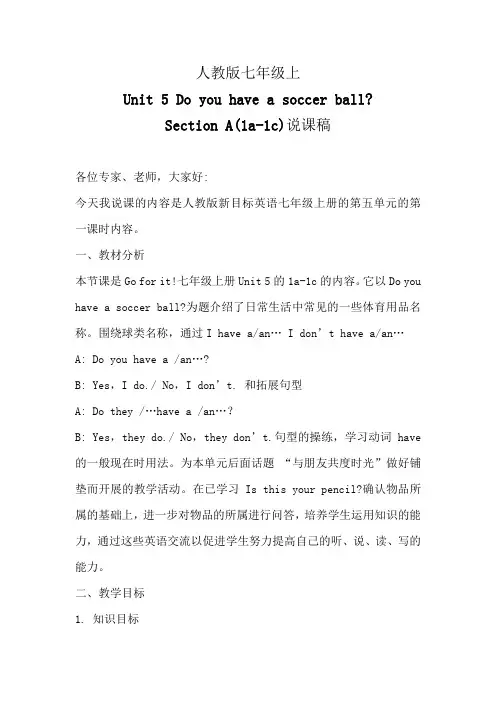
人教版七年级上Unit 5 Do you have a soccer ball?Section A(1a-1c)说课稿各位专家、老师,大家好:今天我说课的内容是人教版新目标英语七年级上册的第五单元的第一课时内容。
一、教材分析本节课是Go for it!七年级上册Unit 5的1a-1c的内容。
它以Do you have a soccer ball?为题介绍了日常生活中常见的一些体育用品名称。
围绕球类名称,通过I have a/an… I don’t have a/an…A: Do you have a /an…?B: Yes,I do./ No,I don’t. 和拓展句型A: Do they /…have a /an…?B: Yes,they do./ No,they don’t.句型的操练,学习动词have 的一般现在时用法。
为本单元后面话题“与朋友共度时光”做好铺垫而开展的教学活动。
在已学习Is this your pencil?确认物品所属的基础上,进一步对物品的所属进行问答,培养学生运用知识的能力,通过这些英语交流以促进学生努力提高自己的听、说、读、写的能力。
二、教学目标1. 知识目标(1)词汇:have, soccer ball ,ping-pong ball ,basketball baseball ,tennis ,ping-pong bat ,tennis racket.(2)句型:I have a/an… I don’t have a/an…A: Do you have a /an…?B: Yes,I do./ No,I don’t.A: Do they/… have a /an…?B: Yes,they do./ No,they don’t.2. 能力目标:(1)掌握所给的有关体育词汇,运用所属关系句型:Do you have a soccer ball?进行问答,并能把它们运用到生活中去。
人教版英语七年级上册Unit5Doyouhaveasoccerball?(第一课时)教学设计

3.观看体育赛事:鼓励学生观看一场球类运动比赛,如足球、篮球等,了解比赛规则和赛事背景,下节课与同学分享观赛感受。
4.制作单词卡片:学生制作本节课所学词汇的单词卡片,包括单词、音标、词性和例句,以便于课余时间复习。
5.培养学生的团队精神,使学生懂得在集体中协作、共同完成任务的重要性。
二、学情分析
针对人教版英语七年级上册Unit5 “Do you have a soccer ball?”的教学内容,我们对学生的学情进行分析。七年级的学生正处于青春期,他们好奇心强,求知欲旺盛,对新鲜事物充满兴趣。在英语学习方面,他们已经具备了一定的词汇量和基本的语法知识,但口语表达能力尚需提高,尤其在实际场景中运用英语进行交流的能力。
8.教学资源利用:充分利用教材、网络资源、实物等教学工具,丰富教学内容,提高教学效果。
四、教学内容与过程
(一)导入新课
1.热身活动:教师播放一段关于不同球类运动的视频,引导学生关注各种运动项目,激发学生对本节课主题的兴趣。
2.老师提问:在观看视频后,教师提出以下问题:“Do you like sports? What sports do you like?”,让学生进行简单的口语练习,引入本节课的核心词汇和句型。
作业布置要求:
1.作业内容要与课堂教学紧密结合,注重培养学生的实际运用能力。
2.作业量适中,避免过多增加学生负担,确保学生有足够的时间进行复习和拓展。
3.鼓励学生主动完成作业,养成良好的学习习惯。
4.教师应认真批改作业,及时给予反馈,关注学生的个体差异,提高教学效果。
3.图片展示:教师展示与球类运动相关的图片,如“soccer”, “ping-pong”, “basketball”, “baseball”, “volleyball”等,让学生识别并说出相应的英文单词,为新课的学习做好铺垫。
人教版七年级上册英语Unit 5 Do you have a soccer ball
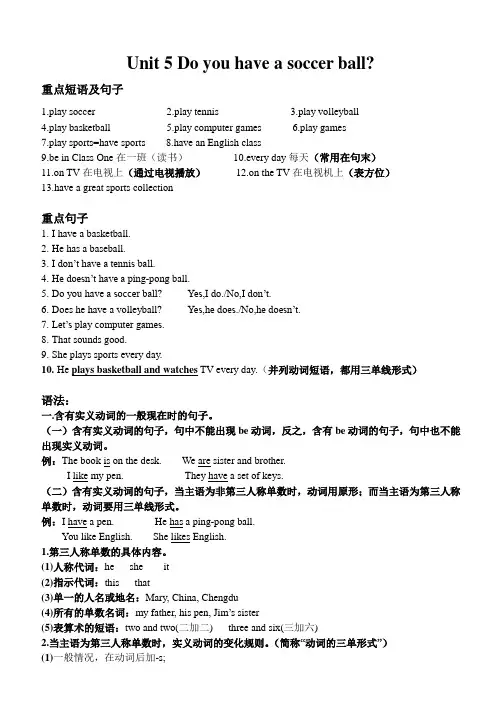
Unit 5 Do you have a soccer ball?重点短语及句子1.play soccer2.play tennis3.play volleyball4.play basketball5.play computer games6.play games7.play sports=have sports 8.have an English class9.be in Class One在一班(读书)10.every day每天(常用在句末)11.on TV在电视上(通过电视播放)12.on the TV在电视机上(表方位)13.have a great sports collection重点句子1.I have a basketball.2.He has a baseball.3.I don’t have a tennis ball.4.He doesn’t have a ping-pong ball.5.Do you have a soccer ball? Yes,I do./No,I don’t.6.Does he have a volleyball? Yes,he does./No,he doesn’t.7.Let’s play computer games.8.That sounds good.9.She plays sports every day.10.He plays basketball and watches TV every day.(并列动词短语,都用三单线形式)语法:一.含有实义动词的一般现在时的句子。
(一)含有实义动词的句子,句中不能出现be动词,反之,含有be动词的句子,句中也不能出现实义动词。
例:The book is on the desk. We are sister and brother.I like my pen. They have a set of keys.(二)含有实义动词的句子,当主语为非第三人称单数时,动词用原形;而当主语为第三人称单数时,动词要用三单线形式。
人教版新目标版七年级英语上册Unit5Doyouhaveasoccerball教案
人教版新目标版七年级英语上册Unit5Doyouhaveasoccerball教案Unit 5 Do you have a soccer ball1.知识与能力目标:1).能预习并说出这单元的主要内容。
2).能运用目标语言询问并描述物品所属关系。
.2.过程与方法目标:通过运用本单元的目标语言,反复练习句型“Do you have a soccer ball? ”“Yes,I do.”“No,I don’t.”从而掌握本单元的重点句型和词组。
3.情感态度与价值观:本单元通过运用过去完成时态,让同学们学会与朋友共度快乐的时光。
Section A第一课时一、课型:新课二、教学重难点:1).Do引导的一般疑问句及其回答。
2)do 和have的意义及用法3)学习有关物品的新单词:tennis、ping-p ong、soccer ball 、volley ball、basketball、baseball、bat。
三、教学准备:多媒体,录音机四.教学过程:1.课前预习回顾上单元所学内容,引出本单元新句型:T:Where’s my book?S: It’s on your desk.T: Where are my pens?S:They’re in your box.T: Yes,thank you! I have a pen,do yo u have a pen?S:Yes,I do./No,I don’t.2.正课教授(1)引入①观察25页图片,引入新单词的学习。
②学习do引导的一般疑问句及其肯定回答和否定回答。
have的用法:①have为实义动词,意为“有”,常用句型sb.have/has+sth.表示某人有某物。
当主语为第三人称单数时,have用其第三人称单数形式。
②have还有“吃、喝”的意思,如:have breakfast。
③含有have的句子变否定句要在have前加don’t;含有has的句子变否定句要在h as前加doesn’t,has变为have。
人教版英语七年级上册Unit5《Do you have a soccer ball_》知识点
Unit 5 Do you have a soccer ball?【重点短语】1.have a volleyball 有一个排球2.play volleyball/tennis 打排球/网球3.have a ping-pong/table tennis 有一个乒乓球4.play ping-pong/table tennis 打乒乓球5.with our friends 和我们的朋友一起6.have a football/soccer ball 有一个足球7.play football/soccer 踢足球8.at school 在校,在上学9.play sports 做运动10.play computer games 玩电脑游戏11.watch TV 看电视12.in the same school 在同一所学校13.after class 下课后14.go to school 去上学【重点句型】1.—Do you have a ping-pong bat? 你有一个乒乓球拍吗?—No, I don’t. 不,我没有。
2.—Do they have a computer? 他们有一台电脑吗?—Yes, they do. /No, they don't. 是的,他们有。
/不,他们没有。
3 .—Does he have a tennis ball?他有一个网球吗?—Yes,he does. /No, he doesn’t.是的,他有。
/不,他没有。
4.He has two ping-pong bats.他有两个乒乓球拍。
5.They have a computer.他们有一台电脑。
6.I don't have a soccer ball, but my brother does.我没有足球,但是我兄弟有。
7.She doesn’t have a volleyball.她没有排球。
8.Let’s play basketball!让我们(一起)去打篮球吧!9.That sounds good.那听起来不错哦。
七年级英语上册《Unit 5 Do you have a soccer ball》知识点 (新版)人教版
Unit 5 Do you have a soccer ball?1. Do you have......? Yes, I do. No, I don’t..你有……吗?是的,我有。
不,我没有。
Do they have......? Yes, they do. No, they don’t..Does he have......? Yes, he does. No, he doesn’t.Does she have......? Yes, she does. No, she doesn’t.在一般现在时中,句子的谓语动词若是实义动词,常借助助动词do或does来构成否定句或疑问句。
Does用于主语是第三人称单数的句子中,其他情况用do。
2. do/does1)作助动词,帮助构成一般现在时的否定句或疑问句,无意义。
Do you have a soccer ball? 你有足球吗?I don’t know. 我不知道。
Does Jim have a sister? 吉姆有妹妹吗?What does he like? 他喜欢什么?He doesn’t like English. 他不喜欢英语。
2) 作实义动词,“做,干”。
I do my homework every day. 我每天都做家庭作业。
Bob does his homework every day. 鲍勃每天都做家庭作业。
3) 在一般现在时中,do/does 可用来替代上文出现过的动词,以避免重复。
Do you have a soccer ball? 你有足球吗?Yes, I do. 是的,我有。
(do 代have)Does she have an eraser? Yes, she does.I don’t have a soccer ball, but my brother Alan d oes.我没有足球,但我的哥哥艾伦有。
3.Let’s do sth. “(让)我们做某事吧。
人教版英语七年级上册Unit-5--do-you-have-a-soccer-ball
人教版英语七年级上册Unit 5 Do you have a soccer ball?单元教材分析本单元主要学习动词have的一般现在时的用法;使用do和does引导的一般疑问句的构成以及简单回答。
本单元围绕“和朋友一起欢度时光”这一话题安排了三个任务:一是列举所学的运动项目,从中挑选出各自喜欢的体育项目,并说明原因,目的是巩固并新学一些体育项目的名词;二是让学生互相询问所爱好的运动,并根据情况发出邀请,学会用have对物品的所属进行提问与回答,掌握用do和does引导的一般疑问句的构成及使用,了解用Let’s提建议的句型;三是写作,把任务一、二的完成情况写成日记,进一步复习、巩固所学的语言目标。
通过本单元的学习,学会用have对物品的所属进行提问与回答;学会用let’s…句型提建议;能够谈论自己喜欢哪些球类运动,不喜欢哪些球类运动及原因;能够谈论怎样和自己的朋友度过一段愉快的时光。
单元总体目标.1. 在询问对方是否有某物的对话中学会使用do和does引导的一般疑问句。
2. 学会使用描述性的形容词来评价事物。
3. 学会在对话中使用名词复数。
4. 学会用祈使句来向对方提出建议。
5. 学会用祈使句询问某人是否有某物。
6. 学会向他人提出建议的句子。
7. 学习了解一般现在时。
8. 在本单元中,通过阅读有关运动的文章和对话,使学生更加热爱体育活动并培养一种适合自己的体育爱好。
9.在小组活动中,培养学生团结协作精神。
本单元的主题是使用have对物品的所属进行提问及回答,以掌握行为动词在一般现在时中的构成和使用;同时引导学生使用所学的句型谈论自己在球类运动中的喜好。
行为动词在一般现在时的肯定句、否定句和一般疑问句中的构成和使用是初中英语教学中非常重要的内容,本单元知识的掌握程度将直接影响今后的英语学习。
学生在以前的学习中已经掌握了be动词在一般现在时中的构成和使用,在学生的头脑中也已经形成了一个模式,这种模式将直接影响学生对本单元知识内容的接受,所以教师在教学中一定要善于引导,以免学生养成不良习惯。