
新教材英语必修一Unit3 Learning about language
另外, 表示将来的动作或 状态还可用以下几种形式:
(1) will / shall+动词原形 I shall be seventeen years old next month.
(2) be going to+动词原形: 表示即将发生的 或最近打算进行的事。 We are going to have a meeting today.
5. 现在进行时表将来与一般现在时 表将来的区别在于: 用现在进行时表 示将来, 其计划性较强, 并往往暗示 一种意图; 而一般现在时表示将来, 则其客观性 较强, 即通常被视为客观事实, 多指 按时刻表或规定要发生的情况。
如果主语是train, concert, programme 等表示事物的名词, 动词通常用一般 现在时表将来而不用进行时。如: What time does the train to Shanghai leave?
2.I _l_ik_e_d_ the first flat we saw _b_e_tt_e_r_ because it was larger. (like…better/prefer…to)
3.The task was difficult, but Helen’s _d_e_te_r_m__in_e_d_ expression let me know that she would not give up. (stubborn/determined)
(3)be to+动词原形: 表示按计划要发生 的事或征求对方的意见。如: Are we to go on with this work? (4)be about to+动词原形, 表示即将发生 的动作, 不与表示将来的时间状语连用。 I was about to go swimming when my guide shouted at me and told me not to do so. 我正要去游泳, 这时向导大声叫我不要去
② 在状语从句中用一般现在时代替 将来时。
If you do that again, I’ll hit you. ③ 用在I bet 和I hope后面, 常用一般
现在时表将来。
7. I wanted to pay the train _fa_r_e_, but my friendi_n__.
8. She persuaded all of us to _c_y_c_l_e_ to work instead of taking the bus.
4.The list of gifts was very long, and we don’t know why, but the most important _i_te_m__ , the golden cup, was forgotten. (detail/item)
5.“How I wish I could make a __jo_u_r_n_e_y__ ”into space and see the stars up close!” cried Sarah. (journey/voyage)
We also discovered a river that was falling off the mountain and became a wonderful _w_a_t_e_r_f_a_ll_. This was even more exciting to see than the _r_a_p_i_d_s_ where the water seemed to boil. Later we followed the river to a quieter _d_e_l_t_a_and finally into a _p_la_i_n_ and the sea.
(5) be +V-ing形式: 表示按计划或 安排要发生的事, 含义是 “预定要……” 这一结构常用趋向动词 go, arrive, come, leave, start, stay, return和play, do, have, work, wear, spend, see, meet等。
--- When are you going off for your holiday? 你什么时候动身去度假?
Unit 3
Travel journal
Learning about language 必修一
Discovering useful words and expressions
1 Find the correct words or expressions from the text for each sentence.
3. 表将来的现在进行时有时含有“决心” 的意思, 多用在否定结构中。 如:I’m not waiting any longer.
4. 现在进行时也可在时间、条件或原 因 状语从句中表示将来。如: When you are passing my house, please drop in. If they are not doing it, what should I do? Because the bride is coming, all the people are pleased.
6.When he returned from his successful climb of Mount Qomolongma, Andrew finished his travel _j_o_u_r_n_a_l_ (journal/diary) and gave it to the newspaper.
用现在进行时表示将来
当句子涉及确切的计划、明确的意图 和为将来安排好的活动时, 现在进行 时可用于表示将来。
1. 现在进行时表将来使用的动词常为 趋向性动词和表示位置转移的动词, 常用的有: arrive, come, do, get, go, have, leave, meet, play, return, see, spend, start, stay, wear, work 等。如: How are you going, by boat or by train? I’m meeting you after class.
3. Some friends _a_r_e_c_o_m_i_n_g_ (come) to Anne’s birthday party this evening. Anne’s mother _i_s (be) busy _g_et_t_in_g_ (get) ready for the birthday dinner. Anne _is__h_e_lp_i_n_g_ (help) her mother now.
2. 现在进行时常表最近或较近的将来, 句子里常有一个表示未来的时间状语。 如: They’re leaving for Hong Kong this afternoon. What are you doing next Sunday? I’m not going out for dinner this evening.
Practice
1. Betty _is_l_e_a_v_in_g_ (leave) for Guangzhou by plane at 3:00 this afternoon. Her brother Bob _i_s_s_e_ei_n_g_ (see) her off. It’s half past one now. They _a_r_e_w_a_i_t_in_g_ (wait) for a taxi outside the school gate.
3. My grandpa _is__fo_n_d__o_f_ fishing and sometimes he fishes all day in the river.
4. Liu Xiaoding is a good teacher and _ca_r_e_s_a_b__o_u_t his students very much.
3 Complete this passage with some of the following words.
rapids glacier mountain delta plain valley waterfall bank
I really enjoyed my school field trip in geography two months ago. We saw so many beautiful things: a _g_l_a_c_ie_r__ that flowed like a river of ice through a _v_a_l_l_ey__ that cut the mountains into two parts.
7.She had only one _sh_o_r_t_c_o_m__in_g_ : she was very stubborn. (disadvantage/shortcoming)
8.The very first time that Joe saw the film “ET” directed by Steven Spielberg, he _m__a_d_e_u__p_h_i_s_m__in_d__ to become a director too. (make up one’s mind/change one’s mind)
2. The Browns _a_re__g_o_in__g (go) to the North China by train next week. They _a_re__s_ta_y_i_n_g_ (stay) in Beijing for a week. They _a_re__g_o_in_g_ (go) to Xi’an. They _a_re__g_e_tt_i_n_g_ (get) there by air.
1. He is so stubborn that no one can _p_e_rs_u_a_d_e_ him to do anything.
新人教高中英语选择性必修一Unit3Fascinating Parks单元分析
Unit 3 Fascinating parks单元分析单元主题:人与自然和人与社会单元内容分析本单元主题是“人与自然和人与社会”,围绕“引人入胜的公园(Fascinating Parks)”这一话题展开。
内容涵盖国家公园、主题公园和城市公园,例如:萨勒克国家公园、北京奥林匹克森林公园、迪士尼乐园等。
本单元鼓励学生多角度认识、思考、探索这些公园的独特之处,在拓展学生视野、让学生领略和感悟美的同时,思考这些公园存在的价值与意义,思考人与自然和谐共处的理念,体会公园这一主题所蕴含的人文内涵和意义。
以下为教材各部分教学内容的简要分析及教学活动实施建议:1.Opening Page主题图是美国黄石国家公园的一处风景名胜-大棱镜温泉,照片内容与主题阅读和单元话题密切相关,使读者身临其境,从而被带入“国家公园”这个阅读主题。
开篇页的引言“A national park is not a playground. It's a sanctuary for nature and for humans who will accept nature on nature's own terms.”可译为:国家公园不是游乐场。
它是自然的庇护所,也为愿意接受自然本来面貌的人类提供庇护。
这句话揭示了国家公园的本质:接受自然的本来面貌,并最大限度地保护自然。
人类在地球上生存与发展,除了利用自然、享受自然的馈赠,更应该保护自然、实现人与自然的和谐相处,尊重自然,就是让自然以原本的面貌存在下去。
2.Reading and Thinking:Experience a national park 主课文是一篇游记,以第一人称的视角,介绍了位于欧洲的萨勒克国家公园,公园全境都是未经开发的原生态区,景色壮丽。
学生通过阅读语篇,了解萨勒克国家公园的自然环境、历史由来和人文生活方式,进一步了解国家公园的存在价值,在人与自然这个主题之下,探索国家公园对自然保护、人类生存发展和人与自然和谐共存的意义。
英语课标人教实验版高一Module 1 Unit 3 Learning about language
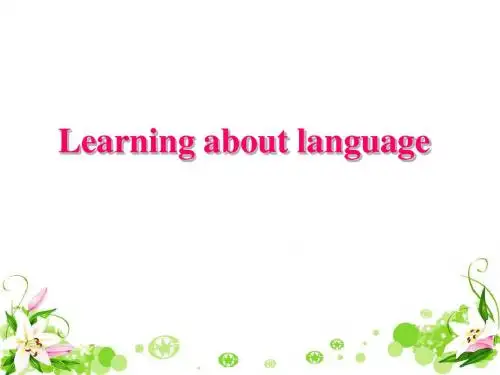
5. --- You’ve left the light on. ---Oh, I have. ___ and turn it off. A. I go B. I’ve gone C. I’ll go D. I’m going 6. --- Is this raincoat yours? ---No, mine____ there behind the door. A. is hanging B. has hung ----Have you moved into the new house? ----Not yet. The rooms___. A. are being painting B. are painting C. are painted D. are being painted
16. ---- do you like the material? ---- Yes, it ____ very soft. A. is feeling B. felt C. feels D. is felt
2. The Browns ________ are going (go) to the
North China by train next week.
They __________ are staying (stay) in Beijing
人教_高一英语必修三_Unit3_Learning_about_Language_重难点词汇详解

Unit3 Learning about Language 重难点词汇详解1.unbelievable adj.难以置信的教材原文His experience was unbelievable.他的经历令人难以置信。
经典例句①We had an unbelievable ( =very good) time in Paris.我们在巴黎的日子快活极了。
②The living conditions in the prison camp were unbelievable ( = very bad ). 集中营的生活条件糟糕透了。
③It is unbelievable that people can accept this sort of behavior.人们竟能接受这样的行为,我震惊不已。
④What you did was unbelievably stupid.你的所作所为真是愚蠢透顶。
(What you did是主语从句)。
2.disagree v.不赞成教材原文He was such a stubborn businessman that he didn’t permit anybody to disagree with him.他是一个如此倔强的商人,以至于他不允许任何人与他意见不一致。
经典例句①He disagreed with his parents on most things.他在大多数事情上都与他的父母意见不一致。
②Orange juice seems to disagree with some babies.橙汁似乎不适合一些婴儿(饮用)。
③There is considerable disagreement over the safety of the treatment.关于这种疗法的安全性争论很大。
3.make up组成;化妆;编造;和好教材原文Now make up your own story with new words and phrases from this unit. 现在用本单元的生词和新短语编你自己的故事。
人教版英语选择性必修一:3.3 Learning about language 练习(解析版)
人教版英语选择性必修一:3.3 Learning about language 练习(解析版)1、Unit3FascinatingParksPeriod3Learningaboutlanguage〔练习解析版〕I:单词拼写1.The governmenthasmadelaws to_________(禁止) tobacco advertisements onTV.【答案】prohibit2.Whenyou_________(打喷嚏), air andoften small drops of liquid suddenly comeoutof y our nose and mouth inawayyoucannot control.【答案】sneeze3.He seems tobe stuck withthe_________(标签)oft2、roublemaker.【答案】label4.Shedecidedto_________(伸出)outher hand and help theoldmanupfromhis chair.【答案】stretch5.Textbookwritingcanbeanintellectually_________(有益的) activity.【答案】rewarding6.The _________(茶壶) camewith a stand tocatch the dripsofwater.【答案】teapot7.He peeled the paper top off a little white tuband p oured the _________3、(奶油) into his coffee. 【答案】cream8.Werequiregrammarandspellingtobe_________(精确的).【答案】accurate9.It’sk nowntousthatsmokingdomuchdamagetothe_________(肺部).【答案】lung10.We saw amother_________(豹子)sleepingunderthe treeswithhercubs.【答案】leopardII:单句语法填空1.Thelocalgovernmenthas announced a_________(prohibit) on smokingon buses.【答案】prohibition4、2.Hissmallsizeprohibitshis_________(become)apoliceman.【答案】becomingn【解析】prohibitsb(sb’s)doingsth,故使用动名词作宾语。
人教版高中英语2019版新教材选择性必修第一册课时作业:Unit 3 Section B Learning about Language含答案
Section B Learning about Language课时作业强化训练Ⅰ.单词拼写.Plastic bags are(禁止) in some cities in California,including Los Angeles..Having no children of their own,they decided to a an orphan..He moved to England in 1980 where,among other things,he worked as a(记者).4.Omar soon picks up the(茶壶),offers me a second cup,and asks me his usual.All the products in this factory are(贴标签) with comprehensive instructions..Cover your nose and mouth with a tissue when you cough or s..Philip said he found his teaching job very interesting and(值得做的).1.我们的新学校是旧学校的四倍大。
Our new school is four times the old one.Our new school is four times the old one.2.我无论何时到他家,我都看到他在房间里学习。
to his home,I find him studying in his room.I go to his home,I find him studying in his room.3.这道数学题太难了,我做不出来。
The maths problem is for me to work out.The maths problem is I can’t work it out.4.人们认为事故是由于驾驶员的粗心引起的。
人教版高中英语必修3 Unit3 Learning about language 优质课件

Unit3 the Million Pound Bank Note
Learning about language
Review
1. 他妈妈是不会允许他晚归的。 His mother wouldn’t permit him to come back late. 2. 他登上飞往巴黎的飞机时偶然被警方认出。 He was spotted by police by accident boarding a plane for Paris.
C. movement of people or cars along a road
bring up go ahead account for by accident on the contrary to be honest 1. Yesterday when I was wandering on the
Answer key for Exercise 2 on page 20
Word
Definitions A. walk slowly without a clear direction
Wander
B. stop paying attention
A. an arrangement what the bank keeps your money Account B. what you own
3. 你曾和你朋友打过赌吗?
Have you made a bet with your friends?
4. 他对他的愚蠢的行为做出的解释实在是 难以置信。 What accounts for his silly behavior is really unbelievable.
Learning about Language
人教课标版高中英语必修1 Unit3_Learning_about_Language长难句型精析
Unit2 Learning about Language长难句型精析1.“no matter+特殊疑问词”引导的让步状语从句no matter+特殊疑问词(what/who/which/when/where/how)引导的让步状语从句,可换成whatever/whoever/whichever/whenever/wherever/however引导的让步状语从句。
注意:whatever/whoever/whichever可引导让步状语从句和名词性从句,no matter what/who/which/when/where/how只能引导让步状语从句。
教材原文A determined person always tries to finish the job,no mater how hard it is.无论工作有多难,一个有决心的人总是会设法完成它。
这是一个主从复合句,本句中no matter how引导让步状语从句。
经典例句①No matter what/Whatever you say,I don't believe it.不论你说什么,我都不会相信。
②No matter when/Whenever you leave,I will see you off.无论你什么时候走,我都会送你。
③Whoever/No matter who breaks the law,he will be punished.无论谁触犯法律,都会受到惩罚。
④Whoever breaks the law will be punished.无论谁触犯法律,都会受到惩罚。
即时训练1完成句子1.无论你做什么决定,我们都支持你。
You have our support, you decide.2.无论我解释得多么仔细,她还是没弄懂。
,she still didn't understand.3.你如果需要帮助随时可以提出来。
人教版英语必修一Unit 3(Revision)教学课件(共21张PPT)
Homework for you
① Finish the article. Swap your article with your partner. Correct the mistakes if any.
Learn poems isn’t about winning or losing. The power of poetry lies in shaping one’s view of life and developing one’s inner world.
Writing
你的表妹Tina来信说最近很困惑,因为父母要求 她背古诗词,但她觉得没必要学古诗词。请结合 以下几点给她回一封信,告诉她学习古诗词的必 要性(100字左右)。 1.有助于了解传统文化 , 增长知识 2. 有助于塑造人生观,丰富内心世界 3. 有助于……
She is a determined girl. Once she decides, nothing can change his mind. In her views, attitude is very important. Although she is famous now, she still pays much attention to her learning as usually .
Task 3. Describe the pictures.
Describe the following pictures in English with the key words that are given.
Unit3 period __ learning about language课件(新人教版必修1)
(4)在由及物动词与介词构成的固定搭配中,宾语从句若作 该动词的宾语,需借用 it 作形式宾语。如: I owe it to you that I am still alive. 多亏有你我才活着。 I took it for granted that he would help us. 我认为他会帮助我们的。
4.—Who is making such a noise?
—________________ (一定是) children. It must be 5.She ________________ (讨厌) when you use her book. hates it
二、把下列各句转换成 it 作形式主语的句子
it 的用法Ⅰ 一、代词 it 1.用作人称代词,指代前文提到的事物、动物、婴儿或性
别不明的人等。如:
I dropped my watch onto the floor and it broke.
我把手表掉在地上摔坏了。
—Where is the dog? 狗在哪?
—It's in the bedroom.在卧室里。
I dislike it when you whistle.我不爱听你吹口哨。 I'd prefer it if I didn't have to do so much work. 要是我不必做那么多工作就太好了。
(3)that 引导的宾语从句在某些短语( 如 ask for, depend on, answer for, insist on, see to 等)后作宾语时,常用 it 作形式宾语。 如: See to it that you're not late again. 注意千万不要再迟到。 I can't answer for it that he will com 1 .I like this house with a beautiful garden, but I don't have buy it enough money to ________________ (买它). it our duty 2.We think ________________ (是我们的义务) to clean our classroom every day. 3.________________ ( 这是) half an hour's walk to the city It's center.
人教选择性必修第一册 Unit3 Learning about language
( H )8. remote n. H. (informal) a device for controlling
sth else from a distance
New words can also be formed by using prefixes and suffixes. Find and underline the prefixes or suffixes in the words below. Then write out the original words.
Work out the meanings of the underlined words in the sentences below and state whether they are compounds or derivatives.
1. I believe that a journalist should be completely objective. derivative 记者 derivative 客观的
★转化是指一个单词的词形不经过任何变化而 由一种词性转化为另一种词性。如:
①名词转化为动词:ship (n.) → ship (v.) (to send or transport sth. /sb. in a ship)
②形容词转化为动词:green (adj.) → green (v.) (to make ... environmentally friendly)
unchangeable adj. _c_h_a_n_g_e_
dislike v. __li_k_e_____ impossibility n. __p_o_ss_i_b_le__ unfriendly adj. __f_ri_e_n_d____ overwork v. ____w_o_r_k_____ misunderstanding n. _u_n_d_e_r_s_ta_n_d___ athletic adj. _a_t_h_le_t_e______ misread v. __re_a_d____ translator n. _t_r_a_n_sl_a_t_e____