
TED英语演讲:成功的真实秘诀
TED英语演讲:成功的真实秘诀为什么有人会成功?因为他们慵智?或者他们只是幸运?都不是。
下面是小编为大家收集关于TED英语演讲:成功的真实秘诀,欢迎借鉴参考。
演说题目:8 secrets of success演说者:Richard St. JohnThis is really a two-hour presentation I give to high school students, cut down to three minutes. And it all started one day on a plane, on my way to TED, seven years ago. And in the seat next to me was a high school student, a teenager, and she came from a really poor family.这真的是一个我给高中学生做的2个小时的演讲,现在缩到了3分钟。
所有的一切都是从7年前的一天开始,我坐在飞往TED会议的飞机上。
在我邻座坐的是一个高中生,一个十几岁的年轻人。
她生于一个贫穷的家庭而且她的愿望是成就一番事业。
And she wanted to make something of her life, and she asked me a simple little question. She said, "What leads to success?"And I felt really badly, because I couldn't give her a good answer.所以她问了我一个简单的小问题。
她说:“怎样做才能成功呢?”我当时觉得糟透了,因为我不能给她一个满意的答案。
So I get off the plane, and I come to TED. And I think, jeez, I'm in the middle of a room of successful people! So why don't I ask them what helped them succeed, and pass it on to kids? So here we are, seven years, 500 interviews later, and I'm going to tell you what really leads to success and makes TEDsters tick.后来我下了飞机,来到TED,忽然间我想到,天啊,我置身于一屋子成功人士之中!为什么我不问问他们是怎样走向成功的呢。
这样我就可以把答案告诉孩子们了。
所以就这样,7年中我坐了500次采访。
现在我就要告诉你们是什么带来了成功,是什么启发了TED演讲者们。
And the first thing is passion. Freeman Thomas says, "I'm driven by my passion." TEDsters do it for love; they don't do it for money.第一点是激情,Freeman Thomas 说:“我总是被我的热情所牵引着” TED的讲演者因为有爱才做事情,不是为了钱。
Carol Coletta says, "I would pay someone to do what I do." And the interesting thing is: if you do it for love, the money comes anyway.Carol Colletta 说:“我会付给别人钱去做我的工作。
”有趣的是,如果你是为了爱而做的,钱自然而然就来了。
Work! Rupert Murdoch said to me, "It's all hard work. Nothing comes easily. But I have a lot of fun." Did he say fun?Rupert? Yes!刻苦!Rupert Murdoch曾经告诉过我“都是刻苦“为努力”“天下没有白吃的午餐。
但是我得到了很多乐趣。
”他提到了乐趣Rupert?是的!TEDsters do have fun working. And they work hard. I figured, they're not workaholics. They're workafrolics.TED讲演者都有一份充满乐趣的工作,而且他们都很刻苦。
我觉得,他们都不是工作狂,他们是享受工作狂精通!Good!Alex Garden says, "To be successful, put your nose down in something and get damn good at it."There's no magic; it's practice, practice, practice.Alex Garden说:”要想成功,就要真的深入其中““然后做到精通。
”想要做到精通没有秘诀,就是练习,练习,再练习。
And it's focus. Norman Jewison said to me, "I think it all has to do with focusing yourself on one thing."And push! David Gallo says, "Push yourself. Physically, mentally, you've got to push, push, push."You've got to push through shyness and self-doubt.还有就是专注。
Norman Jewison 告诉过我,“我想成功就要使自己专注于一件事情”强迫!David Gallo说:“强迫你自己,”“心灵上,神情上。
你一定要强迫,强迫,强迫。
”“你要强迫自己去战胜羞涩和自我怀疑”Goldie Hawn says, "I always had self-doubts. I wasn't good enough; I wasn't smart enough. I didn't think I'd make it."Now it's not always easy to push yourself, and that's why they invented mothersGoldie Hawn说:“我总是怀疑自己。
怀疑自己不够优秀,不用聪明。
我从不相信我会成功。
”想要成功地强迫自己并不总容易,这就是为什么要发明妈妈。
(Applause) Frank Gehry said to me, "My mother pushed me."Serve! Sherwin Nuland says, "It was a privilege to serve as a doctor."Frank Gehry-Frank Gehry对我说: "我妈妈过去总是督促我。
" 服务!Sherwin Nuland 说:“能够作为一名医生为他人服务是一种荣幸。
”A lot of kids want to be millionaires. The first thing I say is: "OK, well you can't serve yourself; you've got to serve others something of value. Because that's the way people really get rich."现在很多孩子告诉我他们想成为百万富翁。
但是一件事我对他们说的是,“好的,但是你不能为你自己服务,”“你需要为他人提供对他人有利的服务。
””因为这就是人们致富的方式。
“点子。
Ideas! TEDster Bill Gates says, "I had an idea: founding the first micro-computer software company."I'd say it was apretty good idea. And there's no magic to creativity in coming up with ideas — it's just doing some very simple things. And I give lots of evidence.TED演讲者Bill Gates 说:”我曾经有过一个点子,“”成立第一个微机软件公司。
“我必须承认这真的是很好的一个点子。
对于能想出点子的创造力来讲没有什么魔力可言。
都是些简单平常的事情。
而且我可以举出很多证据。
Persist! Joe Kraus says, "Persistence is the number one reason for our success." You've got to persist through failure. You've got to persist through crap! Which of course means "Criticism, Rejection, Assholes and Pressure."坚持。
Joe Kraus 说”恒心是我们成功地第一条原因。
“”你必须坚持度过失败,你必须坚持度过crap“”这里的crap是指”批评,拒绝,卑鄙小人和压力“So, the answer to this question is simple: Pay 4,000 bucks and come to TED.Or failing that, do the eight things — and trust me, these are the big eight things that lead to success.所以,这个问题的答案很简单:付4000块来TED会场。
ted八个成功的秘籍

【激情 passion】做事情要有激情,激情源自驱动力,成功人士总是被热爱驱动。
Freeman Thomas 说:“我总是被我的热情所牵引着”
TED的讲演者因为热爱才做事情,不是为了钱。
Carol Colletta 说:“我会付给别人钱去做我的工作。”
有趣的是:如果你是为了热爱而做的,钱自然而然就来了。
Persist! Joe Kraus says, "Persistence is the number one reason for our success." You gotta persist through failure. You gotta persist through crap! Which of course means "Criticism, Rejection, Assholes and Pressure." (Laughter) So, the big -- the answer to this question is simple: Pay 4,000 bucks and come to TED. Or failing that, do the eight things -- and trust me, these are the big eight things that lead to success.
【努力 work】
Rupert Murdoch 曾经告诉过我 “天上不会掉馅饼,做任何事情,都要努力的做,开心的做。” 他提到了乐趣?Rupert?是的!
TED讲演者都有一份充满乐趣的工作,而且他们都很刻苦。 我觉得,他们都不是工作狂,他们是享受工作狂。
【精通 good】
不管做什么事情,都要沉浸其中,一定要做到最好。想要做到精通没有秘诀,就是练习,练习,再练习。
TED英语演讲:成功的真实秘诀
TED英语演讲:成功的真实秘诀Success is a topic that has fascinated people for centuries. Everyone wants to know the secret formula for achieving success, whether it's in their career, relationships, or personal endeavors. In my TED talk today, I want to share with you the real secretto success – a secret that many people overlook or dismiss.The real secret to success is not some magical or elusive force. It's not luck, talent, or even hard work alone. While these factors certainly play a role, the true secret lies in the power of mindset and perseverance.Firstly, having the right mindset is crucial for success. It starts with believing in yourself and your abilities. If you don't believe that you are capable of achieving your goals, then you are already setting yourself up for failure. Cultivate a positive and optimistic attitude that allows you to envision your dreams becoming a reality.Secondly, perseverance is key. Success rarely comes overnight. It requires hard work, dedication, and the ability to push through challenges and setbacks. Many successful individuals have faced numerous failures and rejections before finally reaching their goals. The difference between those who succeed and those who don't is the willingness to keep going, even when things get tough.Furthermore, success is not just about personal accomplishments. It's also about the people you surround yourself with. Building a support network of like-minded individuals who can provide guidance, inspiration, and motivation is crucial. Success is rarely achieved in isolation. Collaborating with others and learning from their experiences can greatly accelerate your own journey towards success.Lastly, it's important to redefine what success means to you. Society often defines success in terms of financial wealth or social status, but true success is much more personal than that. It's about living a fulfilling and meaningful life that aligns with your values and passions. Don't let societal expectations dictate your definition of success. Instead, create your own, and strive for it with all your heart.In conclusion, the real secret to success lies in the power of mindset and perseverance. Believe in yourself, surround yourself with the right people, and redefine success on your terms. With these principles in mind, you can overcome any obstacles and achieve your goals. Remember, success is not a destination, but a lifelong journey.。
TED演讲成功的秘诀
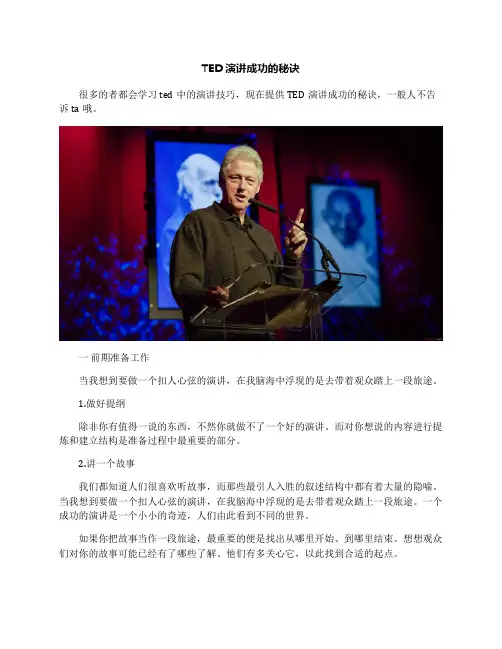
TED演讲成功的秘诀很多的者都会学习ted中的演讲技巧,现在提供TED演讲成功的秘诀,一般人不告诉ta哦。
一前期准备工作当我想到要做一个扣人心弦的演讲,在我脑海中浮现的是去带着观众踏上一段旅途。
1.做好提纲除非你有值得一说的东西,不然你就做不了一个好的演讲。
而对你想说的内容进行提炼和建立结构是准备过程中最重要的部分。
2.讲一个故事我们都知道人们很喜欢听故事,而那些最引人入胜的叙述结构中都有着大量的隐喻。
当我想到要做一个扣人心弦的演讲,在我脑海中浮现的是去带着观众踏上一段旅途。
一个成功的演讲是一个小小的奇迹,人们由此看到不同的世界。
如果你把故事当作一段旅途,最重要的便是找出从哪里开始、到哪里结束。
想想观众们对你的故事可能已经有了哪些了解、他们有多关心它,以此找到合适的起点。
最棒的演讲者会非常快速地介绍主题,解释他们自己为什么会对这个话题感兴趣,并说服观众相信他们也应该关注这个主题。
3.突出重点我在演讲者的初稿中发现的最大问题是会涵盖太多内容。
你无法在一个演讲中去概括整个行业。
如果你试图将你知道的所有东西都塞进演讲,那就没时间去举出关键的细节了,而且你的演讲会因各种抽象的语言而晦涩难懂,从而会导致本身就懂的人能听得懂,而之前不懂的人就不知所云了。
你需要举出具体的例子来使你的想法有血有肉,充实起来。
不要一心想把所有东西都纳入到一个短短的演讲。
相反地,要深入。
不要告诉我们你研究的整个领域,告诉我们你的独特贡献。
当然,过度阐述或者纠结于内容的意义也不可行。
对这种情况有另一套补救的方法。
记住,观众们很聪明。
让他们自己去找寻出一些意义,去各自归纳收获的结论。
4.营造悬念很多顶级的演讲具有着侦探小说般的叙事结构,演讲者引出问题开始演讲,然后介绍寻求解决方法的过程,直到恍然大悟的一刻,这时观众自会看到这一切叙述的意义。
如果一个演讲失败了,几乎都是因为讲者没有设计好整个故事,错误估计了观众的兴趣点,或者忽略了故事本身。
成功的秘诀英文演讲稿
成功的秘诀英文演讲稿每一滴眼泪和汗水,实力便增长了一分,离成功便更进了一步。
以下是小编整理的关于成功的秘诀英文演讲稿,欢迎大家阅读。
成功的秘诀英文演讲稿篇一:thirty college students across the country attended the tenth 21st century cup national english speaking contest in beijing on april 10. eventually, xia peng, from nanjing university was named the champion. the second and third places went to zhang jing, a sophomore from china foreign affairs university, and zhang a xu, from hong kong polytechnic university, respectively. more than 1000 college students in beijing are lucky birds to listen to the speeches on the spot in friendship hotel.just make to it the finals, they had to get past 60 others speaking on “the impact of globalization on traditional chinese values”. that was at the semi-final on april 8-9. what will chinese college students think about the impact? each contestant had his own take on the subject. xia summed up globalization by saying: “it’s just controversial and hard to say whether it is good or bad.” xia took the old wall of his city, nanjing, as a metaphor. he spoke about the conflict over whether to protect the old walls or tear them down to represent the conflict of ideas. he suggested that people protect the wall as a valuable relic while tearing down the “intangible walls” of their minds that prevent communication. while some other students are more focusing on the impact of globalization on family relations, attitudes towards love, and job-hunting.over the past 10 years, the national english speaking competition has given contestants a chance to speak on a variety of topics closely related to their lives. chinese students becomemore open-minded and receive various ideas and thinking over the decade. diversity becomes more obvious on campus, students have more opportunities to express and show themselves. it’s not an easy task for the contestants to win through the fierce competition. owning to their passion, hard work and persistence, they finally succeeded in the contest.liu xin, the first champion of the national contest, is now an anchorperson of cctv-9. recalling the passion of study on campus, she said: “when you want to express your idea by a foreign language without finding a right way, you’re really upset. then you have to encourage yourself, and after a long term of bitterness, suddenly you find you get the right way with joy.” with the champion title in 21st century cup, liu attended the international public speaking competition in london in may 1996 afterward and got the first prize historically.成功的秘诀英文演讲稿篇二:belief in yourself is the secret of successfrom the moment we are born, our destiny had been set. it is the start of our life. as a little child, we go to school and are curious to everything in the world.when we get older, we tend to understand the function in this world.we start to think, sometimes wonder about life. next thing we know, we are growing up. the world is changing, and our life is changing everyday.right now, this particular moment in our life, we think again.we have we done in our life?are we successful?are we rich?are we happy? and flashbacks starts, the memories tookcharge of our brain.we reflect to ourselves, we question ourselves.why are we not successful?why are we not rich?why are we not happy?then, we need to ask how.how to be successful?how to be rich?how to be happy?with the questions, we figure out the answers. one of the dominating techqniue to be successful is first start from yourself. believe in yourself. if you don't believe in what you can do, then who else?if you don't care about yourself, then who else? trust your feelings, believe that you can do it. and as long as you hold that thought, nothing, nothing can stop you.the successful future right ahead of you are led by a pathway called belief.。
thekeytosuccess成功的关键ted演讲

T h e K e y t o S u c c e s s 成功的关键T E D演讲-CAL-FENGHAI-(2020YEAR-YICAI)_JINGBIANThe Key to SuccessWhen I was 27 years old, I left a very commanding job, a managing consulting, for a job that was even more demanding, teaching.I went to teach seventh graders math in the New York City Public Schools. And like any teacher, I made quizzes and tests, I gave out homework assignments. When the work came back, I calculated rates.What strike me was that, IQ was not the only difference between my best and my worst students. Some of my strongest performers did not have IQ scores. Some of my smartest kids weren’t doing so well. And that got me thinking. The Kinds of things that you need to learn in seventh grade math sure they’re hard. But these concepts are not impossible, and I was firmly convinced that every one of my students could learn material if they worked long and hard enough.After several more years of teaching, I came to the conclusion that what we need in education is a much better understanding in students and learning from a motivational perspective, from a psychological perspective.In education, the one thing we know how to measure best is IQ. But what if doing well in school and in life depend on much more that your ability to learn quickly and easily. So I left the classroom and went to a graduate school to become a psychologist. I started studying kids and adults in all kinds of super challenging settings. And in every study my question was who’s successful here and why. My research team and I went to West Point military catemy. We try to predict which cadets would stay in the military training, which would drop out. We went to the national spelling bee, we tried to predict which children would advance far this in the competition. We studied rocky teachers working in really tough neighborhoods, asking which teacher are still going to be there in teaching by the end of the school year, and of those, who would be the most effective at improving learning outcomes for their students. We partnered with private companies, asking which of these sales people are going to keep their jobs and who’s going to earn the most money. In all those very different contexts, one characteristic emerged as a significant predictor ofsuccess, and it wasn’t social intelligence, it wasn’t good looks, physical health and it wasn’t IQ. It was grit.Grit is passion and for very long-term goals. Grit is having . Grit is sticking with your future, day in, day out, not just for the week, not just for the month, but for years, and working really hard to make that future a reality. Grit is living a life like it’s a marathon, not a .A few years ago, I started studying grit in Chicago public schools. I asked thousands of high school juniors to take great questionnaires, and then waited around over a year to see who would graduate. Turns out that, grittier kids are significantly more likely to graduate, even when I matched them on every characteristic I could measure. Things like family income, standardized achievement tests scores even how save kids felt when they were at school. So it’s not that West Point or the national Spelling Bee that grit matters, it’s also in school, especially for kids at rates of dropping out. To me the most shocking thing about grit is that how little we know, how little science knows about building it. Every day parents and teachers asked me how do I build grit kidsWhat do I do to teach kid a solid work How do I keep them motivated on the long runThe honest answer is, I don’t know. What I do know is that talent doesn’t make you gritty, our data show very clearly that there are many talented individuals who simply do not follow through on their commitments. In fact, in our data, girt is usually unrelated or even inversely related to measures of talent. So far the best answer of building grit in kids is something called growth mindset. This is an idea developed at Stanford University by, and it is the belief that the ability to learn is not fixed, that it can change with your effort. Doctor shows that when kids read and learned about the brain and how it changes and grows in response to challenge, they’re much likely to persevere when they fail. Because they don’t believe failure is a permanent condition. So growth mind sit is a great idea for building grit, but we need more and that’s why I’m going to end my remarks, because that’s where we are and that’s the world that stands before us. We need to take our best ideas, ourstrongest intuitions and we need to test them, we need to measure whether we have been successful and we have to be willing to fail, to be wrong, to start over again with the lessons learnt. In other words we need to be gritty in getting our kids grittier.。
TED演讲:成功的秘诀.
成功的钥匙When I was 27 years old, I left a very demanding job in management consulting, for a job that was even more demanding: teaching. I went to teach seventh grades math in the New York City public schools. And like any teacher, I made quizzes and tests, i gave out homework assignments. When the work came back, I calculated grades. What struck me was that I.Q. was not the only difference between my best and my worst students, some of my strongest performers did not have stratospheric I.Q. Scores, some of my smartest kids weren’t doing so well. And that got me thinking, the kinds of things you need to learn in seventh grade math, sure, they’re hard: ratios, decimals, the area of a parallelogram, but these concepts are not impossible. And I was firmly convinced that every one of my students could learn material if they worked hard and long enough。
成功的八个秘诀8 secrets of success
成功的八个秘诀8 secrets of successRichard St.John在Ted英语演讲:激情, 刻苦, 精通,专注,强迫,服务,点子,坚持,这就是成功的秘诀Richard St. John: 8 secrets of success 成功的八个秘诀This is really a two-hour presentation I give to high school students, cut down to three minutes. And it all started one day on a plane, on my way to TED, seven years ago. And in the seat next to me was a high school student, a teenager, and she came from a really poor family.这真的是一个我给高中学生做的2个小时的演讲现在缩到了3分钟所有的一切都是从7年前的一天开始,我坐在飞往TED会议的飞机上。
在我邻座坐的是一个高中生,一个十几岁的年轻人。
她生于一个贫穷的家庭And she wanted to make something of her life, and she asked me a simple little question. She said, “What leads to success?” And I felt really badly, because I couldn't give her a good answer. So I get off the plane, and I come to TED. And I think, jeez, I'm in the middle of a room of successful people! So why don't I ask them what helped them succeed, and pass it on to kids? So here we are, seven years, 500 interviews later, and I'm gonna tell you what really leads to success and makes TED-sters tick.而且她的愿望是成就一番事业所以她问了我一个简单的小问题。
The Key to Success 成功的关键 TED演讲
The Key to SuccessWhen I was 27 years old, I left a very commanding job, a managing consulting, for a job that was even more demanding, teaching.I went to teach seventh graders math in the New York City Public Schools. And like any teacher, I made quizzes and tests, I gave out homework assignments. When the work came back, I calculated rates.What strike me was that, IQ was not the only difference between my best and my worst students. Some of my strongest performers did not have IQ scores. Some of my smartest kids weren’t doing so well. And that got me thinking. The Kinds of things that you need to learn in seventh grade math sure they’re hard. But these concepts are not impossible, and I was firmly convinced that every one of my students could learn material if they worked long and hard enough.After several more years of teaching, I came to the conclusion that what we need in education is a much better understanding in students and learning from a motivational perspective, from a psychological perspective.In education, the one thing we know how to measure best is IQ. But what if doing well in school and in life depend on much more that your ability to learn quickly and easily. So I left the classroom and went to a graduate school to become a psychologist. I started studying kids and adults in all kinds of super challenging settings. And in every study my question was who’s successful here and why. My research team and I went to West Point military catemy. We try to predict which cadets would stay in the military training, which would drop out. We went to the national spelling bee, we tried to predict which children would advance far this in the competition. We studied rocky teachers working in really tough neighborhoods, asking which teacher are still going to be there in teaching by the end of the school year, and of those, who would be the most effective at improving learning outcomes for their students. We partnered with private companies, asking which of these sales people are going to keep their jobs and who’s going to earn the most money. In all those very different contexts, one characteristic emerged as a significant predictor of success, and it wasn’t socialintelligence, it wasn’t good looks, physical health and it wasn’t IQ. It was grit.Grit is passion and for very long-term goals. Grit is having . Grit is sticking with your future, day in, day out, not just for the week, not just for the month, but for years, and working really hard to make that future a reality. Grit is living a life like it’s a marathon, not a .A few years ago, I started studying grit in Chicago public schools. I asked thousands of high school juniors to take great questionnaires, and then waited around over a year to see who would graduate. Turns out that, grittier kids are significantly more likely to graduate, even when I matched them on every characteristic I could measure. Things like family income, standardized achievement tests scores even how save kids felt when they were at school. So it’s not that West Point or the national Spelling Bee that grit matters, it’s also in school, especially for kids at rates of dropping out. To me the most shocking thing about grit is that how little we know, how little science knows about building it. Every day parents and teachers asked me how do I build grit kids? What do I do to teach kid a solid work? How do I keep them motivated on the long run? The honest answer is, I don’t know. What I do know is that talent doesn’t make you gritty, our data show very clearly that there are many talented individuals who simply do not follow through on their commitments. In fact, in our data, girt is usually unrelated or even inversely related to measures of talent. So far the best answer of building grit in kids is something called growth mindset. This is an idea developed at Stanford University by, and it is the belief that the ability to learn is not fixed, that it can change with your effort. Doctor shows that when kids read and learned about the brain and how it changes and grows in response to challenge, they’re much likely to persevere when they fail. Because they don’t believe failure is a permanent condition. So growth mind sit is a great idea for building grit, but we need more and that’s why I’m going to end my remarks, because that’s where we are and that’s the world that stands before us. We need to take our best ideas, our strongest intuitions and we need to test them, we need to measure whether we have been successful and we have to be willing to fail, to be wrong, to start over again with the lessons learnt. In other words we need to be gritty ingetting our kids grittier.。
TED演讲成功的两大秘诀
TED演讲成功的两大秘诀一前期准备工作当我想到要做一个扣人心弦的演讲,在我脑海中浮现的是去带着观众踏上一段旅途。
1.做好提纲除非你有值得一说的东西,不然你就做不了一个好的演讲。
而对你想说的内容进行提炼和建立结构是准备过程中最重要的部分。
2.讲一个故事我们都知道人们很喜欢听故事,而那些最引人入胜的叙述结构中都有着大量的隐喻。
当我想到要做一个扣人心弦的演讲,在我脑海中浮现的是去带着观众踏上一段旅途。
一个成功的演讲是一个小小的奇迹,人们由此看到不同的世界。
如果你把故事当作一段旅途,最重要的便是找出从哪里开始、到哪里结束。
想想观众们对你的故事可能已经有了哪些了解、他们有多关心它,以此找到合适的起点。
最棒的演讲者会非常快速地介绍主题,解释他们自己为什么会对这个话题感兴趣,并说服观众相信他们也应该关注这个主题。
3.突出重点我在演讲者的初稿中发现的最大问题是会涵盖太多内容。
你无法在一个演讲中去概括整个行业。
如果你试图将你知道的所有东西都塞进演讲,那就没时间去举出关键的细节了,而且你的演讲会因各种抽象的语言而晦涩难懂,从而会导致本身就懂的人能听得懂,而之前不懂的人就不知所云了。
你需要举出具体的例子来使你的想法有血有肉,充实起来。
不要一心想把所有东西都纳入到一个短短的演讲。
相反地,要深入。
不要告诉我们你研究的整个领域,告诉我们你的独特贡献。
当然,过度阐述或者纠结于内容的意义也不可行。
对这种情况有另一套补救的方法。
记住,观众们很聪明。
让他们自己去找寻出一些意义,去各自归纳收获的结论。
4.营造悬念很多顶级的演讲具有着侦探小说般的叙事结构,演讲者引出问题开始演讲,然后介绍寻求解决方法的过程,直到恍然大悟的一刻,这时观众自会看到这一切叙述的意义。
如果一个演讲失败了,几乎都是因为讲者没有设计好整个故事,错误估计了观众的兴趣点,或者忽略了故事本身。
即使话题再重要,没有足够的叙述作为铺垫,反而偶然冒出一些武断的意见总会让人感到不爽。
ted成功的秘诀是什么
ted成功的秘诀是什么有人失败,有人成功,这之间是什么因素影响着TED的成功。
以下是分享的aaaa,一起来和看看吧。
TED成功的秘诀1. Passion 激情跟上一个TED演讲谈到了同一个话题,激情产生于爱。
在我看来,不管是做你有激情的事情,还是没有激情的事情,肯定都会碰到各种困难。
没有任何事情是一帆风顺的,其中的区别是,在有激情的时候,你会心甘情愿无怨无悔的解决困难。
激情2. Work 刻苦想要成功,就要付出努力和代价。
天才也是炼成的。
他说,TED的演讲者,都不是工作狂,他们是享受工作狂。
他们刻苦工作,但并没有因此而觉得痛苦,反而能够从中获得能量与愉快。
刻苦3. Good 精通成为某个领域的杰出,真正对这个方面擅长。
要让你和别人相比与众不同。
怎样才能做到精通?他的答案是,没有捷径,只有不断的练习、练习、练习。
精通4. Focus 专注专注是一种需要锻炼的能力,在我看来,为什么番茄工作法是最实用的一种时间管理方法,其实很大程度上,番茄钟就是在锻炼我们的专注力。
从25分钟开始,一步一步的修炼我们的专注。
专注5. Push 强迫强迫自己从身体上、心灵上都更加精进。
他强调了一点“强迫自己战胜羞涩和自我怀疑”。
我觉得这一点在中国人身上体现的比在西方人身上要更加明显一些。
中国人都讲求“含蓄”,往往都意识不到自己有多么优秀,有些自己意识到了,也羞于展现这样的优秀。
但是在现在这个时代,已经远不是那种“金子在哪都发光”的时代了,现在的金子们都不断地跳出土地,恨不得发光发亮照耀所有人。
当然了,总是要强迫自己并不是很容易的事情。
这也是为什么很多人都有拖延症,很多人也克服不了拖延症,很多人想要养成习惯,但是却也总是半途而废。
强迫6. Serve 服务“你不能只为自己服务,你需要为他人提供对他人有利的服务,这就是人们致富的方式。
”在我看来,这就是在说你跟世界的联接。
没有生命体是独立存在的,在这个宇宙中,我们都通过某种方式相互依存,先想想你可以为别人做些什么,而不是我可以从别人那里得到什么。