
PEP六年级英语下册Unit3 B Let's talk 课件
It was OK.答句,找到代替主语的代词就可以了。
1 b__g__t ou h g__f__ i ts 3 re __e f___ at f__sh ood
5 u oot h__rt my f __ 6
2
t__k oo p__ct___s ure i
4
w__nt s_m__ing e i m
r__d__ o e a h__se or
4.climb mountains = climb a mountain
5.see films=see a film
6.plant trees=plant a tree
寒假期间 三亚
离……远 far from=not near
沙滩
听起来
Where did you go over the winter holiday? 寒假期间你们去了哪里? My family and I went to Sanya. 我家人和我去了三亚。
你们怎么去哪里?
2.We went there by plane.
我们坐飞机去。
3.Sounds great!
听起来很不错!
27页重点: 1.询问对方过去怎样去某地: How did XX go to + 某地?
答:XX went to 某地 + 交通方式。 2. far from = not near 离……远
二、实际回答
1.Where did you go last winter holiday? I went to+ 城市名. I went to the+ 地点. Hainan park 2. What did you do last winter holiday? I + 动词过去式. took pictures 3. How did you go to Sanya? I went + 交通方式. by plane 4. Did your mother go to Hainan?(否定) No, she didn’t.
Really? Did you like it?
真的吗?你喜欢它吗? Yes, it was so warm. 是的,它是如此的温暖。 Hainan is far from here. 海南离这里很远。
How did you go there? 你们怎么去哪里? We went there by plane. 我们坐飞机去。 How was the beach? 沙滩怎么样? What did you do there? 你们在那里干了什么? It was beautiful. 它很美。
很好啊
我每个周末都去游泳, 还拍了很多照片。
27页重点:
1.How was your weekend ?
It was OK. 2. How was you?
I was OK.
3. How was your father?
He was OK.
4.How was your summer holiday?
eat fresh food 吃新鲜的食物
ate fresh food吃了新鲜的食物
go swimming 去游泳
went swimming 去了游泳
take pictures 拍照t来自ok pictures 拍了照
buy gifts 买礼物 bought gifts 买了礼物
一凡,你暑假过得怎么样?
一、连词成句
1.see ,I, pictures, can, sometime, your
Can I see your pictures sometime?
2. go, did, how, there, you? How did you go there? 3.took, of , also, swimming ,pictures, I, and, lots,went (.) I also took lots of pictures and went swimming.
与go固定搭配的动语: swimming
camping
go fishing
go加动词的ing boating shopping
hiking
running
1.take pictures = take a picture 2.buy gifts = buy a gift
3.read books= read a book
I took lots of pictures,
我拍了许多照片,
and I also went swimming. 我也去了游泳。
Sounds great! 听起来很不错!
改天我能看看你的照片吗? Sure. 当然可以。
Can I see your pictures sometime?
26页重点句子: 1. How did you go there?
人教版(PEP)六年级英语下册Unit 3《Where did you go》PPT课件

Was it good? NO! It was so bad.
What happened?
I fell off the horse.
fell (fall)
And, I hurt my foot.
hurt my foot (hurt— hurt)
I fell off the horse.So I couldn't ride a horse.
Practice
Pair work
• A: Where did you go last Saturday? • B: I went to ______. • A: What did you do there? • B: I ______.
Exercise
连词成句。
st,you,Where, go,did, Saturday ? ___W__h_e_re__d_id__y_o_u_g_o__la_s_t_S_a_t_u_rd_a_y_?_______
或点击此处播放视频
点 击 图 片 , 播 放 视 频
Practice
rrooddee
ቤተ መጻሕፍቲ ባይዱ
fishing
wweenntt
my foot
hhuurrtt
aa hhorrssee
连一连!
Listen,answer and write
What did they do yesterday?
Carl
Meimei
Check the answers.
1.He rode a horse in Hailar. 2.She visited a museum. 3.She hurt her foot yesterday. 4.He took many photos.
Unit 3 Where did you go (说课稿) 英语六年级下册
授课内容:Unit 3 Where did you go?( PB Let’s talk)Unit 3 Where did you go ?( Part B Let’s talk) 说课一、教学内容分析教材的地位与作用:本节课选自PEP小学六年级下册第三单元Part B第二课时对话课。
本课时共包括两个部分,Let’s try和Let’s talk,本单元以“假期”为话题中心,主要通过讨论寒假活动来学习what ,where ,how, when ,who引导的特殊疑问的运用,进一步学习特殊疑问句。
本单元承接上一单元过去时态(周末)的学习,连接下一单元(购物话题)的学习,起着承上启下的作用。
该单元话题贴近生活,具有较强的实际交流意义,基于内容的生活化课上将通过一系列的活动用英语把身边的事物联系起来,使学生保持积极的学习态度,在大量的语言实践中形成语感,养成良好学习习惯。
二、学生分析六年级的学生已经学了近四年的英语,有了一定的基础。
多数在11-12岁之间,有了一定的生活经验,并能对他们所经历的事情进行阐述。
同时在本册书第二单元中,学生已初步学习了一般过去时的相关短语并能对句型:What did you do last weekend? How was your weekend?做出相应的回答;学生在本单元第一课时初步学习了如何询问并回答有关假期去过的地方及做过的事情的句型:Where did you go?为本节课的学习打下了基础。
三、教学目标及教学重难点基于新课程标准的要求以及学生自身的水平特点,我制定了本节课的教学目标:1、知识与能力1. 能完成Let’s try中的听力任务,根据听力内容完成问题答案的选择。
2. 能够在图片和教师的帮助下理解对话大意,并回答问题。
3. 能够按照正确的语音、语调及意群朗读对话,并能进行角色表演。
4. 能够在情景中运用句型Where did you go…? How did you go there? What did you do? 谈论假期活动。
六年级英语下册Unit 3 Where did you go?Part B Let’s talk人教PEP版
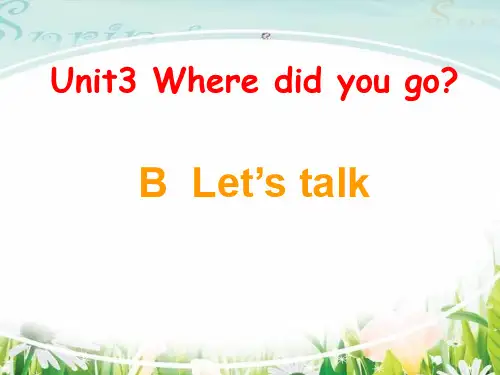
She went to Sanya , Hainan.
My family and I went to sanya.
2.How did she go there? She went there by plane.
they
went
It was warm and
beautiful in Sanya. So they_w_e_n_ t _s_w_i_m_m__i_n_g there and also t_o__o_k lots
of_p_i_c_t_u_r_e_.s
They had a good time in Sanya.
W:
Really?_2_________
C. What do you do there? D. Did you like it?
A:
Yes,
it
was
so
warm.E. What did you do there? F. My family and I went to S
S: Hainan is far from here._3____
Let’s try
Guessing
Wu Yifan and Amy meet Sarah at school.
Look and think
Where did Sarah go over the winter holiday?
She went to Hangzhou.
Let’s talk
Look and guess
A: Sure.
Try to retell
PEP六年级英语下册Unit-3-PartA-Let’s-try课件精选全文
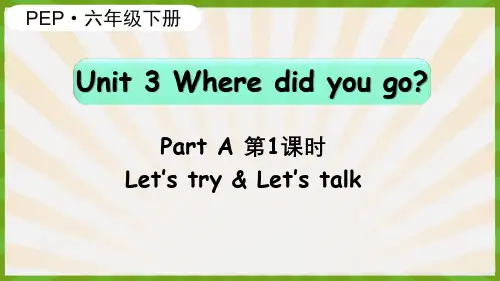
Mt.Tianshan
Turpan
Listen and answer
➢ Where did John go over his holiday? He went to Mt. Tianshan and Turpan in Xinjiang.
➢ What did he do there? He rode a horse and saw lots of grapes.
photos from the Labour Day holiday.
Listen, read and imitate
Amy: Where did you go? John: Mt. Tianshan, Xinjiang. I rode a horse.
Look, it’s very small! Amy: Oh, yes. It looks like a mule! Did you go
sorry I can’t come. Amy: OK. Bye.
What happened? I hurt my foot.
What happened? I had a cold.
John hurt his foot. He didn’t go to school. Did Amy go to John’s home? What happend to John?
1. Where is John now?
He is at the hospital.
2. Where is Amy now?
She is at school.
3. Why did Amy give a phone call to John?
Because John didn’t come to school.
PEP六年级下册英语第三单元Unit3 B Let’s talk说课稿

PEP六年级下册英语第三单元Unit3 B Let’s talk说课稿六下Unit3 B Let’s talk说课稿冯家湾小学石明一、说教材《Let’s talk》是人教版《小学英语》六年级下册第三单元B部分的内容,属于对话教学,是与本单元话题 Where did you go、有关联的对话。
本单元前三个课时,学生已经学习了多个动词短语的过去式。
和句型What did you do ?Where did you go? How did yougo there?并询问他人在过去的时间里做过什么事情。
我所设计的第四课时,是在前面个课时基础上的拓展和延伸,旨在复习巩固本单元A部分的主要词汇和句型,并适当扩展语言,增大语言输入量。
据此,我确定以下教学目标:【知识目标】1、能够在图片和教师的帮助下理解对话大意,并回答读后问题。
2、能够按照正确的语音、语调及意群朗读对话,并能进行角色表演。
3、能够听、说、读、写,并在情景中运用句型 Where did you go …?How did you go there? What did you do?谈论假日安排;能够通过对话学习了解新疆的风土人情。
4、能够在语境中理解生词beach的意思,并能正确发音。
5、能够运用所学句型谈论自己的寒假生活。
【能力目标】1、能够用一般过去时描述自己在过去的时间里所做的事情。
2、能够用主要句型询问他人在过去的时间里所做的事情并作答。
3、学会阅读短文,并从中获取信息,同时能互相谈论有关上个假期所做的事情。
【情感目标】能合理安排假期,懂得热爱生活,热爱每一天!二、说学情经过三年半的英语学习,六年级学生已经具备一定的知识储备,对于英语已经有了一定的自主学习能力。
但是,他们生理和心理都在发生着急剧的变化,英语课堂上表现出来的性格也渐渐由外露变得比较内敛、害羞和敏感。
本课的教学内容语法性比较强,内容比较枯燥,针对六年级学生羞于表达的特点,我设计了游戏、歌曲,还有多个任务来增强趣味性,力求使每一位学生都积极主动参与到教学活动中来,并能在完成任务的过程中体会到学习英语的乐趣。
六年级下册英语教学课件Unit 3 Part B 人教(PEP)

Sarah: Where did you go over the winter holiday? Amy: My family and I went to Sanya. Wu: Really? Did you like it? Amy: Yes, it was so warm. Sarah: Hainan is far A. from here. How did you go there? each Amy: We went there B. by peach plane. Wu: How was the beach? What did you do there? C.I reach Amy: It was beautiful. took lots of pictures, and I also D. beach went swimming. Sarah: Sounds great! Can I see your pictures sometime? Amy: Sure.
Role play
Make a dialogue with “where, how, what” A: Hello. Where did you go over/in/during _____? B: I went to _____. A: How did you go there? B: We went there by ____. A: What did you do there? B: I ___________________________. A: Sounds great! Word bank time: Labour Day holiday, summer holiday place: Shenzhen , Beijing , London , New York Transportation: by plane, by train, by subway Activities: rode a horse, went swimming, climbed the Great Wall,
英语人教版六年级下册unit3 B let's talk
Unit 3 Where did you go? B Let’s talk.教学设计【教学目标】1.我能听、说、认读新单词和重点句子:beach, Where did you go over the winter holiday? What did you do there? How did you go there?2.我能用正确的语音语调朗读对话,并能运用句型询问并描述过去的假期旅游经历。
3.我要多旅游,热爱祖国大好河山, 热爱生活。
【教学重难点】重点:能听懂会说认读新单词和重点句子:beach,Where did you go over the winter holiday? What did you do there? How did you go there?难点:灵活运用句型Where did you go? What did you do there? How did you go there? 等询问并描述过去的假期旅游经历。
【教学过程】Step1:热身活动Enjoy a song. 看视频,听唱歌曲《Talk about your holiday》并思考:What’s the song about?2、Free talk.由歌曲引入复习句型,师生自由谈论寒假假期。
Where did you go over the winter holiday?What did you do there?Step2:情景创设,新课导入有师生谈论寒假假期经历,出示Amy、Sarah and Wu Yifan交谈的图片,引入问题What are they talking about?They are talking about Amy’s winter holiday. 导入语:What do you want to know about Amy’s winter holiday?学生回答……OK.Today we’ll learn Unit 3 Where did you go? PartB Let’s talk.Let’s talk about Amy’s winter holiday.Step3:学习新课B Let’s talk.(一)展示本节课教学目标。
六年级下册英语第三单元let's talk b
六年级下册英语第三单元let's talk b全文共6篇示例,供读者参考篇1Title: The Joy of CommunicatingHello there! My name is Emma, and I'm a sixth-grader at Sunshine Elementary School. In our English class, we recently learned about the importance of communication and how it helps us connect with others. It's been an eye-opening experience, and I'd love to share my thoughts with you.Have you ever tried to explain something to a friend or family member, but they just didn't seem to understand what you were saying? Maybe you were trying to describe a movie you watched or a book you read, but the words didn't come out quite right. That's when effective communication becomes crucial.Communication is more than just words; it's about conveying your thoughts, feelings, and ideas in a way that others can understand. It's like having a secret code that allows you to connect with people and share your experiences with them.In our English class, we've been learning different techniques to improve our communication skills. One of the most important things we've learned is the power of active listening. It's not just about hearing the words someone says; it's about truly trying to understand their message and showing them that you're paying attention.For example, when my friend Sarah was telling me about her weekend, I made sure to nod and ask questions to show her that I was listening. I even repeated back some of the key points she made to make sure I understood correctly. It's amazing how much better we can communicate when we actively listen to each other.Another technique we've learned is the importance of body language and tone of voice. Did you know that a lot of communication happens without words? The way we stand, our facial expressions, and the tone we use can all convey different meanings. For instance, if someone says "I'm fine" but their body language suggests otherwise, it's a sign that they might not be telling the whole truth.One of my favorite activities in our English class isrole-playing. We get to act out different scenarios and practiceour communication skills. It's a lot of fun, and it really helps us understand how to express ourselves more clearly.For example, we had a role-play where one person was a customer at a restaurant, and the other person was the waiter. The customer had to politely explain that their order was wrong, and the waiter had to apologize and offer a solution. It was a great way to learn how to communicate effectively in real-life situations.For instance, in some cultures, it's considered rude to make direct eye contact during a conversation, while in others, it's a sign of respect. Understanding these cultural differences can help us communicate more effectively with people from diverse backgrounds.Another important aspect of communication is being able to express ourselves creatively. In our English class, we've been working on writing stories, poems, and scripts. It's a great way to explore our imaginations and learn how to convey our thoughts and feelings through written language.One of my favorite projects was writing a short play about two friends trying to resolve a conflict. It was challenging to find the right words to express each character's emotions andperspectives, but it was also incredibly rewarding when we finally got it right.For example, we learned about the significance of different colors and symbols in various cultures, and how artists use these elements to communicate their ideas and emotions through their artwork.Communication is truly a fascinating topic, and I've learned so much in our English class. It's amazing to think about how many different ways we can connect with others and share our experiences.Whether it's through spoken language, written words, body language, or creative expression, communication is the key to building relationships, understanding different perspectives, and even resolving conflicts.As I continue to learn and grow, I know that my communication skills will be incredibly valuable in all aspects of my life. They'll help me succeed in school, build strong friendships, and even prepare me for future careers.Who knows, maybe one day I'll become a writer, a public speaker, or even a diplomat, using my communication skills to bring people together and make a positive impact on the world.For now, I'm just grateful for the opportunity to learn and practice these invaluable skills in my English class. Communication is truly a superpower, and I can't wait to see where it takes me.Thank you for taking the time to read my thoughts on this fascinating topic. I hope you've learned something new and been inspired to improve your own communication skills. Remember, the world is full of amazing people and experiences just waiting to be shared, and effective communication is the key to unlocking that treasure trove of connection and understanding.So, let's keep practicing, keep listening, and keep communicating with open hearts and minds. Who knows what incredible connections and discoveries await us?篇2Let's Talk - An Essay by a 6th GraderHi everyone! In our English class, we're learning about the super cool unit called "Let's Talk." It's all about communication and how we can express ourselves in different ways. I've been having a blast exploring all the fun activities and topics. Let me tell you more about it!First up, we learned loads of new vocabulary words related to communication. Words like "gesture," "facial expression," "body language," and "tone of voice." It was kind of mindblowing to realize how much we can convey without even saying anything out loud! Just a simple hand wave or a big smile can send a powerful message.My favorite part was practicing different tones of voice. We took turns saying the same sentence in various ways - happily, sadly, angrily, excitedly, and more. It was hilarious hearing my classmates' over-the-top performances. But it really drove home how important tone is for understanding the true meaning behind someone's words.We also did an activity where we had to act out situational dialogues using only body language and gestures - no words allowed! It was super challenging at first, but after a while, we started getting the hang of it. Shoutout to Tommy for his impressive angry face and Mia for her brilliant idea to pretend to cook something. We all cracked up at their acting skills!Another highlight was learning about different forms of non-verbal communication used by people around the world. For example, we learned that in Bulgaria, nodding your head means "no" and shaking it means "yes" - the total opposite ofwhat it means for us! We had fun practicing some customary gestures from other cultures too, like the "chin flick" greeting used in Italy.What really struck me though, was how powerful communication can be for fostering understanding between people. We read stories about individuals who overcame language barriers or disabilities through finding creative ways to connect. Like the deaf dancer who expressed herself through beautiful sign language and movement. Or the man who befriended a foreigner by miming and drawing pictures. It was super inspiring stuff!To wrap up the unit, we had to work on our own creative communication projects. I decided to choreograph a short dance routine that tells a story through movements and gestures. It was tricky figuring out how to convey different emotions and events without using any words or props. But after a ton of practice (and plenty of awkward missteps), I'm feeling pretty proud of my final performance!Looking back on everything we covered in "Let's Talk," I've gained a whole new appreciation for the incredible power of communication. Whether it's conveying deep emotions through a sad song or simply giving someone a warm smile, the ways wecan connect are truly extraordinary. I'm feeling a lot more confident about expressing myself and way more observant of the unspoken cues in every interaction.I'm already excited to use my new communication skills for our next unit on...well, I probably shouldn't spoil the surprise just yet! But I can confidently say that this unit has opened my eyes to the rich world of human expression and connection. Whatever comes next, I'll be ready to talk about it!篇3Let's Talk About Let's Talk!Hey there! I'm pumped to tell you all about the latest unit we're working on in English class - Let's Talk B from our 6th grade textbooks. This unit is all about communication and how we can express ourselves better through speaking and writing. As a kid who loves to chat, I'm pretty excited about this topic!The first part we learned was how to give instructions and explanations clearly. We practiced using sequence words like "first", "next", "then", and "finally" to put the steps in order. I had fun telling my classmates how to make a peanut butter and jelly sandwich. You'd be surprised how many people forget you have to open the jars first!Another useful tip was using modal verbs likke "can", "should", "must" and "have to" to show necessity or possibility. For example, I should do my homework before playing video games. Or I must brush my teeth twice a day. Using these verbs makes the instructions much clearer.We also reviewed using imperatives and giving negative instructions properly. Rather than saying "Don't run with scissors!", we're supposed to give the positive instruction "Walk carefully with scissors." Makes sense when you think about it - it's better to tell someone what to do rather than what not to do.So those were some of the grammar points we covered for giving instructions. We had plenty of chances to practice too by explaining how to do simple tasks like tying shoes, making a paper airplane, and solving math problems. My personal favorite was when we guided each other through the steps of making a smores! Delicious and educational.In addition to instructions, we spent time learning how to describe things clearly using vivid details. We worked on using sensory details related to sight, sound, smell, taste, and touch to make our descriptions come alive. We read examples of great descriptive writing and identified what made them effective.One of my favorite activities was describing our dream bedrooms in as much detail as possible. We really went wild with bright colors, awesome video game setups, and super cool accessories. Jack's description of his race car bed with built-in TV screens was totally epic! Describing things in this vivid way makes your writing and speaking way more interesting.We've also been working on comparing and contrasting skills to analyze the similarities and differences between things. We use phrases like "both...and", "while...', "on the other hand", and "in contrast" to clearly show how things are alike or different. For example, video games and books are both entertaining, while video games are interactive and books are not. Or a tiger and a housecat are both felines, but a tiger is far larger and more dangerous. See how those comparing words make it easy to see the key points?Just last week, we compared and contrasted two popular eateries in our town - the Burger Palace and the Healthy Salad Hut. We looked at factors like the menu options, prices, atmosphere, and customer service. I'm definitely more of a Burger Palace fan for those delicious cheeseburgers and chocolate milkshakes! But I could also see the appeal of the Salad Hut for people watching their diets more closely.Looking ahead, we're going to start working on expressing opinions through persuasive speaking and writing. We'll use words like "I think", "In my opinion", and "I believe" to state our viewpoints clearly. We'll also need to back up our opinions with facts, examples, and reasoning.I'm really excited about this part because I have LOTS of strong opinions! We're going to debate things like which is the best family vacation spot, what makes a great teacher, and whether robot teachers could eventually replace human ones. I think robots could be good for some subjects like math, but they could never replicate an inspirational human teacher. At least not yet!We'll also get a chance to try out more creative writing like descriptive narratives and short stories. I'm working on a story right now about a kid who gets shrunken down to insect size and has to fight off an evil breed of superintelligent ants. With all the descriptive language we've learned, my story is going to be intense and action-packed!Whew, this unit has already covered so much good stuff on communication skills! We still have persuasive writing and creative storytelling to go. By the time we're done, I'll be a master communicator - both speaking and writing. These skillswill help me greatly in the future when I become a world-famous entrepreneur, author, and motivational speaker. You'll be able to say you knew me way back when!So that's the scoop on Let's Talk B - all about expressing ourselves clearly and vividly through instructions, descriptions, comparisons, and opinions. I hope I did a good job walking you through all the communication skills we're working on. If not, I can try to explain it again more clearly! Maybe this time I'll remember to open the metaphorical peanut butter jar first. Let me know if you have any other questions!篇4Let's Talk About Sports and HobbiesSports and hobbies are a huge part of my life! I love staying active and trying new activities. There are so many different sports to choose from - ball games like basketball, soccer, and tennis, or individual sports like swimming, skateboarding, and gymnastics. Each one is fun in its own way.My favorite sport is definitely basketball. I started playing a few years ago and I'm obsessed! There's just something so thrilling about dribbling down the court, faking out defenders with slick moves, and nailing that perfect jump shot. Swish!Nothing but net. Of course, I'm still working on my skills, but I practice every day after school by shooting hoops in my driveway.I also really enjoy soccer. It's awesome being part of a team and working together to advance the ball and score goals. Soccer requires great footwork, stamina, and strategic thinking. During a tough match, communicating and motivating each other is so important. I'll never forget the rush of scoring the game-winning goal in overtime during last season's championship! My teammates mobbed me in a giant group hug. That篇5Hi everyone! Today I want to tell you about our English lesson in the sixth grade. We are learning about Unit 3 called "Let's Talk B." It's super fun and interesting, so let me share it with you!In this unit, we are learning how to have conversations in English. Our teacher, Mr. Smith, taught us different sentences and phrases we can use to talk to our friends. It's really helpful because now we can have conversations with ourEnglish-speaking friends too."Hello" and "Hi!" Then, we learned to ask, "How are you?" and respond with "I'm fine, thank you" or "I'm not so good." It's nice to ask our friends how they are feeling and show that we care.Next, we learned how to introduce ourselves. We said, "My name is Lucy. What's your name?" It was so much fun because we got to introduce ourselves to our classmates and learn their names too. We also practiced asking questions like, "How old are you?" and "Where do you live?" It's exciting to learn more about our friends.After that, we learned how to talk about our hobbies. We used sentences like "I like swimming" or "I enjoy playing soccer." We took turns sharing our favorite activities with each other. It was great to discover common interests and find new things we can do together.In addition to that, we learned how to invite someone to do something. We practiced saying, "Would you like to go to the park with me?" or "Do you want to watch a movie?" It's important to be polite and friendly when inviting others. We even acted out different scenarios and had role plays in class. It was really fun!"Goodbye" and "See you later!" It's nice to end a conversation with a friendly goodbye. We also learned to say "Thank you" when someone helps us or gives us something. It's good manners to show gratitude.I really enjoy learning English in Unit 3 "Let's Talk B." It's amazing how much we can do with just a few sentences and phrases. Now, I can have conversations with myEnglish-speaking friends and make new friends from different countries.English class is always exciting and full of surprises. I can't wait to learn more and become even better at speaking English. I hope you enjoyed hearing about our lesson today. Thank you for reading, and see you next time!希望这篇文章符合你的要求,并且能够帮助你了解六年级下册英语第三单元"Let's Talk B"。
人教PEP版小学六年级下册英语精品教学课件(课标版)Unit 第3课时 B Let's try
Activity
填体检表活动
学生根据实际情况填写体检表。 学生之间根据体检表询问身高、体重、 鞋码等信息。 学生根据《少年儿童身高体重对照表》 汇报自己的情况。
( A ) 5. May I have a look _________ your pen?
A. at
B. for
C. to
Summary
Key word: kilogram Key sentences: —What size are your shoes? —My shoes are size ______./—Size ______. —How heavy are you? —I’m ______ kilograms.
Lead in
Wu Binbin is taller than Mike. Mike is taller than John. John is taller than Oliver. Who is the tallest? Wu Binbin is the tallest.
Look and predict WThheowaereektehnedy?is coming.
B Let’s talk
Wu Binbin and Mike are in a shoe store. They are trying on the shoes. Look at the picture. Whose feet are bigger?
Listen and fill in the chart.
新人教版六年级下册英语第三单元 课件 Unit3B Lets_talk课件
1.W_h_e_r_e_d_id__y_ou__go__o_ve_r_y_o_u_r _w_in_t_er__h_ol_id_a?y
Let’s talk
Sarah: Where did you go over the winter holiday? Amy: My family and I went to Sanya.
W1u.:TRheaaltly?neDwidsyosuouliknedsit?great! 听起来 AStAW s&1h2345oamm.uermgggI....syy:raYYToooo’::ehedHM?mooh:YWtosssuueeiylewHwkhemirsktaao,liwfcweoiiemtprnmiaioeo(taisopsmnnatkenhoiwtgot有nismaihnttsg(tsehfg–vi时afreei-ss–有basserwome间wretidwtealw时ettteefs.bc,neaaaarsln看hAylrot,nkkkv?stmm不lypteeee起is.W l频cusbrahk确semwnyla–a来ehaoh率eradim定t.ttoemswtp.is.o)opyinadm的compH.g闻iortdki尝iomefnnu时w起ytggr.起opie间d摸um来iic来dde)起toy.uo来truhee感gsroe觉? A2m.Sy:omItewtaims beesauItifwula.tIchtooTkVlotisnotfhpeicteurveesn,inangd.