
将来进行时一般将来时
将来进行时VS 一般将来时
1. 概念:将来进行时主要表示将来某一时间正在进行的动作,或表示要在将来某一时间开始,并继续下去的动作。
常用来表示礼貌的询问、请求等。
(1)如:This time next day they will be sitting in the cinema.
What will you be doing at six tomorrow evening?
I’ll be meeting him tomorrow/ some time.我明天/某个时间将去见他。
2)常用的时间状语:
Soon, tomorrow, this evening,on Sunday, by this time,in two days, tomorrow evening
By this time tomorrow, I'll be lying on the beach. 明天的这个时间,我将会海滩上。
2. 将来进行时的形式:
将来进行时由“动词be的将来时+现在分词”构成,具体形式见下表:
人称单数复数
第一人称I shall/will be leaving. We shall/will be leaving.
第二人称You will be leaving. You will be leaving.
第三人称He/She/It will be leaving. They will be leaving.
3. 将来进行时的基本用法:将来进行时表示在将来某一时间内正在进行的动作。
将来进行时有很强的推测性,因此人们往往在以下几种场合中使用它:
★(1)表示将来某一时间正在进行的动作,一般带状语。
如:
What will you be doing at this time next Monday? 星期一的这个时间你将干什么?
When he comes to my house tomorrow, I will be writing the report.明天他来我家时,我将在写报告。
★ (2)表示现在正在进行的动作,但这个动作会延续到将来。
如:
I wonder if it will still be raining this afternoon.
I think that she will be working on this experiment until next morning.
★ (3)表示预定的将来动作或对将来的预测。
如:
Tomorrow I will be flying to Bombay.
After you take the medicine, you will be feeling much better.
★ (4)表示委婉的请求When shall we be meeting again?
★ (5)表示原因Tomorrow morning, I'll be having a meeting.
★ (6)表示结果Stop the child or he will be falling over.
★ (7)表示对将来的打算(区别于对将来的预测)
My duties will end in July, and I'll be returning to Shanghai.
将来进行时用法:
概念:表示将来某时进行的状态或动作,或按预测将来会发生的事情.
如:I'll be meeting him sometime in the future.
形式:(肯定,否定形式以及一般疑问式)
常用的时间状语:
Soon, tomorrow, this evening,on Sunday, by this time,
tomorrow, in two days, tomorrow evening
By this time tomorrow, I'll be lying on the beach.
一.将来进行时用来表示在将来的某一个时间正在进行的动作和按计划,安排,决定预料将要发生的事
①下个星期的这时候,我们将在那个工厂劳动.
This time next week we shall be working in that factory.
②明天下午三点,我们将正在开会.
We'll be having a meeting at three o'clock tomorrow afternoon.
③你将什么时候见怀特先生(语气较委婉客气,下属对上司)When will you be seeing Mr. White
④今天晚上七点,学生们将正在看电视.
The students will be watching TV at seven this evening.
二.将来进行时主要表示将来某一时刻正在进行的动作,或表示要在将来某一时刻开始,并继续下去的动作.常用来表示礼貌的询问,请求等.例如:
1)This time next day they will be sitting in the cinema.
用法:强调在将来的某个具体时间正在发生的动作或事情.
例:Don't worry, you won't miss her. She will be wearing a red T-shirt and a white skirt at that time.
别担心,你不会认不出她的.她到时会穿一件红色的T恤衫和一条白色的短裙.
例:This time tomorrow you ________ there doing some more exercises.
A) will sit B) will be sitting C) sit D) shall sit
答案是B).因为this time tomorrow是个很具体的将来时间.
三.将来进行时用来表示不含意图又未发生的动作
注意:将来进行时不用于表示"意志",不能说I'll be having a talk with her.
I will be helping Mary tomorrow.明天我帮玛丽干活.
这不表示说话人已安排好要帮助玛丽或者想帮助她.这个句子仅仅说明这一动作将要发生.将来进行时的这种用法有些像表示将来的现在进行时,但有以下几点不同之处.
◆将来进行时通常表示的是对将来事实的简单陈述.
而will+V. (一般将来时)除表示时间概念外,还带有感情色彩.
e.g. 汤姆明天将正在割草. Tom will be cutting grass tomorrow.
汤姆明天愿意割草. Tom will cut the grass tomorrow.
◆一般将来时是对将来的预测,一个表示将来要做的事,将来进行时,表示将来某个时点正在做的事。
eg明天我要看书I'll read a book tomorrow.
明天十点我肯定正在看书I'll be reading a book 10:00 tomorrow.。
中考英语一般将来时与将来进行时混合单选题50题

中考英语一般将来时与将来进行时混合单选题50题1. We ____ a party at school next week.A. will haveB. haveC. hadD. having答案:A。
本题考查一般将来时的用法。
“next week”表示将来的时间,一般将来时的构成是“will + 动词原形”,A 选项“will have”符合一般将来时的结构;B 选项“have”是一般现在时;C 选项“had”是一般过去时;D 选项“having”不能单独作谓语。
所以选择A 选项。
2. My parents ____ me to the zoo this weekend.A. will takeB. takeC. tookD. takes答案:A。
“this weekend”是将来的时间,要用一般将来时,“will + 动词原形”,A 选项“will take”符合;B 选项“take”是一般现在时;C 选项“took”是一般过去时;D 选项“takes”是一般现在时的第三人称单数形式。
所以选A 选项。
3. My sister ____ her homework tomorrow.A. will doB. doesC. didD. is doing答案:A。
“tomorrow”表示将来,一般将来时用“will + 动词原形”,A 选项“will do”符合;B 选项“does”是一般现在时;C 选项“did”是一般过去时;D 选项“is doing”是现在进行时。
因此选 A 选项。
4. The students ____ an exam next month.A. will haveB. haveC. hadD. having答案:A。
“next month”是将来的时间,一般将来时的结构是“will + 动词原形”,A 选项“will have”正确;B 选项“have”是一般现在时;C 选项“had”是一般过去时;D 选项“having”不能单独作谓语。
将来进行时与一般将来时的区别
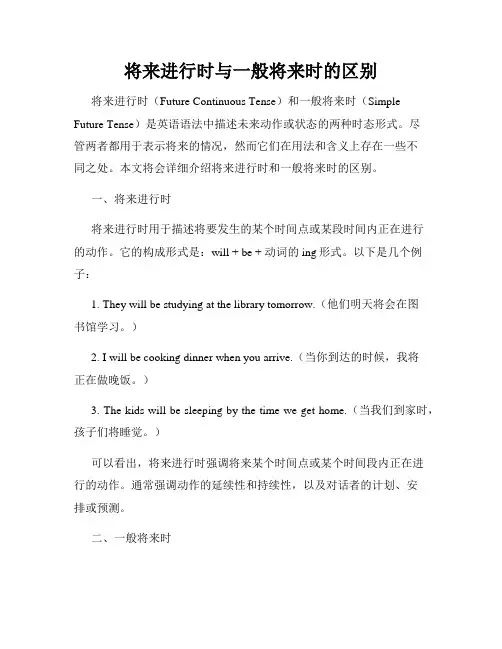
将来进行时与一般将来时的区别将来进行时(Future Continuous Tense)和一般将来时(Simple Future Tense)是英语语法中描述未来动作或状态的两种时态形式。
尽管两者都用于表示将来的情况,然而它们在用法和含义上存在一些不同之处。
本文将会详细介绍将来进行时和一般将来时的区别。
一、将来进行时将来进行时用于描述将要发生的某个时间点或某段时间内正在进行的动作。
它的构成形式是:will + be + 动词的ing形式。
以下是几个例子:1. They will be studying at the library tomorrow.(他们明天将会在图书馆学习。
)2. I will be cooking dinner when you arrive.(当你到达的时候,我将正在做晚饭。
)3. The kids will be sleeping by the time we get home.(当我们到家时,孩子们将睡觉。
)可以看出,将来进行时强调将来某个时间点或某个时间段内正在进行的动作。
通常强调动作的延续性和持续性,以及对话者的计划、安排或预测。
二、一般将来时一般将来时用于描述将来发生的动作或事件,通常没有强调动作的延续性或持续性。
它的构成形式是:will + 动词的原形。
以下是几个例子:1. I will visit my grandmother next week.(我下周会去看望我的奶奶。
)2. The concert will start at 8 PM tonight.(今晚音乐会将在8点开始。
)3. She will call you as soon as she arrives.(她一到就会给你打电话。
)可以看出,一般将来时用于描述将来某个时间发生的动作或事件,并没有强调动作的持续性。
通常表示意愿、承诺、预测、计划或预测。
三、1. 强调不同:将来进行时强调动作的持续性和延续性,而一般将来时则没有这种强调。
将来进行时与一般将来时的异同

将来进行时与一般将来时的异同将来进行时和一般将来时是英语中表示将来的两种时态。
尽管它们都表示将来的动作或状态,但它们在用法和意义上有一些不同之处。
本文将比较这两个时态的异同点。
一、将来进行时将来进行时表示将来某一时刻或时间段内正在进行的动作。
它的构成形式为“will be + 现在分词”。
1. 表示将来某一时刻的动作:例句:I will be studying for the exam tomorrow evening.(明天晚上我将在学习准备考试。
)2. 表示将来某一时间段内的动作:例句:At this time next week, we will be celebrating our anniversary.(下周的这个时候,我们将在庆祝我们的纪念日。
)将来进行时通常用来描述已经计划或决定要做的事情以及按照计划将要发生的事情。
二、一般将来时一般将来时表示将来的动作或状态,用于客观陈述或预测未来的事件。
它的构成形式为“will + 动词原形”。
1. 表示将来的动作:例句:He will visit his grandparents next month.(他下个月将拜访他的祖父母。
)2. 表示将来的状态:例句:She will be a doctor in the future.(她将来会成为一名医生。
)一般将来时常用来表示根据目前的情况或经验预测未来将要发生的事情。
三、1. 异同点:(1)时间表述:将来进行时通常使用某一具体时间点或时间段,而一般将来时一般没有具体时间表述。
例句:I will be attending a conference at 10 a.m. tomorrow.(明天上午10点我将参加一场会议。
)I will attend a conference in the future.(我将来会参加一场会议。
)(2)动作性质:将来进行时重点在于动作的进行过程,而一般将来时重点在于动作的结果或状态。
一般将来时和将来进行和过去将来
((CC)) to表i示nd过ic去at的e a安p排as或t 计arr划angement.
e.g. I was meeting him in town the next day.
((DD)) t表o 示m将ea来n 的tha事t 情th确e f实ut发ur生e a了ction actually happened.
2) —What are you going to do this afternoon?
—I am going to the cinema with some friends. The film _______ quite early, so we _______ to the bookstore after that. (NMET 2005年 重庆)
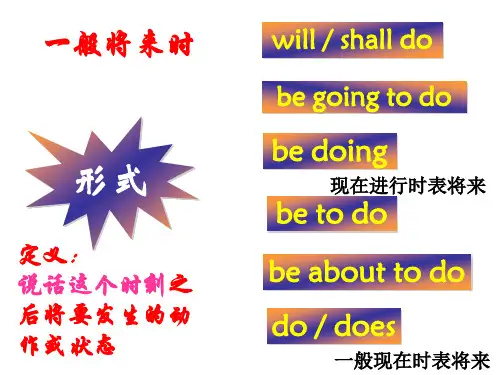
表示与安排,计划或时刻表有关的动作; 或用于if, when等状语从句中代替will do.
练习题
1. Don't cry.The sun __w_il_l_r_is_e___(rise) all the same tomorrow.
2. --Don't make such a mistake. --No.I ______. A.don't B.won't
A. finished; are going B. finished; go
C. finishes; are going D. finishes; go
3) Because the shop ________ , all the T-shirts are sold at half price. (NMET 2004年 浙江)
When will you come again?
新概念二:一般将来时_将来进行时_将来完成时练习

练习:一.单选题1. There __________ a meeting tomorrow afternoon.A. will be going toB. will going to beC. is going to beD. will go to be2. Charlie ________ here next month.A. isn’t workingB. doesn’t workingC. isn’t going to workingD. won’t work3. He ________ very busy this week, he ________ free next week.A. will be; isB. is; is /C. will be; will beD. is; will be4. There ________ a dolphin show in the zoo tomorrow evening.A. wasB. is going to haveC. will haveD. is going to be5. If it ________ tomorrow, we roller-skating.A. isn’t rain ,will goB. won’t rain , will goC. doesn’t rain,will goD. doesn’t fine ,go6.I won’t be able to attend the meeting tonight because____ then.A. I must have a classB. I will be teaching a classC. I teach a classD. I will have taught a class7. -----Could you give these books to Mr. Black?-----Absolutely, ___ him at five this afternoon.A. I will have a talk withB. I have a talk withC. I can have a talk withD. I will be having a talk with8. I’m afraid I won’t be available then. I ___ a friend at three this afternoon.A. seeB. am seeingC. will seeD. will be seeing9. Next Friday I to another concert. They ____ some thing by Mozart at that time.A.go, playB.will go , will be playingC. will go , are going to playD. are going ,are to play10. -----What are you doing, Jack?-----Make a model plane. I ____ it in the science class at 10 o’clock tomorrow morning.A. will be showingB. am going to showC. showD. have showed11. By the end of this year ,I ____enough money for a holiday.A will saveB will be savingC will have savedD have saved12. I have been studying here for four years,by next summer ____-.A shall graduateB shall be graduatedC shall be graduatingD shall have graduated13. I hope her health _______greatly by the time we come back next year.A improvesB improvedC will be improvedD will have improve14. “Are you going to Richard”s birthday party?…“Yes.By then I ______my homework..”A had finishedB will have finishedC would have finishedD finished15. I suppose by the time I come back in ten years‟ time all these old house______down.A will have been pulledB will be pullingC will have pulledD will be pulled二、翻译题1.当我明天早晨起床是,我妈妈将在为我准备早饭。
一般将来时,将来进行时,将来完成时
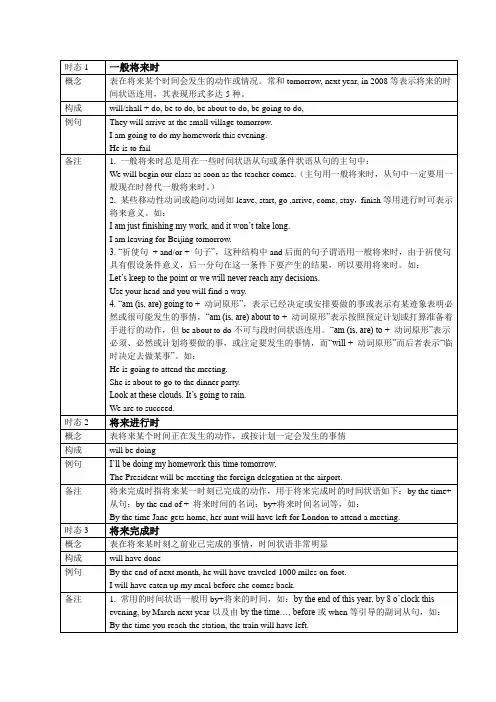
1.I won’t be able to attend the meeting tonight because____then.A. I must have a classB. I will be teaching a classC. I teach a classD. I will have taught a class2. -----Could you give these books to Mr. Black?-----Absolutely, ___ him at five this afternoon.A. I will have a talk withB. I have a talk withC. I can have a talk withD. I will be having a talk with3. I’m afraid I won’t be available then. I ___ a friend at three this afternoon.A. seeB. am seeingC. will seeD. will be seeing4. Next Friday I will go to another concert. They ____ some thing by Mozart at that time.A. playB. will be playingC. are going to playD. are to play5. -----What are you doing, Jack?-----Make a model plane. I ____ it in the science class at 10 o’clock tomorrow morning.A. will be showingB. am going to showC. showD. have showed1. 下星期这时候我们将在那个工厂劳动。
一般将来时、将来进行时、将来完成时
一般将来时:Will\ shall + 动词原形:1. 表将要发生的动作或存在的状态e.g: A: What would you like to drink?B: I’ll have an orange juice, please.2. 表示说话人对将来的看法、假定或推测e.g: I haven’t seen Carol today. I expect she’ll phone this evening.I think Sarah will like the present we bought her.I wonder what will happen.Tom won’t pass the examination. He hasn’t worked hard enough for it.I’ll probably be home late this evening.Tom will probably arrive at about 8 o’ clock.3. 用于祈使句+and/or+陈述句e.g:4. 用于时间状语、条件状语从句中e.g: The plate is very hot. If you touch it, you’ll burn yourself.If you study harder, you will make a progress.Will\shall 与be going to do 的区别:Will 强调在说话时打算去做某事,之前完全没有计划或决定。
Be going to do 强调在说话时已经计划好将要去做某事。
对比1:Sue is talking to Helen:Sue: Let’s have a party.Helen: That’s a great idea. I’ll invite lots of people.Later that day, Helen meets Dave:Helen: Sue and I have decided to have a party. We are going to invite lots of people.对比2:A: George phoned while you were out.B: Ok, I’ll phone him back.A: George phoned while you were out.B: Yes, I know. I’m going to phone him back.对比3:A: Ann is in hospital.B: Oh, really? I didn’t know. I’ll go and visit her.A: Ann is in hospital.B: Yes, I know. I’m going to visit her tomorrow.Will 强调个人对将来的事的预测Be going to do 强调根据客观现状推测或是确信即将要发生的事情。
将来进行时一般将来时
将来进行时VS 一般将来时1. 概念:将来进行时主要表示将来某一时间正在进行的动作,或表示要在将来某一时间开始,并继续下去的动作。
常用来表示礼貌的询问、请求等。
(1)如:This time next day they will be sitting in the cinema.What will you be doing at six tomorrow evening?I’ll be meeting him tomorrow/ some time.我明天/某个时间将去见他。
2)常用的时间状语:Soon, tomorrow, this evening,on Sunday, by this time,in two days, tomorrow eveningBy this time tomorrow, I'll be lying on the beach. 明天的这个时间,我将会海滩上。
2. 将来进行时的形式:将来进行时由“动词be的将来时+现在分词”构成,具体形式见下表:人称单数复数第一人称I shall/will be leaving. We shall/will be leaving.第二人称You will be leaving. You will be leaving.第三人称He/She/It will be leaving. They will be leaving.3. 将来进行时的基本用法:将来进行时表示在将来某一时间内正在进行的动作。
将来进行时有很强的推测性,因此人们往往在以下几种场合中使用它:★(1)表示将来某一时间正在进行的动作,一般带状语。
如:What will you be doing at this time next Monday? 星期一的这个时间你将干什么?When he comes to my house tomorrow, I will be writing the report.明天他来我家时,我将在写报告。
一般将来时、将来进行时、将来完成时
一般将来时/将来进行时/将来完成时一般将来时1.shall用于第一人称,常被will 所代替。
一是表示预见,二是表示意图.will 在陈述句中用于各人称,在征求意见时常用于第二人称。
Which paragraph shall I read first?Will you be at home at seven this evening?2.be going to +v.,表示将来。
1)主语的意图,即将做某事。
What are you going to do tomorrow?2)计划、安排要发生的事。
The play is going to be produced next month.3)有迹象要发生的事。
Look at the dark clouds, there is going to be a storm.3.be +to+v.表将来,按计划或正式安排将发生的事。
We are to discuss the report next Saturday.4.be about to +v.,意为马上做某事。
He is about to leave for Beijing.5. 一般现在时表将来1)下列动词:come, go, arrive, leave, start, begin, return的一般现在时表将来。
这主要用来表示在时间上已确定或安排好的事情。
The train leaves at six tomorrow morning.When does the bus stars? It stars in ten minutes.2)在时间或条件句中。
When Bill comes (不是will come), ask him to wait for me.I ’ll write to you as soon as I arrive there.6. 用现在进行时表示将来主要意义是表示按计划、安排即将发生的动作,常用于位置转移的动词。
英语所有时态结构
英语所有时态结构
英语的时态主要有12 种,以下是它们的基本结构:
1. 一般现在时:主语+ 动词原形(第三人称单数形式)
2. 一般过去时:主语+ 动词过去式
3. 一般将来时:主语+ will/shall + 动词原形
4. 现在进行时:主语+ am/is/are + 现在分词
5. 过去进行时:主语+ was/were + 现在分词
6. 将来进行时:主语+ will/shall + be + 现在分词
7. 现在完成时:主语+ have/has + 过去分词
8. 过去完成时:主语+ had + 过去分词
9. 将来完成时:主语+ will/shall + have + 过去分词
10. 现在完成进行时:主语+ have/has + been + 现在分词
11. 过去完成进行时:主语+ had + been + 现在分词
12. 将来完成进行时:主语+ will/shall + have + been + 现在分词。