
人教版九年级英语unit3知识点,单词讲解
人教版新目标英语9年级全册讲解-Unit 3Unit 3 Teenagers should be allowed to choose their own clothes.重点、难点、考点及疑点注释1. I don’t think twelve-year-olds should be allowed to get their earspierced. (P18)我认为不应该允许12岁的孩子穿耳孔。
(1)当主句的主语是第一人称I或we,谓语动词是think, believe, suppose,guess等词时,其后的从句不能是含有not的否定句;若要否定,须将not提到主句。
在翻译时,按汉语习惯译作否定从句。
例如:“我想他不会给你打电话的”应译为I don’t think he will give you a call而不是I think he won’t give you a call。
特别提示若把此类句式变成反意疑问句,其助动词及主语要根据从句确定,而肯定/否定则要根据主句来确定。
We think you can help him, can’t you? 我们认为你能帮助他,不是吗?I don’t think he is a good student, is he? 我认为他不是个好学生,对吗?(2)本句中的twelve-year-olds相当于twelve-year-old teenagers,意为“12岁的孩子/年轻人”。
知识拓展数词和一个相应的名词单数用“-”连接起来,可以构成一个合成形容词。
常见的还有:two-month holiday 两个月的假期a sixty-pound stone 一块60磅的石头(3)get their ears pierced属于“get+名词/代词+动词的过去分词”结构,表示“使……被做”,“请人做……”。
Go and get your hair cut! 你去理理发吧。
Why haven’t you got the work done yet? 你为什么还不叫人把活干了呢?2. I disagree. (P19)我不同意。
I agree. (P19)我同意。
(1)agree意为“赞成,同意”,用来表示同意某人的意见、观点等;可以单独使用,也可以接由with, to, on等引导的介词短语或接从句。
—Shall we go to the zoo tomorrow? 我们明天去动物园,好吗?—I agree. 我同意。
I quite agree with you. 我完全赞成你的意见。
Do you agree on this plan? 你同意这个计划吗?知识拓展agree with, agree to和agree on都表示“同意”,但用法不同。
◎agree with表示“同意”,后面接表示人的名词或代词,也可以接表示“意见,看法”的名词。
We all agree with him. 我们都同意他的意见。
Do you agree with my ideas? 你同意我的观点吗?◎agree to表示“同意”,后面接表示“计划,建议,安排”等的名词,接动词原形时构成动词不定式结构。
He agreed to our plan at last. 最后他同意了我们的计划。
They agreed to come on Monday. 他们同意星期一来。
◎agreeon表示“(两人以上)就……取得一致意见,在……方面意见一致”,其主语多为复数形式,宾语是表示事、计划等的名词,而不是表示人的名词或代词,它可以与agree in doing sth替换。
They agreed on the plan.=They agreed in doing the plan. 他们对这个计划意见一致。
特别提示agree with也可以表示“某人适应(食物、气候等)”。
The weather doesn’t agree with me. 我不适应这种天气。
(2)disagree是agree的反义词,相当于not agree。
3. They talk instead of doing homework. (P19)他们会说话而不做作业。
本句中的instead of是复合介词,意思是“代替”,后面往往接名词、代词、动名词或介词短语, of后面的内容是被否定的。
I want that book instead of this one. 我要那本书而不是这本。
We went to swim instead of playing basketball.我们没有去打篮球,而是去游泳了。
特别提示副词instead和instead of意思相同,但用法却不同。
instead意为“代替,顶替”,常位于句首或句末,可不译。
I didn’t go to cinema. Instead, I went to go shopping.我没有去看电影,我去购物了。
The water here is not good, so I drink coffee instead.这里的水不好,所以我改喝咖啡。
4. Find someone who is allowed to stay up until 11∶00 pm. (P20)找出被允许熬夜到11点的人。
(1)who is allowed to stay up until 11∶00 pm是一个定语从句,用来修饰前面的someone。
The man who is smoking is my father. 正在抽烟的那个人是我的父亲。
The foreigner who visited our class is from Canada.访问我们班的那个外国人来自加拿大。
(2)stay up在这里是“熬夜”,“不睡觉”的意思,相当于not go to bed。
He stayed up too late last night. 他昨天晚上熬夜到很晚。
She promised the children they could stay up for homework.她承诺孩子们可以熬夜做作业。
5. Do you ever worry that you’ll fail a test? (P21)你曾经担心过考试不及格吗?fail表示考试“不及格”或“不通过”,相当于not pass。
I think I may fail in the English exam this time.我想这次英语考试我可能不及格。
6. Parents should not be too strict with teenagers. (P21)父母对青少年不应该要求太严格。
形容词strict是“严格的”,“严厉的”的意思,对人严格时用介词with,对工作等严格时用介词in。
The teacher was very strict with his students. 这位老师对学生非常严厉。
He is always strict in his work. 他总是对工作要求很严格。
7. The other day, my friends and I talked about the rules that we havein school. (P22)那天,我和我的朋友们谈论我们学校的各种规章制度。
(1)the other day表示“几天以前,不久前的一天”。
I saw him in the street the other day. 不久前的一天,我在街上看到了他。
Li Ming and I went shopping the other day. 几天以前我和李明去购物了。
(3)本句中的get to意为“开始,着手”,后面接动词的-ing形式,表示“着手或开始做某事”。
We get to working after a short rest. 我们歇息了一会儿后就开始干起活来。
He got to wondering why he was in the job.他对自己为什么会从事这份工作感到诧异。
8. We think young people should look smart and so we would like to wearour own clothes. (P22)我们想年轻人应该看起来漂亮潇洒,因此我们想穿自己的衣服。
(1)形容词smart意为“聪明的,机敏的,精明的”,相当于clever。
The dolphin is a smart animal. 海豚是聪明的动物。
He looks very smart in his suit. 他穿上他的西装看起来很帅气。
(2)would like意为“想要”,相当于want,后面接名词或动词不定式。
I would like a cup of coffee. 我想要杯咖啡。
I di dn’t want to go to the cinema. I would like to stay at home.我不想去看电影,我想呆在家里。
◎ would like sb to do sth表示“想要某人做某事”。
I’d like you to help me with my homework. 我想要你帮助我做家庭作业。
特别提示feel like也可以译为“想要”,有时可以与would like替换;其后接名词或动词的-ing 形式。
She feels like a good meal. 她想美美地吃一顿。
I feel like seeing a film tonight. 我今晚想去看电影。
9. Our teachers believe that if we did that, we would concentrate moreon our clothes than our studies.(P22)我们老师相信,如果我们那样做了,我们就会将注意力更多地集中在服装上,而不是学习上。
(1)believe是及物动词,意为“相信”,其后可跟名词或从句。
I don’t believe his story. 我不相信他的故事。
I believe he told us the truth. 我认为他告诉我们的是真的。
◎believe in表示“信任”(即trust)。
She doesn’t believe in God. 她不信奉上帝。
(2)在that if...的句中,that放在believe后面用来引导一个宾语从句,而if则在宾语从句中引导一个条件状语从句,wewould...则是宾语从句中的主句。
We are sure that if they come on time, they won’t be in the rain.我们都确信,如果他们准时到的话,就不会被雨淋了。
人教版九年级英语上册(Unit3单词 短语 句式 知识梳理 精讲)
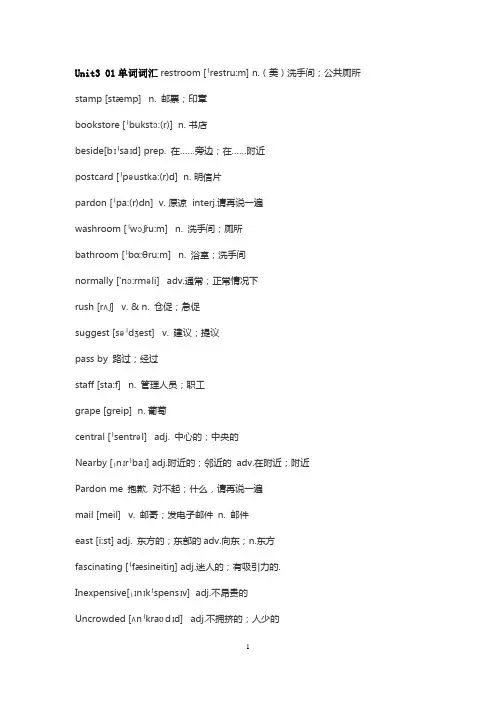
Unit3 01单词词汇restroom [ˈrestru:m] n.(美)洗手间;公共厕所stamp [stæmp]n. 邮票;印章bookstore [ˈbukstɔ:(r)] n. 书店beside[bɪˈsaɪd] prep. 在……旁边;在……附近postcard [ˈpəustka:(r)d] n. 明信片pardon [ˈpa:(r)dn] v. 原谅 interj.请再说一遍washroom [ˈwɔʃru:m] n. 洗手间;厕所bathroom [ˈbɑ:θru:m] n. 浴室;洗手间normally ['nɔ:rməli] adv.通常;正常情况下rush [rʌʃ] v. & n. 仓促;急促suggest [səˈdʒest] v. 建议;提议pass by 路过;经过staff [sta:f] n. 管理人员;职工grape [greip] n. 葡萄central [ˈsentrəl] adj. 中心的;中央的Nearby [ˌnɪrˈbaɪ] adj.附近的;邻近的adv.在附近;附近Pardon me 抱歉, 对不起;什么,请再说一遍mail [meil] v. 邮寄;发电子邮件n. 邮件east [i:st] adj. 东方的;东部的adv.向东;n.东方fascinating [ˈfæsineitiŋ] adj.迷人的;有吸引力的.Inexpensive[ˌɪnɪkˈspensɪv] adj.不昂贵的Uncrowded [ʌnˈkraʊdɪd] adj.不拥挤的;人少的convenient [kənˈvi:niənt] adj. 便利的;方便的mall [mɔ:l] n. 商场;购物中心clerk [kla:k][kl:rk] n. 职员corner [ˈkɔ:(r)nə(r)] n. 拐角;角落politely [pəˈlaitli] adv. 礼貌地;客气地request [riˈkwest] n. 要求;请求direction [diˈrekʃn] [daiˈrekʃn] n. 方向;方位correct [kəˈrekt] adj. 正确的;恰当的polite [pəˈlait] adj. 有礼貌的;客气的. direct [diˈrekt, daiˈrekt] adj. 直接的;直率的. speaker [ˈspi:kə] n.讲(某种语言)的人;发言者whom [hu:m] pron. 谁;什么人impolite [ˌɪmpəˈlaɪt] adj. 不礼貌的;粗鲁的address [əˈdres], [ˈædres] n.住址;地址;通讯处. Underground [ˈʌndəɡraʊnd] adj.地下的;n.地铁Parking lot n.停车场course [kɔ:(r)s] n. 课程;学科Italian [Iˈtæli ən] adj.意大利\人的;n.意大利人\语Tim [tim] 蒂姆(男名)。
新人教版九年级unit3核心知识点解读

新人教版九年级unit3核心知识点解读新人教版九年级Unit3核心知识点解读本文档旨在解读新人教版九年级英语教材Unit3的核心知识点,帮助学生更好地理解和掌握相关内容。
1. 词汇- 单词部分:本单元涉及了许多与旅行和交通相关的单词,如travel, destination, vehicle等。
学生在研究过程中应重点记忆和灵活运用这些单词。
- 短语部分:本单元还包括了一些常用的短语,如get on/off, take a trip, means of transportation等。
学生需要掌握这些短语的用法和意思。
2. 语法- 本单元的语法重点是一般现在时和一般过去时的用法。
学生应该了解并能正确运用这两个时态,以描述旅行经历和过去事件。
- 另外,本单元还涉及了一些其他语法知识,如形容词比较级和最高级的用法,以及时间状语从句的引导词when和before的用法。
3. 阅读技巧- 本单元的阅读部分包含了一篇旅行日记和一篇介绍旅行方式的文章。
学生在阅读时应注意理解文章的主旨和要点,以及从上下文中推测词义和理解隐含信息的能力。
4. 口语表达- 本单元设有口语练环节,学生可以通过角色扮演和对话练等方式提高口语表达能力。
在练口语时,学生应注意正确运用本单元的词汇和语法知识。
5. 写作技巧- 本单元的写作任务要求学生写一篇关于自己最喜欢的交通工具的文章。
学生需要运用所学的语言知识和写作技巧,如使用形容词和副词进行描述,并注意句子的连贯性和语法准确性。
以上是对新人教版九年级Unit3核心知识点的简要解读。
希望学生能通过学习和练习,掌握这些知识点,提升英语学习的能力和水平。
九年级英语人教版unit3笔记
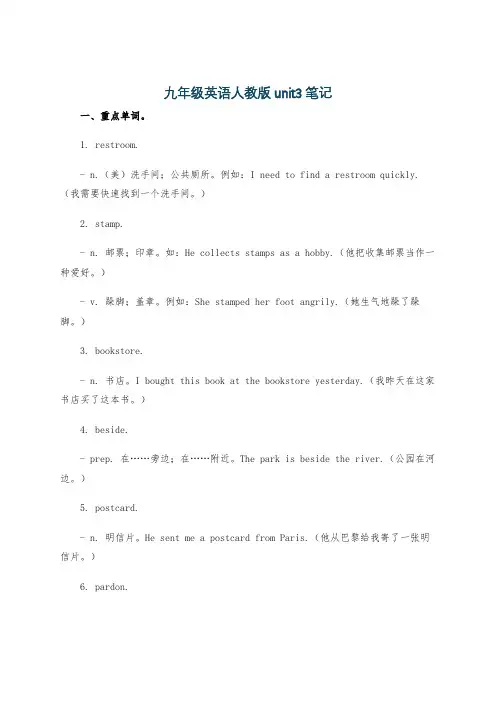
九年级英语人教版unit3笔记一、重点单词。
1. restroom.- n.(美)洗手间;公共厕所。
例如:I need to find a restroom quickly.(我需要快速找到一个洗手间。
)2. stamp.- n. 邮票;印章。
如:He collects stamps as a hobby.(他把收集邮票当作一种爱好。
)- v. 跺脚;盖章。
例如:She stamped her foot angrily.(她生气地跺了跺脚。
)3. bookstore.- n. 书店。
I bought this book at the bookstore yesterday.(我昨天在这家书店买了这本书。
)4. beside.- prep. 在……旁边;在……附近。
The park is beside the river.(公园在河边。
)5. postcard.- n. 明信片。
He sent me a postcard from Paris.(他从巴黎给我寄了一张明信片。
)6. pardon.- v. 原谅;请再说一遍。
Pardon me, I didn't catch your words.(对不起,我没听清你的话。
)- n. 原谅;宽恕。
I beg your pardon for being late.(请原谅我迟到了。
)7. washroom.- n. 洗手间;厕所(同restroom,比较口语化)。
Can you tell me where the washroom is?(你能告诉我洗手间在哪里吗?)8. bathroom.- n. 浴室;洗手间。
There is a bathtub in the bathroom.(浴室里有一个浴缸。
)9. normal.- adj. 正常的;一般的。
It's normal to feel nervous before an exam.(考试前感到紧张是正常的。
人教版九年级英语Unit3单词、课文知识梳理,词汇句式精讲
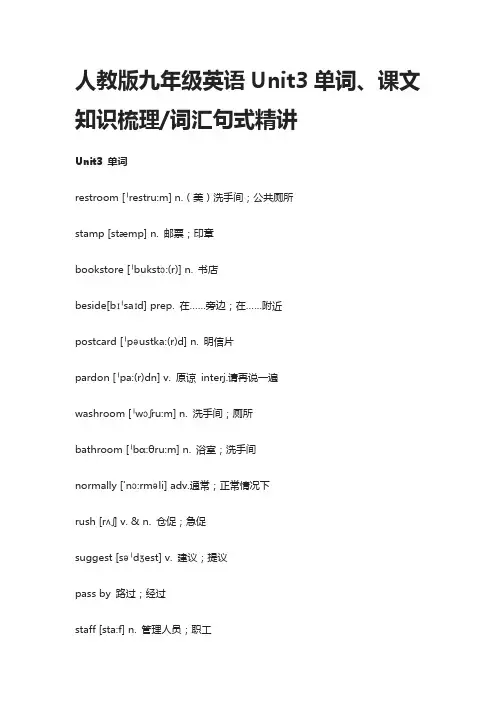
人教版九年级英语Unit3单词、课文知识梳理/词汇句式精讲Unit3 单词restroom [ˈrestru:m] n.(美)洗手间;公共厕所stamp [stæmp] n. 邮票;印章bookstore [ˈbukstɔ:(r)] n. 书店beside[bɪˈsaɪd] prep. 在……旁边;在……附近postcard [ˈpəustka:(r)d] n. 明信片pardon [ˈpa:(r)dn] v. 原谅interj.请再说一遍washroom [ˈwɔʃru:m] n. 洗手间;厕所bathroom [ˈbɑ:θru:m] n. 浴室;洗手间normally ['nɔ:rməli] adv.通常;正常情况下rush [rʌʃ] v. & n. 仓促;急促suggest [səˈdʒest] v. 建议;提议pass by 路过;经过staff [sta:f] n. 管理人员;职工grape [greip] n. 葡萄central [ˈsentrəl] adj. 中心的;中央的Nearby [ˌnɪrˈbaɪ] adj.附近的;邻近的adv.在附近;附近Pardon me 抱歉, 对不起;什么,请再说一遍mail [meil] v. 邮寄;发电子邮件n. 邮件east [i:st] adj. 东方的;东部的adv.向东;n.东方fascinating [ˈfæsineitiŋ] adj.迷人的;有吸引力的. Inexpensive[ˌɪnɪkˈspensɪv] adj.不昂贵的Uncrowded [ʌnˈkraʊdɪd] adj.不拥挤的;人少的convenient [kənˈvi:niənt] adj. 便利的;方便的mall [mɔ:l] n. 商场;购物中心clerk [kla:k][kl:rk] n. 职员corner [ˈkɔ:(r)nə(r)] n. 拐角;角落politely [pəˈlaitli] adv. 礼貌地;客气地request [riˈkwest] n. 要求;请求direction [diˈrekʃn] [daiˈrekʃn] n. 方向;方位correct [kəˈrekt] adj. 正确的;恰当的polite [pəˈlait] adj. 有礼貌的;客气的. direct [diˈrekt, daiˈrekt] adj. 直接的;直率的. speaker [ˈspi:kə] n.讲(某种语言)的人;发言者whom [hu:m] pron. 谁;什么人impolite [ˌɪmpəˈlaɪt] adj. 不礼貌的;粗鲁的address [əˈdres], [ˈædres] n.住址;地址;通讯处. Underground [ˈʌndəɡraʊnd] adj.地下的;n.地铁Parking lot n.停车场course [kɔ:(r)s] n. 课程;学科Italian [Iˈtæli ən] adj.意大利\人的;n.意大利人\语Tim [tim] 蒂姆(男名)Unit3 知识梳理【重点短语】1.a pair of 一对,一双,一副2.between A and B 在a和b之间3.on one’s / the way to 在去……的路上4.pardon me 什么,请再说一遍5.pass by 路过经过6.look forward to 盼望期待7.excuse me 打扰了请原谅8.get some information about 获取有关……的一些信息9.turn left\right 向左\向右转10.go past 经过路过11.a little earlier 早一点儿12.a good place to eat 一个吃饭的好地方13.in different situation 在不同的情况下14.on time 准时按时15.get to 到达16.have dinner 吃晚餐17.on one’s / \the right在右边e on 快点请过来19.the shopping center 购物中心20.the corner of....... 的角落/拐角处21.lead into 导入,引入【重点句型】1.问路常用的句子:①Do you know where is …?②Can you tell me how can I get to …?③Could you tell me how to get to …?④Could/Will/Would you please tell me sth.表示十分客气地询问事情Could you tell me how to get to the park?请你告诉我怎么才能去邮局好吗?2. decide to do 决定做…...She decided to go to have lunch. 她决定去吃午餐。
人教版九年级英语Unit3知识点总结
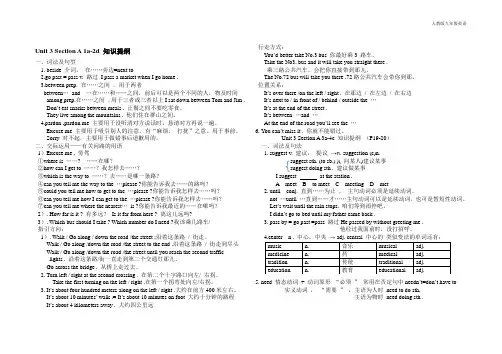
Unit 3 Section A 1a-2d 知识提纲一、词法及句型1. beside 介词,在……旁边=next to2.go past = pass v. 路过I pass a market when I go home .3.between prep. 在……之间,用于两者between…and …在……和……之间,前后可以是两个不同的人,物及时间among prep.在……之间,用于三者或三者以上I sat down between Tom and Jim .Don’t eat snacks between meals . 正餐之间不要吃零食。
They live among the mountains . 他们住在群山之间。
4.pardon ,pardon me 主要用于没听清对方说话时,恳请对方再说一遍。
Excuse me 主要用于吸引别人的注意,有“麻烦,打扰”之意。
用于事前。
Sorry 对不起,主要用于做错事后道歉用的。
二、交际运用——有关问路的用语1)Excuse me , 劳驾①where is ……? ……在哪?②how can I get to ……?我怎样去……?③which is the way to ……?去……是哪一条路?④can you tell me the way to the …please ?你能告诉我去……的路吗?⑤could you tell me how to get to the …please ?你能告诉我怎样去……吗?⑥can you tell me how I can get to the …please ?你能告诉我怎样去……吗?⑦can you tell me where the nearest…is ?你能告诉我最近的……在哪吗?2). How far is it ? 有多远?Is it far from here ? 离这儿远吗?3). Which bus should I take ? Which number do I need ?我该乘几路车/指引方向:1). Walk / Go along / down the road /the street ;沿着这条路/ 街走。
人教版英语九年级全册Unit3 易混淆单词和短语辨析
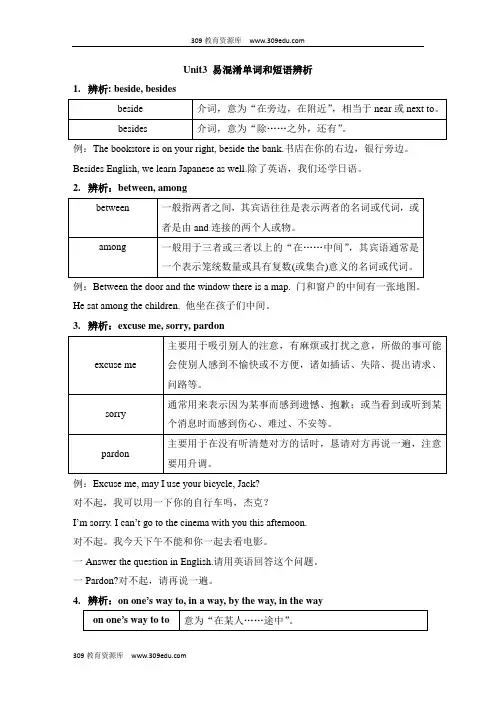
Unit3 易混淆单词和短语辨析1.辨析: beside, besides例:The bookstore is on your right, beside the bank.书店在你的右边,银行旁边。
Besides English, we learn Japanese as well.除了英语,我们还学日语。
2.辨析:between, among例:Between the door and the window there is a map. 门和窗户的中间有一张地图。
He sat among the children. 他坐在孩子们中间。
3.辨析:excuse me, sorry, pardon例:Excuse me, may I use your bicycle, Jack?对不起,我可以用一下你的自行车吗,杰克?I’m sorry. I can’t go to the cinema with you this afternoon.对不起。
我今天下午不能和你一起去看电影。
一Answer the question in English.请用英语回答这个问题。
一Pardon?对不起,请再说一遍。
4.辨析:on one’s way to, in a way, by the way, in the way例:I met an old friend of mine on my way to the station.在去车站的途中,我碰见了我的一位老朋友。
You are right in a way. 在某种程度上你是正确的。
By the way, could you tell me how much it is?顺便问一下,这个东西多少钱?Your car is in the way.你的小汽车挡路了。
5.辨析:scary, scared例:The movie is really scar这电影真恐怖。
人教版英语九年级Unit 3 重点知识归纳及讲解
九年级上Unit 3知识清单Section A一、重点短语1. get some magazines/stamps买些杂志/邮票2. a pair of shoes 一双鞋3. ask for the information about the town 询问关于这个小镇的消息4. pass (by) a bookstore = go past/by a bookstore 走过一家书店5.beside the back = next to/ at the side of the bank 在银行旁边6. go to the second floor 去二楼7. get some postcards 买一些卡片8. try the rides 尝试些乘骑项目9. go on sth继续某事10.be excited to do sth兴奋地做某事be excited about sth/doing sth.11. start with = begin with 以...开始end with 以…结束12. hold my hand 抓住我的手13. come on 加油;得了吧14. walk up to 走向15. go east along 沿着…(向东)走16. on one’s way to sp在去某地的路上17. get angry 饿了18. at the door 在门口19. mail a letter 寄封信20. the Italian restaurant nearby 附近的意大利餐馆二、重点句型1. I was scared first, but shouting did help. 该句话中, “did”的用法是助动词表强调,起加强语气的作用。
同类例句如:I’m not joking, we did go camping last weekend. The summer holiday does start next Monday.2. 英语常见问路/指路表达方式:1) 问路Excuse me/Pardon me, where is the nearest post office?Excuse me, which is the way to the nearest post office?Excuse me/Pardon me, can/could you (please) tell me the way to the post office?Excuse me/Pardon me, how can I get to the nearest post office?Could you please possibly tell me how to get to the library?Excuse me/Pardon me, do you know if there’s a post office around here?Would you please tell me if there is a bank nearby?I wonder +…可加以上所有句型。
人教版九年级上册英语unit3知识点
人教版九年级上册英语unit3知识点九年级上册英语Unit 3知识点如今,学习英语对于我们来说已经变得非常重要。
而九年级上册的英语课程中,Unit 3是一个非常重要的单元,涵盖了很多基础知识点。
本文将结合这些知识点,系统地进行讲解,帮助大家更好地理解和掌握这些内容。
一、单词掌握Unit 3中有许多重要的单词需要我们掌握。
比如,climate(气候),crop(庄稼),fertilizer(肥料),organic(有机的),insect(昆虫)等等。
这些词汇在学习农业和环境方面的内容时非常重要。
我们可以通过课本的记忆技巧和词句搭配的学习方法来记忆和巩固这些单词。
二、句型构造除了单词,句型构造也是我们在学习英语时需要掌握的重要技能。
本单元主要涉及到的句型是"I think"和"It depends"的用法。
我们可以通过阅读课本上的例句和语法练习来掌握这两个常用表达方式。
三、课文理解课本上的课文内容是我们学习英语的重要资源。
在Unit 3中,我们需要理解和掌握关于农业和环境保护的内容。
通过课文的阅读和理解,我们可以了解到农业对于气候和环境的影响,以及如何保护环境。
四、语法知识语法知识在学习英语中非常重要。
在Unit 3中,我们主要学习到了被动语态的用法和时间状语从句的引导词。
被动语态的用法需要我们掌握动词的不同形态,并理解不同句子成分之间的关系。
而时间状语从句的引导词则需要我们记忆和熟练使用。
五、听力技巧提高听力技巧是学习英语的重要环节。
在Unit 3中,我们需要通过听力来理解和回答问题。
为了提高听力技巧,我们可以通过多听英语语音材料,如录音和视频,多做听力练习,增强对不同语速和语调的理解。
六、写作技巧写作是英语学习的重要能力之一。
在Unit 3中,我们可以通过写作来表达对农业和环境问题的看法。
为了提高写作技巧,我们可以多读一些相关的文章,积累一些词汇和表达方式,并多做写作练习来提高自己的写作水平。
人教版英语九年级 第3单元 单词短语及用法
去三楼
get some magazines get a dictionary
尝试乘玩项目 抱歉,对不起;什么,请再说一遍
得到一本字典 买一双鞋
get a pair of shoes pass by
路过;经过
go past
经过;路过
get some information about ... 获取有关……的一些信息
/bɪ'saɪd/ prep.在旁边;在附近 /'pəʊstkɑːd/ n. 明信片 /'pɑːdn/ v.原谅 interj.请再说一遍 /'wɒʃruːm/ n. 洗手间;厕所 /'bɑːθruːm/ n. 浴室;洗手间 /'nɔːməl/ adv.通常;正常情况下
postcard pardon
Unit 3 could you please tell me where the restrooms are? A 一、单词 restroom stamp
/'restruːm/ n.(美)洗手间;公共厕所
rush
/rʌʃ/ v. & n. 仓促;急促 /sə'dʒest/ v. 建议;提议
/stæmp/ n. 邮票;印章 /'bʊkstɔː(r)/ n.书店
当然,但是我真的饿了,你知道我们可以从哪里很快得到一些好吃吃的食物吗?
walk up 走近;走上
Alice and He Wei walk up to a staff person at the door.
艾丽斯和何伟走到门口的一名工作人员的面前。
down the street 沿着这条街道走下去
washroom bathroom normally
人教版九年级全一册英语Unit3单元语法知识点总结
人教版九年级全一册英语Unit3单元语法知识点总结本单元重点短语的具体用法1. a pair of:“一对,一双,一副”,用于表示两个相同或相关的物品。
例如:I need a pair of shoes for the party.(我需要一双参加派对的鞋子。
)2. between A and B:“在A 和B 之间”,用于描述两者之间的关系或位置。
例如:The library is between the school and the hospital.(图书馆在学校和医院之间。
)3. on one's / the way to:“在去……的路上”,表示正在前往某个地点的过程中。
例如:I saw a beautiful flower on my way to school.(我在去学校的路上看到了一朵美丽的花。
)4. pardon me:“什么,请再说一遍”,用于请求对方重复或澄清刚才说的话。
例如:Pardon me, I didn't catch what you said.(请再说一遍,我没听清你说的。
)5. pass by:“路过,经过”,指从某个地方经过但不做停留。
例如:I pass by the park every day on my way to work.(我每天上班路过公园。
)6. look forward to:“盼望,期待”,后面接名词或动名词,表示对某件事情的期待。
例如:I'm looking forward to seeing you again.(我期待再次见到你。
)7. excuse me:“打扰了,请原谅”,用于引起别人的注意或表示歉意。
例如:Excuse me, could you open the door for me?(打扰一下,你能帮我开一下门吗?)8. get some information about:“获取有关……的一些信息”,用于表示获取关于某个主题的信息。