
Unit 4 Body language 教学设计 教案
教学准备
1. 教学目标
主要教学目标有两个:
1.成功导入单元中心话题“body language”
2.阅读课文“Communication :no problem?”找出不同文化信息及两个文化差错。
2. 教学重点/难点
主要教学目标有两个:
1.成功导入单元中心话题“body language”
2.阅读课文“Communication :no problem?”找出不同文化信息及两个文化差错。
3. 教学用具
4. 标签
教学过程
Step 1 Warming-upand lead-in (5 mins)
教师设计一些小活动和学生进行互动,了解学生对肢体语言一些基本情况的熟
悉程度,以此导入到本课的课题。
活动 1 利用四张图片进行师生对话,引入肢体语言表达方式:脸部表情,手势,动作等。
活动2 师生一起做TPR(TotalPhysical Response) 活动。
目的在于复习一些身体部位的表达方法,为接下去的活动做好准备。
活动3 推荐四组学生上台根据图片提示做动作,让全班同学猜出它们的意思,
进行全班互动。
活跃课堂气氛的同时,传达肢体语言在生活中的作用。
Activity 1:Theteacher shows some pictures on screen.
T:What does these pictures mean?
Ss:crying,laughing,it’shappy/…,they are excited (to celebrate
their success.)
T: Great!
Activity 2:
T: Now let’s do some TPR (Total Physical Response)activities together, I hope you will enjoy them and have fun as well.
(the whole classtogether)Touch your head / face / eyes / nose / mouth / ears / cheeks /forehead / shoulders / stomach / legs / feet /
toes ...
(some students tocome to perform)
Shake your head /arm / hand ...
Close your eyes /mouth ...
Open your eyes /arms /mouth ...
Nod your head.
Some students to come to perform.
1.Shake somebody’shands.
2.Touch the other’sshoulder.
3. Cross your arms.
4.Make a face toeach other.
5. Dance as youlike .
Step 2 Reading (20 mins)
1. Warming-up
利用教材SBP25 Warming-upEx.1所提供图片,两两对话。
猜测每幅图片所提供人物肢体语言所表达的意思
T:It’s time to take up the lesson. Please look at thescreen.
Look at thepictuers below. What are these people communicating? Discuss with your partner.Do you both have the same idea about each picture? (SB P25Warming-Up Ex.1)
(Picture 1 The woman is trying to quiet the crying child.
Picture 2 He is thinking deeply.
Picture 3 She is feeling ill /sick.
Picture4 The policeman is telling cars to go.
2.Pre-reading
提出两个问题,让学生思考“语言”的用途。
(1).What do you think is the purpose oflanguage?(To communicate with each other.)
(2).How can youcommunicate with someone if you cannot speak? Give an example.(e.g.You want tobuy a tooth-brush/a watermelon/a pen/a CD…)
总结出“语言”的表达方式:We can communicate through writing, typing or gesturing.
Ways ofcommunicating
speaking
ringing
/calling
writing
typing
gesturing
总结什么是肢体语言What is body language?
What is bodylanguage?
Body language is one form of nonverbal ______________(交流) without usingwords. Eye contact or gaze, facial____________, gestures, and
__________ (姿势), or the way youstand, are different kinds of body language.
Reading Communication: No problem?
Reading- I (5m)Read the text quickly and try to find whothey are and where they are from.
Reading –II ( 3m )
When: __________________________
Who: ______________________________
Where: _______________________________
What to do: ____________________________
Reading – III ( 7m )
Find out the two mistakes the writer found in the airport:
The first mistake
The second mistake
Reading -IV ( 5m )
1.Read the text again and then finish the following form:
2.Matching the people and their different ways of greeting (para2&5)
Homework:
1. Recite the new words in the text.
2.Finish “Learning about language” on P28-29。
高中英语必修四《Bodylanguage》教案设计
高中英语必修四《Body Language》教案设计一、教学目标1.知识目标:o学生能够掌握并识别至少10种常见的肢体语言信号及其含义。
o学生能够理解不同文化背景下肢体语言的差异和共性。
o学生能够运用所学词汇和句型描述和分析肢体语言在不同情境中的应用。
2.能力目标:o提高学生的跨文化交际能力,使其能在国际交流中准确解读他人肢体语言。
o培养学生的观察力和分析能力,通过观察视频或实际场景中的肢体语言,推断交流者的情绪和意图。
o增强学生的口语表达能力,使其能用英语流畅地讨论肢体语言的相关话题。
3.情感态度价值观目标:o培养学生尊重多元文化,理解并接纳不同文化中的肢体语言习惯。
o激发学生对非言语交流的兴趣,认识到肢体语言在日常沟通中的重要性。
o鼓励学生积极参与课堂互动,培养合作学习的精神。
二、教学内容-重点内容:肢体语言的基本概念、常见肢体语言信号及其含义、文化差异对肢体语言的影响。
-难点内容:如何在具体情境中准确识别并解读复杂的肢体语言信号,以及如何在跨文化交流中有效运用肢体语言。
三、教学方法-讲授法:介绍肢体语言的基本概念和理论知识。
-讨论法:分组讨论不同文化背景下肢体语言的差异,分享个人经验。
-案例分析法:通过观看视频片段,分析具体情境中的肢体语言。
-多媒体教学:利用、视频和音频资源,丰富教学内容,提高学生的学习兴趣。
四、教学资源-教材:《高中英语必修四》-教具:多媒体投影仪、电脑-多媒体资源:肢体语言相关视频、课件、音频材料-实验器材:无五、教学过程六、课堂管理1.小组讨论:每组分配明确的任务,确保每位学生都有参与机会。
设定时间限制,避免讨论偏离主题。
2.维持课堂纪律:通过设定课堂规则,如举手发言、尊重他人意见等,维持良好的课堂秩序。
3.激励学生:对积极参与课堂活动和表现突出的学生给予表扬,激发学生的积极性和参与热情。
七、评价与反馈1.课堂小测验:通过选择题或填空题的形式,测试学生对肢体语言基本知识的掌握情况。
Unit4BodyLanguage教案人教必修四.doc
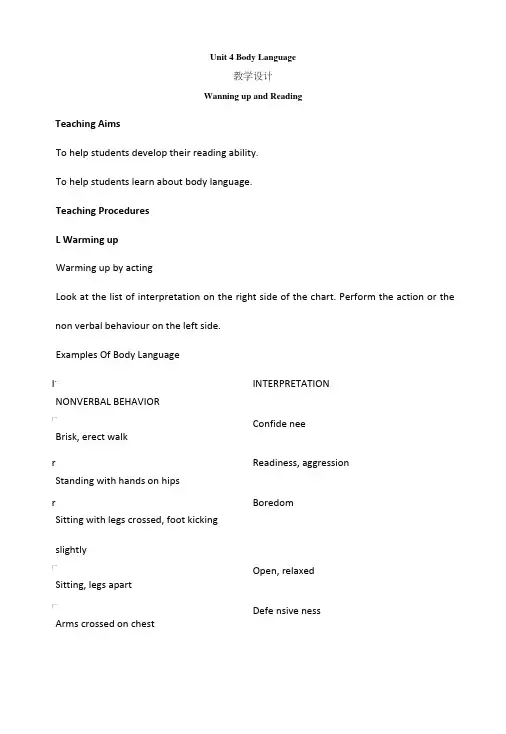
Unit 4 Body Language教学设计Wanning up and ReadingTeaching AimsTo help students develop their reading ability.To help students learn about body language.Teaching ProceduresL Warming upWarming up by actingLook at the list of interpretation on the right side of the chart. Perform the action or the non verbal behaviour on the left side.Examples Of Body LanguageI-INTERPRETATIONNONVERBAL BEHAVIOR厂Confide neeBrisk, erect walkrReadiness, aggressionStanding with hands on hipsrBoredomSitting with legs crossed, foot kickingslightly厂Open, relaxedSitting, legs apart厂Defe nsive nessArms crossed on chestDejectio n rWalki ng with hands in pockets,厂shoulders hunchedEvaluation, thinking1Hand to cheekrRejection, doubt, lying Touching, slightly rubbing nose厂Doubt, disbeliefRubbing the eye厂An ger, frustrati on, apprehensi on Hands clasped behind back厂Apprehe nsionLocked an kiesrBoredomHead resting in hand, eyes downcastrAn ticipatio nRubbing hands厂Confide nee, superioritySitting with hands clasped behind head,legs crossed厂Sincerity, openness, innocence Open palmNegative evaluationrPinching bridge of nose, eyes closedrImpatie neeTappi ng or drummi ng fin gers厂AuthoritativeSteepli ng fin gers厂Lack of self-c on fide nee; in security Patting/fondling hair厂InterestTilted head厂Trying to make a decision Stroking chinDisbeliefrLooking down, face turned awayInsecurity, nervousness i-Biting nails厂IndecisionPulling or tugging at earWarming up by defining—What is body language?describes all forms of human communication that are not Ianguage.。
Unit 4 Body language教案
Unit 4 Body language I.单元教学目标II.目标语言Ⅲ.教材分析和教材重组1.教材分析本单元以Body Language——“体态语”为中心话题,具体涉及什么是“体态语”,如何理解“体态语”,以及“体态语”的跨文化性等。
本单元的语言技能和语言知识也都是围绕“体态语”这一中心话题设计的,旨在通过单元教学,用听、说、读、写、做(表演)等多种形式,让学生正确认识和掌握“体态语”在交际中的作用和意义,使学生明确“体态语”在人类交际中的重要性,了解“体态语”在不同民族、不同文化交际中的多样性;使学生在今后的日常生活、学习、工作和交往中尽量减少或避免运用“体态语”时可能产生的误解,提高他们的“语言交际”能力和“非语言交际”能力。
1.1 WARMING UP 以列表对比(填充及增补)的形式,并通过WARMING UP 的活动,让学生了解有声语言与“体态语”的对应关系,了解语言意义与行为意义(“体态语”)在交际中具有同等重要的作用。
同时,学生在听、说、做(即表演“体态语”的动作)中能够增进对语言交际的感性认识,为他们在阅读过程中上升到对语言交际的理性认识打下基础。
1.2 PRE-READING 通过提供三个关于不同文化背景下“体态语”的问题,启发学生思考我们所学习的“语言”的目的、形式、功能。
通过引导学生联系自己日常生活的实际,提高学生努力学习英语的积极性和自觉性;同时培养学生留心社会、关注生活的洞察力,为引导学生进一步“阅读”作好准备。
1.3 READING 是一篇介绍性(记叙文)体裁的文章,主要介绍了各种文化背景下的“体态语”的异同,为学生提供了来自不同国度、不同语言文化背景的“体态语”及其在交际中的异同和影响的具体例证。
学生也可以结合自己在语言交际中所遇到的实际例子来进一步理解“交际,毫无问题可言吗?”这一主题。
1.4 COMPREHENDING 包括八个问题(前5个旨在检查学生对阅读材料细节的理解,6~7旨在引导学生对“体态语”的意义及文化差异的思考,第8个检查学生能否通过细节进行推理判断),通过对来自不同国度、不同语言文化背景的六个角色对待男女不同性别所使用的“体态语”异同的(学生在老师指导下的自我或小组讨论后的)归纳,进一步熟悉和掌握“体态语”在不同语言文化交际中的作用和意义。
高中英语人教版必修四Unit 4 Body language Grammar教学设计
Unit4Body language–Grammar学习目标:1. Learn about the usage of v-ing form as Attribute and Adverbial2. Learn how to use it3. Make sure you can put them into use重点:1. 理解现在分词的意义、特点2. 掌握现在分词的时间性、语法性难点:定语从句,状语从句简化为分词短语自主学习:一、现在分词概说1. 意义:现在分词(Present Participle,又称-ing形式、现在进行式) ,是分词的一种,它是非限定动词,即在句子里面不能单独充当谓语,但能充当其它的一些成分(定语,表语,补语和状语)。
因此它具备v/n/adj/adv的特征。
2. 特点:现在分词表示主动和进行。
3. 分词短语:v-ing 形式可与其宾语或状语都成分词短语。
二、现在分词作定语1. 定语:修饰名词或代词2. 定语从句:用一个句子来修饰名词或代词3. 现在分词作定语:用现在分词来修饰名词或代词,分前置定语和后置定语4. 现在分词短语作定语:用现在分词短语修饰名词或代词,在意义上相当于定语从句练一练:(找出v-ing, 及所修饰的词)1. She recognized the Tony’s smiling face.2. He rushed into the burning house.3. The room facing south is our classroom.4. The factory making toys is run by neighborhood committee.三、现在分词作状语1. 状语的功能:状语说明地点、时间、原因、目的、结果、条件、方向、程度、方式和伴随状况等。
2. 现在分词短语作状语:动词-ing形式作状语可以修饰谓语动词或整个句子,在意义上相当于状语从句练一练:【例句呈现】观察下列句子中动词–ing 形式作状语的用法,然后加以总结。
Unit4Bodylanguage教学设计教案

Unit4 Body languageWarming up & ReadingDesign ideaThis is the second part of this period. In this period, the main task is to guide students to have a good understanding of the text. Various reading activities are designed for students to get the main idea and detailed information of the text. After that, the students are expected to practice expressing their own opinions.ⅠTeaching aims1.Get students to learn the key words and phrases by heart: represent, curious, approuch, misunderstand, likely, in general.2.Get students to have a good understanding of cultural differences and similarities in body language in different countries.3.Get students to cooperate with others to express their opinions and develop the interest in learning about foreign cultures.ⅡTeaching important and difficult points1.Enable students to distinguish the differences in body language in different countries.2.Enable students to express their opinions in their own words.Ⅲ Teaching aidsBlackboard, chalk, PPT, pictures and a video.Ⅳ Teaching stepsStep1 Warming upT: How many ways of communicating do you know?S: speaking, ringing, writing, ...Then, lead in spoken language, written language and body language and ask students what is body language? (Let them fill in the blanks.)At last, play a game about body language. (Act & guess)(A student acts the words out using body language, and the other students try to guess what he/she means.)Step2 ReadingTask1 Fast reading1.What is the main idea of the whole text?2.Divide the whole passage into 4 parts and match the main idea of each part.Task2 Careful reading1.Read Para.1 and find out the following information.When: _________Who: ________________________Where: _______________________________What to do: _______________________________________2.Find out the two cultural mistakes in Para. 2Fill in the blanks: the first mistake & the second mistake3.Read Para.3 and answer the questions.(1) How do men from Muslim countries greet others?(2) Is the author male or female? How do you know?(3) How did Tony and Darlene greet each other?4.Listen to Para.4 and fill in the blanks.As I get to know more international friends, I learn more about this "body language". Not all cultures greet each other the same way, are they comfortable in the same way with touching or distance between people. In the same way that people communicate with language, they also express their feelings using unspoken "language" through physical distance, actions or . English people, for example, do not usually stand very close to others or touch strangers as soon as they meet. However, people from places like Spain, Italy or SouthAmerican countries others closely and are more to touch them. Most people around the world now each other by shaking hands, but some cultures use other greetings as well, such as the Japanese, who to bow.5.Para.5: True or False(1) Body language in some countries is good while some in others is bad.(2) All members of a culture behave in the same way.(3) Learning English well can certainly help avoid difficulties in today’s world of cultural crossroads.Task3 Post readingDiscussion: Do you think body language is important? Give examples.(Give students several minutes to discuss and ask several students to come to the front to show their opinions and then show the opinion of myself using a micro class.)Task4 SummaryBody language plays a very important role in our daily life, and it may vary from different cultures. We should try to understand and respect each other’s culture. When we are visiting other countries, we should follow their customs.That is to say,when in Rome, do as Romans do.Step3 Homework(1) Retell the text.(2) Find out the language points in this part..。
教学设计7:Unit 4 Body Language
1. What is the purpose of language?
2. How can you tell if someone is sad even if they do not speak?
3. What would you do if you need the other’s help urgently while you two speak different languages?
Possible answers:
Pto do.
Picture 2:Angry; I can’t believe she said that! That is so unfair!
Picture 3:Sad; I’ve lost my wallet!
Part 3. (para. 4 )
Different peoples have different body languages.
Part 4. (para. 5)
Summary of body language.
师生共同总结每段的中心
Task2.Read the text carefully, then decide if the following statements are true (T) or false (F).
重点词汇和短语
unfair; customer; avoid; suitcase; ahead; manage; fold; vary; crazy; part; firm; handshake; bow; fist; bend; tap; gently; anger; useless; occur; focus; specific ahead of; give sb a hand; get through; tear down ;hold up; make a face; in order
《Unit4Bodylanguage》教案教案高中必修4英语
《Unit4Bodylanguage》教案教案高中必修4英语教师在教学的过程中,大部分教学活动要建立在学生的自我构建理论上。
下面是小偏整理的《Unit4Bodylanguage》教案教案高中必修4英语,感谢您的每一次阅读。
《Unit4Bodylanguage》教案教案高中必修4英语教学准备教学目标1.教学目标(1)知识目标:学生能掌握下列重点单词和短语的意义和用法:greet,represent,approach,expression,defend,misunderstand,adul t,cheek,major,likely,ingeneral。
能够表达一些Bodylanguage.(2)能力目标:学生能掌握基本的阅读理解方法:速读,寻读,归纳中心和查找细节。
(3)情感目标:学生了解不同国家和文化的身势语,激发学生学习这种语言的兴趣。
教学重难点教学重点和难点(1)培养学生的阅读策略和技巧,让学生了解文章的细节知识和文章结构。
(2)让学生合适地使用不同的身势语。
(3)课文中现在分词作定语和状语的长难句。
教学过程Step1.Leadin(1)Theteachershowsaquestiononscreen:Howcanwecommunicatewithotherswhenwecan’tspeak?Thenaskastudenttoanswer.设计说明:引出本单元的话题。
(2)Theteachershowssomepicturesonscreenofsomebodylang uageandasksomestudentstoguessanddiscussthemeaningtheystandfor.设计说明:引出本节课的题目。
Step2.Fastreading1.Gothroughthepassagequicklyandfindoutthemainideaofeac hparagraph.oMatchthemainideaofeachpara.withlines.(Para.1)A.Otherexamplesofdifferentgreetingbodylanguage.(Para.2)B.Differentpeoplehavedifferentbodylanguage.(Para.3)C.Summaryofbodylanguage.(Para.4)D.Meetthevisitorsattheairport.(Para.5)E.Examplesofdifferentgreetingbodylanguage.2.Trytowritedownthemainideaofthetext.Thetextismainlyaboutdifferent_____________indifferentcountri es.Inordertoavoiddifficultiesintoday’sworldofculturalcrossroads,weshould___________________________.设计说明:通过这个题目的练习,让学生掌握速读,先对文章段落大意有一个了解。
新人教版必修四Unit4BodyLanguage教案1
新人教版必修四Unit4BodyLanguage教案1Unit 4 Body LanguageI. Teaching aims and demands 教学目标和要求:1.Topics 话题Talk about body language2.Function: 交际功能提供和请求帮助(Making offers and requests)Can/Shall I help you with that? Could you help me with...? Would you like me to...?Do you need some help with that? Could you please...? No,thank you.Thanks for all your help. Would you like some help? No,thanks.I can manage it myself. Could you give me a hand with this? That's very nice of you. Is there anything else I can do for you?3.Vocabulary 重点词汇和短语unfair; customer; avoid; suitcase; ahead; manage; fold; vary; crazy; part; firm; handshake; bow; fist; bend; tap; gently; anger; useless; occur; focus; specific ahead of; give sb a hand; get through; tear down ;hold up; make a face; in order4.Grammar:语法动词-ing形式作主语、宾语和表语(2)1.用英语表达…做某事如何的?---动词-ing形式作主语2.有些及物动词后面需跟动词-ing形式作宾语3.绝大多数介词后面需跟动词-ing形式作宾语4.用英语表达'什么事是某事' ---动词-ing形式作表语II. Difficult pointsIII. Main teaching aids教具:A tape-recorder; Multimedia, projector, role cardsⅣ. Main teaching methods 教法:1. The interaction between the teacher and the students, and among the students themselves; Attention to the students? listening, speaking, reading and writing; and so on.2. Listening-and–answering activity to help the students go through with the listening material.3. Use both individual work and group or pair work to make every student work and think in class V. Teaching procedure:Period 1第一节(一)明确目标1. Learn body language. Warming up to arouse the students love in talking.2. Do some listening to improve the students listening ability.3. Making simple dialogues to train the students speaking ability.(二) 整体感知Step 1 PresentationAsk some students to the front and act out the correct emotions.2. Ask students to make a dialogue in pairs using body language.(三)教学过程Step 2 Warming upGo through warming up and make sure the students understand it and can match each picture with the correct emotion and the correct sentence.Answers (From left to right):1 Picture 1: Confused I don't know what to do.2: Angry I can't believe she said that! That is so unfair!3: Sad I've lost my wallet!4: Happy I got anA in my exam!5: Tired It's been a long day. I can't keep my eyes open.2 Various answers are possible but explanations for choices should refer to details in the pictures.3 Various answers are possible.Step 3 Listening comprehensionNow let s have some listening training.LISTENING TEXT:Part 1Which of the following is a form of communication?A Speaking to someone.B Standing in a comer at a party with your arms crossed.C Avoiding eye contact with the salesman when you are buying something.D All of the above.Speaking, or using language to communicate, is probably the best known form of communication. However, the body language used in answer B and the lack of eye.contact in answer C can say as much or more as speech.Let's take a closer look at answer B. You are at a party and see your friend Tom standing alone in a comer with his arms crossed. When you ask him if he is enjoying the party, he says, "Yes, I'm having a great time." Do you believe him? Probably not, because his body language is telling you that he doesn't like being there. If someone asks you later whether you think T om liked the party, you might say "He said he enjoyed it, but it didn't look like it."Now let's look at C. Imagine that you are a salesman at a store. You always greet your customers with a smile and then talk for a while. But what if one of your customers avoids making eye contact with you? Do you still speak to her? Probably not. By notlooking at you, she has told you that she doesn't want to talk to you.Part 2Body language can help you decide whether a person is telling the truth or not. If a person covers his or her mouth with his or her hand, or if he or she puts his / her finger over his / her mouth, he or she may be lying. If the person you are talking to touches his or her ears or neck, this is also a sign that he or she may not be telling you the truth. How can you tell if the person you are talking to is interested in what you are saying? Watching his or her body language will give you a good idea. Someone who is interested will lean forward in their seat and will look at you when you arespeaking. They may also nod their head to show that they are listening and agree with what you are saying.1 Answers to Part 1 : ID 2B 3AAnswers to Part 2: IB 2B2 Answers will vary but here are a few appropriate ways to communicate each feeling using body language.Enjoying sthsmiling, opening eyes wide, rocking one's head from side to sideLiking someonesmiling, hugging oneself, leaning one's head to one side, lowering with one's eyes, leaning forward or closerInterested in sthstaring a lot, putting a hand 10 your chin as in thought, leaning forward, opening eyes wide, shaping your mouth with a big 0, responding with the same expressions as the person who you're listening toDisagreementlooking away, putting one's head down into one's arms, talking to oneself, whistling, frowning, folding one's arms Not enjoying sthyawning, sighing, complaining, frowning, looking awayIn a hurrysighing, biting down with one's teeth, not standing still, tapping one's toes on the floor, looking toward the door Not interestedsame as not enjoyingWanting to talk to othersraising one's hand to be called on, trying to speak up, waving one's arms over one's head to }&et attention, jumping up and down, shaping one's mouth in a big 0Step 4 Speaking practiceSituation 1: An old man is carrying a very heavy suitcase.Asking for help(0 = Old man; P = Paul)0: Excuse me, young man. Could you give me a hand with this, please? It's very heavy.P: Oh, of course, I'd be happy to. There we go.0: Thank you.P: You're welcome.0: Oh my, this is heavy. Excuse me, sir, could you help me with this bag?P: Certainly. Where should I put it?0: Thank you. Just put it over there, please.P: There you are.0: Thank you, that's very nice of you.P: Dh, not at all.Offering helpP: That bag looks very heavy. Do you need some help with that?0: Oh, thank you. Could you please put it over there? P: No problem. There you are. Is there anything else I can do for you?0: No, thank you. Thanks for all your help.P: Woultl you like some help?0: Oh, yes, please. This bag is simply too heavy for me. Could you give me a hand with it?P: Sure. My, this bag is heavy! Ah, there we go. Where shall I put it'?0: Over there, please. Thank you so much!P: You're welcome.Situation.2:..Someone is late for a flight and wants to go ahead of the queue.(J = Jim; A = Passenger A; B = Passenger B)J: Excuse me, but I'm late for my flight. Could I please go ahead of you?A: Why sure. My flight doesn't leave for another hour. Are these bags yours? Shall I help you with that?J: No, thanks. I can manage it myself. (To the passenger standing at the check-in counter.) Hi. May I cutin front of you? I don't want to miss my plane.B: Go right ahead. I'm still looking for my ticket. Do you need some help with that bag?J: Yes. Could you please help me put it up here? Thank you.B: You're welcome.J: Oh no! I'm late for my flight.A: Excuse me, but did you say that you were late? Would you like to-go ahead of me? My flight doesn't leave for another hour.J: Thank you, that's very nice of you! Could you helpme with this bag, please?A: Sure. There you are. Would you like me to bring it up to the counter?J: Oh, no, thank you. I can manage it myself now.Situation 3: An old and sick person is on a crowded bus and wants to sit down.(0 = Old person; P = Passenger)0: Oh my, this bus is crowded. Excuse me, could you please help me with this bag?P: Certainly. There you are. Here, please take my seat, you look a bit tired.0: Thank you. Yes, I'm not feeling well today. I think I have a bit of a cold. Could you please tell me when we reach Long Street? I'm afraid I can't see where we are when the bus is this crowded.P: Sure. I'll let you know when we get there.P: Shall I help you with that?0: No thanks. I can manage it myself. But could you please let me sit down for a while? I'm not feeling well.P: Oh, of course. Please take my seat.0: Thank you. That's very nice of you.P: Not at all.(四)总结扩展Step 5 Necessary language pointsToday we ve done some listening and speaking, and learn how to give advice and some everyday English used between doctors and patients.Listening and speaking听说要点1>What if a customer avoids making eye contact with you?What if ...? [用法]假使...呢?;若是...又怎么样?[举例]What if he doesn't come (What shall we do if he doesn't com)? 如果他不来,我们怎么办呢?What if it's true (Even if it's true, does it mattere)? 即使这是真的,又有什么关系吗? avoid [用法]vt. 避免[举例]They all avoided mentioning that name. 他们都避免提及那名字。
Unit4 Body Language 单元整体教学设计-高中英语人教版(2019)选择性必修第一册
Unit4 Body Language 单元整体教学设计-高中英语人教版(2019)选择性必修第一册单元整体教学设计(视频+课件+教案)Unit 4 Body Language 教学设计一、教学目标1. 了解肢体语言在英语交流能力中的重要性。
2. 掌握一些基本的肢体语言,以及如何正确运用肢体语言进行交流。
3. 学习一些与肢体语言相关的常用英语词汇和表达方式。
4. 提高学生的观察和理解能力,增强他们的交流能力。
5. 培养学生自信和自尊心,争取利用肢体语言和表情来增强自己的信心和影响力。
二、教学重点1. 肢体语言的作用和类型。
2. 肢体语言的正确运用。
3. 常用英语词汇和表达方式。
三、教学难点1. 学生的情感态度和肢体语言。
2. 让学生在日常生活中更加注重他们的肢体语言。
四、教学过程设计Part 1. Warming-upStep 1. Lead-in(1) Name some popular body language movements and invite students to perform.(2) Explain the importance of body language in communication and how a person's movements and expressions reveal his attitude and feelings.Step 2. Discussion(1) Divide students into small groups and discuss how they feel when communicating without body language.(2) Allow groups to share their thoughts and discuss the importance of body language.Part 2. PresentationStep 1. Introduction(1) Use PowerPoint to display and explain some common body language movements.(2) Explain the differences between positive and negative body language in different situations.Step 2. Practice(1) Play a game of guessing game using body language movements.(2) Call on students to perform various body language movements and guess the meaning.Part 3. ProductionStep1. Role-play(1) Divide students into pairs and choose a situation in which body language can show their feelings such as “interview”,“making friends”etc.(2) Allow students to use body language to express themselves and evaluate their performance.Step2. Discussion and reflection(1) Ask students to share their experience of using body language to express themselves.(2) Encourage students to use positive body language in their daily lives and share their experiences.五、教学评价(1) 观察学生的参与度和表现度。
(完整版)人教版高一英语必修四unit4Bodylanguage教案
人教版高一英语必修四unit4 Body language教案Part 1.Teaching goals: 教学目标1. 语言能力目标●Talk about body language: cultural differences andimprove the students’ reading ability, such as skimming, scanning,get the detailed information and understand the main idea of the text.●让学生通过阅读,能够理解并尊重不同区域的人的身体语言和其文化涵义。
●进一步训练学生推测、略读、找读、归纳内容等阅读技巧;培养学生把握篇章中心内容、归纳段落大意、获取关键信息、并且能针对阅读内容表达自己的观点的能力。
3. 情感态度目标●要学生明白身势语是不同文化的载体,在跨文化交际中起到非常重要的作用,了解肢体语言在不同含义,可以帮助学生在日常的交际中正确的注意和使用自己的体态,姿势,面部表情等,正确的理解和运用肢体语言,达到良好的交际效果。
●Body language is actions that human beings canexpress themselves and communicate with otherswithout words, with which people can avoiddifficulties when they fully understand the bodylanguage when they communicate with others. Bodylanguage plays important roles in communicating.Part 2.Teaching Important and difficult Points●重点词汇与短语greet prediction represent association dormitory canteen flight curious curiouly Colombia approach cheek defend defence major misunderstanding Jordan dash adult spoken Spain Italy likely crossroadsdefend against be likely to in general●重点句子结构与用法Yesterday, another student and I, representing our university’s student association, went to …After half an hour of waiting for their flight to arrive, I saw several young people enter the waiting area looking around curiously.I stood for a minute watching them and then went to greet them.She stepped back appearing surprised and put up her hands, as if in defence.Then Akira Nagata from Japan came in smiling, together with Japanese student.When Darlene Coulon from France came dashing through the door, she recognized Tony Garcia’s smiling face.3.Improve the students’ reading ability, such as skimming, scanning,get the detailed information and understand the main idea of the text.4.let students learn about the words and expressions about body language.Part 2. Teaching Important Points:1.Teach the students how to understand body language used in different countries or cultures as well as in different occasions.2. How does body language differ among people fromdifferent cultures?Part 3. Teaching Difficult Points:1. Let the students know that there is both positive body language and negative body language.2.to grasp the main idea of the text.Part 4.Teaching Methods:。