
人教新目标版(Goforit!)七年级英语下册单元课件-Unit3Howdoyougettoschool课件
Transportation
A: How do you get to school? B: I __t_a_k_e_t_h_e__s_u_b_w_a_y__ to school.
I get to school by subway.
Transportation
人教新目标( Go For It!) ·英语
七年级下册教学课件
Period 1 Section A 1a-2d Period 2 Section A 2e-3c Period 3 Section B 1a-2c Period 4 Section B 3a-Revision
Section A
two hundred
take the plane
take the car
take the bus
/b s /
take the train /trein /
take the subway
/`s bwei /
walk
ride the bike
/raid/
A: How do you get to school? B: I… to school. A: How does your friend get to school? B: He/ She … to school.
Which one is the best?
Class 7 wants to have a school trip , how can you get there according to the situation
If my home is next to the bus stop , I___ta_k_e__th_e__b_u_s______________
30km
35 minutes 15km
10 minutes
25 minutes
20k
10 km
40 minutes 50
min5utkems
2b Listen and complete the chart
How
How long?
How far
Tom
walks
20 min
2 km
Jane
takes the bus
A: How do you get to school? B: I __t_a_k_e_t_h_e__c_a_r__ to school.
I get to school by car.
Transportation
A: How do you get to school? B: I __w__a_lk_________ to school.
If I want to exercise , I w_a_lk__o_r_r_i_de__a__b_ik_e_._ If I want to get there as soon as possible,
I _t_a_k_e_t_h_e_t_a_x_i._________________ If I live near there , I w_a_l_k______________ If I have a car , I_t_a_k_e_t_h_e__ca_r_.___________
200 km
T: How far is it from …to..? Ss: Its’ …
one hundred and sixteen
116 km
three hundred and eighty-five
380 km
70 km
seventy
T: How long does it take to go to ..?
1.I _r_i_d_e__ a bike to my friend’s home. (take/ride)
2. John _t_a_k_e_s(take) a subway to school every day.
3.I take the bus to school.
__H_o_w__ do you __g_e__t_ to work? 4. It takes about 15 minutes to get to school?
1b. Listen and write the mumbers next to the correct students in the picture above.
1. Bob 3. John
5. Yang Lan
2. Mary 4. Paul
6. Jim
1
6
2
3
4
5
A: How do you get to school? B: I… to school.
Ss: It takes …
five hours and thirty minutes
5 时30分
fifteen hours and forty minutes
27时40分
two hours and
济南
twenty-five
minutes
2时25分
台湾
32 44 55 63 94 108 115 216 345 454 999
one hour and 30 min
60 km
A: How does Tom / Jane get home from school? B: He /She ... A. How long does it take to get home? B: It takes about... A. How far is it from the home to school? B: It's about ...
TAXI
2b Listen and complete the chart
How
How long?
How far
Tom
walks
20 min
2 km
Jane
takes the bus
one hour and 30 min
60 km
Conversation 1
Mary:How do you get home from school, Tom? Tom: I walk. Mary: How long does it take? Tom: It takes about 20minutes. Mary: Wow! That's quick ! How far is it from
How do you get to…? How does he get to..? How long does it take to get to school? It takes about... How far is it from your home to school? It's only two kilometers
2b Listen and complete the chart
How
How long?
Tom
walks
20 min
Jane
takes the bus
one hour and 30 min
How far
2 km 60 km
Report Tom/ Jane walks to ....It's about ...from ...to....It takes about ...
Section A
Transportation
A: How do you get to school? B: I __r_i_d_e_t_h_e_b_i_k_e__ to school.
I get to school by bike.
Transportation
A: How do you get to school? B: I __t_a_k_e_t_h_e__b_ik_e__ to school.
1a Match the wards with the ictures
1. take the train
____a_______
2. take the bus
_____d________
3. take the subway
______e________
4. ride a bike
_______b________ 5. walk ___c_______
the school to your home? Tom: Only about two kilometers.
Conversation 2
Peter: How do you get home from school, Jane? Jane: I take the bus. Peter: How long does it take? Jane: Oh, about one hour and 30 minutes. Peter: Wow! That's a long time! Jane: Yes, I only go home on weekends. Peter: How far is it from your home to school? Jane: It's about 60 kilometers.
A: How long does it take to get to school?
B: It takes about ...
A: How far is it from your home to school?
B: It's about ...
10 minutes/
3 km
40 minutes/ 4 km
A: How do you get to school? B: I… to school. A: How long does it take to get to school? B: It takes about...
人教版(Go for it)七年级英语下册Unit3 How do you get to schoo
人教版(Go for it)七年级英语下册Unit 3 How do you get to school?学案Section APeriod One (1a — 2e )学习目标:1、知识与技能:掌握单词sixty ,seventy, eighty, ninety, hundred, minute , kilometer, new, every day,by bike2、过程与方法 1.听说训练2能利用所学知识进行怎样去上学的对话。
.3、情感态度价值观。
通过学习how对交通方式提问的特殊疑问句,让学生了解出行方式。
学习重点:1.学会使用交通工具的表达、引出谈论出行方式的句型。
2 句型—how do you get to school ?—I ride my bike.。
3.学会用数字表达时间。
学习过程:(一)完成活动1a1.要求学生尽可能的说出表示交通工具的词汇2.学习并记住1a中的新单词和短语3.将单词与图画匹配起来4.练习对话-----How do you get to school?------I ride my bike to school(二)预听1b,填空:1) Does Bob go to school by train?(2) How does Mary get to school? Mary the .(3) How does John get to school?He to school bus.(4) How do Paul and Yang Lan get to school.They . Look, there they are now.(5) Does Jim walk to school? . He rides his bike.三、写出下列数字84 __________ 105 99 200 ____________72 ___________ 61 _____________ 120 _168二、课堂学习1.1a 跟读2.听音完成1b。
人教版新目标英语新教材七年级下册Unit3_How_do_you_get_to_school课件

A:
B:
How far is from… to…?
It’s (about)…kilomerer(s).
from..to.. (从…到…) home → school distance(距离) 1 kilometer 5 kilometers 10 kilometers 20 kilometers
home → park(公园)
She goes to work by subway. She takes the subway to work.
A:
How does she get to school?
B: She gets to school by…
She…to school.
by car /takes the car
by bus /takes the bus
How long does take? How do they getitto the park? They ride a bike to the park. It takes about(大约)10 minutes. =They go to the park by bike.
12hours
Beijing
He gets to school by bike. He rides a bike to school.
How does he get to school?
He gets to school on foot. He walks to school.
How does she go to work?
It’s about 5 kilometers.
10 kilometers
10公里
How far is it from your home to school?
七年级英语下册(人教新目标Goforit!)Unit3第1课时(SectionA1a2e)教学设计
a)教师邀请几名学生进行示范,用目标句型进行问答。
b)学生模仿示例,进行角色扮演,巩固所学知识。
(三)学生小组讨论(500字)
1.学生分组,每组选择一个体育活动作为讨论主题,运用目标句型进行问答练习。
-教学策略:
a)学生在小组内进行讨论,轮流扮演提问者和回答者。
b)教师巡回指导,关注学生的讨论过程,给予及时帮助和反馈。
二、学情分析
七年级的学生已经具备了一定的英语基础,对一般现在时态和基本的词汇有了初步的了解。在此基础上,他们对新鲜事物充满好奇,尤其对体育活动表现出浓厚的兴趣。因此,本节课结合Unit3的主题,能够激发学生的学习热情,提高他们的学习积极性。
在语言技能方面,学生在听、说、读、写四个方面均有一定的掌握,但口语表达和听力理解能力仍有待提高。特别是在实际情境中,学生运用英语进行交流的能力需要进一步加强。此外,学生在小组合作中,团队协作能力和沟通能力也需要培养和提高。
3.情境模拟:设计角色扮演活动,让学生模拟真实场景,运用所学知识进行口语交流,提高学生的口语表达能力。
4.合作学习:鼓励学生进行小组合作,培养学生的团队协作能力和沟通能力,同时提高课堂参与度。
-教学策略:
a)小组讨论:让学生在小组内讨论各自的业余活动,用目标句型进行问答,促进学生之间的互动。
b)小组竞赛:设置小组竞赛,激发学生的竞争意识,提高学生的学习积极性。
(二)过程与方法
1.通过小组合作,培养学生的团队协作能力。
2.通过听力训练,提高学生的英语听力技巧,如:预测、关键词识别、主旨大意理解等。
3.通过口语交流,锻炼学生的英语表达能力,提高学生的英语口语水平。
4.通过任务型教学法,引导学生参与课堂活动,提高学生的学习积极性。
(人教新目标Go for it!)七年级英语下册同步备课 Unit 3 第2课时 (Section
Step 5
Language Points Explanation
T explainsknowledge points.
将知识点做好笔记。
将本节课重点汇总系统的进行讲解和分析,帮助学生形成语言体系。
Step6Exercises
T assigns the test.
教学
工具
IWB, PPT
教学
方法
任务型教学法、情景交际法
教学过程
教学步骤
课堂活动
学生活动
设计意图
Step 1
Lead-in
1.Greeting.
2.Tshowssome pictures about thename, the travel mode, the time and the distence. And asks students tolook at the picture andanswer the questions.
Unit3How do you get to school?
SectionAGF-3c
单元
Unit3
课时
第2课时
教学
目标
语言知识:
1.通过看图说话和对话创编,复习目标句型。
2.通过总结归纳,能够掌握“how”, “how long”, “how far”的具体用法,提升理解语言现象的能力。
学习能力:
思维品质:
通通过小组活动,运用目标语言规划更加合理的出行方式,提升自我管理意识。
教学
重难点
1.通过总结归纳,能够掌握“how”, “how long”, “how far”的具体用法,提升理解语言现象的能力。
2.通过填空练习、造句训练和小组活动,能够运用“how”, “how long”, “how far”引导的句型谈论出行方式并做出回答。
2021年人教版七年级英语下册unit3 How do you get to school精品课件
2a
84 105 99 200 72 61
sixty-one ____ seventy-two ________ eighty-four ______ ninety-nine _______ one hundred and five _______ two hundred _______
• Read and guess how I get to Shanghai?
• 1. It’s like a train but goes under the ground.
take the subway
• Read and guess how I get to Shanghai?
• 2. It has two wheels, you can ride it.
ride a bike/bicycle
Pairwork
• A: How do you get to school/ the park/ the zoo/ the hospital / the post office/ Beijing / Shanghai/ Jinan… ?
• B: I
。。。
to
10 minutes take the subway
5minutes
A: How long does it take?
B: It takes __________by bus and __________by subway.
groupwork
How long How far 10 minutes 5 kilometers
half an hour 10 kilometers
1 hour
人教版新目标_go_for_it!七年级下册_英语__1-12单元知识点
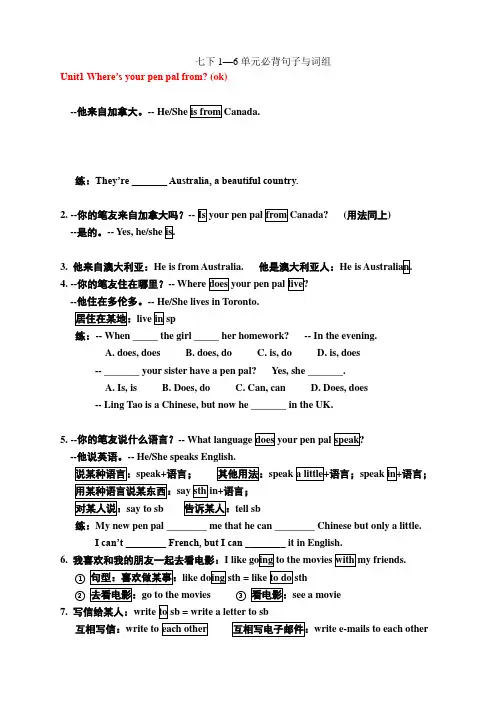
七下1—6单元必背句子与词组Unit1 Where’s your pen pal from? (ok)--他来自加拿大。
练:They’re _______ Australia, a beautiful country.2. --你的笔友来自加拿大吗?(用法同上)--是的。
3. 他来自澳大利亚:He is from Australia. 他是澳大利亚人:4. --你的笔友住在哪里?--他住在多伦多。
-- He/She lives in Toronto.练:-- When _____ the girl _____ her homework? -- In the evening.A. does, doesB. does, doC. is, doD. is, does-- _______ your sister have a pen pal? Yes, she _______.A. Is, isB. Does, doC. Can, canD. Does, does-- Ling Tao is a Chinese, but now he _______ in the UK.5. --你的笔友说什么语言?--他说英语。
-- He/She speaks English.speak+语言;语言;语言;语言;say to sb tell sb练:My new pen pal ________ me that he can ________ Chinese but only a little.I can’t ________ French, but I can ________ it in English.6. 我喜欢和我的朋友一起去看电影:①②go to the movies ③see a movie7. 写信给某人:互相写信:write e-mails to each other8.9. 告诉我关于你自己:讲故事给某人听:10.11. 相似单词比较:(1) 信:letter 一点:little (2) 法国:France 法语:French12. (1) like v. 喜欢;如:(2) like prep. 像;如:13. (1) country n. 国家;如:(2) country n.14. (1) from perp. 来自;如:(2) from prep. 从;如:Unit2 Where’s the post office? (ok)1. 问路:(1) Excuse me, how can I get to the post office?(2) Excuse me, can you tell me the way to the post office?2. --这儿附近有一个邮局吗?--是的。
(人教新目标Go for it!)七年级英语下册同步备课 Unit 3 第1课时 (Section
3.文化意识:
通过目标词汇和语言的学习,能够了解国外生活习惯差异,体验不同的文化带来的魅力。
思维品质:
通过对比分析,能够感知不同出行方式的利弊并作出选择。
教学
重难点
1.通过情境体验,能掌握出行方式、距离和花费时间的提问和表达。
3.T asks students tolisten again and repeat the conversations.
4.T asks students tofinish the task in1c—Look at the picture in 1a. How do the students get to school? Make conversations with your partner.
7.Tasks students to look at thechartandpay attention to the title.
8.Tasks students to finish the task in 2b--Listen and complete the chart.
9.Tasks students to finish the task in 2c--Listen again. Check your answers in 2b.
Step 3
While-listening
1.T asks students tofinish the task in1b—Listen and write the numbers next to the correct students in the picture above.
新目标(Go for it)版七年级英语下册各单元知识点总结
新目标(Go for it)版七年级英语下册各单元知识点总结人教版初一英语下册各单元知识点总结Unit 1 Can you play the guitar?一、 单词与词组表示“参加,加入”,此处指参加社团或组织,成为其中的成员。
Join the army 参军 join the NBA 加入美国篮球协会Join the art/sports/music/English/chess club 参加体育/音乐/英语/象棋俱乐部play soccer/ basketball/volleyball/football/tennis/badminton / 篮球 / 排球 /英式足球,美式橄榄球/网球/羽毛球)Be good at+ sth./doing sth. 擅长做某事Be good with sb 与…相处得好Be good to sb …友好=be friendly toBe good for 对…有好处特指某一次的动作;like doing sth. 强调经常性的爱好。
两者都表示喜讲故事 tell sb. sth. /to do sth. /not to do sth.告诉某人某事/不要做某帮助某人做某事Help yourself/sb. (to sth.)把某物(尤其是指食物,饮料等)拿给自己/某人e.g. Call Mr.Brown at 293-7742意思是“回家”,“到家”。
前面不加介词。
这里的home 是e.g. 1)When do you go home every day?你每天什么时候回家? 2)He drives home after work.他下班的开车回家。
3)She often does some shopping on his way home. 她经常在回家途中买些东西。
2. at home 表示静态概念。
意思是“在家”。
这里的home 是名词,表示具体地点。
人教新目标(Go for it)版知识梳理七年级下册-3 Units 1—3课件
— Anny. My mother never gets up late for my breakfast. What about your mother?
— My mother, __C___. Mothers in China do more for us children. (2019四川达州)
吃(一顿丰盛的)早 / 午 / 晚餐 13. _e_it_h_e_r_._.._o_r__.._. ______
要么……要么……;或者……或者……
14. _E_n_g_l_is_h_-_s_p_e_a_k_in_g__s_tu_d__en__ts_ 说英语的学生 15. _e_v_er_y__d_a_y_______ 每天 16. _g_e_t _d_r_e_ss_e_d______ 穿上衣服 17. _g_e_t _to___________ 到达 18. _g_e_t _u_p__________ 起床;站起 19. _g_o_b_y__b_ik__e_/_c_a_r_/_s_u_b_w__a_y__骑自行车 / 坐车 / 坐地铁去 20. _g_o_h_o_m__e________ 回家
词语,常用于指作为人或事物的一个整体。
【语境应用】根据句子或对话意思选用among或between填空。 1) The boy is standing _b__et_w__ee_n__ his father and his mother. 2) There is a bridge _b__et_w__ee_n__ the two villages. 3) —Who is the woman standing __a_m_o_n_g__ a group of students.
►She can’t type very fast. ►Maria couldn’t ride a horse. ►John isn’t good at running. ►They aren’t able to / are unable to walk very far.
人教新目标go for it七年级下册英语Unit3 教案
Unit 3 How do you get to school?Part 1:Teaching design (第一部分:教学设计)Structures: How questions; Affirmative and negative statementsTarget language:How do you get to school? I take the bus.How long does it take? It takes 20 minutes.How far is it? It’s 10 miles.Vocabulary: get to, how far, bicycle, subway, car, train, bus stop, train station, bus station, subway station, minute, kilometer, mile, transportation, calendarLearning strategies: Personalizing; Inferring vocabularySECTION AGoals●To learn to use How questions, affirmative and negative statements●Lean to talk about how to get to places, how long it takes to go to places, and how far theplaces are●To talk about kinds of transportationProceduresWarming up by talkingHello, everyone! What’s the weather like today? It’s a sunny day with a gentlebreeze. It’s comfortable. So this morning I come to school by bike. It took menearly 50 minutes. You know I live far from school. I often take buses to comehere. But it takes me more than an hour. What about you? Today, let’s talkabout how you go from one place to another. And wewill talk about the time it takes to get to places and how far it is betweentwo places.1a Looking and writingOpen your book at page19. Look at the picture carefully and read thedialogue. Then please write how the students in the picture get to school inthe morning in the chart.Sample answers:1. take the subway2. ride a bike3. take the bus4. take the train5. walk(on foot)6. take a boat7. take a taxi 8. go in a parent’s car1b Listening and writingLook at the picture again. How do students get to school? Let’s listen toa conversation between two people talking about this. Listen carefullyand write the number of the name in the white box next to the student.Please do it individually. Then let’s check the answer.Answers:1. Bob takes the train.2. Mary takes the subway.3. John takes the bus.4. Paul walks.5. Yang Lan walks.TapescriptA: How do Bob and Mary get to school?B: Bob takes the train and Mary takes the subway.A: How does John get to school?B: He takes the bus.A: How do Paul and Yang Lan get to school?B: They walk. Look, there they are waling now!Now read the tapescript, shadow the how questions and underling the expressions.1c Doing pairworkPlease read the dialogue on page 19 in the box. And make your own conversations about how the people in the picture get to school with their partner. Then I’ll ask some pairs to say their dialogue.Sample dialogueA: How does Bob get to school?B: He takes the train.A: Does John take the train to school, too?B: No. He takesthe bus.A: What aboutMary and Paul?B: Paul walks, andMary takes thesubway.A: And Yang Lan walks, does she?B: Yes, she does.2a Listening and repeatingListen to these numbers and repeat. Please pay attention to the pronunciation.Tapescript32, 40, 50, 60, 70, 80, 90, 1002b Writing the numbersforty-six 46 thirty-three 33 seventy-two 72one hundred and five 105 fifty-eight 58 ninety-nine 99sixty-one 61 eighty-four 842c Listening and checkingNow please look at the five transportation pictures. And we’ll listen to two conversations. The people are talking about how students get to school and how long it takes. Listen carefully and put a checkmark to show the kinds of transportation they talk about. Check your answer.10 minutes35minutes40 minutes25minutesListen carefully again and match the time with the kinds oftransportation. Let’s check the answers.TapescriptConversation 1Boy: How do you get to school?Girl: I take the train.Boy: How long does it take?Girl: Oh, around forty minutes. How aboutyou?Boy: I take the subway.Girl: How long does that take?Oh, around thirty-five minutes.Conversation 2Girl: How do you get to school, Tom?Tom: I ride my bike.Girl: How long does it take?Tom: It takes around twenty-five minutes.Tom: How do you get to school?Girl: I walk.Tom: And how long does that take?Girl: It only takes ten minutes.Look at the sentences on the board. “They take the train. It takes about forty minutes.”“Take the train” means to ride the train. And we also use “take” to talk about a length of time. For example, it takes me 20minutes to get to school. So we use the same word, take, in two different ways. Now read the tapescript, shadow the how questions and underling the expressions.2d Doing pairworkNow please make your own conversations about how you get to school and how long it takes. Read the example dialogue first then make yours with your partner.Example:A: How do you get to school?B: well, I usually walk but sometimes I take the bus.A: How long does it take?B: It takes about 25 minutes to walk and 10 minutes by bus. What about you? A: I get to school by bike, sometimes I take my father’s car.B: Oh, how long does it take?A: It takes around 40 minutes by bike and 15 minutes by car.3a Reading and writingSo far you have learned to talk about how you get to school and how long ittakes. The passage you will learn in this part tells us something about Li Lei.Please read the questions about Li Lei in the speech bubbles. Then read thepassage and write the answers to the questions on the line. You shouldcomplete the activity individually.OK, now let’s check the answers.1How does he 2 How long does 3 How far is it fromget to school? it take? his home to school?By bike and It usually takes About 10 kilometers.by bus. about 35 minutes.Now read the passage following the tape sentence by sentence. Please pay attention to the pronunciation and intonation of the native readers and try to imitate them. Then draw lines under the useful phrases and structures.Lin Fei’s home/ is about 10 kilometers /from school. He gets up /at six o’clock/ every day, showers, and has a quick breakfast. Then/ he leaves for school/ at around six-thirty. First, he rides his bicycle/ to the bus station. That takes about ten minutes. Then/ the early bus/ takes him to school. The bus ride/ usually/ takes about 25 minutes.Ok, we have got to know something about Li Lei. What about you? How far are your homes from school? What time do you get up? How do you get to school? Let’s ask some students to say something about you.3b Doing pairworkLook at the pictures on page 21. Can you name each form of transportation? They are easy to you. Read the time and distance that goes with each form of transportation. Pay attention to “mile”, which is a common measure of distance in some western countries. (1 mile=1.6 kilometers).Read the example dialogue in the box.Now make your own conversations using the information in the picture with your partner.A: How do you get to school?B: I take the train.A: How far is it from your home to school?B: It’s eight miles.A: How long does it take you to get from home toSchool ?B: It takes 35 minutes.A: How do you get to school?B: I walk.A: How far is it from your home to school?B: It’s two miles.A: How long does it take you to get from home to school ?B: It takes 40 minutes.A: How do you get to school?B: I take the bus.A: How far is it from your home to school?B: It’s four miles.A: How long does it take you to get from home to school?B: It takes 15 minutes.OK. Stop here please. Let’s ask some pairs to say their dialogues.4 Talking and writingWell done everyone! Now let’s play a game: Info Gap Race! This time you work in groups of three. You decide which one is A, which one is B and which one is C. Please read the instruction. You ask each other questions to learn information for your chart, and then write the answers on the chart in your book. Don’t look at others’ pages please. The first group to fill in all the blanks is the champion.Who How How long How far1. Maria bus twenty minutes five miles2. John bike ten minutes six miles3. Liu Pei subway fifteen minutes eight milesSample dialogue:C:How does Maria get to school?A: She takes the bus. How long does it take Maria to get to school?B: It takes her twenty minutes. How far is it from her home to school?C:It’s five miles.Closing down by asking and answering(using the useful information learned in this part)*How do you get to school?*I usually walk, but sometimes I take the bus.*How long does it to take you to get from your home to school?*It takes 25 minutes.*How far is it from your home to school?*It’s around 4miles. A bus station Section BGoals●To learn to use: bus stop, train station, subway station●To learn to talk about how to get to places further.ProceduresWarming up by asking some individuals questionsHow does Li Lei get to school? First, he rides his bicycle to the bus station. Then he takes the early bus to school. Do you know the bus station? It’s a place where trains stop here. Today we’ll study some other “stations”.1a Looking and matchingLook at the four phrases on the top of page 22 and read them loudly. Then match the words with the pictures.Answers: 1. b bus stop 2. a train station 3. c bus station 4. d subway station1b Doing pairworkRead the dialogue in the box first. Then suppose you use two kinds of transportation to get to school. Now make your own dialogues to tell your partner how you get to school, using the phrases in 1a.Sample dialogue:A: How do you get to school?B: Well, I ride my bike to the subway station. Then I take the subway. What about you?A: First, I walk to the bus stop. Then I take the bus to school.A: How does your father get to his school?B: Well, he walks for ten minutes to Bus No. 11. He takes the bus and gets off at Da Yingpan. Then he walks again for five minutes to his classroom.2a Listening and checkingOK, now. Let’s listen to the conversation between Tina and Thomas. What does Thomas want to know about Nina? Here is a list of information that Thomas wants to know. I’ll ask some students to read lines to the class. Then listen carefully and put a checkmark in front of each thing that Thomas wants to know.Thomas wants to know…√where Nina lives.how far from school she lives.how long it takes Nina to get toschool.√how she gets to school.what she thinks of the transportation.2b Listening and checkingLook at the pictures on page 22 with a blank line in front of each. They show the ways of how to get to school. Which one is Nina’s? Listen carefully and put a checkmark next to the picture that shows how Nina gets to school.1.—to ride a bike to the subway—to take the subway tothe bus—to walk from the bus stop to the school2.√to walk to the bus—to take the bus to the subway—totake another bus after the subway—to walk from the busstop to the school.TypescriptThomas: Where do you live, Nina?Nina: New Street.Thomas: So, how do you get to school?Nina: Well, first I walk to the bus stop.Thomas: Uh-huh.Nina: I take a bus to the subway station. Then I take the subway.Thomas: Yeah…Nina: Next I take a bus to the bus stop on 26thStreet. Finally I walk.You may turn to the tapescript to read it, underlining theexpressions and shadowing the how questions.2c Doing groupworkNow make your conversations about how Nina gets to school in groups of four. You can use the pictures in activity 2b. Pay more attention to the sentence starters: S he…; Next, she…; Then, she… in the box and use them in your conversation.Sample dialogue:A: How does Nina get to school?B: She walks to the bus stop.C: Next, she takes a bus to the subway station.D: Then she takes another bus to the bus stop on 26th street after thesubway.A: Finally she walks to school.Now let’s ask some of you to say your descriptions to the class.3a Reading and writingNow you can say something about how you get to school.Do you want to know how students around the world get to school? Read the article on page 23, and then decide if the statements are true or false in your exercise book.Check the answers:T 1. In North America, not all students take the bus to school.T 2. Other parts of the world are different from the United States.F 3. In Japan, the three most popular ways of getting to school are bus, train and bike. (Students take trains, or walk, or ride bikes)F 4.In China, bikes and buses are the most popular means of transportation. (It depends on where you are)T 5. Students in Hongshanhu and Kaishandao have to take a boat to get to school.Read the article once again, this time, to slash/ the sentences, underline the useful expressions in it and shadow the connectives. After school, you are going to write them down in your notebook. How do students around the world get to school?In North America, most students/ go to school/ on the school bus. Somestudents/ also walk/ or ride bikes to school. In other parts of the world,things are different. In Japan, most students/ take trains to school,although others also walk/ or ride their bikes. In China, it depends on /where you are. In big cities, students usually ride bikes to school/ or take buses. And in places/ where there are rivers and lakes, like Hongshanhu and Kaishandao, students usually go to school/ by boat. That must be a lot more fun/ than taking a bus!3b Reading and writingLook at the chart. Then read the article and fill in the blanks. You can findthe answers in the chart. Please complete the activity individually.Check the answers:How do the students get to Garden High School?At Garden High School, most students ride their bikes to school. Many students walk. Some students drive. Other students take the bus. A small number of students take the subway.3c WritingJust now we filled in an article about how students get to Garden High School. What about you?How do students in our class get to school? Let’s make a survey and listyour ideas on the board. You can use the words and numbers to write apassage about how students in our class get to school.Sample passage:In my class, most students ride their bikes to school. Many students go to school on foot. Some students live far from school, so they go to school by bus. A few students take their parents' car to school.At Taiyuan Wuzhong, most students live at school. They just walk to their classroom. So they don’t ride their bikes to school. Many students play on the playground in the early morning. Some students play football. Some read aloud their English texts. But at the same time, other students in other schools have to take the bus, ride the bike, to hurry to their schools.4 Making a surveyNow turn to page 82, please. Look at the chart. Read the heading and the phrases listed below. Please complete the chart in ten minutes. You can go around the class and ask questions to find out the answers. Look at the dialogue in the box next to the chart. You can ask questions like this. The first student to fill all the blanks wins. Let’s see who the champion is.Find someone who…Nameslives 10 miles away from school.walks to school.takes a bus to school.takes more than an hour to get to school.ride s a bike to school.takes the subway to school.takes less than ten minutes to get to school.Closing up by discussing the main points of this partDo you remember Nina? How does she get to school? How do students around the world get to school? Please tell me in your own words. And I will also ask some of you to say something about themselves. Who will be the first to have a try?SELF CHECKGoals●To revise the vocabulary introduced in the unit●To practice writing skillProcedures1 Filling the blanks and making sentencesLook at part 1 on page 24. Fill in the blanks with the words given to you. Change the form of the word if necessary.Check the answers:1.How do you get to school in the morning?2.What do you think of the transportation in your town?3.When it rains I take a taxi.4.How far do you live from the bus station?5.I like to ride my bike on the weekend.Now make your own sentences with the words. I’ll ask some students to write the answers on the board. And then we shall correct their mistakes together if they get any.1.When will you get to Beijing?2.I cannot think of any good methods to learn English.3.I take a plane to go to my school in Shanghai.4.My teacher lives close to the school.5.I never ride a bike in life. But I like riding horses sometimes.2 Planning schedulesOn page 18 is a schedules planned for tourists to your city. Finish the schedule.Saturday SundayMorning: go to visit Mt. WutaiMorning: take a bus around the city, goshopping at supermarketsAfternoon: visit Jinci Afternoon: go around Pingyao City Evening: watch Jinju at a therter Evening: fly home from TaiyuanJust for fun!Let’s sing a song in English.Three Blind MiceThree blind mice, see how they run!They all ran after the farmer's wife,Who cut off their tails with a carving knife,Did you ever see such a thing in your life,As three blind mice?Part 2: Teaching resources(第二部分:教学资源)I. Background reading1.Traffic in EnglandWhen you are in England, you must be very careful in the streets because the traffic drives on the left.Before you cross a street, you must look to the right first and then the left.If the traffic lights are red, the traffic must stop. Then people on foot can cross the road carefully. If the traffic lights are green, the traffic can go. People on foot mustn't cross. In the morning and in the evening when people go to or come from work, the streets are very busy. Traffic is the most dangerous then.When you go by bus in England, you have to be careful, too. Always remember the traffic moves on the left. So you must be careful. Have a look first, or you will go wrong.In many English cities, there are big buses with two floors. You can sit on the second floor. From there you can see the city very well. It's very interesting!III. Word studies (词语学习)1.takev.1.抓住拾起get hold of something or someone; pick something up: Please take my hand. 请拉住我的手。