
(完整word版)一般过去时变否定句和一般疑问句
按要求改写句子:
1、He was my father.
变否定句:
变一般疑问句:
肯定回答:
否定回答:
2、My mother was a teacher two years ago.
变否定句:
变一般疑问句:
肯定回答:
否定回答:
3、You were a beautiful girl.
变否定句:
变一般疑问句:
肯定回答:
否定回答:
4、I was a boy.
变否定句:
变一般疑问句:
肯定回答:
否定回答:
5、I liked football.
变否定句:
变一般疑问句:
肯定回答:
否定回答:
6、She lived in China ten years ago.
变否定句:
变一般疑问句:
肯定回答:
否定回答:
7、He wanted to go to school.
变否定句:
变一般疑问句:
肯定回答:
否定回答:
8、Her uncle worked in a hospital last year.
变否定句:
变一般疑问句:
肯定回答:
否定回答:
9、My shoes were on the floor just now.
变否定句:变一般疑问句:
肯定回答:
否定回答:
10、There were five apples in the basket two minutes
ago.
变否定句:
变一般疑问句:
肯定回答:
否定回答:
11、I had a baskerball.
变否定句:
变一般疑问句:
肯定回答:
否定回答:
12、She had some books.
变否定句:
变一般疑问句:
肯定回答:
否定回答:
13、I thought she was kind.
变否定句:
变一般疑问句:
肯定回答:
否定回答:
14、She thought he was good at math.
变否定句:
变一般疑问句:
肯定回答:
否定回答:
15、Her mother and her father were doctors.
变否定句:
变一般疑问句:
肯定回答:
否定回答:
16、He did his homework every day.
变否定句:
变一般疑问句:
肯定回答:
否定回答:
17、My birthday is September 5th.
变否定句:
变一般疑问句:
肯定回答:
否定回答:
18、His favorite subject was Chinese.
变否定句:
变一般疑问句:
肯定回答:
否定回答:
19、It was a clever dog.
变否定句:
变一般疑问句:
肯定回答:
否定回答:
20、I went shopping with my friend.
变否定句:
变一般疑问句:
肯定回答:
否定回答:。
一般过去时的疑问句和否定句

一般过去时的疑问句和否定句一般过去时表示过去某个时间里发生的动作或状态,它的疑问句和否定句形式如下:
1.疑问句:
(1)Was/Were+主语+其他?
(2)Did+主语+动词原形+其他?
例如:
(1)Was he at home yesterday?(他昨天在家吗?)
(2)Did you go to the park last weekend?(你上周末去公园了吗?)
2.否定句:
(1)主语+was/were+not+其他.
(2)主语+did+not+动词原形+其他.
例如:
1.He was not at home yesterday.(他昨天不在家。
)
2.I did not go to the park last weekend.(我上周末没去公园。
)
需要注意的是,在使用一般过去时时,要根据主语的人
称和数来确定be动词的形式,第一人称和第三人称单数用was,其余情况用were;而实义动词则用过去式形式,如went、ate、played等。
(完整word版)初中英语语法一般过去时.

一般过去时口诀一般过去并不难,表示过去(动作、状态)记心间。
动词要用过去式,时间状语句末站。
否定句很简单,didn't动词(原形)前,其它部分不要变。
疑问句也好变,did放在句子前,其它部分依次站。
特殊疑问也简单,疑问句首记心间。
最后一条请注意,动词过去要牢记。
1.概念:过去某个时间里发生的动作或状态;过去习惯性、经常性的动作、行为;2.时间状语:ago, yesterday, the day before yesterday, last week,last(year, night, month, 具体时间, just now, at the age of , one day, long ago, once upon a time(很久以前),3.动词变化规则:规则变化:1 直接加ed eg:work worked worked2 以不发音的e结尾的,+d eg:live lived lived3 以辅音字母+y结尾的,变y为i加ed eg:study stuied stuied4 以重读闭音节结尾的,双写最后的辅音字母+ed eg: stop stopped stopped不规则变化例如相等 eg:cut cut read read<注:read和read读音不同!>sit sat have/has -- had, eat--ate ,see--saw4.否定形式:was/were+not;在行为动词前加didn't,同时还原行为动词。
5.一般疑问句:was或were放于句首;用助动词do的过去式did 提问,同时还原行为动词。
She often came to help us in those days. I didn't know you were so busy.6.一般过去式的构成形式:一般过去时表示句式:主语+过去动词+其他I had a word with Julia this morning.今天早晨,我跟朱丽亚说了几句话。
英语四个基本时态的 肯定句变否定句
_M_r_s_.__L_i_a_n_d__K_i_t_t_y__a_r_e__n_o__t_i_n__a_b__ig__s_h_o_p__. ________ .
8. He is crying(哭) under the tree.
____H__e_i_s_n__o_t__c_r_y_i_n_g_(__哭__)___u_n_d_e_r__t_h_e__t_r_e_e__. _____ .
9. His birthday is on the twentieth of November.
The old man doesn’t do morning exercises(早操) every morning.
23. We are from China.
_________W___e__a_r__e_n__’t__f__r_o_m___C__h_i_n_a__.________ .
24. He goes to the library(图书馆) on Sundays.
_____H_e__d_o_e_s_n_’_t__g_o_t_o__th__e_l_ib_r_a_r_y__o_n_S_u_n_d_a_y_s_.____ .
25. They have a class meeting every week.
_T_h__e_y_d__o_n_’t__h_a_v_e__a__c_l_a_s_s_m__e_e_t_i_n_g__e_v_e_r_y__w__e_e_k_. .
(完整word版)新概念英语第一册全部语法
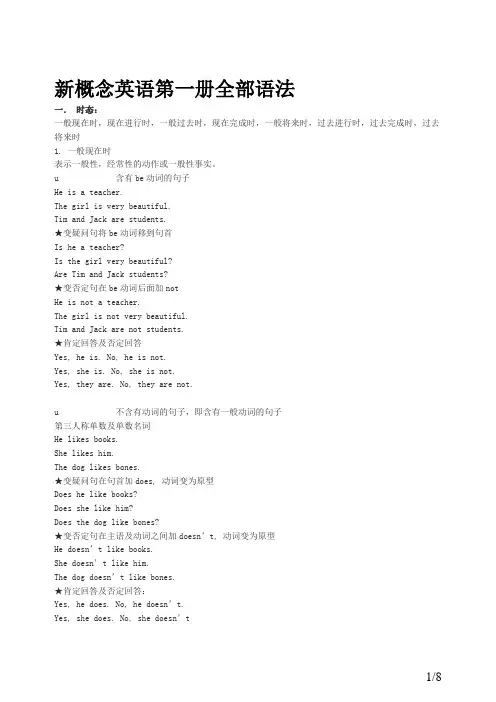
新概念英语第一册全部语法一.时态:一般现在时,现在进行时,一般过去时,现在完成时,一般将来时,过去进行时,过去完成时,过去将来时1. 一般现在时表示一般性,经常性的动作或一般性事实。
u 含有be动词的句子He is a teacher.The girl is very beautiful.Tim and Jack are students.★变疑问句将be动词移到句首Is he a teacher?Is the girl very beautiful?Are Tim and Jack students?★变否定句在be动词后面加notHe is not a teacher.The girl is not very beautiful.Tim and Jack are not students.★肯定回答及否定回答Yes, he is. No, he is not.Yes, she is. No, she is not.Yes, they are. No, they are not.u 不含有动词的句子,即含有一般动词的句子第三人称单数及单数名词He likes books.She likes him.The dog likes bones.★变疑问句在句首加does, 动词变为原型Does he like books?Does she like him?Does the dog like bones?★变否定句在主语及动词之间加doesn’t, 动词变为原型He doesn’t like books.She doesn’t like him.The dog doesn’t like bones.★肯定回答及否定回答:Yes, he does. No, he doesn’t.Yes, she does. No, she doesn’tYes, it does. No, it doesn’t.注意:第三人称单数形式一般在动词后面加S,不要和名词复数混淆,变否定句或疑问句时名词复数没有任何变化。
(完整版)一般过去时及特殊疑问句
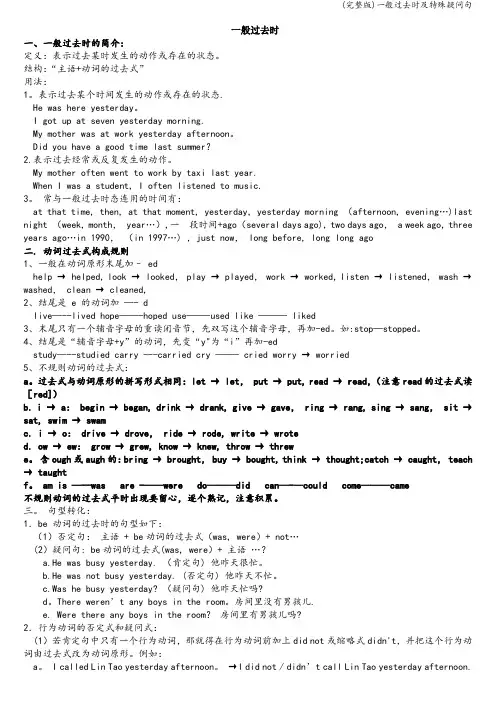
一般过去时一、一般过去时的简介:定义:表示过去某时发生的动作或存在的状态。
结构:“主语+动词的过去式”用法:1。
表示过去某个时间发生的动作或存在的状态.He was here yesterday。
I got up at seven yesterday morning.My mother was at work yesterday afternoon。
Did you have a good time last summer?2.表示过去经常或反复发生的动作。
My mother often went to work by taxi last year.When I was a student, I often listened to music.3。
常与一般过去时态连用的时间有:at that time, then, at that moment, yesterday, yesterday morning (afternoon, evening…)last night (week, month, year…),一段时间+ago(several days ago), two days ago, a week ago, three years ago…in 1990,(in 1997…) ,just now, long before, long long ago二. 动词过去式构成规则1、一般在动词原形末尾加– edhelp → helped, look → looked, play → played, work → worked, listen → listened, wash →washed, clean → cleaned,2、结尾是 e 的动词加—- dlive—--lived hope——-hoped use——-used like ——— liked3、末尾只有一个辅音字母的重读闭音节,先双写这个辅音字母,再加-ed。
完整word版一般过去时讲解
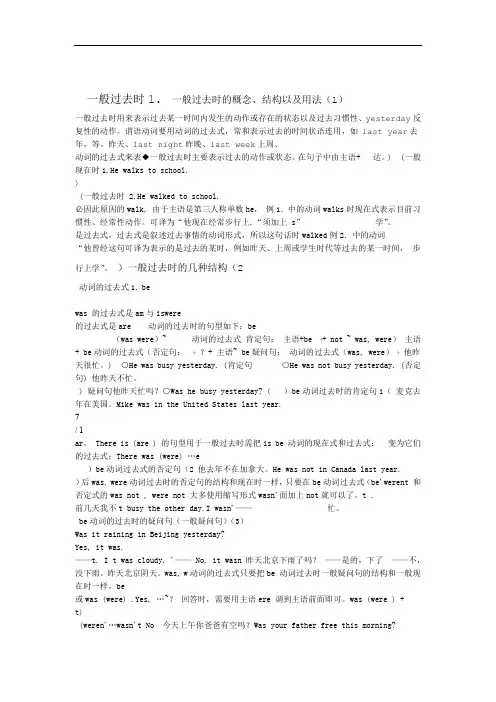
一般过去时1.一般过去时的概念、结构以及用法(1)一般过去时用来表示过去某一时间内发生的动作或存在的状态以及过去习惯性、yesterday反复性的动作。
谓语动词要用动词的过去式,常和表示过去的时间状语连用,如 last year去年,等。
昨天、last night昨晚、last week上周、动词的过去式来表◆一般过去时主要表示过去的动作或状态。
在句子中由主语+ 达。
) (一般现在时1.He walks to school.)(一般过去时 2.He walked to school.必因此原因的walk, 由于主语是第三人称单数he,例1.中的动词walks时现在式表示目前习惯性、经常性动作。
可译为“他现在经常步行上,“须加上 s”学”。
是过去式,过去式是叙述过去事情的动词形式,所以这句话时walked例2.中的动词“他曾经这句可译为表示的是过去的某时,例如昨天、上周或学生时代等过去的某一时间,步行上学”。
)一般过去时的几种结构(2动词的过去式1.bewas 的过去式是am与iswere的过去式是are 动词的过去时的句型如下:be(was were)~ 动词的过去式肯定句:主语+be ?+ not ~ was, were)主语+ be动词的过去式(否定句:??+ 主语~ be疑问句:动词的过去式(was, were)?他昨天很忙。
) ○He was busy yesterday. (肯定句○He was not busy yesterday. (否定句) 他昨天不忙。
) 疑问句他昨天忙吗?○Was he busy yesterday? ( )be动词过去时的肯定句1(麦克去年在美国。
Mike was in the United States last year.7/ 1ar, There is (are ) 的句型用于一般过去时需把is be 动词的现在式和过去式:变为它们的过去式:There was (were) …e)be动词过去式的否定句(2 他去年不在加拿大。
(完整版)一般过去时及特殊疑问句
一般过去时一、一般过去时的简介:定义:表示过去某时发生的动作或存在的状态。
结构:“主语+动词的过去式”用法:1.表示过去某个时间发生的动作或存在的状态。
He was here yesterday.I got up at seven yesterday morning.My mother was at work yesterday afternoon.Did you have a good time last summer?2.表示过去经常或反复发生的动作。
My mother often went to work by taxi last year.When I was a student, I often listened to music.3. 常与一般过去时态连用的时间有:at that time, then, at that moment, yesterday, yesterday morning (afternoon, evening…)last night (week, month, year…),一段时间+ago(several days ago), two days ago, a week ago, three years ago…in 1990, (in 1997…) ,just now, long before, long long ago二. 动词过去式构成规则1、一般在动词原形末尾加–edhelp →helped, look →looked, play →played, work →worked, listen →listened, wash →washed, clean →cleaned,2、结尾是e 的动词加-- dlive---lived hope---hoped use---used like --- liked3、末尾只有一个辅音字母的重读闭音节,先双写这个辅音字母,再加-ed。
一般过去时的否定句和特殊疑问句
一般过去时的否定句和特殊疑问句
过去时的否定句:
一般过去时表示过去发生的动作或状态。
在构成否定句时,在动词前加上“did not”,也可缩写为“didn't”。
以下是一些例句:
1. I did not go to work yesterday.(我昨天没有去上班。
)
2. They did not study for the test.(他们没有为考试学习。
)
3. She didn't like the movie.(她不喜欢这部电影。
)
4. We did not visit the museum.(我们没有参观博物馆。
)
5. He didn't play basketball last night.(他昨晚没有打篮球。
)
特殊疑问句:
特殊疑问句用于询问特殊信息,通常使用疑问词开头。
以下是一些例句:
1. Where did you go on your vacation?(你假期去哪里了?)
2. When did they arrive at the airport?(他们什么时候到达机场的?)
3. Why didn't she join us for dinner?(她为什么没和我们一起吃晚餐?)
4. How did they solve the problem?(他们是如何解决这个问题的?)
5. What did you buy at the grocery store?(你在杂货店买了什么?)
希望以上的信息能帮到您。
若有其他问题,请随时提问。
(完整版)一般过去时及特殊疑问句
般过去时一、一般过去时的简介:定义:表示过去某时发生的动作或存在的状态。
结构:“主语+动词的过去式”用法:1. 表示过去某个时间发生的动作或存在的状态。
He was here yesterday.I got up at seven yesterday morning.My mother was at work yesterday afternoon.Did you have a good time last summer?2. 表示过去经常或反复发生的动作。
My mother often went to work by taxi last year.When I was a student, I often listened to music.3. 常与一般过去时态连用的时间有:at that time, then, at that moment, yesterday, yesterday morning (afternoon, evening⋯)last night (week, month, year⋯),一段时间+ago(several days ago), two days ago, a week ago, three years ago⋯in 1990, (in 1997 ⋯) ,just now, long before, long long ago二. 动词过去式构成规则1、一般在动词原形末尾加–edhelp → helped, look → looked, play → played, work → worked, listen → listened, wash → washed, clean → cleaned,2、结尾是e 的动词加-- dlive---lived hope---hoped use---used like --- liked3、末尾只有一个辅音字母的重读闭音节,先双写这个辅音字母,再加-ed。
(word完整版)史上最全 英语中的16种时态
动词16个时态一、一般现在时1.概念:表示经常发生的情况;有规律出现的情况;总是发生的;和事实真理。
2.时间状语:Always, usually, often, sometimes, every week (day,year, month…),once a week(day, year,month…),on Sundays(on Mondays …),3。
基本结构:动词原形(如主语为第三人称单数,动词上要改为第三人称单数形式)4。
否定形式:主语 + am/is/are + no t + 其他;此时态的谓语动词若为行为动词,则在其前加don’t,如主语为第三人称单数,则用doesn't,同时还原行为动词。
5.一般疑问句:把be动词放于句首;用助动词do提问,如主语为第三人称单数,则用does,同时,还原行为动词。
6.例句:It seldom snows here。
这里很少下雪。
He is always ready to help others.他总是乐于帮助别人。
Action speaks louder than words。
事实胜于雄辩。
二、一般过去时1.概念:过去某个时间里发生的动作或状态;过去习惯性、经常性的动作、行为。
2.时间状语:ago, yesterday, the day before yesterday, last week, last(year, night,month…),in 1989,just now, at the age of 5,one day, long long ago, once upon a time, etc。
3。
基本结构:主语 + 动词的过去式或be的过去式+名词4.否定形式:主语 + was/were + not + 其他;在行为动词前加didn’t,同时还原行为动词.5.一般疑问句:was或were放于句首;用助动词do的过去式did 提问,同时还原行为动词。