
七年级英语Go_for_it!_Unit_2_说课稿课件人教版新目标
三、教学目标
1、语言知识 词汇: A、重点掌握表示建筑物种类的名词, 如post office, hotel, bank, supermarket, street, pay phone, avenue, B、掌握如下描绘性形容词及方位副词,如 clean, quiet, dirty, busy, right, left, down, along, C、方位介词,如next to, across from, in front of, near, between, behind D、短语,如 turn right, turn left, go down, go straight on, walk along, go along,
2、教材的地位及其作用 、 本单元的教学主要内容是:学习“问路指路”的 常用表达方式 ,该话题与学生的日常生活紧密 联系在一起,容易唤起学生的学习兴趣,这对 于提高学生的综合能力很有帮助,特别是说的 能力。通过本单元的学习描述某一建筑物的位 置,学会问路,指路,学会利用地图描述某一 社区。 本单元继续使用一般现在时,这是一个生活中离 不开的时态,也是最基本的一个时态。新课程 标准要求学生重点掌握一般现在时,这在英语 中使用频率很高,学好这一时态的用法对以后 其他时态的学习和交际有很大的帮助。
Students listen to teacher’s instruction and draw out the maps:
Map 1: Across from the bank is a supermarket. There is a post office between the library and the supermarket. Across from the supermarket is a park. Next to the park is a restaurant. Map 2: A library is next to the park. Across from the park is a bank. Next to the bank is a post office. Across from the post office is the restaurant, which is across from the supermarket.
七、教学流程(分四大块 )
Period 1:
1. Talking about a room (revision) 2. Buildings & positions 3. Drawing maps
Step 1 Teacher presents the picture of 3b in Unit 4 of Book 1, students identify the things in the picture and describe their positions. Revision: A. The propositions in; on; under; between; next to; behind, etc B. The sentence pattern Where is the …? It’s / They’re on / 力,教会学生在真 实的语言环境中运用本单元说学的目标语言,询问某 一场所的位置,为他人指明去某一场所的路线,某一 场所个建筑物之间的位置关系,以及利用地图向他 人介绍自己所居住的社区。
五、教学手段
1、导入课堂教学时用电脑多媒体的效果或投影仪来吸引 学生的课堂注意力,让学生再多媒体的动态效果中学 习有关建筑物的单词,并对本单元的内有了初步的意识。 2、利用学校现有的建筑物以及学校的位置特征引导学 在真实的语言环境中进行交际。 3、利用学生所居住的社区使用目标语言进行交际。
4、文化意识: 文化意识:
了解西方人是如何描述场所及地点特征, 表达问路指路。
四、重点难点
基于上述对教材的分析,本单元的教学重点为词汇( 基于上述对教材的分析,本单元的教学重点为词汇(post office, hotel, bank, supermarket, street, pay phone, avenue, clean, quiet, dirty, busy, left, right,)、词组搭 ) 配 ( on the right/left ,go straight on, go down, go along,)、方位介词 ) 方位介词(next to, across from, in front of, near, between)。以及指路问路的目标语言: 。以及指路问路的目标语言: Is there a bank near here? Yes, there is a bank on Center Street. Where’s the supermarket? It’s next to the library. Is there a pay phone in the neighborhood? Yes, it’s on Bridge Street on the right.
六、 理念与思路
1.教法: 教法: 教法 (1) 本单元话题源自生活,立足这一点,充分利用学 生已有的知识和经验,创设生活化的真实情境,引导学 生在运用中学习语言,然后在学习新的语言知识后创造 性地运用语言(为用而学,在用中学,学了能用)。 (2) 设计多种任务活动,提供给学生合作交流的 空 间和时间,促使学生为完成任务和同学进行合作,为完 成任务进行探究学习。
2、学习策略
1)、利用老师所提供的图片做出简单的判断, 学习相关方位介词以及描绘性形容词。 2)、通过地图的展示以及目标语言的操练,学会 问路指路并对地点特征做出简单的描述。 3)、能够运用所学知识熟练的描述本校的校址, 以及本校内各个建筑物的方位。
3、学法指导
在已经学过的where is/ are…?和It’s on/in/under….句 型的基础上,引导学生利用本单元所教授关于指 路问路的短语句型通过听、练以及小组合作的方 式掌握本单元的知识目标 。
新目标英语
Go for it!
(七年级下册) 七年级下册)
Unit 2 说课稿
一、教材分析
1、教学内容 、 1)、 词汇:post office, hotel, bank, supermarket, 、 词汇: street, pay phone, avenue, clean, quiet, dirty, busy, left, right, next to, across from, in front of, near, between, turn right, turn left, go down, go straight on, walk along, go along, on the left/right 2)、 语言结构: 、 语言结构: A、Where questions B、Affirmative statements C、Prepositions of place D、There be structure
重点句型:
Is there a bank near here? Yes, there is . No, there isn’t. Where’s the supermarket? It’s next to the library Is there a pay phone in the neighborhood? Yes, it’s on Bridge Street on the right.
2、 语言技能
1)、能看着图片说话出建筑物的名称; 2)、能运用一般现在时询问街道上某一场所的位置; 3)、能够运用所学语言为他人指明 某一场所的路线; 4)、能够描述某一场所各建筑物之间的位置关系; 5)、能够利用地图向他人介绍自己所居住的社区;
3、情感态度
1)通过各小组的对话练习培养学生的合作精神; 2)通过学习本单元,教会学生礼貌待人,建立 和睦的邻里关系; 3)通过对本单元的任务性活动,培养同学间的 友好相处,同时提高他们的观察能力和判断能力, 激发他们对学习英语的兴趣和热情,在接近生活 常态的交际中能乐于模仿,敢于开口,积极参与, 主动请教。
Step 1 Teacher presents the picture of 1a, in which we can see many buildings. Step 2 Students identify the buildings one by one in Chinese first, then in English with teacher’s guidance with the help of the pictures of the buildings which are more clear. Step 3 Students describe the positions of the buildings, asking and answering with teacher as follow: T: Where is the hotel /…? Ss: It’s next to /across from / … Step 4 Exercise: true and false according to the picture of 1a they describe.
Period 2:
1.Find out the differences between the two similar pictures.
2. Asking for and showing ways 3. Listening and draw out the map
Step 1 Teacher shows two similar pictures, guiding students to find out the differences between them.
Picture 2
payphone hotel library
人教新目标Go For It! 初中英语七年级下册Unit 2 What time do you go to school$%Section A导学案(2)
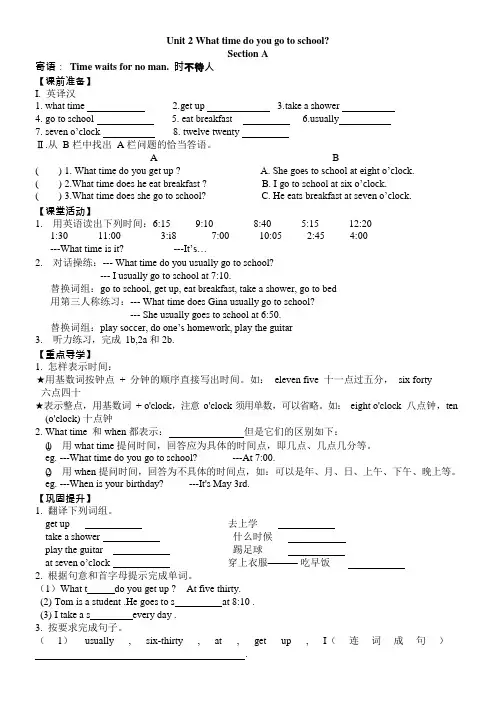
Unit 2 What time do you go to school?Section A寄语:Time waits for no man. 时不待人【课前准备】I.英译汉1.what time2.g et up3.t ake a shower4.go to school 7. seven o’clock5. eat breakfast8. twelve twentyuallyⅡ.从 B 栏中找出A 栏问题的恰当答语。
A B( ) 1. What time do you get up ? A. She goes to school at eight o’clock.( ) 2.What time does he eat breakfast ? B. I go to school at six o’clock.( ) 3.What time does she go to school? C. He eats breakfast at seven o’clock.【课堂活动】1. 用英语读出下列时间:6:15 9:10 8:40 5:15 12:201:30 11:00 3:i8 7:00---What time is it? ---It’s…10:05 2:45 4:002.对话操练:--- What time do you usually go to school?--- I usually go to school at 7:10.替换词组:go to school, get up, eat breakfast, take a shower, go to bed用第三人称练习:--- What time does Gina usually go to school?--- She usually goes to school at 6:50.替换词组:play soccer, do one’s homework, play the guitar3.听力练习,完成1b,2a 和2b.【重点导学】1.怎样表示时间:★用基数词按钟点+ 分钟的顺序直接写出时间。
七年级英语上册(人教新目标GoForIt!)StarterUnit2第1课时(1a2e)优秀教学案例

3.教师总结:本节课我们将学习日常问候和介绍,以更好地与不同国家的人交流。
(二)讲授新知
1.教师通过多媒体展示本节课所学的问候语和介绍语,如Hello!/Hi!/Good morning!/Good afternoon!/Good evening!/How are you?等,并引导学生跟读。
3.运用交际法,鼓励学生积极参与课堂互动,提高学生的口语表达能力和团队协作能力。
4.利用多媒体教学资源,如图片、视频等,为学生提供丰富的视觉和听觉感受,帮助学生更好地理解和掌握课程内容。
(三)情感态度与价值观
1.培养学生对英语学习的兴趣,树立自信心,养成积极向上的学习态度。
2.培养学生具备良好的合作意识,学会尊重他人,培养团队精神。
3.小组合作学习的深入推行:教师合理分配学习小组,鼓励小组成员共同探讨、分工合作,完成任务。这种方法培养了学生的团队精神和沟通能力,使他们在合作中学习,提高了学习效果。
4.教学评价的全面开展:教师引导学生对自己的学习过程进行反思,总结自己的优点和不足,调整学习策略。同时,开展同伴评价,让学生互相观摩、借鉴,共同提高。这种评价方法有助于学生全面认识自己的学习情况,提高了他们的自我管理和自我提高能力。
1.情境教学法的创新应用:教师通过多媒体展示了不同国家的问候语和介绍方式,引导学生思考和讨论,激发了学生的学习兴趣,并成功吸引了他们的注意力。这种方法不仅有助于学生理解文化差异,还使他们在真实情境中学习和实践,提高了他们的语言运用能力。
2.任务型教学法的有效实施:教师设计了具有挑战性和实际意义的任务,让学生在完成任务的过程中,巩固所学知识,提高交际能力。这种方法使学生在实践中学习,增强了他们的自主学习能力和解决问题的能力。
初中英语人教版新目标Go_for_it_九年级qiqiUnit_2_I_used_to_be_afraid_of_the_dark_第一课时

4a write sentences about the past using used to.
1.Grace \watch a lot of TV\
watch a lot of movies Grace used to watch a lot of TV.
She didn’t use to watch a lot of movies.
用括号内所给动词的适当形式填空。 1.My sister used to _______ (be) a nurse. be 2. I’m used to _______ (wash) my face with washing cold water. 3. My pen friend used to ________ speak (speak) Japanese, but now he is used to ________ speaking (speakgh places
speaking in front of a group
Homework
写一篇短文,描述你最喜欢的 人。 请从外貌、性格、爱好、理想 等方面来描述他/她幼时与现在 的变化。
I have changed a lot .In the past,I used to----------but now I am tall and thin. I_____________,now I am outgoing and funny. I ________,now I like English very much.I ____________ now I didn't swim......
C to work now. work, but she is used to ________
初中英语新教材Goforit!Unit2说课稿

初中英语新教材Go for it! Unit 2 讲课稿一、背景解析1.教材概括此套教材是人民教育第一版社和美国Thomson Learning第一版公司初次合作的系列产品,它是在 Thomson Learning 2000年最新第一版的教材Go for it的基础上,合作编写而成。
它会合了美式英语的特点也融入了中国的教课理念,整书没有一其中文字,意在逼迫学生用英语的思想去学习英语,创建一种学习英语的气氛,本书侧重于文化背景知识和学习策略等部分,较其余教材增添了任务型学习成份和语篇输入。
新目标英语教材(Go For It!)有以下几个特点:(一)图文并茂。
打开课本,你都能够在每一页上看到一幅副充满情味,风趣生动的画面,令你眼睛一亮。
(二)适用性强。
每个单元的选材都根源于学生的学习和生活。
牢牢地与学生的年纪特点、认知构造、生活经验联系在一同。
(三)侧重社交。
针对中国学生学英语广泛存在的“聋哑病”,教材设计了大批的听说读写资料。
(四)词汇量大。
第一册有词汇700 个左右,第二册约450 个,第三册约450 个,第四册约 400 个,第五册约500 个,共计2500 个。
这一点正好达到《英语课程标准》 5 级的要求。
2.单元解析本单元的标题为Is this your pencil?话题为Things in the classroom.本单元环绕“辨别物品的所属”,使学生学会咨询物件的主人的基本句型“ Is this/that your/her/his pencil? Yes, it is. No, it isn ’”,t.领会一般疑问句的用法;学习怎样写“失物招领、寻物启事”,稳固所学单词的拼写“ How do you spell pen? P-E-N. ”。
经过以上几个方面的学习,既能提升学生解决问题的能力,又能稳固所学知识。
本单元与第三单元连接密切:由this , that 的学习过渡到 these, those 的学习,由指示一个人、物过渡到指示多个人、物,使学生学会划分远近单复数。
人教新目标Go For It!(2012)初中英语七年级下册Unit 2 What time do
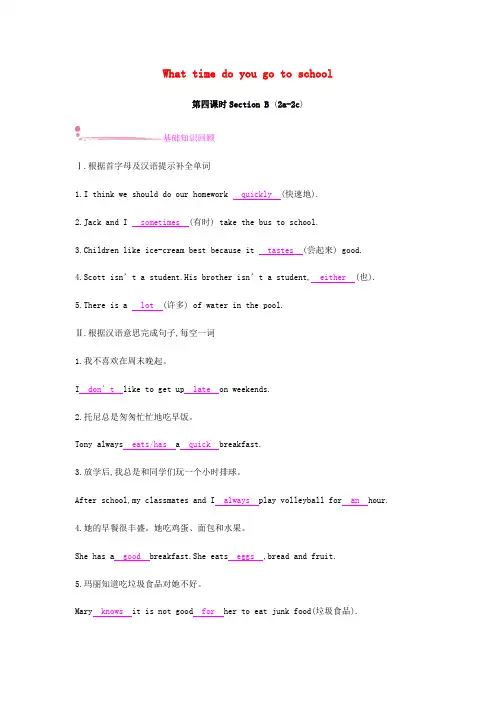
What time do you go to school第四课时Section B (2a-2c)基础知识回顾Ⅰ.根据首字母及汉语提示补全单词1.I think we should do our homework quickly (快速地).2.Jack and I sometimes (有时) take the bus to school.3.Children like ice-cream best because it tastes (尝起来) good.4.Scott isn’t a student.His brother isn’t a student,either (也).5.There is a lot (许多) of water in the pool.Ⅱ.根据汉语意思完成句子,每空一词1.我不喜欢在周末晚起。
I don’t like to get up late on weekends.2.托尼总是匆匆忙忙地吃早饭。
Tony always eats/has a quick breakfast.3.放学后,我总是和同学们玩一个小时排球。
After school,my classmates and I always play volleyball for an hour.4.她的早餐很丰盛。
她吃鸡蛋、面包和水果。
She has a good breakfast.She eats eggs ,bread and fruit.5.玛丽知道吃垃圾食品对她不好。
Mary knows it is not good for her to eat junk food(垃圾食品).Ⅲ.按要求完成句子,每空一词1.Dave usually takes a walk after dinner.(改为一般疑问句) Does Dave usually take a walk after dinner?2.She often goes to park on Sundays.(对画线部分提问) When does she often go to the park?3.Keke never eats vegetables for breakfast.(改为同义句) Keke doesn’t eat vegetables for breakfast.4.It is ten forty-five now.(改为同义句)It is a quarter to eleven now.5.When does Tony play sports?(改为同义句)What time does Tony play sports?Ⅳ.连词成句1.he,much,doesn’t,time,have,breakfast,for(.)He doesn’t have much time for breakfast.2.I,always,when,home,I,get,homework,my,first,do(.)I always do my homework first when I get home.3.weekends,either,TV,I,play,watch,on,games,or,computer(.)I either watch TV or play computer games on weekends.4.dinner,does,takes,she,after,walk,a,her,or,homework,usually(.) After dinner she usually takes a walk or does her homework.5.at,Anna,ten,to,goes,twenty,usually,bed(.)Anna usually goes to bed at ten twenty.综合能力提升Ⅰ.单项填空(C)1.What timeMr.and Mrs.Browndinner?A.do;hasB.does;hasC.do;haveD.does;have(B) 2.My mother seldomat 5:30 p.m.A.gets to homeB.gets homeC.get to homeD.get home(B) 3.My sister doesn’t like meat.I don’t like meat,.A.alsoB.eitherC.tooD.well(A) 4.I sometimes play the violin forhour.A.half anB.an halfC.a halfD.half a(D) 5.He eitherfootball orwalks in the evening.A.play;takeB.plays;takeC.play;takesD.plays;takesⅡ.用方框中所给词的适当形式完成短文Nowadays teenagers(青少年) need to have a healthy habit.My son is in Grade Eight.During summer holidays he 1.has some bad habits.In the morning,he always gets up 2.at ten o’clock.He 3.never eats breakfast.Because lunchtime is coming.He doesn’t eat any food for many 4.hours .So he is hungry and he eats more and 5.quickly .And he doesn’t like vegetables or fruit.He usually eats instant noodles(方便面).After lunch he 6.either watches TV 7.or plays computer games.He never 8.takes a walk.He doesn’t play sports.So he is heavy.At seven in the evening,he begins 9.to do his homework until ten.His eyesight(视力) is poor.He 10.goes to bed at midnight(半夜).。
Unit2第1课时(SectionA1a-2d)教学课件七年级英语下册(人教新目标Goforit!)
Tips: Foreigners like taking showers in the morning.
Jim Anna
6:30 6:45
Let’s listen Listen and repeat.
04
Postlistening
Let’s talk
2b
Work in two and talk about the shower schedule for Jim’s family.
It's thirty past seven.
倒读
It's half past seven.
Let’s learn What’s the time?
正读 It's seven fifteen. It's fifteen past seven.
倒读
It's a quarter past seven.
It’s twenty past eleven. It’s twenty past ten. It’s twenty to eleven.
next
Let’s play
It’s a quarter to nine. It’s a quarter past nine. It’s a quarter to three.
answer questions about Rick’s day.
What time do you usually get up, Rick?
I usually get up at six o’clock.
Let’s predict 2a Look at the picture and answer the questions.
Name Bob Mary Jack Jim Anna Time 5:30 5:50 6:15 6:30 6:45
初中英语新教材Go for it! Unit 2说课稿
初中英语新教材Go for it! Unit 2说课稿初中英语新教材Go for it! Unit 2说课稿一、背景分析1.教材概述此套教材是人民教育出版社和美国Thomson Learning出版集团第—次合作的系列产品,它是在Thomson Learning 2022年出版的教材Go for it的根底上,合作编写而成。
它集合了美式英语的特点也融入了中国的教学理念,整书没有一个中文字,意在强迫学生用英语的思维去学习英语,制造一种学习英语的气氛,本书着重于文化背景知识和学习策略等局部,较其他教材增加了任务型学习成份和语篇输入。
新目标英语教材〔Go For It! 〕有以下几个特色:〔一〕图文并茂。
翻开课本,你都能够在每一页上看到一幅副充满情趣,幽默生动的画面,令你眼睛一亮。
〔二〕有用性强。
每个单元的选材都X于学生的学习和生活。
紧紧地与学生的年龄特征、认知结构、生活经验联系在一起。
〔三〕注重交际。
针对中国学生学英语普遍存在的“聋哑病〞,教材设计了大量的听说读写材料。
〔四〕词汇量大。
第—册有词汇700个左右,第二册约450个,第三册约450个,第四册约400个,第五册约500个,合计2500个。
这一点正好到达(英语课程标准)5级的要求。
2.单元分析本单元的标题为 Is this your pencil 话题为 Things in the classroom. 本单元围绕“识别物品的所属〞,使学生学会询问物品的主人的根本句型“Is this/that your/her/his pencil Yes, it is. No, it isn’t.〞,体会一般疑问句的用法;学习如何写“失物招领、寻物启事〞,稳固所学单词的拼写“How do you spell pen P-E-N.〞。
通过以上几个方面的学习,既能提高学生解决问题的能力,又能稳固所学知识。
本单元与第三单元衔接紧密:由this,that 的学习过渡到these, those的学习,由指示一个人、物过渡到指示多个人、物,使学生学会区分远近单复数。
人教版新目标_go_for_it!七年级下册_英语__1-12单元知识点
七下1—6单元必背句子与词组Unit1 Where’s your pen pal from? (ok)--他来自加拿大。
练:They’re _______ Australia, a beautiful country.2. --你的笔友来自加拿大吗?(用法同上)--是的。
3. 他来自澳大利亚:He is from Australia. 他是澳大利亚人:4. --你的笔友住在哪里?--他住在多伦多。
-- He/She lives in Toronto.练:-- When _____ the girl _____ her homework? -- In the evening.A. does, doesB. does, doC. is, doD. is, does-- _______ your sister have a pen pal? Yes, she _______.A. Is, isB. Does, doC. Can, canD. Does, does-- Ling Tao is a Chinese, but now he _______ in the UK.5. --你的笔友说什么语言?--他说英语。
-- He/She speaks English.speak+语言;语言;语言;语言;say to sb tell sb练:My new pen pal ________ me that he can ________ Chinese but only a little.I can’t ________ French, but I can ________ it in English.6. 我喜欢和我的朋友一起去看电影:①②go to the movies ③see a movie7. 写信给某人:互相写信:write e-mails to each other8.9. 告诉我关于你自己:讲故事给某人听:10.11. 相似单词比较:(1) 信:letter 一点:little (2) 法国:France 法语:French12. (1) like v. 喜欢;如:(2) like prep. 像;如:13. (1) country n. 国家;如:(2) country n.14. (1) from perp. 来自;如:(2) from prep. 从;如:Unit2 Where’s the post office? (ok)1. 问路:(1) Excuse me, how can I get to the post office?(2) Excuse me, can you tell me the way to the post office?2. --这儿附近有一个邮局吗?--是的。
新目标Goforit人教版七年级英语上册全册教案全册新教材
新目标Goforit人教版七年级英语上册全册教案全册新教材人教版七年级英语上册全册教案 Unit1Myname’sGina.授课日期20XX年[ ]月[ ]日授课班级学时数The1stperiod(SectionA1a—1c)授课类型新授课1.Getstudentstolearnhowtogreetpeople,introducethemselvesandmakenewfriends.教学目标2.TeachstudentstosayEnglishnamesintherightway.3.GetstudentstoNewwords:name,clock,—What’syourname?My—name—Hell o!I’mMary教学.内容—Hi,Mary!I’mJim.Nicetome =whatis I =’Iam name =’sthepersonalandpossessivepronouns:I,you,my,your,his,her1.会拼读生词和问姓名的句型。
2.注意中英文姓名的差异。
重点难点学情分析任务型教学、分级评价法、直观教学法、模仿示范法、情景教学和合作学习法教学方法课前预习、课堂内外练习、听说读写结合学习方法教学过程设计备注I.Warming-upandrevision1.Playthetape,enjoytheABCsongorHellosong,gettheSstosingtogether.2.DividetheclassintoGroupAandB.Drawtwofishesontheblackboardastheirsymbols,tellthestudentsthateachtimetheyanswerquestionsright,theycangetoneormore pointsfortheirgroupanddrawoneormorebubblesaroundtheirfish,attheendoftheclass,thegroupwhichgetsmorebubbleswillbethewinner课题引入today.Say,“One,two,three!〞Gettheasswholesitstraight,clthu sannouncethe beginningofthecompetition.3.RevisethethreeunitsinStarters.Showsomekeysentencesin Chineseonthe screen,havestudentstranslatetheminto English,getastudentfromeachgroupto cometothefront andwrite downtheiranswersontheblackboard,thencheckthe answers,eachcorrect sentencewillearnapointforthegroup.II.Presentation1.Teachersays:,“My Hello!nameisLily.What’syour name?〞Getthe studentstoanswer,“Mynameis〞Theteachersays,“It’sagood/nicename.Ilikeyourname.〞2.screenshowalovelymousesaying“Myname’sGina.〞Underline“Myname’s〞,tellthestudentsitmeans学步骤3.Showthequestion“What’yours“Mynameis/教Iam/Iname?〞Underline “What’s〞,tellthestudents及thatitmeans“What主is要内〞容.III.Listeningdrills(1)1.DoSectionA,1b,listenandnumbertheconversations(1-3).2.Showthepictureonpage1onthescreenwithnowordsonit.Getstudentto listentothetapeandtryto repeatthesentencesintheconversations,each correctsentencewillearnapointforthegroup.IV.Pair-work.1.Getthestudentslistentotheconversationsagainandrepeatafterthetape,thenworkingroups,practicetheconversationswiththepartners.2.Havesomestudentscometothe frontandshowtheirownconversation,then makeacommentonit(praisethestudentsfirst)andgive2to4pointstotheirgroup. 3.DoSectionA,1a.First,havethestudentsworkingroups,writedownasmany课堂练习wordsaspossibleontheirstudents’booksinonly2minutes;thengeta studentfromeachgrouptowritedowntheirwordsontheblackboardatthe sametime,theonewhowritesmorecangetmorepoints.V.Listeningdrills(2)1.DoSectionA,2a.Listentofourconversationsandnumberthepictures(1-4). 2.DoSectionA,2b.Listenagain,circlethenamesaccordingtothetape.Listenforthelasttime,thenfillintheblanks.小结与作业课堂小结 1.Listenandreadafterthetapeforthirtyminutes. 2.RecitethefirstconversationofSectionA,2c.Chinesemeaningofthenew本课作业3.Writedownthewordsandkeysentences,then translatethemintoEnglish.本课教学后记〔课堂设计理念,实际教学效果及改良设想〕Unit1Myname’sGina.授课日期20XX年[]月[]日授课班级The2ndperiod(SectionA1c--4)学时数授课类型对话课1.Getthestudentstolearnhowtogreetpeople.2.Getthestudentsto learnto getotherpeople’basicinformationlikenamesfromthe教学目标--What’syour/his/hername?教学内容--My/His/Hernameis、了1解英语与汉语中姓与名的位置不同,准确掌握英语的姓与名的表达;2、听懂并能说出号码,培养学生的英语意识。
人教版go for it七年级英语下教学设计
人教版go for it七年级英语下教学设计人教版Go for it七年级英语下教学设计一、教学目标1. 知识目标:掌握本单元的重点词汇和句型,如“playground”,“library”,“dining hall”等地点名称,以及“Where is the...?”,“It’s on/in/behind/next to...”等基本方位表达。
2. 能力目标:能够运用所学知识进行简单的方位描述,进行有关位置的对话交流,并能够读懂地图并描述物体的位置。
3. 情感目标:通过学习,让学生认识到学校各个场所的位置关系,增强对校园环境的了解和熟悉,提高对英语学习的兴趣。
二、教学内容1. 重点词汇:playground,library,dining hall等学校常见场所的名称。
2. 重点句型:“Where is the...?”,“It’s on/in/behind/next to...”等基本方位表达。
3. 课文内容:阅读短文,理解并描述学校各个场所的位置关系。
三、教学难点与重点1. 难点:方位介词的准确使用,如“on”,“in”,“behind”,“next to”等。
2. 重点:熟练运用方位词描述物体的位置,进行简单的方位对话。
四、教具和多媒体资源1. 投影仪及PPT课件2. 教学卡片3. 学校平面图模型五、教学方法1. 激活学生的前知:通过提问学生校园内的场所名称,激活学生的前知。
2. 教学策略:采用讲解、示范、小组讨论、情境模拟等多种教学方法,帮助学生理解并掌握知识点。
3. 学生活动:组织学生进行角色扮演、地图标注等活动,提高学生的学习参与度和实践能力。
六、教学过程1. 导入(5分钟)通过提问学生校园内的场所名称,激活学生的前知。
然后展示学校平面图模型,让学生对学校各个场所的位置关系有初步了解。
2. 讲授新课(15分钟)通过PPT展示本单元的重点词汇和句型,进行讲解和示范。
然后介绍课文内容,引导学生理解并描述学校各个场所的位置关系。