
人教版八年级英语上册复习课件Unit1 (共28张PPT)
词汇练习 用所给动词的适当形式填空。
1. Tom and Mary ___c_a_m__e (come) to China last month.
2. My daughter _d_id__n_’t_g_o_ (not go) to school yesterday.
3. —__D__id_ she __p_r_a_c_t_ic_e_ (practice) her guitar yesterday?
vacation.
Rick: Hi, Helen. L好o久n没g t见im了e no see. Helen: Hi, Rick. Yes, I was o度n假vacation la上s个t m月onth. Rick: Oh, did you go a有n趣yw的h地e方re interesting? Helen: Yes, I went to Guizhou with my
family. Rick: Wow! Did you see Huang guoshu
Waterfall? Helen: Yes, I did. It was wonderful. We
took 相q当ui多te a few photos there. What about you? Did you do a一n些y特th殊in的g事special last month? Rick: Not really. I just stayed at home m大o部s分t o时f间the time to read and relax.
around the town.
Tuesday, July 16th
What a difference a day makes! My father and I decided to go to Penang Hill today. We wanted to wa步lk行up到t达o 山the顶top, but then it started ra下in雨ing a little so we decided to take the train. We waited over an hour for the train because there were too many people. When we got to the top, it was raining really hard. We didn’t have an umbrella so we were wet and cold. It was terrible! And bec由au于se of the bad weather, we couldn’t see anything below. My father didn’t bring enough money, so we only had one bowl of rice and some fish. The food tasted great because I was so hungry!
everything nothing
Alice: Of course. I boughts_o_m__et_h_i_n_g_ for my parents, but
__n_o_th_i_n_g___ for myself.
Linda: Why didn’t you buy_a_n_y_t_h_in_g___ for yourself?
• I want to know what life was like here in the past.
• 5.He did some sports last week.(改为否定 句) He didn’t do anysports last week.
• 6.What do you think of the TV play?(同义句 转换) How do you like the TV play?
—No, she __d__id_n_’_t ____. 4. There ___w_e_r_e_ (be) three trees around my
house last year. 5. —What ___d_i_d you __d_o___ (do) last weekend?
—I __s_tu_d_i_e_d__ (study) math on Saturday.
• Read page 3 (3b),page 6(2d)and page 8(2).
Practice:
• 一、根据汉语完成英语句子。 • 1.唯一的难题是在晚上除了读书没有什么可做的。 • The only problem was there
was nothing muchto do in the evening but read. • 2.我给我父母买了一些东西,但自己没买什么。 • boIught somethinfgor my parents,nothinfgor myself. • 3.我们等了一个多小时的车,因为有太多的人。
Linda: Did you do_a_n_y_t_h_i_n_g fun on your vacation, Alice?
Alice: yes, I did. I went to Sanya. Linda: How did you like it? Alice: Well, it was my first time there.
转换)
Did you have a good time last night? 2.We rode bicycles to Gegetwon.(同义句转换)
We went to Gegetown by bicycle.
• 3.I wonder what life was like here in the past.(同义句转换)
Grace: Yes, I b买ou了ght something f给or my father. Boy: Oh, really? What?
Grace: I bought him a hat.
Conversation 2 Girl: Where did you go on vacation, Kevin? Kevin: I w去e了nt 沙to 滩the. beach. Girl: Oh, that’s nice. D你id打y排ou球pl了ay吗vo?lleyball? Kevin: No, I didn’t. Girl: Well, d你id游yo泳u了sw吗im?? Kevin: Yes, I did. The water was really warm. Girl: How was the food? Kevin: Everything tasted really good! Girl: Did you meet a有ny趣o的ne人interesting? Kevin: Yes, I 见m到et了 some very interesting people.
• Turn to page 5,read 2b.
Hale Waihona Puke Monday ,July 15 th
I arr到ive达d in Penang in Malaysia this morning with my family. It was sunny and hot, so we dec决id定ed to go to the beach near our hotel. My sister and I tr尝ied试 paragliding. I fe感lt觉like I was a bird. It was so exciting!
Alice: I didn’t really see _a_n__y_th_i_n_g_ I liked.
Conversation 1
Boy: Where did you go on vacation, Grace?
Grace: I went to New York City.
Boy: Oh, really? D你id和y别ou人go一w起ith去a的ny吗on?e? Grace: Yes, I went with my mother. Boy: 你Di去d y中ou心go公t园o C了en吗tra?l Park? Grace: Yes, I did. It was really nice. Boy: D你id买yo了u一bu些y a特ny别th的ing东s西pe吗cia?l?
buildings are still there. In Weld Quay, a really old
place in Georgetown, we s看a到w the houses of the
Chinese traders from 100 years ago. I wonder what
life was like here in the past. I really enjoyed w散alk步ing
Review of Unit 1 Where did you go on vacation ?
• 1.写出过去式。
be help live study stop 2.写出单词。 某事 任何事 一切东西 没有什 么
Where did you go on vacation?
went to New York City went to the beach went to summer camp went to the mountains stayed at home visited my uncle visited museums
We waiteodver an hour for the trainbecause of too many people.
• 4.然而,我们又走了两个小时在到达 山顶之前。
• Then we walked another two hours before getting to the top.
合集下载
人教版初中英语八年级上册Unit 1 Section A 1a—2d(共28张PPT)
Where did she go on vacation ? She stayed at home and watched TV .
Where did they go on vacation ? They went to the beach . Where did they go on vacation ? They went to the
黄山
Mountains
Where did Tina go on vacation?
She went to the mountains.
went to the beach
Where did they go on vacation? They went to the beach.
museums
Where did Mary go on vacation? She visited museums.
went to the mountains went to New York City
stayed at home
visited his uncle went to summer camp
Report like this:
On vacation, Tina went to the mountains. She thinks it was … Xiang Hua … He thinks it was…
根据句意及首字母填空。
1.Where did you go on v_ato summer c_a_m__p____.
3.Did Lucy v_is_it_____ her uncle? Yes,she did.
4.Where did Sally go ?
Unit 1 Where did you go on vacation ?
Where did they go on vacation ? They went to the beach . Where did they go on vacation ? They went to the
黄山
Mountains
Where did Tina go on vacation?
She went to the mountains.
went to the beach
Where did they go on vacation? They went to the beach.
museums
Where did Mary go on vacation? She visited museums.
went to the mountains went to New York City
stayed at home
visited his uncle went to summer camp
Report like this:
On vacation, Tina went to the mountains. She thinks it was … Xiang Hua … He thinks it was…
根据句意及首字母填空。
1.Where did you go on v_ato summer c_a_m__p____.
3.Did Lucy v_is_it_____ her uncle? Yes,she did.
4.Where did Sally go ?
Unit 1 Where did you go on vacation ?
人教版八年级上册Unit1知识点复习课件(共43张PPT)

SectionB
enjoyable adj. 有乐趣的 <2a>
Eg. Swimming is one of the most enjoyable
activities. enjoy+n./代/Ving v.喜欢/享受 enjoy oneself 玩的开心 enjoy my weekend 享受我的周末 enjoy learning English 享受(喜欢)学习英语 常接Ving作宾语的动词/动词短语:
visitor n. 游客
3. Grammar Focus 复合不定代词
1. 作主语时 谓语动词用单数
Eg.Everyone is happy. 2.被定语修饰时(形容词/动词不定式/else 等) 定语后置.
Eg.I like nothing old, but friends.
Eg.Would you like something else? 3.some类用在肯定句,any类用在否定句/ 疑问句在表示请求/提议等希望得到对方 肯定答复的问句中用some不用any
Eg. He has good taste in clothes.
look feel sound smell taste
anything
anyone
everything
something
anything anything
nothing
11. of course "当然" <3a> =sure/certainly of course not-当然不 Eg. --- Would you mind closing the window?
Eg. They were on vacation last
初中英语 人教版八年级上册第一单元复习课件

17. 你买了什么特别的东西吗? __D__id__y_o_u__b_u_y_a_n_y_t_h_in__g_s_p_e_c_i_a_l?______ 18. 每样东西尝起来真的很好! __E_v_e_r_y_th__in_g__ta_s_t_e_d__re_a_l_ly__g_o_o_d_!______
课堂小测
二、根据汉语意思完成句子,词数不限 6. 我们昨天去海滩了。 We ___w_e_n_t_t_o_t_h_e__b_e_a_c_h_ yesterday. 7. 上个月你们做了什么特别的事情吗? Did you __d_o__a_n_y_t_h_in_g__s_p_e_c_ia_l__last month? 8. 她父母今天没有去爬山。 Her parents didn't __g_o_t_o__th_e__m_o__u_n_ta_i_n_s__ today. 9. 他们在动物园里看到相当多的动物。 They saw ___q_u_i_t_e_a__fe_w_____animals in the zoo. 10. 上周末他弟弟只是待在家里看电视。 His brother just __s_ta_y_e_d__a_t_h_o_m__e_____ to watch TV last weekend.
核心单词
1. 有乐趣的;令人愉快的adj.__e_n_j_o_y_a_b_l_e_ 2. 活动n. ___a_c_t_iv_i_ty___ 3. 决定;选定v. ___d_e_c_id_e____ 4. 尝试;设法;努力v. & n.____tr_y______ 5. 滑翔伞运动n.__p_a_ra_g__li_d_in_g_ 6. 鸟n.___b__ir_d_____ 7. 自行车;脚踏车n. __b_i_c_y_c_le____ 8. 建筑物;房子n. __b_u_i_ld__in_g___
课堂小测
二、根据汉语意思完成句子,词数不限 6. 我们昨天去海滩了。 We ___w_e_n_t_t_o_t_h_e__b_e_a_c_h_ yesterday. 7. 上个月你们做了什么特别的事情吗? Did you __d_o__a_n_y_t_h_in_g__s_p_e_c_ia_l__last month? 8. 她父母今天没有去爬山。 Her parents didn't __g_o_t_o__th_e__m_o__u_n_ta_i_n_s__ today. 9. 他们在动物园里看到相当多的动物。 They saw ___q_u_i_t_e_a__fe_w_____animals in the zoo. 10. 上周末他弟弟只是待在家里看电视。 His brother just __s_ta_y_e_d__a_t_h_o_m__e_____ to watch TV last weekend.
核心单词
1. 有乐趣的;令人愉快的adj.__e_n_j_o_y_a_b_l_e_ 2. 活动n. ___a_c_t_iv_i_ty___ 3. 决定;选定v. ___d_e_c_id_e____ 4. 尝试;设法;努力v. & n.____tr_y______ 5. 滑翔伞运动n.__p_a_ra_g__li_d_in_g_ 6. 鸟n.___b__ir_d_____ 7. 自行车;脚踏车n. __b_i_c_y_c_le____ 8. 建筑物;房子n. __b_u_i_ld__in_g___
人教版新目标英语八年级上册unit1(共72张PPT)

always 总是 A
Usually / B
often 通常
Sometimes C
有时
hardly ever D
几乎不
never
E
从不
1b listening
Listen and fill in the blanks:
always(100%) go shopping
usually
exercise
often
= She does well in playing piano. 2,be kind to / be good to 对…好 如:She is very good to us. 3,be good with 和,,,相处的很好 如;Are you good with children?
• 2. want to do sth. 想做某事情
① I always do my homework on weekends. ② I usually / often watch TV. ③ I sometimes listen to music. ④ I hardly ever play computer games. ⑤ I never play soccer.
2a
Listen to the tape. How often does Cheng do different things. Number the activities you hear[1-5]
a, 3
Go to the movies
b, 1
watch TV
C, 5
shop
d, 4
exercise
1b
ቤተ መጻሕፍቲ ባይዱ
a boy
人教版初中英语八年级上册Unit 1Section A 1a—1c(共28页)
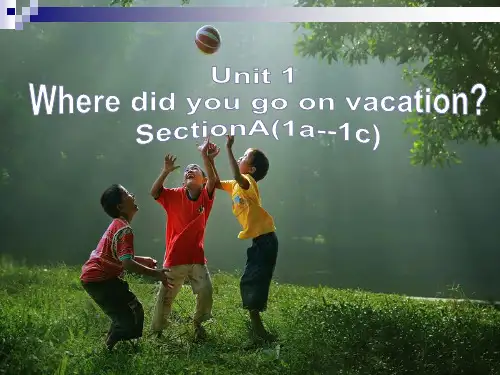
She went to New York City.
Where did they go on vacation?
They went to summer camp. /kæmp/
露营地, 阵营
went to New York City went to the beach went to summer camp went to the mountains stayed at home visited my uncle visited museums
I went to the Great Wall.
Where did you go?
Exercises: 用所给动词的适当形式填空。
1. Tom and Mary _______ came (come) to China last month. 2. My daughterdidn’t ________ go (not go) to school yesterday. Did she _________ practice (practice) her 3. —_____ guitar yesterday? —No, she ___________. didn’t were (be) three trees around my 4. There _______ house last year. did you do 5. —What _____ ______ (do) last weekend? studied (study) math on Saturday. —I _________
2. went to New York b City __ 3. visited my uncle __ g 4. went to summer d camp __ 5. went to the mountains __ c 6. went to the beach __ a e 7. visited museums ___
Where did they go on vacation?
They went to summer camp. /kæmp/
露营地, 阵营
went to New York City went to the beach went to summer camp went to the mountains stayed at home visited my uncle visited museums
I went to the Great Wall.
Where did you go?
Exercises: 用所给动词的适当形式填空。
1. Tom and Mary _______ came (come) to China last month. 2. My daughterdidn’t ________ go (not go) to school yesterday. Did she _________ practice (practice) her 3. —_____ guitar yesterday? —No, she ___________. didn’t were (be) three trees around my 4. There _______ house last year. did you do 5. —What _____ ______ (do) last weekend? studied (study) math on Saturday. —I _________
2. went to New York b City __ 3. visited my uncle __ g 4. went to summer d camp __ 5. went to the mountains __ c 6. went to the beach __ a e 7. visited museums ___
人教版八年级上册英语第一第二单元复习课件(共51张PPT)
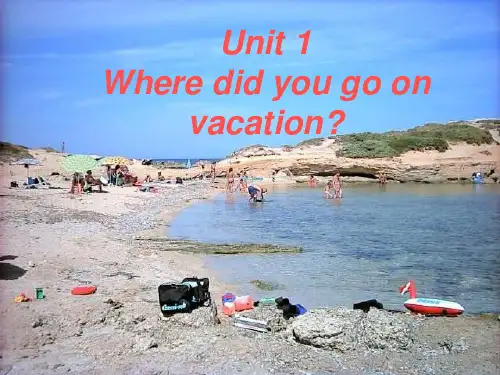
•
drive-drove-driven rise-rose-risen ride-rode-ridden
•
write-wrote-written give-gave-given
•
③其他
中考演练
28. The mobile phone has influenced people’s life a lot since it .(13年中考)
Something is wrong with my watch.
Everyone wants to win.
Nobody knows the boy’s name.
There is something for everyone at Green Park.
中考演练
( B)May I have a talk with you ,sir? (2011陕 西21题)
Revision
为某人买某物 当然 似乎做某事 没事可做除了… 去购物 为考试做准备 大部分的时间 我很无聊
buy sth for sb/ buy sb sth
of course seem to do nothing to do but do… go shopping study for tests most of the time
C. new something D. new anything
(A) 2 I will do____for my motherland. (15原创
A anything B. many C. much D. something
中考热点四
too many +可数名词复数 too much +不可数名词 much too +形容词或副词
人教版八年级上册英语 Unit 1 Section A (1a-2d) 授课课件
是指某些人或物中的“任何一个”,用来表明只限一个
辨析:anyone, anybody与anyone
都指“任何人”,其后一般不接 anybo of,作主语时,谓语动词用第三
dy, 人称单数形式。 anyon 后面不可接动词的否定形式;如
e 果要表达全部否定, 主语用 nobody。 是指某些人或物中的“任何一
.
课文呈现
1c. Makeconversationsaboutthepeopleinthepicture. A:WheredidTinagoonvacation? B:Shewenttothemountains.
课文呈现
People Grace Kevin Julie
Places
Thebeach Home
考点精讲
考点5 quiteafew相当多;不少
修饰可数名词 复数,相当于 many和quite a lot of。
e.g. Quiteafewstudentsgotoschoolbybike.
相当多的学生骑自行车上学。
拓 展 : quitealittle 表 示 “ 相 当 多 ; 不 少 ” , 相 当 于
考点精讲
③Oh, didyougoanywhereinteresting?
考点3 (重点)anywhere/'eniweə/adv. 在任何地方 形容词修饰复合不定代词、不定副词时,位于不定 代词、不定副词的后边。
anywhere常用于否定句和疑问句中,表示“在任何 地方”;如果用在肯定句中,表示“在(或去)任 何地方,随便哪个地方”。
? Grace: Yes. I went with my mother. Boy: Did you go to Central Park? Grace: Yes, I did. It was really nice. Boy: Did you buy anything special? Grace: Yes. I bought something for my f
人教版八年级英语上册Units1-5单元知识复习课件
screen
big/small big /small
distance close/far close /far
sound
good/bad the /the
movie new/old new /old
seat comfortable uncomfortable
comfortable
I. 单项选择:
What do you think of...?
C. happily
D. happiest
4.—What do you think of maths, John?
—For me, maths is ______ than any other subject.
A. difficult
B. mBore difficult
C. most difficult D. the most difficult
B. How often
C. How far
D. How much
习惯用法、搭配
1. help sb. with sth 帮助某人做某事 2. How about…? =What about…? ….怎么样?/ ….好不好?3. want sb. to do sth. 想让某人做某事 4. How many + 可数名词复数+ 一般疑问句 ….有多少…..5. 主语+ find+ that 从句 …发现… 6. It’s + adj.+ to do sth. 做某事是….的7. spend time with sb. 和某人一起度过时光 8. ask sb. about sth. 向某人询问 某事9. by doing sth. 通过做某事 10. What’s your favorite…..? 你 最喜欢的……是什么?11 start doing sth. 开始做某事 12. the best way to do sth. 做某事的最好方式
新人教版八年级英语上册期末总复习课件
单词复习
famous著名的 well-known著名的 nature自然地 agree同意 normal一般的 unless除非不 certainly无疑的 serve服务 look after 照顾 invitation邀请
again再一次 angry发怒的 understanding善解人意的 careless粗心的 often多久 as far关于,至于 natural自然地 turn down拒绝 reply回复 forward发送
until直到 how often多久 how long 多长时间 how soon多久才... lendar日历 daytime白天 in half分成两半 halfway在中途 else别的,其他的
单词复习
how munch多少钱 how far多远 be good for对....好 be good at擅长...... be bad for 对.......有坏处 be good with 与....相处的好 wrong怎么了? halfway在中途 else别的,其他的
今日复习的重点
本单元的所有单词、短语、语法、长难句、课文
grow成长 meeting遇见 pollute污染 prepare准备 prepare for准备 two两个 twice两次 one一个 once一次 health健康 healthy健康的
单词复习
upset沮丧的 different不同的 unhealthy不健康的 difference差异 foot脚 feet脚步 advice建议,劝告 another其他的 happen发生 expect 期待
单词复习
mistake错误 week一周 a lot of 大量 be good for 对什么好 stress压力 get back返回 careful小心的 careless粗心的 advice建议 solve步骤 during在........期间
人教版英语八年级上Unit1整单元课件(共192张)
2)如果动词是延续性动词,则一般它即可 表示动作,也可以表示状态。 如:live/stay/work等就是此类。 3)如果是单独的瞬间性动词,则它只表示 动作。 如:get up/put on/begin就属于此类。
5. Did you buy anything special? 在英语中,anything, something, nothing 和everything是用于指代事物的复合不定代 词,与之相对应的复合不定代词 anyone, someone, no one 和everyone ( anybody, somebody, nobody 和 everybody) 用于指人。
happy.
2d Role-play the conversation. Rick: Hi, Helen. Long time no see. Helen: Hi, Rick. Yes, I was on
vacation last month. Rick: Oh, did you go anywhere
4. I was on vacation last month. be on vacation 译为 “在度假” 强调状态。 而 “go to vacation”, 去度假。 强调动作。 我们应该如何区分英语中强调动作和状态 的词语: 1)一般来说,单独的动词/短语一般强调动 作;而如果“be + 分词/形容词”则只表状态 。如marry sb和get married to sb表动作,而 be married to sb表状态。
She visited the USA. She went to New York City.
Where did they go on vacation?
They went to summer camp. /kæmp/