
传媒的作用 The Function of Mass Media(大学英语作文)
传媒的作用The Function of Mass
Media
大学英语作文
Mass media are very important tools of communication,through which information is passed to even the farthest end of the world. They enable us to communicate with each other by helping us to overcome the barriers of time and apace.
大众媒体是非常重要的沟通工具,通过它信息可以传递到世界的尽头。
他们能够使我们互相交流,帮助我们克服时间和空间的障碍。
Mass media function in various ways. Below are listed the most commonly seen.
大众传媒有各种各样的功能。
下列是最常见的。
First, mass media keep us well informed of the happenings of the world which would otherwise remain unknown.
首先,通过大众传媒,我们可以对风云变幻的世界了如指掌,否则我们就会一无所知。
Second, mass media persuade us mostly through
advertisements. As we can see, newspapers, magazines and TV are filled with all kinds of colourful, persuasive advertisements which tempt us to buy their products.
第二,大众媒体主要通过广告说服我们。
正如我们所看到的,报纸、杂志和电视都充满了各种色彩鲜艳的、有说服力的广告,引诱我们购买他们的产品。
Third, mass media give us entertainment. Television and radio broadcasting provide us with a big variety of programmes every day. Films, books, magazines, etc. give us daily amusement.
第三,大众媒体让我们娱乐。
电视和无线电广播每天给我们提供种类繁多的节目。
电影、书籍、杂志等,给我们日常的娱乐。
In a word, mass media will be all the more important in the future and theirfunctionwill enormously expand.Limited by apace, only a few examples are mentioned here.
总之,大众媒体将在未来将变得更重要,他们的功能也将极大地扩大。
空间有限,在这里之举了少数的例子。
mass media(大众传媒)
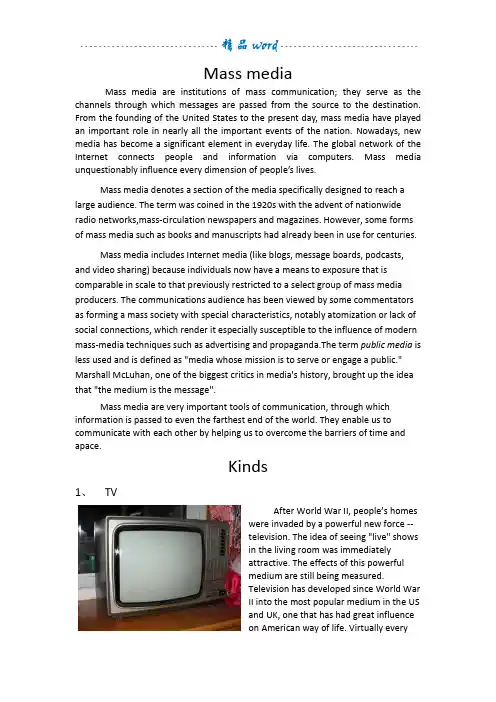
Mass mediaMass media are institutions of mass communication; they serve as the channels through which messages are passed from the source to the destination. From the founding of the United States to the present day, mass media have played an important role in nearly all the important events of the nation. Nowadays, new media has become a significant element in everyday life. The global network of the Internet connects people and information via computers. Mass media unquestionably influence every dimension of people’s lives.Mass media denotes a section of the media specifically designed to reach a large audience. The term was coined in the 1920s with the advent of nationwide radio networks,mass-circulation newspapers and magazines. However, some forms of mass media such as books and manuscripts had already been in use for centuries.Mass media includes Internet media (like blogs, message boards, podcasts, and video sharing) because individuals now have a means to exposure that is comparable in scale to that previously restricted to a select group of mass media producers. The communications audience has been viewed by some commentators as forming a mass society with special characteristics, notably atomization or lack of social connections, which render it especially susceptible to the influence of modern mass-media techniques such as advertising and propaganda.The term public media is less used and is defined as "media whose mission is to serve or engage a public." Marshall McLuhan, one of the biggest critics in media's history, brought up the idea that "the medium is the message".Mass media are very important tools of communication, through which information is passed to even the farthest end of the world. They enable us to communicate with each other by helping us to overcome the barriers of time and apace.Kinds1、TVAfter World War II, people’s homeswere invaded by a powerful new force --television. The idea of seeing "live" showsin the living room was immediatelyattractive. The effects of this powerfulmedium are still being measured.Television has developed since World WarII into the most popular medium in the USand UK, one that has had great influenceon American way of life. Virtually everyAmerican household -- 98% in 1999 -- has at least one TV set. Seven in ten Englishmen in 1991 reported getting most of their news from TV. Three large privately-owned networks -- NBC, CBS and ABC -- claimed 90 percent of the TV market from the 1950s through the 1970s with free broadcasts.Cable TelevisionHowever, the rapid spread of pay cable TV in the 1980s broke the hegemony of the big three. By 1999, close to 70% of American households had subscribed to cable TV. Cable TV, carried by coaxial and fiber-optic cables, originated in 1948 to better serve individuals in mountainous or geographically remote areas who could not receive over-the-air TV stations. The genesis of cable as it is known today stems from development of the domestic communications satellite, approved by the Federal Communications Commission in January 1973.The new technology offered cable programmers a cost-effective method of national and international distribution. In December 1975, Home Box Office, an all-movie channel owned by Time, Inc., became the first programmer to distribute its signal via satellite. The next service to use the satellite was a local television station in Atlanta owned by Ted Turner. It became known as the first "superstation," bouncing its signal off a satellite to reach a nationwide audience. The same technology allowed Turner in 1980 to found the Cable News Network, CNN, the world's first 24-hour all-news channel. By early 1993, MTV, the leading American rock music TV network, had an audience of 46 million in the United States and 32 other countries. Cable television has also been successfully used to reach very defined audiences. Beginning in the late 1970s, a growing number of U.S. cable systems began "narrowcasting" or offering television programming with an entire channel tailored to a narrow section of the audience.Advancing digital technology and increasing wiring of U.S. cities with fiber-optic cable that permits massive transmission of digital signals are giving cable TV subscribers a host of new interactive services. The convergence of the computer with TV is permitting a host of new "interactive" services in which the viewer no longer watches passively, for example "Movies on demand" which allows a viewer to choose between several thousand videos is one interactive service. Another example is "shop-at-home" channels.Public TelevisionU.S. public television stations are independent and serve community needs. All public television organizations are linked nationally, however, through three national organizations: the Corporation for Public Broadcasting (CPB), created by Congress in 1967 to channel federal government funding to stations and independent producers; the Public Broadcasting Service (PBS), formed in 1969 and which today distributes programming and operates the satellite system linking all public TV stations; and the Association of Public Television Stations (APTS), which helps member public TV stations with research and planning. In addition to these public TV stations, there area growing number of noncommercial stations run by Christian evangelistic ministries, which are, for the most part, supported by donations from viewers and member churches.2、MagazinesThe late 1800s saw the start of opinion journals still influential a century later, including the Atlantic Monthly, the Nation, and Harper's. The largest readerships were won, however, by magazines that catered to people's increasing leisure time and appetite for consumer goods, magazines such as Cosmopolitan, the Ladies Home Journal, and the Saturday Evening Post. Publishers were no longer just selling reading material; they were selling readers to advertisers. Because newspapers reached only local audiences, popular magazines attracted advertisers eager to reach a national audience for their products. By the early 1900s, magazines had become major marketing devices.At the same time, a new breed of newspaper and magazine writer was exposing social corruption. Called "muckrakers," these writers sparked public pressure for government and business reforms. Yet magazines did not truly develop as a powerful shaper of news and public opinion until the 1920s and 1930s, with the start of the news weeklies. Time was launched in 1923 by Henry Luce (1898-1967). Intended for people too busy to keep up with a daily newspaper, Time was the first magazine to organize news into separate departments such as national affairs, business and science. Newsweek, using much the same format, was started in 1933. Other prominent news weeklies are Business Week and U.S. News and World Report.Magazine publishers have increasingly tried to appeal to clearly-defined audiences. Computer technology has helped publishers to target special-interest audiences. As a result of this specialization, the number of periodicals published in the United States jumped from 6,960 in 1970 to close to 10,000 in 1999.3、RadioThe beginning of regularcommercially licensed sound broadcastingin the United States in 1920 ended theprint monopoly over the media andopened the doors to the more immediateand pervasive electronic media. By 1928,the United States had three national radionetworks - two owned by NBC (theNational Broadcasting Company), and oneby CBS (the Columbia BroadcastingSystem).Though mostly listened to for entertainment, radio's instant, on-the-spot reports of dramatic events drew huge audiences throughout the Great Depression of the 1930s and World War II. President Franklin Roosevelt recognized the potential of radio to reach the American public, and during his four terms (1933-1945), his radio "fireside chats" informed the nation on the progress of policies to counter the Depression and on developments during World War II. After World War II, television's visual images replaced the audio-only limitation of radio as the predominant entertainment and news vehicle. Radio adapted to the new situation by replacing entertainment programs with a format of music interspersed with news and features. In the 1950s, automobile manufacturers began offering car radios as standard accessories, and radio received a big boost as Americans tuned in their car radios as they drove to and from work.The expansion and dominance of FM radio, which has better sound quality but a more limited range than traditional AM, represented the major technical change in radio in the 1970s and 1980s. FM radio, aided by the invention of ever smaller portable radios and inexpensive "Walkman" headsets, dominates music programs, while AM has shifted to "talk" and news formats. Barely in existence 25 years ago, "talk radio," in which celebrities and experts from various fields answer listener "call-in" questions and offer their advice on various topics, has grown spectacularly in recent years. It has contributed to the comeback of AM radio. Both FM and AM radio have become increasingly specialized. Music formats, for instance, comprise a variety of specializations -- the top five in 1991 being "country and western," "adult contemporary," "top 40," "religious" and "oldies."In an era in which TV is clearly the glamour medium, the reach of radio is still awesome. Ninety-nine percent of American households in 1999 had at least one radio; the average is five per household. Every day, radio reaches 80 percent of the U.S. population at one time or another. Revenues more than doubled from $8.4 billion in 1990 to more than $17 billion in 1999.In 1998, the number of U.S. commercial radio stations had grown to 4,793 AM stations and 5,662FM stations. In addition, there are 1,460 public radio stations in the United States. Most of these stations are run by universities and public authorities for educational purposes and are financed by public and/or private funds, subscriptions and some underwriting. NPR (National Public Radio) was incorporated in February 1970 under the 1967 Public Broadcasting Act. NPR was created to provide leadership in national newsgathering and production and to act as a permanent nationwide interconnection of noncommercial stations.4、NewspaperThe first U.S. newspaper, PublickOccurrences: Both Foreign andDomestick, first published on September25, 1690 lasted only one day before itwas suppressed by British colonialauthorities. Other newspapers quicklysprang up, however, and by 1730, thecolonial press had gained sufficientstature to seriously challenge Britishgovernors. Historians consider the birthof America's free-press tradition to havebegun with the 1734 trial of John PeterZenger for seditious libel. After theRevolutionary War (1775-1783), thisconcept found a home in the Bill of Rights, the first ten amendments to the U.S. Constitution. The First Amendment states: "Congress shall make no law... abridging the freedom of speech or of the press..." These 14 words made it possible for a free press to develop over the next two centuries as one of America's strongest watchdogs over government actions and protectors of individual rights. In fact, one of America's greatest political journalists was one of its first, Thomas Paine. Paine's stirring writings urging independence made him the most persuasive "media" figure of the American Revolution against Britain in 1776.By the early 1800s, the United States had entered a period of swift technological progress that marked the real beginning of the "modern media." The inventions of the steamship, the railroad and telegraph brought communications out of the age of windpower and horses. The high-speed printing press was developed, driving down the cost of printing. Expansion of the educational system taught more Americans to read. Publishers realized that a profitable future belonged to cheap newspapers with large readerships and increased advertising. The press went from a small upper class readership to mass readership in just a few years. It was a time that shaped a breed of editors who set the standard for generations of Americanjournalists. Many of these men were hard-headed reformers who openly sided with the common men, opposed slavery and backed expansion of the frontier. They combined idealism with national pride, and their papers became the means by which great masses of new immigrants were taught the American way of life.By the 1820s, about 25 dailies and more than 400 weeklies were being published in the United States. Horace Greeley founded the New York Tribune in 1841, and it quickly became the most influential newspaper in America. Other important dailies, such as the New York Times, Baltimore Sun, and Chicago Tribune were founded in the 1850s. Two media giants, Joseph Pulitzer and William Randolph Hearst, began building their newspaper empires after the Civil War (1861-1865). Their fierce competition produced "yellow journalism" -- sensational and often inaccurate reporting aimed at attracting readers. "Chain" newspapers under the same ownership became a dominant feature in the early 20th century. In addition to the front-running Hearst chain, the Scripps-Howard and Cowles chains grew following World War I. That trend accelerated after World War II, and in 1990, a total of 135 groups owned 1,228 daily newspapers, accounting for about 75 percent of all U.S. dailies. In 1971, there had been 66 cities with two or more dailies owned by separate companies, while in 1995 there were only 36.In spite of the serious competition from television after World War II, more than two-thirds of American adults read a daily newspaper on an average weekday. The top five daily newspapers by circulation are: the Wall Street Journal, USA Today, the New York Times, Los Angeles Times, and the Washington Post. The number of dailies dropped from 1,763 in 1946 to 1,438 in 1999. However, the number of Sunday papers rose from 497 in 1946 to 905 in 1999, bringing total daily and Sunday papers to 2,388. This figure represents the highest number of newspapers with the highest total circulation -- 115 million -- for any country in the world.Today, American newspapers face competition not only from network TV, but from a whole spectrum of targeted and specialized media, including personalized web services, local cable programming, interactive television, special-interest publications, catalogs and other direct-mail initiatives. Newspapers are relying on new technology to meet the challenge. Through the Internet, electronic newspapers can be transmitted to hand-held computers and printed using personal computers.FunctionMass media function in various ways. Below are listed the most commonly seen.First, mass media keep us well informed of the happenings of the world which would otherwise remain unknown.Second, mass media persuade us mostly through advertisements. As we can see, newspapers, magazines and TV are filled with all kinds of colourful, persuasive advertisements which tempt us to buy their products.Third, mass media give us entertainment. Television and radio broadcasting provide us with a big variety of programmes every day. Films, books, magazines, etc. give us daily amusement.In a word, mass media will be all the more important in the future and their fufietions will enormously expand. Limited by apace, only a few examples are mentioned here.。
大众媒体 英文作文

大众媒体英文作文The media plays a crucial role in shaping public opinion and influencing society. It serves as a platformfor information dissemination, entertainment, and even as a tool for propaganda. However, the impact of mass media can be both positive and negative.News outlets are responsible for reporting current events and keeping the public informed. They provide us with crucial information about politics, economy, andsocial issues. However, the media can also sensationalize news stories to attract viewership, leading to biased reporting and the spread of misinformation.Television and movies are a popular form of entertainment, allowing people to escape from reality and immerse themselves in different worlds. They provide a source of relaxation and enjoyment for many individuals. However, the media can also perpetuate stereotypes and unrealistic beauty standards, leading to body image issuesand low self-esteem among viewers.Social media platforms have revolutionized the way we communicate and connect with others. They allow us to share our thoughts, experiences, and ideas with a global audience. However, the media can also contribute to the spread offake news and cyberbullying, causing harm to individualsand communities.Advertising is a powerful tool used by the media to promote products and services. It influences our purchasing decisions and shapes our consumer behavior. However, the media can also manipulate our desires and create a cultureof materialism, leading to excessive consumption and environmental degradation.In conclusion, the media has a significant impact on society, shaping our beliefs, values, and behaviors. Whileit provides us with valuable information and entertainment, it can also perpetuate stereotypes, spread misinformation, and contribute to societal issues. It is important for individuals to critically analyze and question the mediathey consume to ensure they are not being influenced negatively.。
大众媒体对社会的影响英语作文
大众媒体对社会的影响英语作文The Impact of Mass Media on SocietyMass media plays an essential role in our modern society. It has the power to shape our perceptions, influence our beliefs, and impact our behavior. The influence of mass media on society is profound and multifaceted, affecting various aspects of our lives.Firstly, mass media serves as a primary source of information. Through newspapers, television, radio, and the internet, media outlets provide us with news and updates about local and global events. This constant flow of information helps us stay informed and aware of the world around us. However, it also means that the media has the power to control the narrative and influence public opinion.Secondly, mass media has a significant impact on shaping cultural norms and values. T elevision shows, movies, and music videos often portrayal certain lifestyles, behaviors, and beliefs, which can influence societal standards. For instance, the portrayal of unrealistic body images in the media can lead to body dissatisfaction and low self-esteem among individuals.Furthermore, mass media plays a crucial role in shaping political discourse. It provides a platform for political candidates to express their views, and it also influences public opinion through biased reporting and commentary. The media's influence on political elections and policy-making cannot be underestimated.Moreover, mass media has transformed the way we communicate and interact with one another. Social media platforms have created virtual communities, allowing people to connect globally and share their thoughts and experiences. While this has many positive aspects, such as promoting social awareness and activism, it also has negative consequences, such as online bullying and the spread of misinformation.In addition, mass media has a profound impact on consumer behavior. Advertising and marketing strategies influence our purchasing decisions, often manipulating our desires and creating false needs. This can lead to materialism and excessive consumption, which have negative environmental and social implications.Lastly, mass media can both reflect and perpetuate societal inequalities. It has the power to reinforce stereotypes and biases, thereby contributing to discrimination and social divisions. Representation matters, and the media should strive for diversity and inclusivity to promote a more equitable society.In conclusion, the influence of mass media on society is undeniable. It shapes our perceptions, beliefs, and behavior, and has both positive and negative consequences. As consumers of media, it is crucial to be critical and discerning, while also advocating for responsible and ethical media practices. Only through awareness and action can we harness thepotential of mass media to create a better and more inclusive society.。
大众传媒的优缺点英语作文
大众传媒的优缺点英语作文The Advantages and Disadvantages of Mass MediaMass media plays a pivotal role in today's society, shaping our perception of the world and disseminating information rapidly. However, it also has its own set of advantages and disadvantages.Advantages of Mass Media1.Speed and Reach: Mass media boasts an unparalleled speed and reach.News and information can be disseminated to a global audience withinseconds, ensuring that people are kept up-to-date with the latestdevelopments.2.Diversity of Content: Mass media offers a diverse range of content,including news, entertainment, education, and more. This diversity caters tothe varying interests and needs of the audience.3.Empowerment of Weak Groups: Mass media has become a powerful toolfor empowering vulnerable groups in society. It provides them with aplatform to voice their opinions and concerns, often leading to positivechanges.4.Convenience: With the advent of digital media, accessing information hasbecome increasingly convenient. People can access news and entertainmentcontent from any device, anytime, anywhere.Disadvantages of Mass Mediarmation Overload: In the digital era, people are bombarded with anoverwhelming amount of information. This information overload can make it difficult to distinguish between credible and unreliable sources.2.Loss of Authenticity: With the pursuit of clickbait and sensationalism, massmedia often sacrifices authenticity for popularity. This can lead to the spread of misinformation and rumors.mercialization: Mass media is often influenced by commercialinterests, resulting in the production of content that is more focused onprofits than on quality or social value.4.Unbalanced Coverage: Mass media tends to focus on certain issues andevents, often neglecting other important but less sensational topics. This can create a distorted view of the world.In conclusion, mass media has both positive and negative impacts on society. While it provides us with convenient access to information and empowers vulnerable groups, it also poses challenges such as information overload, loss of authenticity, commercialization, and unbalanced coverage. It is crucial for us to be critical consumers of mass media and to exercise discernment in evaluating the information we receive.。
关于媒体的英语作文
The media plays a pivotal role in modern society,shaping public opinion, disseminating information,and providing entertainment.Here are some key points to consider when writing an essay about the media:1.Introduction to the Media:Begin by defining what the media encompasses,including newspapers,television,radio,and the internet.Highlight its significance in contemporary life.2.Historical Perspective:Discuss the evolution of media from the early days of print to the digital age.Mention the impact of the internet and social media on the way information is shared and consumed.3.Functions of the Media:Informing:The medias primary function is to keep the public informed about current events and issues.Educating:It also serves to educate the public on various topics,from politics to science.Entertainment:Media provides a wide range of entertainment options,from movies and TV shows to music and video games.4.The Role of Media in Democracy:Explore how the media acts as the fourth estate, holding governments and institutions accountable,and facilitating public discourse.5.Media Bias and Objectivity:Discuss the issue of media bias and the importance of journalistic objectivity.Include examples of media outlets known for their biases and how this affects the publics perception of events.6.The Impact of Media on Society:Cultural Influence:Media can shape cultural norms and values.Social Issues:It can bring attention to social issues,potentially leading to change. Public Opinion:Media can influence public opinion,sometimes leading to what is known as the agendasetting effect.7.The Digital Revolution:Talk about how digital technology has transformed the media landscape,including the rise of citizen journalism,the decline of print media,and the impact of social media platforms.8.Challenges Faced by the Media:Fake News:Address the problem of misinformation and the role of media literacy in combating it.Economic Pressures:Discuss the financial challenges faced by traditional media outlets and the shift towards online content and subscription models.9.The Future of Media:Speculate on the future of media,including the potential impact of artificial intelligence,virtual reality,and other emerging technologies.10.Conclusion:Summarize the main points of your essay,emphasizing the medias dual role as both a powerful tool for information and a potential source of misinformation.Remember to support your arguments with relevant examples and to maintain a balanced perspective,acknowledging both the positive and negative aspects of media influence.。
我最喜欢的大众传媒英语作文

大众传媒的魅力:我的最爱In the modern era, the influence of mass media is ubiquitous, shaping our perspectives, informing our decisions, and entertaining us in countless ways. Among all forms of mass media, I find television to be my favorite. Television, with its unique ability to combine visuals, audio, and narrative, has a profound impact on my life.First and foremost, television serves as a powerful medium for education and information. From news programs that keep us updated on global events to documentaries that delve into the depths of human history and culture, television has the capacity to inform and educate its viewers. I find myself constantly learning new things, whether it's about science, history, or current affairs, simply by watching television.Moreover, television provides a platform for entertainment and relaxation. Whether it's watching a comedy show to laugh off stress or bingeing on a thriller series to escape reality, television has something for everyone. The diverse range of content available on television ensures that there's always something tocaptivate the interest of its viewers, making it a reliable source of entertainment.Apart from education and entertainment, television also plays a significant role in shaping social norms and values. Television programs often reflect and promote social values and norms, thereby influencing the way we perceive and interact with the world. By watching television, I gain insights into different cultures, perspectives, and ways of life, broadening my horizons and enhancing my understanding of the world.Additionally, television has the power to evokeemotions and inspire change. Whether it's a heartfelt drama that moves us to tears or a documentary that brings awareness to a pressing social issue, television has the ability to trigger powerful emotional responses and inspire action. I find that television programs often serve as catalysts for change, motivating me to act and make a positive impact in my community.In conclusion, my love for television stems from its unique ability to educate, entertain, inform, and inspire. Television serves as a window to the world, allowing me toexpand my knowledge, relax, and engage with diverse perspectives and cultures. Its power to evoke emotions and inspire change makes it a powerful tool for social progress. As such, television remains my favorite form of mass media. **大众传媒的魅力:我的最爱**在现代社会,大众传媒的影响无处不在,它塑造着我们的观念,指导着我们的决策,并以无数种方式娱乐着我们。
中国的大众传媒英语作文
中国的大众传媒英语作文1The mass media in China play a crucial role in people's lives. They include TV, radio, newspapers, and the Internet. CCTV's news reports have great influence, providing accurate and timely information. Newspapers offer in-depth analysis and commentary. The Internet, like Weibo, enables rapid dissemination of news and interaction. Radio reaches a wide audience, especially in rural areas.TV shows various programs, from entertainment to educational ones. The Internet has changed the way people get and share information.In conclusion, the mass media in China have a significant impact on society, influencing people's thoughts and behaviors, and promoting cultural exchange and development.2In China, mass media face both challenges and opportunities.The issue of information authenticity is a major concern. False news can mislead the public and cause chaos. For instance, some rumors can have negative impacts on social stability.The rapid rise of short-video platforms is an opportunity. They spread information fast, but also bring problems like shallow content.To address these, media should strengthen self-regulation andimprove the verification mechanism. The government should enforce strict regulations. Only in this way can mass media in China develop healthily and provide valuable information.3When I was a child, my favorite thing to do was to watch educational TV programs. One of them was about science, which sparked my interest in exploring the unknown world.As I grew older, I started to make friends through social media platforms. We shared our hobbies and dreams, and it made me feel less lonely.Recently, I participated in an online charity event. It was an amazing experience. I saw how people came together to help those in need. It made me realize the power of unity and kindness.The development of mass media in China has truly enriched my life and broadened my horizons.4In recent years, the mass media in China has witnessed significant growth. The market size has expanded rapidly, reaching an estimated $X billion in 2023. For instance, in the eastern region, the demand for online media has soared by XX% in the past five years. The number of users of short-video platforms has also increased dramatically, with millions of newusers joining every month.The development trend shows a shift towards digital and mobile platforms. Traditional media like newspapers and magazines are facing challenges, while online news and social media are gaining more popularity.In conclusion, China's mass media industry is evolving at a fast pace, presenting both opportunities and challenges. It is crucial for media companies to adapt to the changing landscape to stay competitive.5The mass media in China play a significant role in our daily lives. They include various forms like television, the Internet, and newspapers. The ways they spread information are diverse. For instance, news can be spread quickly through TV and online platforms.Advertising is a common form that influences consumers' behaviors. It reaches people through different channels and affects their purchasing decisions.The factors affecting the mass media include technology and social trends. As technology advances, the way we receive and share information keeps changing. Social trends also shape the content and style of the media.。
媒体的作用 Role of Media 英语作文
Role of Media>Role of Media Essay:Media is known as the fourth pillar of democracy due to its important role in shaping public opinion. Today, in this ultra modern world, the role of media has been augmenting day by day. It has been surving as a vigilant watch dog of India.Long and Short Essays on Role of Media for Kids and Students in EnglishGiven below are two essays in English for students and children about the topic of ‘Role ofMedia’ in both long and short form. The first essay is a long essay on Role of Media of 400-500 words. This long essay about Role of Media is suitable for students of class 7, 8, 9 and 10, and also for competitive exam aspirants. The second essay is a short essay on Role of Media of 150-200 words. These are suitable for students and children in class 6 and below.Long Essay on Role of Media 500 Words in EnglishBelow we have given a long essay on Role of Media of 500 words is helpful for classes 7, 8, 9 and 10 and Competitive Exam Aspirants. Thislong essay on the topic is suitable for students of class 7 to class 10, and also for competitive exam aspirants.Print Media has created an awareness among the people regarding their rights and duties. We can update ourselves just by going through the morning newspaper, getting each and every kind of news from every nook and corner of the world. Catering to all this, today mass media is well-established, wherein it is remarkable to see the All India Radio (AIR) now reaches 90% of the population, TV more than 80% and over 5,600newspapers, 150 of these publications are published daily in over 100 languages.There has been a worldwide growth of the Print Media even after the emergence of the electronic media. Moreover, there has been an increase in the circulation of newspapers around the world even after the emergence of electronic media and the internet. The newspapers play a very important role in the working of any democracy. Our Constitution too grants us the Right to Freedom of Expression which is manifested, in free press in our country. In a democracy, newspapers are the best way ofeducating people politically and socially. They play a decisive role no only in updating the public but also in formulating a well-balanced public opinion. The public read about the current events, interpret them and learn to intelligently participate in the political, social and economic affairs of the country.Newspapers also reflect public opinion, thus formed through letters to the Editor which are usually published in a separate column. Moreover, Print Media provides great incentive to business by large number of advertisements on a variety of things s,uch as a house on sale,shops, electronic goods, stationary, cloth stores, glass ware, crockery shops etc. Matrimonial advertisements, job-opportunities, obituaries are all advertised through the Print Media.Now-a-days, another very popular means of social interaction and propagation that has emerged along with the Print Media is the rise of Electronic Media. The birth of electronic media took place with the invention of radio, it further got spread through television, then through the laptops, computers via internet and now in every hand in I the form of mobile phones. Electronic Media has a very emphatic and motivating effecton the society today. The various news channels keep the vigilant citizens updated. Channels like Discovery and National Geographic keep the inquisitive mind busy and satisfy every intellectual query of a probing mind. Along with these, there are endless number of entertainment channels solely to amuse and tic kle the audience. Now, quite a number of kids’ channels have come up to cater to this special section of the society. Television can help popularise technology and internationalise, and universalise our outlook.These-days, the internet too is gaining a huge momentum, in terms of its role in media. This is because traditional ‘silent citizens’ for traditional media like newspaper often ‘speak out’ through the internet platform to let a society hear their voices. This has in turn increased the society’s level of democratic awareness wherein people of all age groups and sections formulate their opinion on the social networking sites. It is also because internet can be used by anybody, anywhere, at anytime easily to express themselves economically. Infact, these days there are many independent websites established which hope to monitor parliamentactivities and other crucial operations of society. The only major drawback internet is facing is that its spread is limited.Yet, there is other side to media too, wherein it tries to cater to the transient needs of life and to appeal to the emotions of masses instead of maintaining an intellectual level. They even lower the moral tone and publish sub-standard materials to increase their readership.Many times, newspapers try to ally themselves to particular ideology or a party instead of maintaining impartiality and indulge in mudslinging or even communal propaganda.These thoughtless means for easy money provides temporary financial benefits to a handful of people but prove to be extremely disastrous in the end for society at large.Short Essay on Role of Media 200 Words in EnglishBelow we have given a short essay on Role of Media is for Classes 1, 2, 3, 4, 5 and 6. This short essay on the topic is suitable for students of class 6 and below.People involved in this profession should realise the massive responsibility they shoulder andsacredness of the duty that they perform. They should avoid personal bias and prejudice to cloud their good sense. Instead, they should try to combat social evils, communal forces and also keep the government on its toes, committed to its promises. It should try to make people politically conscious and keep patriotism and national pride alive in the people.In today’s world media has become as necessary as food and clothing. In the earlier times, it united people for freedom struggle, today it is uniting people against social evils. It has always been a crucial part, a ‘mirror’ ofsociety in every age, however it only differs in its approach, means and spread, from time to time. It has immense power which needs to be carefully harnessed. Moreover, it has also been seen that media is reduced to a commercialised sector, eying the news which are hot and good at selling. The goal is merely to gain the television rating points.I believe, if the media identifies its responsibility and work sincerely and honestly, then it can serve as a great force in building the nation.Role of Media Essay Word Meanings for Simple UnderstandingAugmenting – increasing, growing, raisingManifested – expressed, establishedDecisive – crucial, significant, critical Formulating – expressing, developingObituaries – a published notice of a death, sometimes with a brief biography of the deceasedPropagation –spreading, spread, promotion, communication, distributionEmphatic – forceful and positive; definite; directInquisitive – curious, questioning, inquiringProbing – searchingAmuse – entertain, please, delightTransient – short-term, temporaryAlly – associate, connectMudslinging –efforts to discredit one’s opponent by malicious or scandalous attacksPropaganda –information, advertising, promotion。
高中生英语作文媒体的作用
高中生英语作文媒体的作用The Role of MediaIn today's society, the role of media is undeniable.It has become an integral part of our lives, influencing the way we think, behave, and interact with each other.The media, which includes television, newspapers, magazines, radio, and the internet, plays a significant role in shaping public opinion, providing information, and entertaining us.In this essay, we will discuss the various roles of media and its impact on our lives.Firstly, one of the primary functions of media is to provide information.Whether it is news about national events, international affairs, or local issues, media ensures that we are well-informed about what is happening around us.It acts as a bridge between the government and the citizens, bringing transparency and accountability.Additionally, media also provides educational content, such as documentaries and programs that enhance our knowledge and understanding of various subjects.Secondly, media plays a crucial role in shaping public opinion.It has the power to influence our views and beliefs, and thus plays a significant role in shaping our society.For example, through its coverage of social issues, media can raise awareness and promote understanding and tolerance.It can also highlight the achievements and positive aspects of a society, fostering a sense of pride and unity.On the other hand, mediacan also spread misinformation and create sensationalism, leading to social divisions and conflicts.Furthermore, media serves as a platform for expression and debate.It allows individuals and organizations to share their ideas, opinions, and perspectives, fostering a culture of free speech and democracy.Social media platforms, in particular, have become a popular means for people to express themselves, share information, and participate in public discourse.However, this also raises concerns about the spread of fake news, hate speech, and online harassment.Moreover, media plays a significant role in entertainment.It provides us with a variety of content, such as movies, music, TV shows, and sports, which help us relax and unwind.Entertainment media also often reflects societal values and norms, shaping our cultural identity.Furthermore, media is a powerful tool for advertising and marketing, influencing our consumption habits and lifestyle choices.In conclusion, the role of media in society is multifaceted and significant.It provides information, shapes public opinion, serves as a platform for expression and debate, and entertains us.However, it is essential to recognize that media also has its pitfalls, such as the spread of misinformation and sensationalism.Therefore, it is crucial for individuals to be critical consumers of media, distinguishing between事实and fiction, and promoting responsible and ethical journalism.In thisway, we can harness the power of media for the betterment of society.。
媒体的英语作文
媒体的英语作文The Power of Media。
Media plays a crucial role in shaping public opinion, influencing policy decisions, and providing information to the masses. Whether it's through newspapers, television, radio, or the internet, the impact of media on society cannot be underestimated.One of the most powerful aspects of media is itsability to raise awareness about important issues. Through investigative journalism and in-depth reporting, media outlets can bring attention to social injustices, political corruption, environmental crises, and human rights abuses. This exposure can lead to public outcry, pressure on authorities to take action, and ultimately, positive change.Moreover, media serves as a platform for diverse voices to be heard. It provides a space for marginalized communities, activists, and experts to share theirperspectives and advocate for their causes. Thisinclusivity and diversity in media representation can challenge stereotypes, foster empathy, and promote understanding among different groups in society.In addition, media has the power to hold those in power accountable. By scrutinizing the actions of government officials, corporate leaders, and other influential figures, media can act as a watchdog, uncovering wrongdoing and ensuring transparency. This function is essential for a functioning democracy, as it helps prevent abuse of power and promotes good governance.Furthermore, media has the ability to shape public opinion and influence public discourse. Through editorial pieces, opinion columns, and talk shows, media can sway public sentiment on important issues, such as healthcare, immigration, and foreign policy. This can have asignificant impact on public opinion, which in turn can influence the decisions made by policymakers.However, with great power comes great responsibility.It is important for media to maintain ethical standards and strive for accuracy and fairness in reporting. Misinformation and fake news can have harmful consequences, leading to public confusion, social division, and erosion of trust in the media. Therefore, it is crucial for media outlets to uphold journalistic integrity and provide reliable, fact-based information to the public.In conclusion, the power of media in shaping public opinion, raising awareness, holding power to account, and influencing public discourse cannot be overstated. It is a force that can bring about positive change, amplify diverse voices, and promote transparency in society. However, it is essential for media to wield this power responsibly and ethically, in order to fulfill its role as a cornerstone of democracy and a catalyst for progress.。