
To Fall in Love With Anyone, Do This - The New York Times
http://nyti.ms/1FBeLRcSTY LETo Fall in Love With Anyone, Do This JAN. 9, 2015Modern LoveBy MANDY LEN CATRONUpdated, Feb. 13, 2015 |To try the 36 questions described below,download our free app for your phone, tablet or other device.More than 20 years ago, the psychologist Arthur Aron succeeded in making two strangers fall in love in his laboratory. Last summer, I applied his technique in my own life, which is how I found myself standing on abridge at midnight, staring into a man’s eyes for exactly four minutes.Let me explain. Earlier in the evening, that man had said: “I suspect, given a few commonalities, you could fall in love with anyone. If so, howdo you choose someone?”He was a university acquaintance I occasionally ran into at the climbing gym and had thought, “What if?” I had gotten a glimpse into his days on Instagram. But this was the first time we had hung out one-on-one.“Actually, psychologists have tried making people fall in love,” I said, remembering Dr. Aron’s study. “It’s fascinating. I’ve always wanted to try it.”I first read about the study when I was in the midst of a breakup.Each time I thought of leaving, my heart overruled my brain. I felt stuck. So, like a good academic, I turned to science, hoping there was a way to love smarter.I explained the study to my university acquaintance. A heterosexual man and woman enter the lab through separate doors. They sit face to face and answer a series of increasingly personal questions. Then they stare silently into each other’s eyes for four minutes. The most tantalizing detail: Six months later, two participants were married. They invited the entire lab to the ceremony.“Let’s try it,” he said.Let me acknowledge the ways our experiment already fails to line up with the study. First, we were in a bar, not a lab. Second, we weren’t strangers. Not only that, but I see now that one neither suggests nor agrees to try an experiment designed to create romantic love if one isn’t open to this happening.I Googled Dr. Aron’s questions; there are 36. We spent the next two hours passing my iPhone across the table, alternately posing each question.They began innocuously: “Would you like to be famous? In what way?” And “When did you last sing to yourself? To someone else?”But they quickly became probing.In response to the prompt, “Name three things you and your partner appear to have in common,” he looked at me and said, “I think we’re both interested in each other.”I grinned and gulped my beer as he listed two more commonalities I then promptly forgot. We exchanged stories about the last time we each cried, and confessed the one thing we’d like to ask a fortuneteller. We explained our relationships with our mothers.The questions reminded me of the infamous boiling frog experiment in which the frog doesn’t feel the water getting hotter until it’s too late. With us, because the level of vulnerability increased gradually, I didn’t notice we had entered intimate territory until we were already there, a process that can typically take weeks or months.I liked learning about myself through my answers, but I liked learning things about him even more. The bar, which was empty when we arrived, had filled up by the time we paused for a bathroom break.I sat alone at our table, aware of my surroundings for the first time in an hour, and wondered if anyone had been listening to our conversation. If they had, I hadn’t noticed. And I didn’t notice as the crowd thinned and the night got late.We all have a narrative of ourselves that we offer up to strangers and acquaintances, but Dr. Aron’s questions make it impossible to rely on that narrative. Ours was the kind of accelerated intimacy I remembered from summer camp, staying up all night with a new friend, exchanging the details of our short lives. At 13, away from home for the first time, it felt natural to get to know someone quickly. But rarely does adult life present us with such circumstances.The moments I found most uncomfortable were not when I had to make confessions about myself, but had to venture opinions about my partner. For example: “Alternate sharing something you consider a positive characteristic of your partner, a total of five items” (Question 22), and “Tell your partner what you like about them; be very honest this time saying things you might not say to someone you’ve just met” (Question 28).Much of Dr. Aron’s research focuses on creating interpersonal closeness. In particular, several studies investigate the ways we incorporate others into our sense of self. It’s easy to see how the questions encourage what they call “self-expansion.” Saying things like, “I like your voice, your taste in beer, the way all your friends seem to admire you,”makes certain positive qualities belonging to one person explicitly valuable to the other.It’s astounding, really, to hear what someone admires in you. I don’t know why we don’t go around thoughtfully complimenting one another all the time.We finished at midnight, taking far longer than the 90 minutes for the original study. Looking around the bar, I felt as if I had just woken up.“That wasn’t so bad,” I said. “Definitely less uncomfortable than the staring into each other’s eyes part would be.”He hesitated and asked. “Do you think we should do that, too?”“Here?” I looked around the bar. It seemed too weird, too public.“We could stand on the bridge,” he said, turning toward the window.The night was warm and I was wide-awake. We walked to the highest point, then turned to face each other. I fumbled with my phone as I set the timer.“O.K.,” I said, inhaling sharply.“O.K.,” he said, smiling.I’ve skied steep slopes and hung from a rock face by a short length of rope, but staring into someone’s eyes for four silent minutes was one of the more thrilling and terrifying experiences of my life. I spent the first couple of minutes just trying to breathe properly. There was a lot of nervous smiling until, eventually, we settled in.I know the eyes are the windows to the soul or whatever, but the real crux of the moment was not just that I was really seeing someone, but that I was seeing someone really seeing me. Once I embraced the terror of this realization and gave it time to subside, I arrived somewhere unexpected.I felt brave, and in a state of wonder. Part of that wonder was at my own vulnerability and part was the weird kind of wonder you get from saying a word over and over until it loses its meaning and becomes what it actually is: an assemblage of sounds.So it was with the eye, which is not a window to anything but rather a clump of very useful cells. The sentiment associated with the eye fell away and I was struck by its astounding biological reality: the spherical nature of the eyeball, the visible musculature of the iris and the smooth wet glass of the cornea. It was strange and exquisite.When the timer buzzed, I was surprised — and a little relieved. But I also felt a sense of loss. Already I was beginning to see our evening through the surreal and unreliable lens of retrospect.Most of us think about love as something that happens to us. We fall. We get crushed.But what I like about this study is how it assumes that love is an action. It assumes that what matters to my partner matters to me because we have at least three things in common, because we have close relationships with our mothers, and because he let me look at him.I wondered what would come of our interaction. If nothing else, I thought it would make a good story. But I see now that the story isn’t about us; it’s about what it means to bother to know someone, which is really a story about what it means to be known.It’s true you can’t choose who loves you, although I’ve spent years hoping otherwise, and you can’t create romantic feelings based on convenience alone. Science tells us biology matters; our pheromones and hormones do a lot of work behind the scenes.But despite all this, I’ve begun to think love is a more pliable thing than we make it out to be. Arthur Aron’s study taught me that it’s possible — simple, even — to generate trust and intimacy, the feelings love needs to thrive.You’re probably wondering if he and I fell in love. Well, we did.Although it’s hard to credit the study entirely (it may have happenedanyway), the study did give us a way into a relationship that feelsdeliberate. We spent weeks in the intimate space we created that night, waiting to see what it could become.Love didn’t happen to us. We’re in love because we each made the choice to be.Mandy Len Catron teaches writing at the University of British Columbia in Vancouver and is working on a book about the dangers of love stories.Sign up to receive our NYT Living newsletter, a weekly roundup oflifestyle news from the Style, Travel, Food and Home sections delivered to your inbox.A version of this article appears in print on January 11, 2015, on page ST6 of the New Yorkedition with the headline: To Fall in Love With Anyone, Do This.© 2015 The New York Times Company。
用fallinlovewith造句简单

用fallinlovewith造句简单I actually got to decide who I want to fall in love with.要决定我想跟谁坠入爱河。
My advice to you is let her go. You cant force her to fall in love with you. 我的建议是由她去。
你不可能强迫她爱上你。
The first is it made me fall in love with Africa.一是让我爱上了非洲。
I fall in love with the sense of loneness, and I love alone.我爱着孤独的感觉,我孤独地爱着爱。
There is no concern of fall in love with a kind of things, love a person毫无顾虑的爱上一种事物,爱着一个人Fall in love with a person that I shouldn't love, may I爱上了一个我不该爱上的人,我真的可以吗You know, if you fall in love with a frog, that's it.要是你爱上了一只青蛙,你就是爱上一只青蛙Expecting you to fall in love with me.期盼你爱上我。
He fall in love with his daughter, Anny, and his baby boy Josh.这位朋友很胆小, 尤其害怕虫子。
每次看见, 必然尖叫。
I fall in love with you, protects you certainly attentively!我爱上了你,认真的,保护你一辈子。
So why do economists fall in love with authoritarian governments?所以为什么经济学家沉迷于独裁主义政府呢?How did I fall in love with you?这是后街的歌吧?是你最喜欢的歌吧?Because you're lovely, because you could never fall in love with me.因为你可爱,因为你永不能和我相爱。
fall in love with用法详解

fall in love with用法详解Fall in love with这个短语在日常英语交流中十分常见,但很多人都不知道它的详细用法。
今天,我们就来一步步地了解一下。
首先,fall in love with意为“爱上,坠入爱河”,指一个人不经意地爱上了另一个人、物品或活动。
例如:- I fell in love with him the first time I saw him.(我一见到他就爱上了他。
)- She fell in love with the city as soon as she arrived.(她一到这个城市就爱上了它。
)- He fell in love with hiking after his first trip.(他第一次旅行后就对徒步旅行着迷了。
)其次,介词with在其中起到了重要的作用。
它表示“和……在一起”,说明主语坠入爱河的对象是谁。
例如:- I fell in love with him.(我爱上了他。
)- She fell in love with the city.(她爱上了这个城市。
)- He fell in love with hiking.(他爱上了徒步旅行。
)注意,with常常和fall in love连用,但并不是必须的。
例如:- They have been dating for a year and I think they are falling in love.(他们交往了一年,我觉得他们正在陷入爱河。
)再次,fall in love with也可用于表示“爱上某种活动”。
例如:- I fell in love with cooking when I was in college.(我大学时爱上了烹饪。
)- My sister fell in love with painting last year.(我姐姐去年爱上了画画。
)也可以说用于强调一个行动的重要性。
Fall-in-Love-with-Anyone

Fall in Love with AnyoneMore than 20 years ago, the psychologist Arthur Aron succeeded in making two strangers fall in love in his laboratory. Last summer, I applied his technique in my own life, which is how I found myself standing on a bridge at midnigh t, staring into a man’s eyes for exactly four minutes.Let me explain. Earlier in the evening, that man had said: “I suspect, given a few commonalities, you could fall in love with anyone. If so, how do you choose someone?”He was a university acquaintance I occasionally ran into at the climbing gym and had thought, “What if?” I had gotten a glimpse into his days on Instagram. But this was the first time we had hung out one-on-one.“Actually, psychologists have tried making people fall in love,” I said, rem embering Dr. Aron’s study. “It’s fascinating. I’ve always wanted to try it.”I first read about the study when I was in the midst of a breakup. Each time I thought of leaving, my heart overruled my brain. I felt stuck. So, like a good academic, I turned to science, hoping there was a way to love smarter.I explained the study to my university acquaintance. A heterosexual man and woman enter the lab through separate doors. They sit face to face and answer a series of increasingly personal questions. Then they stare silently into each other’s eyes for four minutes. The most tantalizing detail: Six months later, two participants were married. They invited the entire lab to the ceremony.“Let’s try it,” he said.Let me acknowledge the ways our experiment already fails to line up with the study. First, we were in a bar, not a lab. Second, we weren’t strangers. Not only that, but I see now that one neither suggests nor agrees to try an experiment designed to create romantic love if one isn’t open to this happening.I Googled Dr. Aron’s questions; there are 36. We spent the next two hours passing my iPhone across the table, alternately posing each question.They began innocuously: “Would you like to be famous? In what way?” And “When did you last sing to yourself? To someone else?”But they quickly became probing.In response to the prompt, “Name three things you and your partner appear to have in common,” he looked at me and said, “I think we’re both interested in each other.”I grinned and gulped my beer as he listed two more commonalities I then promptly forgot. We exchanged stories about the last time we each cried, and confessed the one thing we’d like to ask a fortuneteller. We explained our relationships with our mothers.The questions reminded me of the infamous boiling frog experiment in which the frog doesn’t feel the water getting hotter until it’s too late. With us, because the level of vulnerability increased gradually, I didn’t notice we had entered intimate territory until we were already there, a process that can typically take weeks or months.I liked learning about myself through my answers, but I liked learning things about him even more. The bar, which was empty when we arrived, had filled up by the time we paused for a bathroom break.I sat alone at our table, aware of my surroundings for the first time in an hour, and wondered if anyone had been listening to our conversation. If they had, I hadn’t noticed. And I didn’t notice as the crowd thinned and the night got late.We all have a narrative of ourselves that we offer up to strangers and acquaintances, but Dr. Aron’s questions make it impossible to rely on that narrative. Ours was the kind of accelerated intimacy I remembered from summer camp, staying up all night with a new friend, exchanging the details of our short lives. At 13, away from home for the first time, it felt natural to get to know someone quickly. But rarely does adult life present us with such circumstances.The moments I found most uncomfortable were not when I had to make confessions about myself, but had to venture opinions about my partner. For example: “Alternate sharing something you consider a positive characteristic of your partner, a total of five items” (Question 22), and “Tell your partner what you like about them; be very honest this time saying things you might not say to someone you’ve just met” (Question 28).Much of Dr. Aron’s research focuses on creating interpersonal closeness. In particular, several studies investigate the ways we incorporate others into our sense of self. It’s easy to see how the questions encourage whatthey call “self-expansion.” Saying things like, “I like your voice, your taste in beer, the way all your friends seem to admire you,” makes certain positive qualities belonging to one person explicitly valuable to the other.It’s astounding, really, to hear what someone admires in you. I don’t know why we don’t go around thoughtfully complimenting one another all the time.We finished at midnight, taking far longer than the 90 minutes for the original study. Looking around the bar, I felt as if I had just woken up. “That wasn’t so bad,” I said. “Definitely less uncomfortable than the staring into each other’s eyes part would be.”He hesitated and asked. “Do you think we should do that, too?”“Here?” I looked around the bar. It seemed too weird, too public.“We could stand on the bridge,” he said, turning toward the window.The night was warm and I was wide-awake. We walked to the highest point, then turned to face each other. I fumbled with my phone as I set the timer.“O.K.,” I said, inhaling sharply.“O.K.,” he said, smiling.I’ve skied steep slopes and hung from a rock face by a short length of rope, but staring into someone’s eyes for four silent minutes was one of the more thrilling and terrifying experiences of my life. I spent the first couple of minutes just trying to breathe properly. There was a lot of nervous smiling until, eventually, we settled in.I know the eyes are the windows to the soul or whatever, but the real crux of the moment was not just that I was really seeing someone, but that I was seeing someone really seeing me. Once I embraced the terror of this realization and gave it time to subside, I arrived somewhere unexpected.I felt brave, and in a state of wonder. Part of that wonder was at my own vulnerability and part was the weird kind of wonder you get from saying a word over and over until it loses its meaning and becomes what it actually is: an assemblage of sounds.So it was with the eye, which is not a window to anything but a rather clump of very useful cells. The sentiment associated with the eye fellaway and I was struck by its astounding biological reality: the spherical nature of the eyeball, the visible musculature of the iris and the smooth wet glass of the cornea. It was strange and exquisite.When the timer buzzed, I was surprised — and a little relieved. But I also felt a sense of loss. Already I was beginning to see our evening through the surreal and unreliable lens of retrospect.Most of us think about love as something that happens to us. We fall. We get crushed.But what I like about this study is how it assumes that love is an action. It assumes that what matters to my partner matters to me because we have at least three things in common, because we have close relationships with our mothers, and because he let me look at him.I wondered what would come of our interaction. If nothing else, I thought it would make a good story. But I see now that the story isn’t about us; it’s about what it means to bother to know s omeone, which is really a story about what it means to be known.It’s true you can’t choose who loves you, although I’ve spent years hoping otherwise, and you can’t create romantic feelings based on convenience alone. Science tells us biology matters; our pheromones and hormones do a lot of work behind the scenes.But despite all this, I’ve begun to think love is a more pliable thing than we make it out to be. Arthur Aron’s study taught me that it’s possible —simple, even —to generate trust and intimacy, the feelings love needs to thrive.You’re probably wondering if he and I fell in love. Well, we did. Although it’s hard to credit the study entirely (it may have happened anyway), the study did give us a way into a relationship that feels deliberate. We spent weeks in the intimate space we created that night, waiting to see what it could become.Love didn’t happen to us. We’re in love because we each made the choice to be.The 36 questions were published in a studyby psychologist Arthur Aron called ‘The Experimental Generation of Interpersonal Closeness’.He tested the theory that it’s possib le to make two people fall in love bygetting them to share intimate thoughts and memories. To prove this, he persuaded 52 sets of male and female strangers and 19 sets of female strangers to try it. Two of the participants entered a lab via separate doors, before sitting opposite one another and answering his series of ever-more personal and probing questions.Six months after the experiment? Two of them got married (and they invited thewhole lab to the ceremony).The 36 questions which can make you ‘fall in love with anyone’:Set One1. Given the choice of anyone in the world, whom would you want as a dinner guest?2. Would you like to be famous? In what way?3. Before making a telephone call, do you ever rehearse what you are going tosay? Why?4. What would constitute a “perfect” day for you?5. When did you last sing to yourself? To someone else?6. If you were able to live to the age of 90 and retain either the mind orbody of a 30-year-old for the last 60 years of your life, which would you want?7. Do you have a secret hunch about how you will die?8. Name three things you and your partner appear to have in common.9. For what in your life do you feel most grateful?10. If you could change anything about the way you were raised, what would itbe?11. Take four minutes and tell your partner your life story in as much detailas possible.12. If you could wake up tomorrow having gained any one quality or ability, what would it be?Set Two13. If a crystal ball could tell you the truth about yourself, your life, thefuture or anything else, what would you want to know?14. Is there something that you’ve dreamed of doing for a long time? Why haven’t you done it?15. What is the greatest accomplishment of your life?16. What do you value most in a friendship?17. What is your most treasured memory?18. What is your most terrible memory?19. If you knew that in one year you would die suddenly, would you change anything about the way you are now living? Why?20. What does friendship mean to you?21. What roles do love and affection play in your life?22. Alternate sharing something you consider a positive characteristic of yourpartner. Share a total of five items.23. How close and warm is your family? Do you feel your childhood was happierthan most other people’s?24. How do you feel about your relationship with your mother?Set Three25. Make three true “we” statements each. For instance, “We are both in thisroom feeling … “26. Complete this sentence: “I wish I had someone with whom I could share … “27. If you were going to become a close friend with your partner, please sharewhat would be important for him or her to know.28. Tell your partner what you like about them; be very honest this time, saying things that you might not say to someone you’ve just met.29. Share with your partner an embarrassing moment in your life.30. When did you last cry in front of another person? By yourself?31. Tell your partner something that you like about them already.32. What, if anything, is too serious to be joked about?33. If you were to die this evening with no opportunity to communicate withanyone, what would you most regret not having told someone? Why haven’t youtold them yet?34. Your house, containing everything you own, catches fire. After saving yourloved ones and pets, you have time to safely make a final dash to save anyone item. What would it be? Why?35. Of all the people in your family, whose death would you find most disturbing? Why?36. Share a personal problem and ask your partner’s advice on how he or shemight handle it. Also, ask your partner to reflect back to you how you seemto be feeling about the problem you have chosen.。
关于表达爱意的英语句子

关于表达爱意的英语句子1.I fall in love with you at first sight.我对你是一见钟情.2.I heel over head fall in love with you.我为你神魂颠倒.3.Let's hitch it.让我们拴在一起吧.4.You are my only one.你是我今生的唯一.5.You are a woman of my dream.你是我的梦中情人.6.You are my dearest love.你是我的至爱.7.You look more beautiful every time I see you.每次见到你,你都更美丽。
〔妙就妙在用more这个词,很简单地就表示出“一次比一次更〞美丽的意思〕8. I love you with all my heart.我全心全意爱你。
9. I love you for you.我真心爱你!〔简单吧!当你想表示爱的是对方的人,而不是其他如钱财,权势等,就可以这样说〕10. For the same reason you like me, I like you, too.我也喜爱你啊,就想你喜爱我一样。
11.My love for you is as deep as the sea.对你的爱,似海深。
12.I'll love you as long as I live.爱你一辈子〔爱你千万年〕。
13.If the sun were to rise in the west, I'd never change my mind to love you forever.即使太阳从西边出来,我对你的爱也不会改变。
〔顺便温习一下虚拟语气吧〕14.I'm so happy with you in this starry night.在这繁星闪烁的夜晚,跟你在一起非常快乐。
15.I love stars, and you're as beautiful as a star.我喜爱明星,你和明星一样美丽〔是俗了点,可人家就这麽说!〕16.If you go away, I'll be blue. I'll miss you when you leave.假如你走了,我会很沮丧。
If I were to fall in love

If I were to fall in love,经典英文恋爱诗.It would have to be with youYour eyes, your smile,The way you laugh,The things you say and doTake me to the places,My heart never knewSo, if I were to fall in love,It would have to be with you.Ed Walter要是说我已堕入情网;我的恋人便是你;你的眼睛,你的浅笑;你的笑貌;你说的统统,你做的统统;让我的心迷失了偏向;以是,要是说我已堕入情网;我的爱人便是你。
优美的爱情句子If you were a teardrop;In my eye,Without you?I'd be a soul without a purpose.Without you?I'd be an emotion without a heartI'm a face without expression,A heart with no beat.Without you by my side,I'm just a flame without the没有你? 我将是一个没有目标的魂魄;没有你? 我的情绪将没有了基本;我将是一张没有心情的脸;一颗制止跳动的心;没有你在我身边;我只是一束没有热量的火焰。
If you were a teardrop;In my eye,For fear of losing you,I would never cryAnd if the golden sun,Should cease to shine its light,Just one smile from you,Would make my whole world bright译文:要是你是我眼里的;一滴泪;为了不得到你;我将永不哭泣;你的一个浅笑;将照亮我的整个天下。
Fall in Love with English 爱上英语教学文案
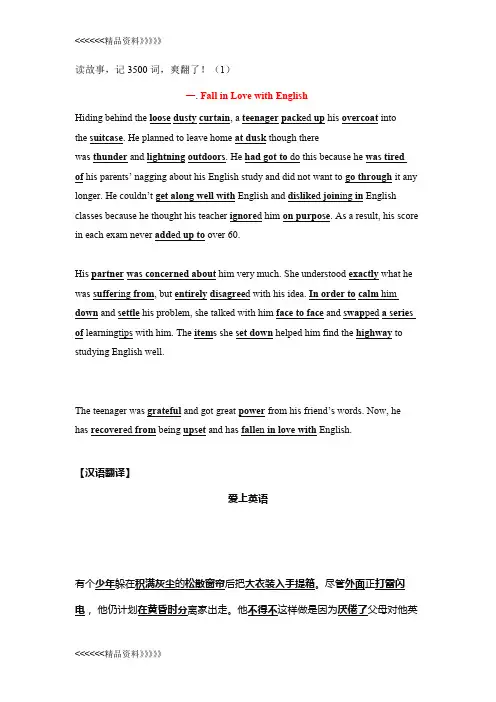
【汉语翻译】
爱上英语
draw画,拉,拖drewdrawn
sleep睡sleptsleptbet赌betbet有个少年躲在积满灰尘的松散窗帘后把大衣装入手提箱。尽管外面正打雷闪电,他仍计划在黄昏时分离家出走。他不得不这样做是因为厌倦了父母对他英语学习的唠叨,不想再忍受下去了。他的英语学习总是无法取得进展,而且不喜欢参加英语课的学习,因为他以为老师有意忽视他。结果,他每次考试的分数合计从未超过伤hurthurt
become变成becamebecome
lay放置laidlaidVoyages of people fromEnglandplay an important part inspreading the English language.At present, English isfrequentlyspoken as anofficialor common language in many countries,such asAmerica,Singapore,Malaysiaand someAfricancountries. Allbased onBritish English, the English spoken in these countries can be well understood bynativeEnglish speakers. Butactually, these Englishes have beengraduallychanging inaccents,spellings,expressions and theusageofvocabulary.
forecast预报forecastforecastupset扰乱upsetupsetThe teenager wasgratefuland got greatpowerfrom his friend’s words. Now, he hasrecoveredfrombeingupsetand hasfallenin love withEnglish.
2021年高考英语词汇素材:fall in love延伸学习
fall in love中文是什么意思•中文翻译•爱上,相爱•爱上某人•爱上他•滴滴•谈恋爱•陷入爱河•陷入爱情•陷入情网,爱上•相爱,爱上•与...恋爱.爱上•追爱总动员•坠入爱河•坠入情网•fall vi. (fell; fallen ) 1.落下;散落,...•love n. 1.爱,热爱,爱戴。
give [send] on ...•fall in love with 爱上(某人或某物); 开始爱上; 喜爱;爱上; 相爱,爱上; 与……相爱•fall in love with it 爱上它•love in fall 爱在深秋•don’t fall in love with dream 别在梦里爱我•fall in love again 重机关报爱过; 重新爱过•fall in love at first sight 相信一见钟情; 一见钟情•fall in love at kiss 一吻倾情•fall in love at the first sight 一见钟情•fall in love on the internet 网络恋情•fall in love with diamond 钻石迷情•fall in love with sb 坠入爱河•fall in love with someone 来电•fall in love with you 和自己恋爱•fall out of love 爱情中断; 失恋•if i could fall in love 假如我堕入爱河(蓝尼克罗维兹); 如果能坠入爱河•if we fall in love again 如果我们相爱再次•it happens everywhere to fall in love 恋爱是随地的•just to fall in love 就这样坠入爱河; 能沉浸在爱情中•kiss and fall in love with you 吻下去爱上你•only fools fall in love 阿呆拜寿; 呆佬拜寿•to fall in love again 再陷情海•when i fall in love 当你坠入爱河; 当我爱上你; 当我堕入爱河(西雅图夜末眠); 当我坠入爱河《西亚图夜未明》主题曲; 当我坠入情网; 身陷情网; 我们相爱的时候; 西雅图夜未眠; 坠入情网•when you fall in love 当你恋爱时•例句与用法1.He has fallen in love with the actress .他已经爱上了这个女演员。
英语学习每日一句22.
英语学习每日一句22.Hold fast to life, but not so fast that you cannot let go.抓住生活,但不要抓得太紧,以致于无法放弃。
Some form of major adversity is either going to be there or it's lying in wait just around the corner.有些灾祸不是即刻发生就是藏于角落以待时机。
Yes, the smile - the unaffected, unplanned, natural connection between people.是的,微笑是人与人之间最自然真挚的沟通方式。
Treasure every moment that you have.珍惜你所拥有的每一刻。
You hold onto memorieswhen you know you can't hold onto anything else.当你知道你抓不住其他东西时,你只好抓住回忆不放。
Honesty is the best policy.诚实是最好的策略。
Books are the ever-burning lamps of accumulated wisdom.书籍是积累智慧的长明灯。
Personality is to man what perfume is to a flower.人品之于人,犹如芳香之于花。
Learn from the mistakes of others. You can't live long enough to make them all yourself. 要从他人的错误中学习,因为你不可能活到犯下所有错误。
What sculpture is to a block of marble, education is to the soul.教育之于心灵,犹如雕刻之于大理石。
双语阅读:三十六个问题让你和陌生人相爱
双语阅读:三十六个问题让你和陌生人相爱以下是小编整理的英语文章:三十六个问题让你和陌生人相爱,希望能对大家的英语学习有帮助。
The path to true love just got a whole lot smoother.通往真爱的路现在更平坦了一点。
The key? To ask someone the 36 questions below - andanswer them yourself. Doing this, psychologists have claimed,can make absolutely anyone fall in head-over-heels.关键方法?问某人以下36个问题——同时自己也回答这些问题。
心理学家称,这样做,就绝对可以让任何人爱得神魂颠倒。
If it sounds easy; it isn't.如果说听上去很容易,那么实际上可没那么简单。
The questions begin gently enough: 'Would you like to be famous?'; 'What's your perfect day?';Or 'When did you last sing to yourself?'这些问题一开始很温和:“你想成名吗?”“你心中完美的一天是怎样的?”或“你上次自己一个人唱歌是什么时候?”But they rapidly become more personal.但是很快,问题就变得更私人。
'Do you have a secret hunch about how you will die?' and 'How do you feel about yourrelationship with your mother?' “关于自己将如何死去,你有神秘的预感吗?”“你和你母亲的关系怎么样?”The idea is to foster the atmosphere of mutual vulnerability and intimacy that a romanticrelationship thrives on. Albeit by revealing to each other your deepest, darkest thoughts - the sortit usually takes a few months to admit (if ever).这些问题的主要意图是营造一个相互脆弱和亲密的氛围,以促进恋爱关系的发展,尽管这需要向彼此吐露你们最深的、最黑暗的想法,这些想法你往往需要几个月的时间才会承认(如果承认的话)。
纪中词汇短文串记练习——Fall in Love with English(爱上英语)
中山纪念中学高中英语词汇短文串记练习(一)Fall in Love with EnglishHiding behind the loose dusty curtain , a teenager pack ed up his overcoat into the suitcase . He planned to leave home at dusk though there was thunder and lightning outdoors . He had got to do this because he was tired of his parents’ nagging about his English study and did not want to go through it any longer. He couldn’t get along well with English and dislike d join ing in English classes because he thought his teacher ignore d him on purpose . As a result, his score in each exam never add ed up to over 60.His partner was concerned about him very much. She understood exactly what he was suffer ing from , but entirely disagree d with his idea. In order to calm him down and settle his problem, she talked with him face to face and swap ped a series of learning tip s with him. The item s she set down helped him find the highway to studying English well.The teenager was grateful and got great power from his friend’s words. Now, he has recover ed from being upset and has fall en in love with English.有个少年躲在积满灰尘的松散窗帘后把大衣装入手提箱。