
2013秋新人教版八上英语Unit1_Where_did_you_go_on_vacation
1. Did you buy anything special? 在英语中,anything, something, nothing和 everything是用于指代事物的复合不定代词,与 之相对应的复合不定代词anyone, someone, no one 和everyone (anybody, somebody, nobody和 everybody) 用于指人。与形容词连用时,形容词 必须置于复合不定词之后,语法上称作“后置”。 例如:I can see someone new in your group. There’s nothing interesting in the news today.
What did you do in your summer vacation?
I went to Beijing for vacation.
I went summer camp.
I went to the mountains.
I stayed at home.
I went to the beach.
Where did you go on vacation? Did you go out with anyone? Did you buy anything special? I went to New York City. No. No one was here.Everyone was on vacation. Yes,I bought something for my father. No, I bought nothing.
语法要点:复合不定代词3
3. 复合不定代词都具有单数的含义,因此通常被看成 是单数第三人称。当它们充当句子的主语时,其后 的谓语动词用单数形式。 复合不定代词表示单数概念,作主语时,谓语动 词用单数。
• • • • Someone is waiting for you at door. Everything begins to grow in sping. Is everyone here today? Nobody/No one knows his name
根据汉语提示完成句子。 1. Did he go out with _________ (任何人)? anyone
2. They didn’t buy anything _______ (特殊的 _______ special 东西) there yesterday. 3. Tell us __________ __________ (有趣的事 something interesting 情) about your vacation, Jenny.
I visited the museums.
1. stayed at home __ f 2. went to New York City __ b 3. visited my uncle __ g 4. went to summer camp __ d 5. went to the mountains __ c 6. went to the beach __ a 7. visited museums ___ e
4. I just stayed at home most of the time to read and relax. most意为“大多数”,后跟可数名词或不 可数名词均可。例如: Most students go to school on foot. 大多数学生步行去上学。
【辨析】 most + 名词 泛指多数,无范围; most + of + the (this/that/those/these等)名 词 ,指某一范围内的多数。 例如: Most of the students go to school by bike. 这些学生们中的多数骑自行车去上学。
Yes, I ...
Read the conversation 2d and match the people with the right place.
Rick
Helen
If (如果)you go to Huangguoshu Waterfall, what will you do?
水+掉下来=瀑布
1c
Where did Tina go on vacation?
Make conversations about the people in 1a.
She went to the mountains.
Where did … go on vacation?
She/He …
Make your own conversations. How was your Great! vacation?
4. They caught _______ ___ _____ (相当多的) quite a few insects in the forest. 5. _____ __ the (大多数) students can get to Most of ___ school early.
请记住 Grammar Focus
语法要点:复合不定代词2
2.形容词修饰复合不定代词时应后置。 即: 复合不定代词+形容词(后置) •
There is something wrong with your ears
Is there anything interesting on TV tonight? I have something important to tell you. Is there anything else in the box?
2. Did you go anywhere interesting? anywhere意为“在任何地方”,常用于一 般疑问句或否定句中,代替somewhere。例 如: I can’t find my keys anywhere. 我到处找不到我的钥匙。
3. We took quite a few photos there. a few 意为“一些,若干(=some)”,后 跟可数名词复数形式。 quite a few 意为“相当多;不少(=many)” 后跟可数名词复数形式。 例如: A few girls are playing volleyball. 几名女孩正在打排球。 There are quite a few birds in the forest. 在那片森林里有大量的鸟。
Where did you go?
I went to the mountains.
I went to the Great Wall.
Where did you go?
Listen. Where did the 2a people go on vacation? Complete the chart.
Role-play the conversation.
Rick: Hi, Helen. Long time no see. Helen: Hi, Rick. Yes, I was on vacation last month. Rick: Oh, did you go anywhere interesting? Helen: Yes, I went to Guizhou with my family. Rick: Wow! Did you see Huangguoshu Waterfall?
语法要点:复合不定代词
• 不定代词some, any, no, every与-one, -body, 成复合代词。我们称之为复合不定代词。 -thing构
every thing everything
一切
any some no anything something nothing
任何事物 某物,某事
Kevin, where did you go on vacation?
I ...
Oh, really? Did you go with anyone?
Yes, I ...
Julie, where did you go on vacation?
I ...
Oh, really? Did you go with anyone?
People Grace Kevin Julie Places New York City The beach Stayed at home
Listen again. Check (√) Yes, I did 2b or No, I didn’t for each question.
Did you… Yes, I did. √ go with anyone? go to central √ Grace Park? Buy anything √ special? Play volleyball? √ Swim? Kevin Meet anyone √ interesting? No, I didn’t
√
Did you… Yes, I did. Do anything interesting? √ Julie Study for tests? Go out with anyone?
No, I didn’t
√ √
2c Role-play the conversations between Grace, Kevin and Julie. A: Grace, where did you go on vacation? B: I went to New York City. A: Oh, really? Did you go with anyone? B: Yes, I went with my mother.
How was the food?
Did everyone have a good time.Everything tased really good!
2013 秋季 人教 八上英语unit1 where did you go on vacation word版课文
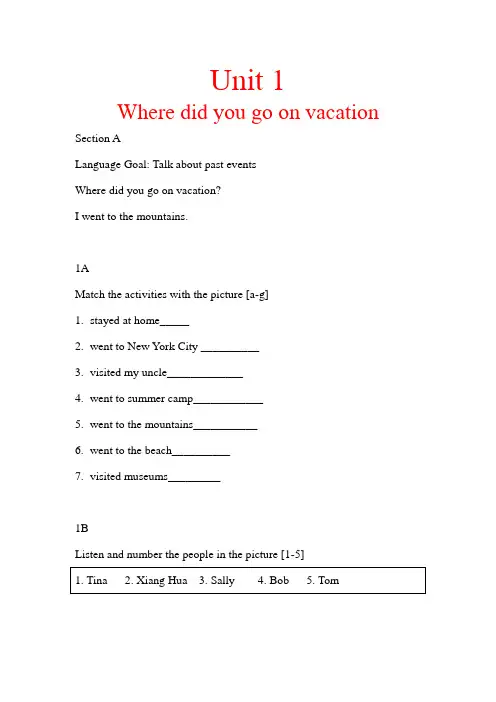
Unit 1Where did you go on vacation Section ALanguage Goal: Talk about past eventsWhere did you go on vacation?I went to the mountains.1AMatch the activities with the picture [a-g]1.stayed at home_____2.went to New York City __________3.visited my uncle_____________4.went to summer camp____________5.went to the mountains___________6.went to the beach__________7.visited museums_________1BListen and number the people in the picture [1-5]1CMake conversations about the people in the pictureA: Where did Tina go on vacation?B: She went to the mountains.2AListen. Where did the people go on vacation? Complete the chart2BListen again. Check (V) yes, I did or No, I didn’t for each question.2CRole-play conversations between Grace, Kevin and Julie.A: Grace, where did you go on vacation?B: I went to New York City.A: Oh, really? Did you go with anyone?B: Yes, I went with my mother.2D:Role-play the conversation.Rick: Hi, Helen. Long time no see.Helen: Hi, Rick. Yes, I was on vacation last month.Rick: Oh, did you go anywhere interesting?Helen: Yes, I went to Guizhou with my family.Rick: Wow! Did you see Huangguoshu waterfall?Helen: Yes, I did. It was wonderful! We took quite a few photos there. What about you? Did you do anything special last month?Rick: Not really. I just stayed at home most of the time to read and relax.Grammar Focus3AFill in the blanks with the words in the box and practice the conversation.Linda: Did you do anything fun on your vacation, Alice?Alice: Yes, I did. I went to Sanya.Linda: How did you like it?Alice: Well, it was my first time there, so everything was really interesting.Linda: Did you go with anyone?Alice: Yes, I did. I went with my sister.Linda: Did you go shopping?Alice: Of course! I bought something for my parents, but nothing formyself.Linda: Why didn’t you but anything for yourself?Alice: I didn’t really see anything I liked.3BFill in the blanks in the e-mail message with the words in the boxDear Bill,How was your vacation? Did you do anything interesting? Did everyone in the family go with you? I went to a friend’s farm in the countryside with my family. Everything is great. We fed some hens and saw some baby pigs. They were so cute. The only problem was there was nothing much to do in the evening but read. Still no one seemed to be bored. Bye for now!Mark.Section B1AMatch the words with the picture below.1B**************************************************&words on the right.1CListen. Lisa is talking about her vacation. Answer the questions.1.where did Lisa go on vacation? She went to Hong Kong.2.Did she do anything special there? What was it?_______________3.Did she buy anything for her best friend?____________________4.Did Lisa like her vacation?_______________________________1DListen again, fill in the blanks.What did Lisa say about?Her vacation greatthe people__________the fun park________the food___________the stores__________1EAsk and answer questions about Lisa’s vacation. Begin your questions with:2ADiscuss the questions with your partner.1.what do people usually do on vacation?2.What activities do you find enjoyable?2BRead Jane’s diary entries about her vacation and answer the questions. Did Jane have a good time on Monday? What about on Tuesday?Monday, July 15th I arrived in Penang in Malaysia this morning with my family. It was sunny and hot, so we decided to go to the beach near our hotel. My sister and I tried paragliding. I felt like I was a bird. It was so exciting! For lunch, we had something very special—Malaysian yellow noodles. They were delicious! In the afternoon, we rode bicycles to Georgetown. There are a lot of new buildings now, but many of the old buildings are still there. In Weld Quay, a really old place in Georgetown, we saw the houses of the Chinese traders from 100 years ago. I wonder what life was like here in the past. I really enjoyed walking around the town.Tuesday, July 16th What a different a day makes! My father and I decided to go to Penang Hill today. We wanted to walk up to the top, but then it started raining a little so we decided to take the train. We waited over and hour for the train because there were too many people. When we got to the top, it was raining really hard. We didn’t have an umbrella so we were wet and cold. It was terrible. And because of the bad weather, we could n’t see anything below. My father didn’t bring enough money, so we only had one bowl of rice and some fish. The food tasted great because I was so hungry!2CRead Jane’s diary entries again. Fill in the chart.2DComplete the conversation about Jane’s trip to Penang using the information in the diary entries.Anna: Hi, Jane. Where did you go on vacation last week?Jane: I ____to Penang in _____.Anna: who ______ you go with?Jane: I went with my_____Anna: what did you do?Jane: the weather was hot and ______ on Monday, so we went _____ on the beach. Then in the afternoon, we _____ bicycles to Georgetown. Anna: Sounds great!Jane: Well, but the next day was not as good. My _____ and I went to Penang Hill, but the weather _____ really bad and rainy. We _______ a long time for the train and we were ______ and cold because we forgot go bring an ________Anna: Oh, no!Jane: And that’s not all! We also didn’t bring _____ money, so we had one bowl of rice and some fish.2EImagine Jane went to Penang Hill again and had a great day. Fill in the blanks in her diary entry with the correct forms of verbs in brackets.Thursday, July 18th Today _____(be) a beautiful day. My father and I _______(go) to Penang Hill again, but this time we ______ (walk) to the top. We _______(start) at 9:30 a.m. and ________(see) and _________(drink) some tea. Then we ________(walk) for another two hours before we ______(get ) to the top.I _____(be) quite tired, but the city ______(look) wonderful from the top of the hill.3AComplete the diary entry about a trip to one of these places. Use the words and phrases in the box to help you.Wednesday, _________20th Today the weather was _____________. I went to __________________. It was ___________________________. We ______________________.I like this place because_______________________________________. For dinner we had __________________. It was___________________. In the evening, I felt really___________________.3BAnswer the questions to make notes about a vacation you took.1.Where did you go?2.Did you go with anyone?3.How was the weather4.What did you do every day?5.What food did you eat?6.What did you like best?7.Did you dislike anything?8.How did you feel about the trip?3CWrite a travel diary like Jane’s on page 5. Use your notes in 3b.4.Imagine you are all foreigners on vacation in China. You meet each other at the airport on your way home. Talk about what you did on your vacation.Hi, my name’s Paul.Hi, Paul. I’m Anna. Where did you go on vacation?I went to Nanjing.Oh, I went to Beijing. Did you do anything special in Nanjing?Self Check1 complete the conversations with the correct words in the box.1.Did ______ go on vacation with you last month?Yes, my family went to the countryside with me.2.Did your family go to the beach with you last weekend?No,________ from my family went, but my friend went with me.3.I didn’t bring back anything from Malaysia._______ at all? Why not?4.Did you buy __________ in the shopping center?No, I didn’t. _________ was very expensive.5.How was the volleyball game yesterday?Great! ___________ had a fun time!2 Complete the passage with the correct forms of the verbs in brackets. Last August, our class _____(do) something very special on our school trip. We _______(go) to Mount Tai. We _______(start) our trip at 12:00 at night. Everyone in our class _______(take) a bag with some food and water. After three hours, someone looked at the map and ______(find) out we ________(be, not) anywhere near the top. My legs ________(be) so tired that I wanted to stop. My classmates _______(tell) me go keep going, so I ______(go) on. At 5:00 a.m., we got to the top! Everyone ________(jump) up and down in excitement. Twenty minutes later, the sum __________(start) to come up. It was so beautiful that we _______(forget) about the last five hours!。
八年级上新人教版Unit1 Where did you go on vacation

八年级上新人教版Unit1 Where did you go on vacation?语言讲解1.Why not +动原+其它?=Why don’t you +动原+其它?为什么不干某事?,Why don’t you play ?=Why not play?, Why didn’t you buy anything for yourself?2.(1)反身代词:myself, yourself, himself, herself, itself, ourselves, yourselves, themselves.(2) by+主语的反身代词,“单独地,独自地”;(3)Why not +动原+其它?=Why don’t you +动原+其它?为什么不干某事?,Why don’t you play ?=Why not play?, Why didn’t you buy anything for yourself? (4)特殊疑问词、不定代词和不可数名词作句子主语,谓语动词按三单。
Everything was excellent.(5) nothing =not anything,(6)keep a diary记日记,3.(1) 不定代词和不定副词定语后放。
不定代词有: something, anything, nothing, everything, someone, anyone, no one, everyone, somebody, anybody, nobody, everybody. 不定副词有: somewhere, anywhere, nowhere, everywhere. 如,something delicious, anything special, Did you go anywhere interesting ?(2)little +不可数,“没一点儿”,a little +不可数,“有一点儿“,few +复数,“没几个”,a few +复数,“有几个”,4.(1)wonder+从句, 从句=引导词+主语+谓语; I wonder what life was like here in the past.(2)because+从句, because of+短语, (3) too many+复数, “太多”; too much+不可数, “太多”; much too+形=too +形,“太”,5.(1) quite a few+复数,”很多”, (2) What about doing…? =How about doing…?干某事怎么样? (3)stay at home to do sth.呆在家干某事. (4)most of time大多数时间,。
新目标英语8年级上册1-5单元知识点

最新(2013秋)人教版八年级上册英语知识点Unit 1 Where did you go on vacation?(谈论假期生活,一般过去时)Unit 2 How often do you exercise?(谈论生活习惯,一般现在时)Unit 3 I'm more outgoing than my sister(谈论事物对比,形容词比较级)Unit 4 What's the best movie theater?(谈论事物比较,形容词最高级)Unit5 Do you want to watch a game show?(谈论内心想法,一般现在时)Unit6 I’m going to study computer science.(谈谈生活的目标,一般将来时)Unit7 Will people have robots?(对将来生活的预言,一般将来时)Unit8 How do you make a banana milk shake?(描述进程,祈使句)Unit9 Can you come to my party?(学习邀请,作出、接受和拒绝邀请,学习表请求的句子) Unit10 If you go to the party, you’ll have a great time.(作出决定,学习if的条件状语从句)①复习一般过去时②复合不定代词的用法③反身代词的用法④系动词的用法⑤动词后的to do和doing 的区别⑥ed形容词和ing形容词的区别⑦“近义词”的区别⑧本单元中的主谓一致现象⑨动词过去式的构成及不规则动词表⑩用同义短语转换同义句时谓语动词形式一致性的培养。
⑾感叹句的结构和连词的选择。
Unit1 Where did you go on vacation?重点短语1. go on vacation去度假at home 待在家里to the mountains 去爬山4. go to the beach 去海滩 5. visit museums 参观博物馆6. go to summer camp 去参加夏令a few 相当多for 为……而学习out 出去of the time 大部分时间11. taste good 尝起来很好吃 a good time 玩得高兴13. of course 当然like 给……的感觉;感受到shopping 去购物the past 在过去17. walk around 四处走走18. because of 因为19. one bowl of… 一碗……20. the next day第二天21. drink tea 喝茶22. find out 找出;查明23. go on 继续photos 照相25. something important 重要的事26. up and down 上上下下27. come up 出来28. buy sth. for sb. / buy sb. sth. 为某人买某物29. taste + adj. 尝起来…… 30. look+adj. 看起来………but+动词原形除了……之外什么都没有+(to be)+ adj. 看起来…… 33. arrive in+大地点/ arrive at+小地点到达某地to do sth. 决定去做某事35. try doing sth. 尝试做某事/ 36. try to do sth. 尽力去做某事37. forget doing sth. 忘记做过某事/ 38. forget to do sth.忘记做某事39. enjoy doing sth. 喜欢做某事40. want to do sth. 想去做某事41. start doing sth. 开始做某事42. stop doing sth. 停止做某事43. have a good time=enjoy oneself=have fun(doing sth.)玩得痛快44. keep doing sth. 继续做某事45. Why not do. sth.? 为什么不做……呢46. so+adj.+that+从句如此……以至于…… 47. tell sb. (not) to do sth. 告诉某人(不要)做某事三、重点句子:1. Where did you go on vacation? 你去哪儿度假的?2. Long time no see. 好久不见。
人教版英语八年级上册_Unit_1_Where_did_you_go_on_vacation教材全解

人教版英语八年级上册Unit 1 Where did you go onvacation?教材全解及单元测试卷【教材内容解析】Section A1.Where did you go on vacation? (P. 1)on vacation意为“在度假”,结构“on+名词”表示“在某种状态中”。
My family went to Hainan on vacation last year.2....visited my uncle (P. 1)visit此处用作及物动词,后接人或物做宾语,意为“拜访、看望”,后接表示地点的名词,意为“参观、游览”。
I visited my grandmother last week.Do you want to visit Shanghai?3....go with anyone? (P. 2)(1)anyone用作不定代词,意为“有人、任何人”,相当于anybody,用于疑问句和否定句中,在肯定句中用someone或者somebody。
但是anyone也可以用在肯定句中,表示“任何一个人”。
Did you meet anyone friendly in that city?Anyone can be helpful in some way.(2)anyone只能指人,不可以指物,后面不接of短语;any one既可以指人也可以指物,后可接of短语。
Anyone in my class knows any one of the singers and any one of their sons.4....buy anything special? (P. 2)(1)buy用作双宾语动词,表示“买”,常用的结构为“buy sb. sth.”或者“buy sth. for sb.”,表示“为某人买某物”。
My father bought me a bike.=My father bought a bike for me.【拓展】可接双宾语的动词还有give, bring, show, tell, sell等。
2013年八年级英语上册-Unit-1-Where-did-you-go-on-vacation-Section-A-3a-3c.

他自己 她自己 它自己
ourselves yourselves
themselves
我们自己 你们自己
他们自己
1. Did you buy anything for yourself? 你为你自己买什么东西了吗?(做介词宾语) 2. The old man taught himself English. 那位老人自学英语。(做动词宾语)
1. 你去了什么地方去度假? _W__h_e_r_e __d__id__ you go on _v_a_c_a_t_io_n__? 2. 我去了纽约市。 I _w_e_n_t___ _t_o__ New York City. 3. 你和别的什么人一起去的吗? _D_i_d___ _y_o_u___ go out with _a_n_y_o_n_e__?
( ) 1. I’m hungry. I want ___B___ to eat. A. anything B. something
C. everything D. nothing
( ) 2. —Do you have __D____ to say for yourself?
—No, I have ______ to say.
smell: 闻起来 ~ sweet
look:看起来 ~ beautiful/handsome/cute
sound: 听起来 ~ good/wonderful feel:摸起来 ~cold/warm/soft(软)
感官动词(系动词)+ 形容词
2.have a good time: 玩的开心、过得愉快
问题是李雪鹏没有钱。
The problem is that Li Xuepeng has no money. 唯一的问题是今天的报纸上没有什么有趣的东西。
2013八年级新人教版uint1where_did_you_go_on_vacation_SectionB(1A-4)self_check
$1
How were the bananas?
$ 100
They were cheap.
Practice
How were the apples? They were terrible.
1a Match the words with the
f delicious 3. ___ c exciting 1. ___ a e cheap 2. ___expensive 4. ___
另外感叹句还可以用how来引导, 结构为How+形容词或副词+主语+谓语! How beautiful the flowers are!
点拨提升
2. We waited over an hour for the train because there were too many people. wait for 为 等候 ,后接人或物。 too many 为太多,后接可数名词复数; too much+不可数名词; much too 为太…后接形容词Leabharlann 副词( much too big)
2b. Read Jane’s diary entries about her
vacation and answer the questions. 1.Did Jane have a good time on Monday?
2. What about Tuesday?
1.Did Jane have a good time on Monday? Yes , she did. 2. What about Tuesday?
Yes
what life was like
there in the past
Because of the bad
2013新人教版八年级上册Unit_1_Where_did_you_go_on_vacation_Section_A
museums
Where did they go on vacation ?
They visited museums.
我会写use the words with the picture
1. stayed at home 2.went to New York City 3. visited my uncle 4. went to summer camp 5. went to the mountains 6. went to the beach 7. visited museums
summer camp
野营;营地
夏令营
Where did you go on vacation?
museum
博物馆
New York City
Where did you go on vacation? he on vacation ? He to New York City .
at home
Where did you go on vacation? She stayat home and cooked .
Unit 1
Where did you go on vacation? Review
复习课
学习目标
1.我会谈论过去所发生的事件—学习一
般过去时的用法
2. 通过小组合作学习,我会谈论节假日 的活动,并能进行书面表达
Where did you go on vacation?
点击查看 动画词汇
下一页 camp
4
Байду номын сангаасPairwork
Where did he/she/they go on vacation ? He / She /They …
Unit_1_Where_did_you_go_on_vacation说课稿
Unit1 Where did you go on vacation?(period 1)说课稿各位老师,大家好!今天我说课的内容是人教版八年级英语上册第一单元第1 课时。
本课是新授课,下面我将从几个方面来阐述一下我的说课内容。
一、教材及教材内容分析本单元是围绕“与朋友共同回忆假期”为话题,开展教学活动,学习动词的一般过去时表达法。
本单元是对假期的去向和评价进行问答,以及用日记的方式记录自己的一天,这是学生日常生活频繁使用的语言交际功能,体现了新教材融会话题、交际功能和语言结构的循序渐进的生活化的学习程序。
本课时的核心语言项目是谈论过去式, 主要话题是学习询问朋友假期的去向。
整个单元以谈论假期的安排为主线,将日常生活中所涉及的语言、词汇等融入一系列小任务中,完成任务最终达到交际目的。
二、教学目标1.语言技能目标a.对假期的去向进行问答,如:Where did you go on vacation?b.掌握不同人称的问句如何进行问答,如Where did he go onvacation?2、语言知识目标a. 熟练掌握及应用be动词、助动词及动词在过去时中的表达法;b. 一些地名和事件的表达法,如go to the mountains;3、情感态度目标a. 由于本单元话题贴近学生生活,符合他们热爱休闲的心理,可以提高他们学习英语的兴趣,积极参与英语实践活动。
b. 谈论与朋友的度假方式,培养同学间团结、友善的精神,以及热爱大自然,形成积极向上的生活观。
4、学习策略目标a. 通过小组讨论,开展调查等研究,明确在用中学,交流中学习的想法。
b. 通过猜测,并大胆的表达,以学习新知识。
c. 兴趣教学策略,其中包括游戏、表演、对话。
5、文化意识目标a. 了解主要的度假方式b. 用恰当的方式表达自己的感受c. 在学习中寻找中西方度假差异,培养学生跨文化意识三、教学重难点1、教学重点Where did you/he/she/they go on vacation?I/he/she/they went to/stayed at…2、教学难点动词的一般过去时的肯定句,一般疑问句等形式。
新人教版八年级上册英语Units1-10单元知识点归纳
2013年秋人教版新目标八年级上册英语Units1-10单元知识点归纳Unit1 Where did you go on vacation?go on vacation去度假stay at home待在家里go to the mountains去爬山go to the beach去海滩visit museums 参观博物馆go to summer camp去参观夏令营quite a few相当多study for为……而学习go out出去most of the time大部分时间taste good尝起来很好吃have a good time玩得高兴of course当然feel like 给……的感觉;感受到go shopping去购物in the past在过去walk around四处走走because of 因为one bowl of… 一碗……the next day第二天drink tea喝茶find out找出;查明go on继续take photos照相something important重要的事up and down上上下下come up出来buy sth. for sb. / buy sb. sth.为某人买某物taste + adj. 尝起来……look+adj. 看起来……nothing…but+动词原形除了……之外什么都没有seem+〔to be〕+ adj. 看起来……arrive in+大地点/ arrive at+小地点到达某地decide to do sth.决定去做某事try doing sth.尝试做某事/ try to do sth.尽力去做某事forget doing sth.忘记做过某事/ forget to do sth.忘记做某事enjoy doing sth.喜欢做某事want to do sth.想去做某事start doing sth.开始做某事stop doing sth. 停止做某事dislike doing sth. 不喜欢做某事keep doing sth.继续做某事Why not do. sth.?为什么不做……呢?so+adj.+that+从句如此……以至于……tell sb. (not) to do sth. 告诉某人〔不要〕做某事Unit2 How often do you exercise?help with housework帮助做家务on weekends在周末how often多久一次hardly ever几乎从不once a week每周一次twice a month每月两次every day每天 be free有空go to the movies去看电影use the Internet用互联网swing dance摇摆舞play tennis打网球stay up late熬夜;睡得很晚at least至少have dance and piano lessons上舞蹈课和钢琴课go to bed early早点睡觉play sports进行体育活动be good for对……有好处go camping去野营not…at all一点儿也不……in one’s free time在某人的业余时间the most popular 最受欢送的such as比方;诸如old habits die hard积习难改go to the dentist去看牙医morn than多于;超过less than少于help sb. with sth.帮助某人做某事How about…? ......怎么样?/ ……好不好?want sb. to do sth.想让某人做某事How many+可数名词复数+一般疑问句?……有多少……?主语+find+that从句. ……发现……spend time with sb.和某人一起度过时光It’s+ adj.+ to do sth.做某事的……的。
英语人教版八年级上册_教材目录及单词
2013年新目标英语人教版初二上册八年级英语上册目录之杨若古兰创作UNIT 1 Where did you go on vacation?Unit 2 How often do you exercise?Uuit 3 I'm more outgoing than my sister.Unit 4 What's the best movie theater?Unit 5 Do you want to watch a game show?Unit6 I'm going to study computer science.Unit 7 Will people have robots?Unit 8 How do you make a banana milk shake?Unit 9 Can you come to my party?Unit10 If you go to the party,you 'll have a great time!2013年新目标八年级上册各单元英语单词Unit1 Where did you go on vacation?anyone ['eniwʌanywhere ['eniweə(r)] adv.任何地方n.任何(一个)地方wonderful ['wʌndəfl] adj.精彩的;极好的few [fjuːmost [məʊst] adj.最多的;大多数的;something ['sʌmθɪŋ] pron.某事物;nothing(=not…anything) ['nʌθɪmyself [maɪeveryone ['evriwʌn] pron.每人;人人yourself [jɔː'self] pron.你本人;你亲自hen [hen] n.母鸡;雌禽bored [bɔːd] adj.无聊的;腻烦的;愁闷的diary ['daɪəri] n.日记;日记簿(keep a diary)seem [siːm] vi.似乎;好像someone ['sʌmwʌn] pron.某人;有人quite a few相当多;很多(后接可数名词)of course [əvkɔːs] 当然activity [æk'tɪvəti] n.活动;活跃decide [dɪ'saɪd] v.决定;选定(decide to do sth.)try [traɪ] v.测验考试;设法;努力(try to do sth. /try doing sth.) bird [bɜːd] n.鸟;禽paragliding ['pærəɡlaɪdɪbicycle ['baɪsɪbuilding ['bɪldɪtrader ['treɪdə(r)] n.商人;商船wonder ['wʌndə(r)] v.惊奇;想晓得;怀疑difference ['dɪfrəns] n.差别;分歧top [tɒp] n.顶部;顶wait [weɪt] v.等;等待(wait for)umbrella [ʌm'brelə] n.伞;雨伞wet [wet] adj.湿的;雨天的below [bɪ'ləʊas [əz] conj.如同;像...一样enough [ɪ'nʌf] adj.足够的adv.足够地;充分地duck [dʌk] n.鸭肉;鸭hungry(反full) ['hʌŋɡri] adj.饥饿的;渴望的feel like(doing sth.)想要dislike [dɪs'laɪk] v.不爱好;讨厌n.不爱好;讨厌;反感Unit2How often do you exercise? housework ['haʊswɜːhardly ['hɑːdli] adv.几乎不;简直不;刚刚ever ['evə(r)] adv.曾;在任何时候once [wʌns] adv.一次;曾twice [twaɪs] adv.两倍;两次Internet ['ɪprogram ['prəʊɡræm]n.节目;程序;课程;节目单full [fʊl] adj.满的;充满的;完整的swing [swɪŋ] n.扭捏;秋千v.扭捏;扭转maybe ['meɪbi] adv.或许;或许;可能swing dance扭捏舞least [liːst] adj.最小的;起码的at least至多hardly ever很少;几乎从不;难得junk n.垃圾;废旧杂物coffee ['kɒfi] n.咖啡;咖啡色health [helθ] n.健康;人的身体或精神形态result [rɪ'zʌlt] .结果;后果percent [pə'sent] adj.百分之...的online [ˌɒn'laɪtelevision ['telɪvɪʒn] n.电视机;电视节目although [ɔːl'ðəʊ] conj.虽然;尽管;然而;可是through [θruː] prep.穿过;凭借;不断到body ['bɒmind [maɪnd] .头脑;设法;定见;心思such [sʌtʃ] adj.如许的;如此的together [tə'ɡeðə(r)] adv.共同;一路die [daɪ] v.死;枯竭;消逝writer ['raɪtə(r)] n.作者;作家dentist ['dentɪmagazine ['mæɡəziːhowever [haʊ'evə(r)] adv.然而;不管如何;不管多么almost ['ɔːlməʊst] adv.几乎;差不多none [nʌn] pron.没有人;没有任何东西,毫无less [les] adj.更少的;较少的point [pɔɪnt] n.看法;要点;重点;小数点;目标;分数such as例如;诸如junk food n.垃圾食品;无养分食品more than超出;多于;不但仅;非常less than不到;少于point n. 得分,点Unit3I'm more outgoing than my sister.outgoing ['aʊtɡəʊɪloudly ['laʊdli] adv.大声地;高声地;花俏地quietly ['kwaɪətli] adv.宁静地;悄悄地;平静地hard-working [hɑːd'wɜːkɪŋ] adj.勤勉的;努力工作的competition [ˌkɒmpə'tɪʃn] n.竞争;角逐fantastic [fæn'tæstɪk] adj.极好的;了不起的which adj.哪一个;哪一些pron.哪一个;哪些clearly ['klɪəli] adv.清楚地;明显地win [wɪcare about关心talented ['tæləntɪd] adj.有才干的;有天赋的truly ['truːli] adv.真实地;朴拙地;准确地care [keə(r)] v.关心;担忧;赐顾帮衬;在意serious ['sɪəriəs] adj.严厉的;严重的;持重的mirror ['mɪrə(r)] n.镜子;反映necessary ['nesəsəri] adj.须要的;必定的both [bəʊshould [ʃəd] aux.应当;可能;该当;将要touch [tʌtʃ] vt.触摸;感动reach [riːtʃ] v.到达;伸出;达成;取得联系;延长;(伸手)去够heart [hɑːt] n.心脏;内心fact [fækt] n.事实;本相;实际break [breɪk] v.打碎;折断;背背;解决;间断laugh [lɑːf] v.发笑;笑;讥笑n.笑声;笑;笑料similar ['sɪshare [ʃeə(r)] vt.分享,共享;分配;共有loud [laʊd] adj.大声的;adv.大声地;洪亮地primary ['praɪməri] adj.最初的,最早的be different from和...分歧information [ˌɪnfə'meɪʃn] n.信息;情报;材料;通知as long as只需bring out拿出;推出the same as与...同样的in fact事实上;实际上;确切地说be similar to类似于;与...类似Unit4 What's the best movie theater? theater ['θɪətə] n.剧场;电影院;剧场comfortable ['kʌmftəbl] adj.舒适的;充裕的seat [siːt] n.坐位;screen [skriːn] n.屏幕;银幕close [kləʊs] v.关;合拢;不开放;停业worst [wɜːst] adj.最坏的;最差的cheaply ['tʃiːpli] adv.廉价地;粗俗地song [sɒŋ] n.歌曲;歌唱choose [tʃuːz] v.选择;决定carefully ['keəfəli] adv.当心肠,认真地reporter [rɪ'pɔːfresh [freʃ] adj.新颖的;清新的comfortably ['kʌmftəbli] adv.舒服地;容易地;充裕地worse [wɜːs] adj.更坏的;更差的service ['sɜːvɪpretty ['prɪmenu ['menjuːact [ækt] v.行动;扮演meal [miːl] n.一餐;膳食so far到目前为止;迄今为止no problem没什么;不客气creative [kri'eɪtɪv] adj.创造的,创造性的;performer [pə'fɔːmə(r)] n.扮演者;履行者talent ['tælənt] n.天赋;才干,才艺;common ['kɒmən] adj.罕见的;共同的;普通的magician [mə'dʒɪʃn] n.魔术师;术士beautifully ['bjuːtɪfli] adv.美丽地;完满地;role [rəʊl] n.感化;角色winner ['wɪprize [praɪz] n.奖品;奖金everybody ['evribɒdi] pron.每人;人人example [ɪɡ'zɑːmpl] n.例子;典范poor [pɔː(r)] adj.可怜的;贫穷的seriously ['sɪəriəsli] 严重地,严厉地give [ɡɪv] v.给;赠予;送crowded ['kraʊdɪhave…in common有不异特征all kinds of各种各样;各品种型be up to是…….的职责;由…….决定play a role发挥感化;有影响makeup假造for example例如take…seriously认真对待Unit5Do you want to watch a game show? sitcom ['sɪtkɒm] n.情景悲剧(= situation comedy)news [njuːz] n.旧事;动静soap [səʊp] n.肥皂;肥皂剧educational [ˌedʒu'keɪʃənl]adj.教育的;有教育意义的plan [plæn] n.计划;方法v.打算;计划hope [həʊdiscussion [dɪ'skʌʃn] n.讨论;谈论stand [stænd] v.站立;忍受happen ['hæpən] vi.发生;碰巧;出现;偶遇may [meɪ] aux.可以,能够;可能,或许expect [ɪk'spekt] v.预期;期待;盼望joke [dʒəʊk] n.笑话;打趣v.说笑话;开打趣comedy ['kɒmədi] n.悲剧;滑稽;滑稽事件find out查明、弄清meaningless ['miːnɪŋləs] adj.有意义的;不次要的action ['ækʃn] n.行为;活动cartoon [kɑː'tuːn] n.卡通;漫画culture ['kʌltʃə(r)] n.栽培;文明;教养famous ['feɪməs] adj.闻名的;着名的appear [ə'pɪə(r)] vi.出现;出版;显得become [bɪ'kʌm] v.酿成;成为rich [rɪtʃ] adj.富有的;富饶的;丰富的successful [sək'sesfl] adj.成功的;美满的might [maɪt] aux.可能;或许;may的过去式main [meɪn] adj.次要的;最次要的reason ['riːzn] n.缘由;理由film [fɪunlucky [ʌn'lʌki] adj.倒霉的;不幸的;不吉利的lose [luːready ['redi] adj.筹办好的;乐意的character ['kærəktə(r)] n.个性;品质;人物;simple ['sɪmpl]adj.简单的;朴素的;单纯的;笨的army ['ɑːmi] n.军队;陆军;一大批action movie动作片be ready to情愿敏捷做某事dress up打扮;乔装打扮take sb.’s place代替;替换do a good job工作干得好;做得好Unit6I'm going to study computer science.doctor ['dɒktə(r)] 大夫engineer [endʒɪ'nɪr] 工程师violinist [ˌvaɪə'lɪnɪst] 小提琴手pilot ['paɪlət] 飞行员pianist ['pɪənɪst] 钢琴家scientist ['saɪəntɪst] 科学家college ['kɑːlɪdʒ] 大学education [ˌedʒu'keɪʃn] 教育medicine ['medsn] 药,医学university [ˌjuːnɪ'vɜːrsəti] 大学,高等学府article ['ɑːrtɪkl] 文章,论文send [send] 邮寄,发送grow up长大成长computer programmer计算机管理员be sure about确信make sure确保resolution [ˌrezə'luːʃn] 决心,决定foreign ['fɔːrən] 本国的able [ˌebəl] 能够discuss [dɪˌskʌs] 讨论,商量promise [ˌprɑmɪs] 承诺,诺言beginning [bɪˌɡɪnɪŋ] 开头,开端improve [ɪmˌpruv] 改进,改善physical ['fɪzɪkl] 身体的self-improvement [selfɪmp'ruːvmənt] 自我改进,自我提高hobby ['hɑːbi] 专业快乐爱好own [oʊn] 本人的,本人的,具有personal ['pɜːrsənl] 个人的,私人的relationship [rɪ'leɪʃnʃɪp] 关系write down写下have to do with关于;与……有关系take up学着做;开始做agree with同意be able to能够做某事Unit 7 Will people have robots? paper ['peɪpər] 纸pollution [pə'luːʃn] 净化;净化物prediction [prɪ'dɪkʃn] 猜测future ['fjuːtʃər] 将来pollute [pə'luːt] 净化environment [ɪn'vaɪrənmənt] 环境planet ['plænɪt] 行星earth [ɜːrθ] n.地球;泥土plant [plænt] 莳植,植物part [pɑːrt] 介入,部分peace [piːs] 和平sky [skaɪ] 天空play apart介入astronaut ['æstrənɔːt] 宇航员apartment [ə'pɑːrtmənt] 公寓房间rocket ['rɑːkɪt] 火箭;space [speɪs] .空间;太空even ['iːvn] 甚至;越发human ['hjuːmən] 人的;n.人;人类servant ['sɜːrvənt] 仆人dangerous ['deɪndʒərəs] 风险的already [ɔːl'redi] 曾经factory ['fæktri] 工厂believe [bɪ'liːv] 信赖disagree [ˌdɪsə'ɡriː] 分歧意shape [ʃeɪp] 外形fall [fɔːl] 倒塌;跌倒possible ['pɑːsəbl] 可能的probably ['prɑːbəbli] 大概;或许;很可能holiday ['hɑːlədeɪ] 假日word [wɜːrd] 单词;space station太空站over and over again多次;反复地hundreds of很多;大量;成百上千fall down突然倒下;跌倒;倒塌look for寻觅;追求Unit 8 How do you make a banana milk shake? blender ['blendər] 搅拌器;果汁机peel [piːl] vt.剥落;削皮pour [pɔːr] pour [pɔːr] 倒;倾倒yogurt ['joʊɡərt] 酸奶;honey ['hʌni] 蜂蜜watermelon ['wɔːtərmelən] 西瓜spoon [spuːn] 勺,调羹add [æd] 添加finally ['faɪnəli] 最初,终极salt [sɔːlt] 盐sugar ['ʃʊɡər] 糖cheese [tʃiːz] 干酪,奶酪popcorn ['pɑːpkɔːrn] 爆米花corn [kɔːrn] 玉米,谷物machine [mə'ʃiːn] 机器sandwich ['sænwɪtʃ] 三明治butter ['bʌtər] 黄油,奶油turkey ['tɜːrki] 火鸡lettuce ['letɪs] 莴苣,生菜piece [piːs] 件;篇;片;块;traditional [trə'dɪʃənl] 传统的traveler ['trævlə] 旅行者England ['ɪŋɡlənd] 英格兰;英国celebrate ['selɪbreɪt] 庆祝;庆贺pepper ['pepər] 胡椒粉;辣椒oven ['ʌvn] 烤箱;烤炉cover ['kʌvər] 粉饰,盖子,gravy ['ɡreɪvi] 肉汁;肉汤serve [sɜːrv] 接待,服务temperature ['temprətʃər] 温度,气候Unit 9 Can you come to my party? prepare [prɪ'per] v.豫备;筹办exam [ɪɡ'zæm] 考试available [ə'veɪləbl] 可得到的;有空的;hang [hæŋ] 吊挂;(使)低垂until [ən'tɪl] 直到...的时候;直到…为止catch [kætʃ] 赶上;捉住;捕获invite [ɪn'vaɪt] 约请accept [ək'sept] 接受;refuse [rɪ'fjuːz] 拒绝invitation [ˌɪnvɪ'teɪʃn] 约请;约请函reply [rɪ'plaɪ] 回答,回复forward ['fɔːrwərd] 转交;发送,向前的delete [dɪ'liːt] 删除preparation [ˌprepə'reɪʃn] 筹办,筹办工作opening ['oʊpnɪŋ] 开幕式,落成典礼guest [ɡest] 客人concert ['kɑːnsərt] 音乐会headmaster [ˌhed'mæstər] 校长event [ɪ'vent] 大事,公开活动calendar ['kælɪndər] 日历,日程表Unit10 If you go to the party,you 'll have a great time! video ['vɪdioʊ] 录像,录像带organize ['ɔːrɡənaɪz] 组织,筹备chocolate ['tʃɑːklət] 巧克力upset [ʌp'set] 难过,失望advice [əd'vaɪsɪ] 劝告,建议travel ['trævl] 旅行agent ['eɪdʒənt] 代理人,经纪人expert ['ekspɜːrt] 专家,能手teenager ['tiːnˌeɪdʒə] 青少年normal ['nɔːrml] 正常的unless [ən'les] 除非,如果不certainly ['sɜːrtnli] 当然,肯定wallet ['wɑːlɪt] 皮夹,钱包worried ['wɜːrid] 担心的,烦恼的angry ['æŋɡri] 生气的,发怒的careless ['kerləs] 粗心的,不当心的understanding [ˌʌndər'stændɪŋ] 善解人意的,体谅人的trust [trʌst] 信赖,信赖mistake [mɪ'steɪk] 错误,失误careful ['kerfl] 当心的,过细的advise [əd'vaɪz] v劝告,建议solve [sɑːlv] 解决;解答experience [ɪk'spɪriəns] 信赖,经历halfway [ˌhæf'weɪelse [els] 此外,其他的。