
仁爱版英语七年级上Unit3_Topic1_SectionC
He lives in…
He can speak …
China
shirt
sister
fish
bird
orange
(录音2)
Expressing Preferences
…like … a lot …like … a little …don’t like … at all
T:
(1)Who is he/she? (2)Where does/ he/she come from? (3)Does he/she speak Chinese? (4)Can you help him/her with his/her Chinese?
S: …
Like this:
My pen pal is…
…
Report like this:
In our group, A likes English a lot, but he doesn't like Chinese very much. B doesn't like English at all, but he likes Chinese very much. C likes ...
有点喜欢/不是很喜欢
(not) like ... at all
一点不喜欢
1. They like English very much.
2. He likes Chinese a little.
3. She doesn’t like it at all.
A: Do you like English? B: Yes, I like it very much. A: Does Li Xiang like English? B: Yes, he likes it a little.
Sally is my good friend.
She speaks English, too
Many students in our class like English a lot, but I like it a little. So my English is not good. Who can help me with it ? My Chinese is OK. Oh, we can help each other.
Many students in our class like English a lot, but I like it a little. (1) a lot 意为“很,非常(表示程度)”, 相当于very much。 如:Thanks a lot for your help. (2) a little意为“一点点”。 如:The book helps me a little with my English.
福建省莆田市秀屿区湖东中学 刘志辉
Name : Jane Age: 12 From: Canada Class: 2 Grade: 7 Phone number: (010)92673388
Jane is my good friend.
She speaks English.
Name : Sally Age: 13 From: America Class: 2 Grade: 7 Phone number: (010)92674466
√
new classmate , nice, come from, speak, like …a lot/a little, help …with , good friend, each other …
like ... very much/a lot
非常喜欢
like ... a little (not) like ... very much
Unit1 Topic3 Section C教案 仁爱版七年级上册英语
Teaching designUnit 1, Topic 3(Book 7A)How Old Are You?Section C(1a-2)I.Teaching contents1a-2in Section C, Topic 3, Unit 1, Book 7A.II.Lesson typeReading.III.Analysis of the teaching materialsIt’s the fifth class of Topic 3, Unit 1. The purpose is to help the students master the first two changing rules of the plural forms of countable nouns and practice using the key sentence structures based on the language knowledge learned in Sections A and B.IV.Analysis of the studentsAs learners in the first stage, the students are very curious so they are interested in talking about something in English. And they have had the ability of asking and answering about the real objects after the learning of Sections A and B.V.Teaching aims1.Knowledge aims:Be able to use the new words and new sentence structures and know about the first two changing rules of the plural forms of countable nouns.2.Skill aims:Be able to talk about the real objects us ing the key structures.3.Emotional aims:Be able to be confident and active. Learn to work with others and help each other.VI.Key pointsMaster the key sentence structures:--What are these/those/they?--They’re....Difficult pointsConclude and master the first two changing rules of the plural forms of countable nouns.VII.Teaching and learning methodsCommunicative teaching method, real-object teaching method, audio-visual teaching method, task-based teaching method, autonomous learning method, inquiry learning method and cooperative learning method.VIII.Teaching strategies1.Warming up before the class can help students get ready for the class quickly and easily and presenting the objectives of this class can help the students learn with purpose.2.Learn new words using the old sentence patterns and learn new structures using the old words so that the students can master the new knowledge more quickly and easily.3.When learning new words, present the correct phonetic symbols in order to help the students pronounce correctly.4.Chanting while remembering words can not only help students memorize quickly but also make the class atmosphere lively.5.Different levels of reading can help students understand the use of the key structures better and improve their oral English level.6.Discussing, t alking and explaining in groups can not only help students practice their oral English but also inspire their potential in learning.7.The emotional teaching throughout the whole class which tells students to help each other can help the students know that they can not only master the English knowledge but also have the ability of being a useful man when learning English.8.Encouraging students in time by oral praise or a small object in time in class can be useful to the English beginner.9.End the class by a summary so that students can realize what they have mastered and consolidate the memory of numerals.10.Deal with the teaching material s suitably so as to make the teaching and learning clear.IX.Teaching procedures1.Warming up1)Greeting s.2)Sing The Apple Song together with the video in order to get the students to get ready for the class and make the atmosphere more lively.2.Lead-in1)Tell the students there are many apples in the video in order to lead to review the sentence pattern--What’s this/that? --It’s a/an...2)Show the objectives of this class to help the students know what they will do in this class so that they can learn with purpose. Then divide them into groups and announce the class rules--(A red paper apple will be given as a prize after finishing a task. The group which gets the most apples will be the winner.) in order to inspire them to compete or cooperate with their partners so that the class can be more efficient.At the same time, guide the students to help others when necessary and learn the new sentence--Let me help you.3.Pre-reading1)Review the sentence pattern“ --What’s this/that? --It’s a/an...”by showing some pictures in the ppt.2)Learn the new words while reviewing the sentence structures, presenting the phonetic symbols; Learn the new sentence structures“--What are these/those/they?--They are...”with the help of some more pictures or some real objects after mastering more words.The purpose is to help the students get the skill of English language step by step. At the same time, write down the key sentence structures and key words on the blackboard.3)Discuss in groups and c onclude the changing rules of the plural forms of countable nouns after observing the words written on the blackboard.Then share their opinions with other students in groups.4)Chant and remember in groups.4.While-reading1)Autonomous learningAsk the students to r ead 1a quickly to find out the plural forms of countable nouns.Then r ead 1a carefully to put the dialogues into a correct order.2)Cooperative learningDiscuss in groups to check the answers.Then r ead 1a in roles for acting it out.5.Post-reading1)Autonomous learningFinish 1b alone.2)Inquiry learningDiscuss in groups to check the answers. Ask the group leader of each group to explain in detail when someone meets problems.3)Cooperative learningMake up new conversations according to 1a, 1b and 2 by choosing two of the pictures in groups.Then share their conversations in the front.4)Summary and self-check.Sum up the key points learnt in this lesson and help the students to make a self-check in order to know their mastering situation.Then count the red paper apples in each group by practicing the sentence pattern “--What are these/those/they? --They are...”to find out the winner and encourage the students to help each other in their daily. At the same time,present “HELP EACH OTHER, DO BETTER”on the screen to achieve the e motional aims.X.Blackboard design:Unit 1, Topic 3(Book 7A)How Old Are You?Section C(1a-2)XI.Self reflectionTeaching activities are colorful, effective and useful. The students must be active and interested during the whole class and I think the effect must be good.。
Unit3Topic1SectionC课件2022-2023学年仁爱版英语七年级上册
(3)so表示因果,承接关系,意为“因此,所以”。 He comes from America, so his English is very good.
2a Listen, read and learn. A: Jan简e,,d你o y喜ou欢li中ke文C吗hin?ese? B: Ye是s,的I l,ik我e i非t v常er喜y m欢u它ch。. A: What那ab你ou呢t ?y山ou姆, S?am? B: 不No,, I我d一on点't l也ik不e i喜t a欢t a它ll.。
□Jane and Sally are very nice.
□√ We often help each other.
□Jane can speak Chinese very well.
1b Read 1a and circle True or False.
1. Jane, Sally and I are in the same class.
so还可当副词,意为“如此,这么” Its hands is so small.它的手如此小。 She is so beautif
(1)and意为“和;又;并”,表示并列关系,用来连接语法作用相同的 词、短语或句子。如: I'm from Beijing and she is from Shanghai.我来自北京,她来自上海。
他来自美国,所以他英语很好。
Language points
用and,but,so填空 1.I like English __a_n_d___ Chinese. 2.I want to buy a pair of new shoes _b__u_t_ I don’t have enough money. (足够的钱). 3.I often help my classmates ___so__ they think I’m a good student. 4.I’m a Chinese __a_n_d_ she is an American. 5.He likes English very much __b_u_t_ his English is not very good. 6.She likes English a lot __s_o___ she studies hard(努力学习) every day.
仁爱初中英语七年级上册《Unit 3Topic 1 Does he speak ChineseC》精品教案 (3)
Topic 1 Does he speak ChineseSection CI. Material analysis本节课是本话题的第三课时,主要活动是1a和2a。
通过介绍“我”的两个同学Jane和Sally,进一步学习和巩固表示喜好的表达法、实义动词第三人称单数的一般现在时的陈述句、一般疑问句及肯定、否定回答以及人称代词的主格和宾格的用法。
同时,通过匹配图片和音标,帮助理解单词意义,并根据音标拼写单词,再现和巩固了Section A中的音标教学,巩固了字母和字母组合ar,er,ir,o,ee,ch,sh等在单词中的发音规律,帮助学生尝试结合发音规律拼读新单词。
II. Teaching aims1. Knowledge aims能根据已学语音、音标及发音规则,正确朗读下列词汇并运用于情景对话中: many, little, a little, so, them, each, each other, all, not ... at all;能在Section A的语法基础上正确运用come, speak, like, help等实义动词第三人称单数的一般现在时的陈述句、特殊疑问句、一般疑问句及其肯定否定回答,同时巩固人称代词的主格和宾格的用法;能在Section A已学的语音基础上结合图片和音标拼写单词,并能尝试结合语音发音规律拼读新单词;ar /3/ : march, farmer er /ə/: farmer, sisterir /8/ : first, bird, shirt o /4/ /əK/: go, orangeee /1/ : see ch /C/ : China, Chineses h /H/ : fish, shirt, ship能结合话题,运用“谈论喜好、朋友”等交际功能的基本表达形式,进行口头和笔头的信息输出,如:Where does he come from?Does he like Chinese?2. Skill aims能听懂有关表达谈论喜好的叙述与对话;能根据图文就谈论喜好等话题进行交流,能结合字母及字母组合的音标规律拼读新单词;能在阅读训练中进行读前猜测、读中验证的活动;能理解并执行有关“谈论笔友”的书面指令并形成短文。
仁爱版七年级上册英语笔记Unit3Topic3-Unit4Topic1知识点总结
仁爱版七年级上册英语笔记Unit3Topic3-Unit4Topic1知识点总结U 3 T3—U4 T11.1)would like = wantwould like没有人称和数的变化I would like an egg.=I want an egg.He would like an egg.= He wants an egg.(would like不能加s)2)would like to do = want to doa. He would like to drink some water.(drink)=He wants to drink some water.b. She would like (visit) the Great Wall.=She the Great Wall.3)I would like=I’d like He would like=He’d like4)a. I’d like an egg.(一般疑问句) Would you like an egg?Yes,please./ No,thanks.b. He’d like a hamburger.he a hamburger?. / .5)Would you like some chicken?(用some 加强语气,表示强调)6)I’d like an egg.What would you like?He’d like some fish.he ?2.1)you—yourself(反身代词)2)yoursel f---yoursel ves(pl.)3.help yourself/yourselves to +n.:随便吃……a. Help yourself (you) to some chicken, Tom.b. Help yourselves (you) to some chicken, kids.4.1)可数名词[C]:有单数和复数的形式.2)不可数名词[UC]:一般没有复数的形式.3)常见的不可数名词有:milk,rice,fish(鱼肉),chicken(鸡肉),(apple/orange) juice,water,bread5.fish:1)作为“鱼” , 是可数名词.fish—fish(pl.)2)作为“鱼肉”, 是不可数名词.some fish6.chicken:1)作为“鸡” , 是可数名词.a chicken2)作为“鸡肉”, 是不可数名词.some chicken7.some + n.(pl.),some+ [UC]some eggssome fish/chicken/milk/apple juice/rice8.---Help yourselves.---Thank you.9.---Would you like…? ---Yes, please. /No, thanks.10.What/How about +sb(宾格)/sth?What about him/her/some milk?11.All right.行,好吧(表示对别人的建议表示赞同)---I’d like some rice and chicken.---All right./doc/6e6981861.html,k for me.13.Me,too.14.表示建议:---What about …? ---Good idea.15.an ideaa good ideaHomework:1.I’d like a hamburger.(一般疑问句) a hamburger?(肯否回答) ./ .2.She’d like some orange juice.she ?3. , boys and girls.(随便吃些鸡肉吧)4.She likes it very much.(否)She it .5..(我想喝些牛奶).6.他们怎么样?Unit 3 T 3 Section B—D1.1)usually:70-80%,often:50-60%2)usually,often放在be之后,行为动词之前.I usually have breakfast at home.2.have…for breakfast/lunch/supper/dinner1)He usually has an egg and some milk for breakfast.2)We usually have some rice and chicken for supper.3.一日三餐前不加a/an/the,后不加s.What do you usually have for/ breakfast?4.1)He usually has some bread for lunch.What does he usually have for lunch?2)We usually have some juice and fish for dinner. usuallyfor dinner?5.have:1)有2)吃,喝:have milk/bread6.[UC]前面不加a/an/the,后不加s.He has / milk and/ bread for breakfast.7.What/How about +sb(宾格)/sth?8.with带着/有,(表示伴随关系)have chicken/fish with vegetables9.some rice10.three meals(餐):breakfast,lunch,supper/dinner11.food:[UC],食物的总称,作主语,谓语用单数.My favorite food is (be) chicken and fish.12.Chinese /English food13.wait(v.)—waiter(指人)(男服务员)---waitress(女服务员)14.take one’s orderMay I take your order?15.something to drink/eat1)修饰词如不定式(to do) ,形容词修饰something时,放在something之后.2)something:某事(肯定句)anything:任何事(否/疑问)nothing:没有什么事(表否定意思的陈述句)3)Would you like +something?Would you likesomething to eat ?16.[UC]表示数量的表达法:1)a glass of apple juice/watera bag of rice /milk2)a glass of apple juice---two/some glasses of apple juice3) a bag of milk---five bags of milk17.wait/just a moment18.Let me see.让我想一想.I see. 我明白了.19.1)Would you like some vegetables?2)some vegetables/rice20.something to drink21.banana juice----Section C1.eat out2.eat---eating(现在分词)3.would like to doWould you like to have (have) dinner with me?4.have / breakfast/lunch/supper/dinner5.with sb(宾格)6.Would you like to have lunch with him?7.Yes, I’d like/love to.(to不能省略)8.1)May/can I help you?=What can I do for you?2)情态动词may/can/could+动原May I help (help) you?9.sir—madam(对应词)10.What would you liketo eat (eat)?11.Why not+动原? =Why don’t you +动原?Why not study (study) with me? = Why don’t you study with me?12.表示建议:1)What about…? 2)Why not…?肯定回答:Good idea.13.Here you are.14.---Would you like sth to drink?---Yes,please./No,thanks.Section D1.in+地点: in China2.many+n(pl.)many friends3.1)all,bothall指三者或三者以上“都”both指两者“都”2)all,both放在be之后,行为动词之前They are all students.We all like school.4.be kind to sbThe teacher is kind to us.5.have dinner with them6.such as +若干例子7.Sichuan food8.be glad to do sthObama is glad to visit (visit) the Great Wall.9.1)here,there是介词,前不加介词.2)be here/thereI’m glad to be (be) here.10.let sb do sthLet me (I) see (see).Homework:1.他晚饭通常吃什么?he usually2.你可以点菜了吗?3.Tom,为什么不随便吃些汉堡包呢,?,Tom?4.你想喝些什么东西吗?来两杯香蕉汁. Would you like.5.She’s glad (be) there.6.I’d like (work) with you.7.Would you like something (say)?8.Why not (tell) him about it.= him about it.9.他对我很友善.He .10.I usually have some rice for lunch. usually for lunch?1.---Do you like…?---Yes, I like …very much/a lot/a little. (No, I don’t like …at all.)Section D1.at / homeHe has a dog at home.2.it’s, its(它是)(它的)a cat. name’s Mimi.3.Tommy =T om4.Zhou Lan likes it a lot.= Zhou Lan likes it very much. (否)Zhou Lan doesn’t li ke it at all.5.some,anyShe has some pets.(否)She doesn’t have any pets.(疑问)Does she have any pets?6.1)人称代词:主格---宾格I—me,you-you,he-him,she-her,it-itwe-us,they-them2)形物代—名物代my-mine,your-yours,his-his,her-hers,its-its,our-ours,their-theirsThis is a girl. name is Lily. is twelve. We like .(Her,She,her) Unit 4 T1 Section A1.What can I do for you?=Can/May I help you?2.madam---sir(对应词)3.want to do = would like to do1)She wants to have milk and bread.=She would like to have milk and bread.2)Would you like a glass of apple juice?=Do you want a glass of apple juice?3)Would she like some vegetables?=Does she want any vegetables?4.clothes:衣服的总称,复数名词,作主语时,谓语用复数形式。
仁爱版七年级课文汉译英unit3
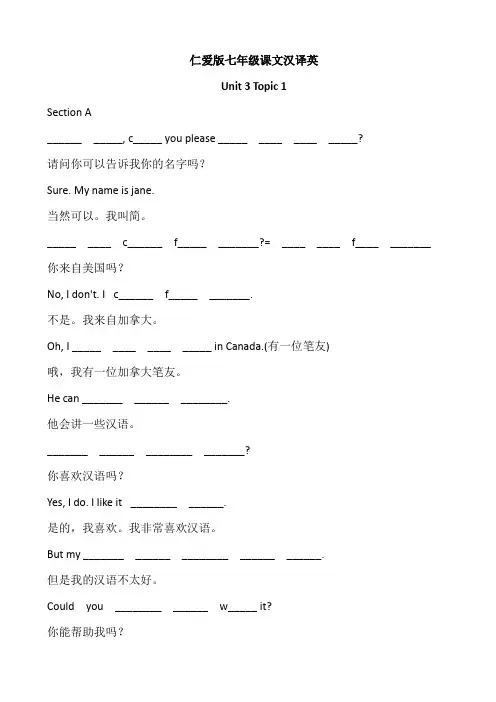
仁爱版七年级课文汉译英Unit 3 Topic 1Section A______ _____,c_____you please_____ ____ ____ _____?请问你可以告诉我你的名字吗?Sure.My name is jane.当然可以。
我叫简。
_____ ____ c______ f_____ _______?= ____ ____ f____ _______你来自美国吗?No,I don't.I c______ f_____ _______.不是。
我来自加拿大。
Oh,I_____ ____ ____ _____ in Canada.(有一位笔友)哦,我有一位加拿大笔友。
He can_______ ______ ________.他会讲一些汉语。
_______ ______ ________ _______?你喜欢汉语吗?Yes,I do.I like it________ ______.是的,我喜欢。
我非常喜欢汉语。
But my_______ ______ ________ ______ ______.但是我的汉语不太好。
Could you ________ ______ w_____it?你能帮助我吗?______ ______.没问题。
I'm Li Wei.My______ ______ ______ _____.我叫李伟。
我的汉语讲的很好。
I often______ ______ ______ w_____ ______.我经常帮助我的朋友学习汉语。
I like______ ______ ______.我非常喜欢汉语。
But my English______ ______ ______ _____.但是我的英语不太好。
I want_____ ______ ______ _____ _____.我希望能有一位笔友。
Could you ______ ______ _____it?=你能帮助我学习英语吗?我的笔记:帮助某人做某事help sb do sth=help sb with sth_____ ______ ______ _____ _____?这封信是谁寄来的?It's______my ____ _____,Sam.是我的笔友萨姆寄来的。
仁爱版英语 七年级上册 Unit 3 Topic 1 课文及翻译

Unit 3 Getting Together一起去Topic 1 Does he speak Chinese ? 他讲中文吗?Section A1aExcuse me,could you please tell me your name?打扰一下,你能告诉我你的名字吗?Sure. My name is Jane.当然。
我的名字是简。
Do you come from America?你来自美国?No,I don’t. I come from Canada.不,我不是。
我来自加拿大。
Oh,I have a pen pal in Canada. He can speak some Chinese. Do you like Chinese?哦。
我有一个笔友在加拿大。
他会说一点中文。
你喜欢中文吗?Yes,I do. I like it very much. But my Chinese is not very good. Could you help me with it?是的。
我很喜欢中文。
但是我的中文不好。
你能帮我提高中文吗?No problem.没问题。
Section B1aWho is the letter from?这封信来自谁?It’s from my pen pai,Sam.来自我的笔友萨姆。
Does he speak Chinese?他讲中文吗?No,he doesn’t. He speaks English. But he knows a lot about China.不,他不讲。
他讲英文。
但是他很了解中国。
Does he live in England?他住在英格兰?Yes,he does.是的。
What does he say in the letter?他在信里说了什么?He wants to visit Beijing.他想浏览北京。
Oh,he can help you with your English.哦。
仁爱版七年级上册英语笔记 Unit3 Topic3-Unit4 Topic1知识点总结
U 3 T3—U4 T11.1)would like = wantwould like没有人称和数的变化I would like an egg.=I want an egg.He would like an egg.= He wants an egg.(would like不能加s)2)would like to do = want to doa. He would like to drink some water.(drink)=He wants to drink some water.b. She would like (visit) the Great Wall.=She the Great Wall.3)I would like=I’d like He would like=He’d like4)a. I’d like an egg.(一般疑问句) Would you like an egg?Yes,please./ No,thanks.b. He’d like a hamburger.he a hamburger?. / .5)Would you like some chicken?(用some 加强语气,表示强调)6)I’d like an egg.What would you like?He’d like some fish.he ?2.1)you—yourself(反身代词)2)yoursel f---yoursel ves(pl.)3.help yourself/yourselves to +n.:随便吃……a. Help yourself (you) to some chicken, Tom.b. Help yourselves (you) to some chicken, kids.4.1)可数名词[C]:有单数和复数的形式.2)不可数名词[UC]:一般没有复数的形式.3)常见的不可数名词有:milk,rice,fish(鱼肉),chicken(鸡肉),(apple/orange) juice,water,bread5.fish:1)作为“鱼” , 是可数名词.fish—fish(pl.)2)作为“鱼肉”, 是不可数名词.some fish6.chicken:1)作为“鸡” , 是可数名词.a chicken2)作为“鸡肉”, 是不可数名词.some chicken7.some + n.(pl.),some+ [UC]some eggssome fish/chicken/milk/apple juice/rice8.---Help yourselves.---Thank you.9.---Would you like…? ---Yes, please. /No, thanks.10.What/How about +sb(宾格)/sth?What about him/her/some milk?11.All right.行,好吧(表示对别人的建议表示赞同)---I’d like some rice and chicken.---All right.k for me.13.Me,too.14.表示建议:---What about …? ---Good idea.15.an ideaa good ideaHomework:1.I’d like a hamburger.(一般疑问句) a hamburger?(肯否回答) ./ .2.She’d like some orange juice.she ?3. , boys and girls.(随便吃些鸡肉吧)4.She likes it very much.(否)She it .5..(我想喝些牛奶).6.他们怎么样??Unit 3 T 3 Section B—D1.1)usually:70-80%,often:50-60%2)usually,often放在be之后,行为动词之前.I usually have breakfast at home.2.have…for breakfast/lunch/supper/dinner1)He usually has an egg and some milk for breakfast.2)We usually have some rice and chicken for supper.3.一日三餐前不加a/an/the,后不加s.What do you usually have for/ breakfast?4.1)He usually has some bread for lunch.What does he usually have for lunch?2)We usually have some juice and fish for dinner.usuallyfor dinner?5.have:1)有2)吃,喝:have milk/bread6.[UC]前面不加a/an/the,后不加s.He has / milk and/ bread for breakfast.7.What/How about +sb(宾格)/sth?8.with带着/有,(表示伴随关系)have chicken/fish with vegetables9.some rice10.three meals(餐):breakfast,lunch,supper/dinner11.food:[UC],食物的总称,作主语,谓语用单数.My favorite food is (be) chicken and fish.12.Chinese /English food13.wait(v.)—waiter(指人)(男服务员)---waitress(女服务员)14.take one’s orderMay I take your order?15.something to drink/eat1)修饰词如不定式(to do) ,形容词修饰something时,放在something之后.2)something:某事(肯定句)anything:任何事(否/疑问)nothing:没有什么事(表否定意思的陈述句)3)Would you like +something?Would you likesomething to eat ?16.[UC]表示数量的表达法:1)a glass of apple juice/watera bag of rice /milk2)a glass of apple juice---two/some glasses of apple juice3) a bag of milk---five bags of milk17.wait/just a moment18.Let me see.让我想一想.I see. 我明白了.19.1)Would you like some vegetables?2)some vegetables/rice20.something to drink21.banana juice----Section C1.eat out2.eat---eating(现在分词)3.would like to doWould you like to have (have) dinner with me?4.have / breakfast/lunch/supper/dinner5.with sb(宾格)6.Would you like to have lunch with him?7.Yes, I’d like/love to.(to不能省略)8.1)May/can I help you?=What can I do for you?2)情态动词may/can/could+动原May I help (help) you?9.sir—madam(对应词)10.What would you liketo eat (eat)?11.Why not+动原? =Why don’t you +动原?Why not study (study) with me? = Why don’t you study with me?12.表示建议:1)What about…? 2)Why not…?肯定回答:Good idea.13.Here you are.14.---Would you like sth to drink?---Yes,please./No,thanks.Section D1.in+地点: in China2.many+n(pl.)many friends3.1)all,bothall指三者或三者以上“都”both指两者“都”2)all,both放在be之后,行为动词之前They are all students.We all like school.4.be kind to sbThe teacher is kind to us.5.have dinner with them6.such as +若干例子7.Sichuan food8.be glad to do sthObama is glad to visit (visit) the Great Wall.9.1)here,there是介词,前不加介词.2)be here/thereI’m glad to be (be) here.10.let sb do sthLet me (I) see (see).Homework:1.他晚饭通常吃什么?he usually?2.你可以点菜了吗??3.Tom,为什么不随便吃些汉堡包呢,?,Tom?4.你想喝些什么东西吗?来两杯香蕉汁.Would you like?.5.She’s glad (be) there.6.I’d like (work) with you.7.Would you like something(say)?8.Why not (tell) him about it.= him about it.9.他对我很友善.He .10.I usually have some rice for lunch.usually for lunch?1.---Do you like…?---Yes, I like …very much/a lot/a little.(No, I don’t like …at all.)Section D1.at / homeHe has a dog at home.2.it’s, its(它是)(它的)a cat. name’s Mimi.3.Tommy =Tom4.Zhou Lan likes it a lot.= Zhou Lan likes it very much.(否)Zhou Lan doesn’t like it at all.5.some,anyShe has some pets.(否)She doesn’t have any pets.(疑问)Does she have any pets?6.1)人称代词:主格---宾格I—me,you-you,he-him,she-her,it-itwe-us,they-them2)形物代—名物代my-mine,your-yours,his-his,her-hers,its-its,our-ours,their-theirsThis is a girl. name is Lily. is twelve. We like .(Her,She,her)Unit 4 T1 Section A1.What can I do for you?=Can/May I help you?2.madam---sir(对应词)3.want to do = would like to do1)She wants to have milk and bread.=She would like to have milk and bread.2)Would you like a glass of apple juice?=Do you want a glass of apple juice?3)Would she like some vegetables?=Does she want any vegetables?4.clothes:衣服的总称,复数名词,作主语时,谓语用复数形式。
仁爱版英语七年级上册单词表
Unit 1 Topic 1 Welcome to China!1.好的,令人愉快的_______________2.早晨,上午___________3.我___________4.是___________5.欢迎___________6.到,对,向___________7.中国___________8.谢谢,感谢___________9.你,你们___________10.这(那)个,这(那)些___________11.美国___________12.英国___________13.喂,你好___________14.是___________15.是,同意___________16.不,不是,没有___________17.不,没有___________18.令人愉快的,友好的___________19.结识,遇见___________20.也,太,很___________21.感谢,谢谢___________22.遇见,看到,明白___________23.妈妈___________24.这个,这___________25.是___________26.我的___________27.老师,教师___________28.怎样,多少,多么___________29.做___________30.爸爸___________31.女士,小姐___________32.女士___________33.下午___________34.再见___________35.健康的,晴朗的___________36.和___________37.(口语)安然无恙,好,行___________38.在这里___________Unit1 Topic 2Where are you from1)原谅___________2)我(宾格)___________3)什么___________4)你的,你们的___________5)名字,名称___________6)请___________7)在(到)哪里___________8)来自,从___________9)加拿大___________10)美国___________11)日本___________12)英格兰___________13)他/她/它们___________14)谁___________15)他___________16)她___________17)看,看起来___________18)电话,号码,数字___________19)它___________20)很,非常___________21)非常,很;多少,许多,大量___________22)非常,很(词组)___________23)那,那个___________24)零___________25)一___________26)二___________27)三___________28)四___________29)五___________30)六___________31)七___________32)八___________33)九___________34)十___________35)她的___________36)家族,家庭___________ Unit1 Topic 31.What class are you in2.十二___________3.年___________4.…岁的,老的,旧的___________5.班级,课___________6.在…里(内,上),用…___________7.年级___________8.十一___________9.十三___________10.十四___________11.十五___________12.十六___________13.十七___________14.十八___________15.十九___________16.二十___________17.英语;英国的,英国人的___________18.橡皮,黑板擦___________19.地图___________20.钢笔,笔___________21.铅笔___________22.书桌.___________23.一(个,件……)___________24.拼写___________25.一(个,件……)___________26.能,会___________27.苹果___________28.玩具___________29.试,试图,努力___________30.再一次___________31.那些___________32.书,本子,预约,预订___________33.这些___________34.让___________35.帮助___________36.尺子___________37.小汽车,轿车___________38.蛋___________39.柑橘; 橙子,橘;橘黄色的___________40.公共汽车___________41.盒,箱___________42.现在___________43.学校___________44.他的___________45.相同的___________46.但是,可是___________47.朋友___________48.初级的___________49.高的;在高处,向高处___________50.初中___________Review of Unit 11)女孩___________2)我们___________3)学生___________4)讲,说,谈话___________I have a small nose.1.猜___________2.有,吃,喝___________3.小的___________4.鼻子___________5.有(第三人称单数形式)___________6.大的___________7.眼睛___________8.知道,认识___________9.正确的,右边的;右边___________10.耳朵___________11.头发___________12.头___________13.脸___________14.脖子___________15.嘴___________16.圆形的___________17.长的___________18.宽的___________19.最喜爱的;特别喜欢的(人或物)___________20.演员___________21.汉语的,中国人的;中国人,汉语___________22.Do 的第三人称单数___________23.胳膊;_______________24.手;___________26.脚,英尺___________27.短的,矮的___________28.男孩___________29.来;来到___________30.出生于,来自___________31.姐妹___________32.不同的___________33.小刀___________写出下列词的复数形式:1)egg___________2) banana___________3)bus___________4)box___________5)class___________6)watch___________7)baby ___________8)family___________9)boy___________10) monkey___________11)knife___________12)wolf ___________13)wife___________14)shelf___________15)foot___________16)man___________17)woman___________18)child ___________What does she look like1)黑色的;黑色___________2)金黄色的;浅色的___________3)蓝色的;蓝色___________4)颜色;给…着色;涂色___________5)粉红色;粉红色的___________6)红色;红色的___________7)紫色;紫色的___________8)棕色;棕色(的)___________9)灰色;灰色(的)___________10)黄色;黄色(的)___________11)绿色(的);___________12)白色;白色的___________13)给___________14)信,字母___________15)对不起,抱歉;难过的___________16)像;跟…一样;喜欢;喜爱___________17)高的___________18)会;将___________19)给,因为,对于___________20)年轻的___________21)男人___________22)成年女子,妇女___________23)雪人___________24)想要;需要___________25)买___________26)T恤衫___________28)一对,一双___________29)(表示所属,数量,其中)……的___________30)鞋___________31)外套;大衣___________32)连衣裙;___________33)裤子___________34)短裙___________35)手套___________36)向;在(几点钟),在(某处)___________37)看着___________38)照片___________39)强壮的___________40)幸福的,快乐的,高兴的___________41)下一个的;随后___________42)在……近旁,紧邻___________43)男式衬衫___________44)酷的;凉爽的___________45)另外,其他___________写出下列相应的物主代词和汉语意思1, my---__________()2, your--__________()3, our--___________()4, their--___________()5, his--_____________()Unit2 Topic 3Whose jacket is this1.我的___________2.谁的___________3.那么;然后_____________4.你的,你们的___________5.她的___________6.我们的___________7./他/它们的___________8.自行车___________9.猫___________10.我们的___________11.香蕉___________12.他/她/它们的___________13.夹克衫,短上衣___________14.想;认为,思考___________15.书包;___________16.婴儿;动物幼畜___________17.新的;___________18.同班同学___________19.衣服___________20.我们___________21.找到;___________22.他___________23.警察___________写出下列对应的词单数复数1,am/ is ___________2, this___________3, that___________4, I___________5, you___________6, he/ she/it___________7, my___________8, your___________9, his/ her/its___________句子单复数互相转换1.This is a box.______ ______ ______.2.That is my book.______ ______ _______ _________.3.Those are your shoes.______ ______ ______ ______.4.These are our pens.______ ______ ______ ______.5.They are pens.______ ______ ______ ______. 6.They are girls.______ ______ ______ ______.7.They are boys.______ ______ ______ ______.Unit 3 Topic 1Does he speak Chinese1)可以…;能___________2)告诉___________3)当然;确信的,肯定的___________4)一些___________5)关于;具有;和; 用___________6)问题___________7)很好地; 好吧,那么;健康的___________8)经常___________9)许多___________10)许多(词组)___________11)关于,大约___________12)居住,生活___________13)说;讲___________14)参观;拜访___________15)许多的;___________16)一点儿;稍许;小的___________17)一点儿(词组)___________18)因此,所以;如此,这么___________19)她/他/它们(宾格)___________20)各个,每个___________21)互相;彼此___________22)所有;全部___________23)一点也不;根本不___________24)读,朗读___________25)人; 人们___________26)每一个,每个___________27)一天,一日;白天___________写出下列对应的词1,old (反义词)_________2,same(反义词)_________3, have (动词的第三人称形式)_________ 4,be(动词的第三人称形式)_________ 5,I(宾格代词)_________6.,their(名词性物主代词)_________ 7,Jane ( 名词所有格)_________8,this (复数形式)_________9,those ( 单数形式)_________Unit3 Topic 2What does your father do1.到家;在家___________2.小孩,开玩笑___________3.高兴的;愉快的___________4.母亲___________5.父亲___________6.医生___________7.父(母)亲___________8.办公室___________9.工人___________10.司机___________11.农民___________12.厨师; 烹调,烹饪;___________13.护士___________14.给…看,出示,表明;演出,展示___________15.工作,运转;劳动___________16.医院___________17.餐馆___________18.在…上;关于___________19.农场___________20.教___________21.扮演,表演___________22.驾驶;开车___________23.婶母; 姨母;伯母;舅母;姑母___________24.叔;伯;舅;姨夫;姑父___________25.兄;弟___________26.长沙发___________27.祖父(母);外祖父(母)___________28.堂(表)姐妹;堂(表)兄___________29.女儿___________30.树___________31.家谱___________32.儿子___________33.可爱的,机灵的___________34.玩耍,演奏;戏剧___________35.它的,她的,他的___________36.爱,喜爱___________Unit3 Topic 3What would you like to drink1)你自己___________2)打算,想要(will的过去式)___________3)鱼;鱼肉;钓鱼___________4)鸡肉,鸡___________5)大米;稻米___________6)喝;饮料___________7)果汁___________8)牛奶___________9)主意___________10)水___________11)蔬菜___________12)面包___________13)汉堡包___________14)通常地___________15)早餐___________16)午餐___________17)晚餐___________18)食物___________19)可以;可能___________20)拿;乘坐;花费___________21)命令,顺序;点菜,组织___________22)先生___________23)某物,某事___________24)(玻璃)杯___________25)嗯___________26)吃___________27)在(到)外面___________28)为什么___________29)亲爱的,昂贵的___________30)友好的; 种, 类___________31)在;是___________Review of Unit 31.在那里;到那里___________2.去,走___________3.得到,到达___________4.动物园___________5.星期日___________6.需要___________7.狗___________8.盼望___________Unit 4 Topic 1What can I do for you1)商店; 购物___________2)夫人;女士___________3)试穿___________4)七十___________5)仅仅;只是___________6)认为;想起___________7)考虑___________8)任何东西(事物)___________9)意思是___________10)千克___________11)袋子___________12)一条(面包)___________13)(长方形)条,块; 酒吧___________14)一瓶的量;瓶子___________15)听,罐___________16)节省,攒钱,挽救___________17)巧克力___________18)可乐___________19)购物___________20)任何的,任一的___________21)重的___________(一到四十是学过的)22)一___________23)二___________24)三___________25)四___________26)五___________27)六___________28)七___________29)八___________30)九___________31)十___________32)十一___________33)十二___________34)十三___________35)十四___________36)十五___________37)十六___________38)十七___________39)十八___________40)十九___________41)二十___________42)三十___________43)四十___________44)五十___________45)六十___________46)八十___________47)九十___________48)百___________Unit4 Topic 2Would you like to cook with us1.空闲的;免费的___________2.发生,向上___________3.野餐___________4.给…打电话;称呼___________5.什么时候,何时,当……的时候___________6.(在)明天;明天___________7.唱歌___________8.歌;歌曲___________9.不得不___________10.放(风筝、飞机模型等);飞行___________11.风筝___________12.时间,次,回___________13.请求,邀请,询问___________14.回到(原处),往后;背部,后部___________15.晚上;傍晚___________16.路,道路,方式___________17.家庭作业___________Unit4 Topic 3What time is it now1)熊猫___________2)猴子___________3)狮子___________4)老虎___________5)象___________6)…点钟___________7)在…之后,超过,经过;过去,往事___________8)一刻钟;四分之一___________9)半;一半___________10)上午,午前___________11)聪明的;聪颖的___________12)动物___________13)小时___________14)以后,后来___________15)在今天,当今,今天,当今___________16)起床,起来___________17)肉类,(某种)食用肉___________18)兔___________19)Review of Units 3-420)如果,是否___________21)电子邮件___________22)下午,午后___________。
【公开课教案】仁爱英语七上Unit 3 Topic 1 Section C
Unit 3 Getting TogetherTopic 1 Does he speak Chinese?教学内容分析及课时分配建议:该话题主要围绕有关认识朋友、谈论喜好等话题展开。
此话题贴近学生实际生活,可以让学生感受到英语在生活中的实践意义,从而提高他们学习英语的积极性。
本话题主要包括三个部分:Li Xiang 和Jane 交朋友并谈论喜好,Jane 和Kangkang谈论笔友,介绍Jane, Sally 和“我” 在学习上互相帮助。
在此过程中学习如何表达询问、请求以及谈论个人喜好等;主要句型和语法是“Could you…?,” “ Does he/she like…?”, “He /She likes …a little/ very much/a lot.”,以及实义动词want/like/speak 的第三人称单数一般现在时的陈述句、一般疑问句及其肯定句和否定句的回答;最后通过project的活动,综合本单元所学,使语言知识学以致用。
本话题建议用5个课时来完成:第一课时:Section A 1a, 1b, 1c, 1d, 2, 3a第二课时:Section B 1a, 1b, 1c, 1d Section A 3b, 4第三课时:Section B 2a, 2b, 3 Section C 4a, 4b第四课时:Section C1a, 1b, 2a, 2b, 3第五课时:Section D Grammar& Functions, 1, 2, Project第四课时(Section C1a, 1b, 2a, 2b, 3)教学设计思路:本课的短文通过介绍“我”的两个同学,进一步学习表示喜好的表达法。
首先通过头脑风暴的方式复习了第三人称单数的一般现在时,为本课学习做铺垫。
通过引入学生喜欢的明星导入本课的重难点,即like…a little, like…a lot/very much, doesn’t like at all.然后让学生结合实际生活,谈论对英语和语文学科的喜好,及时进行复习巩固,同时也训练学生将图表信息转化为口头表达的能力。
七年级英语上册Unit3 Topic1 SectionC教学设计 最新仁爱版
Unit3Getting TogetherTopic1Does he speak Chinese?Section CI.Material analysis本节课是本话题的第三课时,主要活动是1a和2a。
通过介绍“我”的两个同学Jane 和Sally,进一步学习和巩固表示喜好的表达法、实义动词第三人称单数的一般现在时的陈述句、一般疑问句及肯定、否定回答以及人称代词的主格和宾格的用法。
同时,通过匹配图片和音标,帮助理解单词意义,并根据音标拼写单词,再现和巩固Section A 中的音标教学,巩固字母和字母组合ar,er,ir,o,ee,ch,sh等在单词中的发音规律,帮助学生尝试结合发音规律拼读新单词。
II.Teaching aims1.Knowledge aims能根据已学语音、音标及发音规则,正确朗读下列词汇并运用于情景对话中:many, little,a little,so,them,each,each other,all,not...at all;能在Section A的语法基础上正确运用come,speak,like,help等实义动词第三人称单数的一般现在时的陈述句、特殊疑问句、一般疑问句及其肯定否定回答,同时巩固人称代词的主格和宾格的用法;能在Section A已学的语音基础上结合图片和音标拼写单词,并能尝试结合语音发音规律拼读新单词;ar/3/:march,farmer er/ə/:farmer,sisterir/8/:first,bird,shirt o/4/;/əK/:go,orangeee/1/:see ch/C/:China,Chinesesh/H/:fish,shirt,ship能结合话题,运用“谈论喜好、朋友”等交际功能的基本表达形式,进行口头和笔头的信息输出,如:Where does he come from?Does he like Chinese?2.Skill aims能听懂有关表达谈论喜好的叙述与对话;能根据图文就谈论喜好等话题进行交流,能结合字母及字母组合的音标规律拼读新单词;能在阅读训练中进行读前猜测、读中验证的活动;能理解并执行有关“谈论笔友”的书面指令并形成短文。