
人教版七年级英语上册unit 4知识点与同步训练
Unit 4 Where’s my backpack?Class______ Name______ Number______ Mark______重点短语:Where’s=where is在哪里they’re=they are 他们是don’t=do not不是Doesn’t=does not不是watch TV看电视video tape录像带Alarm clock闹钟take拿走-----bring带来sb can do sth 某人会做某事Under the bed在床下on the desk在书桌上in the drawer在抽屉里In front of the house在房子前面behind the door在门后面Next to the sofa在沙发旁边重点句子:Where’s the baseball? It’s in the backpack.Where are your books? They are on the chair.Where are the key? They’re on the table.Where is the set of keys?It’s on the table.Are they on the bed? No, they aren’t.Is it in the room? Yes, it is.Please take these things to your sister.Can you bring some things to school?I need my hat and my pen.This is my room.My baseball is on the floor.重点语法Where’s +单数名词、人称?----It’s +介词短语。
Where are+ 复数人称?----- They are +介词短语。
2. in bed在床上睡觉on the bed 放在床上3.at table 在吃饭at the table 在桌上4.on the wall(图片、黑板、挂钟)在墙上in the wall(钉子、洞、窗户)在墙上5.on the tree (树叶、芽、花)长在树上in the tree(鸟、猫、外界东西)在树上6.in front of (在事物外部)的前面in the front of(在十五内部的)前面7.in 属于on相邻to相离(地理事物)位置关系8.look for寻找的(动作)find(寻找的结果)9.take sth to sb.把某物送去给某人Bring sth to sb.把某物带来给某人10.there be 句型There is a/an +单数可数名词+介词短语There is +不可数名词+介词短语There are +复数可数名词+介词短语There be 句型遵循就近原则There is a tree behind the house.There is some water in the cup.There are some pears in the bag.There is a pen and some books on the desk.There are some books and a pen on the desk.11.can 句型肯定句:sb can do sth.否定句: sb can’t do sth.一般疑问句和回答: Can sb do sth? Yes ,sb can. No ,sb can’t. 特殊疑问句: What can sb do ? Who can do sth?He can read books. He can’t read books.Can he read books? Yes ,he can. / no, he can’t.What can he do ? who can read books?Ⅰ. 单项选择(15*2=30)( )1. Are these your ______?A. chairsB. plantC. boysD. pen( )2. ______ is his math book.A. TheseB. ThoseC. HereD. They( )3. My English book is in the room. Can you ______ it to me?A. bringB. callC. takeD. spell( )4. Where’s my watch? I ______ it.A. lookB. takeC. thankD. need( )5. ______ my photos? They are on the table.A. What’sB. How areC. Where’sD. Where are ( )6. Is the book on the desk? ______. It’s under the desk.A. Yes, they areB. No, it isn’tC. No, they aren’tD. Yes, it is( )7. ______? They are tables.A. What are theyB. What’s thisC. How are youD. Where are they ( )8. Is his pencil case ____________ the drawer?A. inB. atC. behindD. over( )9. I have an alarm clock. It's ____________ video cassette and the computer.A. betweenB. behindC. underD. beside( )10. ____________ that? It's my sister Jane.A. Who'sB. What'sC. Where'sD. How is( )11. The holes are ____________ the wall.A. underB. inC. onD. into( )12.________ under the tree? No,they aren’t.A.Where are B.What is C.Are they D.Is it( )13.________ there water in the cup?A.Is B.Are C.Has D.Have( )14.He ________ a small room. ________ a nice desk in it.A.is, There is B.has, Has C.have, There is D. has, There is ( )15.There ________ an orange and two apples on the table.A.are B.has C.is D. have二、完形填空。
(10*2=20)My name is Grace. Look! This is a 11 of my family. A boy is in it. 12 is my brother, Tommy. Tommy is 13 the sofa. A woman (妇女) is in the picture, too. She is my 14 . She is at the table. My father 15 in the picture. He is at 16 with his students. A plant and a backpack 17 on the table. The backpack is my brother’s. Two 18 are under the chair. They are also my 19 . You can see some 20 . They are on the bookcase.( ) 1. A. chair B. table C. bed D. picture( ) 2. A. She B. He C. It D. They( ) 3. A. on B. at C. under D. of( ) 4. A. sister B. cousin C. mother D. friend( ) 5. A. isn’t B. are C. is D. don’t( ) 6. A. desk B. table C. school D. dresser( ) 7. A. is B. are C. am D. 不填( ) 8. A. rooms B. key C. eraser D. baseballs( )9. A. brother B. brother’s C. sister D. sister’s( )10. A. ID card B. CDs C. beds D. plant三、阅读理解。
(5*2=10)This is a room in Kate’s house. There is a big bed, a table, a computer and some chairs in it. There’s a glass and some books on the table. There is a picture on the wall. Kate is in the room. She is looking at the picture. Her father and mother are in the school. They work hard.()1.Is there only one room in Kate’s house?A.Yes, there is. B.There is a bed.C.There is a computer. D.I don’t know.()2.What’s in the room?A.Only a bed. B.Only a table.C.Only some chairs. D.A bed, a table, a computer and some chairs.()3.Is there anything on the table?A.Yes, there is. B.No, there isn’t.C.Some books. D.A glass.()4.Who is at home?A.Kate’s father. B.Kate’s mother.C.Kate s brother. D.Kate.()5.Kate’s father and mother are ________.A.teachers B.students C.friends D.at home四、改正句中的一处错误。
人教版七年级英语上册Unit4短语、句型、知识点总结
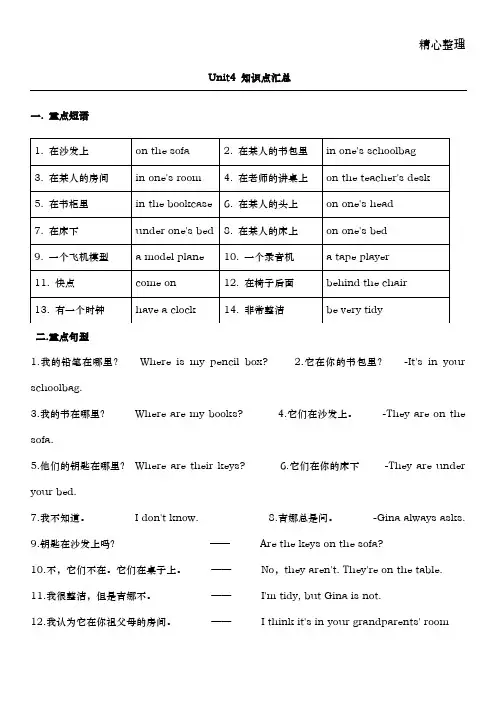
精心整理Unit4 知识点汇总一.重点短语1. 在沙发上on the sofa2. 在某人的书包里in one's schoolbag3. 在某人的房间in one's room4. 在老师的讲桌上on the teacher's desk5. 在书柜里in the bookcase6. 在某人的头上on one's head7. 在床下under one's bed 8. 在某人的床上on one's bed9. 一个飞机模型 a model plane 10. 一个录音机 a tape player11. 快点come on 12. 在椅子后面behind the chair13. 有一个时钟have a clock 14. 非常整洁be very tidy二.重点句型1.我的铅笔在哪里?Where is my pencil box?2.它在你的书包里?-It's in your schoolbag.3.我的书在哪里?Where are my books?4.它们在沙发上。
-They are on the sofa.5.他们的钥匙在哪里?Where are their keys?6.它们在你的床下-They are under your bed.7.我不知道。
I don't know.8.吉娜总是问。
-Gina always asks.9.钥匙在沙发上吗?——Are the keys on the sofa?10.不,它们不在。
它们在桌子上。
——No,they aren't. They're on the table.11.我很整洁,但是吉娜不。
——I'm tidy, but Gina is not.12.我认为它在你祖父母的房间。
——I think it's in your grandparents' room13.我的字典和她的收音机在课桌上。
【初中英语】英语七年级上册Unit4教案+同步讲解+同步练习 人教版4
Unit 4 I want to be an actor.Language goals:●In this unit students learn to talk about jobs.New languages:●What do you do?●I’m a reporter.●What does he do?●He’s a student.●What do you want to be?●I want to be an actor.●What does she want to be?●She wants to be a policewoman.●names of jobs and professionsDifficult points:1. Listening for the names of jobs and professions.2. Read the newspaper want ads. Learn to write your own want ad.Teaching aids:● A tape recorder●Some picturesTeaching periods:●Period 1:Section A1a, 1b, 1c●Period 2:Section A2a, 2b, 2c●Period 3:Section A3a, 3b, 4●Period 4:Section B 1a,1b, 1c, 2a, 2b, 2c●Period 5:SectionB 3a, 3b, 3c, 4●Period 6:Self CheckPeriod 1Teaching aims:1. Teach vocabulary words.2. Target languages:What does she do?She’s a doctor.3. Enable the students to talk about jobs.4. Help the students learn how to talk about different jobs.Teaching procedures:Step 1. BrainstormingBrainstorm with students a list of jobs that friends or relatives do.Write the words jobs on the board and list all the jobs students mention.Point to the jobs one by one and ask students to say whatever they can about these jobs. Accept single word answers or simple sentences such as, It’s fun. It’sa good job.Step 2.Match work (1a)Ask students to tell what they see in each scene. Ask students to name as many of the jobs shown as they can. Then point to a scene, name the job, and ask students to repeat.Say each one and ask students to repeat.Then ask students to match each word with one of the scenes. Say, write the letter of each scene next to one of the words. Point to the sample answer.Check the answers.Step 3. Listening (1b)Point to the different people shown in the picture. Ask various students to tell what they do as you point to each one.Say, Now you will hear three conversations. The conversations are about three of the people in this picture.Play the recording the first time. Students only listen.Play the recording a second time. This time ask students to write a number 1 next to the person being talked about in conversation 1. have students put a 2 and 3 next to the people being talked about in conversations 2 and 3.Step 4. Pair work (1c)Ask a student to read the example conversation with you. Hold up the book and point to the doctor in the picture.Say, Now work with your partner. Make your own conversations about the picture.You can use sentences like the ones in activity 1b.Say a dialogue with a student. Point to a picture of one of the people. Guide the student to answer using one of the words in activity 1a.As students work in pairs, move around the room monitoring their work. Offer language or pronunciation support as needed.Homework1. Ask the students to remember the new words in this period by heart.2. Ask the students to practice the conversation in activity 1c.Period 2Teaching aims:1. Learn the vocabulary words and useful expressions.2. Target languages:What do you want to be?I want to be an actor.What does he want to be?He wants to be a bank clerk.What does she want to be?She wants to be a shop assistant.3. Enable the students to talk about jobs and want to be sentences.4. Help the students learn to talk about jobs and want to be sentences.Teaching procedures:Step 1. Free talk and lead-inRevise the words of jobs.Say: In last period we learnt the words of some jobs. Now let’s do some revision.Please look at the pictures one by one and you have to tell me the word of job in the picture. OK?Show the students the different job pictures one by one.Revise the conversation learnt in the last period.Give more chances to more students to practice talking about jobs.Step 2. Listening (2a)First ask students to look at the three pictures. Ask different students to tell you what they see in each picture. What are the people doing? What jobs do they have?Play the recording the first time. Students only listen. Say, you will hear conversations about the people in these pictures.Play the recording a second time. Say, Write the number of each conversation below the picture of the person being talked about.Check the answers.Step 3. Listening (2b)Point to the three headings in the chart and read the headings to the class. Ask students, what does “wants to be” mean? (it is not the job the person has now. It isthe job the person wants in the future.)Play the recording the first time. Students only listen. Say, You will hear about the people in these pictures. You will hear the job they have now and the job they want in the future.Play the recording a second time. This time ask students to fill in the blanks with the jobs the people have now and the ones they want in the future. Point out the sample answers.Check the answers.Step 4. Pair work(2c)Point out the pictures in activity 2a. ask who each person is. (They are Susan’s brother, Anna’s mother, and Tony’s father.)Say, Now work with your partner. Ask and answer questions about the pictures.Ask, “what does he or she do?” Then ask, “What does he or she want to be?”Say a dialogue with a student. Point to Anna’s mother and then to the example in the speech bubbles. Practice the dialogue with a student.As students work in pairs, move around the room monitoring their work. Offer language support as needed.Step 5.Grammar focusReview the grammar box. Ask students to say the questions and answers.Then pull out the questions that use you and coy these questions on the board, one above the other. Line up the words What do you and the sentence completions so?And want to be? Point out that both questions begin with the same words, What do you. Call attention to the fact that they both use the simple form of the verb in the ending: one question ends with do; the other ends with want to be.HomeworkAsk the students to do the following:1. Make similar dialogues according to the conversation in 2c.2. Ask the students to find more words about jobs.Period 3Teaching aims:1. Teach vocabulary words.2. Target languages:Where does your sister work?She works in a hospital.What does she do?She’s a doctor.3. Enable the students to say where people work.4. Help the students to say where people work.Teaching procedures:Step 1.Match work (3a)Call attention to the pictures. Ask students to read the name for each place. As they name each place, write the word on the board and ask the class to repeat it.Point out the list of jobs with the numbers next to each. Then call attention to the people in the pictures and the speech bubbles. Point out the sample answer and have a student read out the speech bubble.Ask students to work alone. Say, Write the number of each job in the square next to each workplace.Check the answers.Step 2. Pair work(3b)Point out the pictures in activity 3a. Ask students to name the workplace shown in each picture.Then point out the conversation in the speech bubbles. Ask two students to read it to the class.Say, Now work with a partner. First practice the conversation in the picture. Then make new conversations. Use jobs and places from activity 3a.Say a dialogue with a student. Point to the word waiter in activity 3a and then to the picture of the restaurant. Ask a student, Where does he work? Guide the student to answer using the correct place: He works in a restaurant. Then ask, What does he do? And guide the student to answer, He’s a waiter.As students work in pairs, move around the room monitoring their work. Offer language support as needed.Step 3. GameCall attention to the pictures in the book showing how to play the game. Say, You will draw a picture of someone working. Other students will ask questions about the kind of job you are drawing. After two questions someone can try to guess the job.Demonstrate by drawing a picture on the board of stick figure reporter. Add details (microphone, notebook, etc.) until students guess what job it is.Ask a student to go to the board. Say, Draw a picture of a person working. If necessary, help the student add details that show the job the person is doing. He or she can add a bank interior to show that the person is a bank clerk. A student could also use an eye chart on the wall to show that the place is a doctor’s office and the person is a doctor.Ask two different students to ask questions about the job, and then ask a third student to guess what job it is.Play the game using drawings by several different students.Alternative: If you do not want students to move from their seats, then you can askthem to do this activity sitting down in groups of four. They will need pieces of paper on which to draw their pictures. They will also need pencils.HomeworkAsk the students to practice talking about where people work in Activity 3a. Period 4Teaching aims:1. Teach vocabulary words.2. Target languages:He’s a policeman. It’s an exciting job.I want to be a newspaper reporter because it’s an interesting.3. Enable the students to talk about what people want to be and the reasons.4. Help the students to learn how to talk about what people want to be and the reasons.Teaching procedures:Step 1. Warming and lead-inCheck the homework by asking some questions.Show the pictures of different jobs and work place.Say: What does he/she do? Where does he work?Step 2.Match work (1a)Focus attention on the six pictures. Ask, What job does the person have? Where does the person work?Point out the numbered list of words. Say each one and ask students to repeat. Then use simple explanations and short sample sentences to help students understand what each word means. For example, Exciting means very interesting and very fast-moving. A policeman has an exciting job. The job is always changing.Something is always happening. For dangerous you might say, Dangerous means not safe. You might be hurt or killed in a dangerous job.Then ask students to match each word with one of the picture. Say, Write the letter of each picture next to one of the words. Point out the sample answer.Check the answers.Step 3. Pair work (1b)Call attention to the picture in this activity and ask a student to read the statement to the class. Then point to the picture of the policeman and say, It’s an exciting job.Ask the class to repeat. Then say, What else can you say about being a policeman?Someone m ay answer, It’s a dangerous job. Ask the class to repeat each correct answer.Then ask students to work in pairs. Suggest that they each point to the pictures of the workers and make statements about them. As students practice, move around the classroom monitoring their work.Step 4. Oral practice (1c)Say, Name some of the jobs from this unit. Write this list of jobs on the board. Say, Can you name some other jobs? Add any new jobs to the list.Ask some students to make statements about jobs on the list using the words in activity 1a. You may wish to write some of the sentences on the board so that students can copy the sentences into their notebooks.Step 5. Listening (2a)Call attention to the two headings and ask a student to read the headings to the class.Point out the blank lines where students will write the name of a job (under the words wants to be).Play the recording the first time. Students only listen.Say, Now I will play the tape again. This time write the name of a job under the words “wants to be.”Play the recording. Students write their answers.Check the answers.Step 6. Listening (2b)Call attention to the second heading and ask a student to read it to the class. Say, This time you will write why each person wants the job.Play the recording again. Students only listen.Then say, Now I will play the tape again. This time write the reason the person wants the job under the word “Why?”Step 7. Group work (2c)Say, What do you want to be? What words describe each job? Help the class make up a list of jobs they might like to do. As students suggest possible jobs, ask the class to suggest words to describe them. Use a bilingual dictionary, if necessary, to find the names of jobs and words to describe each one.Then ask students to work in small groups. They tell each other what they want to do and why. Encourage students to use dictionaries if necessary. Move from group to group offering assistance as needed.Ask individual students to tell the class about what they want to be and why.Homework1. Ask the students to try to remember the new words learned in this period.2. Ask the students to try to practice talking about the jobs they want to be.Period 5Teaching aims:1. Teach vocabulary words.2. Target languages:Is it a busy job?Yes, it is.Is it a job in a hospital?No, it isn’t.3. Enable the students to write the newspaper want ad.4. Help the students to write the newspaper want ad.Teaching procedures:Step 1. Reading (3a)Call attention to the three newspaper ads and read these ads to the class. Say blank each time you come to a blank line.Then read each ad again separately, pausing to allow students to ask questions about anything they don’t understand. For example, in the first ad, students may not know that work ing late means “working at night.” To work hard means to use a lot of energy to do the job.It is also acceptable to say, “Do you like to work in the evening and at the weekends?” However, the phrasing, “Do you like to work evening and weekends?”is less formal and equally acceptable.Ask students to fill in the blanks in the ads using the words actor, reporter, and waiter.Check the answers.Step 2. Writing (3b)Call attention to the newspaper ad and ask a student to read it, saying blank for each blank line.Ask students to fill in the blanks using words from this section. Say, Look at the pictures next to each blank line. The pictures will help you guess the correct word.Suggest that they look at the names of jobs and the words that describe jobs and the words that describe jobs in the first part of Section B.Check the answers.Step 3. Writing (3c)Point out the blank strip of newspaper where students can write their own ads.Ask one or two students. What are you going to write about? Repeat each of the students’ sentences and ask the class to repeat the sentences after you. For example: Do you want an interesting but dangerous job? Do you want to meet new people?We need a policeman. Call the Smithtown Police Station at 555-2323.Ask students to re ad their ads to a partner. Ask the pairs to correct each other’s work.Step 5.Group work(4)Ask two students to read the conversation in the speech bubbles. Answer any questions students may have about it.Then say, Now please work in groups. Ask questions to find out what jobs each person wrote about. You can use sentences like the ones we just read.As students ask questions, move from group to group. Rephrase any incomplete or incorrect questions. Also rephrase any inaccurate answers.HomeworkAsk the students to practice writing want ads.Period 6Teaching aims:1. Teach vocabulary words.2. Enable the students to write about different jobs and jobs they want to be.3. Help the students to write about different jobs and jobs they want to be.Teaching procedures:Step 1.Warming upCheck the homework. Then show some job pictures to the students.Say: We learned to talk about jobs people want in the last period. And I asked you to write a want ad. Did you finish it?Who’d like to share your w ork?Step 2.Key word check(1)Ask students to check all the words they know. You may wish to have students circle any words that they don’t know.Ask students to find out the meanings of any words they don’t know. They can do this by reviewing the unit, asking you, asking their classmates, or using a learner’s dictionary or bilingual dictionary.Step 3.V ocab-Builders (2)After students have recorded their new words, ask them to share their lists with other students. This can be done with the whole class or informally, in pairs or small groups.Step 4.Writing (3a)Draw students’ attention to the advertisement and the table below. Check that they understand what an “international school” is, and why people who work at such aschool might need to know different languages. Point out the jobs that they are looking for at the school, P.E. teacher, music teacher and check that students understand the meaning of the word “skills”.Students fill in the table.Step 5.Writing (3b)Point out the example. Have a student read it out loud for the rest of the class (or read it out yourself). Draw attention to the use of the verb “speak” to describe the languages the person knows, and “can (do)” to talk about the skills that he or she has.Tell the students to i magine that they want to do one of the jobs in 3a. They don’t have to use real information about themselves-they can imagine that they have the skills (and languages) needed to do one of the jobs. Remind them that they have to show why they are good for the job.Ask students to write letters like the example letter, showing why they are good for the jobs in 3a.Step 6.Just for funAsk students to read the cartoon to themselves.Ask, What is surprising about this cartoon? When you say “actor,” do you think of a person or an animal?Homework1. Ask the students to summarize what they have learned in this unit.2. Ask the students to write an article about one of their favorite jobs.。
七年级上册英语unit4知识点人教版
七年级上册英语unit4知识点人教版七年级上册英语Unit 4 知识点人教版Unit 4 主要内容是介绍食物和饮料的名称和种类,以及询问和谈论这些食物和饮料的偏好和习惯。
本课程也介绍了如何用食品词汇描述食物的味道,讨论何时喜欢和不喜欢某些食物,并学习询问和回答有关日常饮食习惯的一些简单句型。
下面是本单元的重点:一、食物和饮料名称在本单元中,我们将学习一些食物和饮料的名称和种类,例如:1. Food食品:hamburger 汉堡包French fries 炸薯条pizza 披萨hot dog 热狗spaghetti 意大利面chicken wings 鸡翅2. Drinks饮料:water 水juice 果汁milk 牛奶tea 茶soda 苏打水coffee 咖啡二、描述食品味道在本单元中,我们将学习如何用食品词汇和形容词来描述食品的味道。
例如:1. Taste口味:sweet 甜的sour 酸的spicy 辣的salty 咸的bitter 苦的2. Texture质地:crispy 酥脆的chewy 嚼劲十足的tender嫩的soft 柔软的hard 坚硬的三、更多有关食品和饮料的句型和表达除了上面的词汇和描述外,还有更多有关食品和饮料的句型和表达必须了解。
例如:1. Do you like…?你喜欢……吗?Do you like pizza?你喜欢披萨吗?2. What’s your favourite…?你最喜欢的是……What’s your favourite food?你最喜欢的食物是什么?3. I like…我喜欢……I like chicken wings.我喜欢鸡翅。
4. I don’t like…我不喜欢……I don’t like spicy food.我不喜欢辣的食物。
5. How about you?你呢?I like hamburgers. How about you?我喜欢汉堡包,你呢?6. Can I have some…?我可以要一些……吗?Can I have some water?我可以要一些水吗?本单元的这些内容都是学生学习英语的基本知识。
人教版七年级英语上册unit 4期末基础知识点复习及训练(含答案)
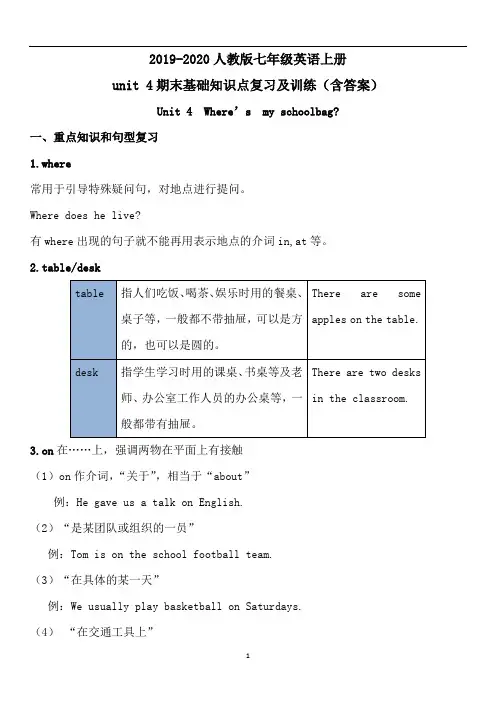
2019-2020人教版七年级英语上册unit 4期末基础知识点复习及训练(含答案)Unit 4 Where’s my schoolbag?一、重点知识和句型复习1.where常用于引导特殊疑问句,对地点进行提问。
Where does he live?有where出现的句子就不能再用表示地点的介词in,at等。
2.table/desk3.on在……上,强调两物在平面上有接触(1)on作介词,“关于”,相当于“about”例:He gave us a talk on English.(2)“是某团队或组织的一员”例:Tom is on the school football team.(3)“在具体的某一天”例:We usually play basketball on Saturdays.(4)“在交通工具上”4.in在……里面例:There is some milk in the bottle.(1)“用……语言”例:What’s this in English ?(2)表示“穿着,戴着”例:The girl in red is Kate.(3)表示时间(年、月、季节、早晨、下午、晚上)例:I get up at six in the morning.(4)表示地点,用在表示大地方(国家、城市)的名词前。
5.Where are my books?该句是where引导的特殊疑问句,用于询问“某人或某物在哪里”,结构为“where+be+主语?”,句子的主语可以是人或物,be动词要与后面的主语保持一致。
例:Where is your sister?(1)在回答该句式时,用“主语+be+表示地点的介词短语”,意为“……在……”。
答句的主语一般用人称代词代替,以避免与前面问句中的名词重复。
例:---Where is my book?---It’s on the desk.6.I think it’s in your grandparents’ room.(1)think作动词,意为“认为;想;思考”,其后常接宾语从句,从句中的that常省略。
七年级上册英语unit4知识点
七年级上册英语unit4知识点七年级上册英语Unit4 知识点Unit4主要涉及描述人物外貌、性格和兴趣爱好等常用英语表达。
本文将介绍Unit4的知识点,以帮助读者巩固英语语法和词汇。
一、基本句型1.主语+be动词+形容词例如:Tom is tall and thin.Lily is beautiful and kind.2.主语+be动词+不定式例如:My dream is to be a doctor.His goal is to travel around the world.3.主语+be动词+名词例如:She is a teacher.He is a musician.4.主语+动词+副词例如:The dog runs quickly.She speaks English fluently.5.主语+动词+宾语例如:He likes playing basketball. They enjoy watching movies.6.主语+动词+间接宾语+直接宾语例如:She gave him a book.They showed us how to cook.7.主语+情态动词+动词原形例如:I can swim.He should study harder.二、形容词形容词用于描述人的外貌和性格,下面列出一些常用的形容词:外貌高:tall矮:short胖:fat瘦:thin漂亮:beautiful帅气:handsome性格友好:friendly腼腆:shy聪明:smart勇敢:brave慷慨:generous害羞:timid三、不定式不定式用于表示目的或意图,下面列举一些常用的不定式:to be:成为to do:做to have:拥有to go:去to learn:学习to play:玩to read:读to see:看to sing:唱歌四、人物的兴趣爱好人物的兴趣爱好也是本单元的重点,下面是一些有用但简单的短语:play sports:运动listen to music:听音乐play musical instruments:演奏乐器read books:阅读watch TV:看电视draw pictures:画画write stories:写作五、总结总之,Unit4主要强调描述人物的外貌、性格和兴趣爱好等方面。
人教版英语七年级上册Unit4知识点与同步练习(有答案)
人教版英语七年级上册Unit4知识点Unit4 Where’s my backpack?1. 谈论物品的位置Where’s + 单数物品? t’s + 介词短语.Where are + 复数物品?They’re + 介词短语.1) Where’s the baseball? It’s in the backpack. 棒球在哪?在背包里。
2) Where’s my computer game? It’s under the bed.我的电子游戏机在哪?在床下面。
3) Where are your books? They’re on the chair.你的书在哪?在椅子上。
4) Where are the keys? They’re on the dresser.钥匙在哪?在梳妆台上。
名词前已有作定语的this, that, my, your, some, any, each, every等代词,则不用冠词。
2. 表位置的介词on 在......上(两者相接触)in 在......里under 在......下面(正下方)3. Come on, Jack! 快点儿,杰克!= Hurry (up), Jack!4. Gina’s books are everywhere. 吉娜的书到处都是。
5. I don’t know. 我不知道。
6. take sb/sth to + 地点:把某人/某物带到某地。
take “带走,拿走”表示从近处带到远处,从说话者的地方带到别的地方。
7. Can you bring some things to school? 你能带些东西到学校吗?bring“带来,拿来”表示从远处带到近处,从别的地方带到说话者的地方。
8. some和any(一些)1) some一般用于肯定句,any用于否定句和疑问句2) 在表示请求、建议、征求意见等委婉语气的疑问句中,用some而不用any。
人教版七年级上册英语Unit 4知识点梳理及语法讲义(教师版)
七年级上册英语Unit 4知识点与语法精讲精练词汇梳理(一)完成单词梳理:名词:1. table桌子 2. bed 床 3. bookcase 书架;书柜4. sofa 沙发5. chair 椅子6. desk 书桌7. room 房间8. hat 帽子9. head 头10. radio 收音机11. clock 时钟12. tape 磁带;录音带13. player 播放机14. model 模型15. plane 飞机动词:1. come 来;来到 2. think 认为;想;思考 3. know 知道;了解代词:1. their 他(她、它)们的 2. our 我们的介词:1. on 在……上 2. under 在……下副词:1. where 在哪里;到哪里 2. everywhere 处处;到处;各个地方3. always 总是连词:1. but 但是形容词:1. tidy 整洁的;井井有条的感叹词:1. yeah 是的;对(二) 词汇变形小结:1. they (人称代词主格:他/她/它们) — them (人称代词宾格) — their (形容词性物主代词:他/她/它们的) — theirs (名词性物主代词:他/她/它们的)2. tidy (adj. 整洁的) — untidy (反义词:不整洁的)3. radio (n. 收音机) — radios (复数)4. we(人称代词主格:我们) — us (人称代词宾格) — our (形容词性物主代词:我们的) — ours (名词性物主代词:我们的)【练一练】用所给词的适当形式填空1.Look! Those are four beds (bed) in my house.rry and I are Bill’s daughters, so Bill is our (we) father.3.Those old CD players ( player) are very nice.4.Susan and Emma thank their (they) teacher for helping them find the keys.5.Tina comes (come) to the gym and plays sports.6.These rooms (room) are too small.7.Look! Your model plane is (be) on the sofa.8.The Chinese book is his (he).9.Look at my mother’s (mother) room. It’s very clean.10.These are their (they) baseballs.(三) 短语攻关:come on快点儿tape player 磁带播放机model plane飞机模型on the sofa 在沙发上in one’s schoolbag在某人的书包里under one’s bed 在某人的床下面on one’s head在某人的头上teacher’s desk 讲桌pencil box 铅笔盒computer game电脑游戏知识点梳理1. Where are my books? 我的书在哪里?【用法详解】“Where+be动词+主语?”该句型为where引导的特殊疑问句,用来询问“某人或某物在哪里?”。
教版七年级英语上册unit 4期末基础知识点复习及训练(含答案)
2019-2020人教版七年级英语上册unit 4期末基础知识点复习及训练(含答案)Unit 4 Where’s my schoolbag?一、重点知识和句型复习1.where常用于引导特殊疑问句,对地点进行提问。
Where does he live?有where出现的句子就不能再用表示地点的介词in,at等。
2.table/desk3.on在……上,强调两物在平面上有接触(1)on作介词,“关于”,相当于“about”例:He gave us a talk on English.(2)“是某团队或组织的一员”例:Tom is on the school football team.(3)“在具体的某一天”例:We usually play basketball on Saturdays.(4)“在交通工具上”4.in在……里面例:There is some milk in the bottle.(1)“用……语言”例:What’s this in English ?(2)表示“穿着,戴着”例:The girl in red is Kate.(3)表示时间(年、月、季节、早晨、下午、晚上)例:I get up at six in the morning.(4)表示地点,用在表示大地方(国家、城市)的名词前。
5.Where are my books?该句是where引导的特殊疑问句,用于询问“某人或某物在哪里”,结构为“where+be+主语?”,句子的主语可以是人或物,be动词要与后面的主语保持一致。
例:Where is your sister?(1)在回答该句式时,用“主语+be+表示地点的介词短语”,意为“……在……”。
答句的主语一般用人称代词代替,以避免与前面问句中的名词重复。
例:---Where is my book?---It’s on the desk.6.I think it’s in your grandparents’ room.(1)think作动词,意为“认为;想;思考”,其后常接宾语从句,从句中的that常省略。
Unit4单元知识点归纳总结人教版七年级英语上册
Unit 4 知识归纳短语in one's schoolbag 在某人的书包里on / under one's bed 在某人的床上 / 下on / under the sofa / table / chair / desk在沙发 / 桌子 / 椅子 / 书桌上 / 下in one's room 在某人的房间里in your grandparents’ room 在你爷爷奶奶的房间里on the right 在右边on one’s right 在某人的右边tape player 磁带播放机model plane 飞机模型on the teacher's desk 在老师讲桌上at home 在家look at/for/after 看;寻找;照顾have a clock 有个时钟e on 快点儿;加油 e here 过来 e to +地点来到某地here and there (=everywhere) 到处;处处句型1.where引导的特殊疑问句: 用来询问位置/方位/地点(询问人或物在什么地方)(详见课本P21 Grammar Focus)句型结构:Where +is / are +人或物?○1—Where is / Where’s your sister?—She is in the classroom / In the classroom.○2—Where are my books?—They’re in the bookcase / In the bookcase.2.I think + (that) + 句子我认为……I think that the keys are Linda’s.I think the chair is nice.语法知识ask( v. 动词)○1请求;要求ask sb. for sth. 向某人要某物eg: I ask my parents for money.ask sb. for help 向某人求助eg: You can ask your teacher for help.ask sb. to do sth. 叫/要求/请求某人做某事eg: I ask Linda to help me with my English.○2询问;问ask sb. about sth. 询问某人关于某事eg: I ask my English teacher about homework.Writing(写作)Sample:Hello, everyone. This is my room.Look! My schoolbag is on the bed. A puter and a pencil box are on the desk. Some books are in the bookcase,and a picture is on the wall. Where’s my basketball? It is under the desk.I love my room.。
人教版七上英语Unit 4知识点
Unit 4小结一.词汇.1.n. 桌子________ 床__________ 书架__________沙发__________ 椅子_________ 书桌__________房间__________ 帽子_________ 头____________收音机________ 时钟_________ 磁带__________播放机________ 模型_________ 飞机__________ 2. prep :在…里/上/下/_______ _______ _______※在…后面_________ 在…旁边____________在…和…之间____________3. pron: 我们的:_______ 他们的: _________4. v. 来:______ 想,认为,思考_______ 知道_______5.adj. 整洁的:_______6.adv. 在哪儿________ 到处_______ 总是_______7. conj: 但是_______8. interj: ________二.词组.1.介词词组:在书桌上: ______________ 在桌子下:____________在书架里: ______________ 在沙发上: ____________在Tom的床下___________ 在我的椅子上_________在父母的房间里________________在我们的书包里________________在他们的头上__________________※在我后面___________ 在Jim 旁边___________ 在书架和书桌之间___________________________在树上:__________________ ( )__________________ ( ) 在墙上: __________________ ( )__________________ ( ) 在地板上:________________穿红色衣服的那个女孩____________________床上的这件夹克__________________________2. 动词词组:快点,加油_____________3. 名词词组:他的录音机______________ 一间整洁的房间_________ 她的白色的飞机模型______________你的帽子________三.句型.1.戒指在桌上: ____________________________2.爸爸的钥匙在沙发上:____________________________________________3.他的橡皮在我的文具盒里:___________________________________________4.一些女孩在我的房间里:____________________________________________5.我的字典,直尺和钢笔在文具盒里.______________________________________________ 6.你的时钟在哪儿?在我的书包里。