
英语八年级上册知识讲义 不定代词(Units 1-2语法归纳)-人教新目标版
知识梳理:【教材原句】Did you go with anyone? 你和其他人一起去的吗?No. No one was here. Everyone was on vacation. 不。
没人在这儿。
大家都在度假。
Everything tasted really good! 一切尝起来都很棒!【概念】不指明代替任何特定名词或形容词的代词叫不定代词。
【常见的不定代词】everything 每件事;一切1. some系列的词主要用于肯定句中;any系列的词主要用于疑问句、否定句中。
它们都既可修饰可数名词,也可修饰不可数名词。
【例句】There is something wrong with her. 她生病了。
There isn’t anyone in the classroom. 教室里没有人。
提示:在Would you like sth.?一类的问句中用some,不用any。
2. 由some, any, no, every构成的复合不定代词作主语时,谓语动词用第三人称单数形式。
【例句】Everyone in China likes the Spring Festival. 在中国,人人都喜欢春节。
3. 形容词修饰不定代词时,通常放在不定代词的后面。
【例句】Please do something special. 请做些特别的事情吧。
4. 几组不定代词的区别:① both, either, neither这三个词都指两者,both表示“两者都”,either表示“两者中的任何一个”,neither表示“两者都不”。
【例句】—Which do you like better, tea or coffee? 你更喜欢哪个,茶还是咖啡?—Neither, I like water better. 两者都不,我更喜欢水。
② a few; few;a little; little★ a few, few用来修饰可数名词,a little, little用来修饰不可数名词。
其中a few, a little表示肯定,意为“有一点”;few, little表示否定,意为“几乎没有”。
★ quite a few和quite a little意为“相当多”;very few和very little 意为“很少”。
【例句】There is a little milk left in the bottle. 在瓶子里有点剩余的牛奶。
There are quite a few apples in the store. 在商店里有相当多的苹果。
③ many, muchmany修饰可数名词,much修饰不可数名词。
【例句】I have many things to do. 我有许多事情要做。
He has much homework to do. 他有许多作业要做。
④ other, another, others, any other, the other, the others★other表示泛指,意为“另外的、其他的”。
常与复数名词或不可数名词连用。
如果其前有the, this, some, any, each, every, no, one 以及形容词性物主代词时,其后就可接单数名词。
【例句】I have no other place to go. 我没有其他地方可去。
★another常用于指三者或三者以上中的“另外一个”,泛指单数。
可单独使用,也可后接名词。
如果其后接复数名词,则表示“又、再、还”。
【例句】This cap is too small for me. Show me another(one).这顶帽子对于我来说太小。
给我另一顶看看。
We need another three assistants in our shop. 我们商店里还需要三名服务员。
★others是other的复数形式,表示泛指,意为“别的人或物”,但不指全部。
用于特指时在其前加定冠词the;前面可加任何限定词以及数量词。
【例句】He has more concern for others than for himself. 他对别人的关心多于对他自己。
★any other表示一个之外的其他任何一个,而不是两个之中的另一个。
【例句】China is larger than any other country in Asia. 中国比亚洲的其他任何一个国家都大。
★the other表示两者中的另外一个。
可单独使用,也可后接单数名词。
【例句】There are two erasers. One is for me, the other is for him. 这里有两块橡皮。
一块给你,另一块给他。
★the others表示同类中的剩余全部。
【例句】Fifty students are in our class. Twenty of them are 15, the others are 14.我们班有五十名学生。
二十名15岁,剩余的都是14岁。
⑤ neither, noneneither表示“两者都不”,反义词是both“两者都”。
neither of引导主语时谓语动词用单数形式。
Neither of them isinterested in math. 他们两个都对数学不感兴趣。
none 表示“三者或三者以上都不”,反义词是all,表示“三者或三者以上全都”,none of引导主语时谓语动词用单、复数形式都行。
None of them is/ areexcited about the news.听到这个消息他们谁也不感到振奋。
都表示否定意义。
none后可跟of短语,no one 和nobody则不能;none 既可指人,又可指物;nobody和no one只能指人。
【例句】Nobody/ No one believed his story. 没有人相信他的故事。
None of us believed his story. 我们没人相信他的故事。
none用来回答how many或how much提问的特殊疑问句,no one 和nobody 用来回答who提问的特殊疑问句。
【例句】—How many dogs do you keep? 你养了多少条狗?—None. 一条也没养。
—Who was late? 谁迟到了?—No one. / Nobody. 谁也没迟到。
【考题链接】—Who helped you finish the work?—___________________. I finished it by myself.A. NoneB. No oneC. NeitherD. All答案:B思路分析:根据答语“我自己完成的”可知“没有人帮助我”,故选B项。
no one 和nobody用来回答who提问的特殊疑问句。
即学即练:单项选择1. There must be ____________wrong with the clock. It doesn’t work.A. nothingB. somethingC. everythingD. anything答案:B思路分析:根据“它不工作了”可知“这块表肯定出了毛病”,故选B项。
2. Ms. Wang is an excellent teacher. ______________ in our class loves her.A. SomeoneB. No oneC. EveryoneD. Anyone答案:C思路分析:由句意“王老师是一名优秀教师”可知“我们班的每个人都喜欢她”,故选C项。
3. Mrs. Brown is nice. Every day she tried to cook _________________________for me during my stay in Canada.A. something differentB. anything differentC. nothing differentD. everything different答案:A思路分析:根据句意“布朗夫人很好”可知“在我呆在加拿大时,她每天都尽力给我做不同的东西吃”,故选A项。
4. —We have red and yellow T-shirts. Which color do you like?—I’m afraid ______________. I think blue will be OK.A. bothB. eitherC. neitherD. none答案:C思路分析:根据答语“我认为蓝色不错”可知既不喜欢红色也不喜欢黄色,故选C项。
A项意为“两者都”;B项意为“两者中的每一个”;C项意为“两者都不”;D项意为“三者或三者以上中都不”。
5. —How many birds can you see in the tree?— . All the birds have flown away.A. NoneB. No oneC. NothingD. A few答案:A思路分析:根据答语“所有的鸟都飞了”可知“一只也没有”;问句是以howmany引导的,应用none回答。
故选A项。
专项练习:(答题时间:20分钟)I. 选词填空1. You must do carefully. (something, everything)2. Granny Liu has rice now. Let’s buy _______________ forher. (little, a little, some)3. I am off duty today. Give me to read. (everything,something)4. They all came to the playground for morning exercises. of them were late. (neither, none)5. My sister gave me two pictures. One is the Great Wall, is the Ming Tombs. (another, other, the other)6. He asked for money and I gave him . (some, any)7. Did you eat at supper time? (much, many)8. If calls, tell him I am busy. (anyone,someone)9. Is ___________________ here today? (everyone; someone)II. 根据汉语意思完成下列句子1. 太阳总是从东方升起。
新版英语人教版八年级上册重点难点知识点讲解归纳总结

新版英语人教版八年级上册重点难点知识点讲解归纳总结第一篇:新版英语人教版八年级上册重点难点知识点讲解归纳总结Unit 1 Where did you go on vacation?Section A 1.go to the mountains去爬山2.visit +地点/人visitorn.旅游者 3.不定代词:人:somebodyanybodynobody everybodysomeoneanyoneno oneeveryone物:somethinganythingnothingeverything(1)和every相关的everybody、everyone、everything可用于各类句子。
例:Everything goes well一切顺利(2)和any 相关的 anyone、anybody、anything用于否定句和疑问句。
例:Mary doesn’t know anything about the news(3)和some相关的somebody、someone、something用于肯定句,表示“某人或某物”。
例:Someone is singing.(4)Nobody、no one、nothing本身具有否定意义。
例:Nobody knows this important secret.(5)形容词与不定代词相连用的位置:不定代词+形容词例:something important anything special(6)不定代词作主语,谓语动词用单数。
4.go with+sb 和某人一起去…… 5.Long t ime no see 好久不见6.quite a few相当多=lots of=a lot of=plenty of 接可数名词a few有一些、few很少(几乎没有、否定概念)接不可数名词a little有一些、little很少(几乎没有、否定概念)7.take photos拍照take photos with 和……合影take photos of 给……拍照8.what about+名词/代词/动名词9.Most of the time大多数时间谓语动词的单复数取决于Most of 后面所修饰的名词例:Most of the students go to the beach.例:Most of the water turns green.10.taste/look/feel/sound/smell+形容词11.一切顺利:Everything was excellent./ Everything goes well12.你认为……怎么样?How do you like…?=what do you think of …?= how do you feel about…? 13.buy sb sth=buy sth for sb 14.Seem 看起来……(1)seem+形容词例:Tom seems tired.(2)Seem like “好像” 例:It seems like a good idea.(3)Seem to do“似乎” 例:I seem to have a cold.(4)It seems/seemed +从句“似乎” 例:It seems that I can pass the exam.15.nothing much to do没什么事可做nothing…b ut出了……之外,什么也没有16.Bye for now 到这该说再见了17.feed----fed 喂养 18.Keep a diary 记日记Section B 1.到达(1)arrive in+大地点arrive at+小地点(2)get to +地点(3)reach+地点 2.decide to do 决定做……3.try doing sth 动作已发生,不一定付出太多努力try to do sth动作未发生,付出努力 4.(1)feel like+从句“感受到……”例:He feels like he is swimming.(2)feel like “想要……”+名词/代词/动名词例:Do you feel like taking a walk with me?5.wonder “想知道,琢磨”后接who,what,why等疑问词引导的宾语从句。
人教新目标八年级英语上册Unit1知识点归纳大全
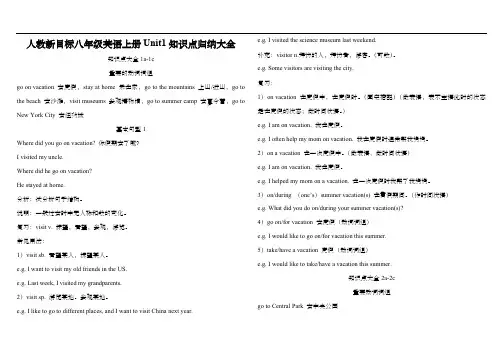
人教新目标八年级英语上册Unit1知识点归纳大全知识点大全1a-1c重要的动词词组go on vacation 去度假,stay at home 呆在家,go to the mountains 上山/进山,go to the beach 去沙滩,visit museums 参观博物馆,go to summer camp 去夏令营,go to New York City 去纽约城基本句型1Where did you go on vacation? 你假期去了哪?I visited my uncle.Where did he go on vacation?He stayed at home.分析:试分析句子结构。
说明:一般过去时中无人称和数的变化。
复习:visit v. 探望,看望,参观,游览。
常见用法:1)visit sb. 看望某人,探望某人。
e.g. I want to visit my old friends in the US.e.g. Last week, I visited my grandparents.2)visit sp. 游览某地。
参观某地。
e.g. I like to go to different places, and I want to visit China next year. e.g. I visited the science museum last weekend.补充:visitor n.拜访的人,拜访者,游客。
(可数)。
e.g. Some visitors are visiting the city.复习:1)on vacation 在度假中,在度假时。
(固定搭配)(做表语,表示主语此时的状态是在度假的状态;做时间状语。
)e.g. I am on vacation. 我在度假。
e.g. I often help my mom on vacation. 我在度假时通常帮我妈妈。
人教新目标英语八年级上册unit1单元知识点总结
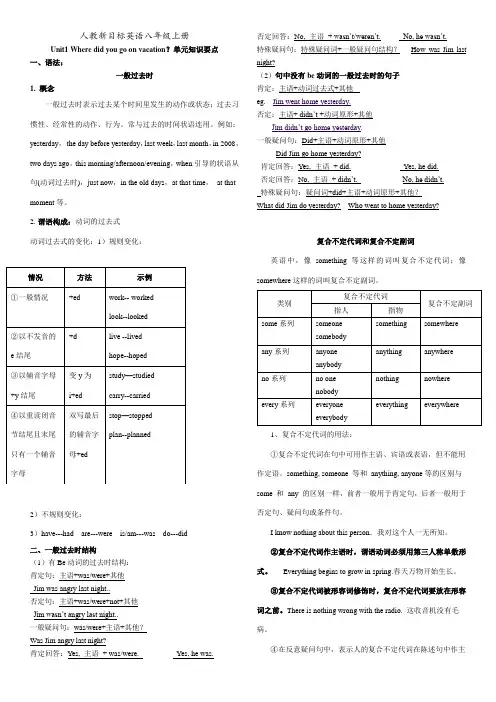
人教新目标英语八年级上册Unit1 Where did you go on vacation?单元知识要点一、语法:一般过去时1. 概念一般过去时表示过去某个时间里发生的动作或状态;过去习惯性、经常性的动作、行为。
常与过去的时间状语连用。
例如:yesterday,the day before yesterday,last week,last month,in 2008,two days ago,this morning/afternoon/evening,when引导的状语从句(动词过去时),just now,in the old days,at that time,at that moment等。
2.谓语构成:动词的过去式动词过去式的变化:1)规则变化:2)不规则变化:3)have---had are---were is/am---was do---did二、一般过去时结构(1)有Be动词的过去时结构:肯定句:主语+was/were+其他Jim was angry last night..否定句:主语+was/were+not+其他Jim wasn’t angry last night..一般疑问句:was/were+主语+其他?Was Jim angry last night? 否定回答:No, 主语+ wasn’t/weren’t.No, he wasn’t.特殊疑问句:特殊疑问词+一般疑问句结构?How was Jim last night?(2)句中没有be动词的一般过去时的句子肯定:主语+动词过去式+其他eg. Jim went home yesterday.否定:主语+ didn’t +动词原形+其他Jim didn’t go home yesterday.一般疑问句:Did+主语+动词原形+其他Did Jim go home yesterday?肯定回答:Yes, 主语+ did. Yes, he did.否定回答:No, 主语+ didn’t. No, he didn’t.特殊疑问句:疑问词+did+主语+动词原形+其他?What did Jim do yesterday? Who went to home yesterday?复合不定代词和复合不定副词英语中,像something等这样的词叫复合不定代词;像somewhere这样的词叫复合不定副词。
人教新目标英语八年级上册Unit1单元知识点讲义

人教新目标英语八年级上册Unit 1 单元知识点讲义1.复合不定代词:指人: someone anyone no one everyone某人某人,任何人没有人每人somebody anybody nobody everybody指物:something anything nothing everything某物某物,任何事物没有东西每件事物1) 复合不定代词做主语,谓语动词用单三.Ex. Someone is waiting for you at the door.Nobody knows the answer to the question .2) some…一般用于肯定句中,any…一般用于否定句和疑问句中.Ex. There is something in the room .There isn’t anything in the room .Is there anything in the room ?I have something to do today .I don’t have anything to do today .There is someone outside the door .There isn’t anyone outside the door.Is there anyone outside the door ?3) 在表示邀请,请求,建议希望得到对方肯定回答时,用some… , 不用any…Would you like something to drink / eat ?4) 肯定句中anything 表示任何事物, anyone = anybody 任何人Ex. Anything is OK.I can do anything for you .Anybody knows the answer.5) 形容词或to do 形式修饰复合不定代词时要后置.Ex. There is nothing wrong with my car.I have something important to tell you .There isn’t anything interesting here .Do you want something to drink / eat ?6) not everybody / everyone / everything 表示部分否定,意为‘并非都…’Ex. Not everyone likes singing .Not everything goes well .not any …和no…表示全部否定Ex. He listened ,but heard nothing .He listened ,but didn’t hear anything .not anything = nothing not anyone/ body = no one / nobodyEx. There is nothing in the bottle . = There isn’t anything in the bottle.7) no one 指人,回答Who 提问, no one of … / nobody 不能加ofnothing 指物, 不能加of none 指人或物,回答Is there …? 提问none of …Ex. Who is in the room ? No one .Is there anyone in the room ? None .2.表地点复合不定副词:somewhere anywhere某地,肯定句中某地,否定句和疑问句中/ 任何地方,肯定句中nowhere everywhere没有地方到处,每个地方, 用于肯定句中Ex. I want to go somewhere interesting .3.wonderful adj. 精彩的Ex. We had a wonderful time on the beach .It is such a wonderful film that we all enjoy it .who…wonder v. 想知道what…引导的宾语从句,用陈述句语序why…Ex. I wonder who the boy is . = I want to know who the boy is .I wonder what they are doing . =I want to know what they are doing .wonder +特殊疑问词+ to doEx. I wonder what to do . = I want to know what to do . = I wonder what I should do.I wonder where to go . / I wonder how to do that .4、几乎没有few 后接可数名词复数(否)little 后接不可数名词肯 a few 有一些,后加可数名词复数quite a few 相当多,不少a little 有点,后加不可数名词quite a little相当多,不少only a few 只有一点only a littlevery few 非常少very littleEx. I have a few friends. 肯I have few friends . 否I have quite a few friends .a little 修饰adj. = kind of= a little bit5. most of the time 大部分时间most of the foodmost of us/themmost of + n. = most +n.Ex. Most of the students like English . = Most students like English .6. Of course . = Sure. = Certainly . 当然.7. 反身代词第一人称:myself ourselves 我们自己第二人称:yourself 你自己yourselves 你们自己第三人称:himself 他自己herself 她自己itself 它自己themselves 他们自己8. seem 似乎,好像1) seem to be +形容词/名词= seem + 形容词/名词似乎…Ex. That seems to be her mother . = That seems her mother .It seems to be too difficult . = It seems too difficult.2) seem to do sthHe seems to have a cold.3) It seems that + 从句.It seems that he is happy. = He seems to be happy . = He seems happy.9. adj. bored 感到无聊的修饰人boring 令人厌烦的修饰事或物I feel bored , because the movie is boring.be bored with …对…感到无聊Ex. I’m bored with the boring movie.10. keep / write a diary = keep /write diaries 记日记(keep优先使用)11. activity n. 活动activities 复数Ex. What activities did you find interesting ?12. decide 决定1) decide to do sth. 决定做某事= make a decision to do sth = make one’s mind doing sthThey decide to visit the museum.decide not to do sth 决定不要做某事decide + 疑问词+动词不定式He can not decide when to leave.2) decide + 宾语从句(陈述句语序)He can’t decide when he leaves .I can’t decide where I should go. 改为同义句I can’t decide where to go.13. try to do sth. 努力尽力去做某事Ex. You must try to pass the exam.try doing sth. 试着做某事Ex. He tried making a model plane.try one’s best to do sth = do one’s best to do sth 尽最大努力做某事Ex. You should try your best to learn English well .have a try 试一试try on 试穿Ex. Let me have a try .14. feel like1)给……的感觉,后接从句He feels like he is swimming.I felt like I was a bird.2) feel like 想要后接名词/代词/doing sthfeel like doing sth = want to do sth =would like to do sth想要做某事Do you feel like taking a walk with me ?Do you want to take a walk with me ?3) feel + 形容词, 感到…I feel bored .look +adj. sound+adj. feel +adj.look like +n. sound like+n. feel like +n.15.look 看起来taste 尝起来be( was were is am are)sound 听起来feel 感觉摸起来系动词+adj.smell 闻起来seem 似乎16. build v. 建筑n. 体格of medium build 中等身材building n. 建筑物,大楼builder n. 建筑师16.difference n. 不同点-----differences n. 复数different adj. 不同的be different from …不同于… = not the same as…Ex. 1) Chinese names are different from English names. = Chinese names aren’t the same as English names .2) I’m different from you . = I’m not the same as you .3) I can’t see the differences between the buses in the picture.n. 不同之处17. on the top of the hill在山顶, 面at the top of the hill 在山顶, 点(最高点)at the foot of the hill在山脚下walk up to the hill top 径直走向山顶come top 登顶,得第一Ex. He always comes top every exam.18. wait for + 人或物wait 不及物动词,连接forEx. I’ll wait for you at the door.He waited over an hour for the train . ( He waited for the train over an hour. )can’t wait to do sth 迫不及待做某事Ex. The wonderful vacation , I can’t wait .19. because + 从句because of + n./ pron./ doingBecause the weather was bad, we couldn’t see anything below.Because of the bad weather, we could n’t see anything below.20. enough 1) adj足够的,修饰名词做定语We have enough time to do our homework.I have enough money .2) adv.足够地,充分地,用来修饰形容词或副词,一般置于被修饰词之后I know him well enough.我足够了解他。
人教版八年级上册英语unit1语法讲解

Unit 1 核心语法知识点一、不定代词1.不定代词是不指明代替任何特定名词或形容词的代词。
常见的不定代词有some,any, no, every, each, both, all, little, few, a little, a few, other, another等。
2.some和any既可以修饰______________,也可以修饰______________。
但是some常用于_____句, any则多用于_____句、_____句和条件状语从句。
例如:→A: Is there _____ water in the bottle?B: Yes, there is _____ water. / No, there is not _____ water.3.但是在would you like some water?这类问句中用_____而不是用_____,因为问话者希望得到对方肯定的答复。
4.many, much, a lot of均表示“很多”。
但是many只修饰______________, much只修饰_______________, 而a lot of既可接____________,又可与__________连用。
5.few与a few是一对反义词,修饰____________;little和a little也是一对反义词,修饰___________。
few和little侧重于_____的概念,意思为_________,而a few和a little侧重于______的含义,意为__________。
→翻译Few students know what happened./ There is a little time to go.6.复合不定代词是由some-, any-, every-, no-, 加上-one, -body, -thing等所组成的不7.语动词用单数第三人称形式。
八年级上册英语单元语法及知识点归纳

新人教版八年级上册英语单元语法及知识点归纳Unit1 Where did you go on vacation?【重点语法】不定代词:不指名代替任何特定名词或形容词的代词叫做不定代词。
用法注意:1. some 和any +可数名/不可数名。
some 多用于肯定句,any多用于否定句、疑问句和条件从句。
有些问句中用some,不用any, 问话者希望得到对方肯定回答。
2. 由some, any, no, every 与body, one, thing构成的复合不定代词作主语时,其谓语动词用三单。
3. 不定代词若有定语修饰,该定语要置于其后:如:something interesting【重点短语】1. buy sth for ab./ buy sb. sth 为某人买某物2. taste + adj. 尝起来……3. nothing...but + V.(原形) 除了……之外什么都没有4. seem + (to be) + adj 看起来5. arrive in + 大地方/ arrive at + 小地方到达某地6. decide to do sth. 决定做某事7. try doing sth. 尝试做某事/ try to do sth. 尽力做某事8. enjoy doing sth. 喜欢做某事9. want to do sth. 想去做某事10. start doing sth. 开始做某事=begin doing sth.11. stop doing sth. 停止做某事区分:stop to do sth. 停下来去做某事12. dislike doing sth. 不喜欢做某事14. so + adj + that + 从句如此……以至于……16. tell sb. (not) to do sth. 告诉某人(不要)做某事17. keep doing sth. 继续做某事18. forget to do sth. 忘记去做某事/ forget doing sth 忘记做过某事【词语辨析】1. take a photo/ take photos 拍照quite a few+名词复数“许多…”2. seem + 形容词看起来…... You seem happy today.seem + to do sth. 似乎/好像做某事I seem to have a coldIt seems + 从句似乎..…. It seems that no one believe you.seem like ... 好像,似乎….. It seems like a good idea.3. arrive in +大地点= get to= reach+地点名“到达......”arrive at +小地点(注:若后跟地点副词here/there/home, 介词需省略,如:arrive here; get home)4. feel like sth 感觉像…feel doing sth. 想要做某事5. wonder(想知道)+疑问词(who, what, why)引导的从句。
精心整理人教版新目标八年级上册英语知识点全册知识讲解
精心整理人教版新目标八年级上册英语知识点全册人教版八年级上册英语知识点Unit 1 Where did you go on vacation?(谈论假期生活,一般过去时)Unit 2 How often do you exercise?(谈论生活习惯,一般现在时)Unit 3 I'm more outgoing than my sister(谈论事物对比,形容词比较级)Unit 4 What's the best movie theater?(谈论事物比较,形容词最高级)Unit5 Do you want to watch a game show?(谈论内心想法,一般现在时)Unit6 I’m going to study computer science.(谈谈生活的目标,一般将来时)Unit7 Will people have robots?(对将来生活的预言,一般将来时)Unit8 How do you make a banana milk shake?(描述进程,祈使句)Unit9 Can you come to my party?(学习邀请,作出、接受和拒绝邀请,学习表请求的句子) Unit10 If you go to the party, you’ll have a great time.(作出决定,学习if的条件状语从句)①复习一般过去时②复合不定代词的用法③反身代词的用法④系动词的用法⑤动词后的to do和doing 的区别⑥ed形容词和ing形容词的区别⑦“近义词”的区别⑧本单元中的主谓一致现象⑨动词过去式的构成及不规则动词表⑩用同义短语转换同义句时谓语动词形式一致性的培养。
⑾感叹句的结构和连词的选择。
Unit1 Where did you go on vacation?单词anyone ['eniwʌn] pron.任何人anywhere ['eniweə(r)] adv.任何地方 n.任何(一个)地方wonderful ['wʌndəfl] adj.精彩的;极好的few [fjuː] adj.很少的;n.少量most [məʊst] adj.最多的;大多数的;something ['sʌmθɪŋ] pron.某事物;nothing (=not…anything) ['nʌθɪŋ] pron.没有什么n.没有myself [maɪ'self] pron.我自己everyone ['evriwʌn] pron.每人;人人yourself [jɔː'self] pron.你自己;你亲自hen [hen] n.母鸡;雌禽bored [bɔːd] adj.无聊的;厌烦的;郁闷的pig n.猪diary ['daɪəri] n.日记;日记簿(keep a diary)seem [siːm] vi.似乎;好像someone ['sʌmwʌn] pron.某人;有人quite a few相当多;不少(后接可数名词)of course [əvkɔːs] 当然activity [æk'tɪvəti] n.活动;活跃decide [dɪ'saɪd] v.决定;选定(decide to do sth.)try [traɪ] v.尝试;设法;努力 (try to do sth. /try doing sth.) bird [bɜːd] n.鸟;禽paragliding ['pærəɡlaɪdɪŋ] n.空中滑翔跳伞bicycle ['baɪsɪkl] n.自行车building ['bɪldɪŋ] n.建筑物trader ['treɪdə(r)] n.商人;商船wonder ['wʌndə(r)] v.惊奇;想知道;怀疑difference ['dɪfrəns] n.差异;不同top [tɒp] n.顶部;顶wait [weɪt] v.等;等待(wait for)umbrella [ʌm'brelə] n.伞;雨伞wet [wet] adj.湿的;雨天的below [bɪ'ləʊ] prep.低于;在...下面adv.在下面as [əz] conj.如同;像...一样enough [ɪ'nʌf] adj.足够的adv.足够地;充分地duck [dʌk] n.鸭肉;鸭hungry(反full) ['hʌŋɡri] adj.饥饿的;渴望的feel like(doing sth.)想要dislike [dɪs'laɪk] v.不喜欢;厌恶 n.不喜爱;厌恶;反感重点短语1. go on vacation去度假2.stay at home 待在家里3.go to the mountains 去爬山4. go to the beach 去海滩5. visit museums 参观博物馆6. go to summer camp 去参加夏令营7.quite a few 相当多8.study for 为……而学习9.go out 出去10.most of the time 大部分时间11. taste good 尝起来很好吃12.have a good time 玩得高兴13. of course 当然14.feel like 给……的感觉;感受到15.go shopping 去购物16.in the past 在过去17. walk around 四处走走18. because of 因为19. one bowl of… 一碗……20. the next day 第二天21. drink tea 喝茶22. find out 找出;查明23. go on 继续24.take photos 照相25. something important 重要的事26. up and down 上上下下27. come up 出来28. buy sth. for sb. / buy sb. sth. 为某人买某物29. taste + adj. 尝起来……30. look+adj. 看起来……31.nothing…but+动词原形除了……之外什么都没有32.seem+(to be)+ adj. 看起来……33. arrive in+大地点 / arrive at+小地点到达某地34.decide to do sth. 决定去做某事35. try doing sth. 尝试做某事 /36. try to do sth. 尽力去做某事37. forget doing sth. 忘记做过某事/38. forget to do sth. 忘记做某事39. enjoy doing sth. 喜欢做某事40. want to do sth. 想去做某事41. start doing sth. 开始做某事42. stop doing sth. 停止做某事43. dislike doing sth.不喜欢做某事44. keep doing sth. 继续做某事45. Why not do. sth.? 为什么不做……呢?46. so+adj.+that+从句如此……以至于……47. tell sb. (not) to do sth. 告诉某人(不要)做某事48 .have a good time=enjoy oneself=have fun(doing sth.)玩得痛快三、重点句子:1. Where did you go on vacation? 你去哪儿度假的?2. Long time no see. 好久不见。
八年级英语上册1—2单元必考知识点汇总
八年级英语上册1—2单元必考知识点汇总Unit1Where did you go on vacation?【重点语法】不定代词:不指名代替任何特定名词或形容词的代词叫做不定代词。
用法注意:1. some 和any +可数名/不可数名。
some 多用于肯定句,any多用于否定句、疑问句和条件从句。
有些问句中用some,不用any, 问话者希望得到对方肯定回答。
2. 由some, any, no, every 与body, one, thing构成的复合不定代词作主语时,其谓语动词用三单。
3. 不定代词若有定语修饰,该定语要置于其后:如:something interesting【重点短语】1. buy sth for ab./ buy sb. sth 为某人买某物2. taste + adj. 尝起来……3. nothing...but + V.(原形) 除了……之外什么都没有4. seem + (to be) + adj 看起来5. arrive in + 大地方/arrive at + 小地方到达某地6. decide to do sth. 决定做某事7. try doing sth. 尝试做某事/try to do sth. 尽力做某事8. enjoy doing sth. 喜欢做某事9. want to do sth. 想去做某事10. start doing sth. 开始做某事=begindoing sth.11. stop doing sth. 停止做某事区分:stop to do sth. 停下来去做某事12. dislike doing sth. 不喜欢做某事14. so + adj + that + 从句如此……以至于……16. tell sb. (not) to do sth. 告诉某人(不要)做某事17. keep doing sth. 继续做某事18. forget to do sth. 忘记去做某事/forget doing sth 忘记做过某事【词语辨析】1. take a photo/ take photos 拍照quite a few+名词复数“许多…”2. seem + 形容词看起来…... You seem happy today.seem + to do sth. 似乎/好像做某事 I seem to have a coldIt seems + 从句似乎..…. It seems that no one believe you. seem like ... 好像,似乎….. It seems like a good idea.3. arrive in +大地点= getto= reach+地点名“到达......”arrive at +小地点(注:若后跟地点副词here/there/home, 介词需省略,如:arrive here; gethome)4. feel like sth 感觉像…feel doing sth. 想要做某事5. wonder(想知道)+疑问词(who, what, why)引导的从句。
英语八年级上册知识讲义不定代词(Units1-2语法归纳)-人教新目标版
英语八年级上册知识讲义不定代词(Units1-2语法归纳)-人教新目标版知识梳理:【教材原句】Did you go with anyone? 你和其他人一起去的吗?No. No one was here. Everyone was on vacation. 不。
没人在这儿。
大家都在度假。
Everything tasted really good! 一切尝起来都很棒!【概念】不指明代替任何特定名词或形容词的代词叫不定代词。
【常见的不定代词】everything 每件事;一切1. some系列的词主要用于肯定句中;any系列的词主要用于疑问句、否定句中。
它们都既可修饰可数名词,也可修饰不可数名词。
【例句】There is something wrong with her. 她生病了。
There isn’t anyone in the classroom. 教室里没有人。
提示:在Would you like sth.?一类的问句中用some,不用any。
2. 由some, any, no, every构成的复合不定代词作主语时,谓语动词用第三人称单数形式。
【例句】Everyone in China likes the Spring Festival. 在中国,人人都喜欢春节。
3. 形容词修饰不定代词时,通常放在不定代词的后面。
【例句】Please do something special. 请做些特别的事情吧。
4. 几组不定代词的区别:① both, either, neither这三个词都指两者,both表示“两者都”,either表示“两者中的任何一个”,neither表示“两者都不”。
【例句】—Which do you like better, tea or coffee? 你更喜欢哪个,茶还是咖啡?—Neither, I like water better. 两者都不,我更喜欢水。
② a few; few;a little; little★ a few, few用来修饰可数名词,a little, little用来修饰不可数名词。
人教版英语八上语法知识篇
GrammarUnit1. 不定代词(Indefinite Pronouns)不定代词的用法中有几点需要注意上:1. some 和any既可修饰可数名词复数,也可修饰不可数名词。
some多用于肯定句,any则多用于否定句、疑问句和条件从句。
例如:A: Are there any apples in the fridge? B: Yes, there are some. / No, there aren’t any.A: Is there any water in the bottle? B: Yes, there is some water./ No, there isn’t any water.但在Would you like some tea?这类问句中则用some,而不用any,这是因为问话者希望得到对方肯定的答复。
2. many, much, a lot of 均表示“很多”。
但many 只修饰可数名词复数,much只修饰不可数名词,而a lot of既可接可数名词复数,又可与不可数名词连用。
3. few 与a few是一对反义词,修饰可数名词复数;little与a little 也是一对反义词,修饰不可数名词。
few 和little的意思是“很少;几乎没有”,侧重“否定”的含义;a few 和a little 的意思是“有一些”,侧重“肯定”的含义。
例如:Don’t worry. There is a little time to go. We took quite a few photos there.Few people know what happened. There is now little hope of success.4.由some, any, no, every构成的复合不定代词作主语时,都作单数看待,其谓语动词用单数第三人称形式。
例如:Something is wrong with my watch. Well, everyone wants to win.Nobody knows what the future will be like.There is something for everyone at Greenwood Park.5.除no one以外,其他复合不定代词都写成一个词。