
09年广州市英语中考试题
2009年广州市中考英语试题1.一IV.听力部分(略)V.语音(共10小题,每小题1分)1.指出各个句子中哪一个划线单词黑体部分的字母发音与其他划线单词黑体部分的字母不同。
2.指出下列句子中,哪一个划线单词的重音位置与其他划线单词不同。
VI.单项填空(共28小题,每小题1分)在下列各题的四个答案中选择一个最佳答案。
36. The boys arrived late at the cinema, and the start of the film.A. caughtB. missedC. gotD. lost37. —Guess, how much does it cost?—I think it costs 15 and 20 dollars.A. fromB. betweenC. amongD. with38. As we know, some people are good at but bad at giving back.A. lendingB. keepingC. borrowingD. using39. —Why couldn't you the correct spelling of the word?—Err. . . I hadn't got a Chinese-English dictionary at hand.A. look forB. look downC. look upD. look at40. —You look very tired this morning. What did you do yesterday afternoon?—I did Christmas shopping.A. a lot ofB. a few ofC. a number ofD. a piece of41. —Would you mind looking after my dog while I'm on holiday?—.A. Of course notB. Yes. I'd be happy toC. Not at all. I've no timeD. Yes, please42. —What can I do for you?—A. Yes, you can give a skirt to meB. I'd like a skirtC. No, I can do it myselfD. I can do what I want43. After school we usually play basketball for half an hour on playground.A. the; theB. 不填;不填C. 不填; theD. the;不填44. Each of us has to write a report every two weeks.A. two-hundred-wordB. two-hundreds-wordC. two-hundreds-wordsD. two-hundred-words45. —Which would you like to drink, coffee or orange juice?—. Please give me a cup of tea.A. NeitherB. BothC. A11D. None46. An old friend of my sister's always helps my brother and with English.A. I; ourB. me; ourselvesC. I; myD. me; our47. The little boy ate a big meal he said he wasn't hungry.A. ifB. thoughC. becauseD. as48. —What do you like doing after class?—I like not only reading painting.A. andB. but alsoC. orD. for49. We love to go to the country in spring as the flowers smell so .A. wellB. niceC. wonderfullyD. nicely50. The letter from my uncle was short. There wasn't news.A. manyB. a fewC. muchD. few51. The boy doesn't speak his sister, but his written work is very good.A. as well asB. so good asC. more better thanD. more worse than52. —When did your uncle arrive China?—He got to Guangzhou the morning of the 16th of April.A. at; inB. in; inC. to; onD. in; on53. The food my country is quite different that here.A. in; likeB. to; fromC. from; toD. in; from54. way it is from Guangzhou to Paris!A. How longB. What a longC. How a longD. What long55. —I take some photos in the hall?—No, you .A. Can; needn'tB. Must ; mustn'tC. Could; won'tD. May; mustn't56. —What is the weather like this summer here?—There very little rain.A. hasB. has beenC. areD. have been57. If you carefully, you the report well.A. will listen; will be understoodB. will listen; understandC. listen; will understandD. listen; understand58. They about eight hundred English words by the end of last term.A. will learnB. had learnedC. are going to learnD. have learned59. Excuse me, sir. Could you tell me ?A. where is the bank nearestB. where is the nearest bankC. where the nearest bank isD. the nearest bank is where60. —How did the accident happen?—You know, it difficult to see the road clearly because it .A. was; was rainingB. is; has rainedC. is; is rainingD. will be; will rain61. —Hi, Tom! Can you tell me when for London?—Yes, tomorrow afternoon.A. leavingB. leavesC. to leaveD. are you leaving62. Don't worry. All the children by the nurses.A. are well taken care ofB. take good care ofC. are taken good careD. take good care63. Have you your new classmates yet?A. had friends withB. made friend withC. got friend toD. made friends withVII.完形填空(共10个空格,每个空格1分)先通读下面短文,掌握大意,然后从下面四个答案中选择可以填入相应空白处的最佳答案Peter and Paul passed by a small house on their way home late at night. They saw thick 64 coming out of its windows. "It's on fire!" said Peter. "We must get help. "The two brothers ran 65 the road shouting "Fire! Fire! "They 66 on the door of the next house. They asked them to 67 the police and the firemen.They ran back to the house. They saw 68 the window an old lady sitting in an arm-chair. It was 69 that she could not move. Peter and Paul tried hard to carry her out of the 70 and so they did! Some neighbours (邻居) came and helped take some things out.In no time the firemen 71 as well as the policemen. The fire was put out. The old lady cried sadly 72 she was not hurt. She thanked Peter and Paul and her neighbours 73 .64. A. snow B. clouds C. fire D. smoke65. A. over B. along C. at D. with66. A. knocked B. beat C. locked D. opened67. A. tell B. report C. telephone D. find68. A. at B. through C. above D. on69. A. old B. difficult C. free D. clear70. A. arm-chair B. window C. house D. road71. A. arrived B. fought C. left D. returned72. A. so B. for C. and D. but73. A. up and down B. again and again C. hour after hour D. from side to side VIII.阅读理解(共12小题,每小题1分)阅读下面的短文,然后根据短文内容选择最佳答案。
2009-2013年广州市英语中考真题 答案汇总版
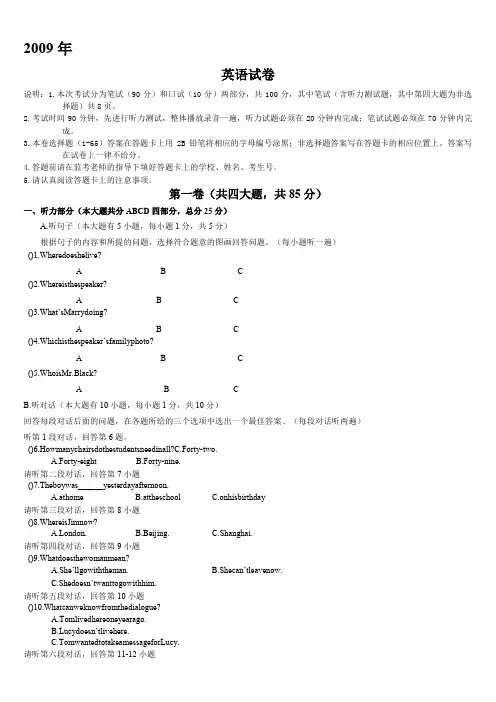
2009年英语试卷说明:1.本次考试分为笔试(90分)和口试(10分)两部分,共100分,其中笔试(含听力测试题,其中第四大题为非选择题)共8页。
2.考试时间90分钟,先进行听力测试,整体播放录音一遍,听力试题必须在20分钟内完成;笔试试题必须在70分钟内完成。
3.本卷选择题(1-65)答案在答题卡上用2B铅笔将相应的字母编号涂黑;非选择题答案写在答题卡的相应位置上。
答案写在试卷上一律不给分。
4.答题前请在监考老师的指导下填好答题卡上的学校、姓名、考生号。
5.请认真阅读答题卡上的注意事项。
第一卷(共四大题,共85分)一、听力部分(本大题共分ABCD四部分,总分25分)A.听句子(本大题有5小题,每小题1分,共5分)根据句子的内容和所提的问题,选择符合题意的图画回答问题。
(每小题听一遍)()1.Wheredoeshelive?A B C()2.Whereisthespeaker?A B C()3.What’sMarrydoing?A B C()4.Whichisthespeaker’sfamilyphoto?A B C()5.WhoisMr.Black?A B CB.听对话(本大题有10小题,每小题1分,共10分)回答每段对话后面的问题,在各题所给的三个选项中选出一个最佳答案。
(每段对话听两遍)听第1段对话,回答第6题。
()6.Howmanychairsdothestudentsneedinall?C.Forty-two.A.Forty-eightB.Forty-nine.请听第二段对话,回答第7小题()7.Theboywas______yesterdayafternoon.A.athomeB.attheschoolC.onhisbirthday请听第三段对话,回答第8小题()8.WhereisJimnow?A.London.B.Beijing.C.Shanghai.请听第四段对话,回答第9小题()9.Whatdoesthewomanmean?A.She’llgowiththeman.B.Shecan’tleavenow.C.Shedoesn’twanttogowithhim.请听第五段对话,回答第10小题()10.Whatcanweknowfromthedialogue?A.Tomlivedhereoneyearago.B.Lucydoesn’tlivehere.C.TomwantedtotakeamessageforLucy.请听第六段对话,回答第11-12小题()11.WhatisTomdoing?A.Heiswritingaletter.B.Heisreadingaletter.C.Heisdoinghomework.()12.WheredoesTomwanttogoforhisuniversitystudy?A.BeijingB.ShanghaiC.New York请听第七段对话,回答第13-15小题()13.Howdoesthewomanfeelafterthelongtrip?A.Verytired.B.OK.C.Quitesleepy.()14.Howlongwillittakethemtogethome?A.Afewminutes.B.Aboutanhour.C.Abouttwohours.()15.Wheredoesthedialoguehappen?A.AtthestrainstationB.AttheairportC.AtthebusstopC.听短文(本大题有5小题,每小题1分,共5分)根据短文内容,在各题所给的三个选项中,选出一个最佳选项。
2009年广东省中考英语真题(含答案)
2009年广东省初中毕业生学业考试英语说明:1.全卷共10页,考试用时90分钟(其中听力考试约15分钟),满分为120分中听力部分30分)。
2.答题前考生必须将自己的姓名、准考证号按要求填写在密封线左边的空格内,并将姓名和准考证号写、涂在答题卡指定位置上。
3.试卷分试题和答卷,4个选项以下(含4个选项)的选择题答案在答题卡上作答超过4个选项的选择题和非选择题的答案在答卷上作答,写在试题上的答案无效4.使用答题卡作答,必须用规定的铅笔将答题卡上对应的小题所选的选项涂黑。
5.非选择题须用黑色或蓝色字迹的钢笔、圆珠笔按各题要求答在答卷上,不能用铅笔和红笔。
6.考试结束时,将试题、答卷和答题卡一并交回。
一.听力理解(本大题分为A、B、C、D四部分,共25小题,每小题1分,共25分)二、单项填空(本大题20小题,每小题1分,共20分)每小题的四个选项中,选出可以填入空白处的最佳答案。
( )26.There are ________ months in a year. October is the ________ month.A.twelve; ten B.twelfth; tenth C.twelve; tenth D.twelfth; ten( )27.—We have five kinds of schoolbags. Do you like this one?—No. Can you show me ________?A.another B.each other C.the other D.others( )28.The film “Kung Fu Panda” is ________ interesting ________ I would like to see it again.A.such; that B.too; to C.as; as D.so; that( )29.________ old man behind Mary is ________ university teacher.A.An; an B.A; the C.The; a D.The; an( )30.E-mail is very popular today. People seldom write letters now, ________?A.did they B.do they C.didn’t they D.don’t they( )31.The Changjiang River is the ________ river in China.A.lent B.longest C.short C.shorted( )32.Mike didn’t get get wet because his teacher ________ him an umbrella.A.lent B.discovered C.borrowed D.taught( )33.“It’s really very kind ____ you to help me with the housework on Sundays.” said Grandm a Huang.A.of B.with C.for D.from( )34.Sam ________ Chinese since he came to China. He speaks good Chinese now.A.learns B.learned C.has learned D.will learn( )35.We have to get up at 7:15 tomorrow morning, ________ we will be late for the 7:40 train.A.before B.or C.if D.so( )36.Don’t ________ others. Sometimes you make mistakes too.A.knock at B.laugh at C.look at D.arrive at( )37.Tom’s mother asked him ________ some washing after dinner.A.to do B.does C.do D.did( )38.If it ________ tomorrow, we will stay at home. We won’t go to the museum.A.rain B.rains C.will rain D.rained( )39.—Shush, be quiet! The baby ________ in the next room. —Ok. Sorry.A.sleep B.slept C.sleeps D.is sleeping( )40.Lily’s mother looked for her for half an hour, but could not find ________.A.what Lily was B.what was Lily C.where Lily was D.where was Lily( )41.________ terrible weather we had last Sunday.A.What B.What a C.Such D.How( )42.—________? —I have a headache.A.How do you do B.What do you doC.What’s wrong with you D.How do you like it( )43.—Mr. Wang, must I come again on Sunday morning to clean the windows?—No, you ________. I have asked others to do it.A.don’t have to B.mustn’t C.can’t D.shouldn’t( )44.—It’s really hot today. What drinks do we have in the fridge? —We have some ________.A.noodle B.cheese C.sausages D.lemonade( )45.The new library building ________ last week.A.was completed B.is completed C.completed D.has completed三、完形填空(本大题有10小题,每小题1分,共10分)通读下面短文,掌握其在意,然后在各小题所给的四个选项中,选出一个最佳答案。
2009年广东省深圳市中考英语试题(Word版-有答案)学习啊

2009年广东省深圳市中考英语试题(Word版-有答案)学习啊学英语简单吗?肯定会有许多学生说:“难死了”。
为什么有好多学生对英语的学习都感到头疼呢?答案只有一个:“不得法。
” 英语与汉语一样都是一种语言,为什么你说汉语会如此流利?那是因为你置身于一个汉语环境中,如果你在伦敦呆上半年,保准说起英语来会非常流利。
但很多中学生没有很好的英语环境,那么你可以自己设置一个英语环境,坚持“多说”、“多听”、“多读”、“多写”,那么你的英语成绩肯定会很出色。
一、多“说”。
自己多创造机会与英语教师多讲英语,见了同学,尤其是和好朋友在一起时尽量用英语去问候,谈心情……这时候你需随身携带一个英汉互译小词典,遇到生词时查一下这些生词,也不用刻意去记,用的多了,这个单词自然而然就会记住。
千万别把学英语当成负担,始终把它当成一件有趣的事情去做。
或许你有机会碰上外国人,你应大胆地上去跟他打招呼,和他谈天气、谈风景、谈学校……只是别问及他的年纪,婚史等私人问题。
尽量用一些你学过的词汇,句子去和他谈天说地。
不久你会发现与老外聊天要比你与中国人谈英语容易的多。
因为他和你交谈时会用许多简单词汇,而且不太看重说法,你只要发音准确,准能顺利地交流下去。
只是你必须要有信心,敢于表达自己的思想。
如果没有合适的伙伴也没关系,你可以拿过一本书或其它什么东西做假想对象,对它谈你一天的所见所闻,谈你的快乐,你的悲伤等等,长此坚持下去你的口语肯定会有较大的提高。
二、多“听”寻找一切可以听英语的机会。
别人用英语交谈时,你应该大胆地去参与,多听听各种各样人的发音,男女老少,节奏快的慢的你都应该接触到,如果这样的机会少的话,你可以选择你不知内容的文章去听,这将会对你帮助很大,而你去听学过的课文的磁带,那将会对你的语言语调的学习有很大的帮助。
三、多“读”。
“读”可以分为两种。
一种是“默读”。
每天给予一定时间的练习将会对你提高阅读速度有很大的好处,读的内容可以是你的课本,但最好是一些有趣的小读物,因为现在的英语高考越来越重视阅读量和阅读速度。
2009年广东省初中毕业生学业考试二模(英语)

2009年小榄镇初三中考第二次模拟考试英语第一卷语言知识与技能(共四大题,共85分)一、听力理解(本大题分四节,共25分)第一节听句子(本节有5小题,每小题1分,共5分)根据所听句子的内容和所提的问题,选择符合题意的图画回答问题,并将最佳选项的字母编号写在题前的括号里。
若用答题卡答题,则将答题卡上对应题目所选的选项涂黑。
每小题听一遍。
( )1.What does Jenny look like?A B C( )2.What did Mrs. White buy last Sunday?( )3.What is the weather like today?( )4.Where did the woman want to go at noon?( )5.Who is Tom going to see this morning?第二节听对话(本节有10小题,每小题1分,共10分)根据所听对话的内容和所提的问题,选择符合题意的答案回答问题,并将最佳选项的字母编号写在题前的括号里。
每小题听两遍。
若用答题卡答题,则将答题卡上对应题目所选的选项涂黑。
每段对话听两遍。
听第一段对话,回答第6小题。
( )6.Where does the dialogue probably take place?A.At the man's house.B.At a restaurant.C.At a supermarket.听第二段对话,回答第7小题。
( )7.How old is Ton?A.He’s ten.B.He’s fifteen.C.He's twenty—five.听第三段对话.回答第8小题。
( )8.What is Sam going to do this evening?A.To go to Linda's birthday party.B.To cook dinner for Mum.C.To have dinner at hone.听第四段对话,回答第9小题。
2009年广州市中考英语真题及答案

2009年广州市中考英语试题1.一IV.听力部分(略)V.语音(共10小题,每小题1分)VI.单项填空(共28小题,每小题1分)在下列各题的四个答案中选择一个最佳答案。
36. The boys arrived late at the cinema, and the start of the film.A. caughtB. missedC. gotD. lost37. —Guess, how much does it cost?—I think it costs 15 and 20 dollars.A. fromB. betweenC. amongD. with38. As we know, some people are good at but bad at giving back.A. lendingB. keepingC. borrowingD. using39. —Why couldn't you the correct spelling of the word?—Err. . . I hadn't got a Chinese-English dictionary at hand.A. look forB. look downC. look upD. look at40. —You look very tired this morning. What did you do yesterday afternoon?—I did Christmas shopping.A. a lot ofB. a few ofC. a number ofD. a piece of41. —Would you mind looking after my dog while I'm on holiday?—.A. Of course notB. Yes. I'd be happy toC. Not at all. I've no timeD. Yes, please42. —What can I do for you?—A. Yes, you can give a skirt to meB. I'd like a skirtC. No, I can do it myselfD. I can do what I want43. After school we usually play basketball for half an hour on playground.A. the; theB. 不填;不填C. 不填; theD. the;不填44. Each of us has to write a report every two weeks.A. two-hundred-wordB. two-hundreds-wordC. two-hundreds-wordsD. two-hundred-words45. —Which would you like to drink, coffee or orange juice?— . Please give me a cup of tea.A. NeitherB. BothC. A11D. None46. An old friend of my sister's always helps my brother and with English.A. I; ourB. me; ourselvesC. I; myD. me; our47. The little boy ate a big meal he said he wasn't hungry.A. ifB. thoughC. becauseD. as48. —What do you like doing after class?—I like not only reading painting.A. andB. but alsoC. orD. for49. We love to go to the country in spring as the flowers smell so .A. wellB. niceC. wonderfullyD. nicely50. The letter from my uncle was short. There wasn't news.A. manyB. a fewC. muchD. few51. The boy doesn't speak his sister, but his written work is very good.A. as well asB. so good asC. more better thanD. more worse than52. —When did your uncle arrive China?—He got to Guangzhou the morning of the 16th of April.A. at; inB. in; inC. to; onD. in; on53. The food my country is quite different that here.A. in; likeB. to; fromC. from; toD. in; from54. way it is from Guangzhou to Paris!A. How longB. What a longC. How a longD. What long55. —I take some photos in the hall?—No, you .A. Can; needn'tB. Must ; mustn'tC. Could; won'tD. May; mustn't56. —What is the weather like this summer here?—There very little rain.A. hasB. has beenC. areD. have been57. If you carefully, you the report well.A. will listen; will be understoodB. will listen; understandC. listen; will understandD. listen; understand58. They about eight hundred English words by the end of last term.A. will learnB. had learnedC. are going to learnD. have learned59. Excuse me, sir. Could you tell me ?A. where is the bank nearestB. where is the nearest bankC. where the nearest bank isD. the nearest bank is where60. —How did the accident happen?—You know, it difficult to see the road clearly because it .A. was; was rainingB. is; has rainedC. is; is rainingD. will be; will rain61. —Hi, Tom! Can you tell me when for London?—Yes, tomorrow afternoon.A. leavingB. leavesC. to leaveD. are you leaving62. Don't worry. All the children by the nurses.A. are well taken care ofB. take good care ofC. are taken good careD. take good care63. Have you your new classmates yet?A. had friends withB. made friend withC. got friend toD. made friends with67. A. tell B. report C. telephone D. find68. A. at B. through C. above D. on69. A. old B. difficult C. free D. clear70. A. arm-chair B. window C. house D. road71. A. arrived B. fought C. left D. returned72. A. so B. for C. and D. but73. A. up and down B. again and again C. hour after hour D. from side to sideVIII.阅读理解(共12小题,每小题1分)阅读下面的短文,然后根据短文内容选择最佳答案。
9广州中考英语试题与答案
2009年广州市中考英语试卷1.一IV.听力部分(略)V.语音(共10小题,每小题1分)1.指出各个句子中哪一个划线单词黑体部分的字母发音与其他划线单词黑体部分的字母VI.单项填空(共28小题,每小题1分)在下列各题的四个答案中选择一个最佳答案。
36. The boys arrived late at the cinema, and the start of the film.A. caughtB. missedC. gotD. lost37. —Guess, how much does it cost?—I think it costs 15 and 20 dollars.A. fromB. betweenC. amongD. with38. As we know, some people are good at but bad at giving back.A. lendingB. keepingC. borrowingD. using39. —Why couldn't you the correct spelling of the word?—Err. . . I hadn't got a Chinese-English dictionary at hand.A. look forB. look downC. look upD. look at40. —You look very tired this morning. What did you do yesterday afternoon?—I did Christmas shopping.A. a lot ofB. a few ofC. a number ofD. a piece of41. —Would you mind looking after my dog while I'm on holiday?— .A. Of course notB. Yes. I'd be happy toC. Not at all. I've no timeD. Yes, please42. —What can I do for you?—A. Yes, you can give a skirt to meB. I'd like a skirtC. No, I can do it myselfD. I can do what I want43. After school we usually play basketball for half an hour on playground.A. the。
2009年广州市中考口语真题4
请你向你的美国朋友介绍自己的爱好。 爱好:唱歌 学画时间:10年 基本情况:1、一周练习2次 2、喜欢唱流行歌曲 3、有时参加歌唱比赛 感受:唱歌有趣;有益健康 I like singing very much. I have learnt it for about 10 years. Now I need to practice singing twice a week. I sometimes take part in the singing competitions. I think singing is fun, and it is also good for my health. I love it!
二、请根据情景回答问题。(共5题, 5分) (用简短回答更好,不能用me too) 1. You look tired these days. When do you usually go to bed? 1.Very early. / At about 10 o'clock. 2. I spend a lot of time doing my homework. How much time do you need for yours? 2.About 2 hours/ One hour and half 3. Sports are good for our health. How often do you play sports? 3.Every day/ Not very often. Sometimes 4. I like art. What's your favourite subject? 4.Music/ Chinese/ Chemistry 5. Gosh, I lost my watch on my way to school this morning. 5.Oh, I'm sorry/ Sorry to hear that. /That's terrible
09广州中考英语试题
Ⅱ.语言知识及应用(共两节,满分35分)第一节完形填空(共10小题;每小题2分,满分20分)阅读下面短文,掌握其大意,然后从21—30各题所给的A、B、C和D项中,选出最佳选项。
Grasslands need time to recover when cattle and other animals feed on them. Moving animals from one field to another can provide the 21 needed for new growth. This is called rotational grazing(轮流放牧), and here‟s more about how it 22 . Rotational grazing is good for the land and the animals, and it can save money. This farm of grazing can decrease the need for pesticides(杀虫剂) by reducing the 23 of weeds. And it can 24 the need for chemical fertilizers by letting animal waste do the job of natural fertilizer. Rotational grazing can even help prevent wildfires by keeping 25 in good condition.Letting animals feed constantly in the same grazing areas can require 26 planting. Animals eat the most 27 growth first. When that keeps happening, the roots do not have enough time to recover. 28 , less wanted plants may replace them. Heavily used grassland are also harmed as the soil is 29 pressed down under the weight of heavy animals.While rotational grazing can save money over time, it also requires 30 . And that starts with a good map to mark fences, water supplies and grazing areas.21.A.cattle B. time C. space D. help22.A.works B. happens C. does D. grows23.A.cost B. size C. growth D. availability24.A.spread B. meet C. dismiss D. limit25.A.soil B. cattle C. grasslands D. weeds26.A.costly B. unnecessary C. priceless D. immediate27. A. rapid B. common C. necessary D. desirable28. A. On the other hand B. In short C.As a result D. In fact29. A. surprisingly B. continually C. gently D. accidentally30. A. training B. planning C.co-operation D. determination第二节语法填空(共10小题,每小题1.5分,满分15分)阅读下面短文,按照句子结构的语法性和上下文连贯的要求,在空格处填入一个适当的词或使用括号中词语的正确形式填空,并将答案填写在标号为31--40的相应位置上。
2009年广东省初中毕业学业考试
2009年广东省初中毕业学业考试英语试卷说明:1.全卷共12页,满分为120分,考试用时90分钟;2.答题前,考生务必用黑色字迹的钢笔或签字笔将自己的姓名、准考证号、试室号和座位号填写在答题卡相应位置上;3.选择题每小题选出答案后,用2B铅笔将答题卡上对应题目选项的答案信息涂黑,如需改动,用橡皮擦干净后,再选涂其他答案。
作答在试卷上的答案无效;4.非选择题必须用蓝、黑色字迹钢笔或签字笔作答,答案必须写在答题卡各题目指定区域内相应位置上。
如需改动,先划掉原来的答案,然后再写上新的答案。
不准使用铅笔或涂改液,否则答案无效;5.考试结束时,将试卷、答卷(用答题卡的连答题卡)交回。
第一卷(共四大题,共85分)一、听力部分(本大题共分ABCD四部分,总分25分)A.听句子(本大题有5小题,每小题1分,共5分)根据句子的内容和所提的问题,选择符合题意的图画回答问题。
(每小题听一遍)( )1. Where does he live?A B C( )2.Where is the speaker?A B C( )3.What’s Marry doing?A B C( )4.Which is the speaker’s family photo?A B C( )5.Who is Mr. Black?A B CB.听对话(本大题有10小题,每小题1分,共10分)回答每段对话后面的问题,在各题所给的三个选项中选出一个最佳答案。
(每段对话听两遍)听第1段对话,回答第6题。
( ) 6. How many chairs do the stude nts need in all?A. Forty-eightB. Forty-nine.C.Forty-two请听第二段对话,回答第7小题( )7. The boy was ______ yesterday afternoon.A. at homeB.at the schoolC. on his birthday请听第三段对话,回答第8小题( )8. Where is Jim now?A. London.B. Beijing.C. Shanghai.请听第四段对话,回答第9小题( )9. What does the woman mean?A. She’ll go with the man.B. She can’t leave now.C. She doesn’t want to go with him.请听第五段对话,回答第10小题( )10. What can we know from the dialogue?A. Tom lived here one year ago.B. Lucy doesn’t live here.C. Tom wanted to take a message for Lucy.请听第六段对话,回答第11-12小题( )11. What is Tom doing?A. He is writing a letter.B. He is reading a letter.C. He is doing homework.( )12. Where does Tom want to go for his university study?A. BeijingB. ShanghaiC. New York请听第七段对话,回答第13-15小题( )13. How does the woman feel after the long trip?A. Very tired.B. OK.C. Quite sleepy.( )14. How long will it take them to get home?A. A few minutes.B. About an hour.C. About two hours.( )15. Where does the dialogue happen?A. At the strain stationB. At the airportC. At the bus stopC.听短文(本大题有5小题,每小题1分,共5分)根据短文内容,在各题所给的三个选项中,选出一个最佳选项。
广州市近年中考英语试题-听力部分
2013年广州市初中毕业生学业考试英语一、听力(共两节,满分35分)听下面一段对话,回答第1〜2两个小题。
1. How much are the red apples a kilo?A. 10 yuan.B. 15 yuan.C. 20 yuan.2. What docs the man finally buy?A. Apples and grapes.B. Grapes and bananas.C. Apples and bananas.听下面一段对话,回答第3〜5三个小题。
3. What is the relationship between the speakers?A. Teacher and parent.B. Teacher and student.C. Student and headmaster.4. What is Billy's problem?A. He often comes to school late.B. He's always tired in class.C. He sometimes fights with his classmates.5. How does the woman plan to solve Billy's problem?A. Buy him a new iPad.B. Move him to a new school.C. Let him use his iPad only on weekends.听下面一段独白,回答第一8三个小题。
6. What is the main purpose of the talk?A. To thank customers for coining to the store.B. To tell customers the store is closing.C. To advertise a sale at the store.7. What clothes are on sale?A. Jeans and T-shirts.B. T-shirts and socks.C. Skirts and coats.8. What can you do on the 6th floor?A. Choose a computer.B. See a new TV.C. Have a meal.听下面一段对话,回答第9〜12四个小题。