
英语:必修4_Unit4_Body_language-Reading课件(新人教版)
Japanese will bow to others as greeting.
T
E.g. Ahmed People from Aziz Jordan will move very close to you as you introduce yourself to them. T Some body languages in some countries are good while some body language are F These actions is countries’ not good or bad. bad.
George Cook from (Canada)
Retelling
represented • Yesterday I ______ our student association to go to meet international students. The first one to CIA to _____ arriveis Mr. Garcia from Columbia, closely ______ followed _____ by Julia Smith from Britain. Iintroduced _____ them to each other ,and surprised I was _____ to see them greet each other. Just then, a visitor from Japan comes insmiling ____, together with Gorge Cook from Canada. When Gorgereached ____his hand out to him, it happens that Mr Cook’s handtouched ____the Japanese’s bowed different nose as he ____ . So you see, people from _____cultures may not _____ greet others in the same way. Now ,most people shakehands when they meet while the around the world _____ Japanese ______ prefer to bow. bad which are In a word, body languages are not good ____or ____, widely used in _____ in today’s world . communication
Thinking
Are body languages the same in different countries /cultures all over the world ? Y or N ?
Skim the passage to check if you are
right ,and match the main idea of each part. A) Summary of body Part 1 : (Para1) language. Part 2: (Para 2 and 3) B) Different people have different body languages. C) You are sent to the Capital Airport to meet international students. D) Examples of cultural “body language”.
a Japanese The second cultural mistake
He ________ bowed to Mr. Cook and his nose touched Mr. _________ moving Cook’s _______ ________. hand He ________ reached his hand ________ _______ ________ to the out Japanese.
What can we learn from the passage?
Different countries have different cultures and body languages , so when people greet each other, they will have different body languages. If people don’t know the cultural differences well, people may have difficulties in communicating with others throughout the world.
George Cook
(Canada)
a Japanese Julia Smith (Britain)
Mr. Garcia (Columbia)
Read para2 carefully: Find out the two cultural mistakes the writer found in the airport.
• Body Language is a form of non-verbal communication.
It is the movements or positions of our body showing other people what we are thinking or feeling. Such as eye contact, facial expression, gesture, and posture.
He approaches Ms Smith Mr. Garcia by touching _______ ______ her from The _________ _______ shoulder and kissing (Columbia) first her on the ________. cheek cultural She ______ stepped ________ back mistake Julia Smith appearing surprised _________ From and put up her hands, as if _______ ______. (Britain ) in defence
Part 3: (Para 4 )
Part 4: (Para5)
Scan the text and choose the best answer.
1. What did the writer go to the Capital International Airport for yesterday? B A. To see off his friend. B. To meet international students. C. To buy a flight ticket. D. To meet visitors from several countries. 2. Where is Tony Garcia from? C A. Britain. B. Japan. C. Colombia. D. Canada. 3. From Paragraph 2 we know that Japanese prefer to ____ A when they are introduced to others . A. bow B. shake hands C. kiss D. touch others’ shoulders 4. According to the text, men from the Middle East often ____. D A. nod heads and wave hands to girls B. touch others’ heads when they first meet C. kiss each other twice on each cheek D. stand quite close to other men when they talk
gesture
eye contact
ห้องสมุดไป่ตู้
posture
facial expression
Different feelings of the baby
happy
sad
frightened
angry
surprised
curious
What is body language? How much do you know about it?
Reading
COMMUNICATION: NO PROBLEM?
Different ways to communicate
handshake
a loving hug
a kiss on the cheek
two palms together
nose- kiss
bow
• She is deaf and dump, so body language plays a very important part in her life.
Do it!
Use your body language to thank your teacher . Only use your body language!
Read the text carefully, and do the T or F. If false, correct the mistakes.
Englishmen often don’t stand close to others or touch strangers as soon as they meet. F Most people around the world now greet each other by kissing F shaking. hands.
高中英语必修四4_Unit4_Body_language_Reading新人教版

A conclusion of the passage.
Careful reading
( Read para1-2 Find out the answers to the questions)
1 Who will be present at the meeting?
people from different countries
a Japanese The second mistake
George Cook from (Canada)
He ________ bowed to Mr. Cook and his nose touched Mr. _________ moving Cook’s _______ ________. hand He ________ reached his hand ________ _______ ________ to the out Japanese.
Para.1-2 (example)
people present local businessmen
people representing the Chinese government
2 Why are people visiting China?
purpose mistakes
interest
People from different countries misunderstand each other.
He approaches Ms Smith Mr. Garcia by touching _______ ______ her from The _________ _______ shoulder and kissing (Columbia ) first her on the ________. cheek mistake She ______ stepped ________ back Julia Smith appearing surprised _________ from and take a few steps (Britain) away from _______ ______ Mr. Garcia.
必修4-Unit4-Body-language-reading课件

Look at the title and picture on page 26 and predict what the passage is about.
Which is the main idea of the text? A. There are different customs in different countries. B. Foreigners should follow the customs of the country where they are visiting. C. People use body movements to send messages and different body movements have different meanings. D. The importance of knowing customs.
Canada shake hands Japan bow
Spain, Italy, South
American countries
approach others closely and are more likely to touch them
France
shake hands and kiss each other twice on each cheek
gesture
Guess the following facial expressions or gestures ?
satisfied unhappy
shocked
Come here.
Bye-bye.
• Victory/win! • Ok!
What is body language ?
Body Language is a set of _姿g_e势_s_t;手u_r_势e_s___, _b_o_d_y_肢_m体_o_动v_e作_m_e_n_t_s_ and _fa_c_ia_l_e_x_p_r_es_s_io_n.s People use to make themselves 面部表情 understood.
高中英语人教版必修四unit4body_language重点单词和短语ppt课件
通知;通告;布告
Ⅱ.重点短语必背
1.__d__ef_e_n_d__a_g_a_in_s_t *2.__o_n_t_h_e_c_o_n_t_r_a_r_y__ *3.__a_t _e_a_se_ *4.t_u_r_n__o_n_e_'s_b__a_ck__t_o_
5.__g_e_t__cl_o_s_e_t_o *6._b__e_l_ik_e_l_y_t_o_._..__ *7.__i_n_g_e_n_e_r_a_l *8.__lo_s_e_f_a_c_e_ 9.__w_a_t_c_h_/_lo_o_k__o_u_t_ 10. put up
n. 真实;
真理
14. truly adj.好奇的→ trnu.th好奇心
adv. 好奇地→
true
15. curiovuts. 保护;保卫→
cunr.iou防sl御y ;保卫
curiosity
defend
defence
1.语境串记(用所给词的适当形式填空) (1)It was curiousthat he should have given in to _______ and openceudritohseity
2.主题串记
请根据词性和汉语提示写出以-ment为后缀的高频单词
(1) statement n.
陈述;说明
(2) achievementn.
功绩;成就
(3) adjustment n.
调整;调节
(4) advertisement n.
广告
(5) agreement n.
同意;一致;协定;协议
(6) announcementn.
代表;象征 接近;靠近;走近 接近;方法;途径 主要的 成人;成年人 成人的;成熟的 可能的
人教版高中英语必修四 Unit4 Body Language reading 课件
Para1 Body language is one of the most powerful means of communication, often even more powerful than spoken language. People around the world show all kinds of feelings, wishes and attitudes that they might never speak aloud. It is possible to "read" others around us, even if they do not intend for us to catch their unspoken communication. Of course, body language can be misread, but many gestures and actions are universal.
but many gestures and actions are universal. Para7 With so many cultural differences between people, it is great
to have some similarities in body language. We can often be wrong about each other, so it is an amazing thing that we understand each other as well as we do!
Para7 With so many cultural differences between people, it is great to have some similarities in body language. We can often be wrong about each other, so it is an amazing thing that we understand each other as well as we do!
人教版英语必修四课件:Unit+4+Body+Language语法专题课

3.He lost his life _d_e_f_e_n_d_in_g_the honor of his nation..
4.She sat by the windows,_e_n_j_o_y_i_n_g__ the beautiful sights outside. 5.The _sh_a_k__in_g__buildings showed us that an earthquake was coming.
• 8.In the same way that people communicate with spoken language, they also express their feelings _u_s_in_g_u_n_s_p_o_k_en__‘l_a_n_g_u_ag_e_’_th_r_o_u_g_h_p_h_y_s_ic_a_l __________ _d_is_t_a_n_ce_,a_c_t_io_n_s_a_n_d_p_o_s_tu_r_e_.
Body language
语法专题
教学目标
I. Know the rules of the –ing form. 1. The –ing form can be used as an attribute. 2.The –ing form can be used as an adverbial of time/reason/accompanying/result… II. Make use of the rules to make sentences.
6.How attentive the students are! They are all sitting
straight,_f_o_c_u_s_in_g_ their eyes on the screen. 7. It is exciting to watcha_p_p_r_o_a_c_h_i_ngathletes reach the other end of
新人教版高中英语必修4Unit 4 Body Language Reading(含答案)
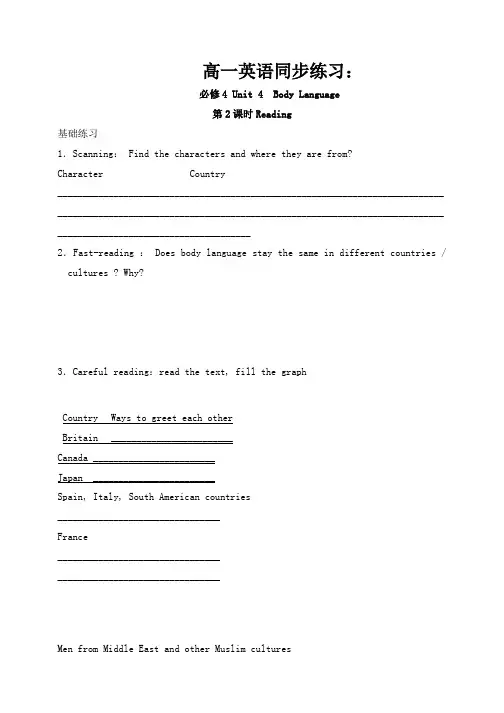
高一英语同步练习:必修4 Unit 4 Body Language第2课时Reading基础练习1.Scanning: Find the characters and where they are from?Character Country____________________________________________________________________________ ____________________________________________________________________________ ______________________________________2.Fast-reading : Does body language stay the same in different countries / cultures ? Why?3.Careful reading:read the text, fill the graphCountry Ways to greet each otherBritain ________________________Canada ________________________Japan ________________________Spain, Italy, South American countries________________________________France________________________________________________________________Men from Middle East and other Muslim cultures实战演练一. 英汉互译1. Yesterday, another student and I, representing our university’s studentassociation, went to the Capital International Airport to meet this year’s international students.______________________________________2.我看见几个年轻人走进了等候区,好奇地四周张望。
新人教版高中英语必修4Unit 4 Body Language Using language(含答案)
高一英语同步练习:必修4 Unit 4 Body Language第4课时Using language基础练习本单元重点知识归纳总结:一、重点词汇:(写出汉意及词性)1. represent______________2 .curious _______________3 .defend______________4 . approach ______________5. be likely to______________6 .in general______________7. at ease ______________8.lose face ______________9 .turn one’s back to______________二、重点句式:1. prohibition and warning(禁令和警告):Do not...; Stop! ;Keep away from...;Always stay...;Watch out! Look out! Go away. Don’t enter hereBe careful when..., Come here.You may not...You will be fined...,Don’t smoke here. Don’t slip;2.obligation(义务和责任)You must...,You should never...,You will be...,You will have to...,You will need to...,We ought to...,He’s supposed to...(书中supposed 第一个s是大写)三、课文重点句型:1 .Not all cultures greet each other the same way, nor arethey comfortable in the same way with touching or distance between people.1. 各种文化背景下的人互致问候的方式不尽相同,身体接触和相互间距的程度也不尽相同。
高中英语 Book4 Unit4body language 说课课件 新人教必修4(通用)
1). Analysis of the teaching material 教材分析
The type of this class is an extensive reading class, which plays an important part in developing students’ reading ability. So,during the teaching process, the teacher should focus on developing the students’s reading ability by extensive reading, and get them to learn some reading skills such as skimming, scanning and so on. Moreover, the students should receive some moral education, let them know more about body language in cultures in different countries.
课前探索(Pre-class Exploration):
Let students search for more information about body language which shows different meanings in different cultures and countries.
掌握该部分的重点词句
3.Let students read and understand the passage “Showing our feelings”.
让学生读懂本篇文章
Teaching difficult points (教学难点)
必修四--Unit4-Body-language[PPT课件白板课件思维导图知识点知识树复习资料]人教版高中英语
总有一款PPT 适合您【最新出品\精心整理\倾情奉献\敬请珍惜】Ⅰ.高频单词必记1.vt .代表;象征2.vt .&vi .接近;靠近;走近n .接近;方法;途径3.adj .主要的4.n .成人;成年人adj . 成人的;成熟的represent approach major adult5.adj .可能的6.adj .面部的7.n .作用;功能;职能vi .起作用;运转8.n .安逸;舒适vt .减轻(痛苦、忧虑)9.adj . 主观的likely facial function ease subjective10.n .陈述;说明→vt .陈述;说明11.n .社团;联系;联想→vt .把……联系起来12.adj .好奇的→adv .好奇地→n .好奇心statement state association curious curiously curiosityassociate13.vt .保护;保卫→n .防御;保卫14.vt .误解;误会→n .误解;误会15.adj .口语的→adj .未说出口的;非口语的defend defence misunderstand misunderstanding spoken unspokenⅡ.重点短语必背1.保卫……以免受2.相反地3.以相同的方式4.舒适;快活;自由自在5.背对;背弃defend against on the contrary in the same way at easeturn one‘s back to6.靠近;接近7.很可能……;有希望……8.总的来说;通常9.丢脸10.小心11.举起;升起;搭建;留宿get close to be likely to in general lose face watch/look output upⅢ.经典句型必会1.The first person to arrive was Tony Garcia from Colombia,closely followed by Julia Smith from Britain.第一个到达的是从哥伦比亚来的托尼·加西亚,随后紧跟着的是英国的朱莉娅·史密斯。
高一必修4-unit4-reading公开课PPT课件
George Cook__r_ea_c_h_e_d_ his hand _o_u_t_ to the
Japanese student. The second
misunder-
Tony Garcia
standing
Akira Nagata _b_o_w__ed___ so his nose
_t_o_u_c_h_e_d_George’s _m__o_v_in_g_ _h_a_n_d____.
misunder-
standing
Julia Smith _st_e_p_p_e_d__b_a_c_k_ appearing _su_r_p_r_i_s_e_d_
AkiraanNd apguat taup her hands, as if _in__de_f_e_n_c_eG__e Cook
(e.g. Ahmed Aziz from Jordan) to women: nod, no touching
Darlene Coulon from France shake hands, kiss each other
English people
Do not stand very close to others or touch strangers when they meet.
America
OK
Japan
money
France
zero
Germany Brazil
rudeness
9
USA
“great”or “good job” Nigeria rudeness Germany Japan
one
10
Are there any problems when people from different countries communicate with each other?