
牛津译林版英语九年级上册Unit8 Detective Stories task 公开课课件
A description of the suspect
I don’t know. I’ve never seen him before.
• Who else did Detective Li interview? • Who was Nick? • What did Nick say?
Nick said he had never seen Mr. Smith before.
((…… bbyy aa gguunn // aa kknniiffee)) • WWhhoo ffoouunndd tthheeiirr nneeiigghhbboouurr ddeeaadd
at hhoommee??
• How did they feel ?
• What did they do ?
Objects or clues found at the crime scene
He was murdered. Start looking for clues.
Detective Li
• Who arrived soon?
• What could he find after checking the scene?
• A description of the crime • Any objects or clues found at the scene of the
crime • A description of the suspect • How the detective knows he or she has found the
We’d better call the police.
Mr. Smith Mr. and Mrs. Brown
• WWhhaatt hhaappppeenneedd oonnee nniigghhtt?? • HHooww wwaass MMrr.. SSmmiitthh kkiilllleedd??
• How did Nick look?
Nick, a cook in a nearby restaurant
How the detective knows he or she has found the right person
I’ll have to check these for fingerprints.
Discussion
Tom was not guilty, but how can we help him prove it?
We’d better call the police.
He was murdered. Start looking for clues.
I don’t know. I’ve never seen him before.
a jewellery shop Tom was shocked.
a diamond necklace
1
2
3
4
Police
station
c
b
a
d
a. A witness said that she had seen someone running into
Tom’s building.
b. Tom planned to take the necklace to the police station the
next day.
c. One day, Tom found a diamond necklace outside his door.
d. Tom was charged with robbery.
Tom and the robber
Tom got along with all of his neighbours except the man who lived next door. The man never spoke to anyone and no one knew what he did for a living. One day, when Tom came home from work, he found a (1) _d_ia_m__o_n_d_n_e_c_k_l_a_ce_ outside his (2)_d_o_o_r.Tom wondered where it came from. Tom thought that perhaps someone had dropped the necklace. So he planned to take it to the (3) p_o_l_i_ce__s_ta_t_io_n_ the next day. He
• How did Detective Li know the cook was the murderer ? Fingerprints / Other evidences.
• Why did the cook do this?
You’re under arrest for murder.
A detective story should include __4_ parts.
240、:3敏17而.1好4.学20,20不20耻:3下17问.1。4.。2072.1042.02:03210270.:1341.:2401270.1240.:230122002:301:32107:3.114:4.2102200:31:41
这醉人芬春芳去的春季又节回,,愿新你桃生换活旧像符春。天在一那样桃阳花光盛,开心的情地像方桃,在 45、不海要内为存它知的已结,束天而涯哭若,比应邻当。为Tu它es的da开y,始Ju而ly笑1。4, 72.01240.2J0u2ly0270.1T4u.2e0sd2a0y2,0J:3u1ly2104:3,122002:0371/:1441/2200:2301:41 花一这样醉美人丽芬,芳感的谢季你节的,阅愿读你。生活像春天一样阳光,心情像桃 56、莫生愁命前的路成无长知,已需,要天吃下饭谁,人还不需识要君吃。苦8时,3吃1分亏8。时T3u1e分sd1a4y-J, uJlu-l2y0174.1,42.022002J0uly 20Tuesday, July 14, 20207/14/2020
Байду номын сангаас
标准
标分值准
得 分
描写侦描探写故侦事探的故事4的0 四大环节, 四大环缺节一,不缺可一
不可 文章构思合乎逻辑
分值 40
10
得分
文辑章构文思章合过乎渡逻自然1、0 流畅
10
文章过语渡法自、然词、汇运1用0 得当
40
流畅
语法、词汇运用 40 得当
Homework
Choose one of them to write about.
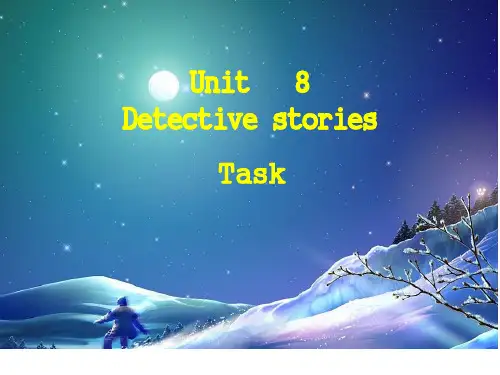
Tips Time: One night Place: At home Crime: Murder Victim: Mr. Smith Witnesses: the Browns Detective: Detective Li Murderer: Nick 供认…(admitted that…)
写作侦探故事的评分标准 写作侦探故事的评分标准
67、生人命生太贵过相短知暂,,何今用天金放与弃钱了。明20天.7.不14一20定.7能.1得42到0.。7.184时。3210分280时年371月分1144日-J星ul期-2二07二.14〇.2二02〇0年七月十四日
花一样美丽,感谢你的阅读。 78、放勇眼气前通方往,天只堂要,我怯们懦继通续往,地收狱获。的20季:31节2就0:3在1前:41方7.。142.02.072.104T2u0e.s7d.1a4y2, 0Ju.7ly.1144。, 2020年7月14日星期二二〇二〇年七月十 四日 8、拥有梦想只是一种智力,实现梦想才是一种能力。20:3120:31:417.14.2020Tuesday, July 14, 2020
the scene of crime
◆ Protect the crime scene. ◆ Check the scene for objects,
f_i_n_ge_r_p_r_in_t_s_ or other c_lu_e_s_ .
◆ Interview w___it_n_e_ss_esfor more information.
◆ Decide who the s__u_s_p_e_c_tsare and talk to them.
◆ Find the right c___ri_m_i_n_al.
???
Tom was _a_r_re_s_te_d__ _f_o_r robbery. Tom was under arrest for robbery.
thought the police would be able to find the owner. Just then, the (4) _p_o_li_c_e came to Tom’s home and saw the necklace in his hand. Tom was very shocked when he was (5) _c_h_a_rg_e_d__w_i_th_ robbery. A policeman told him that a jewellery shop had been robbed. A (6) _w_it_n_e_s_s said that she had seen someone run from the jewellery shop into (7) _T_o_m_’_s_b_u_i_ld_i_n_g_ right after the (8) r_o_b_b_e_r_y.Tom was not (9) _g_u_il_ty_, but how could he prove it ?
• What did the Browns say ? They said they hadn’t seen or heard anything because of having a party.
牛津译林版九年级上册Unit 8《Detective stories》教学设计3
牛津译林版九年级上册Unit 8《Detective stories》教学设计3一. 教材分析《Detective stories》是人教版牛津译林九年级上册的一篇阅读文章,主要讲述了一位侦探如何通过观察和推理找出真凶的故事。
文章内容丰富,情节紧凑,能够激发学生的学习兴趣。
本课的教学内容主要包括:理解文章大意,掌握重点词汇和短语,提高阅读理解能力;学习侦探的观察和推理技巧;培养学生的团队合作和口语表达能力。
二. 学情分析九年级的学生已经具备了一定的英语基础,能够理解和运用一些基本的英语知识。
但是,他们的阅读理解能力、观察和推理能力还有待提高。
因此,在教学过程中,需要注重培养学生的阅读理解能力,引导学生运用观察和推理的技巧,提高他们的英语应用能力。
三. 教学目标1.知识目标:让学生掌握文章中的重点词汇和短语,理解文章大意;2.能力目标:培养学生运用观察和推理的技巧,提高阅读理解能力;3.情感目标:培养学生对侦探小说的兴趣,激发他们学习英语的积极性。
四. 教学重难点1.重点:文章重点词汇和短语的学习,以及阅读理解能力的提高;2.难点:侦探的观察和推理技巧的运用。
五. 教学方法1.任务型教学法:通过完成各种任务,激发学生的学习兴趣,提高他们的实践能力;2.情境教学法:创设情境,让学生在实际情境中学习英语,提高他们的应用能力;3.合作学习法:引导学生分组讨论,培养他们的团队合作精神。
六. 教学准备1.准备文章的PPT,包括文章内容、图片、视频等;2.准备相关的侦探工具,如放大镜、推理卡片等;3.准备侦探小游戏,以供课堂巩固环节使用。
七. 教学过程1.导入(5分钟)a.向学生展示一些侦探工具的图片,如放大镜、推理卡片等,引导学生谈论侦探的观察和推理技巧;b.让学生观看一段侦探小说的视频,激发他们的学习兴趣。
2.呈现(10分钟)a.通过PPT呈现文章内容,引导学生整体理解故事情节;b.讲解文章中的重点词汇和短语,让学生初步理解文章大意。
牛津译林版英语九年级上册Unit8《Detectivestories.》说课稿1
牛津译林版英语九年级上册 Unit 8 《Detective stories.》说课稿1一. 教材分析《Detective stories》是牛津译林版英语九年级上册Unit 8的一篇阅读课文。
本篇文章主要讲述了一名侦探如何通过观察、推理和分析,破解一起盗窃案件的故事。
文章内容丰富,语言生动有趣,情节引人入胜,非常适合九年级学生学习。
通过本篇文章的学习,学生可以提高阅读理解能力,学习到一定的侦探技巧,并能够运用到日常生活和学习中。
二. 学情分析九年级的学生已经具备了一定的英语基础,对阅读理解也有一定的掌握。
但是,对于一些较复杂的句子结构和词汇,学生可能还有一定的困难。
因此,在教学过程中,教师需要关注学生的个体差异,针对不同学生的学习需求给予适当的引导和帮助。
此外,学生对于侦探故事这一主题比较感兴趣,教师可以充分利用学生的兴趣,激发他们的学习积极性。
三. 说教学目标1.知识目标:学生能够掌握文章中的重点词汇和短语,理解文章的基本内容。
2.能力目标:学生能够运用所学知识,提高阅读理解能力,培养观察、推理和分析问题的能力。
3.情感目标:学生能够通过学习侦探故事,增强对英语学习的兴趣,培养积极向上的学习态度。
四. 说教学重难点1.重点:文章中的重点词汇和短语,如detective、clue、suspect等。
2.难点:文章中的一些复杂句子结构和词汇,如however、on theother hand等,以及侦探技巧的理解和运用。
五. 说教学方法与手段1.教学方法:采用问题驱动法、情景教学法和小组合作法。
2.教学手段:利用多媒体课件、图片、侦探工具模型等辅助教学。
六. 说教学过程1.导入:教师通过展示侦探工具模型,引导学生谈论侦探故事,激发学生的学习兴趣。
2.自主学习:学生通过阅读课文,自主学习文章中的重点词汇和短语。
3.课堂讲解:教师针对文章中的重点内容和难点,进行讲解和分析。
4.小组讨论:学生分组讨论侦探故事中的线索和推理过程,培养学生的观察和分析能力。
译林牛津版九年级英语上 Unit 8 Detective stories Integrated sk
译林牛津版九年级英语上Unit 8 Detective stories Integrated skills 教学设计9A Unit 8 Detective stories Integrated skillsⅠ.Teaching objectives: By the end of the lesson students should be able tounderstand the recording of the policemen’s questioning suspects;fill in the blanks according to some required information and then complete a report on the kidnapping case;talk about some safety tips to keep safe and stop crime.Ⅰ.Teaching contents:New vocabulary: kidnapping, of great wealth, in prison, safety, lock, shut, guard against.Listening materials.Ⅰ. Focus of the lesson and predicted area of difficulty:Listen and acquire information about a certain topic;Arouse students’ interest in the topic and make them participate in the discussion.Ⅰ. Teaching aids:Tapes,blackboard, chalk, PPT, pictures,Ⅰ.Teaching Procedures:1.Greeting and lead-in (presentation)Say:Good morning, everyone! Today let’s study integrated skills of unit8.first ,let me check your words.please take out your papers.part1 is translation.who canWork out them (每组一个,每个一分) now ,follow me to read them.part 2。
牛津译林版九年级英语上册9AUnit8 Detective Stories task 公开课课件
Tips Time: One night Place: At home Crime: Murder Victim: Mr. Smith Witnesses: the Browns Detective: Detective Li Murderer: Nick 供认…(admitted that…)
写作侦探故事的评分标准 写作侦探故事的评分标准
Objects or clues found at the crime scene
He was murdered. Start looking for clues.
Detective Li
• Who arrived soon?
• What could he find after checking the scene?
a jewellery shop Tom was shocked.
a diamond necklace
1
2
3
4
Police
station
c
b
a
d
a. A witness said that she had seen someone running into
Tom’s building.
b. Tom planned to take the necklace to the police station the
• A description of the crime • Any objects or clues found at the scene of the
crime • A description of the suspect • How the detective knows he or she has found the
牛津译林版九年级英语上册Unit 8 Detective stories Reading I

Unit 8 Detective stories ( Reading I )【学习目标】1、能用正确的语音、语调无障碍地朗读课文;2、能根据问题提示理解文章大意;3、了解侦探类故事的基本结构,掌握这类文章的阅读方法。
【学习过程】(一)背景知识:侦探小说是悬疑小说的一种,主要特点是侦探破案,通常是谋杀案。
侦探询问怀疑对象,寻找线索,查清谁是杀人凶手。
一般来说,侦探调查的依据是动机、时机和犯罪手段。
侦探排除那些不符合标准的怀疑对象,得出最终的结论。
为了增加侦探的破案难度和读者的兴趣,作者要侦探的破案过程复杂化,如:误导的线索和人数众多的嫌疑犯(他们中间有些人说谎,有些人则说真话)。
只有等到最后,侦探才找到凶手,并解释破案的过程。
英语小说中的一些著名侦探包括夏洛克·福尔摩斯Sherlock Holmes(柯南·道尔Conan Doyle创作)、玛波小姐Miss Marple和波罗Polo(阿加莎·克里斯蒂Agatha Christie创作)、布朗老人(切斯特顿Chesterton创作)等。
(二)课前准备:1、试着朗读全文:A、划出本课新单词,根据音标和读音规则多读几遍,在不会读的生词下作标记“△”;B、根据录音磁带多跟读几遍,划出读不通的的句子。
2、再次仔细阅读课文,试着完成书中P110 B1, B2部分。
3、通过预习你有什么不懂之处?__________________________________________________________________________________________________________________________ (三)课堂活动:1、预习检查:a. 小组交流讨论课前准备情况;b. 师生共同解决预习中发现的问题。
2、阅读策略培养:a.初读课文,整体感知。
What is the article about? → _________________________________b. 再读课文,捕捉细节。
牛津译林版九年级英语上册Unit 8 Detective stories Task 示范课教案
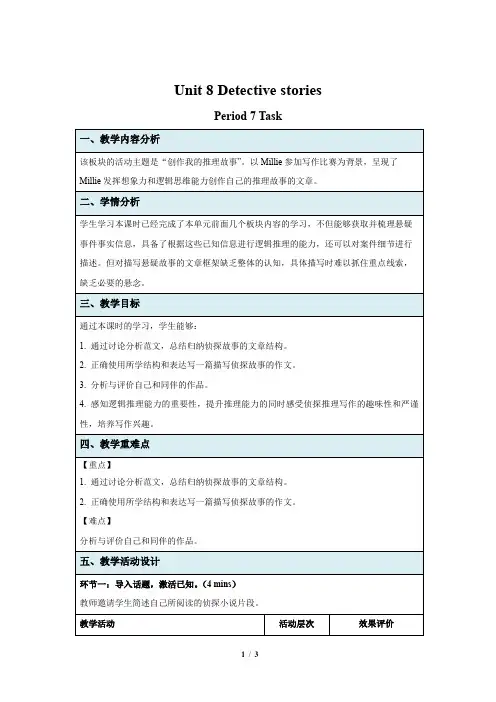
断
效果评价
观察学生对侦探故事的关键元素的分析情况,适当的时候给与指导和帮助。
环节设计意图:帮助学生充分了解故事内容,为后续写作活动做准备。
环节四:根据已知信息和所学知识进行侦探故事写作,并互评文章。(15 mins)
教师引导学生根据所学知识,整理故事细节内容并安排写作结构,完成一篇完整描述该故事的文章,之后同桌互评。
教师创设情境,学生学习新单词,补全侦探写作中遗漏的部分,分析文章结构,并通过小组讨论的方式简单续写故事。
教学活动
2. Studentslearnsomenewwords.
3. Students make a prediction according to the new words.
4. Students look at the pictures and describe them.
三、教学目标
通过本课时的学习,学生能够:
1.通过讨论分析范文,总结归纳侦探故事的文章结构。
2.正确使用所学结构和表达写一篇描写侦探故事的作文。
3.分析与评价自己和同伴的作品。
4.感知逻辑推理能力的重要性,提升推理能力的同时感受侦探推理写作的趣味性和严谨性,培养写作兴趣。
四、教学重难点
【重点】
1.通过讨论分析范文,总结归纳侦探故事的文章结构。
活动层次
学习理解之描述与阐述
效果评价
倾听学生的反馈,了解学生的作业完成情况以及对小说内容的理解情况。
环节设计意图:学生在分享自己的阅读结果的同时,能够有意识地注意推理小说的行文逻辑和具体结构,为本节课的写作活动做准备。
环节二:感知故事情节,了解故事的起因经过和结果,在情境中学习推理写作的结构和行文方式。(18 mins)
牛津译林版九年级上册Unit 8《Detective stories》(reading 1)说课稿
牛津译林版九年级上册Unit 8《Detective stories》(Reading 1)说课稿一. 教材分析《Detective stories》(Reading 1)选自牛津译林版九年级上册,本文主要讲述了一位名叫Black的大侦探通过观察和推理找到了失窃的珠宝,并成功抓住了罪犯。
文章内容丰富,情节紧凑,激发了学生对侦探故事的兴趣。
通过本节课的学习,学生可以掌握一般过去时的被动语态,提高阅读理解能力,并培养观察和推理的能力。
二. 学情分析九年级的学生已经具备了一定的英语基础,对于一般过去时和被动语态有一定的了解。
但部分学生对英语阅读兴趣不高,阅读理解能力有待提高。
此外,学生们的逻辑思维和推理能力参差不齐,因此在教学过程中需要关注学生的个体差异,激发学生的学习兴趣,提高他们的阅读和推理能力。
三. 说教学目标1.知识目标:学生能够掌握一般过去时的被动语态,理解文章的基本内容。
2.能力目标:学生能够提高阅读理解能力,培养观察和推理的能力。
3.情感目标:激发学生对侦探故事的兴趣,培养学生的团队合作精神。
四. 说教学重难点1.重点:学生能够掌握一般过去时的被动语态。
2.难点:学生能够理解文章的细节,提高阅读理解能力,并运用观察和推理的能力。
五. 说教学方法与手段1.教学方法:采用任务型教学法,让学生在完成任务的过程中提高英语阅读和推理能力。
2.教学手段:利用多媒体课件、图片、侦探游戏等辅助教学,激发学生的学习兴趣。
六. 说教学过程1.导入:以侦探游戏引入课题,激发学生的兴趣。
2.阅读理解:学生独立阅读文章,回答问题,检测学生对文章内容的理解。
3.小组讨论:学生分组讨论文章细节,培养团队合作精神。
4.推理练习:教师给出案例,学生运用观察和推理能力解决问题。
5.总结:教师引导学生总结文章主题和一般过去时的被动语态。
6.作业:学生回家后编写自己的侦探故事,培养创造力和写作能力。
七. 说板书设计板书设计包括文章标题、主要人物、情节发展、一般过去时的被动语态等关键信息,帮助学生梳理文章内容和巩固知识点。
牛津译林版九年级上册Unit 8《Detective stories》教学设计2
牛津译林版九年级上册Unit 8《Detective stories》教学设计2一. 教材分析《Detective stories》是人教版牛津译林九年级上册的一篇阅读文章,主要讲述了一名侦探破案的故事。
文章情节紧凑,悬念迭起,能够激发学生的学习兴趣。
本节课主要通过学习这篇课文,让学生掌握一定的侦探故事相关词汇和表达,提高阅读理解能力,同时培养学生的推理和分析能力。
二. 学情分析九年级的学生已经具备了一定的英语基础,对于故事类文章兴趣较高。
但部分学生在阅读理解方面仍有困难,需要教师在教学中给予引导和帮助。
此外,学生的词汇量和语法知识有限,需要在教学过程中逐步扩充和巩固。
三. 教学目标1.知识目标:学生能够掌握与侦探故事相关的词汇和表达,理解文章的基本情节和人物关系。
2.能力目标:学生能够阅读并理解侦探故事类文章,提高阅读理解能力;通过分析推理,提高学生的思维能力。
3.情感目标:学生能够培养对侦探故事的兴趣,激发学习英语的热情。
四. 教学重难点1.重点:学生能够掌握侦探故事相关词汇和表达,理解文章情节。
2.难点:学生能够运用所学生词和表达进行简单的口语交流和写作。
五. 教学方法1.任务型教学法:通过设置各种任务,激发学生的学习兴趣,培养学生解决问题的能力。
2.情境教学法:创设相关情境,让学生在真实的环境中学习和运用英语。
3.交际法:引导学生进行小组讨论和互动,提高学生的口语表达能力。
六. 教学准备1.课件:制作与课程内容相关的课件,包括图片、视频等。
2.教材:准备牛津译林九年级上册课本和相关辅导资料。
3.教学工具:录音机、投影仪等。
七. 教学过程1.导入(5分钟)利用图片或视频引入侦探主题,激发学生的兴趣。
提问学生:“你们最喜欢的侦探故事是什么?”引导学生谈论侦探故事的相关知识。
2.呈现(10分钟)教师快速阅读文章,引导学生关注文章标题和关键词。
然后让学生自主阅读文章,理解大意。
3.操练(15分钟)学生分角色朗读文章,注意模仿语音语调。
牛津译林版 英语九年级上册 Unit 8 Period 8 Detective stories.
第8课时[Unit 8 名著阅读]As the train passed through beautiful valleys of England, Archibald Craven smiled. It had been years since he smiled. He knew that his life would get better. He knew that he could make a difference in Colin's life.When Archibald finally arrived back home, he called for Mrs Medlock. “How is my son, Mrs Medlock?” “You should go and see for yourself, Mr Craven. I think you'll be surprised,” Mrs Medlock, his servant said.“Where is he, then?”“He's in the garden. He goes there every day now. No other people are allowed to go near.”Archibald then went to the garden. He walked down the same path that Mary had walked down on her first day at Misselthwaite Manor.He walked to the garden's door and stopped. He knew where the door was, even though the ivy(常春藤) covered it,__but he couldn't remember where he had hidden the key.Just then, he heard sounds. The sounds seemed to be coming from the garden. He heard children playing and laughing aloud.“That's strange,” he thought. “Nobody has been in that garden for ten years.”Suddenly, Archibald heard a shout of laughter and a boy ran through the doorway. The boy ran right into Archibald's arms. He was a tall, handsome boy. He was glowing with life. His strange, gray eyes made Mr Craven gasp for breath. He had never thought of such a meeting.“Oh! Who are you, little boy?” he asked.“It's me, Father! Don't you recognize your own son Colin?”Mr Craven couldn't believe his eyes. His boy looked strong and healthy. He seemed happy.He didn't look at all like that Colin Craven Archibald knew.“Colin? I can't believe it! Is that really you? You look so different!”“That's because I've grown, Father. I stopped dying and I started living. I wa s brought back to life. Just like this garden. I want to show you something. Come with me, Father.”Colin then led his father into the garden. The garden was alive with colour. It looked more beautiful than it had ever looked before.“I thought this garden would be dead,” Archibald said. “I thought so, too, at first,” saidMary.“Your niece, Mary. It is your sister's daughter who brought it alive again,” said Dickon.—Adapted from The Secret Garden(《秘密花园》)()1.The underlined word “it” in the story refers to ________.A.the garden B.the doorwayC.the key to the door D.the door of the garden()2.Which of the following shows the relationship between Archibald, Colin and Mary?B.D.()3.Which of the following shows the correct order of the story?a.Archibald Craven went to the garden.b.Archibald Craven arrived back home.c.Colin Craven led his father into the garden.d.Colin Craven ran right into Archibald's arms.e.Archibald Craven heard children playing and laughing aloud.A.a-b-e-c-d B.b-a-e-d-cC.d-a-e-c-b D.b-d-a-c-e()4.Why didn't Archibald Craven recognize the boy outside the doorway at the beginning?A.Because the boy was a stranger.B.Because Archibald Craven was too old to see the boy clearly.C.Because the boy looked different from that Colin Craven Archibald knew.D.Because the boy ran so fast that Archibald Craven couldn't see him clearly.答案【主旨大意】本文是一篇记叙文,节选自名著《秘密花园》,主要讲述Archibald多年之后回到家,发现生病的儿子有了很大的变化——变得强壮、健康;家里那封存已久、荒凉的花园也变得生机勃勃了。
牛津译林版英语九年级上册 Unit 8 《Detective stories.》 教学设计2
牛津译林版英语九年级上册 Unit 8 《Detective stories.》教学设计2一. 教材分析《Detective stories》是人教版牛津初中英语九年级上册Unit 8的教学内容。
本节课主要让学生通过学习侦探故事,掌握一般过去时的被动语态,并能运用所学知识进行口语交流和写作。
教材内容丰富,插图生动有趣,能够激发学生的学习兴趣。
二. 学情分析九年级的学生已经具备了一定的英语基础,能够听、说、读、写简单的英语句子。
他们对侦探故事这类题材比较感兴趣,容易产生学习动力。
但部分学生在运用英语进行口语交流方面还存在一定的困难,需要教师在教学中给予关注和指导。
三. 教学目标1.知识目标:让学生掌握一般过去时的被动语态,能运用所学知识进行口语交流和写作。
2.能力目标:提高学生的听说读写能力,培养他们运用英语进行交际的能力。
3.情感目标:激发学生对侦探故事的兴趣,培养他们学习英语的积极性。
四. 教学重难点1.重点:让学生掌握一般过去时的被动语态。
2.难点:引导学生运用所学知识进行口语交流和写作。
五. 教学方法1.情境教学法:通过设置侦探故事的情境,让学生在实际语境中学习和运用英语。
2.任务型教学法:引导学生参与各种侦探活动,完成任务,提高英语实际运用能力。
3.激励评价法:鼓励学生积极参与课堂活动,给予及时的表扬和鼓励,提高他们的自信心。
六. 教学准备1.教材:《Detective stories》相关材料。
2.课件:侦探故事相关图片、视频、音频等。
3.学具:侦探道具(如放大镜、笔记本等)。
4.课堂练习:相关侦探故事的练习题。
七. 教学过程1.导入(5分钟)利用课件展示侦探故事的相关图片,引导学生谈论自己喜欢的侦探故事。
同时,教师简要介绍本节课的学习内容,激发学生的兴趣。
2.呈现(10分钟)教师通过课件展示一般过去时的被动语态的例句,让学生感知和理解这一语法现象。
同时,引导学生注意句子中的时间状语,帮助他们把握一般过去时的被动语态的用法。