
七年级英语下册Module6Aroundtown语法篇试题新版外研版
1Module 6______________________________________________________________________________ ______________________________________________________________________________介词的用法 方位的表达方式 问路与指路的表达方式常用介词的基本用法一、表示时间的常用介词1.at多用于具体钟点前,如:at seven, at ten to nine;也可用于固定搭配中,如:at noon,at night。
2.In表示一段时间,用于年、月、季节、或泛指的一天的上午、下午、晚上等前。
如:in the morning,in summer,in 2016;还可用于表示“从现在起,多长时间以后或多久之后”的短语中。
3.On主语用在星期几、具体某一天的早、中、晚或节日前。
如:on June 1st, on Monday。
4.after表示以过去为起点的某一段时间之后,用于过去时。
如:They finished the work after two years.after 还可与时间点连用表示将来某个时间之后。
如:I’ll ring you up after two o’clock.5.until与否定词连用,译为“直到。
才”,其前的谓语动词多用瞬间性动词;until用在肯定句中,译为“直到。
为止”,其前的谓语动词需用延续性动词。
如:I didn’t leave until my mother came home.6.before和after表示时间,分别译为“在。
之前”和“在。
之后”。
如:Pl ease bring your homework before ten o’clock.二、表示地点的介词1.表示方位的in, on,toin表示在某一地区之内;to表示在某一地区之外;on表示与某地的毗邻关系。
如:China is to the west of Japan.2.over,above,on的用法over有“正上方”“越过”“覆盖在上面”之意。
above指在上方,不一定表示正上方。
2on指在上面,表示两物体接触。
3.at,in,on的用法at与较小的地点连用。
如:at homein与较大的地点连用。
如:in the worldon表示在一个平面上。
如:on the farm4.in front of ,in the front of,beforein front of 表示“在。
的前部”(范围外)。
如:There are some trees in front of the classroom.in the front of 表示“在。
的前部”(范围内)。
如:He stood in the front of the classroom.before所表示的位置关系和in front of 相同,表示“在。
前面”。
如:He sits before me.5.across,throughacross和through都表示“穿过”。
across着重指从一条直线或一物体表面的一边到另一边,表示游渡、乘船过海或过河时用across;through含有“从。
中间穿过”之意。
如:He can swim across the river.She had to push her way through the crowed to get to her son.6.on the left\right在左边\右边next to与。
紧挨着opposite在。
的对面on the corner 在拐角处3between...and...在。
和。
之间三、问路与指路常见的相关表达方式有很多,例如:Where is ......?How can I get/go to ......?Can you tell me the way to.....?Can you show me the way to......?Is there a ......near here?Take the bus\underground.....Go along ......and turn left\rightGo across......on the left\right.....opposite......如:--Excuse me ,can you tell me the way to Wangfujing Dajie?--Certainly.Go across Dong Chang’an Jie,go along the street and turn left at the third street on the left.单项选择1.Go along the street and__________right.You will see the park.4A.turnB.crossC.carryD.through答案:A解析:考查指路的用法,向右转是turn right。
故答案是A。
2.The sun now is__________the tree in the east.A.underB.downC.alongD.above答案:D解析:考查方位介词的用法,根据根据句意“现在太阳在树的上方”,故选D。
3.The school is next__________the book shop.A.toB.forC.acrossD.at答案:A解析:根据句意“学校紧挨着书店”可知用next to,故选A。
4.He was born__________a cold Monday morning.A.inB.onC.atD.to答案:B解析:考查时间介词的用法,具体的时间前用介词on,故选择填B。
5.There are many flowers__________summer.A.inB.onC.atD.to答案:A解析:考查时间介词的用法,季节之前用用介词in故选择填A。
56基础演练单项选择1.You must ride your bike__________ the right side of the rode. --It’s eighty yuan.A.atB.onC.inD.for2.Two tall boys are sitting__________me,so I can’t see the blackboard. A.next to B.behind C.in front of D.between3.They are talking about how to walk__________the forest. A.across B.over C.through D.under4.Go straight,and you can find the bank__________your right. A.for B.at C.in D.on5.He lives__________the third floor.A.atB.inC.onD.over答案:BCCDC巩固提高根据句意和汉语提示翻译句子1.打扰一下,你能告诉我去广场的路吗?__________ __________!Can you tell me__________ __________ __________Square?2.这附近有书店吗?__________ __________ a bookshop near here?3.在第二个拐角处向右转__________ __________ __________ the second turning4.向左转进国王街道,经过一座教堂?__________ into King’s Street and _________ a church.5.它在学校和电影院之间。
It is __________ the school __________ the cinema.答案:1.Excuse me ,the way to2.Is there3.Turn right at4.Turn left,go pass5.between, and单项选择1.He often visit his grandpa__________Sunday.7A.inB.onC.atD.to2.We’ll have a meeting at Hilton Hotel __________ May, 2015.A. onB. inC. atD. from3.Beihai Park is __________ the corner of the two streets.A.toB.fromC.onD.for4.The Forbidden City is__________Tian’anmen Square.A.inB.oppositeC.atD.on5.Walk__________this street until you find the library.A.onB.inC.alongD.to6.I have an uncle.He lives__________Shanghai.A.onB.inC.forD.to7.John usually gets up at seven__________the morning.A.onB.inC.atD.over8.The foreign friends will come to our school__________October 8th,2015.A.onB.inC.atD.after9.We usually have the first class__________8:00 in the morning.A.onB.inC.atD.through10.--Where is your Chinese teacher?--He is__________the meeting room,A.onB.inC.atD.for8完形填空Many people all around the world like to listen to classical music. Do you know ___1___ about this kind of music? In fact, it is not easy to ___2___. It means different things to different people. Let me ___3___ you about it.Some famous classical composers were Beethoven, Schumann and Tchaikovsky. They wanted to ___4___ people their strong feelings(情感) by music. They told stories ___5___ love and some other things. Sometimes they wrote music only for holidays.___6___, some other composers were not the same. In their ___7___, they did not tell a story or show their strong feelings. They wanted to ___8___ beautiful and interesting music with lovely sounds(声音). Some of ___9___ composers were Bach, Vivaldi, Haydn, and Mozart.Classical music has been ___10___ for hundreds of years. It is difficult to understand sometimes.1. A. anything B. nothing C. anywhere D. somewhere2. A. translate B. name C. discover D. describe3. A. say B. talk C. tell D. speak4. A. plan B. show C. wish D. cost5. A. In B. with C. at D. about6. A. However B. And C. Yet D. Perhaps7. A. dream B. music C. story D. secret8. A. hear B. read C. sell D. make9. A. these B. they C. that D. this91010. A. important B. delicious C. popular D. latest答案:单项选择1--5BBCBC 6--10BBACB 完形填空 1--5ADCBD 6--10ABDAC____________________________________________________________________________________________________________________________________________________________西城区期末1. Kate came to China the morning of July 25th, 2008. A .onB .inC .atD .of2. I have two brothers. One is a worker, is a teacher. A. otherB. anotherC. the otherD. others3. You__ __a meeting at 9 last Monday morning. A. haveB. were havingC. are havingD. will have4. When Mr White opened the red box, he found but a small key in it.A. somethingB. everythingC. nothingD. anything5. My father_ _to America on business two days ago.A. fliesB. flewC. will flyD. flown答案:ACBCB单项选择:1.Be careful when you go__________the street.A.acrossB.throughC.crossD.past2.--Excuse me,where can I__________the cinema?--Go down this street.Turn right at the first turning and you will see it on the right.A.go toB.get toC.look forD.find3.I think the best way to travel around the town is by__________boat.A.aB.anC.theD.\4.--Do you know how they__________the railway station?--Yes,I do. They went there by taxi.A.get toB.arriveC.arrive inD.reach to5.It.__________me about twenty minutes to get there.A.spendsB.costsC.paysD.takes6.The bus is coming!I My mother asks me to be careful when I__________the bus.A.get offB.get onC.get backD.get up117.It’s time to go to bed.My parents asked me to__________the TV and go to my bedroom .A.turn rightB.turn leftC.turn onD.turn off8.--__________ is the nearest market?--It’s opposite my home.A.WhenB.WhereC.WhatD.Why9.--__________does it take you to get to school?--About twenty minutes.A.How longB.How farC.How oftenD.How soon10.--__________Can you tell me the way to the zoo?--Sure.It is over there..A.SorryB.Excuse meC.Thank youD.Good luck完形填空:Last summer I was a volunteer (志愿者) at a shelter for the homeless, a place for homeless people to sleep at night. I wasn’t working that summer and was 1 only two classes in summer school, so I had some 2 time.There nights a week, I helped in the kitchen of the shelter along with four other volunteers. We planned and 3for 45 people hot meals with vegetables, chicken, fish and fruit. The homeless people needed this good food because many of them usually didn’t eat well.I enjoyed this volunteer work, making 4 with the four volunteers in the kitchen. One was a very nice elderly housewife, one a movie maker, another a young teacher and the other a college student, 5 me.12I talked to a lot of the homeless people at the shelter. Their life stories filled me with sympathy (同情心). Some of them had 6 with alcohol (酒) or drugs, while others only had bad luck. One woman worked for almost 30 years for a small company, and then she lost her job. She looked for a new job, but couldn’t find one, for she was too 7 . She could do nothing but sell her furniture—sofas, chairs, and tables 8 she could pay for her food. The woman went on job hunting, but she still couldn’t find one. She hadno money for her 9 and had to sleep in her car. Then she had to sell her car. Alone, 10 , and homeless, she finally came to the shelter.1. A. studying B. planning C. holding D. taking2. A. full B. free C. part D. long3. A. ordered B. bought C. cooked D. finished4. A. decisions B. wished C. friends D. changes5. A. as B. like C. except D. besides6. A. habits B. worries C. difficulties D. problems7. A. old B. poor C. sick D. dull8. A. though B. because C. so that D. in case9. A. block B. family C. building D. apartment10. A. afraid B. shy C. shocked D. Mad阅读理解AComputers are useful machines.They can help people a 1ot in their everyday life.For example,they can help people save much time,and they can help people work out many problems they13can't do easily.Our country asks everyone to learn to use computers except the old people. Today more and more families own computers.Parents buy computers for their children. They hope computers can help them improve(提高)their studies in schoo1.But many of the children use computers to play games,to watch video or to sing Karaoke.instead of studying.So many teachers and parents complain that computers can not help children to study but make them fall behind.So computers are locked by parents in the boxes.In some other countries,even some scientists hate computers.Thy say computers let millions of people lost their jobs or bring them a lot of trouble.Will computers really bring trouble to people or can they bring people happiness ?It will be decided by people themselves.1. Why do we say the computer is a useful machine? Because .A.our country asks us to learn it B.it can help us a lotC.we can use it to play games D.it can help us to find jobs2. What do many teachers and parents complain about?A.Their students and children use computers to play games.B.Computers let them lost their jobs.C.Computers make the students and children fall behind.D.Computers bring people a lot of trouble.3.In this passage we know computers ___________ .A.also bring us trouble B.bring us happiness onlyC.are hated by people D.are bad for people’s health4. ---Can computers really help children to study? ---________14A.Yes,they can.B.It’s easy to say.C.No,they can’t.D.Of course not.5. How do you understand the last sentence of this passage? I think it means_________. A.computers are used by peopleB.people can live well without computersC.one must decide how to use computersD.computers are strange machinesBI loved music when I was young. I learned to play the guitar at 11 and I wrote my first song four years later. My dream was to become a country singer.After years of hard work, a record company was showing interest in me. One day during a trip to mountains, a friend offered me a bit of meth, a kind of drugs(毒品). I smoked it. And that was all that I thought about for the next year and a half. I couldn’t live without it.When the police came to me, I looked like death. The first seven days in prison, I just slept. When I woke up on the eighth day, I had never known such shame and guilt(罪恶感).I walked down the hall to the pay phone. My mama is the sweetest person on the earth, and I knew this was going to break her heart. When I heard her voice on the phone, I told her where I was. She just said, “Son, don’t you know you can’t do anything to make me not love you?”Her words gave me the confidence to face my trouble. And I also realized this was my chance to start a new life.When people hear my words, I hope they will not make the same mistake as I have, but15I do know that you can overcome almost anything, especially smoking drug. That’s why I share my story here.1. The writer wrote his first song when he was ____ years old.A. 11B. 13C. 15D. 172. Why was the writer put into prison?A. Because he offered others meth.B. Because he took drugs.C. Because he refused the company.D. Because he didn’t pay for his phone.3. The writer’s purpose in telling his story is to ____.A. show the drugs’ dangerB. thank his motherC. warn his friendsD. help other peopleCSometimes you think your teacher hates you? You’re not the only one. Teachers and students sometimes have personality clashes(冲突), just like an y two people who don’t get along. After all, teachers aren’t perfect.However, most of the time, there are lot of reasons why you complain about your teacher’s bad attitude(态度) to you. So try to find out if your teacher really does dislike you. Or something else is going on. Here are some questions to ask yourself: * Is your teacher angry at you personally, or at something you’ve been doing?All teachers have something that they strongly dislike. Maybe your teacher hates it when people whisper(低声说话) in class. If you try hard not to do these things, the situation might get better.* Are you the only person being treated badly, or is your teacher shouting at the whole class?16Ask your classmates if they’ve been having trouble with the teacher too. If they say yes, perhaps your teacher is having problems outside of school, or is new and feels something badly.*Are you working up to your ability?You and the kid sitting beside you both got a C on the last test, and y our teacher told you that you could do better, but didn’t say anything to her! Isn’t this unfair? Well, teachers often treat different students in different levels in different ways. They will be angry if they feel someone does not do the work he is able to. It’s their way to enco urage a student to try a little harder.* Are you more sensitive(敏感) than most students?Try to find out if you are very sensitive to be criticized(批评). If the other students aren’t as sensitive, they will not be in such trouble even though the teach er treated them the same way. There’s nothing wrong with being sensitive, but if you act to criticism differently than most kids, this would be the reason why you think your teacher doesn’t like you.1. The writer thinks that it is ____ when teachers and students have clashes.A. not a matter at allB. a serious problemC. something normalD. no good for students2. If only one boy is criticized in a teacher’s class, the boy should ____.A. ask his classmates for helpB. think more about himselfC. talk with the teacher at onceD. treat the teacher the same way3. The writer wrote the passage to tell students how to ____.A. get along with their teachersB. do during a class as a studentC. understand the teachers’ feelingD. act when they are criticized17答案:单项选择1--5ABDAD 6--10BDBBB完形填空 1--5DBCCB 6--10DACDA阅读理解:BCAAC CBD CBA18。
七年级英语下册 Module 6 Around town测试 (新版)外研版
Module 6 模块测试听力部分(20分)一、听力(20分)第一节:听对话和问题,选择正确答案。
(5分)()1. A. On Fifth Avenue. B. On Fourth Avenue. C. On Sixth Avenue.()2. A. It’s in front of the school.B. It’s behind the school.C. It’s next to the school.()3. A. It is dirty. B. It is quiet. C. It is clean. ()4. A. To the food shop.B. To the clothes shop. C. To the fruit shop.()5. A. It is opposite the supermarket.B. It is on the right of the street.C. It is on City Street.第二节:听长对话,回答问题。
(5分)听下面一段较长对话,回答6—7两小题。
()6. What does the woman ask the man?A. The way to the police station.B. The way to the train station.C. The time of the train to London.()7. Where is it?A. On Paris Street.B. On London Road.C. On New York Road.听下面一段较长对话,回答8—10三小题。
()8. Where’s the supermarket?A. Near No. 1 Hospital.B. Near No. 1 Middle School.C. Opposite the hotel.()9. Which bus can take the girl to the supermarket?A. No. 8.B. No. 18.C. No. 28.()10. Where is the bus stop?A. It’s opp osite the hotel.B. It’s behind the hotel.C. It’s next to the hotel.第三节:听独白,完成信息记录表。
【K12小初高学习】七年级英语下册Module6Aroundtown语法篇试题新版外研版
Module 6______________________________________________________________________________ ______________________________________________________________________________介词的用法方位的表达方式问路与指路的表达方式常用介词的基本用法一、表示时间的常用介词1.at多用于具体钟点前,如:at seven, at ten to nine;也可用于固定搭配中,如:at noon,at night。
2.In表示一段时间,用于年、月、季节、或泛指的一天的上午、下午、晚上等前。
如:in the morning,in summer,in 2016;还可用于表示“从现在起,多长时间以后或多久之后”的短语中。
3.On主语用在星期几、具体某一天的早、中、晚或节日前。
如:on June 1st, on Monday。
4.after表示以过去为起点的某一段时间之后,用于过去时。
如:They finished the work after two years.after 还可与时间点连用表示将来某个时间之后。
如:I’ll ring you up after two o’clock.5.until与否定词连用,译为“直到。
才”,其前的谓语动词多用瞬间性动词;until用在肯定句中,译为“直到。
为止”,其前的谓语动词需用延续性动词。
如:I didn’t leave until my mother came home.6.before和after表示时间,分别译为“在。
之前”和“在。
之后”。
如:Please bring your homework before ten o’clock.二、表示地点的介词1.表示方位的in, on,toin表示在某一地区之内;to表示在某一地区之外;on表示与某地的毗邻关系。
精选七年级英语下册Module6Aroundtown(语法篇)试题(新版)外研版

Module 6____________________________________________________________________________________________________________________________________________________________介词的用法方位的表达方式问路与指路的表达方式常用介词的基本用法一、表示时间的常用介词1.at多用于具体钟点前,如:at seven, at ten to nine;也可用于固定搭配中,如:at noon,atnight。
2.In表示一段时间,用于年、月、季节、或泛指的一天的上午、下午、晚上等前。
如:in the morning,in summer,in 2016;还可用于表示“从现在起,多长时间以后或多久之后”的短语中。
3.On主语用在星期几、具体某一天的早、中、晚或节日前。
如:on June 1st, on Monday。
4.after表示以过去为起点的某一段时间之后,用于过去时。
如:They finished the work after two years.after 还可与时间点连用表示将来某个时间之后。
如:I’ll ring you up after two o’clock.5.until与否定词连用,译为“直到。
才”,其前的谓语动词多用瞬间性动词;until用在肯定句中,译为“直到。
为止”,其前的谓语动词需用延续性动词。
如:I didn’t leave until my mother came home.6.before和after表示时间,分别译为“在。
之前”和“在。
之后”。
如:Please bring your homework before ten o’clock.二、表示地点的介词1.表示方位的in, on,toin表示在某一地区之内;to表示在某一地区之外;on表示与某地的毗邻关系。
外研版七年级下册英语Module6Aroundtown模块测试卷(含答案)
外研版七年级下册英语Module 6 Around town达标检测试卷(60分钟 100分)一 .单项选择(15分)1. The students ________ the bus and walk across the bridge ________ the river.A. get into; onB. get off; overC. get on; aboveD. get down; over2. ________you go along the river, you’ll see many people fishing.A. AsB. WhereC. WhatD. Which3. We can’t go out for a walk ________ a rainy day.A. inB. atC. onD. with4. —Would you please show me the way _______ the bank? —Yes, go straight ahead. It’s opposite the school.A. inB. forC. withD. to5. ______the students visited the Summer Palace last week.A. Many ofB. MostC. MuchD. Most of6. She is a pretty girl ______ long hair.A. hasB. haveC. withD. of7.—I will visit my grandparents in Beijing next month. Could you please tell me______? —Oh, you may take the subway there.A. where is the new airportB. how I can get to the new airportC. where will the new airport beD. how can I get to the new airport8. Go _________ the cave (洞), but don’t go into it.A. inB. throughC. pastD. into9.. The town stands _________ side of the river.A. on the leftB. next toC. on the cornerD. at the right10. We ask someone the way. We should say, “_________.”A. What’s the matterB. Thank you all the sameC. Can I ask you a questionD. Excuse me二. 完形填空。
外研社版最新七年级英语下册Module6Aroundtown语法篇试题附答案

第 1 页 共 20 页奋斗令我们的生活充满生机,责任让我们的生命充满意义,常遇困境说明你在进步,常有压力,说明你有目标。
给自己定目标,一年,两年,五年,也许你出生不如别人好,通过努力,往往可以改变%的命运。
破罐子破摔只能和懦Module 6____________________________________________________________________________________________________________________________________________________________介词的用法 方位的表达方式 问路与指路的表达方式第 2 页 共 20 页奋斗令我们的生活充满生机,责任让我们的生命充满意义,常遇困境说明你在进步,常有压力,说明你有目标。
给自己定目标,一年,两年,五年,也许你出生不如别人好,通过努力,往往可以改变%的命运。
破罐子破摔只能和懦常用介词的基本用法 一、表示时间的常用介词1.at 多用于具体钟点前,如:at seven, at ten to nine ;也可用于固定搭配中,如:at noon,at night 。
2.In 表示一段时间,用于年、月、季节、或泛指的一天的上午、下午、晚上等前。
如:in the morning,in summer,in 2016;还可用于表示“从现在起,多长时间以后或多久之后”的短语中。
3.On 主语用在星期几、具体某一天的早、中、晚或节日前。
如:on June 1st, on Monday 。
4.after 表示以过去为起点的某一段时间之后,用于过去时。
如: They finished the work after two years.after 还可与时间点连用表示将来某个时间之后。
如: I’ll ring you up after two o’clock.5.until 与否定词连用,译为“直到。
外研版英语(新标准)七年级下册Module 6 Around town模块过关卷及答案
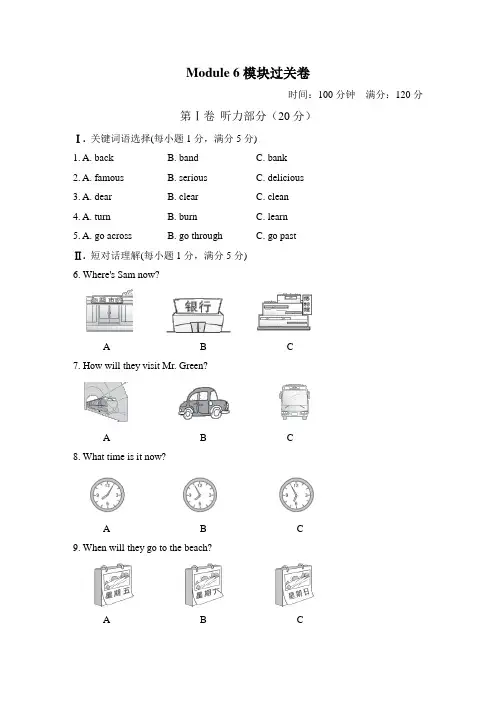
Module 6模块过关卷时间:100分钟满分:120分第Ⅰ卷听力部分(20分)Ⅰ. 关键词语选择(每小题1分,满分5分)1. A. back B. band C. bank2. A. famous B. serious C. delicious3. A. dear B. clear C. clean4. A. turn B. burn C. learn5. A. go across B. go through C. go pastⅡ. 短对话理解(每小题1分,满分5分)6. Where's Sam now?A B C7. How will they visit Mr. Green?A B C8. What time is it now?A B C9. When will they go to the beach?A B C10. What will the girl do tomorrow?A B CⅢ. 长对话理解(每小题1分,满分5分)听下面一段对话,回答第11至12小题。
11. Where is the woman going?A. To a bus station.B. To a bookshop.C. To a park.12. How is the woman going there?A. On foot.B. By bus.C. By bike.听下面一段对话,回答第13至15小题。
13. Where is the museum?A. Opposite the post office.B. In front of the supermarket.C. Between the post office and the supermarket.14. How long does it take to go to the museum on foot?A. About half an hour.B. About forty minutes.C. About an hour.15. How is the girl going to the museum?A. By bus.B. By taxi.C. By underground. Ⅳ. 听短文,补全表格中所缺信息(每小题1分,满分5分)第Ⅱ卷笔试部分(100分)Ⅴ. 单项填空(每小题1分,满分10分)21. The Children's Park is ________ the cinema.A. onB. acrossC. inD. opposite22. We can't go out for a walk ________ a rainy day.A. inB. atC. onD. with23. —Excuse me, where is the library?—________. I'm new here, too.—Thank you all the same.A. Sorry, I don't knowB. That way, pleaseC. This is the libraryD. There it is24. What's the most important thing ________?A. seeB. seeingC. to seeD. saw25. To my pleasure, my family are always ________ me whatever I decide to do.A. aboveB. behindC. fromD. through26. Walk ________ this street and you'll find the bank ________ the zoo.A. down;in the front ofB. along;in the front ofC. along;in front ofD. away;in front of27. Look at the picture on the right! She is going________.A. into the libraryB. out of the post officeC. into the supermarketD. out of the bank28. There is ________ underground station over there.A. aB. anC. theD. /29. —Why not ________ John a toy car for his birthday?—Good idea! He is crazy about toy cars.A. buyB. buyingC. to buyD. buys30. —________?—Go along this road and you'll see it on your left.A. How far is the stationB. Which bus can I takeC. Is there a station near hereD. Where is the stationⅥ. 完形填空(每小题1. 5分,满分15分)Most Chinese families like to have a holiday ________(31) summer. Summer is a good season ________(32) holidays. It is very hot during the months of July and August. Children do not go to school during these ________(33)months. Some ________(34) like to stay at home during the holiday. They work in the garden, ________(35) books, or ________(36) TV. Many families ________(37) their lunch to a park or somewhere far ________(38) the city. They like to eat where there are many trees or there is a nice lake. If they live near the sea, they often go to the beach. They can fish, swim or enjoy the sun there. China is a large country. Many families travel by ________(39) or by train to visit interesting places. They also travel by plane to a foreign country. Many big cities have many famous buildings, theatres, shops and other places ________(40) travellers.31. A. to B. in C. on D. at32. A. at B. under C. for D. about33. A. one B. two C. three D. four34. A. people B. peoples C. man D. woman35. A. see B. watch C. look D. read36. A. sees B. watch C. looks D. read37. A. takes B. take C. will take D. are taking38. A. from B. away C. to D. off39. A. car B. plane C. ships D. bikes40. A. for B. in C. on D. atⅦ. 补全对话(每小题1分,满分5分)X:Hi, Zhao Li. Where are you going?Z:(41)________X:To buy CDs? You needn't go to Xinhua Bookstore. There is a special club named Music Sound.Z:Music Sound? (42)________X:It is a place where people can exchange (交换) CDs with others.Z:Really? (43)________X:Sure. Go down this street and turn right at the fourth crossing. It's next to Hualian Supermarket.Z:How far is it?X:(44)________Z:Can I take a bus?X:Certainly.Z:(45)________X:The No. 3 bus or the No. 21 bus.Z:I see. Thank you.X:You're welcome!A. What place is it?B. You can buy a guidebook.C. It's about twenty minutes' walk.D. It's very nice of you.E. Could you please tell me how I can get there?F. Which bus can I take?G. Hi,Xiao Jian. I'm going to Xinhua Bookstore to buy some CDs.Ⅷ. 阅读理解(每小题3分,满分45分)ADear Betty,Thank you very much for your email. I know you'd like to visit the NationalMuseum in our city. It is a big and famous museum. Let me tell you the way to it. Take your car from your house and drive along Hongxing Street. Turn left at the third turning, not the last one. You'll see a park on your right. The museum is opposite the park. It is open from 9:30 am to 5:30 pm every day. There are lots of old things and paintings in the museum. I hope you can have a nice time there. But don't take a camera. You can't use it in the museum. There is a supermarket next to it. You can buy some souvenirs(纪念品)in it.Yours,Jerry46. Betty should turn left at the ________ turning in Hongxing Street.A. firstB. secondC. lastD. third47. Where is the museum?A. In the front of the park.B. On the right of the park.C. Opposite the park.D. Behind the park.48. Which of the following is TRUE?A. This email is from Betty to Jerry.B. The museum closes at half past five in the afternoon.C. You can take photos of the things in the museum.D. You can't see any paintings in the museum.BBeakl ey gets a letter from his grandma. It says, “Please come and visit me soon. ”Beakley puts his green toothbrush (牙刷) and some socks into his bag. He takes his favourite toy Bunny, too. His friend Weber goes with him.They take a yellow taxi to the airport. “This airport is very big,” says Beakley. “I am scared(恐惧的) of flying. Maybe we should drive there. ” “No,” says Weber. “It's too far. The pilot can fly over buildings and trees just like a bird. ”Flying is fantastic and soon they land (着陆). And then Beakley takes a big purple boat with Weber. It crosses the sea to a big island (岛). On the island, Beakley and Weber take a train. After getting off the train, they rent (租) a bike. “This goes very fast. This is fun,” says Beakley.Finally they get to a pink house and Grandma waits for them.49. What's in Beakley's bag?A. Some socks.B. A small bird.C. Some fruits.D. A good book.50. The underlined word “pilot” means ________ in Chinese.A. 宇航员B. 飞行员C. 研究员D. 测试员51. What does Beakley think of riding a bike?A. It's hard.B. It's interesting.C. It's not fast.D. It's dangerous.52. Which of the following is TRUE according to the time order (依据时间顺序)?A. Plane→bike→train→taxi→boatB. Taxi→boat→plane→bike→trainC. Taxi→train→bike→boat→planeD. Taxi→plane→boat→train→bike53. What's the best title (标题) for the passage?A. Beakley and his grandmaB. Beakley's toy BunnyC. Beakley and Weber's tripD. Beakley and his friendsCDear Mike,I know that you are coming to my city next week. Welcome to my home. Let me tell you the way to my home. After you walk out of the bus station, go straight along North Park Street. The street is old but clean. It will take you thirty minutes to walk to Hospital Street. If you take a taxi, it will take you five minutes. Then go straight along Hospital Street. You can stop when you see a school. It will take you five minutes. There is a supermarket opposite the school. The supermarket has got a big square and is famous in the city. My home is behind the supermarket. There is a payphone in frontof the supermarket. You can call me and I will meet you there.I hope you will have a good trip.Yours,Li Qiong54. How will Mike come to Li Qiong's city?A. By taxi.B. By plane.C. By bus.D. By train.55. How is North Park Street?A. It is old and dirty.B. It is new but dirty.C. It is new and clean.D. It is old but clean.56. How long will it take Mike to get to the school on foot from the bus station?A. For 5 minutes.B. For 10 minutes.C. For 25 minutes.D. For 35 minutes.57. Which of the following is TRUE about the supermarket?A. There is a payphone in it.B. It's famous in the city.C. It's behind Li Qiong's home.D. It has got a small square.阅读下面短文,并用英语回答问题(请注意每小题后面的词数要求)。
七年级英语下册 Module 6 Around town(语法篇)试题 (新版)外研版
Module 6____________________________________________________________________________________________________________________________________________________________介词的用法方位的表达方式问路与指路的表达方式常用介词的基本用法一、表示时间的常用介词181.at多用于具体钟点前,如:at seven, at ten to nine;也可用于固定搭配中,如:at noon,at night。
2.In表示一段时间,用于年、月、季节、或泛指的一天的上午、下午、晚上等前。
如:in the morning,in summer,in 2016;还可用于表示“从现在起,多长时间以后或多久之后”的短语中。
3.On主语用在星期几、具体某一天的早、中、晚或节日前。
如:on June 1st, on Monday。
4.after表示以过去为起点的某一段时间之后,用于过去时。
如:They finished the work after two years.after 还可与时间点连用表示将来某个时间之后。
如:I’ll ring you up after two o’clock.5.until与否定词连用,译为“直到。
才”,其前的谓语动词多用瞬间性动词;until用在肯定句中,译为“直到。
为止”,其前的谓语动词需用延续性动词。
如:I didn’t leave until my mother came home.6.before和after表示时间,分别译为“在。
之前”和“在。
之后”。
如:Please bring your homework before ten o’clock.二、表示地点的介词1.表示方位的in, on,toin表示在某一地区之内;to表示在某一地区之外;on表示与某地的毗邻关系。
七年级英语下册外研版module6 Around town测试题
七年级英语下册外研版module6 Around town测试题一、英汉互译1 去······的路____________2 在右边____________3到达____________ 4多谢______________5沿······前行____________ 6在······前面____________7左拐_____________ 8在那边____________9 an underground station___________10 take a bus_____________11 have a nice day____________ 12 in the middle of_________13 on a clear day____________ 14 the best way____________15 begin with______________ 16 walk along_____________17 tour of London____________ 18 下船_________________19 欢迎到________________ 20 坐船回去_____________21 走过教堂________________ 22在广场上_____________23 去邮局________________ 24 一直走_______________25 在街道的尽头______________ 26 on the other side of_______27 learn about____________ 28 a part of_________________29 excuse me_____________ 30 do some shopping____________二、根据汉语提示完成句子1 Uncle Wang works in a ____________(银行)2 Is there a ____________(博物馆) in your city?3 You can get many kinds of books you need in the __________(书店).4 The station is ____________(在······对面) the National Gallery.5 Please be careful when you go____________(越过)the street.6 Many ____________(游客) go to France and Italy in summer.7 You’ll see an ____________(地铁) station over there.8 Please____________(换方向) left at the third street on the left.9 There are many famous__________(油画) in the National Gallery. 10 My family will have a short ____________(游览) of the West Lake.11The London Eye can take you to see most of London on a ____(晴朗的) day.12 The Great Wall is very___________(著名的).13 A____________(教堂) is a building in our city.14 When do you ____________(完成) writing that email.15 There is a picture__________(在······之上) the bookshelf.三、单项选择1 Welcome to London! The London is________.A at rightB on your rightC in your rightD right2 The friendship ________China________the US has a long history.A of; withB between andC between; toD with; and3 We often have a walk________the river after supper.A onB atC overD by4 The bookshop is________the right side of the road.A onB atC overD of5 Turn left________Hope Street, and it’s on your right.A inB intoC onD of6 You can________the garden.The hotel is________your left.A walk across onB walk cross atC across inD walk at7 There is a bridge________the river.A atB inC overD along8 Please________the boat________Tower Bridge.A get off atB get of atC get off inD to get off at9 We ________opposite the National Gallery.A standB are standingC standsD standing10 When you are tired ,the best way________London________by boat.A see isB seeing beC to see isD sees are四、根据汉语完成句子1 打扰一下,你能告诉我去王府井大街的路吗?Excuse me,can you tell me________ ________ ________Wangfujing Dajie?2 穿过东长安街,沿着这条街直走,左转,在第三条街的左边。
【2020】最新七年级英语下册Module6Aroundtown语法篇试题新版外研版
3. The writer’s purpose in telling his story is to ____.A. show the drugs’ dangerB. thank his motherC. warn his friendsD. help other peopleCSometimes you think your teacher hates you? You’re not the only one. Teachers and students sometimes have personality clashes(冲突), just like any two people who don’t get along. After all, teachers aren’t perfect.* Is your teacher angry at you personally, or at something you’ve been doing?All teachers have something that they strongly dislike. Maybe your teacher hates it when people whisper(低声说话) in class. If you try hard not to do these things, the situation might get better. * Are you the only person being treated badly, or is your teacher shouting at the whole class?Ask your classmates if they’ve been having trouble with the teacher too. If they say yes, perhaps your teacher is having problems outside of school, or is new and feels something badly. *Are you working up to your ability?You and the kid sitting beside you both got a C on the last test, and your teacher told you that you could do better, but didn’t say anything to her! Isn’t this unfair? Well, teachers often treat different students in different levels in different。
[小初高学习]七年级英语下册 Module 6 Around town(语法篇)试题 (新版)外研版
Module 6______________________________________________________________________________ ______________________________________________________________________________介词的用法方位的表达方式问路与指路的表达方式常用介词的基本用法一、表示时间的常用介词1.at多用于具体钟点前,如:at seven, at ten to nine;也可用于固定搭配中,如:at noon,at night。
2.In表示一段时间,用于年、月、季节、或泛指的一天的上午、下午、晚上等前。
如:in the morning,in summer,in 2016;还可用于表示“从现在起,多长时间以后或多久之后”的短语中。
3.On主语用在星期几、具体某一天的早、中、晚或节日前。
如:on June 1st, on Monday。
4.after表示以过去为起点的某一段时间之后,用于过去时。
如:They finished the work after two years.after 还可与时间点连用表示将来某个时间之后。
如:I’ll ring you up after two o’clock.5.until与否定词连用,译为“直到。
才”,其前的谓语动词多用瞬间性动词;until用在肯定句中,译为“直到。
为止”,其前的谓语动词需用延续性动词。
如:I didn’t leave until my mother came home.6.before和after表示时间,分别译为“在。
之前”和“在。
之后”。
如:Please bring your homework before ten o’clock.二、表示地点的介词1.表示方位的in, on,toin表示在某一地区之内;to表示在某一地区之外;on表示与某地的毗邻关系。