
新pep版英语六上Unit2 Read and write
It’s fast.
In Papa Westray, Scotland,the
children go to school by ferry,
Some children in Jiangxi, China,
too. But in 2009, they went to
school b_y_p_la_n_e because the
go to school b_y_f_e_r_ry every day. ferry didn’t work.
Some children go to school o_n__f_o_o_t in M__u_n_ic_h_,__G_e__rm__a_ny.
2.You can help each other.
(组员之间相互帮助,相互补充。)
3.You only have 3 minutes.
(在3分钟内完成。)
4.Hands up and be quiet after the task.
(完成后,举手示意,并保持安静。)
1. When they see the traffic lights, what must they do?
to school by ferry, too.
But in 2009, they went
to school by plane
3. What does the
because the ferry didn’t work.
word “work” mean at A. 行驶,运作 B. 著作,事业
Does everyone in the
In Papa Westray, Scotland,the
children go to school by ferry,
Some children in Jiangxi, China,
too. But in 2009, they went to school by plane because the
(任务2:快速阅读,回答问题。)
How many 1wmaiynustet!o go to schoUondl e(cr1al分inne钟yt快oh速eu k阅fei读ynd!ph)irnastehs!e text? Underl(in直e线t划he出m关.键词!)
(找到答案快速举手!)
Go
4 8 12 16 20 24 28 32 36 40 44 48 52 56 60
go to school by ferry every day. ferry didn’t work.
Some children go to school
on foot in _M_u_n_ic_h_, _G_e_r_m_any.
In _A_la_sk_a_, _U_SA, it snows a lot.
Westra(y, 用Sc波otl浪and线? W划h出y?答案关键句!)
3. What does the w4ordm“iwnourtke” sm!ean at the end of the
text?
(4分钟内完成哦!)
A. 行驶,运作 B. 著作,事业
Go
1
2
3
4
In Alaska, USA, it snows a lot. Some kids go to school by sled. It’s fast.
Some children go to school by_f_er_r_y __ inP_a_p_a_W_e_st_ra_y_ , _Sc_o_l went to school by_pl_an_e__.
Different ways to go to school
Germany.
In Alaska, USA, it snows a lot. Some kids go to
’ ’ school by sled. It’s fast. ’Some children in Jiangxi, China, go to school by
’ferry every day.
2. Can they let the dogs run too fast?
3. What must they wear when they go to school by ferry?
4.What can’t they do on the ferry?
liaison (连读)
Some children go to school on
(任务1:快速阅读,划出关键词。)
How many1 wmianuytse! to go to schUondoelr(cl1in分aen钟th快yeo速uk阅e读fyi!nph)draisnest! he text? U(n直d线e划rl出in关e键词th!e)m.
(小组完成举手示意!)
Task 1: Read quickly and answer.
Sure!
Task 2: Read and answer in pairs.
(任务3:同桌一起小声朗读,并回答问题。)
1. Why do the kids go to school by sled in Alaska, USA?
Underline the key sentences 2. When did thewcihtihldrewnagvoytolsicnheosol! by plane in Papa
[‘fe ri ] 轮渡
In Papa Westray, Scotland, the children go to school by ferry.
But in 2009, they went to school by plane
because the ferry didn’t work. [wɜ:k]
Some kids go to school by sled. It’s fast.
In _Pa_p_a_W_e_s_tr_a_y,_S_c_ot_la_nd,the
children go to school by ferry,
Some children in J_ia_n_g_x_i,_C_h_i_na,
f’ oot in ’Munich, Germany.
连读:前一个词以辅音结尾,后一个词以元 音开头,可以连读。
come and have a look
stop at a red light pictures of
请找出连读
In Alaska, USA, it s’nows a lot.
请找出连读
[‘mju:nik]
德国慕尼黑
rains a lot 多雨
slow life 慢生活
Alaska, USA [ə’læ s kə]
美国阿拉斯加州
snows a lot
cold
Jiangxi, China
many mountains many rivers
Papa Westrary, Scotland
But in 2009, they went to school by
plane because the ’ferry didn’t ’work.
Task 4:DRieffaedrietnbtewttaeyr(s 任to务g4:o 朗to读更sc进h一oo步l )
’ ’ Some children go to school on foot in Munich,
In Alaska, USA, it snows a lot. Some kids go to school by sled. It’s fast.
A. It often snows. B. Sometimes it snows.
Some children in Jiangxi, China, go to school by ferry every day.
Yes!
text go to school?
Please tell them….
Task 3: Look, read and imagine. (任务3:图文结合,展开想象。)
Group work( 4人小组活动) 1. Answer one question at least.
(每人至少回答一个问题。))
1. Why do the kids go to school by sled
2. When did the children go to school
by plane in Papa Westray, Scotland?
In Papa Westray,
Why?
Scotland, the children go
Good to know
生活在这座偏远海岛上的6位孩子每周 坐飞机往返学校和家里。
2009年,轮渡翻修暂停服务,在此期间, 这6位孩子只能坐飞机到韦斯特雷去上初中。
Some children in___,____,go to school____.
Some children in___,____,go to school_____.
Munich, Germany
Alaska, USA
Jiangxi, China
Papa Westray,Sctoland
Some children go to school by______ in_____,_____.
Thanks, Robin. I have some other questions. Can you read it again?
Unit2 Ways to go to school
B. Read and write
pep 六年级上 Unit 2 Read and write

Unit2
Ways to go to school
课型
Part B Read and write
备课时间
教学内容
本课时分为读、写、语音三部分:第一部分要求学生阅读图片和文段并回答两个问题;第二部分为有意义的以读促写活动,分两个步骤:第一步为前文提到的小朋友选择交通建议,第二步为朋友制作交通建议的海报;第三部分为语音意识培养,要求通过示例掌握文段中的连读现象。
(二)阅读中
1. Read the text quickly. Underline the difficult words or sentences with “~~~”. Help each other in groups.
2. Read the text quickly. Underline the ways with “——”. Underline the places with“~~~”.
教学目标
1.能借助图片读懂简单的故事或小短文,并养成自主阅读的习惯;
2.能根据拼读的规律,读出简单的句子。
学习目标
1.能借助图片读懂简单的故事或小短文,并养成自主阅读的习惯;
2.能根据拼读的规律,读出简单的句子。
教学重点
通过合作学习,能阅读短文并完成课后相应练习。
教学难点
根据阅读所获取的信息写文章梗概。
2.热身/复习(Warm-up/Revision)Sing a song
教师播放歌曲“How do you get there?”,学生跟唱。
Read.
Sing a song.
二、呈现新课
(Presentation)
Read and write
(一)阅读前
1.show a picture of Wuyifan`s grandpa.
最新pep人教版六年级英语上册Unit 2 Ways to go to school第5课时 Read and write教案
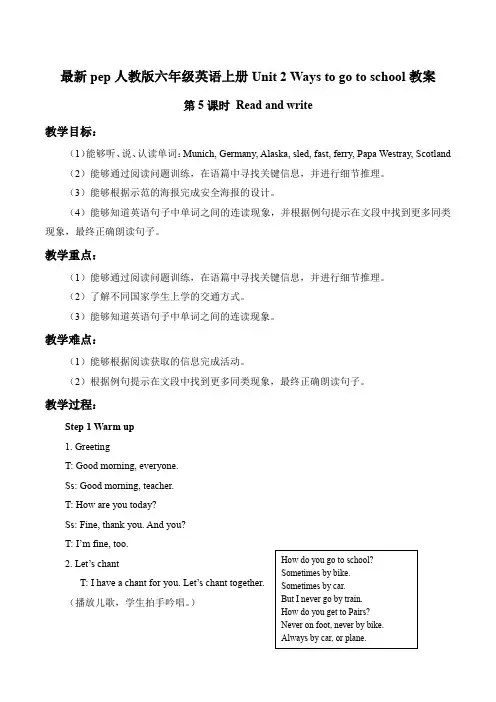
最新pep人教版六年级英语上册Unit 2 Ways to go to school教案第5课时Read and write教学目标:(1)能够听、说、认读单词:Munich, Germany, Alaska, sled, fast, ferry, Papa Westray, Scotland (2)能够通过阅读问题训练,在语篇中寻找关键信息,并进行细节推理。
(3)能够根据示范的海报完成安全海报的设计。
(4)能够知道英语句子中单词之间的连读现象,并根据例句提示在文段中找到更多同类现象,最终正确朗读句子。
教学重点:(1)能够通过阅读问题训练,在语篇中寻找关键信息,并进行细节推理。
(2)了解不同国家学生上学的交通方式。
(3)能够知道英语句子中单词之间的连读现象。
教学难点:(1)能够根据阅读获取的信息完成活动。
(2)根据例句提示在文段中找到更多同类现象,最终正确朗读句子。
教学过程:Step 1 Warm up1. GreetingT: Good morning, everyone.Ss: Good morning, teacher.T: How are you today?Ss: Fine, thank you. And you?T: I’m fine, too.2. Let’s chantT: I have a chant for you. Let’s chant together.(播放儿歌,学生拍手吟唱。
)Step 2 Lead in1. Ask and answerT: How do you come to school?S1: I come......T: Do you come to school by plane/by train/...?Ss: No, I don’t.2. T: Look at the picture.(呈现吴一凡的爷爷卧病在床的图片)Who is he? Ss: He’s Wu Yifan’s grandpa.T: He’s ill. What does Robin want to do?Ss: He wants to read a magazine to him.(引导学生说出)T: What’s it about? Let’s have a look together.Step3 Presentation1. 阅读前(1)呈现第一幅图。
人教PEP英语六年级上册Unit2 read and write
4.do some exercises on the PPT.
1.Finish the blanks.
2.Group work.
3.Retell the text.
4. finish the exercises on PPT.
通过小组操练对话内容并表演出来,增强学生的积极性。通过调查表来巩固学生对知识的灵活运用。
2.She is going to make mooncakes.
3.She will tell a story.
Homework
1.Copy the passage one time and recite.
2.Finish the exercises in Tongbu.
3.Preview the next lesson.
Out-put
Review the whole lesson and the homework.
Try to have good hobbies.
情感目标的延伸,教导学生如何问路。
Board writing
Unit2 Waysto go to school
Read and write
1.Robin and Wu are going to read a poem
情感目标:让孩子们了解个别节日的习俗,激发学生对生活的追求。
Teachingfocus:
be going to do结构在生活中的正确使用
Teaching procedures
Steps
Teachers’ activities
Students’ activities
purpose
人教PEP版六年级上册英语 Unit2PartB Read and write教案
Unit2 《Ways to go to school》教案第五课时(Part B Read and write)教学目的:1.通过本课的学习,使学生掌握四会词汇:Munich, Germany, Alaska,sled, fast, ferry, Westray, Scotland.2.在学生掌握句式的基础上熟练运用:Some kids go to school by sled. It’s fast.But in 2009, they went to school by plane because the ferry didn’t work. You must stop at a red light.Don’t go at a red light.教学重点词汇: Munich, Germany, Alaska, sled, fast, ferry, Westray, Scotland.掌握并能正确运用句式:Some kids go to school by sled. It’s fast.But in 2009, they went to school by plane because the ferry didn’t work. You must stop at a red light.Don’t go at a red light.教学难点: 能够听说对话并用:But in 2009, they went to school by plane because the ferry didn’t work. Don’t go at a red light.You must stop at a red light.教具准备: PPT教学过程:Step1 Let’s chant1.让学生学说chant.练习乘车方式:by car, by bus, by bike, by train, walk.Step2. Free talk1. Let’s talk(1).出示教学图片,让学生观察图上的交通工具,教会学生掌握四会词汇:on foot, by, bus, plane, taxi, ship, subway, train等。
5.人教pep版-六上unit2-partB-Read and write
What suggestions will you give to your friends? Make a poster.
Present-Read and write Look, listen and say
Language points
英语句子中连读的运用: 1.在同一个意群(意思密切相关的一组词)中,如果前一个 词的读音以辅音结尾,后一个词的读音以元音开头,前边
我乘公共汽车去公园。
Summary
1.如何询问对方的出行方式: How do you come(to)+地点? 你(们)怎么来……的? 2.回答交通方式: (1)go to+地点名词+by+交通工具名称 =take a/an+交通工具名称+to+地点名词 (2)walk to+地点名词 =go to+地点名词+on foot
Present-Read and write Listen and read
by sled 坐雪橇
Present-Read and write Talk
How many ways can you think of to go to school? Talk with your partner.
Present-Read and write Talk
的辅音和后边的元音可以连起来读,这种现象叫连读。
2.用符号“ ︶ ”表示。 3.连读所构成的音节一般不重读。
Practice
根据中文含义补充句子。 go to the park? — _______ How do you_______
你怎么去公园? by — I go to the park_______ bus.
小学英语人教PEP新版六年级上册Unit 2read and write
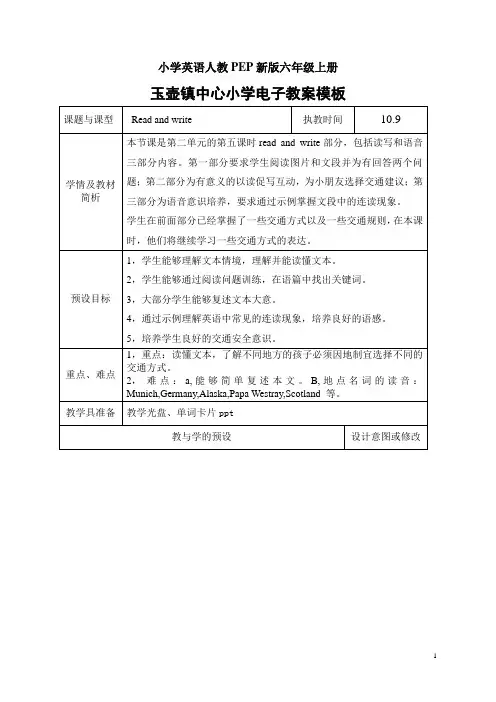
1,重点:读懂文本,了解不同地方的孩子必须因地制宜选择不同的交通方式。
2,难点:a,能够简单复述本文。B,地点名词的读音:Munich,Germany,Alaska,Papa Westray,Scotland等。
教学具准备
教学光盘、单词卡片ppt
教与学的预设
设计意图或修改
1,warm up:
学生在前面部分已经掌握了一些交通方式以及一些交通规则,在本课时,他们将继续学习一些交通方式的表达。
预设目标
1,学生能够理解文本情境,理解并能读懂文本。
2,学生能够通过阅读问题训练,在语篇中找出关键词。
3,大部分学生能够复述文本大意。
4,通过示例理解英语中பைடு நூலகம்见的连读现象,培养良好的语感。
5,培养学生良好的交通安全意识。
T: The pictures can help us,and the sentences can help us,too.
Look at the picture one,how do the kids go to school?
S: On foot.
T: How do the kids go to school in picture2? Can you find the phrase the sentence?
T: Maybe there are many rivers in Jiangxi.
T:Why do kids in Papa Westray go to school by plane?
Read and find the answer.
S: The ferry didn’t work.
T:So the children went to school by ferry before 2009, but since 2009 the kids went to school by plane.
人教版PEP六年级上册英语第二单元教学课件 Read and write
二、能力目标:
1.能运用句型“You must…”和“Don’t…”,并结合现实生活给朋 友提出交通安全建议。 2. 通过阅读,提高获取信息的能力。
三、情感目标:
了解不同国家学生上学的交通方式。
Unit2 Ways to go to school? B Read and write
by car
Different ways to go to school.
不同的上学方式。
Ways to go to school
Let’s find some more…
05. 2016
Different ways to go to school
美国 阿拉斯加
Some children go to school on 德国 慕尼黑 foot in Munich, Germany . Munich, Germany
本课时教学目标
一、知识目标:
1.能听、说、认读单词Munich, Germany, Alaska, sled, fast, ferry 和Papa Westray, Scotland; 2.能够在图片的帮助下理解Read and write杂志里有关上学交通 方式的报道。 3.了解英语句子中单词之间的连读现象,如:Stop at a red light...
Papa Westray, Scotland By plane
Pay attention!
Pappy
You must Don’t
_ at stop a red light. go a red light. at
________
________
It’s a life jacket.
救生衣
You must wear a Don’t run on the ferry.
新版pep六年级英语上册Unit2 read and write
Underline the key words! (用直线划出关键词!)
Some children go to school on foot in Munich, Germany. _____
In Alaska, USA, it snows a lot__ by sled. It’s fast.
Germany/'dʒə:məni / 德 国 Munich/ 'mju:nik/慕尼黑 USA美国 Alaska/ə'læskə/ PaPa Westray,Scotland 阿拉斯加州 /,pa:pə 'westrei 'skɔtlə nd/ 苏格兰,帕帕维斯特雷岛
根据课文内容填空:
In Munich,Germany, some children goes to school on ________; In foot Alaska,USA, some kids goes to school ________; by sled In Jiangxi,China, some children goes to by ferry In Papa school________; Westray,Scotland, the children go to school________, by ferry but in 2009, they go to school ________. by plane
Tips for pronunciation
Listen, look and say.
come and have a look
pictures of stop at a red light.
Tips for pronunciation
PEP人教版六年级英语上册《Unit2_B_Read_and_write公开课教案》
教材图片:Unit2 Part B Read and write教材:人教PEP小学英语六年级上册P18-P19单元主题:Ways to go to school课型:阅读课一、教材解析本课时是六年级上册Unit2的第五课时,包含B Read and write。
本课时分为读、写、语音三部分:第一部分要求学生阅读图片和文段,回答问题;第二部分为有意义的以读促写活动,分为两个步骤:第一步为前文提到的小朋友选择交通建议,第二步为朋友制作交通建议的海报;第三部分为语音意识培养,要求通过示例掌握文段中的连读现象。
二、目标预设1. 学生通过头脑风暴活动汇总自己所知的各种上学方式,激活已有的背景知识和储备词汇。
2. 通过阅读问题训练,学生能在语篇中寻找关键词,并能进行细节推理;能根据示范的海报完成安全海报的设计。
3. 能根据例句提示在文段中找到更多同类现象,最终正确朗读句子。
三、重难点预设教学重点:理解短文并完成课后相应练习。
教学难点:地名比较难读;根据思维导图提示复述文段。
四、教学过程(一)阅读前(Pre-reading)1. 师生相互问候,练习课堂口语。
2. 播放热身歌曲How do you go to school? 学生跟唱,进行课堂热身。
3. 师生讨论各自来学校所采用的交通方式。
4. Brainstorm:学生进行头脑风暴,说一说自己所知道的上学的方式。
5. Listen and answer教师请学生猜猜看:How does Robin go to school?学生听Robin所说的话:I don’t go to school. I learn at home. 了解Robin并不去学校,他在家学习,引出本课内容。
(二)阅读中(While-reading)1. Read and answer教师呈现吴一凡的爷爷卧病在床的配图,提问:Who is he? He is Wu Yifan’s grandpa. He is ill. What does Robin want to do? He wants to read a magazine to him.2. Read and choose: What’s it about?A. Different ways to travelB. Different ways to go to school3. Read and answer学生快速阅读,找出文中总共提到几个地点及几种交通方式。
人教PEP版小学英语六年级上册教学设计(Unit2 B.Read and write)
教学课件说明(B.Read and write)Read and write一、Pre-reading1.Free talk:让学生用句型A: How do you come to school? B: I usually/often/sometimes come … .进行句型操练,巩固复习前面所学内容。
2.Brain storm:让学生思考自己所知道的上学的出行方式,回顾所学的交通方式,并为学习本节课内容作铺垫。
二、学习新知1.快速阅读课本Read and write部分的文章,让学生总结文章大意,熟悉本课大致内容。
2.再次阅读,让学生找出文中各地学生的出行方式,考查学生对出行方式的熟练度。
3.阅读文章,让学生找出文中出现的地方或城市。
4.讲解文中的单词、词组等,让学生了解文中出现的各地学生是如何上学,并对出现的城市(慕尼黑,阿拉斯加州,江西,苏格兰帕帕维斯特雷岛)进行文字和图片的简要介绍,扩充学生的知识面。
三、巩固练习1.Read and match:通过学习文章,考查学生是否掌握学生的出行方式。
2.归纳文中出现的新词。
3.根据课文内容,填写出行方式。
四、拓展学习通过文中的介绍,拓展一些其它地区(云南)学生的出行方式。
五、巩固练习1.通过图片展示和词组展示,让学生根据图片和自己的了解,对图片上呈现的地区学生的出现方式进行说明。
2.Discuss in group:通过图片,让学生总结图片情境下需要注意的交通规则(You should/We must…、Don’t…)。
3.通过学习其他地区学生的出行方式(步行、轮渡、雪橇、索道等),呼吁学生珍惜我们的学习时间和校园生活。
六、Homework课外作业的布置。
让学生回归课本,通过作业的形式,巩固本次课所学内容,并为下次课的学习做准备。
PEP小学英语六年级上册重点单词和句型练习一、重点单词Unit 1:by ( ) foot( ) bike( ) bus( ) train( ) how( )go to school() traffic()traffic light()traffic rule()stop()wait() get to()Unit 2library( ) post office( ) hospital( ) cinema( ) turn( ) bookstore( ) where( ) please( )next to( ) right ( ) left( ) straight( )then ( )Unit 3next week( ) this morning( ) this afternoon( )this evening ( ) comic book( ) post card( )newspaper( ) buy( )Unit 4hobby( ) ride a bike--riding a bike( ) dive--diving( )play the violin—playing the violin( ) make kites—making kites( ) collect stamps—collecting stamps( ) live –lives( ) teach--teaches( ) go--goes( ) watch--watches( ) read--reads( ) does doesn’t=does notUnit 5singer( ) writer( ) actor( ) actress( ) artist( ) TV reporter( ) engineer( ) accountant( ) policeman( ) salesperson( ) cleaner( ) where() work()Unit 6rain( ) cloud ( ) sun( ) stream( ) come from( ) seed( ) soil( ) sprout ( ) plant( )should ( ) then( )Unit 1: ▁▁(经,乘) ▁▁(脚) ▁▁(自行车) ▁▁(公共汽车) ▁▁(火车)▁▁(怎样) ▁▁▁▁(上学)▁▁▁▁(交通)▁▁▁▁▁▁(交通灯)▁▁▁▁▁▁(交通规则)▁▁(停,停车站)▁▁(等待)▁▁▁▁(到达)Unit 2 ▁▁▁▁(图书馆) ▁▁▁▁(邮局) ▁▁▁▁(医院) ▁▁▁▁(电影院)▁▁(转弯) ▁▁▁▁(书店) ▁▁▁(在哪里,到哪里) ▁▁▁(请)▁▁▁(与…相邻) ▁▁▁ (右边) ▁▁(左边) ▁▁▁(成直线地) ▁▁▁(然后)Unit 3 ▁▁▁▁▁(下周) ▁▁▁▁▁(今天上午) ▁▁▁▁▁(今天下午)▁▁▁▁ (今天晚上) ▁▁▁▁(漫画书) ▁▁▁▁(明信片) ▁▁▁▁ (报纸) ▁▁▁(购买)Unit 4▁▁▁(爱好) ▁▁▁▁▁--▁▁▁▁▁▁(骑自行车) ▁▁▁--▁▁▁(跳水) ▁▁▁▁▁▁—▁▁▁▁▁▁▁(拉小提琴) ▁▁▁▁▁—▁▁▁▁▁▁▁(制作风筝) ▁▁▁▁▁▁—▁▁▁▁▁▁(集邮) ▁▁▁–▁▁▁(居住)▁▁▁▁--▁▁▁▁(教) ▁▁--▁▁▁(去) ▁▁▁--▁▁▁(看)▁▁--▁▁▁(读,看) does doesn’t=▁▁▁▁Unit 5▁▁▁▁(歌唱家,歌手) ▁▁▁▁(作家) ▁▁▁▁(男演员) ▁▁▁▁(女演员) ▁▁▁▁(画家) ▁▁▁▁(电视台记者) ▁▁▁▁(工程师) ▁▁▁(会计) ▁▁▁▁(男警察) ▁▁▁▁▁▁(销售员) ▁▁▁(工作)▁▁▁▁(清洁工) ▁▁▁▁(在哪里,到哪里)Unit 6▁▁▁(雨) ▁▁▁ (云) ▁▁▁(太阳) ▁▁▁▁(河,溪) ▁▁▁▁(来自,从…来) ▁▁▁(种子) ▁▁▁(土壤) ▁▁▁ (苗,芽) ▁▁▁(植物,种植) ▁▁▁(应该) ▁▁▁▁(然后)二、单词分类1)交通方式:by bus, by train, by subway, by ship, by plane, by car, on foot2)文具书籍:dictionary, newspaper, comic book, post card3)职业:singer, writer, TV reporter, actor, actress, engineer, accountant, salesperson, policeman, policewoman,artist, cleaner4)V-ing形式:riding a bike, collecting stamps, diving, making kites, playing the violin5)第三人称单数形式:lives,teaches, watches, goes, does, doesn’t6)公共场所:library,post office, cinema, hospital, science museum, bookstore7)方位:east, west, south, north, turn left, turn right, go straight8)交通灯; red light, yellow light, green light9)自然:sun, cloud, rain, vapour, stream六年级上册四会句子1.你是怎样去上学的?▁▁▁▁▁▁▁▁2.通常我走路去上学。