
5A Unit4知识点 五年级上册英语 译林版
Unit Four五2 徐子宽【词汇】1. hobby 爱好2. be good at 擅长于3. with 与……一起4. also 也5. read 读,阅读6. story故事7. a lot of 很多8. play the piano 弹钢琴9. dance 跳舞10. watch films 看电影11. sing 唱歌12. both 两个都13. group 组14. idea 主意15. ice 冰16. hole 洞17. Look out! 当心!注意!18. wet湿的,潮的【词组和短语】1. play basketball well 篮球打得好2. play football 踢足球3. be good at 擅长4. like drawing 喜欢画画5. in the park 在公园里6. with my brother 和我弟弟一起7. play table tennis 打乒乓球8. read stories 读故事9. a lot of books 许多书10. play the piano 弹钢琴11. like dancing 喜欢跳舞12. watch films 看电影13. like swimming 喜欢游泳14. talk about谈论15. their hobbies他们的爱好16. in winter 在冬天17. like skating喜欢滑冰18. skate very well 滑冰滑得很好19. have an idea 一个主意20. go skating 去滑冰21. this afternoon今天下午22. a great idea一个好主意23. skate on the ice 在冰上滑24. look out 小心25. cold and wet又冷又湿26. in our group 在我们组里27. a hole in the ice 冰上一个洞【语法】like + doing sth 意为(习惯性或经常性)喜欢做某事,like后面的动词要用其名词形式,即动词+ing形式。
1. 动词接ing的变化方式:(1) 一般在动词末尾加ing, 如:think → thinking stand → standing study → studying(2) 以不发音字母e结尾的动词,先去掉e, 再加ing,如skate → skating make → making dance → dancing write → writing have → having ride → riding come → coming(3) 以重读闭音节结尾的动词,末尾只有一个元音字母(闭音节),以及一个辅音字母, 应双写末尾的辅音字母,再加ing, 如:put →putting run-running swim → swimming jog → jogging sit → sitting chat-chatting2. like doing sth句式变化:肯定句:主语+ like(s) + doing +…当主语是第三人称单数时,like后面要加s,如:I like singing. They like dancing. He likes playing basketball. She likes skating.否定句:主语+ don’t/ doesn’t + like + doing + ….,如:I don’t like singing. They don’t like dancing.He doesn’t like playing basketball. She doesn’t like skating.一般疑问句:Do/ Does + 主语+ like + doing + …? 如:Do you like sing? Do they like dancing?Does he like playing basketball? Does she like skating?特殊疑问句:疑问词+ do/ does + 主语+ like + doing + …? 如:What do you like? What do they like doing? What does he/she like (doing)?句型训练:My name is Pat. I have a lot of hobbies. I like _________(draw) and ________(play) the piano. I like _________(fish) and __________(shop), too. But I don’t like _________(listen) to music or _________(dance). I have a good friend. Her name is Allan. She ________ (like) ________ (play) basketball and _________(have) a picnic. She __________(not like) __________(read) or ___________(run).【知识点分析】一、A. I like playing basketball. B. She also likes playing the piano.注意:球类不加the,乐器要加the。
1. 作及物动词的playplay 用作及物动词时的含义较多,用法也不尽相同。
(1) 表示“玩”,后接“牌、游戏、棋类”等名词。
此时这些名词前不用冠词。
如:Many people like playing cards. 很多人喜欢打牌。
Don’t play chess in the classroom. 不要在教室里下象棋。
(2) 表示“打(踢)球”、“参加(体育活动、比赛)”等。
此时表示球类名词前不加冠词。
如:Can you play football? 你会踢足球吗?Let's go and play table tennis. 让我们一起去打乒乓吧。
He can play the piano. 他会弹钢琴。
She likes playing the violin after school. 她喜欢在放学后拉小提琴。
2. 作不及物动词的playplay用作不及物动词,常和介词with相连,表示“玩”、“玩耍”。
如果说play 的“玩”是进行比较正规的文体活动,那么play with的“玩耍”就是表示进行非正规的游戏,尤指小孩利用玩具或其他东西来娱乐。
如:The little boy can play with a yo-yo. 这个小男孩能玩溜溜球。
Don't play with fire. It's very dangerous. 别玩火,那很危险。
二、too, also和either的区别A. He likes playing football too. 他也喜欢踢足球。
B. She also like playing the piano. 她也喜欢弹钢琴。
C. Don’t be sad, Bobby. I can’t fly either. 别伤心。
我也不会飞。
(4A Unit4)以上三个句子中too, also, either三个单词都有“也”意思,但在句子中的用法有所不同。
1. too用在肯定句句尾,如:I'm a student, too.我也是个学生。
2. also放在句中,位于行为动词之前;位于系动词, 助动词或情态动词之后。
如:Mrs Green can also sing the song in Chinese.格林夫人也能用汉语唱这首歌。
They also have fish shops in that small town.那个小镇上也有鱼店。
3. either 表示“也”时一般只用于否定句,且只置于句末。
如:I don't know him.Tom doesn't know him,either.我不认识他,汤姆也不认识他。
He doesn’t have apples. She doesn’t, either. 他没有苹果,她也没有。
三、on the ice和in the ice的区别A. Sam and Billy skate on the ice.B. There is a hole in the ice.on the ice和in the ice从字面上翻译都解释为“在冰上”。
on the ice表示物体只和冰有接触面,而没有穿到冰里去。
in the ice表示物体穿过这个冰层,在冰的里面。
类似还有:on the wall/ in the wall 如:There is a picture on the wall. 墙上有一幅画。
There is a window in the wall. 墙上有一扇窗。
四、A. I’m not good at football.我不擅长踢足球 B. You are really good at skating, Billy. 你真的擅长滑冰。
be good at 意为“擅长,在……方面做得好”,如果像B句后面跟动词skate,那么这个动词要变为其名词形式skating。
即be good at+动词ing形式如:Are you good at singing? 你擅长唱歌吗?同样A句可以改为:I’m not good at playing football.五、Su Hai likes watching films. 苏海喜欢看电影。
watch films (watch a film) 意为“看电影”,也可以说see films (see a film)。
Look, see, watch和read的区别:look指集中注意力地看,是有意的,强调“看”的动作。
单独使用时,用来引起对方的注意;如果跟宾语,要和at连用。
例如:Look! Tom is over there.看!汤姆在那儿。
Look at the blackboard, please.请看黑板。
see强调“看”的结果,意为“看见、看到”。
例如:How many birds can you see in the tree?你能看到树上有多少只鸟儿?watch强调“专注地看”,有欣赏的意味,常用于看电视、看球赛等。
例如:Do you watch TV at night? 你晚上看电视吗?read指“看”时实指“阅读”,常用于看书、看报等。
【译林版】5A英语Unit 4 Hobbies语言点小归纳及练习
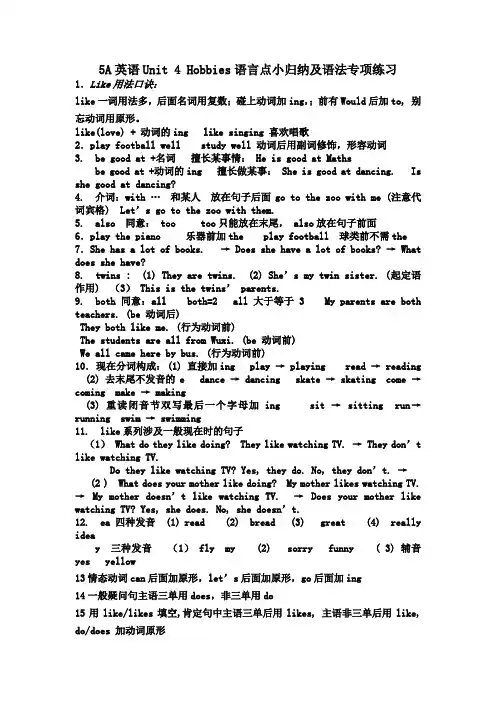
5A英语Unit 4 Hobbies语言点小归纳及语法专项练习1.Like用法口诀:like一词用法多,后面名词用复数;碰上动词加ing,;前有Would后加to, 别忘动词用原形。
like(love) + 动词的ing like singing 喜欢唱歌2.play football well study well 动词后用副词修饰,形容动词3. be good at +名词擅长某事情: He is good at Mathsbe good at +动词的ing 擅长做某事: She is good at dancing. Is she good at dancing?4. 介词:with … 和某人放在句子后面go to the zoo with me (注意代词宾格) Let’s go to the zoo with them.5. also 同意: too too只能放在末尾, also放在句子前面6.play the piano 乐器前加the play football 球类前不需the 7.She has a lot of books. → Does she have a lot of books? → What does she have?8. twins : (1) They are twins. (2) She’s my twin sister. (起定语作用) (3)This is the twins’ parents.9. both 同意:all both=2 all大于等于 3 My parents are both teachers. (be 动词后)They both like me. (行为动词前)The students are all from Wuxi. (be 动词前)We all came here by bus. (行为动词前)10.现在分词构成: (1) 直接加ing play → playing read → reading (2) 去末尾不发音的e dance → dancing skate → skating come →coming make → making(3) 重读闭音节双写最后一个字母加ing sit → sitting run→running swim → swimming11. like系列涉及一般现在时的句子(1) What do they like doing? They like watching TV. →They don’t like watching TV.Do they like watching TV? Yes, they do. No, they don’t. →(2 ) What does your mother like doing? My mother likes watching TV. →My mother doesn’t like watching TV. →Does your mother like watching TV? Yes, she does. No, she doesn’t.12. ea 四种发音 (1) read (2) bread (3) great (4) really ideay 三种发音(1) fly my (2) sorry funny ( 3) 辅音yes yellow13情态动词can后面加原形,let’s后面加原形,go后面加ing14一般疑问句主语三单用does,非三单用do15用like/likes填空,肯定句中主语三单后用likes, 主语非三单后用like, do/does 加动词原形一、用do,does填空1.(Do/Does)______ Tina go swimming on Sunday?2.(Do/Does)_____they play football? Yes, they ___(do/does)3. (Do/Does)_____your dog walk in the zoo?4. What (do/does) _____you have?5.(do/does) _____ she have long hair? No, she _____ (do/does) not.6.What (do/does) _____ his sister like doing?7.(do/does) _____ you like singing? Yes, I _______ (do/does)8. How many stickers (do/does) _______she have?二、用like/likes填空。
五年级英语上册Unit4知识点整理(江苏译林牛津版)

五年级英语上册Unit4知识点整理(江苏译林牛津版)五年级英语上册Unit4知识点整理Unit4Hobbies一、词汇singanddance唱歌跳舞begoodat擅长于ithybrother 和我弟弟readstories读故事inthepar在公园里playthepiano 弹钢琴alotof许多atchfils看电影talabout谈论某事yhobby我的爱好theirhobbies他们的爱好ininter在冬天veryell很好anidea一个主意agreatidea一个好主意thisafternoon今天下午ontheice在冰上begoodatsating擅长溜冰abighole一个大洞intheice在冰里coldandet又冷又湿lieclibing喜欢爬山liesiing喜欢游泳liedraing喜欢画画playbasetball打篮球playtabletennis打乒乓playfootball踢足球二、句型hatdoyouliedoing?你喜欢干什么?Ilieplayingbasetballandfootball.我喜欢打篮球和踢足球。
Icanplaybasetballell,butI’notgoodatfootball.我篮球打得很好,但我不擅长足球。
Heliesplayingfootballtoo.他也喜欢踢足球。
Shealsoliesplayingthepiano.她也喜欢弹钢琴。
Theybothliesiing.她们都喜欢游泳。
hatdoesheliedoing?他喜欢干什么?Heliesdraing.他喜欢画画。
hatdoessheliedoing?她喜欢干什么?Sheliesreadingstories.她喜欢读故事。
hatdotheyliedoing?她们喜欢干什么?Theylieatchingfils.她们喜欢看电影。
SaandBillytalingabouttheirhobbies.山姆和比利谈论他们的爱好。
五年级英语上册Unit 4知识点整理(江苏译林牛津版)
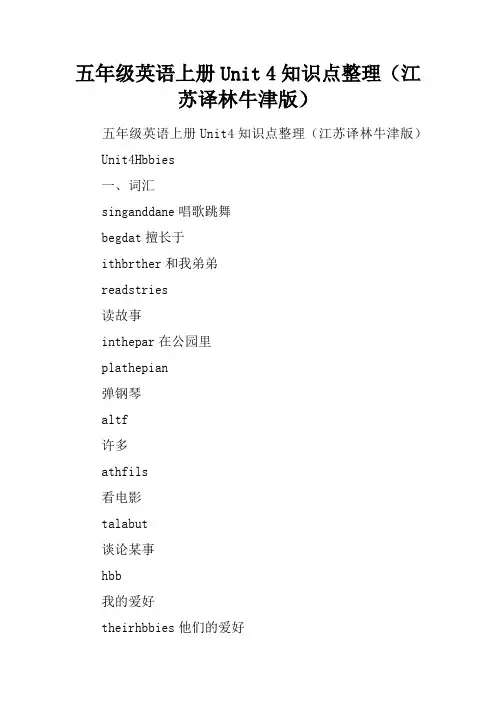
五年级英语上册Unit 4知识点整理(江苏译林牛津版)五年级英语上册Unit4知识点整理(江苏译林牛津版)Unit4Hbbies一、词汇singanddane唱歌跳舞begdat擅长于ithbrther和我弟弟readstries读故事inthepar在公园里plathepian弹钢琴altf许多athfils看电影talabut谈论某事hbb我的爱好theirhbbies他们的爱好ininter在冬天verell很好anidea一个主意agreatidea一个好主意thisafternn今天下午ntheie在冰上begdatsating擅长溜冰abighle一个大洞intheie在冰里ldandet又冷又湿lielibing喜欢爬山liesiing喜欢游泳liedraing喜欢画画plabasetball打篮球platabletennis打乒乓plaftball踢足球二、句型hatdulieding?你喜欢干什么?Ilieplaingbasetballandftball我喜欢打篮球和踢足球。
2Ianplabasetballell,butI’ntgdatftball我篮球打得很好,但我不擅长足球。
3Heliesplaingftballt他也喜欢踢足球。
4Shealsliesplaingthepian她也喜欢弹钢琴。
Thebthliesiing她们都喜欢游泳。
6hatdeshelieding?他喜欢干什么?Heliesdraing他喜欢画画。
7hatdesshelieding?她喜欢干什么?Sheliesreadingstries她喜欢读故事。
8hatdthelieding?她们喜欢干什么?Thelieathingfils她们喜欢看电影。
9SaandBilltalingabuttheirhbbies山姆和比利谈论他们的爱好。
0Let’sgsatingthisafternn咱们今天下午去滑冰。
1Lut!小心!2Thereisahleintheie冰里有一个洞。
译林牛津版英语5A Unit4单元知识总结及练习

Unit Four【词汇】1.hobby爱好2.be good at擅长于3.with与……一起4.also也5.read读,阅读6.story故事7.a lot of很多8.play the piano弹钢琴9.dance跳舞10.watch films看电影11.sing唱歌12.both两个都13.group组14.idea主意15.ice冰16.hole洞17.Look out!当心!注意!18.wet湿的,潮的【词组和短语】1.play basketball well篮球打得好2.play football踢足球3.be good at擅长4.like drawing喜欢画画5.in the park在公园里6.with my brother和我弟弟一起7.play table tennis打乒乓球8.read stories读故事9.a lot of books许多书10.play the piano弹钢琴11.like dancing喜欢跳舞12.watch films看电影13.like swimming喜欢游泳14.talk about谈论15.their hobbies他们的爱好16.in winter在冬天17.like skating喜欢滑冰18.skate very well滑冰滑得很好19.have an idea一个主意20.go skating去滑冰21.this afternoon今天下午22.a great idea一个好主意23.skate on the ice在冰上滑24.look out小心25.cold and wet又冷又湿26.in our group在我们组里27.a hole in the ice冰上一个洞【语法】like+doing sth意为(习惯性或经常性)喜欢做某事,like后面的动词要用其名词形式,即动词+ing形式。
1.动词接ing的变化方式:(1)一般在动词末尾加ing,如:think→thinking stand→standing study→studying(2)以不发音字母e结尾的动词,先去掉e,再加ing,如skate→skatingmake→making dance→dancing write→writing have→having ride→ridingcome→coming(3)以重读闭音节结尾的动词,末尾只有一个元音字母(闭音节),以及一个辅音字母,应双写末尾的辅音字母,再加ing,如:put→putting run-running swim→swimming jog→jogging sit→sitting2.like doing sth句式变化:肯定句:主语+like(s)+doing+…当主语是第三人称单数时,like后面要加s,如:I like singing.They like dancing.He likes playing basketball.She likes skating.否定句:主语+don’t/doesn’t+like+doing+….,如:I don’t like singing.They don’t like dancing.1He doesn’t like playing basketball.She doesn’t like skating.一般疑问句:Do/Does+主语+like+doing+…?如:Do you like sing?Do they like dancing?Does he like playing basketball?Does she like skating?特殊疑问句:疑问词+do/does+主语+like+doing+…?如:What do you like?What do they like doing?What does he/she like(doing)?句型训练:My name is Pat.I have a lot of hobbies.I like_________(draw)and________(play)the piano.I like_________(fish)and__________(shop),too.But I don’t like_________(listen)to music or_________(dance).I have a good friend.Her name is Allan.She________(like) ________(play)basketball and_________(have)a picnic.She__________(not like) __________(paint)or___________(run).【知识点分析】一、A.I like playing basketball.B.She also likes playing the piano.A句中,play后面不跟the,B句中,play后面跟the。
译林版5上第四单元知识整理
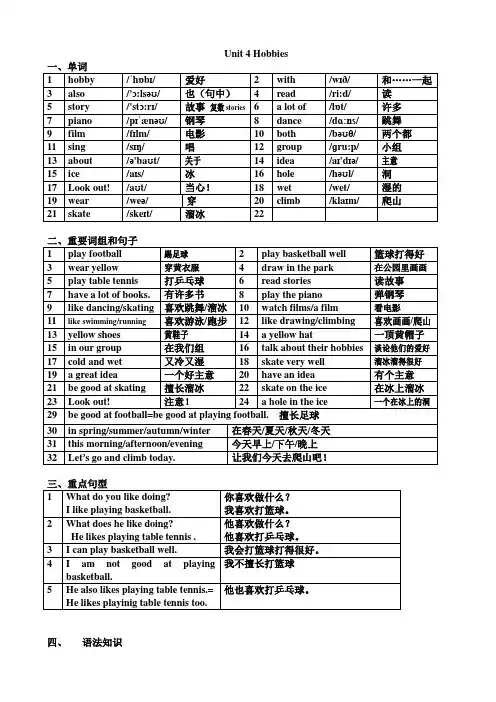
Unit 4 Hobbies四、语法知识1、对划线部分提问解题方法1、根据划线部分找出特殊疑问词;2、特殊疑问词+一般疑问句;3、划线部分不能出现在问句中。
例如:I can see fifteen apples .①②①Who can see fifteen apples?②How many apples can you see?2、like的用法①like后面一般跟名词的复数,也可以跟单数例:I like dogs. I like this dog.②like后面跟动名词(动词+ing)例:I like swimming.She likes going swimming.⑴be good at表示:擅长于be good at+名词/动名词注意:be动词要随着人称而变化例如:I am good at football. 我擅长于足球。
He is good at playing basketball. 他擅长于打篮球。
They are good at swimming. 他们擅长游泳4、a lso和too的区别also和too都表示:也位置有所不同:also用于句中,而too用于句末。
例如:He also likes playing football.= He likes playing football too.5、both和all的区别both和all都表示“都”,但both用于两者之间,而all用于三者及三者以上。
如:Su Hai and Su Yang both like swimming.My friends and I all like swimming.6、go like at 后面加动词ing例句:Let’s go skaing. She likes playing the piano. I’m good at playing football.7、do does can后面加动词原形例句:What do you like? What does she like? I can skate very well.五、作文(提示:写之前写好2个注意点1. like 后加动词ing.2.三单人称后like加s)HobbiesI have many hobbies.I like reading stories.I like playing football too.Nancy is my friend.She likes skating.She also likes singsing.。
新译林版英语五年级上册Unit4资料总结

Unit 4 单元知识单词1. be good at 擅长于2. read 读,阅读3. story 故事4. a lot of 很多5. dance 跳舞6. sing 唱歌7.Look out!当心!注意!词组1.play basketball 打篮球2.play football踢足球3.like drawing喜欢画画4.in the park在公园、5.my friend 我的朋友6.play table tennis打乒乓球7.play the piano弹钢琴8. watch films看电影9.be good at skating擅长溜冰10.a lot of books许多书11.read stories看故事12.like dancing/singing 喜欢跳舞/唱歌13. like swimming喜欢游泳14.skate very well溜冰溜得好15.have an idea 有一个主意16.go skating去溜冰17.this afternoon 今天下午18.look out小心19.cold and wet又冷又湿20.a hole in the ice在冰上的一个洞21.a great idea一个好主意22.my friends’ hobbies我的朋友们的爱好23. watch cartoons 看卡通24. talk about their hobbies 谈论他们的爱好25.wear yellow穿黄衣服26.yellow shoes黄鞋子27.a yellow hat一顶黄帽28.in our group在我们组里29.a year一年句型1. I can play table tennis well, but I am not good at football.我乒乓球打得好,但我不擅长踢足球。
2. I usually draw in the park with my brother Tim.我通常和我弟弟蒂姆在公园里画画。
牛津译林英语五年级上册5AUnit4英语知识清单
重点句型
5.They both like swimming. 她们都喜欢游 泳。 6.What does she like doing?她喜欢干什么 ? 7.They like watching films. 她(他)们喜欢
牛津译林英语五年级上册 5A Unit 4
YL版
英语知识清单
重点单词
1.hobby业余爱好 起 3.also也 5.story故事 7.both两个都
2.with与……一
4.read读,阅读 6.dance跳舞 8.sing唱歌
重点词
9.group组 11.idea主意 13.hole洞 的
10.about关于 12.ice冰 14.wet湿的,潮
重点句型
1.What do you like doing?你喜欢干什么? 2.I can play basketball well, but I'm not good at football. 我篮球打得很好,但我不擅长足球。 3.He likes playing football too. 他也喜欢踢
重点短语
1.sing and dance唱歌跳舞 2.be good at擅长于 3.read stories读故事 4.play the piano弹钢琴 5.a lot of很多 6.watch films看电影
重点短语
8.have an idea有一个主意 9.a hole in the ice冰上的一个洞 10.cold and wet又冷又湿 11.like swimming喜欢游泳 12.be good at skating擅长溜冰 13.look out当心,注意
五年级上册第四单元译林版英语知识点总结
五年级上册第四单元译林版英语知识点总结本文档将总结五年级上册第四单元译林版英语的知识点。
以下是重要的知识点和要点:1. 词汇:掌握以下单词的拼写和意义:- Unit 4: apple, banana, cherry, grape, lemon, orange, peach, pear, strawberry, watermelon2. 句型:掌握以下句型的用法:- I like [fruit].(我喜欢[水果]。
)- Do you like [fruit]?(你喜欢[水果]吗?)- Yes, I do. / No, I don't.(是的,我喜欢。
/ 不,我不喜欢。
)- What fruit do you like?(你喜欢哪种水果?)- I like [fruit] best.(我最喜欢[水果]。
)- How about you?(你呢?)3. 语法:了解以下语法知识:- 形容词最高级:用于表示三个或以上事物之间的比较,形式为"the + 形容词的最高级 + 名词"。
- 例如:I like strawberries best.(我最喜欢草莓。
)4. 对话:参考以下对话,掌握正确的表达方式:- A: What fruit do you like?B: I like apples.A: Do you like bananas?B: No, I don't.5. 口语练:尝试与同学或家人进行以下口语练,以提高口语表达能力:- A: What fruit do you like best?B: I like watermelons best. How about you?A: I like oranges best.以上是五年级上册第四单元译林版英语的知识点总结。
请同学们复并掌握这些内容,以提高英语水平。
(注:本文档的内容来自译林版五年级上册英语教材,内容真实可信。
小学英语牛津译林苏教版五年级上册(新版)5AUnit4知识整理
5A Unit 4 Hobbies 知识点一、词组1.play basketball 打篮球2.play football踢足球3.be good at擅长4.like drawing 喜欢画画5.in the park 在公园里6.my friend 我的朋友7.play table tennis 打乒乓球8.like reading stories 喜欢读故事9.a lot of books 许多书10.play the piano 弹钢琴11.like dancing 喜欢跳舞12.watch films 看电影13.like swimming 喜欢游泳14.talk about谈论15.their hobbies他们的爱好16.in winter 在冬天17.like skating喜欢滑冰18.skate very well划得很好19.have an idea 一个主意20.go skating 去滑冰21.this afternoon今天下午22.a great idea一个好主意23.on the ice在冰上24.look out 小心25.cold and wet又冷又潮二、句型1.I can play basketball well , but I am not good at football.我篮球打得好,但是我不擅长踢足球。
2.I usually draw in the park with my brother Tim.我通常和我的弟弟蒂姆一起画画。
3.She also likes playing the piano. 她也喜欢弹钢琴。
4.Su Yang likes watching films .苏阳喜欢看电影。
,5.What do you / they like doing ?6.What does he / she like doing ?7. I/ You /We / They like ……?8. He/ She likes …….9.be good at 擅长于…I am good at running. She is good at baseball.三、语法1. like + doing sth动词接ing:(1).一般在动词末尾加ing,如:think → thinking stand → standing(2).以不发音字母e结尾的动词,先去掉e,再加ing,如skate → skating make → making dance → dancing write → writing have → having ride → riding come → coming(3).以重读闭音节结尾的动词,末尾只有一个元音字母(闭音节),以及一个辅音字母,应双写末尾的辅音字母,再加ing, 如:put →putting run-running swim → swimming jog → jogging sit → sitting2. 一般现在时的构成一般现在时肯定式的构成,应注意不同人陈be动词或实义动词的正确使用。
五年级英语上册5A Unit4 Hobbies知识点整理
五年级英语上册5A Unit4 Hobbies知识点整理一、单词:1. hobby /'hɒbɪ]/ 爱好2. dance /dɑ:ns/ 跳舞3. draw /drɔ:/ 画画4. read / ri:d/ 读,阅读5. piano / pɪˈænəʊ / 钢琴6. film /fɪlm/ 电影7. also /ˈɔ:lsəʊ / 也 8. with / wɪð/ 与…一起9. both / bəʊθ/ (二者)都 10. all / ɔ:l / 都(两者以上)11. climb / klaɪm/ 攀爬 12.group /gru:p/ 组13. ice / aɪs/ 冰 14. hole / həʊl/ 洞15.wet / wet/ 湿的 16. idea / aɪ'dɪə/ 主意17 about /əˈbaʊt/ 关于 18. story /ˈstɔ:rɪ/ 故事二、词组1. my hobby 我的爱好2. your friends’ hobbies 你朋友们的爱好3. play football 踢足球4. play basketball well 打篮球打得好5. draw in the park 在公园画画6. draw …with …和……一起画……7. with my brother和我弟弟8. play with me/them 和我/他们一起玩9.be good at 擅长于…10.be good at football = be good at playing football擅长足球11.be good at singing 擅长唱歌12.play table tennis 打乒乓球13.play the piano 弹钢琴14.read stories 读故事15.a lot of = lots of 许多16.watch films 看电影17.like dancing 喜欢跳舞18.They both like swimming.他们都是喜欢游泳。