
外研版 七年级英语上M4 U2
Post reading
Meals of a day:
Breakfast: nothing. Lunch: cola and 3 hamburgers. Supper: rice, chicken, beef, ice cream. What’s wrong with Liming? He is very fat. What’s your advice(建议) for him?
Homework
必做: 1.抄写熟记本课时单词
2.课时特训P56 第1,2,3,6大题
选做:1.完成课本P23 第4部分 2.为自己设计一日三餐的食物
Read the passage and complete the table
1.What is bad or not good for children?
Healthy food and drink Unhealthy food and drink ice cream, cola, hamburgers Candy sugar
Module 4 Healthy food
Unit 2 Is your food and drink healthy?
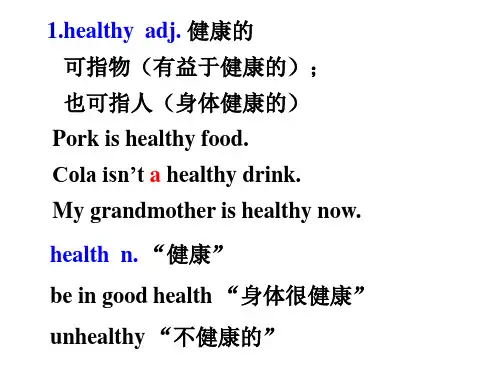
I like apples, because they arefood. healthy. Apples are my favourite
I like juice because it is good for me. An apple a day keep the doctor away.
But it is delicious.
Cola is delicious but it isn’t healthy.
Chocolate is delicious but it is not healthy. candy
List some unhealthy food and drink.
ice cream
hamburger hamburgers
candies candy
some delicious food
noodles
bread
rice
chicken soup
They are healthy food.
tired
sweet potatoes egg Chicken soup fish cheese is good for you.
1.What food are good for your eyes?
Carrots, eggs and sweet potatoes are good for your eyes.
2.What are milk, cheese and fish good for?
They are good for your teeth.
I like …because they are /it is healthy/good for me.
List some healthy food and Leabharlann rink.food drink
I like …because they are /it is healthy/good for me.
Is cola good for us? No, it isn’t. It is bad for us.
meat, milk, carrots, water, eggs, tea, sweet potatoes, juice, cheese, fish, chicken soup, noodles, rice, fruit, vegetables
While- reading: 1.What food are good for your eyes?
Before reading
How to stay healthy?
It’s important to eat right food.
Let’s talk. 小组讨论,一名组员 代表发言。noodles
right food
rice
fruit
vegetables eggs Soup …
Fast reading
2.What are milk, cheese and fish good for?
3.What do you have when you are a bit tired?
4.What is important to remember?
5.How many pieces of advice (建议)are there ?What are they?
Group work
Eat noodles or rice, not hamburgers. Have a good breakfast every morning. Drink juice, water, tea and milk, not cola. Eat lots of fruit and vegetables.
3.What do you have when you are a bit tired?
Have lots of delicious chicken soup.
4.What is important to remember?
Eat well, stay healthy, and don’t get If fat!you have a balanced diet, You will be healthy ,Otherwise 5.How many pieces of advice (建议 )are there are they? (否则 )you will ?What get fat! There are four pieces of advice.
Have a balanced diet.(饮食平衡)
Eat noodles or rice, not hamburgers. Have a good breakfast every morning. Drink juice, water, tea and milk, not cola. Eat lots of fruit and vegetables.
Sweet potatoes and eggs Fish and cheese are are good for your eyes. good for your teeth .
Too much
is bad for children.
meat sugar
Meat is healthy but too much meat is not Too much sugar good for us.
外研版七年级英语上册教学优质课件M4U2

外研版七年级英语上册教学优质课件M4U2一、教学内容本节课选自外研版七年级英语上册M4 Unit 2,主要内容包括:描述人物外貌和性格特征的词汇和句型,如“tall, short, fat, thin, kind, friendly”等,以及“How do you describe?”的问答句型。
本节课着重讲解和练习如何用英语描述自己和他人的外貌与性格。
二、教学目标1. 能够听懂、会说、会拼写描述外貌和性格的词汇。
2. 能够用英语描述自己和他人的外貌和性格。
3. 能够运用目标句型进行问答,并进行简单的对话交流。
三、教学难点与重点重点:描述外貌和性格的词汇及句型的掌握。
难点:如何灵活运用所学词汇和句型进行真实情境下的描述和交流。
四、教具与学具准备1. 教师准备:PPT、卡片、录音机、教材。
2. 学生准备:课本、练习本、彩色笔。
五、教学过程1. 导入:通过展示一组人物图片,引导学生用中文描述图片中人物的外貌和性格,为新课学习做好铺垫。
教学活动:学生观看图片,尝试用中文描述;教师记录关键词,为学生提供英文表达方式。
2. 呈现:呈现教材中的对话,让学生跟读、模仿,学习描述外貌和性格的词汇和句型。
教学活动:学生听录音,模仿对话;教师纠正发音,指导句型运用。
3. 实践:分组练习,让学生相互描述外貌和性格,巩固所学知识。
教学活动:学生分组进行角色扮演,进行描述练习;教师巡回指导,给予反馈。
4. 应用:设置真实情境,让学生运用所学知识进行问答和对话。
教学活动:学生模拟真实情境,进行问答和对话练习;教师评价、指导。
六、板书设计1. M4 Unit 2 Describing People2. 重点词汇:tall, short, fat, thin, kind, friendly3. 重点句型:How do you describe?七、作业设计1. 作业题目:描述你的一位同学的外貌和性格。
答案示例:My classmate is tall and thin. He is very friendly and always helps others.2. 作业要求:不少于80词,正确使用所学词汇和句型。
外研版七年级上册Module4 Unit2 教学课件(共43张ppt)
Module 4 Unit 2
__F_is_h_ is healthy but _h_a_m__b_u_r_g_e_r_s aren't healthy.
Module 4 Unit 2
4.1.1. e.g.: We can visit the World Park or travel
around the world. 我们可以参观世界公园, 或者周游全世界.
连接并列的单词、词组、短语或句子, 表示"或 者"的意思.
Module 4 Unit 2
4.1.2. e.g.: Is that an apple or an orange? 那是苹果还是桔子?
Module 4 Healthy food
Unit 2 Is your food and drink healthy?
Making a poster about a healthy breakfast.
犍为县罗城初级中学教学课件V3. 0 制作人: 张平
Module 4 Unit 2
同步预习辅导. Q1. What is healthy food and drink?
Module 4 Unit 2
Activity 4. Complete the passage with the correct form of the words and expression from the box.
delicious fat important lots of meal remember stay sweet tooth (pl teeth) A healthy breakfast is (1) _i_m_p_o_r_t_a_n_t_ in the morning and it's my favorite (2) _m__ea_l_. There are (3) _l_o_ts_o_f_ fruit and vegetables for lunch at school. but there isn't any cola or candy. Candy and cola are (4) _s_w_e_e_t_ food and drink and they're had for your (5) __te_e_t_h_. At home my grandma's dinners are (6) _d_e_li_c_io_u_s__ and we aren't (7) __f_a_t _. (8) _R__e_m_e_m__b_e_r_! Eat well, and (9) __s_ta_y__ healthy.
秋外研版七年级上册英语课件:Module 4 Unit 2 (共26张PPT)

Lead-in
6. Let’s get some _c_o_f_f_e_e (咖啡) for mum. 5. What _k__in_d___ (种类) of fruit do you
like best?
7. How about some apple __j_u__ic_e_ (果汁)? 8. There are lots of _t_o_m__a_t_o_e_s(西红柿)
Complete the passage with the correct from of the words and expression from the box.
delicious fat important lots of meal remember stay sweet tooth (pl. teeth)
les and fruit are healthy food. Cola, ice cream and hamburgers aren’t healthy food and drink.
Meat, vegetables and fruit are healthy food but cola, ice cream and hamburgers aren’t healthy food and drink.
13、He who seize the right moment, is the right man.谁把握机遇,谁就心想事成。2021/9/82021/9/82021/9/82021/9/89/8/2021 •14、谁要是自己还没有发展培养和教育好,他就不能发展培养和教育别人。2021年9月8日星期三2021/9/82021/9/82021/9/8 •15、一年之计,莫如树谷;十年之计,莫如树木;终身之计,莫如树人。2021年9月2021/9/82021/9/82021/9/89/8/2021 •16、教学的目的是培养学生自己学习,自己研究,用自己的头脑来想,用自己的眼睛看,用自己的手来做这种精神。2021/9/82021/9/8September 8, 2021 •17、儿童是中心,教育的措施便围绕他们而组织起来。2021/9/82021/9/82021/9/82021/9/8
外研版七年级英语上册M4U2课件
外研版七年级英语上册M4U2 课件一、教学内容本节课的教学内容选自外研版七年级英语上册Module 4 Unit 2。
本节课主要讲述野生动物的保护。
教材内容包括野生动物的种类、特点以及保护野生动物的方法等。
通过本节课的学习,学生能够掌握有关野生动物的词汇和表达方式,提高他们的阅读理解能力。
二、教学目标1. 学生能够听懂、会说、会读本节课的生词和短语,如:wild animal, endangered species, protection等。
2. 学生能够理解并运用目标句型“What characteristics? They are”来描述野生动物的特点。
3. 学生能够阅读并理解关于野生动物的短文,提高他们的阅读理解能力。
三、教学难点与重点重点:1. 掌握本节课的生词和短语。
2. 能够运用目标句型描述野生动物的特点。
3. 提高阅读理解能力。
难点:1. 正确运用情态动词“can”和“may”的疑问句和否定句。
2. 理解并运用短文中的一些固定搭配,如:endangered species, protection等。
四、教具与学具准备1. 教具:PPT、黑板、粉笔、录音机、磁带等。
2. 学具:课本、练习册、录音机、磁带等。
五、教学过程1. 热身(5分钟)1.1 教师与学生用英语进行自由对话,如:询问学生周末的活动,引导学生谈论动物等。
1.2 学生听录音,模仿发音,重复单词和短语。
2. 引入(10分钟)2.1 教师通过展示一些野生动物的图片,引导学生谈论这些动物的特点。
2.2 学生观看PPT,听录音,模仿发音,重复单词和短语。
3. 新课内容(15分钟)3.1 教师引导学生学习本节课的生词和短语,如:wild animal, endangered species等。
3.2 学生跟读单词和短语,模仿发音。
3.3 教师讲解目标句型“What characteristics? They are”,并让学生进行句型练习。
外研版英语七年级上册Module 4 Unit 2课件
A. meat, eggs and milk B. water, tea and hamburgers
C. chicken soup
D. milk, cheese and fish
( D ) 5.Which of the following is NOT true? A. Eat noodles or rice, not hamburgers. B. Have a good breakfast every morning. C. Drink juice, water, tea and milk, not cola. D. Eat lots of chocolate and vegetables.
Tips:看标题、
开头句。
( D ) 1. What’s the passage mainly about?
A. Healthy food
B. Healthy drink
C. Shopping list
D. Both A and B
( B ) 2. __________ are good for your eyes.
3. 在否定句中代替and,“和” I don’t like bread, rice or porridge. 我不喜欢面包、米饭和粥。
4. 连接两个并列的句子,表 “否则,要不然” Hurry up, or you’ll be late. 快点,否则你要迟到啦。
You must go there quickly or you will not get the gift. 你必须快点去那儿,否则你就得不到礼物了。
A. carrots, eggs and sweet
B. milk, cheese and fish
2024年外研版七年级英语上册教学课件M4U2
2024年外研版七年级英语上册教学课件M4U2一、教学内容1. What can you do?(你能做什么?)2. I can do quite a lot(我能做很多事情)二、教学目标1. 让学生掌握并熟练运用与个人能力相关的英语表达。
2. 培养学生运用情态动词can描述自己和他人的能力。
3. 提高学生的听说读写能力,尤其在口语交流中能自信地表达自己的能力。
三、教学难点与重点1. 教学难点:情态动词can的用法,以及如何用can描述各种能力。
2. 教学重点:掌握can的肯定句、否定句和疑问句结构,并能灵活运用。
四、教具与学具准备1. 教具:PPT、卡片、录音机、磁带2. 学具:英语课本、练习册、笔记本五、教学过程1. 导入:通过播放一首英文歌曲,引入话题“能力”,让学生在轻松愉快的氛围中进入学习状态。
2. 新课展示:展示PPT,讲解情态动词can的用法,并引导学生用can描述自己的能力。
3. 例题讲解:讲解教材中的例题,让学生理解并掌握can的用法。
4. 随堂练习:发放练习册,让学生完成相关练习,巩固所学知识。
5. 小组活动:学生分成小组,用英语讨论组员们的各种能力,并做好记录。
6. 口语练习:邀请学生上台展示,用英语介绍自己的能力。
六、板书设计1. M4U2 What can you do?2. 内容:情态动词can的用法描述能力的句子结构例句及练习七、作业设计1. 作业题目:(1)用can写5个句子,描述自己的能力。
(2)编写一段对话,讨论你和你的朋友的能力。
2. 答案:(1)I can play the piano. I can swim. I can draw. I can cook. I can dance.(2)A: What can you do, Li Ming?B: I can play football and basketball. What about you, Wang Hong?A: I can sing and dance. Let's be friends!八、课后反思及拓展延伸1. 课后反思:关注学生在课堂上的表现,了解他们对情态动词can的掌握程度,针对问题进行课后辅导。
外研版七年级英语上册教学课件M4U2
外研版七年级英语上册教学课件M4U2一、教学内容本节课选自外研版七年级英语上册M4 Unit 2,主要内容包括:现在进行时态的用法,以及与颜色相关的词汇。
具体涉及章节为:1. 现在进行时态的构成和用法;2. 颜色词汇的学习和应用。
二、教学目标1. 掌握现在进行时态的构成,并能熟练运用;2. 学会与颜色相关的词汇,并能灵活运用;3. 提高学生的听说读写能力,培养他们的英语思维。
三、教学难点与重点难点:现在进行时态的用法,尤其是动词变化形式;重点:颜色词汇的掌握,现在进行时态的构成和应用。
四、教具与学具准备1. 教具:PPT课件、黑板、粉笔、卡片;2. 学具:笔记本、彩色笔、练习册。
五、教学过程1. 导入:通过展示一组图片,让学生观察并描述图片中的颜色,引出颜色词汇的学习;2. 新课内容展示:展示PPT课件,讲解现在进行时态的构成和用法,结合例句和图片进行讲解;3. 实践情景引入:设计一个场景,让学生用现在进行时态描述场景中的人物动作;4. 例题讲解:结合教材中的例题,讲解现在进行时态的用法;5. 随堂练习:发放练习册,让学生完成相关的练习题;6. 小组讨论:将学生分成小组,讨论练习题中的问题,并进行分享;8. 课堂反馈:了解学生对课堂内容的掌握程度,针对问题进行解答。
六、板书设计1. M4U2 现在进行时态与颜色词汇;2. 内容:a. 现在进行时态的构成:主语+be动词(am/is/are)+动词现在分词;b. 颜色词汇:red, yellow, blue, green, black, white, purple, orange, pink, grey等;c. 例句和场景描述。
七、作业设计1. 作业题目:a. 用现在进行时态描述你正在做什么;b. 描述一幅自己喜欢的画作,至少使用5个颜色词汇;2. 答案:a. I am writing homework now.b. This is my favorite painting. It is full of colors, such as red, blue, green, yellow and purple.八、课后反思及拓展延伸1. 反思:关注学生在课堂上的参与度,以及他们对现在进行时态和颜色词汇的掌握程度,及时调整教学方法;2. 拓展延伸:鼓励学生在课后观察周围的事物,用英语进行描述,提高他们的英语应用能力。
外研版七年级英语上册M4U2课件
外研版七年级英语上册M4U2 课件一、教学内容本节课选自外研版七年级英语上册M4U2,主要内容包括:Unit 2 What's your number?,涉及电话号码、家庭成员称谓以及询问电话号码的日常交际用语。
具体章节内容为:1.听、说、认读关于电话号码和家庭成员的词汇;2.掌握一般疑问句及其回答方式,如:“What's your/his/her number?”“My/His/Her number is”;3.学会在特定情境中进行电话交流。
二、教学目标1.能够听懂、会说、认读关于电话号码和家庭成员的词汇;2.掌握一般疑问句“What's your/his/her number?”及其回答;3.能够在实际情境中运用所学知识进行电话交流。
三、教学难点与重点1.教学难点:家庭成员称谓和电话号码的表达;2.教学重点:一般疑问句“What's your/his/her number?”及其回答。
四、教具与学具准备1.教具:多媒体课件、录音机、磁带、卡片;2.学具:英语课本、练习本、彩色笔。
五、教学过程1.导入:通过展示一个实践情景,如:一个学生在给朋友打电话,引出本节课的主题——电话号码。
2.新知呈现:展示多媒体课件,学习关于电话号码和家庭成员的词汇,引导学生跟读、模仿。
3.例题讲解:呈现例题,讲解一般疑问句“What's your/his/her number?”及其回答,引导学生进行角色扮演,进行实际操作。
4.随堂练习:学生两人一组,进行电话交流的角色扮演,巩固所学知识。
5.巩固拓展:通过游戏、竞赛等形式,让学生在轻松愉快的氛围中复习所学知识。
六、板书设计1.What's your number?2.词汇:phone number, mother, father, sister, brother, grandpa, grandma等;3.句子:What's your/his/her number? My/His/Her number is七、作业设计1.作业题目:完成练习册上的相关习题;2.答案:见附件。
外研版英语七年级上册Module 4 Unit2 精品教案
Unit2 精品教案ⅠTeaching modelReading and writing.Ⅱ Teaching methodTop-down approachⅢ Teaching aims1. To get information from the reading material about healthy food.2. To write about healthy food with but and and.Ⅳ Teaching ObjectivesKey vocabulary: healthy, delicious, bread, fish, hamburger, ice cream, noodle, rice, sugar, eat, child (pl. children), sweet, right, egg, eye, cheese, tooth(pl. teeth), bit, tired, soup, important, remember, well, stay, fat, or,breakfast, every, lunch, home, dinnerKey phrase: be good for, be bad for, a bit,Key structures: … and …are healthy food but … and … are my favourite food.Ⅴ Teaching aidsRecorder, OHP, videoⅥTeaching StepsStep 1 Warming-up1. Show some pictures to review the words of food and drink.2. Review the text of Unit 1.Step 2 Work in pairs.1. Remember six words for food and drink. Make two lists.Healthy food and drink:Favourite food and drink:2. Look at the pictures. Label the food and drink.Answers:1. noodles2. ice cream3. fish4. hamburger5. bread6. sugar7.cola8. rice 9. candiesEat: noodles, rice, fish, candies, ice cream, hamburger, bread, sugarDrink: cola3. Call back the answers from the whole class.4. Read the words after the teacher.Step 3 Reading.1. Play the recording.2. Ask the students to read through the passage.3. Read the passage and complete the table.4. Check with a partner.5. Call back the answers from the whole class.Keys:1. Healthy food and drink: meat, carrots, eggs, potatoes, milk, cheese, fish, chicken, noodles, rice, juice, water, tea, fruit, vegetables2. Not healthy food and drink: ice cream, hamburgers, cola, candyStep 4 Do exercises.1. Ask the students to read through the passage in Activity 4.2. Complete the passage with the correct from of the words and expression from the box.3. Check with a partner.4. Call back the answers from the whole class.5. Read the passage together.Step 5 Work in pairs.1. Ask the students to choose food from Units 1 and 2 for their meals.2. Talk about their answers like this:1) What’s your favourite food and drink?2) Is it healthy food and drink?Step 6 Writing.1. Join the sentences with but.1) Juice is a healthy drink. Cola isn’t a healthy drink.2) Noodles are healthy food. Hamburgers aren’t healthy food..3) Meat, vegetables and fruit are healthy food. Cola, ice cream and hamburgers aren’thealthy food and drink.4) Chocolate is delicious. Too much chocolate isn’t good for you.2. Check with a partner.3. Call back the answers from the whole class.4. Complete the sentence about you.… and …are healthy food but … and … are my favourite food.Step 7 Important and difficult points.A.重点短语:1. have/has got 拥有2. go shopping 去买东西;去购物3. let’s do sth. 让我们去做某事4. too much 太多5. too many 太多6. lots of 许多7. be good for 对……有益8. be bad for 对……有害9. How about… ? ……好吗?……行吗?B. 重要知识点:可数名词的特殊变化:1.child—children 孩子2. tooth—teeth牙齿连词and, or, but 的区别:1.and:表示“和,又,与,并”,连接两个名词、动词或句子,表示并列关系。
外研版英语七年级上册M4U2教学精品课件
外研版英语七年级上册M4U2教学精品课件一、教学内容本节课选自外研版英语七年级上册Module 4 Unit 2,主要内容包括:描述人物的外貌和性格特征,学会使用一般现在时描述人的日常活动和习惯。
具体章节为:1.课文学习;2.语法讲解;3.词汇学习。
二、教学目标1. 能够听懂、会说、会读、会写关于人物外貌和性格特征的词汇,如:funny, kind, helpful, tall, short, fat等;2. 能够运用一般现在时描述人物的日常活动和习惯;三、教学难点与重点重点:描述人物外貌和性格特征的词汇和一般现在时的用法。
难点:一般现在时的构成及其正确运用。
四、教具与学具准备1. 教师准备:PPT课件、教材、黑板、粉笔;2. 学生准备:教材、笔记本、练习本。
五、教学过程1. 导入:通过PPT展示不同人物的照片,引导学生用英语描述他们的外貌和性格特征,激发学生的兴趣。
2. 新课内容展示:教师带领学生阅读课文,讲解课文中的新词汇和语法点,如:funny, kind, helpful, tall, short, fat等,以及一般现在时的用法。
3. 实践情景引入:教师创设情境,让学生分组扮演不同角色,用英语描述自己的外貌和性格特征,以及日常活动和习惯。
4. 例题讲解:教师针对一般现在时的用法,给出例句,并讲解其构成和用法。
5. 随堂练习:教师给出练习题,让学生运用所学知识进行练习,巩固新知识。
6. 小组活动:学生分组讨论,用英语编写一段对话,描述组内成员的外貌和性格特征,以及他们的日常活动和习惯。
六、板书设计1. Module 4 Unit 22. 重点词汇:funny, kind, helpful, tall, short, fat等;3. 重点句型:He/She is; He/She has; He/She does七、作业设计1. 作业题目:请用英语写一段话,描述你的好朋友的外貌和性格特征,以及他/她的日常活动和习惯。