
人教版新目标英语2018中考第一轮复习课件八年级(上)Unit4-6
人教版新目标初中英语八年级上册 Unit4 教学课件Section A 1a2d (共22张PPT)
1a Choose
How do you choose which movie theater to go to?
Write the things in the box.
Important
Not important
comfortable seats
close to home
big screens
cheap
most cheaply there.
970 AM 97.9 FM 107.9 FM _9_7_0__A_M___ It has the worst music. _9_7_._9_F_M___ They play the most boring songs. _1_0_7_.9__F_M__ The DJs choose songs the most
comfortable —— the most comfortable
(多音节词和部分双音节词前加 the most) good —— the best
bad/badly —— the worst
many/much —— the most 特殊变化的,需单独记忆)
cheaply —— (the) most cheaply carefully —— (the) most carefully
•11、凡为教者必期于达到不须教。对人以诚信,人不欺我;对事以诚信,事无不成。 •12、首先是教师品格的陶冶,行为的教育,然后才是专门知识和技能的训练。 •13、在教师手里操着幼年人的命运,便操着民族和人类的命运。2021/11/52021/11/5November 5, 2021 •14、孩子在快乐的时候,他学习任何东西都比较容易。 •15、纪律是集体的面貌,集体的声音,集体的动作,集体的表情,集体的信念。 •16、一个人所受的教育超过了自己的智力,这样的人才有学问。 •17、好奇是儿童的原始本性,感知会使儿童心灵升华,为其为了探究事物藏下本源。2021年11月2021/11/52021/11/52021/11/511/5/2021 •18、人自身有一种力量,用许多方式按照本人意愿控制和影响这种力量,一旦他这样做,就会影响到对他的教育和对他发生作用的环境。 2021/11/52021/11/5
人教版新目标八年级英语上unit6(period 4, sectionB,3a-selfcheck)
九年级英语上unit6(sectionB,reading,3a)教案授课人:缪小平授课日期: 2012 年 11 月Teaching Plan for Unit 6 (Go for it Book 2A)The forth period, listening, speaking and writing: “should friends be different or the same?”I. Teaching aims1. Knowledge objects:(1)Functions: Students learn to talk about personal traits and how to compare people.(2)Key vocabulary: opposite, view, interest, though, necessary, beat, friendship, primary school, information(3)Target languages:It’s not necessary to be the same.He always beats me in tennis.I don’t really care.Be different from…2. Ability objectsReading skills, Writing skills, and Communicative competence3. Moral objectsBy the end of class, the students are able to make good friends.II. Teaching key pointsUnderstand the important sentences in the article.III. Teaching difficult points(1)Oral practice(2)Reading and writing practice(3)Know how to compare people by using the target languageIV. Teaching methods1. Listening, reading, skimming, scanning, discussing, (asking and answering, pictures, fastreading, careful reading, personal work, Explanation…)2. Teaching Aids: a tape recorder, a projector and a computer …V. Teaching procedure sStep 1 Greet the class and New words learning (about 2 minutes)Ask students to look at the screen and read the new words after teacher for twice. Then show some sentences by using the new words on the PowerPointStep 2 Lead-in (About 6 minutes)1. T: Class, as we know, everyone has his/her best friend. Now think over two questions:(1) what the similarities and differences between you and your friend. (2) Is it necessaryto be the same between friends? (Two questions are presented on the PowerPoint)2. T: Now I’d like to introduce my best friend, Xiao Qian. We havesimilarities and differences.(present similarities and differences between I and she on PowerPoint). How about you, guys? Think over it for several minutes, later I’ll invite some students to give their answers.S1…T: we can see it is not necessary to be the same between friends. Ok, we asked three people on the page 35.Step 3 Pre-reading (About 2minutes)Deal with the questions in the pre-reading part.T: Scan the text, and think for pre-reading questions on the screen.Suggested answers:1. Who is James Green’s best friend?…Step 4 Skimming (about 8 minutes)1. Ask students to skim the text and find the answers to the post-reading questions2. T: Let’s read for some specific information and check the answers together. Show theanswers on the power point one by one.Step 5 Reading (about 15 minutes)Deal with the reading parts, play the tape for students to listen. Ask them to underlinethe words that describe what people are like.T: we have learnt something about the similarities and differences between friends, this time we will deal with some difficult language points.1.opposit的用法(1)adj: 相反地,对面的…2. Interest的用法3. the same as the same n. as …. 和…..一样…… (Present all language points on the blackboard)Step 6 Do exercise on the PowerPoint (About 5 minutes)Step 7 Summary (About 1 minute)(1)Summarize the contents of this class.(2)We know that the more excellent people they are, the more chances they have.VI. Homework (about 2 minute)(1) Write a composition according to page35, 3c.(2) Write a composition according to page36, 2.VII. Blackboard design。
人教版八年级英语上册 Unit4 复习课件(共16张ppt)
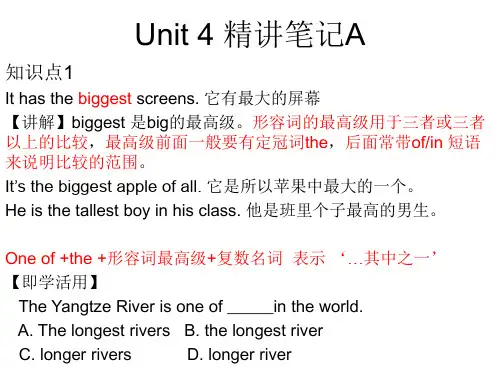
Thanks for ‘因…而感谢’,表示感谢的原因 Thanks for helping me
Thanks to ‘多亏,幸亏,由于’, 并无当 Thanks to your help, I
面感谢的意思,有时等于with passed the exam the help of
• 【讲解】 • 此句式结构为 ‘It is+形容词+(for sb.) to do sth. ’ • Watch sb. / sth. do sth 意为‘观看某人/某物做某事’ (全程) • Watch sb. doing sth. 看见某人正在做某事 (动作正在进行) • 接不带to的不定式做宾补的动词: • 三眼,两耳,一注意,加上三个小使役,半个help莫忘记。
• 常用句型in common with sb./ sth. 和…一起 ; 像…一样
• In common with many others, she applied for a training place. 她和许多人一起申请参加训练。
• You are in common with me.我们俩志趣相投。 • 【即学活用】 • 皮皮和我有很多共同点。 • ______________________________________
从家到学校有多远?--- 步行30分钟的路程
__________________________________________________
•9、要学生做的事,教职员躬亲共做;要学生学的知识,教职员躬亲共学;要学生守的规则,教职员躬亲共守。2021/8/122021/8/12Thursday, August 12, 2021 •10、阅读一切好书如同和过去最杰出的人谈话。2021/8/122021/8/122021/8/128/12/2021 12:03:21 PM •11、只有让学生不把全部时间都用在学习上,而留下许多自由支配的时间,他才能顺利地学习……(这)是教育过程的逻辑。2021/8/122021/8/122021/8/12Aug-2112-Aug-21 •12、要记住,你不仅是教课的教师,也是学生的教育者,生活的导师和道德的引路人。2021/8/122021/8/122021/8/12Thursday, August 12, 2021
人教版新目标 八年级(初二)英语上册Unit1-Unit6分单元复习题(原创精编版)

Review for Unit 1-61.Most students exercise three times a week. (就划线部分提问)do most students exercise?2.I sleep nine hours every night. (就划线部分提问)hours do you sleep every night?3.My favorite program is Animal World. (就划线部分提问)your favorite program?4.My sister often goes to a movie on weekends. (就划线部分提问)your sister often on weekends? 5.She sometimes does her homework at school. (就划线部分提问)does she her homework at school?三、用括号内单词的适当形式完成句子1.My father plays basketball (two) a week.2.Jodie often (exercise) in the park.3.Maria is (act) at school.4.He (watch) TV every night.5. —How often does your mother exercise?—(one) a week.四、在横线上填上适当的词语1.妈妈想让我天天喝牛奶。
My mother wants me every day.2.天天跑步对我们的健康有好处。
Running every day is our health.3.我努力吃大量的蔬菜。
I a lot of vegetables.4.我健康的生活方式帮着我取得好成绩。
My healthy lifestyle helps me . 5.你多久吃一次垃圾食品?1.得(病),患(病) ____________ (单数第三人称) ____________2.脚,足____________ (复数形式) ____________3.胃,肚子____________ (复数形式) ____________4.牙齿____________ (复数形式) ____________5.疾病____________ (形容词) ____________6.发烧____________________7.牙痛____________________8.喉咙痛___________________9.躺下来休息____________________10.hot tea with honey____________________三、按要求完成句子1.He has a fever. (就划线部分提问)with him?2.Tom should eat something. (变成否定句)Tom eat .3.My headache started two days ago. (就划线部分提问)your headache ?4.I have a cold. (变成一般疑问句)you a cold?5.She has a toothache. (变成否定句)She a toothache.四、在横线上填上适当的词语1. 我们需要一个阴阳平衡。
人教版.英语第一轮词汇复习 八年级(上) Units 5~6。

21. foreign(adj.)外国的 →_f_o_re_i_g_n_e_r (n.)外国人 32次 22. able(adj.)能够 →_u_n_a_b_l_e__ (adj.)未能;无法 →_a_b_i_li_ty___ (n.)能力;才能 →_d_is_a_b_l_e__ (v.)使失去能力;使残废 →_d_is_a_b_l_e_d_ (adj.)残疾的 9 次
形容词
18. main(adj.)主要的;最重要的 →_m__a_in_l_y__ (adv.)主要地;总体上;大致 7 次 19. common(adj.) 普通的;常见的 →_u_n_c_o_m__m_o_n___ (adj.)不普通的 ★_h_a_v_e_._.._in__c_o_m__m_o_n_ 有相同特征;(想法、兴趣等方面)相同 20. simple(adj.)简单的;易做的 →_s_im__p_l_er__ (比较级)更简单的 →_s_im__p_l_es_t_ (最高级)最简单的 →_s_im__p_l_y__ (adv.)仅仅;只;不过 6 次
7. When I was at primary school, I walked to school with my mum. Now I go to school by bus __o_n___ my own. [译林牛津八 (下)Unit 1 P17] 8. I completely lost myself ____in____ this wonderful book that I didn't hear someone calling me.
13. become(v.)→_b_e_c_a_m__e_ (过去式) →_b_e_c_o_m__e_ (过去分词)开始变得;变成 30次 14. lose(v.)→___l_o_s_t __ (过去式/过去分词)失去;丢失 8 次 ★_lo_s_e_o_n__es_e_l_f_in__ 沉迷于,专心于 15. send(v.)→___s_e_n_t__ (过去式/过去分词)邮寄;发送 6 次 ★_s_en__d_s_b_._s_th__. _______ =send sth. to sb.把某物寄/送给某人 ★_s_en__d_s_b_._/s_t_h_. _to__s_p_. __ 送某人/某物到某处
八年级上Unit4 复习课件
进行一次关于野生动物 give a test on wild animals 的测试 print something out 把某样东西打印出来 look like a white mouse 看起来像只白老鼠 8个月前(常用于过去时) 8个月后(常用于过去时) 长成一只健康的熊猫 不再 eight months ago eight months later
根据所给首字母完成下列单词。 1.Our English teacher e us to answer his questions in class. 3.Pandas eat bamboo shoots and l . 4.If tigers are hungry, they will a people. 5.Many animals lost their l because people buy animal fur. 6.Mother giant pandas have one or two b at a time. 7. We are writing to you about ___________(保护) wild animals. 8. They will live in family _________(组/群) and hunt together if they live in the wild. 9. If farmers _________(继续)to make new farmland, wild animals won‟t get enough food. 10. His job is (喂)animals.
It is not easy for giant pandas to survive in the wild . the Why? Hunters want to kill them for their fur Farmers cut fur. down cut downtrees and forests so that pandas will have nowhere to nowhere to live . People often take baby pandas away. Now pandas are in danger and we must take actions to protect them. If we do actions nothing , soon there will be no giant pandas in the world. giant pandas
人教新目标版八年级英语上册期中复习资料Unit4
人教新目标版八年级英语上册期中复习资料Unit 4一.重要词组1. 自己动手做。
Do it yourself.2. 清楚的说明clear instructions3. 最好做某事/ 最好不做某事had better do sth. / had better not do sth.4. 最好拿些工具来had better get some tools5. 给某人拿某物get sb. sth.=get sth. for sb6. 受到年轻人的欢迎be popular among / with young people7. 代表、象征……stand for……8. 写他们“自己动手做”的故事write about their DIY stories9. 制作、修理或装饰东西make, repair or decorate things 10. 而不是,代替instead of 11. 而不是花钱让人做instead of paying someone to do it 12. 付钱给某人做某事pay sb. to do sth.13. 付钱买某物pay for sth. 14. 做一些纸玫瑰make some paper roses15. 给某人做某物make sb. sth.=make sth. for sb. 16. 听起来好极了sound lovely17. 喜欢制作新鲜玩意儿enjoy making something new 18. 对……着迷be crazy about sth.19. 看起来很糟糕look terrible 20. 断电have a power cut21. 在他卧室里安装一盏更明亮的灯put in a brighter light in his bedroom22. 犯错误make a mistake / make mistakes 23. 敲裂水管hit a pipe24. 在他卧室的墙上张贴一张画put up a picture on his bedroom25. 房间里充满水fill the room with water 26. 用……填充fill……with……27. 把客厅刷成蓝色paint the living room blue 28. 坚持刷keep on painting 29. 不但……而且……not only……but also 30. 上“自己动手做”课程take a course in DIY31. 不仅有蓝色的墙,而且还有蓝色的天花板和地板have not only blue walls but also a blue ceiling and floor32. 花5个小时把架子安装在墙上spend five hours putting up the shelf on the wall33. 建议某人(不要)做某事advise sb. (not) to do sth. 34. 使他很生气make him angry35. 生某人的气be angry with sb. 36. 去上课attend lessons 37. 出席会议attend a meeting 38. 安装一盏新灯失败了fail to put in a new light39. 想把“自己动手做”做得更好want to get better at DIY 40. 发出指令give instructions41. 以……开始一个句子start a sentence with……42. 以……开始……start / begin……with……43. 以……开始start / begin with……44. 触摸湿油漆touch thewet paint45. 用一把剪刀剪出一张张卡片cut out pieces of card with a pair of scissors46. 在卡片的另一面on the other side of the card 47. 放弃某事give up sth.48. 把它/ 它们放弃give it / them up 49. 放弃做某事give up doing sth.50. 坚持努力keep trying 51. 上学迟到be late for school52. 了解一点点关于“自己动手做”的知识know a liitle about DIY53. 要有耐心be patient 54. 一本有用的书 a useful book55. 一本无用的词典 a useless dictionary 56. 干“自己动手做”的活do a DIY job57. 如何制作水果沙拉how to make a fruit salad 58. 把他们混合在一起mix them together59. 加一些沙拉酱add some salad cream 60. 把……切成……cut……into……61. 把一些大一点的水果切成小块cut some of the larger fruit into small pieces62. 确保make sure 63. 看起来和它尝起来一样好look as good as it tastes64. 把它留在空气中一段时间leave it in the air for some time 65. 例如for example 66. 另外一片面包another piece of bread 67. 进行户外运动do outdoor sports68. 整天呆在家里stay at home all day 69. 我们的隔壁邻居our neighbour next door70. 遍布整个地板all over the floor 71. 收拾妥,整理好tidy up72. 把它/ 它们整理好tidy it / them up 73. 立刻,马上right now=right away=at once74. 决定做某事decide to do sth. 75. 决定不做某事decide not to do sth.76. 做一张上面有玫瑰花的卡片make a card with some roses on it77. 合作得很愉快have fun working together 78. 把玫瑰红涂成红色colour / paint the roses red79. 把它粘贴在封面上stick it on the cover 80. 用旧衣服制成东西make things from old clothes二. 重要句型1. Here are clear instructions. Read them first. 这儿有清楚的说明,先看看吧。
新目标八年级英语上册第5-6单元复习课件
10、明天,他将和爸爸一起钓一整天的鱼。
He is going fishing with his father the whole吧。 Let’s discuss the science report . 12、请保持安静!他正在尽力学习。 Please keep quiet ! He is trying to study . 13、我不能加入你们当中因为我工作日要帮助我妈。 I can’t join you because I have to help my mother on weekdays . 14、谢谢你邀请我。 Thank you for inviting me . 15、谢谢你对我发出的晚会邀请。 Thank you for your invitation to the party .
Jim usually watches TV on weekends .
4、Open the door , please .(改为否定句)
Don’t open the door , please .
5、Lin Fei usually goes to school by bike. (画线提问)
How does Lin Fei usually go to school ?
on the calendar 9. 在日历上 the day after tomorrow 10. 后天 11. 今天是几号,星期几? What’s today? 12. 今天是14号,星期一。It’s Wednesday the 14th. 13. 多谢你的邀请。
Thank you for your/the invitation. =Thanks (a lot) for asking/inviting me. 14. 忙于做某事 be busy with sth =be busy doing sth 15. 今天晚上 this evening = tonight 16. 进行网球训练 have tennis training next vacation 17. 下个假期 18. 保持安静 keep quiet
人教版八年级上册英语Unit4_单元总复习课件 (共22张PPT)
Reporter: Why?
B. It has the worst music.
Boy:(2) __D____It’s much better than the C. What’s the best clothing store?
other stations.
D. Because it has the most
B.to choose D.chose
2. —How does your father go to work?
—On foot. Our house __B____ his office.
A.is different from
B.is close to
C.is far from
D.is the same as
谢谢观赏
You made my day!
我们,还在路上……
5. When people watch the show, they usually play a role in deciding the winner.
本句是含有时间状语从句的复合句。 play a role in “在……中起作用;扮演角色”,in是介词 ,后接名词、代词或动词ing形式。 6. Some think that the lives of the performers are made up. make up 编造(故事;谎言)
句型大闯关
3. —__A____ do you think of the film?
—Very interesting.
A. What
B. Who
C. How
4. Although they are twins, they have nothing __D_____
八年级英语上册unit4课件
A: How do you get to school?
take a bus B: Well, I usually _________but take the subway sometimes I___________.
A: How far is it from your home to school?
本课是新目标英语八年级上册第四单元围绕谈论如何去上学这一话题展开引导学生通过课本上的各种活动来学会使用英语谈论乘坐不同的交通工具这些与现实相连因此在教学过程中将联系生活采用多种方式以说为主配以听的练习来解决问题同时通过howdoyougettoshool
Unit 4 How do you get to school?
How does he get to school?
He rides a bike. He walks to school. to school
Guess:
How does she go to work?
She takes the train to work.
How does she go to work?
to school.
I go to school by +交通工具\ on foot.
How do you usually get to school? I usually get to school by bike,but sometimes I come on foot.
在英语中,表示乘某种交通工具要用“by+交通工 具名称”这一介词短语。注:by后的名词一律用单数, 而且这一名词前一般不加冠词。如:by bike / bus/ car/ train/ motorbike/electric bike/subway by plane/air by boat/water by ship/sea 当交通工具名称前有“ a /the”时,不能再用“ by”, 要用“on” 或 “in” 。如: on a (the) bus/bike/motorbike/electric bike/ train/subway in a plane/ship/taxi/car 但是,表示步行时,要用on foot.