
外研社九年级上册英语module1知识点讲解
2. — Can I speak to Mr. Li now?
— Sorry, he with a film star in the meeting room.
3. Look! The girls their dance teacher in the playground.
4. The little boy the dark, so he always sleeps with the lights on.
5. Lily seeing her favourite tennis player Lin Dan.
Ⅱ. 用括号内所给动词的适当形式填空。
1. Dan and Lingling (reach) the island by boat yesterday afternoon.
2. — I (write) something wrong just now. May I use your eraser?
— Sure! Here you are.
3. — I think the red dress (suit) Mrs Smith.
— Yeah, she looks great in it.
4. — Excuse me, can I speak to Mrs. White, please?
— Oh, sorry. She (go) to the supermarket.
5. — Why didn’t you answer my phone at 4 pm yesterday?
— Oh, I (climb) a mountain with my father then.
Ⅲ. 按要求改写下列句子(每空一词)。
1. Has Tina’s brother visited Stonehenge? (作否定回答)
, .
2. Jane bought a nice scarf for her mother yesterday. (改为一般疑问句)
Jane a nice scarf for her mother yesterday?
3. The glass pyramid is over twenty meters tall. (对划线部分提问)
is the glass pyramid?
4. Michael drew a picture of the Jin Mao Tower this morning. (改为否定句)
Michael a picture of the Jin Mao Tower this morning.
5. In Lily’s opinion, Tim can’t finish the work by himself. (改为同义句)
Tim can’t finish the work by himself.
Ⅳ. 从方框中选出适当的句子完成对话(有两个多余选项)。
A. Who was with you?
B. No, it was not that easy.
C. Have you ever been there?
D. Did you go somewhere exciting?
E. It’s the world’s largest natural wonder.
F. I hear it’s one of the seven wonders of
the world.
G. Mount Qomolangma is more
interesting than the Great Wall.
Zoe: Hi, Anna! What’s your favourite country?
Anna: China. It has a rich and fascinating (吸引人的) history.
Zoe: (1)
Anna: Oh, yes. I visited it four years ago.新课标第一网
Zoe: (2)
Anna: My parents.
Zoe: (3)
Anna: Yes, we went to the world’s highest mountain, Mount Qomolangma. Zoe: Wow! Did you climb to the top?
Anna: (4)
Zoe: Where else did you go?
.
教育之通病是教用脑的人不用手,不教用手的人用脑,所以一无所能。
教育革命的对策是手脑联盟,结果是手与脑的力量都可以大到不可思议。
.。
九年级外研版第一板块语法讲解
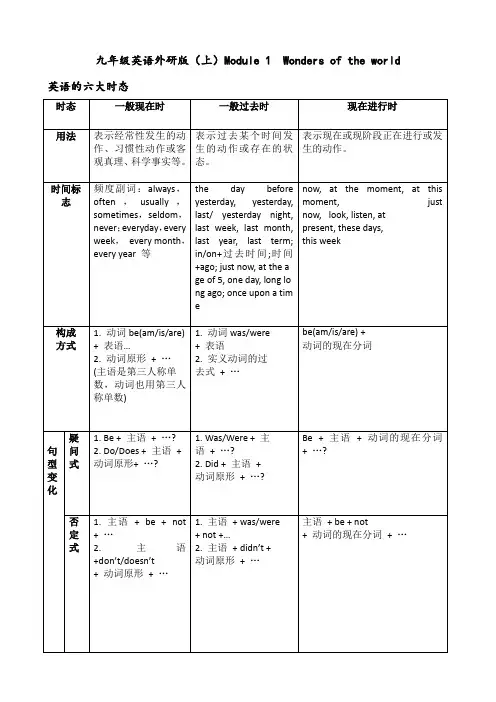
九年级英语外研版(上)Module 1 Wonders of the world 英语的六大时态提升训练:1、Jenny ____ in an office.Her parents ____in a hospital.A work; worksB works; workC work; are workingD is working; work2、One of the boys_____ a black hat.A haveB there isC there areD has3 、We will go shopping if it____ tomorrow.A don't rainB didn't rainC doesn't rainD isn't rain4 、He said the sun ____in the east and ____in the west.A rose; setB rises; setsC rises, setD rise; sets5 、Wang Mei ____ music and often ____ to music.A like; listenB likes; listensC like; are listeningD liking ; listen6、Look! He _____their mother do the housework.A. is helpingB. are helpC. is helpD.is helpping7 、_____are the boys doing ? They are singing in the room.A .WhoB .How C.What D.Where8、Don’t talk here. My mother _____.A. is sleeping B .are sleeping C. sleeping D .sleep9 、Danny ______. Don’t call him.A. is writeing B .is writing C.writing D .writes10 、–----- When_____he_____back? –------ Sorry, I don’t know.A. does,comeB.are comingC.is comeD.is coming11、She lived there before he____to China.A. cameB. comesC. comeD. coming12、I _____but_____nothing.A . was listened;was hearing B. listened;heard C . have listened; heard D. listened; heard of13、When did you ____here?A. got toB. reachedC. arrive inD. reach14、I____my homework at 7:00 yesterday evening.A. finishedB. would finishC. was finishingD. finish15、------He didn't go shopping with you yesterday afternoon, did he?- -----A. No, he doesn'tB. Yes, he didn'tC. No, he didD. Yes, he did.16、_____you ____a doctor when you grow up?A Will; going to beB Are; going to beC Are; /D Will; be17、I don’t know if his uncle _____.I think he _____ if it doesn’t rain.A will come; comesB will come; will comeC comes; comesD comes; will come18、He will be back _____a few minutes.A withB forC onD in19、What time _____we meet at the gate tomorrow?A willB shallC doD are20、He will have a holiday as soon as he _____the work next week.A finishesB doesn’t finishC will finishD won’t finish21、What ______ from three to four yesterday afternoon?A have you doneB had you doneC did you doD were you doing22、-– I call you yesterday evening, but there was no answer.--- Oh., I’m sorry I _____ dinner at my friend’s home.A homeB hadC was havingD have had23、My mother _____ while my father _____TV.A cooked; was watchingB was cooking; was watchingC was cooked; watchedD cooked; watched24、When I got home, my son _____ the music.A am listening toB listened toC was listening toD was listening25、We heard a cry when we ______ TV last night.A were watchingB would watchC watchD watched。
外研版英语九年级上册Module1words讲解
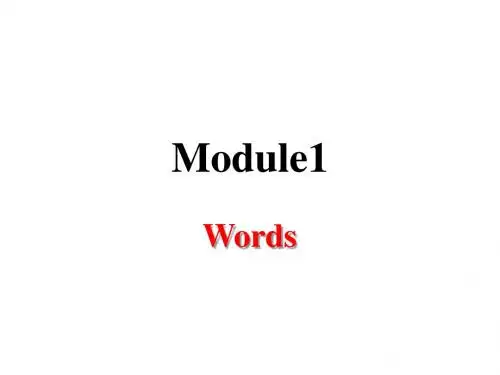
自然的,天然的 奇观 n. 大声的adj. 寂静的adj. 除…之外(还) 想知道,惊讶v. 大声地 adv.(3) 几乎,差不多(2) 附近,旁边(4) 虽然(4)
自然 n. 讨论n. 讨论v. 寂静n. 寂静地adv. 精彩的adj.
做……是理所应当的 盘算,思考 进行关于……的讨论 在某人看来 安静地,静静地 保持沉默 数百万 超过
12. by (1).在……旁边 by the sea (2).通过(做)by +doing (3).乘(坐)by car (4).被,由 ( 被动语态) It was made by Tom. (5).在……之前 I want an answer by 10:00 (6). 通过,利用 learn by heart (7). 一个接一个地 one by one, day by day…
3. discussion n. discuss v. have a discussion about/on sth. have a discussion with sb. 4. loud adj. loud voice 作定语、表语 adv. =loudly aloud adv. read aloud/ think aloud 5. in one’s opinoin in one’s point of view e.g: In my opinion, he is right.
少于 爱上 被绊倒
落后 向下倾斜 跌倒,倒塌
从…落下 一个接一个 穿过(内部)
6. more than+数词 “超过” (反) less than e.g: I have more than ten friends. more than更(adv.) e.g: I more than love the film Wolf Warriors ⅱ. 7. millions of/ thousands of/ hundreds of tens of thousands of several thousand 8. below (职位,年龄,数量,程度,位置等) e.g: The shirt sells below $20. I’m one grade below him.
外研版英语九年级英语上册Module1知识汇总

外研版英语九年级英语上册Module1知识汇总Module 1单词Man-made ['mæn'med] 人造的natural ['nætʃrəl] 大自然的wonder ['wʌndə] 奇迹,奇观discussion [dɪ'skʌʃn] 讨论,商讨eastern ['iːst(ə)n] 在东边的,来自东边的though [ðəʊ] 虽然,尽管loud [laʊd](声音)响亮的wow [waʊ] 呀,哇opinion [ə'pɪnjən] 主张,看法in one’s opinion按照某人的观点electricity [ɪ,lek'trɪsəti] 电millions of 大量的;无数的below [bɪ'ləʊ] 在下面,在….下面shine [ʃaɪn] (shone shone, shined shined)照耀sign [saɪn] 迹象,标志,招牌silent ['saɪlənt] 寂静的silver ['sɪlvɚ] 银灰色的,银制的sky [skaɪ] 天空grey [greɪ] 灰色的,阴沉的go through 穿过beside在…..旁边,在…附近reply [rɪ'plai] 回答,回复clear [klɪə] (烟雾等)开始消失fall away 突然向下倾斜stream [strim] 小溪,小河nearly ['nɪəlɪ] 几乎,差不多on top of 在……上面,盖住canyon ['kænjən] 峡谷remain [rɪ'meɪn] 逗留,留下by [baɪ] 在……旁边,靠近Module1知识梳理【重点短语】1.wonders of the world世界奇观natural wonders 自然奇观man-made wonders人造奇观2.join in参加;加入(活动) = take part in3. I'm notsure. 我不确信4. agree with sb. 同意某人的看法sb. agree with sth. 某人适应(食物、气候)agree to do sth. 同意做某事agree to sth.(plan /decision/suggestion) 同意/赞成agree on sth.( plan/ ) 在……方面意见一致5. on the eastern coast of ...在……的东海岸6. in one's opinion据某人看来;按某人的意见7. more than= over 多于,超过8. produce electricity 供电9. millions of 数百万的;数以百万计的10. wouldlike to do sth. = want to do sth. 想做某事Would like sb. to do sth. 想要某人做某事11. early morning 大清早12. become grey变成灰色13. get out of ...从....出来14. got hrough 意为“穿过,强调从物体内部穿过”;从头至尾的练习15. fall away突然向下倾斜16. look over 从(某物上面)看过去:仔细检查look across眺望look down to 俯视;向下看17. on top of 在.....顶部18. at the bottom of在.....的底部19. on both sides在两边20. be famous for意为“以.......而闻名”21. do an interview做采访do an interview withsb. 采访某人22. draw a picture of 画一副......的图画23. go down下去;下沉;坠落24. wait for等候25. dozens of 许多26. in height高度;在高度上【用法集萃】1. agree with sb 同意某人agree to dosth 同意做某事2. would like to do sth 想要做某事3. in +一段时间在.....(多长时间)之后,常用于回答How soon 的提问4. have been/gone to 以及have been in的区别5. because of+名词因为……6. without doing sth 没有做某事7. be afraid of doing sth. / be afraid to do sth. 害怕做某事8. one of +the+形容词最高级+可数名词复数最......的.....之一9. look forward to doing sth 盼望做某事【重点语法】【话题写作】假如你是来自北京的张楠,在你们学校的留学生交流会上,你打算向大家介绍世界人造奇观——万里长城。
外研版英语九年级上册Module 1知识点总结
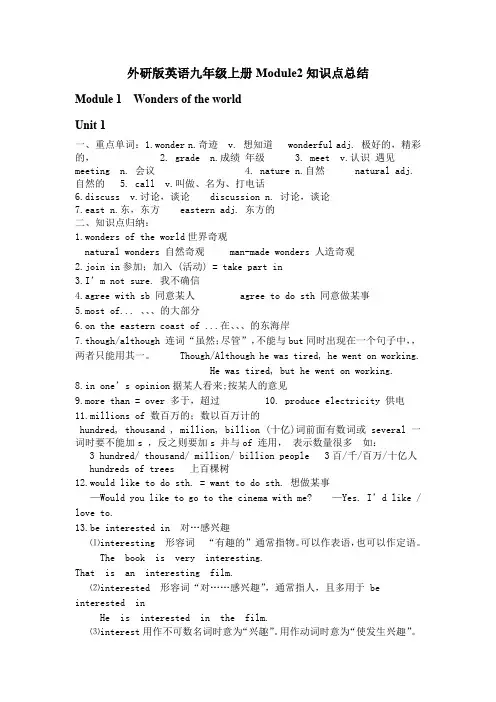
外研版英语九年级上册Module2知识点总结Module 1 Wonders of the worldUnit 1一、重点单词:1.wonder n.奇迹 v. 想知道 wonderful adj.极好的,精彩的, 2. grade n.成绩年级 3. meet v.认识遇见meeting n. 会议 4. nature n.自然 natural adj.自然的 5. call v.叫做、名为、打电话6.discuss v.讨论,谈论 discussion n. 讨论,谈论7.east n.东,东方 eastern adj. 东方的二、知识点归纳:1.wonders of the world世界奇观natural wonders 自然奇观 man-made wonders 人造奇观2.join in参加;加入 (活动) = take part in3.I’m not sure. 我不确信4.agree with sb 同意某人 agree to do sth 同意做某事5.most of... 、、、的大部分6.on the eastern coast of ...在、、、的东海岸7.though/although 连词“虽然;尽管”,不能与but同时出现在一个句子中,,两者只能用其一。
Though/Although he was tired, he went on working.He was tired, but he went on working.8.in one’s opinion据某人看来;按某人的意见9.more than = over 多于,超过 10. produce electricity 供电lions of 数百万的;数以百万计的hundred, thousand , million, billion (十亿)词前面有数词或several 一词时要不能加s ,反之则要加s 并与of 连用,表示数量很多如:3 hundred/ thousand/ million/ billion people 3百/千/百万/十亿人hundreds of trees 上百棵树12.would like to do sth. = want to do sth. 想做某事—Would you like to go to the cinema with me? —Yes. I’d like / love to.13.be interested in 对…感兴趣⑴interesting 形容词“有趣的”通常指物。
外研版初三英语上册Module1知识点讲义
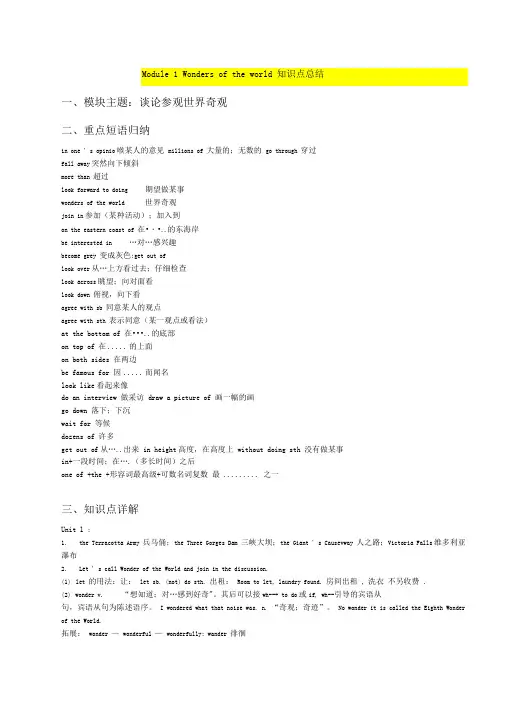
一、模块主题:谈论参观世界奇观二、重点短语归纳in one ' s opinio喉某人的意见millions of 大量的;无数的go through 穿过fall away突然向下倾斜more than 超过look forward to doing 期望做某事wonders of the world 世界奇观join in参加(某种活动);加入到on the eastern coast of 在•・•..的东海岸be interested in …对…感兴趣become grey 变成灰色;get out oflook over从…上方看过去;仔细检查look across眺望;向对面看look down 俯视,向下看agree with sb 同意某人的观点agree with sth 表示同意(某一观点或看法)at the bottom of 在•••..的底部on top of 在..... 的上面on both sides 在两边be famous for 因..... 而闻名look like看起来像do an interview 做采访draw a picture of 画一幅的画go down 落下;下沉wait for 等候dozens of 许多get out of从…..出来in height高度,在高度上without doing sth 没有做某事in+一段时间;在….(多长时间)之后one of +the +形容词最高级+可数名词复数最 ......... 之一三、知识点详解Unit 1 :1.the Terracotta Army 兵马俑;the Three Gorges Dam 三峡大坝;the Giant ' s Causevway 人之路;Victoria Falls维多利亚瀑布2.Let ' s call Wonder of the World and join in the discussion.(1)let 的用法:让:let sb. (not) do sth. 出租:Room to let, laundry found. 房间出租, 洗衣不另收费.(2)wonder v. “想知道;对…感到好奇"。
【最新】外研版九年级英语上册Module 1--Unit 1 要点解析
Unit 1 It’s more than 2,000 years old 要点解析1. The Terracotta Army. 兵马俑army的用法army是一个可数的集合名词,意思是“陆军”“大群”“大批”等。
注意以下用法:(1) 表示军队或陆军,其前通常用定冠词;若与不定冠词或数词连用,则表示一支或几支军队。
When I grow up, I’m joining the army. 我长大了要参军。
It was said that it was a modern army. 据说那是一支现代化的军队。
(2) army作主语时,谓语动词可用单数(视为整体)或复数(侧重个体)。
The army was [were] called out to enforce the curfew. 军队被派去强制执行宵禁。
【固定搭配】join into the army 参军leave the army 退伍2. Which is an ancient wonder? 哪一个是古代的奇迹?知识点一:ancient 的用法ancient adj.远古的,古老的【拓展】反义词为modernin ancient times在古代,在远古;ancient civilization古代文明China is a great country with a long history and an ancient civilization.中国是一个具有悠久历史和古老文明的伟大国家。
【迷你练习】(1) One of the wonders of the world is the ________ pyramids in Egypt.A. oldB. naturalC. modernD. ancientD【解析】old的意思是“年老的,陈旧的”;natural的意思是“自然的”;modern的意思是“现代的”;ancient的意思是“古老的,古代的”。
九年级英语上册Module1知识点总结(外研版)
九年级英语上册Module1知识点总结(外研版)position写作文awonderoftheworld世界奇观14.theancientpyramidsinEgypt埃及的古老的金字塔15.suggestdoingsth=suggest+(that)+sb.(should)+动词原形建议某人做某事suggestion为可数名词“建议”advisesb.(not)todosth.建议某人(不)做某事Module1Unit21.thenaturalworld自然界ancientwonder古老的奇观naturalwonder自然奇观modernwonder现代奇观2.getoutof…从……内出来3.gothrough穿过(物体内部)goacross=cross穿过(物体表面)4.nothingtosee什么也看不到todo不定式可以作后置定语修饰前面的名词、代词eg.Ihavealotofhomeworktodo.我有很多的作业要做。
5.infrontof在(物体外部的)前面inthefrontof在(物体内部的)前面6.gotherightway走正确的道路gothewrongway走错误的道路7.in+时间段“在……之后(内)”,用于将来时对该结构提问要用howsoon.8.lookover仔细检查lookacross眺望lookafter照顾、照看lookout(of)小心、当心looklike看起来像lookup向上看/查阅(字典)lookdown(at)俯视、向下看lookaround环顾四周lookfor寻找lookforwardto盼望lookdownupon/on看不起9.too…to…太……以至于不能……Heistooyoungtogotoschool.他太小了以至于不能去上学。
Heissoyoungthathecan’tgotoschool. Heisnotoldenoughtogotoschool.10.thecloudscleared云散开了It’scleartoday.今天天气晴朗。
外研版英语九年级上册Module1重要词句讲解
九上Module 1 Wonders of the world一、课内基础(一)重点词句【课文原句】Hmm, I’ve never seen it, so I’m not sure I agree with you.【用法】never常用作副词,意为“从未;一点都不”,在句中的位置和not相同。
如:I have never done that before.He will never go there again.当never位于句首表强调时,句子采用倒装语序。
如:Never in my life have I seen such a plant.【拓展】常用搭配:Never mind. 没关系。
口语的常见用法:1)表示安慰,意为“没关系”。
如:Never mind. Next time I’m sure you can do better.2)用来回答道歉,意为“没关系;没什么”。
如:--- Sorry to have kept you waiting so long.--- Never mind.【用法】sure形容词,意为“确信的,有把握的,一定的,无疑的”。
“be sure+that从句”表示“确信......”I’m sure that I can pass the exam.【拓展】be sure of意为“对...有把握,肯定...”He is sure of his success.【用法】agree with表示同意某人的意见、想法、分析、解释等(即持同一观点)。
如:I don’t agree with you.They agreed with this idea.I agree with what you say.【辨析】agree to主要用来表示接受别人提出的建议、安排、计划等。
如:I agree to your advice.【注意】1)后接表示人的名词或代词时,一般只用agree with。
外研九年级上册module1知识点
外研九年级上册module1知识点Module 1: MusicMusic is a universal language that transcends barriers and connects people from different cultures and backgrounds. It is a form of expression that allows individuals to convey their emotions, tell stories, and share experiences. The study of music in the 9th grade English curriculum focuses on cultivating an appreciation for various musical genres, exploring the history of music, and understanding the role of music in society.1. Appreciating Musical GenresIn this module, students are exposed to a wide range of musical genres, including classical, pop, rock, jazz, and traditional Chinese music. By listening to and analyzing different pieces from each genre, students develop an understanding and appreciation for the unique qualities and characteristics of each style.For instance, classical music, often characterized by its intricate melodies and harmonies, evokes a sense of grandeur and sophistication. On the other hand, pop music, known for its catchy melodies andrelatable lyrics, appeals to a broader audience and often reflects the popular culture of the time. By exploring these genres, students gain a deeper understanding of the cultural and historical context in which they emerged.2. Exploring the History of MusicThe study of music also includes an exploration of its rich history. Students learn about significant composers, musicians, and musical movements that have shaped the development of music throughout the centuries. For example, they may discover the iconic works of Mozart, Beethoven, and Bach in classical music or learn about the origins of jazz and its cultural significance in African American communities.By understanding the historical background of different musical genres and movements, students can better appreciate how music has evolved over time and how societal changes have influenced its development. They may also draw connections between music and other art forms, such as literature and visual arts, further enhancing their understanding of cultural expression.3. The Role of Music in SocietyBeyond its artistic value, music also plays a crucial role in society. It can unite people, foster social change, and provide solace in times of struggle. Students in the 9th grade explore the impact of music on various societal issues, such as civil rights movements, political activism, and cultural identity.For instance, they might study the role of protest songs in the Civil Rights Movement in the United States, understanding how artists like Bob Dylan and Nina Simone used their music to fight against racial inequality. Students may also analyze the influence of pop music on shaping cultural trends and promoting diversity and inclusivity.Additionally, music has therapeutic benefits, as it can alleviate stress, enhance mood, and improve overall well-being. The module introduces students to the concept of music therapy and its application in treating individuals with emotional or mental health issues. They might learn about how music can evoke different emotions, regulate heart rate, and facilitate self-expression.In conclusion, Module 1 of the 9th-grade English curriculum focuses on the study of music, its appreciation, history, and societal impact. By immersing themselves in various musical genres, understanding the historical context, and exploring the role of music insociety, students develop a holistic understanding of this universal language. Through this module, students not only gain knowledge about music but also cultivate a deeper appreciation for the cultural diversity and artistic expression that music offers.。
Module 1 外研版英语九年级上册知识点详解
外研版英语九(上)Module 1 Wonders of the world知识点详解Unit 1What is a wonder of the world?★(A3).【知识点再现】Let’s call Wonder of the World and join in the discussion. 我们给《世界奇观》节目打电话,加入讨论吧。
【知识点1】wonder可作动词或名词,其用法如下:①wonder作名词,意为“奇迹;奇观”时,是可数名词,其复数形式为wonders。
如:We have visited many wonders of the world. 我们已经参观了许多世界奇观。
The Great Wall is one of the seven wonders of the world. 长城是世界上七大奇迹之一。
②wonder作名词,意为“惊叹;惊奇”时,是不可数名词。
常用的句型有:It’s a wonder that...令人惊奇的是……;It’s no wonder that... 难怪……。
如:It’s no wonder that he is late. 难怪他迟到了。
It’s a wonder (that) more people weren’t hurt. 奇怪的是没有更多的人受到伤害。
③wonder作动词,意为“想知道”,相当于want to know,后面接who, what, why, where, if或that等引导的宾语从句或“疑问词+不定式”构成的短语。
如:I wonder who she is. 我想知道她是谁。
// She wondered what the child was doing. 她感到疑惑,孩子究竟在干什么。
I wonder why Ann is late. 我想知道安为什么迟到了。
// I wonder (that) she has won the race. 我对她赢了比赛感到惊讶。