
译林版牛津初中英语八年级上册 Unit 5 Wild animals 单元基础练习题
译林版牛津初中英语八年级上册Unit 5 Wild animals 单元基础练习题一、单项选择( )1. ____ only live in China.A. TigersB. SquirrelsC. Giant pandasD. Kangaroos( )2. Please remember the door when you leave the room.A. to closeB. closeC. closesD. closed( )3. People should make giant panda reserves bigger ____.A. protect themB. to protect themC. hunt them easilyD. to kill them easily( ) 4. My teddy bear is red, so this blue one must be ____.A. else someone’sB. someone else’sC. other one’sD. some other’s( )5. There are ____ giant pandas in Africa.A. fewB. a fewC. littleD. a little( )6. You’d better ____ the w ild animals.A. not hurtB. not to hurtC. don’t hurtD. not hurting( )7. I like reading very much because reading can bring me .A. happyB. happilyC. happinessD. unhappy( )8. There were a lot of people in the park on May Day. We had to take a rest, so we got very tired.A. everywhereB. somewhere C .nowhere D. anywhere( )9.—May I have another cake, Mum? —Sorry, there is .A. any moreB. no moreC. some moreD. many more( )10 .—does the baby mouse weigh? —About 20 grams.A. HowB. WhatC. How manyD. How much( )11 . is the best place for animals to live in.A. The homeB. The wildC. The zooD. The street( ) 12. –Is the book interesting?-I thought it would be. But , it’ s very boring.A. in allB. in factC. in additionD. in future( ) 13. ——Tom, is there ______ on the table?——Yes, and I think you will like it .A. something deliciousB. delicious somethingC. anything deliciousD. delicious anything( ) 14. Which do you like , elephants or tigers?A. wellB. best C . better D . good( ) 15. -My mother says that we won’t go on a trip to the museum. I just can’t understand.-A. Never mind.B. have a good time!C. What a pity! D .Don’t worry about it.( ) 16. tiger is a dangerous animal. Don’t you think so?A . AB .AnC . TheD . One()17. If you feel hungry, why not some milk and bread?A. hasB. haveC. to haveD. having()18. If we do ______ , soon giant pandas will die out.A. nothingB. everythingC. somethingD. anything()19. He is in hospital and the doctor says he is ______.A. dangerB. in dangerC. dangerousD. a danger()20. We will go swimming if it ______ tomorrow.A. won’t rainB. doesn’t rainC. rainsD. will rain()21. I saw such a beauty _____ in my life.A. on timeB. in timeC. at the same timeD. for the first time()22. There are _______ giant pandas in Africa.A. fewB. a fewC. littleD. a little()23. Lucy is going to write a report animals in danger for the club newsletter.A. onB. withC. forD. to()24.There is a giraffe in the zoo.A. six-month-oldB. six-months-oldC. six months oldD. six-month old()25. My brother 5 dollars on the dictionary.A.spent B. paid C. cost D. took()26. The baby four months enjoys smiling at people.A. inB. onC. forD. at()27. When she grows , she will grow a beautiful woman.A. up; upB. up; intoC. into; intoD. into; with()28. Giant pandas will have to live if farmers keep taking their living areas.A. SomewhereB. everywhereC. nowhereD.anywhere()29. Mrs Smith will write a report animals in danger for the club newsletter.A. OnB. atC. ofD. in()30. There are story-books in the library.A. thousandB. thousandsC. thousand ofD. two thousand()31. did the baby panda when he was born?A. How; likeB. How; is likeC. What; look alikeD. What; look like()32. It’s time for people to to protect animals.A. take actionsB. catch actionsC. take actsD. catch acts()33. Hurry up, _______ late for school.A. and you areB. or you areC. but you will beD. or you’ll be()34. Tigers live as a family baby tigers are 2-3 years old.A. andB. butC. orD. until()35. If I don’t buy them, will buy them.A. else someoneB. else anyoneC. someone elseD. anyone else()36. It is very difficult giant pandas in the wild.A. of; surviveB. or; to surviveC. for; surviveD. of; surviving()37. I won’t believe that he can do it I see it with my own eyes.A.untilB. afterC. whenD. if二、用所给动词的适当形式填空1. If you keep (work) on the problem, you (solve) it soon.2. Are you interested in (play) hide-and-seek?3. There (be) a class visit to Beijing Zoo next Sunday.4. Don’t keep me (wait) so long.5. He then decided (have) a great day out by motorbike.6. Be quiet! Let him continue (talk).7. What you (have) for breakfast yesterday morning?8. You’d better ask him (not go) there alone.9. Before (cook), mother cut the meat into pieces.10.Would you like __________(go) swimming with me.11.Mr Cao told his son ________(ride)on the right.12.It ________ (take) me one hour to finish my homework last night.13.It’s time for them __________(have)lunch.14.Thank you for __________(help)me with my Maths.15. Some foreigners really don’t know how (live) in another country.16. Jim, together with his classmates, (play) table tennis now.17. Last Sunday morning, I did nothing but (write) a letter to my grandma.18. When the traffic (stop), you can cross the road.19. If you (not study) hard, you (not pass) the exam.20. They needed (climb) the tree with a ladder.三、用适当的介词或副词填空1. His father died _________ he was only three years old.2. When did you meet her ________ the first time?3. Do you know how to survive ________ the wild?4. ________ what do you want to kill the sheep?5. At an early age, the boy lived _______ his own.6. ________ four months, the baby weighed 10 kilograms.7. Who has taken my pen_________?8. We shouldn’t cut ________ too many trees.四、用所给单词的适当形式填空1.Please be careful , or you will be in ___________(dangerous).2.There are at ________(little) 90 teachers in our now.3.He became (interest) in science when he was young.4.__________(lucky),the little bo y didn’t hurt________(he).5.I don’t feel like eating anything, I feel even (bad)6. It’s ________ (danger) to play football in the street .7. He became (interest) in science when he was ten years old.8. I think it’s (easy ) to learn English than to learn Chinese.9. Can you help me with the (follow) question?10. He looked (sad) at the broken toy car.11. Would you like ________ (join) the trip to the Tai San Park ? It’s very interesting .12. The teacher made us __________ (clean) the classroom .13. The young mother has two (baby) giraffes..14. It is difficult for me (answer) this question.15. If the wild animals (not have) any food, they (die).16. Go to bed early after finishing (watch) TV.17. This little girl spent the whole night (get) ready for the exam.18. I (one) went to Beijing at the age of six.19. Pandas like eating bamboo (leaf).20. Please write as (care) as possible.21. (elephant) tusks are very expensive.22. I saw the (feed) of animals yesterday.23. September is the (nine) month in a year.24. Though Nick tried his best to play tennis, he played very (bad).25. She didn’t know how to do things for (she) when she stayed at home alone.26. He is one of the most famous (write).27. She is (slim) than her sister.28. Linda studies (hard) than others.29. He decided (see) the film the next day.30. Thanks for (be) with us.31. –Who (teach) you maths?–Miss Gao does.32. (work) hard, or you (fail) in the exams.33. They plan (take) Jack out.34. Come on, Mike. Let’s (enjoy) ourselves.35. She often spends a lot of time (chat) with her friends on the phone.36. Could you show me how (do) with it?37. The film was (move). We were all (move) to tears.38. –Do you know the girl (wear) a red dress?–Yes, we call her Helen.39. He was not (suit) for the job.40. It’s so nice and (peace) here.41. There are a lot of (mouse) in the old small house.42. He is a popular (write) in our country.43. She looked at the broken model plane (sad).44. Please look at the (follow) instructions.45. There are fewer and fewer (wolf) in the world.46. Edison carried the frightened boy to a (safety) place.47. One continues (learn) things in life.48. We’ll never forget your (kind) to us.49. I want to tell my best friend about Chinese. New Year’s (celebrate).50. The food smells terrible. I have the same (feel).51. We will have a parents’(meet) this weekend.52. The (collect) of these stamps took ten years.五、根据句意、首字母或汉语提示完成单词1. Can you work out this maths problem (单独地)?2. A few days ago, they found a few (乌龟)on the fields.3. Mrs Wu always (鼓励)us to work hard at our lessons.4. (遗憾的是), we don’t seem to have much chance of winning the match.5. This book is much (厚)than that one. I’ll take that one.6. The l of living areas makes tigers nowhere to live.7. Mrs green found her son u because he lost his favourite tou train.8. He has written a lot of books. Now he is one the most popular w in China.9. People sometimes h tigers for their fur.10. Of all the food the pandas like eating b .11. To p your eyes, you’d better not read in the sun.12. Don’t stand o . come in, please.13. Let’s ask the (猎人)not to kill wild animals.14. I want to buy a book, but there is (没有一个)left in the shop.15. It is raining so hard. We have to stay at home. We have (无处)to go.16. This large box is made of (竹子).17. He was so strange because he lived in the (森林)with monkeys all his life.18. Many people (杀死)animals only for their fur.19. (可惜), Tim didn’t pass the exam.20. (狼)catch small animals for their food.21.It’s not right to (杀死)the wild birds.22.Everyone should (行动)to protect the wild birds.23.-Do you have (厚的)fur?-Sorry, I don’t know.24.Some animals are dangerous to (人类).。
牛津译林版八上《Unit5 Wild animals》word教案
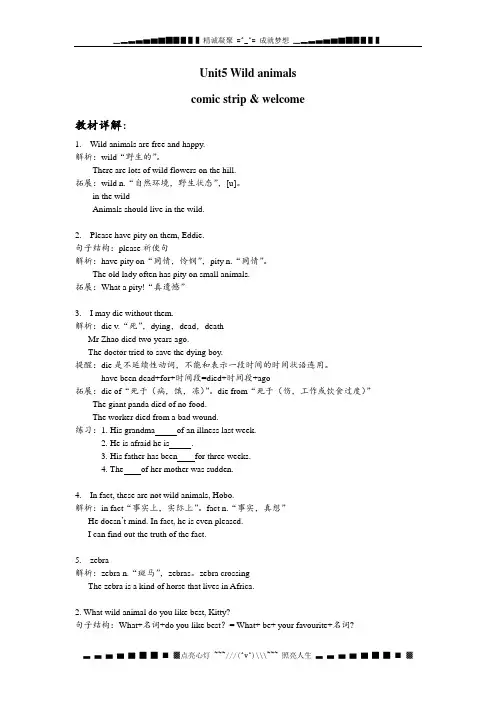
Unit5 Wild animalscomic strip & welcome教材详解:1.Wild animals are free and happy.解析:wild“野生的”。
There are lots of wild flowers on the hill.拓展:wild n.“自然环境,野生状态”,[u]。
in the wildAnimals should live in the wild.2.Please have pity on them, Eddie.句子结构:please祈使句解析:have pity on“同情,怜悯”,pity n.“同情”。
The old lady often has pity on small animals.拓展:What a pity!“真遗憾”3.I may die without them.解析:die v.“死”,dying,dead,deathMr Zhao died two years ago.The doctor tried to save the dying boy.提醒:die是不延续性动词,不能和表示一段时间的时间状语连用。
have been dead+for+时间段=died+时间段+ago拓展:die of“死于(病,饿,冻)”。
die from“死于(伤,工作或饮食过度)”The giant panda died of no food.The worker died from a bad wound.练习:1. His grandma of an illness last week.2. He is afraid he is .3. His father has been for three weeks.4. The of her mother was sudden.4.In fact, these are not wild animals, Hobo.解析:in fact“事实上,实际上”。
牛津译林版英语八上Unit 5《Wild animals》(Reading1)说课稿
牛津译林版英语八上Unit 5《Wild animals》(Reading1)说课稿一. 教材分析《牛津译林版英语八上Unit 5 Wild animals》(Reading 1)讲述了关于野生动物的保护问题。
通过阅读一篇关于非洲象的文章,让学生了解非洲象的生活习性以及面临的生存困境,从而引发学生对野生动物保护的思考。
教材内容丰富,插图生动,旨在提高学生对野生动物保护的意识,培养学生关爱地球生态的责任感。
二. 学情分析八年级的学生已具备一定的英语阅读能力,对野生动物有较高的兴趣。
但在阅读长篇文章时,部分学生可能会遇到生词、长句等困难,影响阅读理解。
此外,学生对野生动物保护的认识有限,需要通过课堂引导深化其环保意识。
三. 说教学目标1.知识目标:学生能理解文章主要内容,掌握的生词和短语;2.能力目标:学生能运用所学知识进行阅读理解,提高阅读技巧;3.情感目标:学生能增强对野生动物保护的意识,培养关爱地球生态的责任感。
四. 说教学重难点1.重点:学生能理解文章主要内容,掌握的生词和短语;2.难点:学生能运用所学知识进行阅读理解,提高阅读技巧。
五. 说教学方法与手段1.教学方法:采用任务型教学法,分组合作,讨论交流;2.教学手段:多媒体辅助教学,图片、视频等资料引导学生深入理解课文。
六. 说教学过程1.导入:展示非洲象的图片,引导学生谈论对野生动物的印象,引出本课主题;2.读前预测:学生浏览文章标题和图片,预测文章内容;3.快速阅读:学生快速阅读文章,回答简单问题;4.仔细阅读:学生分组讨论,深入理解文章内容,回答较难问题;5.小组活动:学生分组进行角色扮演,模拟文章中的场景,加深对文章的理解;6.总结提升:教师引导学生总结文章主题,谈论野生动物保护的重要性;7.作业布置:学生课后写一篇关于我国野生动物保护的文章。
七. 说板书设计板书设计如下:1.课题:Unit 5 Wild animals2.阅读文章:African Elephants3.生词短语:–wildlife protection–survival–conservation–poaching–habitat destruction4.文章主题:关爱野生动物,保护地球生态八. 说教学评价1.课堂参与度:观察学生在课堂上的发言和讨论情况;2.阅读理解:检查学生回答问题的准确性;3.作业完成情况:评估学生课后作业的质量。
译林版八年级上册英语Unit 5 Wild animals词汇精讲-(包含答案)
Unit 5 Wild animals词汇精讲1.wild adj.野生的,野蛮的,狂热的,疯狂的n.自然环境;野生状态如: a wild elephant野象; wild flowers野花注意①wild的副词形式为wildly②wide的比较等级形式为wilder; wildest③由wild构成的词组有: in the wild野生的,在荒野中;run wide撒野,放肆; go wild兴奋;高兴得疯了似地2.free①(adj.) 自由的,不受束缚的Students have a free choice of courses in their final year.②(adj.) 有空的,空闲的be free = have time 有空in one’s free time 在某人的空闲时间③(adj.) 免费的Come to the robot show on 14 March and you can receive a copy of Robot magazine for free.④n.freedom adv.freely (adj. wise n. wisdom adv. wisely)3.die (vi) 死(三单)_____________(现在分词)______________(过去式)___________ (1)死于.....:die of:死于自身原因(如疾病等)die from:死于外因(灾难、战争等环境因素)In the 1960s, many Chinese ________________________(死于饥饿).(2)dead (adj.) 死的,失去生命的His mother is _________. She _______ in 1987. (die)When autumn comes, many _________ leaves fall onto the ground. (die)In the film, a wealthy doctor is found _________ in his house. (die)(3)dying (adj.) 临死的,垂死的The doctor are trying to save the ___________ man. (die)(4)death (n.) 死,死亡He has decided to donate his body for medical research after his ________. (die)The victim was wounded with a knife and bled to _________ as a result. (die)练习:1)The _________ old man is his enemy.He ________ two days ago.A. died; died B dead; dead C. died; dead D. dead; died2)The doctor ________ a _________ yesterday.A. saved;dying B saved; dead C. safe;dead D. safe;dying3) Wang Wei, the young pilot,________(die) for our country.He will live in our hearts forever.4) Hurry, doctor! It's a matter of life and_______(die).解析:dies;dying;died;(1)died from hunger;(2)dead;died;dead(3)dying(4)death;death1-4 DA died;death4.mean (vt.) 意思是,意味着过去式:meant meaning (n.) 意思,意义meaningful (adj.) 意味深长的,有意义的meaningless (adj.) 无意义的(1)--What does this sentence mean? =What’s the meaning of this sentence?--It means “Thanks”.=Its meaning is “Thanks”. (mean)练习:(1)A word usually has several ___________. (mean)(2)She does not have as much money as before, but she thinks her life is _____________ (mean).(3)It is ____________ to work as volunteers at community centres or in libraries at the weekend. (mean)(4)We fill our lives with _____________ tasks. We feel bored. (mean)(5)你坐在那儿不说话是什么意思?What do you mean________ _______ there ________ _______ anything.(6)误了火车就等于要再等上一个小时。
牛津译林版八年级上册Unit5《Wildanimals》(Reading1)说课稿
牛津译林版八年级上册Unit 5《Wild animals》(Reading 1)说课稿一. 教材分析《牛津译林版八年级上册Unit 5 Wild animals(Reading 1)》主要讲述了关于野生动物的保护问题。
通过一篇关于非洲象的阅读材料,引导学生了解非洲象的生活习性以及目前面临的生存困境。
文章语言真实自然,富有感染力,能够激发学生的学习兴趣,同时培养学生的环保意识。
本节课的内容与学生的生活实际密切相关,易于引起学生的共鸣。
二. 学情分析八年级的学生已经具备了一定的英语基础,能够运用英语进行简单的交流。
但他们在阅读理解、词汇积累以及写作方面还存在一定的困难。
因此,在教学过程中,教师需要关注学生的个体差异,善于激发学生的学习兴趣,引导他们主动探究,提高他们的阅读理解能力和环保意识。
三. 说教学目标1.知识目标:学生能够掌握文章中的重点词汇和短语,理解文章的主要内容,了解非洲象的生活习性和目前面临的生存困境。
2.能力目标:学生能够运用所学知识进行阅读理解,提高自己的阅读能力;通过讨论和写作,提高自己的表达和交流能力。
3.情感目标:学生能够树立环保意识,关注野生动物的保护问题,养成关爱自然、保护动物的良好习惯。
四. 说教学重难点1.教学重点:学生能够掌握文章中的重点词汇和短语,理解文章的主要内容,了解非洲象的生活习性和目前面临的生存困境。
2.教学难点:学生能够运用所学知识进行阅读理解,提高自己的阅读能力;通过讨论和写作,提高自己的表达和交流能力。
五. 说教学方法与手段1.教学方法:采用任务型教学法,让学生在完成任务的过程中,提高自己的阅读理解能力和表达能力。
2.教学手段:利用多媒体课件、图片等辅助教学,激发学生的学习兴趣,提高课堂效果。
六. 说教学过程1.Pre-reading:教师通过展示一些关于野生动物的图片,引导学生谈论自己喜欢的动物,激发学生的学习兴趣。
2.While-reading:教师引导学生快速阅读文章,回答一些简单的问题,帮助学生理解文章大意。
牛津译林版八年级上册Unit 5《Wild animals》(Welcome to the unit)课件
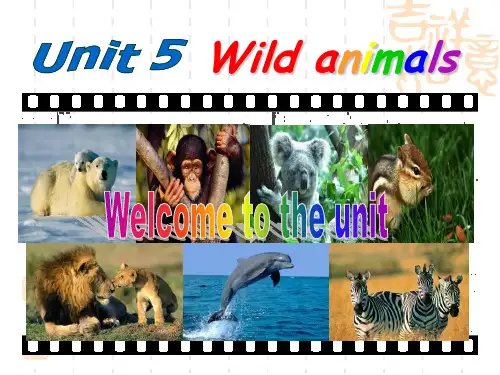
Dolphins
Talk about favourite wild
animals
Listen and fill in the table
Kitty
Wild animals
monkeys
Reason
clever , funny
Simon
lions
strong, run fast
Peter
pandas
Wild animals
Would you like to live in the wild?
Read after the tape
Come on! It’s your turn.
Act out the dialogue with your partner.
What wild animals can you see?
cute
Work in pairs
Talk about the animals you like best and least
A: Which animal do you like best? B: I like …best. A: Why? B: Because … A: Which animal do you like least? B: I like … least. A: Why? B: Because…
Bears are big and strong. They have small eyes, black or brown fur and sharp paws. Bears are good at swimming and climbing trees! They can walk like people. Bears like to move around slowly in the daytime. Because of this, they look a little lazy. They seldom hurt people.
牛津译林版英语八上Unit 5《Wild animals》(Reading1)教学设计
牛津译林版英语八上Unit 5《Wild animals》(Reading1)教学设计一. 教材分析牛津译林版英语八上Unit 5《Wild animals》(Reading 1)主要介绍了野生动物的特点、生活习性和面临的威胁。
本节课的主要内容是阅读一篇关于非洲象的阅读材料,通过阅读让学生了解非洲象的生活习性和面临的困境。
教材还包括了词汇表、阅读理解题和写作任务,旨在提高学生的阅读理解能力和写作能力。
二. 学情分析学生在学习本节课之前已经学习了动物相关的词汇和表达方式,具备一定的阅读理解能力。
然而,部分学生对野生动物的生活习性和面临的威胁了解不多,可能对阅读材料的理解存在一定的困难。
因此,在教学过程中需要关注学生的个体差异,合理调整教学难度,引导学生在课堂上积极思考和参与。
三. 教学目标1.知识目标:–掌握课文中的关键词汇和表达方式。
–理解阅读材料的主旨大意,了解非洲象的生活习性和面临的威胁。
2.能力目标:–提高学生的阅读理解能力,能够通过阅读获取和处理信息。
–培养学生的写作能力,能够运用所学知识进行写作表达。
3.情感目标:–增强学生对野生动物保护的意识,培养学生的环保意识。
四. 教学重难点•课文的理解和阅读技巧的运用。
•词汇和表达方式的掌握。
•对阅读材料深层次含义的理解。
•写作任务的完成。
五. 教学方法1.任务型教学法:通过设定具有挑战性的任务,激发学生的学习兴趣,培养学生独立思考和合作交流的能力。
2.情境教学法:创设真实、生动的情境,使学生在实际情境中学习和运用英语。
3.交际法:通过师生互动、生生互动,提高学生的口头表达能力。
4.启发式教学法:引导学生主动探索,发现问题,培养学生的自主学习能力。
六. 教学准备1.教师准备:–熟悉教材,明确教学目标和要求。
–准备相关的教学资源和素材。
2.学生准备:–预习课文,提前了解课文内容。
–准备笔记本,记录课堂笔记。
七. 教学过程1.导入(5分钟)–教师通过提问方式引导学生回顾已学的动物相关知识,激发学生的学习兴趣。
牛津译林版英语八年级上册:Unit 5 Wild animals. 教案2
Unit 5 Wild animals Lesson 1Teacher:Wildanimals are our friends. It is important to protect wild animals.Let’s check how much you know about wild animals. Do you know them?Play a guessing game.Write the names on pieces of papers and then invite some of the more able students to choose and say something of the animals (To make it easier, ask the students to use the first person). The other students should listen carefully and guess what animal it is.1.Bear: I am strong. Sometimes, I eat people. But if I find the people died, I don’t eat them. Who am I?2.Zebra: I’m like a horse, with black and white lines on my body. Who am I?3.Squirrel: I have a long and soft tail. I live in the tree. Who am I? 4.Giant Panda: I have black eyes and four black paws. I like eating bamboo shoots. I am very lovely. Who am I?5.Dolphin: I like swimming. I can do different kinds of swimming shows. Many people bring their children to watch my shows. Who am I?6.Tiger: I am the king of the animals. I look like a cat but I’m bigger than a cat. Usually, I have yellow fur and black stripes. Who am I? Step 4 Practice Part B1.T: Millie and her classmates are talking about their favourite wild animals.Let’s listen to their conversation and find their favourite wild animals.Simon Kitty Peter & Millie2.Play the tape again and let Ss read.。
牛津译林版英语八上Unit5WildAnimals
Second,we’llhavenoplacetoliveornofoodtoeat.Y ouknow,wemainlyliveonaspecialkindofbamboo ,butbambooforestsarebecomingsmallerandsma ller.Sadly,famerscutdown(砍 伐)theforests.Somebadhunters(猎 人)killusforourfur!
1. Finishtheexercises 2. TellsomethingaboutXiWang toyourfriend. 3. Trytowriteareportonananima lindanger
初中英语课件
madeadiscussion withyourgroupme mbers!
while-reading-----xiwang’sbrightfuture
Theactionwecantake:--------(aboutpara5-6) .helppanadashavemorebabies .makelawstoprotectpanadas .buildmorepanadareserves(保护区). reserven.(动植物)保护区 Moreideas: 1.Makegiantpandareservesbigger. 2.Askfamerstoleavethegiantpandareserves. 3.Askhuntersnottokillanimalsfortheirfur. 4.Don’tcutdowntreesandforests. 5.Don’tbuytheclothesmadeofanimalfur
reserves laws none danger takeaction Asaresult
牛津译林版英语八上Unit 5《Wild animals》(Grammar)教学设计
牛津译林版英语八上Unit 5《Wild animals》(Grammar)教学设计一. 教材分析牛津译林版英语八上Unit 5《Wild animals》主要介绍了一些野生动物,包括老虎、狮子、熊、大象等。
本单元主要让学生掌握一般现在时的被动语态和一般过去时的被动语态,以及如何运用这些时态描述野生动物的特点和习性。
此外,本单元还包括一些关于野生动物的保护和濒危问题,旨在提高学生的环保意识。
二. 学情分析学生在学习本单元前,已经掌握了动词的现在时态和过去时态,以及一些基本的野生动物知识。
但部分学生对英语语法的学习仍有一定难度,尤其是对被动语态的运用。
因此,在教学过程中,需要关注学生的个体差异,针对不同学生的学习需求进行引导和帮助。
三. 教学目标1.能熟练运用一般现在时和一般过去时的被动语态描述野生动物的特点和习性。
2.能听懂、会说、会读、会写与野生动物相关的词汇和句子。
3.提高学生的环保意识,增强对野生动物的保护意识。
4.培养学生的合作能力和观察能力。
四. 教学重难点1.一般现在时和一般过去时的被动语态的运用。
2.野生动物相关词汇的掌握和运用。
3.对文本内容的理解和运用。
五. 教学方法1.任务型教学法:通过设定各种任务,让学生在实践中学习和运用语言。
2.情境教学法:创设各种情境,让学生在真实的环境中学习和运用语言。
3.合作学习法:鼓励学生分组合作,共同完成任务,培养团队精神。
4.观察法:引导学生观察野生动物的特点和习性,提高观察能力。
六. 教学准备1.教材、课件和教学资源。
2.野生动物的图片、视频等素材。
3.练习题和测试题。
4.分组合作的任务单。
七. 教学过程1.导入(5分钟)利用图片、视频等素材,引导学生谈论他们所知道的野生动物,激发学生的学习兴趣。
2.呈现(10分钟)展示教材中的图片和文字,引导学生观察和描述野生动物的特点和习性。
同时,引入一般现在时和一般过去时的被动语态。
3.操练(15分钟)分组进行角色扮演,让学生运用所学的被动语态描述野生动物的特点和习性。
牛津译林版英语八上Unit5《Wildanimals》(integratedskills)说课稿
牛津译林版英语八上Unit 5《Wild animals》(integrated skills)说课稿一. 教材分析《牛津译林版英语八上Unit 5 Wild animals》主要介绍了一些野生动物,包括老虎、狮子、熊、猴子等。
本单元以动物为主题,通过学习动物的特点、生活习性以及保护动物的重要性,提高学生对野生动物的认识和关注。
本节课为单元的Integrated Skills部分,主要通过听力、口语、阅读和写作等多种形式,让学生综合运用本单元所学知识。
二. 学情分析八年级的学生已经具备了一定的英语基础,对于一些基本的词汇和句型能够熟练掌握。
但是,对于一些较为复杂的动物特点和保护动物的观点表达,还需要进一步引导和培养。
因此,在教学过程中,需要关注学生的个体差异,针对不同水平的学生给予适当的辅导和激励。
三. 说教学目标1.知识目标:学生能够掌握本节课所学的词汇和句型,了解各种野生动物的特点和生活习性。
2.能力目标:学生能够听懂、会说、会读、会写关于野生动物的短文,提高学生的综合语言运用能力。
3.情感目标:学生能够认识到保护动物的重要性,培养关爱动物的情感。
四. 说教学重难点1.重点:学生能够掌握本节课所学的词汇和句型,运用所学知识进行口语交流和写作表达。
2.难点:学生能够正确使用一般现在时描述动物的特点和生活习性,以及表达保护动物的观点。
五. 说教学方法与手段1.任务型教学法:通过设置各种任务,激发学生的学习兴趣,提高学生的参与度和积极性。
2.情境教学法:创设生动、真实的情境,帮助学生理解动物的特点和生活习性。
3.合作学习法:鼓励学生分组讨论、合作完成任务,培养学生的团队协作能力。
4.多媒体教学手段:利用多媒体课件和视频,丰富教学内容,提高学生的学习兴趣。
六. 说教学过程1.导入:通过展示一些野生动物的图片,引导学生谈论自己喜欢的动物,从而引入本节课的主题。
2.展示:教师通过多媒体课件,展示本节课所学的词汇和句型,让学生初步感知和理解。